Computational Linguistics and Chinese Language Processing
Vol. 10, No. 3, September 2005, pp. 329-346 329
© The Association for Computational Linguistics and Chinese Language Processing
[Received January 31, 2005; Revised August 24, 2005; Accepted August 26, 2005]
Collocational Translation Memory Extraction Based on
Statistical and Linguistic Information
Thomas C. Chuang
∗, Jia-Yan Jian
+, Yu-Chia Chang
+and
Jason S. Chang
+Abstract
In this paper, we propose a new method for extracting bilingual collocations from a parallel corpus to provide phrasal translation memories. The method integrates statistical and linguistic information to achieve effective extraction of bilingual collocations. The linguistic information includes parts of speech, chunks, and clauses. The method involves first obtaining an extended list of English collocations from a very large monolingual corpus, then identifying the collocations in a parallel corpus, and finally extracting translation equivalents of the collocations based on word alignment information. Experimental results indicate that phrasal translation memories can be effectively used for computer assisted language learning (CALL) and computer assisted translation (CAT).
Keywords: Bilingual Collocation Extraction, Collocational Translation Memory, Collocational Concordancer
1.
Introduction
Example-based machine translation (EBMT) has been proposed as an alternative approach to automatic translation. Translations of examples range from two-word to multi-word, translations, with or without syntactic or semantic structures [Nagao 1984; Kitano 1993; Smadja 1993; Lin 1998; Andrimanankasian et al. 1999; Carl 1999; Brown 2000; Pearce 2001; Seretan et al. 2003]. In the approach, text and translations are preprocessed and stored in a translation memory, which serves as an archive of existing translations that the MT system can reuse. A number of proposed applications for machine translation and computer assisted translation systems use translation examples found in bilingual corpora; these methods include
∗
Department of Computer Science and Information Engineering, Vanung University, No. 1, Vanung Road, Jhongli, Taoyuan, Taiwan
E-mail: [email protected]
+
330 Thomas C. Chuang et al.
[Transit 2005], [Deja–Vu 2005], [TransSearch 2005], and [TOTALrecall 2005].
Statistical methods have been proposed for automatic acquisition of bilingual collocations [Smadja et al. 1996; Gao et al. 2002; Wu and Zhou 2003] from parallel bilingual corpora [Kupiec 1993; Smadja et al. 1996; Echizen-ya et al. 2003] or from two comparable monolingual corpora [Lu and Zhou 2004]. These bilingual collocations, if acquired in quantity, can enable a machine translation system to produce more native-speaker like translations. However, parallel corpora of substantial size are harder than monolingual corpora to come by. Therefore, in small- to mid-size parallel texts, collocations may not have high enough counts for a statistical method to reliably extract them.
Consider the example of extracting verb-noun collocations for the noun “influence” from 50,000 bilingual sentences (SMEC-50000) in the Sinorama Mandarin-English Corpus (SMEC)1
. Some useful bilingual collocations in SMEC have very low occurrence counts. For instance, the bilingual collocation “use influence; 發揮 影響力” appears only once in SM-50000 (see Example 1). Such collocations may not be extracted by the methods proposed in the literature.
(1) These circumstances make it unlikely that APEC will be able to avoid reform. In Lai's analysis, the implosion of the Asian economies last year demonstrates their interconnectedness. Therefore, in order to place its own existence on a more secure foundation, Taiwan should carefully observe changes in APEC and use its influence to make the organization into a vehicle driving regional consolidation.
他分析,亞洲國家近年來經濟危機持續不去,證明瞭彼此的連動性,因
此台灣應該注意觀察APEC的轉變,發揮意見的影響力,以使APEC能
夠成為區域整合的火車頭,為我國創造更大的生存利基。
A good way of extracting such bilingual collocation might be to first extract “use influence” as a collocation in a large, separate, monolingual corpus, and then identify its instances and translations in the given parallel corpus (e.g., the Sinorama Mandarin-English Corpus). At present, it is not difficult to obtain a much larger monolingual corpus (e.g., the British National Corpus) that contains enough instances of “use influence” such that extraction of such a collocation type is mostly effective. Example (2) shows one of the 60 instances of
1
Collocational Translation Memory Extraction Based on 331 Statistical and Linguistic Information
“use influence” in BNC. Such a relatively high count makes it very easy to identify “use influence” as a collocation by using any the method proposed in the literature.
(2) I don't know who it and apparently he asked him that, are, are any of your men gonna be there and if there are he said, I'm, I'm gonna pull out and use all my influence to stop the march and the IRA police said no there would not be any gunmen there so I thought yeah, fucking right, oh yeah that's easy to say, and then if like the reporter said and, and you believe him and you have the feeble excuse towards a small community he said, you know what 's going on.
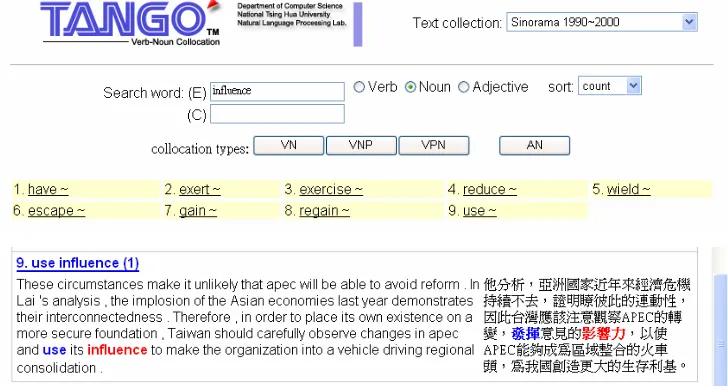
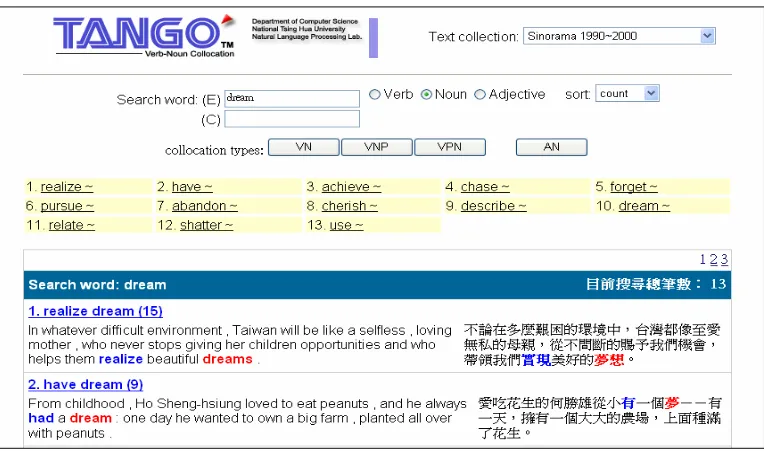
We will present a new method that automatically performs shallow parsing on an English corpus to identify all the statistically significant collocation types and their instances in the monolingual corpus and the English part of the given bilingual corpus. After that, the translation of each collocate of each collocation is identified based using primarily the word alignment technique. We will also present a computer assisted translation system, Tango, which accepts user queries of words, parts of speech, and types of collocation, and displays citations with bilingual collocations highlighted. An example of a Tango search for bilingual collocations for the noun “influence” is shown in Figure 1.
332 Thomas C. Chuang et al.
The rest of the article is organized as follows. We will review related works in the next section. Then we will present our method for automatically processing sentences in monolingual and parallel corpora, and extracting bilingual collocations (Section 3). As part of our evaluation, we will describe an implementation of the proposed approach using SMEC and BNC (Section 4) and discuss the results of our evaluation carried out to assess the performance of bilingual collocation extraction (Section 5).
2.
Extraction of Collocational Translation Memory
It is difficult to extract bilingual collocations from parallel corpora due to their limited availability and small sizes. Methods proposed in previous works typically extract collocations based solely on co-occurrence counts and statistical association measures in bilingual corpora. Unfortunately, a substantial part of the collocations in a modest-sized parallel corpus might not have high enough frequency counts for statistical extraction methods to be effective. Many bilingual collocations useful for machine translation and computer assisted language learning may appear only once or twice in a small to medium size corpus. To extract bilingual collocations, a promising approach is to acquire collocations in from a very large monolingual corpus and obtain translations from a parallel corpus.
2.1
Problem Statement
We will focus here on the first step of building a translation memory for a bilingual collocation tool this involves; extracting a set of bilingual collocations instances from a sentence-aligned parallel corpus. These collocation instances can be used for the purpose of computer assisted translation and language learning. Thus, the collocations, including those that appear only once or twice, should be identified in the part of the parallel corpus that is written in one of the two languages. At the same time, it is crucial that the translations also be identified. Therefore, our goal is to return a reasonable-size set of documents that, at the same time, must contain an answer to the question. For simplicity, we will focus on verb-noun collocations in this paper. We formally state the problem that we are addressing below.
Problem Statement: Given a parallel corpus PC of npairs of sentences (SEi, SFi) written in
the first language Eand the second language F.Our goal is to identify a set of k collocations and translations (CEij, CFij) in (SEi, SFi). To accomplish this task, we make use of a large
334 Thomas C. Chuang et al.
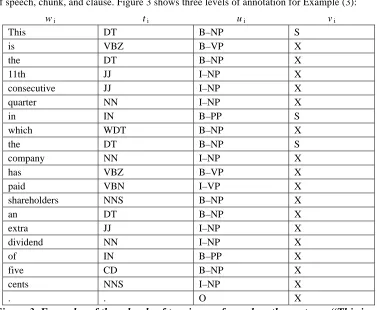
(3) This is the 11th consecutive quarter in which the company has paid shareholders an extra dividend of five cents.
As shown in Figure 3, each word is tagged with a parts of speech tag (e.g., DT for determiner and VBZ for third person singular verb), a chunk tag indicating the basis phrase type (e.g., noun phrase, NP, verb phrase VP, etc.) Plus the position of the word (e.g., “B” for words beginning a chunk and “I” for all other words in the chunk), and a clause tag (e.g., “S” for a clause-beginning word and “X” otherwise). The chunk annotation shown in Figure 3 indicates that “This,” “the 11th consecutive quarter,” “the company,” “shareholder,” “an extra dividend,” and “five cents” are nouns on noun phrases, while “is” and “has paid” are verb phrases. Similarly, the clause annotation results indicate that “This is the 11th consecutive quarter” and “in which the company has paid shareholders an extra dividend of five cents” are the only two clauses in the sentence. With a substantial amount of annotated sentences like the above we can develop three taggers for each level of analysis.
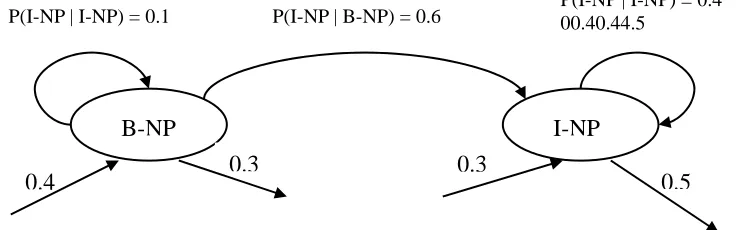
For the parts of speech tagger, the HMM operates on a set of states represented by all possible POS tage, goes through a sequence of state t i, and produces words w i, i = 1 to n. An
example of transition probability function
P(
u
i|
u
i-1)
for the chunk tagger is shown in Figure 4. A first order HMM is characterized by the emission probability, P(w i | t i), and statetransition probability, P(t i | t i-1). An example of the emission probability function
P(
t
i|
u
i)
for the chunk tagger is shown in Figure 5.Figure 4. Example of transition probability function
P(
u
i|
u
i-1)
for the chunk taggerPOS DT NN Others
B-NP 0.6 0.2 0.2 I-NP 0.1 0.7 0.2
others … … …
Figure 5. Example of the emission probability function
P(
t
i|
u
i)
for thechunk tagger
B-NP
I-NP
P(I-NP | I-NP) = 0.1 P(I-NP | B-NP) = 0.6
0.3
0.5
P(I-NP | I-NP) = 0.4 00.40.44.50.4
0.3
336 Thomas C. Chuang et al.
(4) Confidence in the pound is widely expected to take another sharp dive if trade figures for September due for release tomorrow fail to show a
substantial improvement from July and August’s near-record deficits.
The taggers described in Section 2.2 will produce the parts of speech tags, chunk tags, and clause tags shown in Examples (5)-(7):
(5) Confidence/NN in/IN the/DT pound/NN is/VBZ widely/RB expected/VBN to/TO take/VB another/DT sharp/JJ dive/NN if/IN trade/NN figures/NNS for/IN September/NNP ,/, due/JJ for/IN release/NN tomorrow/NN ,/, fail/VB to/TO show/VB a/DT substantial/JJ improvement/NN from/IN July/NNP and/CC August/NNP 's/POS near-record/JJ deficits/NNS ./.
(6) Confidence /B-NP in/B-PP the/B-NP pound/I-NP is/B-VP widely/I-VP expected/I-VP
to/I-VP take/I-VP another/B-NP sharp/I-NP dive/I-NP if/B-SBAR trade/B-NP figures/I-NP
for/B-PP September/B-NP due/ADJP for/B-PP release/B-NP tomorrow/I-NP ,/O
fail/O to/O show/O a/B-NP substantial substantial/I-NP improvement/I-NP from/B-PP
July/B-NP and/O August/B-NP 's/B-NP near-record/I-NP deficits/I-NP ./O
(7) Confidence /S in/X the/X pound/X is/X widely/X expected/X to/S take/X another/X sharp/X dive/X if/S trade/X figures/X for/X September/X due/X for/X release/X tomorrow/X ,/ * fail/S to/X show/X a/X substantial/X improvement/X from/X July/X and/X August/X 's/X near-record/X deficits/X ./X
338 Thomas C. Chuang et al.
We have described a method for handling VN collocations. This method can be easily extended to handle VPN and VNP collocations as well. The idea is quite simple. After identifying a VN collocation type where the verb and noun are separated by a preposition, we go on to consider the preposition that comes between the verb and the noun or that follows the verb and noun. The VPN and VNP collocations are validated again by calculating the LLR between each VN pair and the preposition.
2.4
Extraction of Collocation Instances in PC
We subsequently identify collocation instances in the n sentence SEi of the give parallel
corpusPC. First, each sentence SEi is subjected to the same POS, chunk, and clause analyses
as is applied to the corpus M. The collocation instances of the forms VN, VPN, and VNP are extracted in a similar way to that described in Section 2.2. There are two cases in which a collocation instance will be considered as a valid collocation:
1. if it passes the LLR threshold calculated based on the counts of words and co-occurrences in PC;
2. if it is in the list of valid collocations found in M.
The quantity and quality of collocations in a very large monolingual corpus surely will facilitate collocation identification in a smaller bilingual corpus with better statistical measures.
2.5
Extracting Collocation Translation Equivalents in a Bilingual Corpus
After instances that are most likely valid collocations are obtained from a bilingual corpus, we go on to work on the second part of the parallel corpus PC. We exploit statistical word-alignment techniques [Melamed 1997] and dictionaries to find translation candidates for each of the words in a given collocation. Using Melamed’s approach, we can establish a word translation based on corpora to supplement English-Chinese dictionaries, which generally suffer due to insufficient information. We first locate the translation of the noun. Subsequently, we locate the verb nearest to the noun translation to find the translation of the verb. Figure 7 shows some examples.
English sentence Chinese sentence
If in this time no one shows concern for them, and directs them to correct thinking, and teaches them how to express and release emotions, this could very easily leave them with a terrible personality complex
Collocational Translation Memory Extraction Based on 339 Statistical and Linguistic Information
they can never resolve.
Occasionally some kungfu movies may appeal to foreign audiences, but these too are exceptions to the rule.
偶爾有一些武打片對某些外國觀眾 有吸引力,但也是個案。
Figure 7. Examples of identifying translations of nouns (in bold) and verbs (shaded) of VN collocation instances in bilingual sentence pairs
3.
Implementation and evaluation
We have implemented a program for extracting bilingual collocations based on the proposed method and experimented with 50,000 bilingual sentences (SMEC-50000) from the Sinorama Mandarin-English Corpus (SMEC). We wanted to assess the performance of the program and verify whether useful bilingual collocations in SMEC with very low occurrence counts (e.g., “use influence; 發揮 影響力”) could be extracted. Such collocations are beyond the reach of methods previously proposed in the literature.
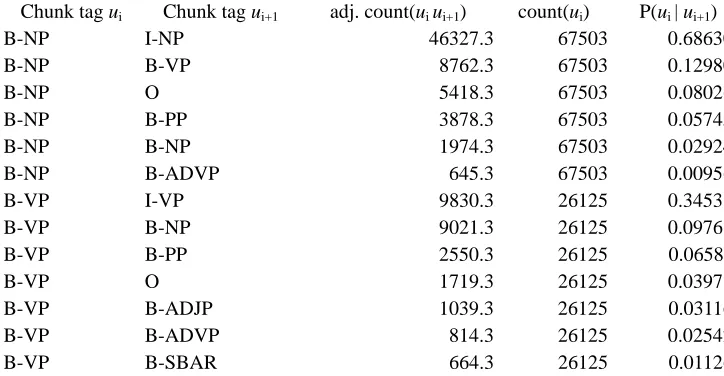
We used the Brown corpus to develop a parts-of-speech tagger and the CoNLL-2000 benchmark database to build a chunk tagger and clause tagger. The chunk tagger relied on the transition and output probabilities of chunks. Figures 8 and 9 show examples of these two processes. The average precision rate of the chunk tagger was about 93.7%, based on CoNLL testing data.
Chunk tag ui Chunk tag ui+1 adj. count(ui ui+1) count(ui) P(ui | ui+1)
B-NP I-NP 46327.3 67503 0.686300
B-NP B-VP 8762.3 67503 0.129806
B-NP O 5418.3 67503 0.080268
B-NP B-PP 3878.3 67503 0.057454
B-NP B-NP 1974.3 67503 0.029248
B-NP B-ADVP 645.3 67503 0.009560
B-VP I-VP 9830.3 26125 0.345313
B-VP B-NP 9021.3 26125 0.097619
B-VP B-PP 2550.3 26125 0.065811
B-VP O 1719.3 26125 0.039782
B-VP B-ADJP 1039.3 26125 0.031169
B-VP B-ADVP 814.3 26125 0.025428
B-VP B-SBAR 664.3 26125 0.011265
Collocational Translation Memory Extraction Based on 341 Statistical and Linguistic Information
VN type Example
Exert influence That means they would already be exerting their influence by the time the microwave background was born.
Exercise influence The Davies brothers, Adrian (who scored 14 points) and Graham (four), exercised an important creative influence on Cambridge fortunes while their flankers Holmes and Pool-Jones were full of fire and tenacity in the loose.
Wield influence Fortunately, George V had worked well with his father and knew the nature of the current political trends, but he did not wield the same influence internationally as his esteemed father.
Extend influence The CAB extended its influence into the non-government sector, funding research by the Cathedral Advisory Commission and the Royal Society for the Protection of Birds.
Diminish influence To break up the Union now would diminish our influence for good in the world, just at the time when it is most needed.
Gain influence In general, women have not benefited much in the job market from capitalist industrialization nor have they gained much influence in society outside the family through political channels.
Counteract influence To try and counteract the influence of the extremists, the moderate wing of the party launched a Labour Solidarity Campaign in 1981. Reduce influence Whether the curbs on police investigation will reduce police influence
on the outcome of the criminal process is not easy to determine.
Figure 11. Examples of collocation instances extracted from SMEC
With the collocation types and instances extracted from the corpus, we built an on-line collocation reference tool called TANGO to support searching for collocations and translations of a given word.
344 Thomas C. Chuang et al.
Acknowledgements
This work was part of the “CANDLE” project funded by the National Science Council of Taiwan (NSC-2213-E-238-015 and NSC92-2524-S007-002). Further information about CANDLE is available at http://candle.cs.nthu.edu.tw/.
References
Andriamanankasina, T., K. Araki, and T. Tochinai, “Example-Based Machine Translation of Parts-Of-Speech Tagged Sentences by Recursive Division,” In Proceedings of MT SUMMIT VII, Singapore, 1999.
Brown, R. D., “Automated Generalization of Translation Examples,” In Proceedings of the Eighteenth International Conference on Computational Linguistics (COLING-2000), Saarbrücken, Germany, August 2000, pp. 125-131.
Carl, M., “Inducing Translation Templates for Example-Based Machine Translation,” In Proceedings of MT Summit VII, 1999.
CoNLL yearly meeting of the SIGNLL, the Special Interest Group on Natural Language Learning of the Association for Computational Linguistics. The shared task of text chunking in CoNLL-2000 is available at http://cnts.uia.ac.be/conll2000/.
Echizen-ya, H., K. Araki, Y. Momouchi, and K. Tochinai, “Effectiveness of Automatic Extraction of Bilingual Collocations Using Recursive Chain-Link-Type Learning,” The 9th Machine Translation Summit, 2003, pp.1 02-109.
Gao, J., J. Nie, H. He, W. Chen, and M. Zhou,“Resolving Query Translation Ambiguity Using a Decaying Co-occurrence Model and Syntactic Dependence Relations,” The 25th Annual International ACM SIGIR Conference on Research and Development in Information Retrieval, 2000, pp.183 -190.
Kitano, H., “A Comprehensive and PracticalModel of Memory-Based Machine Translation,” In Proceedings of IJCAI-93, 1993, pp. 1276-1282.
Kupiec, J., “An algorithm for Finding Noun Phrase Correspondences in Bilingual Corpora,” In Proceedings of the 31th Annual Meeting of Association for Computational Linguistics, 1993, pp. 17-22.
Lin, D., “Extracting Collocation from Text Corpora,” First Workshop on Computational Terminology, 1998, pp. 57-63.
Lü, Y., and M. Zhou, “Collocation Translation Acquisition Using Monolingual Corpora,” Association for Computational Linguistics 2004, pp. 167-174.
Melamed, I. D., “A Word-to-Word Model of Translational Equivalence,” In Proceedings of the Association for Computational Linguistics 1997, Madrid Spain, 1997, pp. 490-497. Nagao, M., “A Framework of a Mechanical Translation between Japanese and English by
Collocational Translation Memory Extraction Based on 345 Statistical and Linguistic Information
Pearce, D., “Synonymy in Collocation Extraction,” In Proceedings of the NAACL 2001 Workshop on WordNet and Other Lexical Resources: Applications, Extensions and Customizations, CMU, 2001.
Seretan, V., L. Nerima, and E. Wehrli, “Extraction of Multi-Word Collocations Using Syntactic Bigram Composition,” International Conference on Recent Advances in NLP, 2003, pp. 424-431.
Manning, C.D., and H. Schutze, “Foundations of Statistical Natural Language Processing” MIT Press, Cambridge, Mass, 1999.
Smadja, F., “Retrieving Collocations from Text: Xtract,” Computational Linguistics, 1993, 19(1), pp.143-177.
Smadja, F., K. R. Mckeown, and V. Hatzivassiloglou, “Translation Collocations for Bilingual Lexicons: a Statistical Approach,” Computational Linguistics, 22, 1996, pp.1-38. Wu, H., and M. Zhou, “Synonymous Collocation Extraction Using Translation Information,”
The 4Jth annual conference of the Association for Computational Linguistics, 2003, pp. 120-127
Related web pages:
Deja–Vu (http://www.atril.com/).