Date: Tuesday, July 03, 2007
Name: Wouter Pot
Student number: 0007188
Version: 1.00
Number of pages: 77
Supervisors: dr. Zsófia Ruttkay dr. Mannes Poel ir. Dennis Reidsma
A
A
m
m
a
a
c
c
h
h
i
i
n
n
e
e
l
l
e
e
a
a
r
r
n
n
i
i
n
n
g
g
a
a
p
p
p
p
r
r
o
o
a
a
c
c
h
h
f
f
o
o
r
r
g
g
e
e
n
n
e
e
r
r
a
a
t
t
i
i
n
n
g
g
e
e
x
x
p
p
r
r
e
e
s
s
s
s
i
i
v
v
e
e
m
m
u
u
s
s
i
i
c
c
a
a
l
l
t
t
r
r
a
a
n
n
s
s
c
c
r
r
i
i
p
p
t
t
i
i
o
o
n
n
s
s
M
0. Table of contents A machine learning approach for generating expressive musical transcriptions
T
T
a
a
b
b
l
l
e
e
o
o
f
f
c
c
o
o
n
n
t
t
e
e
n
n
t
t
s
s
1. Introduction... 6
1.1. Research questions... 7
1.2. Applications... 8
1.2.1. Experimental environment... 8
1.2.2. Annotation of musical transcriptions ... 8
1.2.3. Initiation to expressive music synthesis... 8
1.2.4. Tutoring guitar students ... 8
2. Approach... 9
2.1. Goals... 9
2.2. Exprimulator ... 9
2.3. Creating corpora ... 10
2.4. Calculating feature vectors ... 10
2.5. Training & evaluation of classifiers... 10
2.6. Transcribing & annotating song corpus ... 11
3. Literature review ... 12
3.1. Audio descriptors... 12
3.1.1. MPEG-7 audio description ... 12
3.2. Machine learning for sound classification ... 14
4. Musical theory ... 15
4.1. Musical expression ... 15
4.1.1. Explicit and implicit characteristics... 15
4.1.2. Relation between expression and playing techniques ... 16
4.2. Communicating expression with annotation... 16
4.3. Expressiveness per instrumental category ... 17
4.4. Guitar anatomy ... 17
4.5. Timbre and guitar ... 18
4.5.1. Static timbral properties of the guitar (physical characteristics) ,,... 18
4.5.2. Dynamic timbre control ... 19
4.5.2.1. Right hand playing position ... 19
4.5.2.2. Right hand finger configuration ... 20
4.5.2.3. Left hand finger configuration ... 20
4.6. Overview of expressive dimensions ... 20
5. Design of Exprimulator... 23
5.1. Requirements ... 25
5.1.1. Functional requirements for producing annotated transcriptions... 25
5.1.2. Functional requirements regarding experimenting and evaluation ... 25
5.1.3. Usability ... 26
5.1.4. Non-functional requirements ... 26
6. Design machine learning methodology... 27
0. Table of contents A machine learning approach for generating expressive musical transcriptions
6.2. Feature vectors... 29
6.2.1. Calculation of feature vectors ... 29
6.3. Classifiers ... 30
6.3.1. Overview of classifier categories... 30
6.3.1.1. Decision trees... 31
6.3.1.2. Support Vector Machines (SVMs)... 31
6.3.1.3. Neural networks ... 31
6.3.1.4. Bayesian learning... 32
6.3.1.5. Lazy learning ... 32
6.3.1.6. Rule learning... 32
6.3.2. Literature review of classifiers used for sound classifying problems ... 33
6.3.3. Selection of classifiers to test... 34
6.3.4. Incontrollable interfering dimensions ... 35
7. Implementation ... 36
7.1. Implementation of Exprimulator ... 36
7.1.1. Classifier manager ... 36
7.1.2. Transcriber... 37
7.2. Creation of training corpora with Exprimulator ... 38
7.2.1. Test case: creating an initial training corpus with Exprimulator ... 38
7.2.2. Test case: creating a definite training corpus with Exprimulator... 39
7.2.3. Design decisions ... 39
7.2.4. Practical realization of the training corpus ... 40
7.2.5. Recording settings ... 40
7.3. Implementation of machine learning methodology ... 41
7.3.1. Calculating feature vectors ... 41
7.3.1.1. Settings for audio descriptor algorithms ... 41
7.3.2. Settings for classifiers... 42
7.3.3. Measurable results of experiments... 42
7.3.3.1. Case test: performance test with initial training corpus ... 44
7.3.3.2. Exceptions in calculating feature vectors... 45
8. Experiments and results ... 47
8.1. Testing preparations... 47
8.1.1. Recording songs ... 47
8.1.2. Transcription and annotation of guitar performances ... 47
8.1.3. Creating classifiers... 48
8.2. Results ... 48
8.2.1. Corpus size ... 48
8.2.2. Cross validating classifiers ... 50
8.2.3. Annotation performance ... 51
8.2.4. Interpretation of learned models ... 53
8.2.5. Relation between note characteristics and misclassification ... 58
8.2.6. Fine-tuning classifiers... 59
0. A machine learning approach for generating expressive musical transcriptions
9.1. Performance evaluation ... 61
9.2. Evaluation of Exprimulator ... 62
10. Future work ... 65
10.1. Annotating more realistic performances ... 65
10.2. Extensions to Exprimulator ... 66
10.3. Generalizing issues ... 67
10.4. Annotation adequacy for future applications ... 67
11. Glossary of musical terms... 68
0. Acknowledgements A machine learning approach for generating expressive musical transcriptions
A
A
c
c
k
k
n
n
o
o
w
w
l
l
e
e
d
d
g
g
e
e
m
m
e
e
n
n
t
t
s
s
1. Introduction A machine learning approach for generating expressive musical transcriptions
1
1
.
.
I
I
n
n
t
t
r
r
o
o
d
d
u
u
c
c
t
t
i
i
o
o
n
n
Everybody is familiar with digital synthesized music in general. Well known are MIDI-files, one or more tracks with sequenced notes that can be played on a computer or keyboard. Characteristics of music that is played by and synthesized on a computer are that it sounds mechanical and artificial. The striking difference that exists between a human and a machine performance is because of the computer’s inability to put expression into music. Expression is the quality that accounts for emotion in music and makes it interesting to listen to. This expression is realized by using the appropriate phrasing, style, interpretation and by applying variations in dynamics and tempo [1]. Although some of these factors can be realized by means of MIDI controls such as the aftertouch (force by which a key is struck), legato, release time (the time it takes for a tone to fade out) or attack time (the time it takes for a tone to fade in) these controls need to be programmed or recorded explicitly. The common MIDI sequencers offer no logic that deduces settings for these controls on basis of the musical structure for example.
The mechanical nature of synthesized sound inspired many researchers the last decades to study expressive performance by quantitative or computational modeling. Computational modeling is an attempt at formulating hypotheses concerning expressive performance in such a precise way that they can be empirically verified (or disproved) on real measured performance data, as defined in [2]. In this article, 4 approaches of computational music modeling were compared: analysis-by-synthesis (evaluation of rules brought forward by researchers by professional musicians), analysis-by-measurement (obtaining empirical evidence directly from measurements of human performances), applying mathematical musical music
theory and the machine learning model (discovering significant regularities in musical performances via
inductive machine learning and data mining techniques). The last model was adopted for this thesis as a way of obtaining an expressive knowledge base.
In order to realize models that can synthesize expressive performances, three stages are distinguished: 1. Capture low-level expressive characteristics of a large set of human performances
2. Develop higher level rules and models on basis of the knowledge base from step 1 3. Use these models to synthesize expressive performances
In this thesis an experimental environment (Exprimulator) is presented that realizes the goal of step 1. It aids researchers with capturing these expressive characteristics. This thesis addresses the design, implementation and testing of this piece of software. Exprimulator was tested with guitar performances, that were transcribed (by capturing note onset, note duration and pitch) and annotated on a note-level scale with expressive labels. These expressive labels could in principle denote any playing technique a musician used to convey expression in the performance. However, in order to limit and focus the scope of this thesis one particular expressive dimension (the scale between two complementary playing techniques in which a musician can vary) was chosen as a proof of concept, namely the Right Hand Playing Position (RHPP). Variation in the striking position of the right hand is an important and commonly used form of expression for guitarists. It can effectuate any sound color between sharp and soft tones.
1. Introduction A machine learning approach for generating expressive musical transcriptions
In contrast to the numerous video annotators, musical annotators are scarce. The most important are: Timeliner [7], the Acousmograph1, MiXA [8], Marsyas [9], the CLAM Annotator [10] and Mucosa [11]. Timeliner is a pedagogical visualization and annotation tool for a musical library, whereas Acousmograph, Marsyas and the CLAM annotator do not offer (semi)-automatic annotation. Only MiXA and Mucosa incorporate automatic annotation, and aim towards collaborative annotation of existing music. The systems are mainly built in order to create online databases with musical transcriptions that can be queried with high-level descriptors of several dimensions (genre, melody, tonality, instrumentation, style, etc.). This contrasts with the note-level annotation that Exprimulator provides. An annotation tool that is more focused on the annotation on note-level (event level in the percussive context), is described in Exploration of techniques for automatic labeling of audio drum tracks’
instruments [12]. In this project it has been attempted to create a drum track from a performance that
denotes the appropriate percussive instrument for a certain percussive event. The major difference between Exprimulator and the discussed annotators is however that outputted transcription is not the sole goal; it is part of a bigger context – namely that of creating expressive synthesized performances.
In the major part of literature concerning extraction of expressive content or synthesis of expressive music (for example [13-17]) variation in dynamics, timing and melodic structure characteristics are regarded as the constituting elements of musical expression:
• Rhythmical variation (tempo): Notes can be deliberately played too soon or late in order to express a certain feeling (rubato), or one can slow down (ritardando) or speed up (accelerando).
• Volume variation (dynamics): Volume increase or decrease can build up certain suspense or release it. Variation in volume is indicated with for instance crescendo (play gradually louder) or diminuendo (play gradually softer).
• Pitch variation (frequency): A musician can deliberately deviate from the prescribed pitch from the score, by means of a vibrato or glissando, for example. This form of expression can only be produced by a limited class of instruments, among which the string instruments.
Albeit the importance of these factors is not denied, this thesis focuses more on the expressive modes that can be affected by applying different timbral playing techniques. This means that annotation takes the form of describing the concrete playing technique that is used, say sul tasto or appoyando. In this way emotive and subjective expressive labels such as tender, aggressive, sad, joyful, calm and restless [16] are avoided. The same applies to ambient labels such as heavy, soft, hard, bright and dark [18]. Concrete labels show unambiguously how a certain tone was played and how it should be played in future. By definition, concrete labels specify a playing mode in one expressive dimension. On the other hand an emotive or ambient label gives a musician freedom to use any of the available expressive dimensions. In this thesis a method to obtain musical transcriptions annotated with expressive labels by means of machine learners is presented. To reduce the complexity of this problem the scope of the project has been narrowed and concretized to transcribing guitar performances. The transcription has been labeled with expressive labels concerning the right hand playing position (RHPP) of the guitarist. This proof of concept case has been executed in a dedicated environment called Exprimulator that facilitates several tasks such as creating optimal classifiers, transcribing, annotating and visualizing resulting (intermediary) data.
1.1.
Research questions
In this thesis the following global question are answered:
• Can scores be annotated with expressive annotation concerning the right hand playing position using a machine learning approach?
• Is the achieved accuracy of annotating the RHPP dimension satisfying enough to make the presented methodology applicable for the recognition of other expressive dimensions?
1
1. Introduction A machine learning approach for generating expressive musical transcriptions
More detailed sub questions that are related to our specific test case of creating annotated transcriptions of guitar performances are stated below.
o What expressive dimensions can be discerned on a guitar, and how can they be divided into classes (equivalent with playing techniques) so that recognition by machine learners is possible? (chapter 4)
o Which audio features can be used as classifier input to determine the playing technique?
o Given a set of classifiers, which one annotates musical performances most accurately and consistently?
A question related to applicability of Exprimulator:
• Does Exprimulator provide enough general freedom for researchers to develop sound classifiers for the annotation of musical transcriptions?
1.2.
Applications
Exprimulator is designed as a general tool for sound classification and musical annotation. Therefore, it can serve as an initiation to a variety of future applications.
1.2.1. Experimental environment
Exprimulator can serve as a general environment for exploring feature data and different classifiers. Studies performed with the help of Exprimulator can be compared with each other, because they are similar in execution (same note segmentation, same classifier implementation, etc.). In this way Exprimulator serves as a test environment for carrying out musical sound classification experiments and eases re-execution of these experiments and storage of experimental results.
1.2.2. Annotation of musical transcriptions
Exprimulator can serve as a tool to make more descriptive transcriptions, than regular scores or MIDI files. Besides the basic annotation such as note duration, pitch and onset, Exprimulator provides additional information about the playing technique. This application can have its benefits for existing scores, as these often lack annotation concerning playing techniques. Furthermore, annotation can be provided for any expressive dimension, as long as playing modes defined within the dimension are recognizable by an appropriate combination of feature vectors and classifiers. The annotated transcriptions could be used for musicians who need more guidance in learning a score, or for online databases to enable searching on expressive characteristics.
1.2.3. Initiation to expressive music synthesis
Exprimulator can be used to create a large corpus of annotated musical guitar performances, from which expressive rules can be inferred. These rules can relate musical structure to playing techniques. For this application, a skilled guitarist has to perform a significant amount of songs that are to be transcribed and annotated. The now obtained corpus of songs can serve as a knowledge base to deduce rules that relate musical structural quantities (characteristic note sequences, characteristic sequences of note durations and/or dynamics) to expressive quantities. The intention of these rules is to expose ‘universal’ playing conventions that guitarists share. It is also likely that these rules can capture more specific trends such as the playing style, musical genre, the unique style of a musician or the mood of the musician.
1.2.4. Tutoring guitar students
2. Approach A machine learning approach for generating expressive musical transcriptions
2
2
.
.
A
A
p
p
p
p
r
r
o
o
a
a
c
c
h
h
The main goal of this thesis is to be able to recognize different expressive playing modes within an expressive dimension. This chapter outlines the steps taken to realize expression recognition.
Recognition of expressive playing modes is valuable for the different applications proposed in the previous chapter, such as acquiring transcriptions annotated with expressive markup, deducing expressive rules or tutoring guitar students. Several machine learning approaches were chosen to classify a continuous expressive dimension into a discrete set of classes. For testing purposes, these machine learners had to recognize the expressive dimension RHPP. Corpora were recorded that contained sufficient repetitions of tones per distinguished class. In order to train a classifier to recognize different playing modes within the RHPP dimension suitable audio descriptors had to be calculated from the corpus’ tones. These audio descriptors were arranged in feature vectors that were used to train classifiers with different machine learning approaches. The accuracy of the classifiers was evaluated and compared by calculating the annotation accuracy over a song corpus consisting of a representative amount of human performances.
Literature study formed an important part of this thesis to determine the ways how guitarists can perform musical expression. This survey was used to pick out a representative dimension for our research, in our case RHPP. Literature study was also conducted in order to obtain suitable audio descriptors and machine learners.
2.1.
Goals
Below we list the necessary goals to answer the main research questions. These goals are evaluated in the experiments chapter 8 and the conclusions chapter 9.
• Determining expressive playing modes and dimensions for a guitarist
• Obtaining an optimal training corpus
• Obtaining a selection of best performing classifiers
• Obtaining optimal classifier configurations for the best performing classifiers
• Obtaining suitable audio descriptors and feature vectors
• Proving possibility of expressive playing mode recognition
• Proving possibility of transcribing guitar performances and using expression recognition to annotate them
• Obtaining transcriptions with an annotation performance of at least 80%
2.2.
Exprimulator
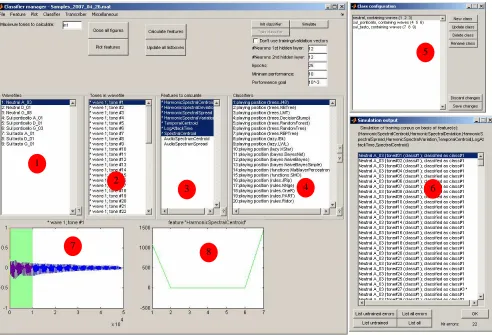
The experiments (creating corpora, calculating feature vectors, transcribing and annotating guitar performances) have been conducted in a dedicated environment called Exprimulator. This environment has been developed in Matlab and combines the strengths and ease of the scripting language of Matlab with the wide selection of machine learning methodologies that WEKA offers and the audio descriptor calculation features of the MPEG-7 toolbox Matlab-XM.
2. Approach A machine learning approach for generating expressive musical transcriptions
1. Creation of a sound corpus consisting of tones played with different playing techniques (one realization of a specific playing technique equals a class in this occasion).
2. Calculation of feature vectors for a configurable fraction of each tone.
3. Creation of several types of classifiers that can be trained with the feature data from the preceding step
4. Creating transcriptions (containing note onsets, durations and pitches) of guitar performances. 5. Annotation of transcriptions with the classifiers of the third step. With help of this feature classifier
performances can be mutually compared, if ascertained that expressive annotation is possible/satisfying at all (related to the main research question of section 1.1).
These features have been implemented with the research questions and goal setting in mind. Configurability is the key aspect to realize the majority of the goals of the previous section. Configurable GUI controls have to be implemented to investigate the influence of different corpora, feature vectors and classifier settings on the annotation performance. An optimal experimental set-up for future work is expected to be found by varying these dimensions.
In the following sections the sequential tasks Exprimulator performs in order to get to annotated transcriptions are described in more detail.
2.3.
Creating corpora
In order to create a classifier that is able to distinguish nominal playing modes on a continuous expressive dimension, training material that exemplifies these classes have to be presented as input. Corpora have been created by playing tones with a certain expressive mode repetitively with a certain amount of jitter to reflect the natural inaccurateness of a guitarist. Subsequently, these recorded waveforms are segmented into individual tones and grouped in accordance with the class arrangement in the expressive dimension. The resulting corpus has to be easily adjustable by excluding tones that were played incorrectly. This manual revision of the corpus is realized by means of the possibility to visually and audibly review the individual corpus tones.
2.4.
Calculating feature vectors
In order to derive sufficiently small feature vectors from the corpus’ tones that can serve as input for classifiers, appropriate audio descriptor algorithms have to be implemented. Literature on sound classification (preferably timbral sound classification [12]) has been explored to find candidate descriptors. After suitable ones are found they have to be either manually implemented or integrated from existing packages. Once audio descriptors are found that provided adequate class separation, calculation parameters have to be ascertained. Amongst these are the window size, fractions of tones over which the descriptors are calculated, hopsize, window type, etc. These parameters need to be accessible via the GUI of Exprimulator. With the parameters set, the feature vectors of all the tones of the corpus are calculated in one run.
The resulting feature vectors are input in the classifiers as training material together with an index specifying the desired class. These feature vectors can be reviewed as a whole by plotting them grouped per class in different colors. Another way is to review individual feature attributes by creating a scatter plot wherein all the instances are plotted in a domain spanned by two selected feature attribute dimensions. These evaluation methods are used to judge the degree of separation power of the audio descriptors and to recalculate them with different settings if necessary.
2.5.
Training & evaluation of classifiers
2. Approach A machine learning approach for generating expressive musical transcriptions
configuration). For comparison considerations, the corpora have been kept constant throughout the experiments though.
The trained classifiers can be reviewed visually or statistically. Visual review provides insight in the trained model by plotting its structure, weights, or parameters. Statistical review means the prediction of the tones present in the song corpus by the trained classifiers, after which the correct prediction fraction is calculated. These measures are used as a guideline to optimize a classifier by fine-tuning its WEKA settings. The prediction performance is also used to obtain better performing classifiers. By defining a quantitative exclusion rule for the classifiers with the lowest performance, a reduced set of classifiers has been determined. This reduction spares evaluation time for future experiments.
2.6.
Transcribing & annotating song corpus
3. Literature review A machine learning approach for generating expressive musical transcriptions
3
3
.
.
L
L
i
i
t
t
e
e
r
r
a
a
t
t
u
u
r
r
e
e
r
r
e
e
v
v
i
i
e
e
w
w
The extensive amount of literature on sound classification has been used to make choices for the design of the machine learning methodology. Reviewing this literature helps to narrow down the possible ways to conduct this research and helps finding common approaches for sound classification. Finding a common approach comes down to the selection of common classifiers and audio descriptors primarily. Research on sound classification often has the character that a set of classifiers are compared by using some performance measure. Also feature selection methods are applied to obtain optimal audio descriptors. The results of such experiments can be used to the advantage of this project to exclude classifiers and audio descriptors that have been proved unsuccessful. In like manner, extra attention can be paid to classifiers which have been proven more successful.
3.1.
Audio descriptors
Due to the fast growing body of multimedia content on the internet, the necessity for adequate storage with descriptive meta-data rises. This meta-data is necessary for humans to be able to retrieve media with content describing queries, instead of just a filename. The idea is to make the web just as searchable for multimedia content as it is for text. From the calculation of lower level acoustic properties of media content, higher level descriptors that are understandable and relevant for humans can be derived.
In the scope of audio retrieval the need for these descriptors is just as urgent as in the fields of image and video retrieval. Examples of recent audio retrieval methods are query by genre, by humming, by spoken/sung content or by rhythm. Besides retrieval applications, audio descriptors are used for other tasks such as score following/aligning or the sole purpose of providing musical annotation, as in this thesis. For the latter purpose, classifiers are used to ‘convert’ low level descriptors to higher level annotation that has an expressive musical meaning. In order to find good candidates for audio descriptors, an investigation of the musical characteristics that need to be derived is necessary. As has been stated before, the forms of musical expression that this thesis focuses on are timbre related, as is the case with RHPP. Analysis of musical audio by timbre recognition is an approach that has been applied often in the scope of musical instrument [19], playing technique [20, 21] and genre [3] recognition. These applications are considered related to the RHPP recognition problem in principle, and are therefore scanned for commonly used audio descriptors.
By scanning the relevant timbre related literature, in a lot of occasions the MPEG-7 standard have been used, a description framework in which several commonly used higher and lower descriptors are implemented. An important benefit of using a standard approach is the compatibility with other software that uses MPEG-7 and the uniformity by which the audio description algorithms are defined and implemented. This compatibility is ensured by the fact that MPEG-7 uses the widespread XML-scheme for describing the multimedia content. MPEG-7 has been used in several applications that are closely related to the ones of this thesis, namely the classification of musical instruments [22-26], musical sound recognition within one instrument [21], genre recognition [27], environmental sounds recognition [28-30] and music recommendation [31]. Although not all these applications are strictly related to expression recognition, the MPEG-7 descriptors are designed to be universal in their application. The following section outlines the descriptive strength of the MPEG-7 audio descriptors.
3.1.1. MPEG-7 audio description
3. Literature review A machine learning approach for generating expressive musical transcriptions
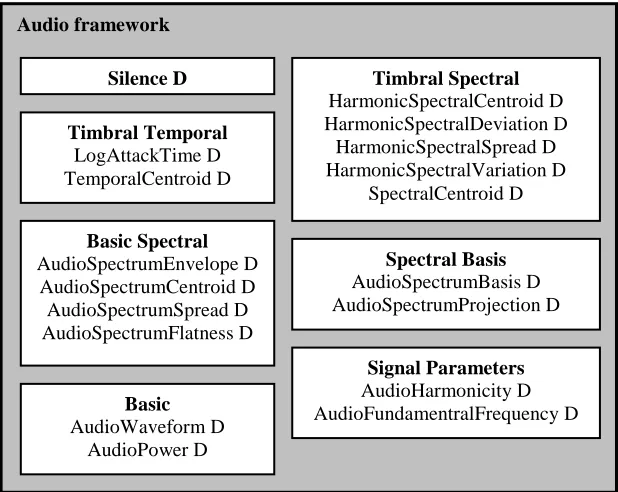
The MPEG-7 unit that is relevant in the light of timbre recognition is MPEG-7 Audio. The audio descriptors that can be calculated with this toolbox are divided in low-level descriptors (LLD’s), such as spectral, parametric or temporal features of the signal, and high-level Description Schemes (DS). The LLD’s describe sound characteristics such as harmonics, sharpness, pitch and timbre. They are applied to short time frames of the sound signal and yield either scalars or vectors, which can be aggregated using mathematical operators such as minimum, maximum, mean, and variance. The Description Schemes describe sound at a higher level and are more related to the way humans describe audio. Examples of these description schemes are Musical Instrument Timbre Description Tools, Melody Description Tools and Spoken Content Description Tools. The LLD’s are depicted in Figure 3.1, and grouped in seven categories. In the following, the MPEG-7 descriptors are outlined per category.
Basic Descriptors
The basic descriptors basically represent the shape of the waveform of an audio signal. The
AudioWaveform is a representation of the waveform’s envelope. The AudioPower descriptor computes the
average square of the waveform in a certain time frame, thereby describing the power of a signal over time.
Basic Spectral
This group describes basic properties of the audio signal’s spectrum. The AudioSpectrumEnvelope (ASE) is a logarithmic representation of the short-term power spectrum in frequency bands. The
AudioSpectrumCentroid is the center of gravity of the ASE spectrum. The AudioSpectrumSpread
describes the deviation of the ASE from its centroid. The last descriptor, AudioSpectrumFlatness, is a fingerprinting algorithm for determining the similarity between two sounds.
Spectral basis
The spectral basis descriptor group contains the AudioSpectrumBasis and AudioSpectrumProjection descriptor. The former transforms a signal’s spectrum to a lower dimensional representation, while the latter does the same for the ASE. Both descriptors aim at representing the spectra while preserving the maximum amount of information.
Signal parameters
This group contains the AudioFundamentalFrequency and the AudioHarmonicity descriptors. The first descriptor calculates the fundamental frequency curve of an audio signal. The second calculates the harmonic ratio (varying between 0 for noise to 1 for purely harmonic) as well as the upper limit of harmonicity.
Timbral temporal
3. Literature review A machine learning approach for generating expressive musical transcriptions
Figure 3.1: Low-level MPEG-7 audio descriptors
As one might expect, in the discussed literature from section 3.1 concerning timbre recognition, the
Timbral Temporal and Timbral Spectral categories play an important role. These categories describe the
perceptual features that make two sounds having the same pitch and loudness sound different. The descriptors can be related to human notions such as ‘attack’, ‘brightness’ or ‘richness’. Because of these reasons these LLD’s would seem obvious candidates for the application of recognizing RHPP.
3.2.
Machine learning for sound classification
Machine learning is a commonly applied methodology in the field of sound recognition and classification. The applications vary from environment recognition for PDA’s [29] and musical instrument recognition [25] to emotion recognition [32]. The more closely related literature on timbre recognition from the previous section was scanned for common machine learning approaches.
Most of the literature discusses around 6 different classifier approaches that fall in one the following categories: decision trees, Neural Networks, Bayesian learning, lazy learning, rule learning or Support Vector Machines (SVMs). The different classifiers are evaluated on test material so that their performances can be compared. It is worth noticing that in most of the projects no conclusions have been drawn about the best performing classifier, and results of mutual projects seem to contradict in case the same classifiers have been used. However, in general the used set of classifiers and experimental approach differs too much to compare one study with the other.
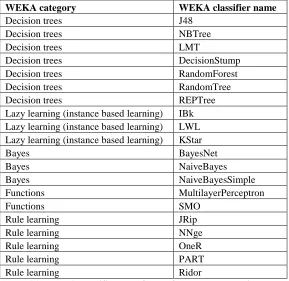
A considerable amount of studies use the classifiers implemented in Waikato Environment for Knowledge Analysis (WEKA, see appendix B). Compatibility, standardization and robustness reasons motivate incorporation of WEKA classifiers within Exprimulator. Section 6.3 outlines in greater detail what classifiers are generally addressed in literature, along with the degree of similarity with this thesis.
Audio framework
Silence D
Timbral Temporal
LogAttackTime D TemporalCentroid D
Basic
AudioWaveform D AudioPower D
Basic Spectral
AudioSpectrumEnvelope D AudioSpectrumCentroid D AudioSpectrumSpread D AudioSpectrumFlatness D
Timbral Spectral
HarmonicSpectralCentroid D HarmonicSpectralDeviation D
HarmonicSpectralSpread D HarmonicSpectralVariation D
SpectralCentroid D
Spectral Basis
AudioSpectrumBasis D AudioSpectrumProjection D
Signal Parameters
4. Musical theory A machine learning approach for generating expressive musical transcriptions
4
4
.
.
M
M
u
u
s
s
i
i
c
c
a
a
l
l
t
t
h
h
e
e
o
o
r
r
y
y
In order to start with recognition of musical expression, it is important to determine what dimensions of expression exist and – within the expressive dimensions (ED) – the playing modes that can be identified. This chapter starts with a general explanation of musical expression. Section 4.3 briefly summarizes per instrument category what the most important expressive dimensions are. The subsequent section outlines for the guitar what static and dynamic parameters influence the timbre of the guitar sound. Finally, in section 4.6 several EDs are defined by the scale between two complementary playing techniques. The playing modes that are a result of dividing the EDs are to be recognized by human ear or a machine learning methodology.
4.1.
Musical expression
Expression can be defined as a quality that accounts for the specific emotional effect of music. When a musician plays with expression, the listener (1) may praise his musical sensitivity or that the musician has a keen sense of how the passage should be played. One can also say (2) that an expressive performance is one that recognizably embodies a particular emotion, and may cause alike emotional response in the listener2.
4.1.1. Explicit and implicit characteristics
Musical performances contain a lot of implicit characteristics (characteristics which are not the result of the explicit annotation of Table 4.1) beside explicit characteristics. The implicit characteristics are the result of the musician’s unique playing style, implicit musical style conventions and the acoustic properties of the guitar. Partly, these implicit characteristics are beyond the ability of the musician to control, such as the acoustical properties of an instrument. Besides that, from the characteristics that are controllable by the player, a large part is applied unconsciously. The part that is applied consciously can be regarded as musical expression. This project tries to capture the expressive part of implicit characteristics, by extracting them from recorded human performances. Combined with the explicit markup already present in a score file, rules can be obtained by finding relations between the explicit markup and the implicit characteristics extracted from the human performances.
Explicit characteristics Implicit characteristics
Note duration Note length deviation
Note pitch Different timing
Dynamics Timbral variation
Vibrato Plucking style
Plucking style
Table 4.1: Explicit and implicit characteristics
The distinction between implicit and explicit characteristic is not disjoint, i.e. most of the explicitly annotated characteristics (such as vibrato or portamento) can also be applied implicitly (i.e. applied to the player’s insight, when there is no explicit annotation present that tells the player to do so). Vibrato is a good example of an expression that is used a lot among guitarists and violinists in more places than those prescribed by explicit annotation. Very often it is applied unintentionally and/or unconsciously.
4. Musical theory A machine learning approach for generating expressive musical transcriptions
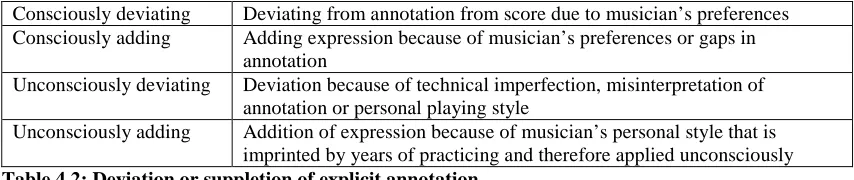
Explicit annotation can be (un)consciously deviated from or supplemented as follows:
Consciously deviating Deviating from annotation from score due to musician’s preferences Consciously adding Adding expression because of musician’s preferences or gaps in
annotation
Unconsciously deviating Deviation because of technical imperfection, misinterpretation of annotation or personal playing style
Unconsciously adding Addition of expression because of musician’s personal style that is imprinted by years of practicing and therefore applied unconsciously
Table 4.2: Deviation or suppletion of explicit annotation
4.1.2. Relation between expression and playing techniques
Musical expression is a subjective notion related to conveying an underlying emotional message of a song and bringing listeners into that desired emotional state. The subjective emotional message is not directly interpretable by a computer. Therefore the concept of musical expression is concretized to analyzable quantities such as playing techniques that are presented in section 4.6. Although the application of playing techniques that this project focuses on does not comprise the full arsenal a musician has at his disposal for transmitting an emotional message, it forms an important part. Playing techniques affect to a large extent the timbre that is produced when playing a song. Timbre, on its turn, is a concept that is strictly related to musical expression because a tone’s timbre is often explained in terms with an emotional load or terms related to the taste or touch sense. Examples of such terms are soft, harsh or muddy, which are commonly heard when music is described orally. Although the interpretation of these descriptions are not determinative either, timbre can be described in terms of measurable acoustic quantities equally well (see section 3.1, amongst others). This measurability enables computational analysis and annotation of performances with timbral markup.
4.2.
Communicating expression with annotation
In expressing music, there are a lot of ambiguities that can limit the clarity by which a composer can convey his message. A composer initially starts with a musical piece with a certain message attached to it that should be conveyed through the score. At several stages, however, this conveying can be hampered. Firstly, the song meaning must be transcribed in musical notation, with restricted freedom of expression. A composer can choose to incorporate annotation with the following increasing levels of concreteness:
• Emotive annotation (e.g. amoroso – loving): with this kind of annotation, the composer makes clear what emotional character a musical phrase should bear. The resulting musical performance should convey this specific emotion. This is the vaguest category of transcription.
• Relative annotation (e.g. crescendo, ritardando): describes a change in tempo or volume in relation to the current playing conditions. Examples of these relative annotators are crescendo which means to play louder, or ritardando, referring to a slow down. It is not always clearly denoted what the pre- and post playing conditions are.
4. Musical theory A machine learning approach for generating expressive musical transcriptions
not detailed enough: a score mostly provides only the keyword ‘vibrato’ under the music bar, without any further clues for the musician how to fill in the unknown parameters, such as the speed and the amplitude of the modulation.
• Absolute annotation: can be interpreted unambiguously, because it involves numeric quantities. Examples are metrical indicators such as the time signature (4/4 for example) or the tempo (in BPM).
Figure 4.1 depicts the way through which a musical message or song meaning is normally transmitted from composer to listener through the musician and the media score and performance. It also depicts the actions that the actors have to undertake in order to come to the intended intermediate states and final state of mind. These actions require unique personal skills (the most important are depicted between the parentheses) that are the reason why the musical communication course is never the same. Within this thesis the computer performs the listener’s role to extract the initial score from the beginning of the course. In this way the communication course is executed in the reverse direction, without intervention from the musician. The intended characteristics for the computer to capture are quantitative parameters, but do not necessarily reconstruct the original score.
4.3.
Expressiveness per instrumental category
For this thesis, expression recognition is demonstrated by using a guitar. The ultimate goal would be the realization of universal expression recognition for any musical instrument, but the ways to realize expression per instrument are in most cases too unique and specific. While the role of the guitar in this thesis is merely a demonstrating than a motivated choice, there are some benefits of this instrument. String instruments in general offer more expressive freedom than other categories mainly because both the pitch and the onset of a tone are directly controlled by human hand without mechanical intervention. This mechanical intervention is present for instance in a piano, where a hammer touches the string at a fixed location, thereby narrowing the control over the timbre.
Other instrumental categories offer control over other expressive dimensions. For instance, with the family of wind instruments the envelope of a tone can be controlled to a great extent, thereby allowing a crescendo within a tone. This is an ability that only the bowed string instruments are capable of within the family of string instruments. For the other ‘plucking’ instruments, the sustain follows invariably a certain exponential decay function. An expressive mode that is important for the percussive instruments is the striking location. Whereas pitch is of no concern for the majority of percussionists, their attention is mostly directed towards the realization of different timbres by striking a cymbal, tom or snare drum on a unique location.
4.4.
Guitar anatomy
4. Musical theory A machine learning approach for generating expressive musical transcriptions
Figure 4.2: Anatomy of an acoustic guitar3
4.5.
Timbre and guitar
The concept of timbre is hard to define, in comparison to other psycho acoustical features such as pitch, duration and intensity. These latter can be scaled and organized hierarchically and notated, but timbre has a very complex definition and is multi dimensional in the time and spectral domain [33]. According to the ANSI definition timbre is that attribute of sensation in terms of which a listener can judge that two sounds having the same loudness and pitch are dissimilar. There are five timbral parameters to distinguish [34]: 1. The range between tonal and noise like character.
2. The spectral envelope.
3. The time envelope in terms of rise, duration, and decay.
4. The changes both of spectral envelope (formant-glide) and fundamental frequency (micro-intonation).
5. The prefix, an onset of a sound quite dissimilar to the ensuing lasting vibration.
In order determine how the timbre of a guitar is constituted, a distinction is made between the unique static timbral properties of a guitar, and the dynamical timbral differences that can be effected by a musician. The next two subsections outline the most attributive components of static and dynamic timbre.
4.5.1. Static timbral properties of the guitar (physical characteristics) 4,5,6
Guitar builders can recognize the limitless factors that influence the sound of a guitar. While a musician can influence the sound of guitar by playing differently, every guitar also has from itself a unique sound color. The acoustic properties that define this static timbre are largely defined when building a guitar. It is important to be aware of these characteristics, as static sound differences between two guitars can make general dynamic timbre recognition impossible. Below the most important properties of a guitar are outlined that define its sound.
3 http://www.phys.unsw.edu.au/music/guitaracoustics/anatomy.html 4
http://www.phys.unsw.edu.au/music/guitaracoustics/anatomy.html
5
http://www.frets.com/FRETSPages/Musician/Strings/Strings/strings01.html
4. Musical theory A machine learning approach for generating expressive musical transcriptions
Material composition
The materials that are used for the construction of a guitar have direct consequences for its acoustic characteristics. The part that defines the guitar’s sound most dramatically is the body, especially the top plate. The majority of the guitar’s sound is namely produced when the vibrating energy from the strings are transferred via the bridge to this plate, causing it to resonate. The detail by which the top plate resonates is a key defining element for the guitar’s timbre. The traditional and up to date most commonly used material is wood, mostly tonewood like spruce, red cedar or mahogany. A common problem with the application of wood is that two plates of wood are never the same, due to natural variation. With this knowledge it is impossible to create two guitars with the same timbre.
A variety of synthesized materials have been explored to imitate or replace existing woods. Examples of these materials are fiberglass, carbon fibre and polymers. The most important arguments for research of these materials are that synthetics are cheaper and believed to exhibit less variation. The latter assumption has not been validated yet, as the synthetics expose as much acoustic variation as wood. Furthermore the characteristics of the synthetics still cannot mimic those of wood, so the timbre of wood cannot even be approximated with synthetics.
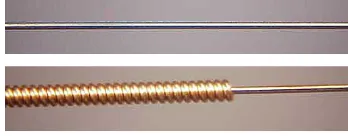
The strings, the initiators of the sound, exist in many variants. The choice of the string is a subjective one which is up to the musician. The most important difference exists between Spanish guitars and steel-string guitars. The top three strings of Spanish guitar are nylon strings, whereas the lower three are composite strings made of a silk fibre core wrapped with silver or gold-plated copper wire. Steel string guitars are equipped with plain steel string for the three highest strings and steel strings wounded with a wire of some metal alloy. The most commonly used alloys are bronze, phosphor bronze, nickel or silver plated copper. Sometimes the core is wrapped with silk filaments before wound by the steel wire. The used alloy has much effect on the sound and durability of the strings.
Guitar’s anatomy
When constructing a guitar there are many choices to be made that have large effect on the timbre. The most important part with respect to construction is – again – the guitar’s body. The back of the top plate of the body is supported by a grid of wooden strips, called braces (see Figure 4.2), which can be arranged in different geometries. The bracing technique is acoustically critical: it alters the stiffness-to-mass ratios and elastic moduli dramatically, thereby defining the guitar’s sound radiation. These braces are necessary to support the top plate, because it is relatively thin in comparison with its surface. The guitar’s sound hole, through which sound is transmitted to the exterior of the guitar, can vary in shape and size. This geometry is most important for the transmission of lower frequencies. Lower frequencies are namely produced by the ‘coupling’ between successively the strings, bridge, sound-board, ribs (sides of the guitar), back plate and ultimately the air cavity in the guitar’s body. If these elements have a strong interaction, the guitar is said to be strongly coupled. The higher frequencies are mainly realized by the coupling between the strings, bridge and top plate. The interaction strength can be tuned by a luthier according to taste: a certain amount is necessary for the transmission of vibration, but too much coupling causes harsh tones.
4.5.2. Dynamic timbre control
4. Musical theory A machine learning approach for generating expressive musical transcriptions
a melodically whole, marked by pauses). In this way, the distinction between sentences is emphasized and effects such as question-answering can be realized. Below is displayed how the playing style is related to psycho acoustic properties and physical properties.
Playing style Psycho acoustic properties Physical properties
At bridge Metallic, sharp Stronger higher harmonics
On fret board Smooth, round Fundamental frequency stronger, less upper harmonic content
Table 4.3: Right hand playing positions and resulting sound properties
4.5.2.2. Right hand finger configuration
Timbre variation can also be realized with a fixed right hand position, but then varying the finger configuration. A couple of variables are stated below that can change the sound [35]:
1. The angle of contact between finger and the string: A slight rotation of the wrist can drastically
affect the angle between the finger and the string. A guitarist can achieve a range of timbres in between striking the string with the right or left side of the finger nail. The sound is the smoothest at the edges and the most metallic when the nail is in line with the string.
2. The amount of weight transmitted to the string via the finger: Involves channeling the weight
of the entire arm to one finger, ranging from very light (the string barely flexes before it is released) to as much weight as possible without creating a distorted sound.
3. The firmness of the first joint in the striking finger: This variable determines the firmness of the
sound. As the first joint is loosened, the finger becomes less perpendicular to the string as the stroke is made. With more firmness on the other hand, the effected sound is more metallic, without having to move the right hand towards the bridge.
4. The ratio of fingernail to flesh touching the string at release time: This ratio determines the
degree of harmonic overtones the vibrating string produces. An attack with pure nail results in a lot of depth in the higher harmonic overtones, while a combination of flesh and nail produces a more full sound, with a wider range of overtones including the lower overtones and sub harmonics.
5. The direction from where the string is touched: The string can be struck from below (tirando) or
from above (appoyando). The appoyando technique realizes a louder and a fuller sound.
4.5.2.3. Left hand finger configuration
The left hand is not a common way to create different timbres with. A professional guitarist would attempt to find the optimal position to place a finger within a fret, in order to create the clearest sound. This means placing the finger as close as possible to the fret without extending it. Any placement further from the fret results in a buzzing sound, which is not considered as a way of intentionally realizing timbre within this thesis.
However, sometimes tones are intentionally played in a certain fashion to create harmonics, which sounds radically different than an ordinary guitar tone. Basically, when playing harmonics, the fundamental frequency and some of its overtones are eliminated. This effect is obtained by slightly touching instead of pressing the string above the fret with the left hand. This can only be realized in certain fret positions, namely the ones that divide the string into halves, thirds or fourths. They double, triple or quadruple the pitch of the string’s base frequency respectively. One does not come across harmonics regularly in scores, and it is mostly used for aesthetic reasons or for special occasions (comparable with the scarce use of
pizzicato). For this reason, it is hard if not impossible to induce expressive rules for the use of harmonics.
4.6.
Overview of expressive dimensions
4. Musical theory A machine learning approach for generating expressive musical transcriptions
These outputs are used on their turn as eventual annotation for the transcription. This means that the transcription contains annotation relating to the applied playing technique.
The following are only a selection of the total amount of timbre comprising dimensions. A convenient property of these 5 defined dimensions is however, that they can be applied simultaneously. The dimensions are defined by two complementary playing techniques, indicated between the parentheses. The first four are continuous dimensions, meaning that there are an unlimited number of intermediate playing modes between the two extreme playing techniques. Fingering on the other hand is a discrete dimension.
Degree of palm muting (Pizzicato – non-pizzicato)
The degree of muting is a measure for the extent by which a guitar’s string is damped by slightly resting the side of the right hand on the strings near the bridge. This results in a buzzing tone that has a shorter sustain, less overtones and is softer. The amount of muting can be increased by applying more pressure on the strings, or by moving the side of the hand farther from the bridge.
Plucking direction of fingers (Appoyando-Tirando)
The playing techniques appoyando (rest stroke) and tirando (free stroke) refer to the direction the strings are pulled to. With tirando a bended finger is positioned below a string before it is plucked, thereby raising the string. With appoyando the opposite technique the string is ‘pushed’ downward before released, after which the striking finger rests on the adjacent string. Appoyando generally results in a fuller sound containing more harmonics, while a tirando tone is more metallic.
Right hand playing position (RHPP) (sul tasto – sul ponticello)
The Italian annotation sul tasto and sul ponticello refer to the playing position of the right hand, respectively on the fret board or at the bridge. Sul ponticello produces a characteristically glassy sound, which indicates that the tone contains more higher harmonics at the expense of fundamental harmonics. Below the position of the techniques in relation to the sound hole are indicated together with the unofficial intermediate label neutral.
Figure 4.3: attack position of the string
Dynamics (piano – forte)
The timbre defining role of the dynamics-dimension is debatable. Volume, after all, is not regarded as a timbral dimension. However, in the case of a guitar the timbre of loud tones vary from soft ones in more dimensions than just the volume. This is because loud tones result in different resonance of the guitar’s body and sometimes a buzzing sound (a noise component). Moreover the preceding finger movement is larger for a tone played forte, thereby irrevocably affecting the timbre.
Fingering (discrete dimension: thumb, index, middle or ring)
The finger used for a certain tone is often prescribed when applying a strumming technique that requires finger alteration or if the score incorporates fingering annotation. Sometimes the fingering configuration is fixed because a chord needs to be played. Therefore in most occasions the fingering is more a technical convention than a free expressive choice. However, every finger has its unique mass, texture, shape,
sul ponticello neutral
4. Musical theory A machine learning approach for generating expressive musical transcriptions
striking angle and power, thereby creating a subtly unique timbre. Recognizing this dimension would therefore be most useful in the application of the tutoring system (section 1.2.4), when for example finger alteration is to be tutored.
5. Design of Exprimulator A machine learning approach for generating expressive musical transcriptions
5
5
.
.
D
D
e
e
s
s
i
i
g
g
n
n
o
o
f
f
E
E
x
x
p
p
r
r
i
i
m
m
u
u
l
l
a
a
t
t
o
o
r
r
The experimental environment called Exprimulator has been designed, to meet the research goals and answer the research questions. While the tasks and responsibilities of this system already have been outlined briefly in chapter 2, this chapter goes more deeply into the underlying design and program requirements.
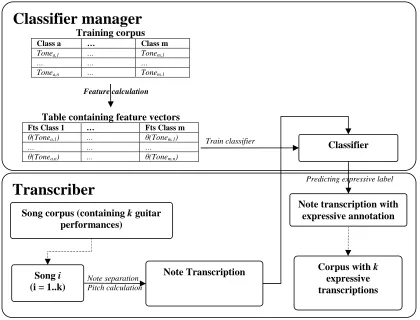
In Figure 5.1 the event structure of the two components (the classifier manager and the transcriber) that comprise Exprimulator are illustrated. The scheme clearly shows the responsibilities of each component. The logical operation procedure prescribes the creation of a training corpus initially. This training corpus is a two dimensional wavetable, in which every training instance is categorized per class according to the class labels defined by the user. These class labels are used by the transcriber as annotation labels in a later stage. From every instance of this wavetable feature vectors can be calculated. Such a feature calculation function is denoted by θ(Tonea,i). The composition of this function in terms of calculated audio
descriptors can be configured by the user. Once for every tone in the wavetable the feature vector is calculated, classifiers based on several machine learning approaches can be created and trained to recognize the defined class distribution. The trained classifiers are used in a later stage by the transcriber for the annotation of transcriptions. The transcriber starts by loading one or more recorded song performances of which a transcription can be created by tone segmentation and pitch calculation. This note segmentation also enables separate feature calculation of every tone. The composition of these feature vectors needs to correspond with the classifier that is intended to be used for annotation. The classifiers that are trained with an identical feature vector composition can now be used to provide annotation by predicting the class within an expressive dimension.
5. Design of Exprimulator A machine learning approach for generating expressive musical transcriptions
In Figure 5.2 the procession of data structures managed by the classifier manager and the transcriber is illustrated. The user and processors can affect state transitions of these data structures which are denoted by dashed arrows.
5. Design of Exprimulator A machine learning approach for generating expressive musical transcriptions
5.1.
Requirements
The goals and approach presented in chapter 2 give rise to the following requirements for the classifier manager and transcriber component of Exprimulator. The functional requirements that are necessary to come to annotated transcriptions are presented in section 5.1.1, whereas the next subsection states the functional requirements for Exprimulator’s to serve as an experimental tool. Section 5.1.3 presents some measures to ensure easy operation. At last non-functional requirements are given that have to ensure durability and extendibility of Exprimulator.
5.1.1. Functional requirements for producing annotated transcriptions
The final version of Exprimulator must be capable of performing the following tasks:
• Creating training corpora by automatically splitting wave files containing repetitions of training tones into separate tones.
• Ordering tones present in corpus in classes. This class layout is intended to be learned by the classifiers.
• Creating, parameterizing and training classifiers.
• Configurable calculation of feature vectors for tones present in training corpus.
• Transcribing songs, i.e. detect note onsets and pitches. These detection algorithms must be parameterizable via Exprimulator’s GUI.
• Calculating feature vectors for tones present in songs. Therefore the user has to be capable of specifying the intended classifiers by which annotating the song, in order to calculate the correct feature vectors.
• Annotating songs with a trained classifier.
• Setting desired annotation for notes of song, if this information is available for the recordings.
• Displaying classifier performance by calculating percentage of correctly annotated notes.
5.1.2. Functional requirements regarding experimenting and evaluation
• Visualizing waveforms of corpus tones in order to be able to check wrong onset calculation.
• Providing means to correct miscalculated or missed onsets by splitting and appending tones, or by repositioning the onset.
• Flexibly including or excluding misplayed tones for the training of classifiers.
• Providing insight into feature data by visualizing feature vectors grouped by class.
• Providing insight into underlying model of classifiers by visualizing rules, statistics, decision trees or networks.
• Visualizing annotated transcriptions in a representation resembling a MIDI sequence with textual annotation referring to the predicted classes.
• Visualizing performance statistics per classifier that annotated a song (number of notes, correctly classified notes, annotation performance).
• The waveforms of performed songs must be viewable together with the calculated note onsets. In this way falsely calculated note onsets can be detected.
• Select notes in the waveform of a song performance. In this way certain fragments can be evaluated by listening or by observing the respective note statistics.
5. Design of Exprimulator A machine learning approach for generating expressive musical transcriptions
5.1.3. Usability
• Carrying out repetitive tasks efficiently for large amounts of data: tone segmentation, pitch calculation and calculation of feature descriptors of multiple tones of a training corpus, constructing and training multiple classifiers and annotation of multiple songs with multiple classifiers.
• Sequential tasks must be automatized. For example, a common sequence of actions within the transcriber is transcribing calculating feature vectors annotating. This sequence has to be
aggregated in order to ease operation.
5.1.4. Non-functional requirements
• Exprimulator has to be general in its design so it can be applied to any musical note-level sound classification problem. The sound content that the classifier manager is intended to process must not be restricted to guitar sound. Therefore general purpose audio descriptors have to be implemented, so that in theory any set of sound classes can be recognized, provided that they are acoustically separable. The same applies to the transcriber: it has to be capable of transcribing any musical performance and not only guitar performances.
6. Design machine learning methodology A machine learning approach for generating expressive musical transcriptions
6
6
.
.
D
D
e
e
s
s
i
i
g
g
n
n
m
m
a
a
c
c
h
h
i
i
n
n
e
e
l
l
e
e
a
a
r
r
n
n
i
i
n
n
g
g
m
m
e
e
t
t
h
h
o
o
d
d
o
o
l
l
o
o
g
g
y
y
6.1.
Design of training corpus
The initial step for obtaining machine learners that recognize musical expression is to create a training corpus. This step is a crucial one as the class configuration embedded in the corpus is learned by classifiers when trained. This learned class configuration is hoped to represent the more general difference between playing techniques. Two training corpora were created to be able to realize playing technique recognition, and to test Exprimulator’s supporting features for realizing this goal. One initial training corpus with less training material was created to get a provisory idea about the adequacy of the corpus and ideas for improvements of the extensive corpus. The extended corpus was used for final experiments and ought to be representative enough for classifiers to annotate a larger amount of song performances. A more detailed description of these two corpora is given in section 7.2. The design of the corpora raises some primary questions. Important considerations for answering these questions are discussed below, whereas definitive answers are given in section 7.2.
• What expressive dimension is to be recognized?
Exprimulator allows for creation of corpora with any imaginable sound class configuration. However, this does not guarantee accurate recognition by a classifier of these sound classes in a later stage. Differences between the sound classes can be simply too subtle to recognize. A good initial guideline within our context is to check whether the sound classes can be distinguished by ear. If not, the chances of successful recognition are naturally smaller. It is also debatable if recognizing inaudible sound differences (if they exist at all) is desirable for annotating musical transcriptions.
Furthermore, the context of recognizing musical expression narrows the possible sound class configurations. The sound classes need to have some relation with actual playing techniques that can be realized on a guitar. Moreover, the playing techniques need to be known and accepted by musicians to realize expression, and they should be arrangeable on one single expressive dimension. With respect to the goals of this thesis, it is necessary to find an expressive dimension that demonstrates the possibility of expression recognition. Therefore it is important to not choose a dimension that is too easy to classify, as this does not guarantee succession of more difficult recognition tasks.
• How are classes distributed over the expressive dimensions?
Dimensions are defined as the range of possible playing configurations between two complementary playing techniques; hence a training corpus for a playing dimension should contain at least the two classes of complementary playing techniques. In case there is a lot of timbral variation possible in between the two complementary playing techniques, intermediate classes can be created. In this manner the classifier can interpolate between the two extreme classes more smoothly. However, caution should be taken that these inner classes do contribute to a more accurate classifier, and that the distances between the classes are large enough to recognize.
• What interfering dimensions should be incorporated in the training corpus to reflect real performances as much as possible?
For this paragraph, we define an interfering dimension as any other dimension than the expressive dimension which has to be classified, and might disrupt correct expression recognition. This is formalized as follows:
6. Design machine learning methodology A machine learning approach for generating expressive musical transcriptions
o
tone
adenotes a tone realized by applying playing modea
∈
A
, whiletone
a×b denotes a tone by applying playing modea
∈
A
simultaneously with playing modeb
∈
B
o
pred
A(
c
j,
θ
(
tone
a))
: The predicted playing mode within dimension A, by classifierc
jIt is important to decide which i