Using Cognates in a French - Romanian Lexical Alignment System: A
Comparative Study
Mirabela Navlea
Linguistique, Langues, Parole (LiLPa) Université de Strasbourg
22, rue René Descartes BP, 80010, 67084 Strasbourg cedex
Amalia Todiraşcu
Linguistique, Langues, Parole (LiLPa) Université de Strasbourg
22, rue René Descartes BP, 80010, 67084 Strasbourg cedex
Abstract
This paper describes a hybrid French - Roma-nian cognate identification module. This mod-ule is used by a lexical alignment system. Our cognate identification method uses lemma-tized, tagged and sentence-aligned parallel corpora. This method combines statistical techniques, linguistic information (lemmas, POS tags) and orthographic adjustments. We evaluate our cognate identification module and we compare it to other methods using pure sta-tistical techniques. Thus, we study the impact of the used linguistic information and the or-thographic adjustments on the results of the cognate identification module and on cognate alignment. Our method obtains the best results in comparison with the other implemented sta-tistical methods.
1 Introduction
We present a new French - Romanian cognate identification module, integrated into a lexical alignment system using French - Romanian pa-rallel law corpora.
We define cognates as translation equivalents having an identical form or sharing orthographic or phonetic similarities (common etymology, borrowings). Cognates are very frequent between close languages such as French and Romanian, two Latin languages with a rich morphology. So, they represent important lexical cues in a French - Romanian lexical alignment system.
Few linguistic resources and tools for Romanian (dictionaries, parallel corpora, MT systems) are currently available. Some lexically aligned cor-pora or lexical alignment tools (Tufiş et al., 2005) are available for Romanian - English or
Romanian - German (Vertan and Gavrilă, 2010). Most of the cognate identification modules used by these systems are purely statistical. As far as we know, no cognate identification method is available for French and Romanian.
Cognate identification is a difficult task due to the high orthographic similarities between bilin-gual pairs of words having different meanings. Inkpen et al. (2005) develop classifiers for French and English cognates based on several dictionaries and manually built lists of cognates. Inkpen et al. (2005) distinguish between:
- cognates (liste (FR) - list (EN));
- false friends (blesser (‘to injure’) (FR) - bless (EN));
- partial cognates (facteur (FR) - factor or
mail-man (EN));
- genetic cognates (chef (FR) - head (EN)); - unrelated pairs of words (glace (FR) - ice (EN) and glace (FR) - chair (EN)).
Our cognate detection method identifies cog-nates, partial and genetic cognates. This method is used especially to improve a French - Roma-nian lexical alignment system. So, we aim to ob-tain a high precision of our cognate identification method. Thus, we eliminate false friends and unrelated pairs of words combining statistical techniques and linguistic information (lemmas, POS tags). We use a lemmatized, tagged and sentence-aligned parallel corpus. Unlike Inkpen
et al. (2005), we do not use other external
re-sources (dictionaries, lists of cognates).
To detect cognates from parallel corpora, several approaches exploit the orthographic similarity between two words of a bilingual pair. An effi-cient method is the 4-gram method (Simard et
al., 1992). This method considers two words as
cognates if their length is greater than or equal to 4 and at least their first 4 characters are common. Other methods exploit Dice’s coefficient
son and Boreham, 1974) or a variant of this coef-ficient (Brew and McKelvie, 1996). This meas-ure computes the ratio between the number of common character bigrams of the two words and the total number of two word bigrams. Also, some methods use the Longest Common Subse-quence Ratio (LCSR) (Melamed, 1999; Kraif, 1999). LCSR is computed as the ratio between the length of the longest common substring of ordered (and not necessarily contiguous) charac-ters and the length of the longest word. Thus, two words are considered as cognates if LCSR value is greater than or equal to a given thre-shold. Similarly, other methods compute the dis-tance between two words, which represents the minimum number of substitutions, insertions and deletions used to transform one word into anoth-er (Wagnanoth-er and Fischanoth-er, 1974). These methods use exclusevly statistical techniques and they are language independent.
On the other hand, other methods use the phonet-ic distance between two words belonging to a bilingual pair (Oakes, 2000). Kondrak (2009) identifies three characteristics of cognates: recur-rent sound correspondences, phonetic similarity and semantic affinity.
Thus, our method exploits orthographic and pho-netic similarities between French - Romanian cognates. We combine n-grams methods with linguistic information (lemmas, POS tags) and several input data disambiguation strategies (computing cognates’ frequencies, iterative ex-traction of the most reliable cognates and their deletion from the input data). Our method needs no external resources (bilingual dictionaries), so it could easily be extended to other Romance languages. We aim to obtain a high accuracy of our method to be integrated in a lexical align-ment system. We evaluate our method and we compare it with pure statistical methods to study the influence of used linguistic information on the final results and on cognate alignment. In the next section, we present the parallel corpo-ra used for our experiments. In section 3, we present the lexical alignment method. We also describe our cognate identification module in section 4. We present the evaluation of our me-thod and a comparison with other meme-thods in section 5. Our conclusions and further work fig-ure in section 6.
2 The Parallel Corpus
In our experiments, we use a legal parallel cor-pus (DGT-TM1) based on the Acquis Communau-taire corpus. This multilingual corpus is
availa-ble in 22 official languages of EU member states. It is composed of laws adopted by EU member states since 1950. DGT-TM contains 9,953,360 tokens in French and 9,142,291 tokens in Roma-nian.
We use a test corpus of 1,000 1:1 aligned com-plete sentences (starting with a capital letter and finishing with a punctuation sign). The length of each sentence has at most 80 words. This test corpus contains 33,036 tokens in French and 28,645 in Romanian.
We use the TTL2 tagger available for Romanian (Ion, 2007) and for French (Todiraşcu et al., 2011) (as Web service3). Thus, the parallel cor-pus is tokenized, lemmatized, tagged and anno-tated at chunk level.
The tagger uses the set of morpho-syntactic de-scriptors (MSD) proposed by the Multext Project4 for French (Ide and Véronis, 1994) and for Romanian (Tufiş and Barbu, 1997). In the Figure 1, we present an example of TTL’s out-put: lemma attribute represents the lemmas of lexical units, ana attribute provides morpho-syntactic information and chunk attribute marks nominal and prepositional phrases.
<seg lang="FR"><s id="ttlfr.3">
<w lemma="voir" ana="Vmps-s">vu</w> <w lemma="le" ana="Da-fs"
chunk="Np#1">la</w>
<w lemma="proposition" ana="Ncfs" chunk="Np#1">proposition</w> <w lemma="de" ana="Spd" chunk="Pp#1">de</w> <w lemma="le" ana="Da-fs" chunk="Pp#1,Np#2">la</w>
<w lemma="commission" ana="Ncfs" chunk="Pp#1,Np#2">Commission </w>
<c>;</c> </s></seg>
Figure 1 TTL’s output for French (in XCES format)
1
http://langtech.jrc.it/DGT-TM.html
2
Tokenizing, Tagging and Lemmatizing free running texts
3 https://weblicht.sfs.uni-tuebingen.de/ 4
3 Lexical Alignment Method
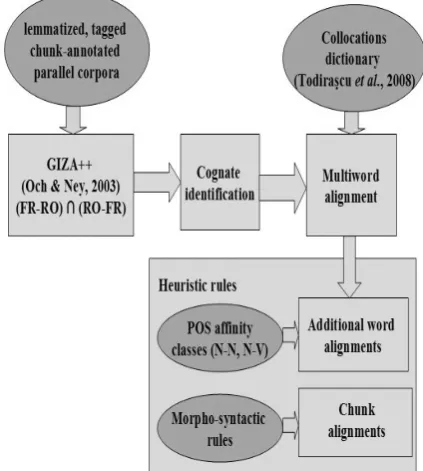
The cognate identification module is integrated in a French - Romanian lexical alignment system (see Figure 2).
In our lexical alignment method, we first use GIZA++ (Och and Ney, 2003) implementing IBM models (Brown et al., 1993). These models build word-based alignments from aligned sen-tences. Indeed, each source word has zero, one or more translation equivalents in the target lan-guage. As these models do not provide many-to-many alignments, we also use some heuristics (Koehn et al., 2003; Tufiş et al., 2005) to detect phrase-based alignments such as chunks: nomin-al, adjectivnomin-al, verbnomin-al, adverbial or prepositional phrases.
In our experiments, we use the lemmatized, tagged and annotated parallel corpus described in section 2. Thus, we use lemmas and morpho-syntactic properties to improve the lexical align-ment. Lemmas are followed by the two first cha-racters of morpho-syntactic tag. This operation morphologically disambiguates the lemmas (Tufiş et al., 2005). For example, the same French lemma change (=exchange, modify) can be a common noun or a verb: change_Nc vs.
change_Vm. This disambiguation procedure
im-proves the GIZA++ system’s performance. We realize bidirectional alignments (FR - RO and RO - FR) with GIZA++, and we intersect them (Koehn et al., 2003) to select common alignments.
To improve the word alignment results, we add an external list of cognates to the list of the trans-lation equivalents extracted by GIZA++. This list of cognates is built from parallel corpora by our own method (described in the next section). Also, to complete word alignments, we use a French - Romanian dictionary of verbo-nominal collocations (Todiraşcu et al., 2008). They represent multiword expressions, composed of words related by lexico-syntactic relations (Todiraşcu et al., 2008). The dictionary contains the most frequent verbo-nominal collocations extracted from legal corpora.
To augment the recall of the lexical alignment method, we apply a set of linguistically-motivated heuristic rules (Tufiş et al., 2005):
a) we define some POS affinity classes (a noun might be translated by a noun, a verb or an adjective);
b) we align content-words such as nouns, adjectives, verbs, and adverbs, according to the POS affinity classes;
c) we align chunks containing translation equivalents aligned in a previous step; d) we align elements belonging to chunks
by linguistic heuristics. We develop a language dependent module applying 27 morpho-syntactic contextual heuristic rules (Navlea and Todiraşcu, 2010). These rules are defined according to morpho-syntactic differences between French and Romanian.
The architecture of the lexical alignment system is presented in the Figure 2.
Figure 2 Lexical alignment system architecture
4 Cognate Identification Module
In our hybrid cognate identification method, we use the legal parallel corpus described in section 2. This corpus is tokenized, lemmatized, tagged, and sentence-aligned.
Thus, we consider as cognates bilingual word pairs respecting the linguistic conditions below:
1) their lemmas are translation equivalents in two parallel sentences;
2) they have identical lemmas or have or-thographic or phonetic similarities be-tween lemmas;
avoid ambiguous pairs such as lui ‘him’ (personal pronoun) (FR) vs. lui ‘s' (pos-sessive determiner) (RO), ce 'this' (de-monstrative determiner) (FR) vs. ce 'that' (relative pronoun) (RO).
To detect orthographic and phonetic similarities between cognates, we look at the beginning of the words and we ignore their endings.
We classify the French - Romanian cognates de-tected in the studied parallel corpus (at the ortho-graphic or phonetic level), in several categories:
1) cross-lingual invariants (numbers, cer-tain acronyms and abbreviations, punc-tuation signs);
2) identical cognates (document ‘document’ vs. document);
3) similar cognates:
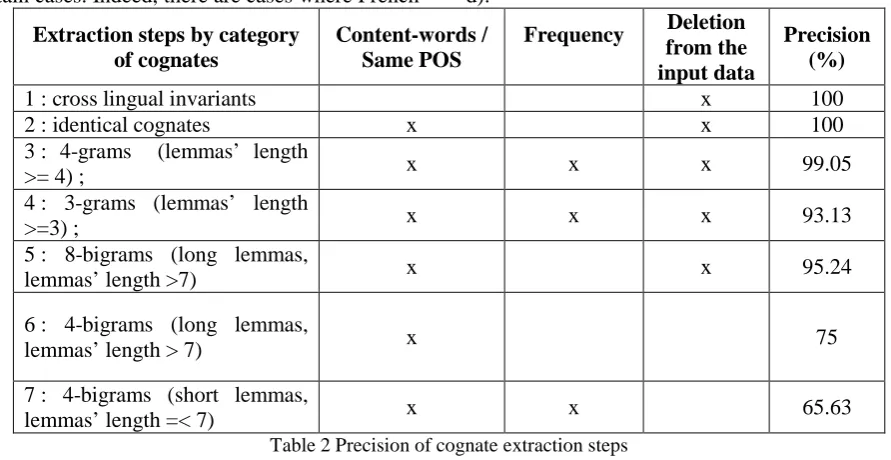
a) 4-grams (Simard et al., 1992); The first 4 characters of lemmas are identical. The length of these lemmas is greater than or equal to 4 (autorité vs. autoritate 'authority').
b) 3-grams; The first 3 characters of lemmas are identical and the length of the lemmas is greater than or equal to 3 (acte vs. act 'paper').
c) 8-bigrams; Lemmas have a common sequence of characters
among the first 8 bigrams. At least one character of each bi-gram is common to both words. This condition allows the jump of a non identical character (souscrire vs. subscrie 'submit'). This method applies only to long lemmas (length greater than 7). d) 4-bigrams; Lemmas have a
common sequence of characters among the 4 first bigrams. This method applies for long lemmas (length greater than 7)
(homolo-gué vs. omologat 'homologated')
but also for short lemmas (length less than or equal to 7) (groupe vs. grup 'group').
We iteratively extract cognates by identified cat-egories. In addition, we use a set of orthographic adjustments and some input data disambiguation strategies. We compute frequency for ambiguous candidates (the same source lemma occurs with several target candidates) and we keep the most frequent candidate. At each iteration, we delete reliable considered cognates from the input data. We start by applying a set of empirically estab-lished orthographic adjustments between French - Romanian lemmas, such as: diacritic removal, phonetic mappings detection, etc. (see Table 1).
Levels of orthographic adjustments French Romanian Examples FR - RO
diacritics x x dépôt - depozit
double contiguous letters x x rapport - raport
consonant groups ph
th dh cch ck cq ch ch
f [f] t [t] d [d] c [k] c [k] c [k]
ş [∫] c [k]
phase - fază méthode - metodă adhérent - aderent bacchante - bacantă stockage - stocare grecque - grec fiche - fişă chapitre - capitol
q q (final)
qu(+i) (medial) qu(+e) (medial) qu(+a) que (final)
c [k] c [k] c [k] c(+a) [k] c [k]
cinq - cinci
équilibre - echilibru marquer - marca qualité - calitate pratique - practică
intervocalic s v + s + v v + z + v présent - prezent
w w v wagon - vagon
y y i yaourt - iaurt
Table 1 French - Romanian cognate orthographic adjustments
While French uses an etymological writing and Romanian generally has a phonetic writing, we
We implemented these methods using ortho-graphically adjusted parallel corpus (see Table 1). Moreover, we evaluate 4-grams method on the initial parallel corpus and on the orthographi-cally adjusted parallel corpus to study the impact of orthographic adjustments step on the quality of the results.
These methods generally apply for words having at least 4 letters in order to decrease the noise of the results. Cognates are searched in aligned rallel sentences. Word characters are almost pa-rallel (rembourser vs. rambursare 'refund').
Methods P (%) R (%) F (%)
LCSR 44.13 58.95 50.47
DICE 56.47 60.91 58.61
4-grams 91.55 72.42 80.87
Our method 94.78 89.18 91.89
Table 3 Evaluation and methods’ comparison; P=Precision; R=Recall; F=F-measure
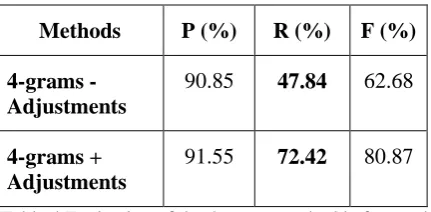
Our method extracted 1,814 correct cognates from 1,914 provided candidates. The method obtains the best scores (precision=94.78% ; re-call=89.18% ; f-measure=91.89%), in compari-son with the other implemented methods. The 4-grams method obtains a high precision (90.85%), but a low recall (47.84%). Orthographic adjust-ments step improves significantly the recall of 4-grams method with 24.58% (see Table 4). This result is due to the specific properties of the law parallel corpus. Indeed, many Romanian terms were borrowed from French and these terms present high orthographic similarities.
Methods P (%) R (%) F (%)
4-grams - Adjustments
90.85 47.84 62.68
4-grams + Adjustments
91.55 72.42 80.87
Table 4 Evaluation of the 4-grams method before and after orthographic adjustments step
However, our method extracts some ambiguous candidates such as numéro ‘number’ - nume
‘name’, compléter ‘complete’ - compune
‘com-pose’. Some of these errors were avoided by
keeping the most frequent candidate in the stu-died corpus. So, the remaining errors mainly concern hapax candidates.
Also, some cognates were not extracted: heure -
oră ‘hour’, semaine - săptămână ‘week’, lieu - loc ‘place’. These errors concern cognates
shar-ing very few orthographic similarities.
The lowest scores are obtained by the LCSR me-thod (f-measure=50.47%), followed by the DICE’s coefficient (f-measure=58.61%). These general methods provide a high noise due to the important orthographic similarities between the words having different meanings. Their results might be improved by combining statistical tech-niques with linguistic information such as POS affinity or by combining several association scores.
As we mentioned, the output of the cognate iden-tification module is exploited by a French - Ro-manian lexical alignment system (based on GI-ZA++) described in section 3. We compared the set of cognates provided by GIZA++ with our results to study their impact on cognate align-ment. GIZA++ extracted 1,532 cognates representing a recall of 75.32% (see Table 5). Our cognate identification module significantly improved the recall with 13.86%.
Systems
Number of extracted
cognates
Number of total cognates
Recall (%) GIZA++ 1,532
2,034
75.32 Our
method 1,814 89.18
Table 5 Improvement of our method’s recall
6 Conclusions and Further Work
Cognate identification module will be integrated in a French - Romanian lexical alignment sys-tem. This system is part of a larger project aim-ing to develop a factored phrase-based statistical machine translation system for French and Ro-manian.
References
George W. Adamson and Jillian Boreham. 1974. The use of an association measure based on character structure to identify semantically related pairs of words and document titles, Information Storage
and Retrieval, 10(7-8):253-260.
Chris Brew and David McKelvie. 1996. Word-pair ex-traction for lexicography, in Proceedings of
In-ternational Conference on New Methods in Natural Language Processing, Bilkent, Turkey, 45-55.
Peter F. Brown, Vincent J. Della Pietra, Stephen A. Della Pietra, and Robert L. Mercer. 1993. The ma-thematics of statistical machine translation: Para-meter estimation, Computational Linguistics, 19(2):263-312.
Nancy Ide and Jean Véronis. 1994. Multext (multilin-gual tools and corpora), in Proceedings of the 15th
International Conference on Computational Lin-guistics, CoLing 1994, Kyoto, pp. 90-96.
Diana Inkpen, Oana Frunză, and Grzegorz Kondrak. 2005. Automatic Identification of Cognates and False Friends in French and English, RANLP-2005, Bulgaria, Sept. RANLP-2005, p. 251-257.
Radu Ion. 2007. Metode de dezambiguizare semantică automată. Aplicaţii pentru limbile engleză şi română, Ph.D. Thesis, Romanian Academy, Bu-charest, May 2007, 148 pp.
Philipp Koehn, Franz J. Och, and Daniel Marcu. 2003. Statistical Phrase-Based Translation, in
Pro-ceedings of Human Language Technology Confe-rence of the North American Chapter of the Asso-ciation of Computational Linguistics, HLT-NAACL 2003, Edmonton, May-June 2003, pp. 48-54.
Grzegorz Kondrak. 2009. Identification of Cognates and Recurrent Sound Correspondences in Word Lists, in Traitement Automatique des Langues
(TAL), 50(2) :201-235.
Olivier Kraif. 1999. Identification des cognats et ali-gnement bi-textuel : une étude empirique, dans
Actes de la 6ème conférence annuelle sur le Trai-tement Automatique des Langues Naturelles, TALN 99, Cargèse, 12-17 juillet 1999, 205-214.
Dan I. Melamed. 1999. Bitext Maps and Alignment via Pattern Recognition, in Computational
Linguis-tics, 25(1):107-130.
Mirabela Navlea and Amalia Todiraşcu. 2010. Lin-guistic Resources for Factored Phrase-Based
Statis-tical Machine Translation Systems, in Proceedings
of the Workshop on Exploitation of Multilingual Resources and Tools for Central and (South) East-ern European Languages, 7th IntEast-ernational Confe-rence on Language Resources and Evaluation,
Malta, Valletta, May 2010, pp. 41-48.
Michael P. Oakes. 2000. Computer Estimation of Vo-cabulary in Protolanguage from Word Lists in Four Daughter Languages, in Journal of Quantitative
Linguistics, 7(3):233-243.
Franz J. Och and Hermann Ney. 2003. A Systematic Comparison of Various Statistical Alignment Models, in Computational Linguistics, 29(1):19-51.
Michel Simard, George Foster, and Pierre Isabelle. 1992. Using cognates to align sentences, in
Pro-ceedings of the Fourth International Conference on Theoretical and Methodological Issues in Machine Translation, Montréal, pp. 67-81.
Amalia Todiraşcu, Ulrich Heid, Dan Ştefănescu, Dan Tufiş, Christopher Gledhill, Marion Weller, and François Rousselot. 2008. Vers un dictionnaire de collocations multilingue, in Cahiers de
Linguis-tique, 33(1) :161-186, Louvain, août 2008.
Amalia Todiraşcu, Radu Ion, Mirabela Navlea, and Laurence Longo. 2011. French text preprocessing with TTL, in Proceedings of the Romanian
Acad-emy, Series A, Volume 12, Number 2/2011, pp.
151-158, Bucharest, Romania, June 2011, Roma-nian Academy Publishing House. ISSN 1454-9069.
Dan Tufiş and Ana Maria Barbu. 1997. A Reversible and Reusable Morpho-Lexical Description of Ro-manian, in Dan Tufiş and Poul Andersen (eds.),
Recent Advances in Romanian Language Technol-ogy, pp. 83-93, Editura Academiei Române,
Bucureşti, 1997. ISBN 973-27-0626-0.
Dan Tufiş, Radu Ion, Alexandru Ceauşu, and Dan
Ştefănescu. 2005. Combined Aligners, in
Proceed-ings of the Workshop on Building and Using Paral-lel Texts: Data-Driven Machine Translation and Beyond, pp. 107-110, Ann Arbor, USA,
Associa-tion for ComputaAssocia-tional Linguistics. ISBN 978-973-703-208-9.
Cristina Vertan and Monica Gavrilă. 2010. Multilin-gual applications for rich morphology language pairs, a case study on German Romanian, in Dan Tufiş and Corina Forăscu (eds.): Multilinguality
and Interoperability in Language Processing with Emphasis on Romanian, Romanian Academy
Pub-lishing House, Bucharest, pp. 448-460, ISBN 978-973-27-1972-5.
Robert A. Wagner and Michael J. Fischer. 1974. The String-to-String Correction Problem, Journal of the