Towards Multilingual Event Extraction Evaluation:
A Case Study for the Czech Language
Josef Steinberger DCSE, NTIS Centre, FAV University of West Bohemia
Univerzini 8, 306 14 Plzen Czech Republic
Hristo Tanev Joint Research Centre European Commission
via Fermi 2749, Ispra Italy
Abstract
This paper presents a multilingual corpus of news, annotated with event metadata in-formation. The events in our corpus are from the domain of violence, natural and man made disasters. The main goal of the corpus is automatic evaluation of event de-tection and extraction systems in different languages. As a use case, we take a rule-based event extraction system, extend it to cover a new language, Czech in our case, and evaluate it on the corpus. We explain what needs to be done to cover a new lan-guage, especially learning domain-specific dictionaries and event extraction patterns. The evaluation of the Czech system can be viewed as a starting point for further re-search into the evaluation of multilingual event extraction systems, which is an im-portant stage during the development of such systems. The comparison of the per-formance for the Czech and English sys-tems indicates the importance for multilin-gual event extraction evaluation.
1 Introduction
The quantity of information on Internet has reached a critical point. Simple keyword indexing cannot satisfy any more the need for fast and accu-rate access to this information ocean. In this light, the development of effective methods for informa-tion extracinforma-tion are of particular importance. In this paper we will discuss issues related to automatic event metadata extraction. Mainstream media and part of the social media are event-oriented, there-fore development of methods for accurate identi-fication, classification and extraction of metadata about events is of particular importance. Note-worthy, crisis events, such as natural, man-made disasters, crime and armed conflicts are the most
frequent types of events, described in online news and often referred to in social media.
Due to the complexity of the event extraction task, preparing a gold standard and evaluation of event extraction systems is not straightforward. Event annotation can be done in many different ways. Different taxonomies of event types can be used, as well as different event properties may be annotated. Moreover, one cannot give a sin-gle accuracy number, which characterizes an event extraction system performance. Rather than that, the accuracy for the extraction of each event prop-erty is measured separately. Even measuring the overlap between the gold standard and the output, produced by a system, can be done in different ways. Similarly, evaluating the similarity between event types, such asbombingandterrorist attack requires investigating into the nature of the events and the goals of the evaluation schema.
In this paper we make a small step into the in-finite field of problems and solutions which the evaluation of event extraction system poses in front of the researchers in the field of information extraction.
We propose an event annotation model which consists of a taxonomy for classification of cri-sis events, as well as a template model with their most important slots. Then, we present a multi-lingual corpus annotated according to this model. Finally, we describe semi-automatic acquisition of lingistic resources for event extraction in Czech language. We plug these resources into a state-of-the-art event metadata extraction system and then we evaluate the performance of the system, using the annotated event corpus. Clearly, our solution is just an island in the sea of possible annotation and evaluation schemas.
The rest of the paper is structured as follows: Section 2 reports about related work. Section 3 describes the event annotation model. Section 4 is about the creation of the corpus. Section 5
Violence-related event (upper level subclasses)
Politically motivated
Political execution Armed conflict Terrorist attack Anti-terrorist operation Assassination
Kidnapping/Hostage taking (political) Hostage release (political)
Military movements
Asylum/Fleeing a country for political reason Criminal
Robbery
Kidnapping/Hostage taking (criminal) Hostage release (criminal)
Shooting (criminal) Stabbing
Abusing/offending people Physical attack
Drug trade Vandalism Arson/Firebombing Piracy
Cyber attack Prison break Socio-political
Boycott/Strike Public demonstration Riot
Sabotage Mutiny Juridical
Arrest Charging Trial Execution Raid
Table 1: A part of the event taxonomy - violence-related events.
which were used, but also the motivation behind it and its context. While some event types may look similar, likeShootingas a subtype ofArmed con-flictandShootingas a criminal event, in our tax-onomy they are two different event classes, since the context and the motivation behind these ac-tions are different. In the armed conflict shoot-ing, the action is carried out by troops which serve their country, while in the criminal shoot-ing, the main actors are criminals, whose motiva-tion is to rob, to defend themselves from the po-lice, etc. In the same way, we make difference between politically-motivated executions, execu-tions by terrorists, and normal execuexecu-tions ordered by the court, without political motivations. Con-sideration of the motivation and the context is im-portant, since they can give birth to different par-ticipants, means in use and consequences from the events. On the other hand, it is difficult for an event extraction system to draw the line between
similar event classes. In order to overcome this last issue, during our experiments, we allowed for mapping of one class of the event extraction output to several classes from our model. For example, the event extraction system typeExecutionis con-sidered a correct match for any of the execution classes used in our model.
event of typeHostageRelease. In order to model this type of relations, the event ontology should encompass different types of relations, such as causesandsubevent-of. The upper level violence-related classes of our taxonomy are shown in table 1.
3.2 Event properties
The properties of the event types in our model are represented through a unified template, which fea-tures the union of the properties of all event types. This is a simplification, since in reality the three big event classes: Violent event, Natural disas-ter and Juridical event have different properties. Properties related to the participants of the events: dead, wounded, kidnapped, arrested, etc. are ac-tually pairs - specification of the participants, e.g. five peopleand their number, e.g. 5. The proper-ties template is shown on table 2.
Property Time Location
Dead count and specification Missing count and specification Wounded count and specification Perpetrator count and specification Kidnapped count and specification Arrested count and specification Weapons used
Table 2: The event properties template.
In addition, the model includes quantifiers where it is applicable. Examples:
• at least 20 people died (or not more than 20) =
20-• over 20 dead = 20+
• hudreds of injured = 100x
• around 100 people = 100˜
4 Creating multilingual corpus with annotated events
Annotating articles about same events in multiple languages gives us a possibility to evaluate a mul-tilingual event extraction system and the results are then directly comparable among languages. By comparing the results among languages, one
could analyse how different language properties affect the quality of template extraction. As we want to make our corpus available to the commu-nity, we selected Wikinews as the source of event-related articles, since its licence allows us to share the news.
As a first application of the multilingual cor-pus, we wanted to evaluate our system in a newly supported language, namely Czech. Because of that, our starting page was the Czech Wikinews site. We manually selected event-related articles. We selected only articles which were available for more languages (visible in the left bar of the Wikinews site).
As the coverage of Czech Wikinews is not that high we included articles from the Multiling’13 corpus1. For now, we included only Czech, En-glish and Spanish variants from the Multiling cor-pus.
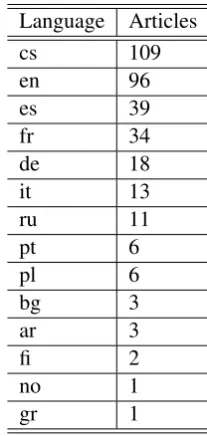
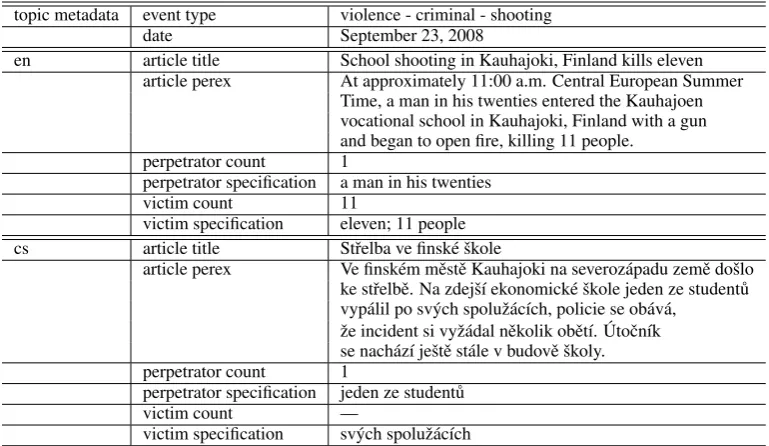
An example of an event topic with English and Czech data and annotation can be found in table 3. There are 109 topics in the corpus. Altogether, it includes 344 articles in 14 langauges. Distribu-tion of between languages is given in table 4.
Language Articles
cs 109
en 96
es 39
fr 34
de 18
it 13
ru 11
pt 6
pl 6
bg 3
ar 3
fi 2
no 1
gr 1
Table 4: Topics per language counts.
Most of the annotated news articles were avail-able both in Czech and English languages.
4.1 Statistics about event roles
Regarding the event slots, which are represented in the corpus, the predominant event-specific role 1A corpus created by the summarization community:
topic metadata event type violence - criminal - shooting
date September 23, 2008
en article title School shooting in Kauhajoki, Finland kills eleven article perex At approximately 11:00 a.m. Central European Summer
Time, a man in his twenties entered the Kauhajoen vocational school in Kauhajoki, Finland with a gun and began to open fire, killing 11 people.
perpetrator count 1
perpetrator specification a man in his twenties
victim count 11
victim specification eleven; 11 people
cs article title Stˇrelba ve finsk´e ˇskole
article perex Ve finsk´em mˇestˇe Kauhajoki na severoz´apadu zemˇe doˇslo ke stˇrelbˇe. Na zdejˇs´ı ekonomick´e ˇskole jeden ze student˚u vyp´alil po sv´ych spoluˇz´ac´ıch, policie se ob´av´a,
ˇze incident si vyˇz´adal nˇekolik obˇet´ı. ´Utoˇcn´ık se nach´az´ı jeˇstˇe st´ale v budovˇe ˇskoly. perpetrator count 1
perpetrator specification jeden ze student˚u
victim count —
victim specification sv´ych spoluˇz´ac´ıch
Table 3: An example of an annotated event topic.
for all the languages was found to be: victim, which includes dead, injured and kidnapped peo-ple. There are around 600 victims mentions (usu-ally they are mentioned in both title and the first paragraph). For Czech only we have found more than 110 victim mentions. 15 weapons mentioned - too little to provide a proper basis for evaluation; 73 perpetrator mentions; 64 arrested people men-tions; 37 sentenced people mentions.
We plan to extend the corpus with articles from English Wikinews and translate them to other lan-guages.2
5 Event extraction system and semi automatic acquisition of dictionaries for it
We created Czech dictionaries and a cascaded grammar for analysis of crisis events, as well as boolean combination of keywords for recognition of event types, which was then used in the multi-lingual event extraction system – NEXUS (Tanev et al., 2008).
5.1 NEXUS
NEXUS is a multilingual rule-based event ex-traction system, developed at the Joint Research Centre, EC, which extracts event metainformation from online news in several languages. NEXUS essentially performs two types of tasks: first, us-ing semantic grammar rules, backed up by domain 2The corpus will be available for download at
http://nlp.kiv.zcu.cz.
specific dictionaries, it identifies in the text a set of noun phrases, which are assigned certain semantic roles. For example, in the text The prime minis-ter was kidnapped by masked gunmen, the system will extract the prime ministeras kidnapped vic-tim and masked gunmen as perpetrators. More-over, the system classifies the events, based on combinations of keywords. In the previously men-tioned textgunmenandkidnappedwill trigger the event typekidnapping. In order to plug in a new language in our event extraction system, we im-plement new domain specific dictionaries, as well as keyword combinations for event classifications. The grammars in use are also changed, although between similar languages, the change is small. This is due to the fact that the linguistic knowl-edge is mostly encoded in the domain-specific dic-tionaries: for example, for English we have all the possible patterns for kill: was killed, have been killed, murdered,murdered by, etc. This solution puts a stress on the domain-specific dictionaries, which are usually large and therefore we use semi-automatic methods, in order to learn them.
5.2 Learning dictionaries and linguistic patterns
The dictionaries used by NEXUS are developed following a semi-automatic procedure described in (Tanev et al., 2009). For each dictionary, the following steps are performed:
2. It runs the LexiClass multilingual dictionary expansion tool which suggests more words and multiwords, distributionally similar to the seed set, ordered by their l similarity 3. The expanded dictionary is cleaned
manu-ally by looking at its top elements (which are most similar to the seed set)
For example, if the seed set are the English words: soldiers, policemen, security forces, the top elements from the expanded dictionary are troops, civilians, officers, personnel, militants, peacekeepers. A better description of the algo-rithm is provided in (Tanev et al., 2009) , where the precision of the algorithm for Portuguese was found to be 51% and for Spanish 71%. The al-gorithm is described also in (Tanev and Zavarella, 2013). Following the above-mentioned algo-rithm. we created the following Czech dictionar-ies, which are used by NEXUS: dictionary of noun phrases, referring to people and a dictionary of modifiers of these noun phrases. Moreover, we manually created a list of Czech numerals. These three resources were used in the first layer of the event-slot extraction grammar, which is responsi-ble for detection of references to people.
The second layer of the grammar detects pat-terns, which co-occur with the person references, found on the first level. These patterns express dif-ferent semantic roles which people take in the cri-sis event contexts: deadorwounded victim, per-petrator, etc. In order to discover the patterns, first we used the previously-described procedure to learn verbs and nouns, which introduce the con-sidered semantic roles. Then, we searched auto-matically in a corpus co-occurrence patterns be-tween these role-expressing words and references to people. A detailed description of the algorithm is provided in (Tanev et al., 2009). As an example, the output of the algorithm for English language for the semantic roledead victimwill be patterns likekilled [PERSON],[PERSON] was murdered, etc.
Using these algorithms, we acquired 270 person-referring nouns, 600 person modifiers and 250 patterns for dead, wounded, arrested, kid-napped and perpetrators.
5.3 Providing keyword combinations for event type detection
In our event extraction system, the event class, e.g. armed conflict,robbery, etc., are detected through
boolean combinations of keywords. We created these keyword combination mostly manually, us-ing in some cases the LexiCLass system.
6 Evaluation
6.1 Methodology
We have run the NEXUS event extraction system on the news from our annotated corpus and eval-uated the results. As NEXUS can currently detect only part of the event types in the corpus, we run the system only on the events, whose types are de-tectable by the system.
It is an important issue in the event extraction evaluation that the annotated event types and the detected by the system can differ in their speci-ficity. For example, if the annotation is suicide bombing and the system says terrorist attack, is that a correct match? Probably, it is appropri-ate to consider this as a correct hit. However, if the system says that the type isterrorist executing hostages and the annotation is suicide bombing, then the match should not be considered correct.
In our experiments, we adopted a simple solu-tion, which even if not perfect, provides a basis for evaluation of the event class detection. We simply mapped both annotated event types and the detected ones to event types, which were found to be specific enough, but not too specific, i.e. their taxonomy depth is somewhere in the middle. For example, all the daughter nodes ofsocio-political were mapped to this event type, the same for ter-rorist attack. Apart from the event type, we evalu-ated the following event participant properties:
• dead victim specification
• dead victim count
• wounded victim specification
• wounded victim count
• perpetrator spectification
• arrested spectification
matching, i.e. if the system finds a part of the spectification, it counts as a correct match. The obvious disadvantage is that we do not evaluate the completeness of the phrase detection, how-ever from a practical point of view, event a partial match is useful.
Another problem in front of evaluation of event extraction systems is matching the numbers of vic-tims. In some cases, the system may detect a num-ber which is close to the annotated numnum-ber. For example, if in the text there is the phrasemore than 100 died, the event extraction system may suggest 100 as number of dead. This is not correct, but again, from a practical point of view, it is better to have a rough estimation of the death toll, rather than having no estimation. In such cases, we con-sider the system output as correct.
6.2 Event type detection
75% of the events in the corpus could be mapped to NEXUS event types. The system classifies the event type with .38 precision and .60 recall (F is .46).
The easiest type is Shooting, the system cor-rectly classified all events. On the other side is Suicide bombing (a terrorist attack), which was most of the times wrongly classified as Explosion (a man-made disaster). The solution will be to make more complex patterns which would distin-guish these lexically similar event types.
A large corpus and a trainable classifier would be a good solution for event type detection, al-though distinguishing close event types would re-quire a very large number of countersamples.
6.3 Event roles detection
The system predicts an event property with .49 re-call and .85 precision (F is .63). It performs the best on predicting dead victim specifications (F is .80), the most difficult is perpetrator specification (F is .42). Counts of dead and wouded victims are predicted with F=.57 and F=.62. The complete re-sults are given in table 5.
6.4 Discussion
In 56% of the wrong predictions, the problem was in the grammar. An example:
CZ: Ozbrojenci se dostali do nigerijsk´e vˇeznice t´ım, ˇze odp´alili n´aloˇze a zabili pˇri pˇrestˇrelce jednoho str´aˇzce. EN: Gunmen entered a Nigerian prison by bombing their way inside and killing a guard during a shootout.
Property R P F
dead victim spectification .67 1 .80 dead victim count .48 .71 .57 wounded victim spectification .63 1 .77 wounded victim count .50 .80 .62 perpetrator spectification .29 .80 .42 arrested spectification .33 .75 .46
all .49 .85 .63
Table 5: Results of event roles detection for Czech.
The lexical resources contain both ozbrojenci = gunmen as a possible actor, zabili = killed as a pattern and jednoho str´aˇzce = a guard as another possible actor. The perpetrator patterns contain ‘[perpetrator-group] zabili [dead-group]’, however, the word spans between the pattern items does not allow to catch the pattern. A solution could be to allow larger gaps between the pattern items, but this can result in a lower precision.
In 44% of the wrong predictions, the lexical re-sources were missing the specification. Examples of missing complex person groups:
CZ-1: militantn´ı skupina al-ˇSabab spojen´a s al K´aidou EN-1: the militant group al-Shabab associated with al Qaeda CZ-2: program´ator otevˇren´eho software
EN-2: programmer of open software
The are several challenges connected to a rule-based approach and dealing with the Czech lan-guage. First, Czech has a free word order. The grammar patterns would need to capture all the following statements. In the following example, all the four sentences could be found in news:
CZ-1: Bombov´y ´utok zabil v lednu na moskevsk´em letiˇsti Domodˇedovo 36 lid´ı.
CZ-2: Bombov´y ´utok zabil na moskevsk´em letiˇsti Do-modˇedovo v lednu 36 lid´ı.
CZ-3: Bombov´y ´utok zabil 36 lid´ı na moskevsk´em letiˇsti Do-modˇedovo v lednu.
CZ-4: 36 lid´ı zabil bombov´y ´utok v lednu na moskevsk´em letiˇsti Domodˇedovo.
EN: The suicide bombing killed 36 people at the Moscow’s Domodedovo airport in January.
Then, an object can preseed a subject and a lex-ical form of the nouns cannot distinguish them. The system can thus wrongly exchange a victim and a perpetrator. In the following example, the following sentences are equal and the roles can be distiguished only by their case, not by the position.
Hristo Tanev, Jakub Piskorski, and Martin Atkinson. 2008. Real-time news event extraction for global crisis monitoring. In Natural Language and Infor-mation Systems, pages 207–218. Springer.
Hristo Tanev, Vanni Zavarella, Jens Linge, Mijail Kabadjov, Jakub Piskorski, Martin Atkinson, and Ralf Steinberger. 2009. Exploiting machine learn-ing techniques to build an event extraction system for portuguese and spanish. Linguam´atica, 1(2):55– 66.
Veronika Vincze, Gy¨orgy Szarvas, Rich´ard Farkas, Gy¨orgy M´ora, and J´anos Csirik. 2008. The bio-scope corpus: biomedical texts annotated for uncer-tainty, negation and their scopes. BMC bioinformat-ics, 9(Suppl 11):S9.
Roman Yangarber and Ralph Grishman. 1998. Nyu: Description of the proteus/pet system as used for muc-7. InIn Proceedings of the Seventh Message
Understanding Conference (MUC-7. Citeseer.
Roman Yangarber, Ralph Grishman, Pasi Tapanainen, and Silja Huttunen. 2000. Automatic acquisition of domain knowledge for information extraction. In
Proceedings of the 18th conference on
Computa-tional linguistics-Volume 2, pages 940–946.