Domain Adaptation for Parsing
Eric Baucom
Indiana University Bloomington, IN, USA [email protected]
Levi King
Indiana University Bloomington, IN, USA [email protected]
Sandra K ¨ubler
Indiana University Bloomington, IN, USA [email protected]
Abstract
We compare two different methods in domain adaptation applied to constituent parsing: parser combination and co-training, each used to transfer information from the source domain of news to the tar-get domain of natural dialogs, in a set-ting without annotated data. Both methods outperform the baselines and reach similar results. Parser combination profits most from the large amounts of training data combined with a robust probability model. Co-training, in contrast, relies on a small set of higher quality data.
1 Introduction
Research on parsing has mostly concentrated on parsing the Penn Treebank (Marcus et al., 1993). As a consequence, most parsers have probability models that are optimized for the syntactic an-notations in this treebank and more generally for the language in the treebank. This means that a parser trained on the Penn Treebank will show a severe degradation in performance when used for parsing data from another domain (McClosky et al., 2010). More recently, research has started on adapting parsers to new domains so that the degra-dation in parsing is minimized. One of the first venues at which domain adaptation was targeted was the 2007 CoNLL shared task on dependency parsing (Nivre et al., 2007).
One of the challenges in domain adaptation for parsing is the lack of annotated data in the target domain. Research has covered a range of differ-ent approaches, all geared towards providing auto-matically labeled data in the target domain to add as training data. Approaches include ensembles of parsers, self-training, and methods for selecting high quality sentences to reduce the noise (see sec-tion 2 for details). The most promising approach at
present is an approach by McClosky et al. (2010), which automatically selects a domain that is the most similar to the target domain.
In our current work, we investigate domain adaptation for constituent parsing, in a setting where no labeled data in the target domain is avail-able. More specifically, we compare two differ-ent approaches: One approach is based on an en-semble of parsers, the other one uses co-training with two different parsers. Both approaches reach moderate improvements over the baseline, and we are interested in seeing the advantages and disad-vantages of those two promising methods. The source domain for our experiments is the Penn Treebank; the target domain consists of sponta-neous dialogs based on cooperative tasks involv-ing navigation on a map or in a search envi-ronment. For the unlabeled target domain data, we use the Edinburgh Map Task (HCRC) corpus (Thompson et al., 1996), and the Indiana Cooper-ative Remote Search Task (CReST) corpus (Eber-hard et al., 2010) as test set.
The remainder of the paper is structured as fol-lows: In section 2, we discuss related work. Sec-tion 3 introduces the two methods that we will compare, and section 4 describes the experimen-tal setup. In section 5, we first discuss the results of the individual approaches, and then attempt a comparison and an error analysis. In section 6, we conclude and describe future work.
2 Related Work
Domain adaptation can be divided into two differ-ent scenarios: one where a small set of annotated data from the target domain is available, and one where no annotated target data is available. Early work on domain adaptation for parsing shows that not having target domain data makes the task ex-tremely challenging: In the CoNLL 2007 shared task on dependency parsing (Nivre et al., 2007), no team submitting results for the out-of-domain
setting improved much over the baseline. Dredze et al. (2007), for example, presented three ap-proaches to domain adaptation: modifications to the feature set, using a parser ensemble, and target focused learning, but they reached the best results by using all the available data. The best perform-ing system (Sagae and Tsujii, 2007) used a combi-nation of two different models of an LR parser and then selected identically parsed target sentences to add to the training set of the final parser. This ap-proach outperformed the baseline of Dredze et al. (2007) by approximately 1%.
McClosky et al. (2006) use self-training in com-bination with a PCFG parser and reranking. They train the parser and reranker on the Penn Treebank, then parse and rerank a small set of target domain data. They reach an error reduction of 28% in the target domain. However, Sagae (2010) shows that while the reranking approach by McClosky et al. (2006) reaches higher F-scores than a self-training approach without reranking, the latter actually per-forms better in a semantic role labeling task.
Reichart and Rappoport (2007), in contrast, use a small annotated data set in the target domain for self-training without reranking. I.e., they train the parser on their small target domain data set and then perform self-training on more unlabeled data. They evaluate their parser in terms of annotation cost, and they show a 50% reduction in annotation cost.
Chen et al. (2008) work on domain adaptation without labeled target data: They parse the target data with a dependency parser. But rather than using the full parses as additional training data, they only add short-distance dependencies, which can be parsed more reliably. They gain approx. 1% over adding all sentences in Chinese. Kawa-hara and Uchimoto (2008) use a similar approach: They train a classifier to recognize reliably parsed sentences to add to the training set. This method outperforms the source domain baseline as well as all CoNLL 2007 systems by approx. 1%.
Finkel and Manning (2009) extend the work by Daume III (2007), who investigated a method for selecting general features that hold across do-mains. Finkel and Manning (2009) apply this method to dependency parsing, by using a hier-archical Bayesian model. They show an improve-ment of their approach over training on data from all domains in 4 out of 6 domains.
McClosky et al. (2010) investigate the auto-matic selection of source domains that are use-ful for parsing a target domain. Thus, the parser can adapt per document to a new target domain. They use different similarity metrics to determine the similarity of different source domains to the target domain and feed those into a regression model. They show that their model outperforms self-training, a uniform model as well as the best single domain for training selected by an oracle.
Miceli Barone and Attardi (2012) perform do-main adaptation for dependency parsing using unannotated data. They integrate a transductive SVM as classifier, which can handle labeled and unlabeled examples as training data, into a shift-reduce dependency parser. They also reach an im-provement in the area of 1% on Italian.
This overview shows that most work concen-trates on domain adaptation when no annotated data in the target domain is available or when the target domain is unknown. Our work also focuses on a scenario where there is only unlabeled target domain data available. We compare co-training, a method that has not been used successfully for do-main adaptation in parsing before, and a simpler approach based on an ensemble of three different parsers.
3 Domain Adaptation Methods
3.1 Parser Combination
A simple way of creating additional, labeled train-ing data in a new domain is to use an ensemble of parsers and then select the sentences on which the parsers agree. This parser combination method takes advantage of the different biases built into different parsing algorithms; agreement between parsers should translate into a greater likelihood that the agreed upon parse will be correct.
In practice, the ensemble of parsers is trained on an available annotated data set in the source domain, i.e., the Penn Treebank (PTB) for pars-ing. They are then used to parse a corpus of unan-notated data in the target domain. The sentences from the unannotated target domain on which the parsers agree are added to the original source do-main gold-standard annotated data, and one (or more) parser is retrained on the resulting union.
task of parsing by retraining with agreed upon parses from only a part of the ensemble as well as with partial trees. This will lead to more training data, though potentially of a lower quality.
3.2 Co-Training
Co-training, as proposed by Blum and Mitchell (1998), is a semi-supervised machine learning ap-proach that uses two different “views” of the data to train two specialized classifiers, which provide additional training data for each other. In co-training for domain adaptation of parsers, we fol-low Goldman and Zhou (2000) in assuming two different parsers rather than two different feature sets. In other words, the different views come from two parsers built on different parsing algo-rithms, i.e., with different biases. The source-trained parsers are used to parse the unlabeled tar-get data, providing a confidence score with each parse. The parsers each parse sentences from a pool of m randomly selected sentences from the set of unlabeled target domain data. The output of each parser is ranked by confidence scores, and the n-best parsed sentences from each parser are added to the original training data for the next cy-cle. Then the set of sentences is replenished from the unlabeled data set. This process is repeated until no further improvement on the development set is observed. Because the parsers have different algorithms and, theoretically, different strengths, each should be able to learn from highly-confident training data provided by the other.
4 Experimental Setup
4.1 Data Sets
We use the following data sets: The Penn Tree-bank (PTB) (Marcus et al., 1993) serves as the training set from the source domain. The PTB training files were modified to remove any gram-matical functions not present in our target domain (see below). All experiments use either sections 2-11 (as in the 2007 CoNLL shared task on domain adaptation), or sections 2-21 (the standard training set for parsing).
Our target domain is dialog text taken from cooperative map tasks. The test corpus consists of Cooperative Remote Search Task (CReST) di-alogs, in which a searcher collects and deposits items throughout a search location (a series of connected offices) at the guidance of a director, who has a map of the location and communicates
instructions remotely by mobile telephone. The original CReST corpus contains a small number of novel tags to handle phenomena that are com-mon in dialog data but not in newspaper text, such as imperative verbs. These tags were converted to their closest equivalents in the PTB tagset. The syntactic annotation of the CReST corpus includes constituent and dependency annotations. We use the constituent annotation, which follows the PTB annotation (Santorini, 1991). In contrast to the PTB, the CReST annotations use a subset of the grammatical functions from the Penn Treebank: subject, predicate, location, direction, and tempo-ral modifications. For our experiments, 5 dialogs (1 137 sentences) of the CReST corpus were re-served for development, and 18 dialogs (4 518 sen-tences) were used as the test set.
The Human Communication Research Center Map Task Corpus (HCRC, also known as the Edin-burgh Map Task) (Thompson et al., 1996) is used as the unlabeled target domain set. HCRC con-sists of 128 dialogs. In each dialog, both partic-ipants had a map of the same area, but the maps differed in the landmarks featured in given loca-tions, and participants could not see their partners’ maps. One map included a route, and the holder of that map was asked to verbally guide the other par-ticipant to redraw the route on his or her map. We ignore all annotations in the corpus and only use the transcribed sentences. The full corpus contains 27 084 sentences. When one-word sentences are removed (as described below), 18 738 sentences remain. Note that this corpus shares many char-acteristics with the CReST corpus, but there are differences in the domain: the environments, land-marks, and the task itself are different, and in HCRC, neither participant is physically present in the mapped location. Furthermore, dialectal dif-ferences exist, in that 61 of the 64 HCRC partici-pants were from the Glasgow, Scotland area, while the 46 CReST participants were from the US.
4.2 Parsers
Both experiments use the Berkeley Parser (Petrov et al., 2006). For parser combination, we also use the Bikel Parser (Bikel, 2004) and LoPar (Schmid, 2000), and for co-training, the Stanford Parser (Klein and Manning, 2003).
parser performs split-merge cycles on the train-ing data to automatically induce a PCFG with op-timized syntactic categories. Collins’ model 2 (Collins, 1997) is a generative model based on bigram probabilities, dependencies between pairs of words, as well as sub-categorization frames for head-words. LoPar was used in concert with these two parsers for the parser combination ex-periments due to its human accessible grammar files: rule counts can be directly modified and new rules added to the LoPar grammar. Thus, we can add partially agreeing sentences, in the form of in-dividual rules, from the HCRC data. For the co-training experiments, we used the Stanford parser instead of Bikel’s because the co-training exper-iments require the parsers to generate confidence scores for each parse. The Berkeley parser pro-duces such scores, Bikel’s does not. The Berkeley parser’s training was limited to 5 split-merge cy-cles in order to avoid overfitting to the PTB.
In all experiments, sentences longer than 40 words were excluded from training and testing. All parsers were trained on the source domain training sets of PTB sections 2-11 and 2-21. All experiments use gold POS tags for the PTB and CReST. HCRC is tagged with TnT (Brants, 2000), trained on the full PTB.
4.3 Parser Combination
The three parsers were used to parse the HCRC corpus. Agreement among the three was deter-mined by bracketing alone (unlabeled condition), and bracketing along with node labels (labeled condition). For the unlabeled condition, the labels to add to training are simply taken from the parser with the highest overall baseline, i.e. Berkeley.
LoPar alone was chosen as our test parser for the experiments that involve adding agreeing rules directly to the training. For the other experiments, we also used the Berkeley parser and Bikel’s parser as final parsers.
4.4 Co-Training
For co-training, the value of thenbest sentences added to the training set per cycle was chosen be-tween 20 and 500, and a minimum of four co-training cycles were performed. The size of the pool of randomly selected sentences to parse, m, was chosen from values ranging from 250 to 1500. Optimal combinations of n and m were deter-mined by a non-exhaustive search on the PTB 2-11 training set and the CReST development set. The
optimal values for nand m were found to be 20 and 500, respectively. Then, we repeated the ex-periment with the PTB 2-21 training set.
We used a single training set for both parsers; i.e., after each cycle, the n-best parsed sentences from each parser were added to a common train-ing set, rather than passed to a unique traintrain-ing set for the opposite parser. Initial experiments showed that the set of n-best ranked sentences was comprised almost entirely of single-word sen-tences, leading to a decrease in performance from the baselines. Consequently, we removed all one-word sentences from the raw target domain data.
4.5 Evaluation
For evaluation, we used the standard evalb soft-ware1and report F1-scores, based on labeled pre-cision and recall. We performed significance tests using Dan Bikel’s Randomized Parsing Evaluation Comparator2.
5 Results
5.1 Parser Combination
For the experiments on parser combination, we report three baselines, one baseline per parser. Then, we investigate agreement across 3 parsers and across 2 parsers.
Agreement across 3 parsers. Here, we report results for the following experiments:
1. SENTLAB adds HCRC sentences on which the 3 parsers agree on labeled analyses.
2. SENTUNLAB adds HCRC sentences on which the 3 parsers agree on bracketing but not necessarily on labels.
3. RULES adds individual context free rules to training on which the 3 parsers agree.
The third condition can only be used with LoPar as the final parser, the other two conditions are used in combination with each parser.
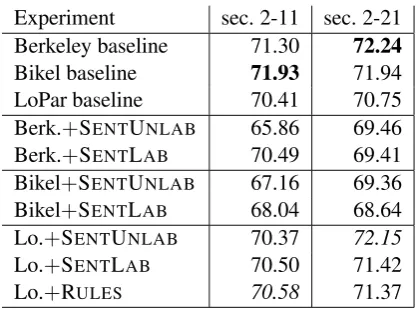
In table 1, we present the results for these ex-periments. We also experimented with conditions where we removed one-word HCRC sentences from the additional training data. However, the F-scores with one-word sentences removed were very close to their counterparts, if not somewhat lower. For this reason, we do not report them.
1http://nlp.cs.nyu.edu/evalb/ 2
Experiment sec. 2-11 sec. 2-21 Berkeley baseline 71.30 72.24
Bikel baseline 71.93 71.94 LoPar baseline 70.41 70.75 Berk.+SENTUNLAB 65.86 69.46 Berk.+SENTLAB 70.49 69.41 Bikel+SENTUNLAB 67.16 69.36 Bikel+SENTLAB 68.04 68.64
Lo.+SENTUNLAB 70.37 72.15 Lo.+SENTLAB 70.50 71.42 Lo.+RULES 70.58 71.37 Table 1: Results of the parser combination on the CReST test set (F1). We report labeled F1.
The results show that the baseline parsers profit only marginally from the larger training set in the second column. Note that the results are lower than normally reported for in-domain pars-ing. This is due to the fact that the two domains are very different. LoPar performs lower than its two counterparts, the Berkeley parser and Bikel’s, as is expected, since it is a PCFG parser with a straightforward probability model.
When we add the training data from HCRC to the source training, both the Berkeley parser and Bikel’s parser degrade in performance while LoPar’s performance increases over its baseline. A major source of error lies in CReST’s many one-word sentences: 1 638 out of 4 518. In CReST, the vast majority (1 580) of the one-word sentence parses have INTJ as the unary node. The ex-tended grammars used by LoPar closely matches this distribution, with a majority of the one-word sentence parses being dominated by the INTJ
unary node. The Berkeley and Bikel parsers, in contrast, have a strong preference to label the unary nodes asFRAG. Despite being trained on the same additional data, LoPar is not as subject to this errant distribution. This may be due to the fact that the probability models in the Berkeley and Bikel parsers are more finely tuned to the PTB and thus more brittle to noisy data, whereas LoPar uses a simpler model and is more robust.
For LoPar, providing additional training data from HCRC in all 3 variants improves the F-scores by a small margin over its baseline, with only one exception: In the experiment where we train LoPar on the small training set and add all sentences on which all three parsers agree, we see a small loss in the F-score. The second trend that can be
ob-served is that LoPar trained on the large source domain data set profits more from the additional target domain data than when it is trained on the smaller source domain set.
The best performing condition given the small source domain training set is the one in which we add individual rules, RULES. Given the larger source domain training set, the best performing condition is the one using sentences with un-labeled agreement, SENTUNLAB. Thus, if the parser has a solid, large grammar from the source domain, it can use the large but noisy addition to its grammar while the smaller source domain grammar requires more high quality additions. In the setting with the small source domain gram-mar, RULES adds 8 966 additional rules, SENT -LAB adds 3 135 rules, and SENTUNLAB adds 25 764 rules. However, note that even the best per-forming LoPar variant cannot outperform the re-sults by the Berkeley baseline (or the Bikel base-line, in the setting with the smaller source domain training set).
Agreement across 2 parsers. We now turn to the experiments with enforced agreement based on a dyad of parsers. In table 2, we present results from the experiments with the relaxed condition, for each possible dyad of parsers, combined with LoPar as the final parser. We also retrained the Berkeley and the Bikel parser on the extended data sets, but the results were far below the ones for LoPar. This is interesting in itself because LoPar, as the weakest baseline parser, is capable of prof-iting the most from the additional target domain data. We assume that this is a consequence of LoPar’s simple, but robust probability model.
The best performer for both sizes of source domain data is the combination of the Berkeley parser and Bikel’s in the unlabeled sentence condi-tion (BERKELEY/BIKELSENTUNLAB), which is
addi-Experiment F1(sec. 2-11) F1 (sec. 2-21)
Berkeley baseline 71.30 72.24
Bikel baseline 71.93 71.94
LoPar baseline 70.41 70.75
LoPar+BERKELEY/BIKELSENTLAB 71.26 72.77† LoPar+BERKELEY/LOPARSENTLAB 70.51 71.36 LoPar+BIKEL/LOPARSENTLAB 70.15 71.10
LoPar+BERKELEY/BIKELSENTUNLAB 73.41† 73.66†
LoPar+BERKELEY/LOPARSENTUNLAB 70.43 72.22 LoPar+BIKEL/LOPARSENTUNLAB 72.87‡ 73.29†
LoPar+BERKELEY/BIKELRULES 71.52 72.22 LoPar+BERKELEY/LOPARRULES 70.62 71.20 LoPar+BIKEL/LOPARRULES 70.49 71.35
Table 2: Results for LoPar with HCRC training, based on 2 parsers, on the CReST test set.†=significance atp <0.001over the best performing baseline,‡atp < 0.005.
tional training data boosts LoPar’s accuracy to im-prove over both the Berkeley and the Bikel base-lines. We also see that in this condition, there is only a minimal difference between the small and the large source domain training set.
We also looked at the influence of quantity of (additional) training data on the results. In gen-eral, more training data leads to better results. As expected, PTB sections 2-21 perform better than sections 2-11, but as more and more data is added, the results converge, leading us to the conclusion that as more reliable target domain training data is available, the size of the initial source domain training set becomes less important. However, there must be a critical mass of additional train-ing data before results start to improve, with more data required for a smaller source domain train-ing set. This might suggest that the other parser combinations may not have resulted in this critical mass; in other words, that the HCRC corpus may be too small as a target domain data set given a parser combination setting.
5.2 Co-Training
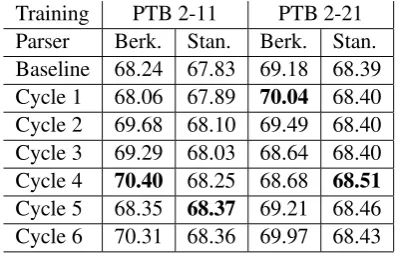
In the co-training setting, the additional training set is produced by two individual parsers, the Berkeley and Stanford parser. The selection of re-liable sentences is based on parser confidence val-ues, i.e., the probabilities associated with parses. The additional sentences are added in cycles. We stopped the co-training process after 10 cycles. The results on the CReST development set for 6 cycles are given in Table 3.
The results show that both parsers reach lower
Training PTB 2-11 PTB 2-21 Parser Berk. Stan. Berk. Stan. Baseline 68.24 67.83 69.18 68.39 Cycle 1 68.06 67.89 70.04 68.40 Cycle 2 69.68 68.10 69.49 68.40 Cycle 3 69.29 68.03 68.64 68.40 Cycle 4 70.40 68.25 68.68 68.51
Cycle 5 68.35 68.37 69.21 68.46 Cycle 6 70.31 68.36 69.97 68.43
Table 3: F-scores for 6 cycles (development data).
baseline results on the development set than in parser combination. It is also obvious the Berke-ley parser outperforms the Stanford parser and that the larger, source domain training set has only a minimal effect on parser accuracy.
For the smaller training set, the Berkeley parser reached optimal results in the fourth co-training cycle and the Stanford parser in the fifth cycle. Withnset at 20, these scores represent the addi-tion of 160 and 200 target domain sentences to the training set, respectively. For the larger training set, the Berkeley parser reached optimal perfor-mance in the first cycle, and the Stanford parser in the fourth cycle, meaning 20 and 160 sentences were added, respectively.
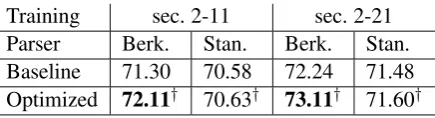
Training sec. 2-11 sec. 2-21 Parser Berk. Stan. Berk. Stan. Baseline 71.30 70.58 72.24 71.48 Optimized 72.11† 70.63† 73.11† 71.60†
Table 4: F-scores for co-training on the test set. †=significance atp <0.001over the baseline.
scores saw significantly higher improvements; the greatest improvement overall came from the com-bination of Berkeley and PTB 2-11, which rose from a baseline of 68.24 to 70.40 in the fourth cy-cle. The best results on the test set, for both PTB training sizes, are reached by the Berkeley parser, with an F-score of 72.11 given the small training set and an F-score of 73.11 given the larger train-ing set. The results are surpristrain-ing given that only a very small number of target domain sentences was added to the source domain training set.
5.3 Discussion
We are now in a position to compare the results of the two domain adaptation methods. A first com-parison shows that both methods reach a similar performance: Given the larger PTB training set, the parser combination method reaches an F-score of 73.66 while co-training reaches 73.11. How-ever, these results are obtained by different parsers and by training on different amounts of target do-main training sentences: While the parser combi-nation approach reaches the highest results based on using LoPar, co-training favors the Berkeley parser. And while parser combination adds 15 200 sentences from the HCRC corpus (including one-word sentences), the best co-training results are reached by adding only 20 sentences. Also, the best performing parser combination took approx-imately 3.5 hours while the best performing co-training experiment (which took only 1 cycle) re-quired 2.5 hours on the same cluster.
Error analysis. In examining the results of our two approaches, unsurprisingly, we found that a large proportion of the errors are related to the considerable differences between the source and target domain. Newspaper text is more formal than spontaneous dialogs. Moreover, some phenomena that occur frequently in CReST are absent or rare in the PTB training data. For example, sentence-initial “and” is a prominent feature of CReST, but naturally, not so frequent in the PTB. There are
no sentences that begin with “and” in the train-ing set, which makes them a challenge for the parsers. Thus, in our best co-training experiment, the Berkeley parser relied heavily on the genericX
label. However, this label is not used in this con-text in the gold standard. Notably, the distribution of these labels in the Stanford parses as well as in the parser combination parses is similar to that of the gold standard. However, all parse models have a tendency to assume such sentences are fragmen-tary and thus should be grouped under theFRAG
label.
In general, fragmentary cases, which are abun-dant in CReST, are difficult for parsers to learn since they often require global information to de-cide that a constituent is incomplete. All parsers tend to either posit an extra element FRAGwhere there should be none, or omit it when it should be there. This can have a devastating effect on the F-scores of short sentences, which are extremely frequent in CReST.
6 Conclusion and Future Work
We performed domain adaptation for constituent parsing using two different methods. Our target domain consists of spontaneous dialogues involv-ing collaboration between speakers. In the com-parison of parser combination versus co-training, both methods outperform their respective base-lines, and they reach a similar performance on the test set. We can conclude that the best parser com-bination adds more target domain sentences to the source domain training set while the co-training technique is faster. Potentially, LoPar could also profit from the small number of sentences chosen in the co-training experiment, but we assume that their number is too small to have an effect on the rather robust probability model.
For the future, we are planning to extend our ex-periments: First, we are planning to add the Stan-ford parser to the parser combination experiments. Then, we will use both domain adaptation meth-ods for dependency parsing. Since both the Penn Treebank and CReST are available in dependency format, we can perform these experiments on the same data sets.
Acknowledgment
Kenji Sagae. 2010. Self-training without reranking for parser domain adaptation and its impact on semantic
role labeling. InProceedings of the 2010 Workshop
on Domain Adaptation for Natural Language Pro-cessing, pages 37–44, Uppsala, Sweden.
Beatrice Santorini. 1991. Bracketing guidelines for the Penn Treebank Project. Department of Computer and Information Science, University of Pennsylva-nia.
Helmut Schmid. 2000. LoPar: Design and implemen-tation. Technical report, Universit¨at Stuttgart.
Henry Thompson, Anne Anderson, Ellen Gurman Bard, Gwyneth Doherty-Sneddon, Alison New-lands, and Cathy Sotillo. 1996. The HCRC Map Task Corpus: Natural dialogue for speech
recogni-tion. InProceedings of the ARPA Human Language
Technology Workshop, Plainsboro, NJ.
Hans van Halteren, Walter Daelemans, and Jakub
Za-vrel. 2001. Improving accuracy in word class