Computational Linguistics and Chinese Language Processing
Vol. 21, No. 1, June 2016, pp. 69-90 69 The Association for Computational Linguistics and Chinese Language Processing
Identifying the Names of Complex Search Tasks with
Task-Related Entities
Ting-Xuan Wang
and Wen-Hsiang Lu
Abstract
Conventional search engines usually consider a search query corresponding only to a simple task. Nevertheless, due to the explosive growth of web usage in recent years, more and more queries are driven by complex tasks. A complex task may consist of multiple sub-tasks. To accomplish a complex task, users may need to obtain information of various task-related entities corresponding to the sub-tasks. Users usually have to issue a series of queries for each entity during searching a complex search task. For example, the complex task “travel to Beijing” may involve several task-related entities, such as “hotel room,” “flight tickets,” and “maps”. Understanding complex tasks with task-related entities can allow a search engine to suggest integrated search results for each sub-task simultaneously. To understand and improve user behavior when searching a complex task, we propose an entity-driven complex task model (ECTM) based on exploiting microblogs and query logs. Experimental results show that our ECTM is effective in identifying the comprehensive task-related entities for a complex task and generates good quality complex task names based on the identified task-related entities.
Keywords: Complex Search Task, Task Name Identification, Task-related Entity.
1.
Introduction
Conventional search engines usually consider single queries corresponding only to a simple search need. In reality, however, more and more queries are driven by complex search tasks (Guo & Agichtein, 2010; Jones & Klinkner, 2008). Generally, a real-life complex search task usually has more than one sub-task to be accomplished. Therefore, users usually cannot accomplish a complex search task by submitting only a single query. Some researchers have worked to try to identify sub-tasks in order to help users deal with complex search tasks (Tan
Departmenr of Computer Science and Information Engineering, National Cheng Kung University, Tainan, Taiwan
70 Ting-Xuan Wang and Wen-Hsiang Lu
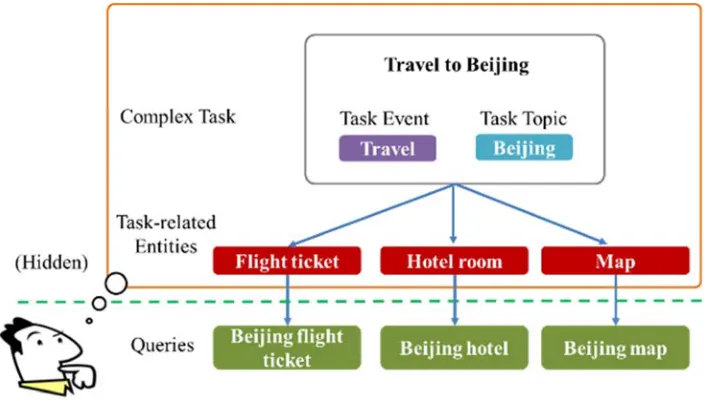
et al., 2006; MacKay et al., 2008; Ji et al., 2011; Kotov et al., 2011; Yamamoto et al., 2012). Nevertheless, only identifying sub-tasks in a complex search task is not sufficient to help users who want to search the complex task name directly e.g., “北京旅遊 (travel to Beijing)”. Understanding complex task names for complex search tasks can help search engines deal with complex-task-based queries. A complex search task can be represented by a task event and a task topic. For example, as shown in Figure 1, a complex task “travel to Beijing,” which is composed of a task topic “Beijing” and a task event “travel,” has at least three sub-tasks, including “book flight ticket,” “reserve hotel room,” and “survey maps”. Users need to issue at least three queries for each sub-task including “Beijing flight ticket,” “Beijing hotel,” and “Beijing map”. The queries targeting a sub-task usually focus on a task-related entity, such as “flight ticket,” “hotel room,” and “maps”. Therefore, understanding task-related entities is very important for a complex task and can help search engines provide integrated search results containing a variety of information of distinct task-related entities.
Figure 1. The structure of a complex task with task-related entities and search queries.
When users search for a complex task, we have found the users often have a task event that triggers the users to perform exploratory or comparative search behaviors, such as “prepare something,” “buy something,” or “travel somewhere”. Furthermore, the search behaviors are usually around a certain task topic that is the subject of interest in the complex task. Users may describe the task event and task topic of their complex task with various task-related entities in microblogs, e.g., Twitter or Weibo1
. Microblogs are a miniature version
1
72 Ting-Xuan Wang and Wen-Hsiang Lu
tasks. Guo and Agichtein (2010) investigated the hierarchical structure of a search task with a series of search actions based on search sessions. Agichetin et al. (2012) conducted a comprehensive analysis of search tasks and classified them based on several aspects, such as intent, motivation, complexity, work-or-fun, time-sensitive, and continued-or-not. Beeferman and Berger (2000) proposed a graph-based iterative approach to clustering query logs. Wen et al. (2001) clustered similar queries based on query content and document clicks. Cui et al. (2011) grouped search queries from a click-through log with similar search tasks using the random walk method. Unfortunately, exploring only the query content and click-through information for query clustering may not obtain precise results since queries usually are short and ambiguous. Note that the above works only focus on single-goal task discovery, while our work focuses on identifying a complex task with relevant sub-tasks over a series of sessions.
Cross-session task prediction: Kotov et al. (2011) noticed that a complex task may require a user to issue a series of queries, spanning a long period of time and multiple search sessions. Thus, they addressed the problem of modeling and analyzing complex cross-session search tasks. Lucchese et al. (2011) tried to identify task-based sessions in query logs by semantic-based features extracted from Wiktionary and Wikipedia to overcome a lack of semantic information. Ji et al. (2011) proposed a graph-based regularization algorithm to predict popular search tasks and simultaneously classify queries and web pages by building two content-based classifiers. White et al. (2013) improved the traditional personalization methods for search-result re-ranking by exploiting similar tasks from other users to re-rank search results. Wang et al. (2011) addressed the problem of extracting cross-session tasks and proposed a task partition algorithm based on several pairwise similarity features. Raman et al. (2013) investigated intrinsic diversity (ID) for a search task and proposed a re-ranking algorithm according to the ID tasks.
Identifying the Names of Complex Search Tasks with Task-Related Entities 73
this work, we propose an entity-driven complex task model (ECTM) to deal with the problems mentioned above. To the best of our knowledge, there is no existing approach to utilizing multiple resources in dealing with task identification and identifying human-interpretable names for complex search tasks with various task-related entities.
3.
Entity-driven Complex Task Model
3.1 System Architecture
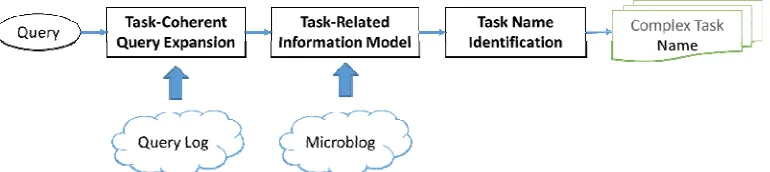
To improve current search engines without support for complex task searches, we proposed an entity-driven complex task model (ECTM), which can automatically identify the name of a complex task and discover task-related entities behind the complex task. Figure 2 shows our ECTM architecture. The ECTM utilizes web resources, including query logs and microblogs. Given a search query that is driven by a latent complex task, there are three major stages in the ECTM to suggest integrated search results.
Figure 2. Architecture of our proposed entity-driven complex task model.
1. Task-Coherent Query Expansion: Integrate an expanded task-coherent query set to help identify the latent complex search task. In this stage, we utilize query logs and user search sessions to collect task-coherent queries.
2. Task-Related Information Model: Extract multiple task-related entities from a task-coherent query set, then retrieve microblog posts based on extracted task-related entities.
3. Task Name Identification: Identify the complex task name consisting of a task topic and a task event extracted from the retrieved microblog posts.
In the following, we describe the details of each major stage in the ECTM.
3.2 Task-Coherent Query Expansion
In fact, only using a single query is insufficient for finding the latent complex task. We thus try to extract other relevant task-coherent queries from search sessions. Although users may persistently search for the same complex task over a period of time, they may also simultaneously search for multiple interleaved tasks (Liu & Beklin, 2010; MacKay & Watters, 2008). Therefore, identifying task-coherent queries from search sessions is an important and
74 Ting-Xuan Wang and Wen-Hsiang Lu
non-trivial issue. The process for extracting task-coherent queries is described below.
Given an input query q and query logs Q, we first separate queries in the query logs into search sessions by the time gap of 24 hours. We extract search sessions containing the input query q and obtain a set of sessions Sq. To extract task-coherent queries Qt from the session set
Sq, we employ a log-linear model (LLM) with the following three useful features.
Average Query Frequency: Generally, the frequency of a query reflects its popularity. To avoid a long session resulting in high query frequency, we calculate the normalized query frequency as:
| |
∑
, | |
∈
(1)
where freq(qt,s) is the frequency of the query qt in the session s, is the sessions containing
qt, |s| is the number of queries in the session s, and | | is the number of sessions containing
query qt in the set .
Session Coverage: The queries occurring in several sessions are candidates in terms of task-coherence. To collect queries occurring in many sessions, we use average session frequency, which can be calculated as follows:
exp
|| ||
(2)
where | | is the number of sessions containing the input query q in the set , | | is the number of sessions containing query qt in the set , and exp ∙ is the exponential function.
Average Query Distance: Since queries that close to the input query in a search session may have high task-coherence degree for the latent complex task. We thus use normal distribution to estimate the task-coherence for each query:
√
(3)
where σ is standard deviation (which is set to 6.07, according to our training dataset, see Section 4.1.2), d is the average number of queries between qt, and input query q in sessions.
We employ a log-linear model to calculate the probability of each candidate task-coherent query based on the features described above:
;
∑| |(4) where Qt is the set of all candidate queries in the session set Sq, |F| is the number of used
feature functions , W is the set of weighting parameters wi of feature functions, and Z(Qt)
Identifying the Names of Complex Search Tasks with Task-Related Entities 75
3.3 Task-Related Information Model
Sometimes, complex search task names will not occur in the expanded query set Qt; therefore,
we cannot directly identify a complex task name from the query set Qt. In this stage, we
expand the content of Qt by extracting task-related entities and use the entities to retrieve
microblog posts from a microblog search service, such as Weibo2.
3.3.1 Task-Related Entity Extraction
We first try to extract task-related entities from expanded task-coherent query set Qt. In fact,
the queries in the query set Qt usually consist of a task topic and a task-related entity. For
example, a query “北京機票 (Beijing flight ticket)” contains a topic “北京 (Beijing)” and an entity “機票 (flight ticket)”. To realize the Part-Of-Speech (POS) of the task-related entity in the query set Qt, we generated statistics on 2000 queries randomly selected from a query log.
The entities were labeled with a POS tag by a Chinese segmentation and tagging tool. Table 2 shows the results of the POS tag distribution of queries. We find that most entities are common nouns (87.5%), such as cellphone or flight ticket. For the POS of the task topic, we find that 78.9% of task topics are proper nouns and 19.8% are common nouns. Therefore, we extract task-related entities from the query set Qt by extracting all common nouns in each set
of queries and select the top-frequency proper noun as a candidate task topic. We thus can obtain a candidate task topic and a list of task-related entities Et ordered by the occurrence
frequency.
Table 2. The POS tag distribution of task entities and task topics
POS tag Entity Topic
Common Noun 87.5% 19.8%
Proper Noun 7.3% 78.9%
Others 5.2% 1.3%
3.3.2 Task-Related Microblog Retrieval
To identify a complex task name that does not occur in queries, the basic idea is to collect microblog posts from microblog search engines based on the given task-related entities. According to our observations, a microblog post containing most of the task-related entities may also contain the task name (see the example in Table 1). Unfortunately, a microblog post may contain only a portion of the entities required for a complex task. To overcome the above problem, we identify pseudo queries based on all subsets containing two or three entities from
2
76 Ting-Xuan Wang and Wen-Hsiang Lu
top-n entities of Et. To make sure that each pseudo query is relevant to the candidate topic t,
we combine the candidate topic t with each pseudo query and retrieve a set of microblog posts via microblog search engines.
3.4 Task Name Identification
Based on the identified task-related entities and microblog posts in the previous stage, we aim to identify a complex task name. To identify a suitable task name, we utilize conditional random field (CRF) (Lafferty et al., 2001) to automatically label each term in a microblog post with a task-semantic tag.
3.4.1 Automatically Labeling of Task Name
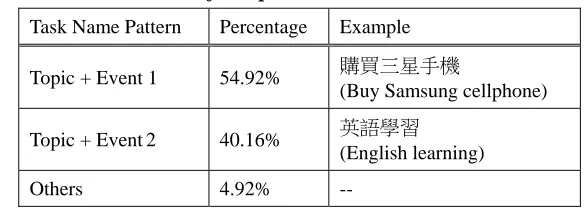
To realize the structure of a complex task name, we annotated 244 distinct complex task names from 513 search sessions (the details of the annotation process will be described in Section 4.1.2). Table 3 shows the statistics of the structure distribution. We found most task names consist of a task topic and a task event, such as “購買三星手機 (buy Samsung cellphone),” where “三星 (Samsung)” is the task topic, and “購買手機 (buy cellphone)” is the task event. We also find that the task event usually is composed of a transitive verb (i.e., buy) and an event object (i.e., cellphone). Nevertheless, some events are intransitive verbs needing no event object, such as “英語學習 (English learning),” where ”學習 (learning)” is an intransitive verb in Chinese. Therefore, we define the two types of events as Event 1 and Event 2, where Event 1 consist of a transitive verb (E1V) and an object (E1O), and Event 2 is
only an intransitive verb. We aim to automatically label each term in a microblog post with one of the five task-semantic tags, T (topic), E1V (Event 1), E1O (Event object), E2 (Event 2),
and O (Others).
Table 3. The statistics of complex task name structure distribution
Task Name Pattern Percentage Example
Topic + Event 1 54.92% 購買三星手機
(Buy Samsung cellphone)
Topic + Event2 40.16% 英語學習
(English learning)
Others 4.92% --
Identifying the Names of Complex Search Tasks with Task-Related Entities 77
in a sentence. We use a popular CRF implementation “CRF++,”3 which can adopt multiple features for each term. In the following, we describe the two types of features for complex task name identification, including term-based and post-based features.
3.4.2 Features for Complex Task Name Identification
(1) Term-based features
There are five term-based features proposed in this work.
Stop word: A stop word usually is unimportant and not a task name. We consider stop word as a binary feature to indicate if the term is a task name.
Candidate topic: In the previous stage (see Section 3.3.1), we extracted a candidate topic from task-coherent query set Qt. Therefore, we can utilize the candidate topic as a binary
feature for indicating if a term is a task topic.
Term frequency: Generally, a term in a post with high frequency may indicate the term is more important than other terms in the post. The term frequency is normalized by dividing the largest frequency of terms in the post. The normalized term frequency is divided into three ranges, including high [1, 0.8), middle (0.2, 0.8], and low [0, 0.2].
Document frequency: A term occurring in several search-result posts may indicate the term is a task topic or a task event. The reason is that the search-result posts usually are related to a certain complex task. We normalize the document frequency by dividing the post number of search results. The normalized document frequency is divided into three intervals, including high [1, 0.8), middle (0.2, 0.8], and low [0, 0.2].
POS tag: According to our observation, the POS tag of a task topic usually is a proper noun (Np) or a common noun (Nc), and the POS tag of a task event usually is a transitive verb
(Vt) + common noun (Nc) or an intransitive verb (Vi). To enhance the accuracy of the CRF
model, we only use four types of POS tag “Vi,” “Vt,” “Nc,” and “Np” and others are labeled as
“Others”.
(2) Post-based Features
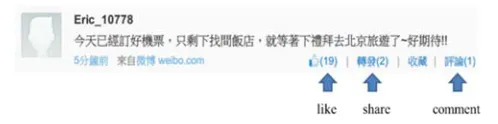
According to our observation, a post describing a complex task usually is more important or popular for an author or the author’s friends. For example, when users write posts talking about their wedding, they will receive more attention than other ordinary posts. Therefore, we try to calculate a post importance score based on four post features, including descriptive, interactive, attractive, and influential degrees, according to the metadata of microblog posts. Figure 3 shows a real example of a microblog post collected from Weibo. We can see that there is some metadata on the post, such as the click times of “like,” “share,” and “comment”.
3
78 Ting-Xuan Wang and Wen-Hsiang Lu
Figure 3. A real example post containing various metadata, such as the times of “like,” “share,” and “comment”
Descriptive degree: Generally, a complex task needs more words to describe a variety of subtasks. Thus, we assume that a microblog post p with longer context can provide more content about the complex task. Nevertheless, some spam posts may contain long text with repeated terms. Therefore, we calculate the entropy to represent post descriptive degree:
∑
∈log
(5) where Term(p) is a set of terms in post p and P(w) is the occurrence probability of term w.
Interactive degree: If a post has many “comments,” we assume the post is more interactive. An interactive post has higher probability of mentioning a complex task. We formulate the interactive degree of a post as:
∈
(6)
where CommentCount(p) is the “comment” number of a post p and where max ∙ function returns the max “comment” number of a post pi in the post set P.
Attractive degree: If a post receives many “likes,” we assume the post is more attractive. An attractive post has higher probability to mention a complex task. We formulate the attraction of a post as:
∈
(7)
where LikeCount(p) is the “like” number of a post p and where max ∙ function returns the max “like” number of a post pi in the post set P.
Influential degree: If a post was shared many times, we assume the post is more influential. An influential post has higher probability to mention a complex task. We formulate the influential degree of a post as:
∈
(8)
where ShareCount(p) is the “share” number of a post p and where max ∙ function returns the max “share” number of a post pi in the post set P.
Identifying the Names of Complex Search Tasks with Task-Related Entities 79
often in more important posts, we can assume the term is important. Therefore, we calculate average term importance based on post importance as follows:
∑ ∈
| |
(9)
where PostImportance(pi) can be replaced by one of the above four feature functions, Pw is a
set of posts containing the term w, and |Pw| is the number of posts in the set Pw. We further
normalize fTermImportance (w) as follows:
∈
(10)
where W is the set of all terms. Finally, we divide the normalized term importance score into three ranges, high [1, 0.8), middle (0.2, 0.8], and low [0, 0.2].
3.4.3 Complex Task Name Composition
Based on the task-semantic tagging results of the CRF model, we can calculate the highest frequency task-semantic tagging terms, including e1V, e1O, e2, and t, for each type of
task-semantic tag E1V, E1O, E2, and T, respectively. To compose a semantically suitable
complex task name c, we use a rule-based algorithm that considers the frequency and POS of each task-semantic tagging term. Figure 4 shows the algorithm of complex task name composition (CTNC), which combines a task topic and a task event into a complex task name, where Freq(e) is the frequency of an event e and POS(t) is the POS tag of a topic t. We first compare the term frequency of a transitive event e1V and an intransitive event e2. If the
frequency of e2 is greater than e1V, CTNC simply returns a complex task name composed of
<t+e2>, e.g., “北京<t>旅遊<e2> (Beijing<t> travel<e2>)”. Otherwise, if the topic t is a
common noun, CTNC returns a complex task name composed of <e1V+t>, e.g., “學習<e1V>英
語<t> (learn<e1V> English<t>)”. Otherwise, if the topic t is a proper noun, CTNC returns a
complex task name composed of e1V+t+e1O, e.g., “購買<e1V>三星< t >手機<e1O> (buy<e1V>
Samsung< t > cellphone<e1O>)”.
Algorithm: complex task name composition
Input: task-semantic tagging terms , , , Output: A complex task name
If < Then return
Else If is “common noun” Then return Else return
80 Ting-Xuan Wang and Wen-Hsiang Lu
4.
Experiments
4.1 Experimental Setup
4.1.1 Dataset
We use a month of query logs from the Sogou search engine as our dataset. The query logs contain 21,422,773 records with 3,163,170 distinct queries. We group these query records into search sessions according to user ID. Since a complex task may span a period of time, we used 24 hours as the time gap to segment search sessions, which resulted in 264,360 search sessions.
4.1.2 Data Labeling
In this work, we employed three annotators to label each query with a task-related entity and a latent complex task name. Since the query logs are diverse and often ambiguous, heuristically labeling the task-related entities and task names for each query may lead to inconsistent results. To identify reasonable and consistent training/testing data for evaluating our ECTM, a formal annotation method procedure should be provided. In the following, we describe the guidelines for annotators on how to label a task-related entity and a complex task name for each search query.
In general, a search query should give one entity that users focus on. Annotators thus only focus on queries containing exactly one entity and discard other queries.
To better interpret task-related entities and task names for queries, annotators are encouraged to exploit external resources, e.g., clicked pages, search results for queries, or query context (i.e., other queries in the same search session).
Since a complex task should be determined based on the whole search session, annotators should complete the labelling of all task-related entities in a search session before they begin to label task names.
Identifying the Names of Complex Search Tasks with Task-Related Entities 81
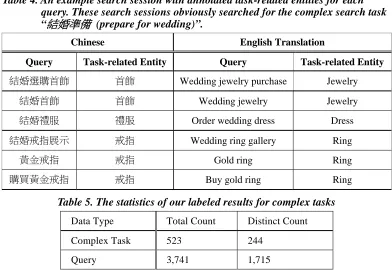
simple tasks in one session, few complex tasks occurred in the same session. In other words, we found users seldom deal with two complex tasks simultaneously within the same period of time. The statistics of the labeled results are shown in Table 5. On average, there are 5.68 (2972 / 523) entities per task in our labeled dataset.
Table 4. An example search session with annotated task-related entities for each query. These search sessions obviously searched for the complex search task “
結婚準備
(prepare for wedding)”.Chinese English Translation
Query Task-related Entity Query Task-related Entity
結婚選購首飾 首飾 Wedding jewelry purchase Jewelry
結婚首飾 首飾 Wedding jewelry Jewelry
結婚禮服 禮服 Order wedding dress Dress
結婚戒指展示 戒指 Wedding ring gallery Ring
黃金戒指 戒指 Gold ring Ring
購買黃金戒指 戒指 Buy gold ring Ring
Table 5. The statistics of our labeled results for complex tasks
Data Type Total Count Distinct Count
Complex Task 523 244
Query 3,741 1,715
Training data: We sampled 100 complex tasks as the training dataset, which contained 724 queries and 424 distinct entities. For the log-linear model (LLM) used in task-coherent query expansion, we identified pairwise training data according to our labeled data set. Each query pair indicates if two queries belong to the same complex task. Therefore, we could obtain 4950 (i.e., the combination number ) query pairs to train LLM. For the CRF model used in task name identification, we manually labeled 30 microblog posts retrieved for each complex task; thus, there were 3000 microblog posts for training the CRF model.
Testing data: We used the remaining 423 complex tasks as the testing dataset, which contained 3017 queries and 1426 distinct entities. For each testing complex task, we randomly selected a query from the testing task as the input query.
4.1.3 Task Name Quality Labeling
82 Ting-Xuan Wang and Wen-Hsiang Lu
name by an automatic keyword matching approach. To overcome the above problem, we employed three judges to give scores independently for identified task names of all compared methods (the details of the compared methods will be described in Section 4.1.5). To ensure the fairness for all compared methods, we designed a labeling procedure.
1. Merge all identified task names from different methods into a large task name list.
2. Remove the duplicated task names in the task name list.
3. Shuffle the task names in order to hide the information of the original rank of different methods.
In order to give a relevance score, the judges could look at our pre-labeled task names and survey the information of the complex tasks. The score for each task name should be 0, 1, or 2. We define the criterion of giving a relevance score as follows.
Bad (score of 0): A bad complex task name is irrelevant to the complex task or is semantically unsuitable.
Fair (score of 1): A fair task name is semantically suitable but the judges cannot determine whether the task name can represent the complex task.
Good (score of 2): A good task name is semantically suitable and semantically the same as the pre-labeled task name.
Since there were three judges (thus, we had three relevance scores for each task), we needed to decide the final relevance scores for evaluating performance of the compared methods. We used the majority decision to decide the final relevance score for each task. For instance, when a name was labeled with relevance scores 1, 0, and 0, the final relevance score would be 0. If a task name was labeled with three distinct relevance scores 0, 1, and 2, the final relevance score would be 1. We only considered a task name with a relevance score of 2 as a correct task name.
4.1.4 Evaluation Metrics
Inclusion rate: The inclusion rate is to evaluate the fraction of the top n identified complex task names that include at least one correct complex task name. The equation of inclusion rate is given as follows:
| |
| |
(11)
Identifying the Names of Complex Search Tasks with Task-Related Entities 83
Mean reciprocal rank (MRR): Since we only need one correct task name for each testing data, we use MRR, which only considers the rank of the first returned correct task name for each testing data task. To calculate the MRR, the equation is as follows:
| |
∑
| |(12) where |T| is the number of testing tasks and rank(i) is the rank of the first identified correct task name of the ith testing task.
Normalized discounted cumulative gain (NDCG): To realize the overall quality of the top n identified task name, we also use NDCG to evaluate the performance for different methods. According to scores of identified task name, we first have to calculate the DCG as follows:
∑
(13) where n is the number of identified task names and ∈ 0,1,2 is the relevance score of the top-i task name. In order to normalize the DCG value from 0 to 1, the DCG divided by IDCG, called NDCG, is defined as follows:
(14) where IDCG can be calculated the same as DCG with an ideal rank, which was ranked by labeled scores.
4.1.5 Task Name Identification Method Comparison
LRM_SERP (linear regression model with search engine result snippet): This method was proposed by Zeng et al. (2004) to identify salient phrases from search-result snippets. Salient phrases are identified using several regression models with five proposed features, including TFIDF, phrase length, intra-cluster similarity, cluster entropy, and phrase independence. We used the linear regression model (LRM) with the five features proposed in their work to extract salient phrases as task names from search-result snippets. Since using only the testing input query to collect search-result snippets may not be fair for identifying complex task names, we used our produced pseudo queries with task-related information model to collect search-result snippets from a web search engine (see Section 3.3). The weight for each feature was set as in Zeng et al.’s work.
LRM_MB (linear regression model with microblog): We also tried to adopt a linear regression model with microblog posts in order to compare the resources of SERP and microblog based on the five features proposed in Zeng et al.
84 Ting-Xuan Wang and Wen-Hsiang Lu
ECTM (entity-driven complex task model): This is our proposed entity-driven complex task model, which utilizes microblog as extending data for a task-coherent query set. We used all features proposed in this work for training a CRF model to identify the name of complex task. The only difference between LRM_MB+ and our method is that the former first extracts bigrams and trigrams from posts as candidate phrases before using LRM to determine their correctness, and our method uses CRF to directly label each term in the posts with a task-semantic tag (i.e., topic or event).
4.1.6 Parameter Selection
Identifying the Names of Complex Search Tasks with Task-Related Entities 85
Figure 5. The top 3 task name inclusion rate of different number of entities for producing pseudo queries
Figure 6. The precision for different number of microblog posts (MB) in complex task name identification.
4.2 Results of Task Name Identification
Table 6 shows the overall results of task name identification using different methods. Generally, the four methods achieved adequate top 5 inclusion rate (0.68, 0.72, 0.79, and 0.83 for LRM_SERP, LRM_MB, LRM_MB+, and ECTM, respectively). We found LRM_MB using a microblog is better than LRM_SERP using an SERP in identifying the complex task name. According to our analysis, microblog posts contain more task names, even in tail posts. On the contrary, only a few top-ranked search result snippets contain complex task names. The reason is that microblog posts are identified by users; thus, they have more likelihood to talk about a real-life complex task. Therefore, LRM_MB can achieve better performance than LRM_SERP. We also compared the performance between using and not using our proposed features in a microblog post (i.e., LRM_MB and LRM_MB+). Using microblog features can slightly improve the overall performance since important posts usually mention a complex task. Our proposed ECTM using CRF to automatically label task-semantic tags for each term can improve the performance significantly, and it achieved Top-1 MRR of 0.57.
0%
20%
40%
60%
10
20
30
40
50
Pr
ecision
The number of posts
86 Ting-Xuan Wang and Wen-Hsiang Lu
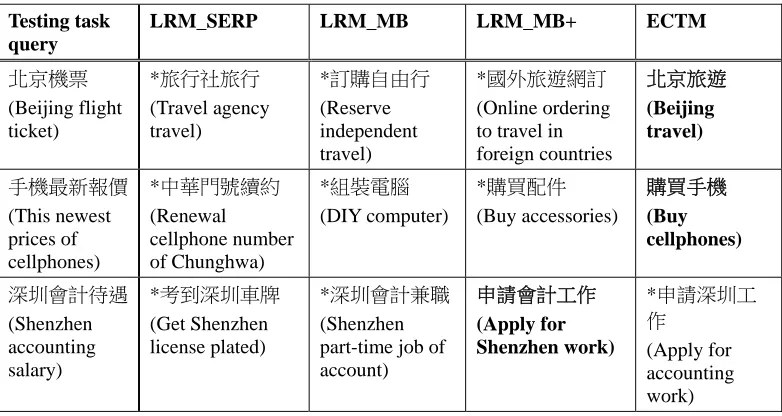
To realize whether the identified complex task names are semantically suitable, some example of top-1 identified task names are shown in Table 7. For the query “北京機票 (Beijing flight ticket),” only our ECTM identified correct task name “北京旅遊 (Beijing travel)”. LRM_SERP identified incorrect task name “旅行社旅行 (travel agency travel),” which is not semantically suitable. The reason is that search-result snippets sometimes are not represented as complete natural language sentences. Therefore, when we try to extract a bigram or trigram, there are some combinations that are not semantically suitable. LRM_MB and LRM_MB+ identified incorrect task names “訂購自由行 (reserve independent travel)” and “國外旅遊網訂 (online ordering to travel in foreign countries),” which are semantically suitable but not very related with Beijing travel. The reason is that the above two methods do not consider the task topic when identifying complex task names. According to our observation, the task topic of a complex task usually occurs in almost every search query. For the testing task query “深圳會計待遇 (Shenzhen accounting salary),” only LRM_MB+ identified the correct task name “申請會計工作 (apply for accounting work),” and our ECTM identified an incorrect task name “申請深圳工作 (apply for Shenzhen work)”. According to our analysis, ECTM identified an incorrect task topic “深圳 (Shenzhen),” which is a location name in China and occurs many times in a task-coherent query set (see Section 3.2). Nevertheless, the correct task topic should be “會計 (accounting)”, which specifies the career searched by the user. As a result, we find our ECTM may identify incorrect task names when the task topic is not the most frequent term in the task-coherent query set.
Table 6. The overall complex task identification performance comparison of four methods
Method MRR NDCG IR
Top 1 Top 3 Top 5 Top 1 Top 3 Top 5 Top 1 Top 3 Top 5
LRM_SERP 0.37 0.41 0.47 0.22 0.35 0.31 0.37 0.45 0.68
LRM_MB 0.42 0.52 0.54 0.27 0.46 0.42 0.42 0.65 0.72
LRM_MB+ 0.48 0.54 0.59 0.39 0.54 0.53 0.48 0.68 0.79
ECTM 0.57 0.63 0.66 0.45 0.61 0.58 0.57 0.71 0.83
88 Ting-Xuan Wang and Wen-Hsiang Lu
composed of a topic “北京 (Beijing),” an event “治療 (treat),” and an event object “打鼾 (snore)”. In this work, we still cannot provide a perfect solution for composing task names.
6.
Conclusion and Future Work
In this work, we proposed an entity-driven complex task model (ECTM), which addressed the problem of improving the user experience when searching for a complex task. We exploited various web resources, including query logs, microblogs, and search-result snippets, to enhance the performance of our ECTM. To identify a human-interpretable complex task name from short-content queries, we utilized microblog posts and investigated several useful features to train the CRF model to automatically identify complex task names. Experimental results show that ECTM efficiently identifies complex task names with various task-related entities. Nevertheless, there are still some problems that need to be solved. In the future, we will try to investigate other useful features to improve the task name identification when dealing with real-life complex task queries.
References
Agichtein, E., White, R. W., Dumais, S. T., & Bennett, P. N. (2012). Search, Interrupted: Understanding and Predicting Search Task Continuation. In Proc. of SIGIR 2012. Beeferman, D. & Berger, A. (2000). Agglomerative Clustering of a Search Engine Query log.
In Proc. of KDD ‘00, 407-416.
Boldi, P., Bonchi, F., Castillo, C., Donato, D., Gionis, A., & Vigna, S. (2008). The Query-Flow Graph: Model and Applications. In Proc. of CIKM 2008.
Cui, J., Liu, H., Yan, J., Ji L., Jin R., He, J., Gu, Y., Chen, Z., & Du, X. (2011). Multi-view Random Walk Framework for Search Task Discovery from Click-through Log. In Proc. of CIKM 2011.
Feild, H. & Allan, J. (2013). Task-Aware Query Recommendation. In Proc. of SIGIR 2013. Guo, Q. & Agichtein, E. (2010). Ready to Buy or Just Browsing? Detecting Web Searcher
Goals from Interaction Data. In Proc. of SIGIR 2010.
Ji, M., Yan, J., Gu, S., Han, J., He, X., Zhang, W. V., & Chen, Z. (2011). Learning Search Tasks in Queries and Web Pages via Graph Regularization. In Proc. of SIGIR 2011. Jones, R., & Klinkner, K. (2008). Beyond the Session Timeout: Automatic Hierarchical
Segmentation of Search Topics in Query Logs. In Proc. of CIKM ‘08, 699-708.
Kotov, A., Bennett, P. N., White, R. W., Dumais, S. T., & Teevan, J. (2011). Modeling and Analysis of Cross-Session Search Tasks. In Proc. of SIGIR 2011.
Lafferty, J., Mccallum, A., & Pereira, F. (2001). Conditional Random Fields: Probabilistic Models for Segmenting and Labeling Sequence Data. In Proc. of ICML, 282-289. Liao, Z., Song, Y., He, L.-W., & Huang, Y. (2012). Evaluating the Effectiveness of Search
Identifying the Names of Complex Search Tasks with Task-Related Entities 89
Lin, T., Pantel, P., Gamon, M., Kannan, A., & Fuxman, A. (2012). Active Objects: Actions for Entity-Centric Search. In Proc. of WWW 2012.
Liu, J & Belkin, N. J. (2010). Personalizing Information Retrieval for Multi-Session Tasks: The Roles of Task Stage and Task Type. In Proc. of SIGIR 2010.
Lucchese, C., Orlando, S., Perego, R., Silvestri, F., & Tolomei, G. (2011). Identifying Task-based Sessions in Search Engine Query Logs. In Proc. of WSDM 2011.
MacKay, B. & Watters, C. (2008). Exploring Multi-Session Web Tasks. In Proc. of CHI ‘08, 1187-1196.
Mihalkova, L. & Mooney, R. (2009). Learning to Disambiguate Search Queries form Short Sessions. In Proc. of ECML ‘09, 111-127.
Raman, K., Bennett, P. N., & Collins-Thompson, K. (2013). Toward Whole-Session Relevance: Exploring Intrinsic Diversity in Web Search. In Proc. of SIGIR 2013.
Tan, B., Shen, X., & Zhai, C. (2006). Mining Long-Term Search History to Improve Search Accuracy. In Proc. of KDD ‘06, 718-723.
Wang, T.-X., & Lu, W.-S. (2011). Identifying Popular Search Goals behind Search Queries to Improve Web Search Ranking. In Proc. of AIRS 2011.
Wen, J.-R., Nie, J.-Y., & Zhang, H.-J. (2001). Clustering User Queries of Search Engine. In Proc. of WWW 2001.
White, R. W., Chu, W., Hassan, A., He, X., Song, Y., & Wang, H. (2013). Enhancing Personalized Search by Mining and Modeling Task Behavior. In Proc. of WWW 2013. Yamamoto, T., Sakai, T., Iwata, M., Yu, C., Wen, J.-R., & Tanaka, K. (2012). The Wisdom of
Advertisers: Mining Subgoals via Query Clustering. In Proc. of CIKM 2012.
Zeng, H.-J., He, Q.-C., Chen, Z., Ma, W.-Y., & Ma, J. (2004). Learning to Cluster Web Search Results. In Proc. of SIGIR 2004.