Building a learner corpus
Jirka Hana, Alexandr Rosen, Barbora ˇStindlov´a, Petr J¨ager
Charles University in Prague, Faculty of Mathematics and Physics & Faculty of Arts Technical University of Liberec, Faculty of Education
[email protected], [email protected], [email protected], [email protected]
Abstract
The paper describes a corpus of texts produced by non-native speakers of Czech. We discuss its annotation scheme, consisting of three interlinked levels to cope with a wide range of error types present in the input. Each level corrects different types of errors; links between the levels allow capturing errors in word order and complex discontinuous expressions. Errors are not only corrected, but also classified. The annotation scheme is tested on a doubly-annotated sample of approx. 10,000 words with fair inter-annotator agreement results. We also explore options of application of automated linguistic annotation tools (taggers, spell checkers and grammar checkers) on the learner text to support or even substitute manual annotation.
Keywords:learner corpora, error annotation, Czech
1.
Introduction
We describe the process, annotation scheme, tools and tech-nical decisions behind the annotation of a learner corpus of Czech. The corpus is compiled from texts written by stu-dents of Czech as a second or foreign language. We dis-cuss the whole pre-processing work-flow, starting from the transcription of hand-written texts, conversion into the an-notation format, and the anan-notation itself. Here, we focus mainly on the computational and organizational issues, for a detailed discussion of the linguistic aspects involved see (Hana et al., 2010; ˇStindlov´a et al., 2012).
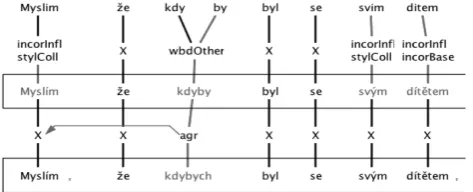
After a brief introduction to the project of the learner cor-pus of Czech in§2., followed by an account of reasons for building such a corpus in§3., and a sketch of our annotation scheme in§4., we present a description of the workflow in
§5.
2.
A learner corpus of Czech
The learner corpus of Czech as a Second Language (CzeSL) is built as a part of a larger project, the Acquisition Cor-pora of Czech (AKCES), a research programme pursued at Charles University in Prague since 2005 ( ˇSebesta, 2010). In addition toCzeSL,AKCEShas written (SKRIPT) and spo-ken (SCHOLA) parts, collected from native Czech pupils, and a part collected from pupils with Romani background (ROMi). Methods and tools used for collecting, transcrib-ing, annotating and managing the texts are currently the same at least for CzeSLandROMi, and most of them are supposed to extend to other parts of the project.
By the end of the first phase of the project in May 2012, the size of transcribed texts ofCzeSLandROMiwill reach the size of 2 million word tokens, of which nearly 20% are expected to be error-annotated manually. The anonymized transcripts, supplemented by rich metadata, will be avail-able for registered users via a standard concordancer as a part of the Czech National Corpus,1 while a newly built
search tool will be used for the error-annotated parts with their complex mark-up.
1http://korpus.cz
CzeSLis focused on native speakers of the following lan-guages: (1) Slavic, (2) other Indo-European, (3) non-Indo-European. The data include mainly written texts (such as essays or exams), collected as manuscripts. They cover all language levels, from real beginners (A1) to advanced learners (B2 and higher).
Each text is equipped with metadata records, some of them relate to the respondent (such as age, gender, first language, proficiency in Czech, knowledge of other languages, dura-tion and condidura-tions of language acquisidura-tion), while other specify the character of the text and circumstances of its production (availability of reference tools, type of elicita-tion, temporal and size restrictions etc.).
3.
What can be done with a learner corpus
In addition to its role in the research of second language ac-quisition, the corpus will be used in the education of teach-ers of Czech as a foreign language, as a source of examples usable in the classroom and for educational tools, and will help to tailor instructions and teaching materials to specific groups of learners ( ˇStindlov´a, 2011).
Despite the fact that teaching Czech as a foreign language has already become a well-established field, a proper teach-ing methodology is not available. Teachers often take re-course to methods and techniques used for languages such as English or German. Since Czech is a typologically dif-ferent language, there are a number of phenomena that make such an approach grossly inadequate, such as much richer morphology or relatively free word order. Alterna-tively, teachers tend to confront their students with Czech grammar as an academic subject, making the necessary learning curve extremely steep.
A specific problem is the issue of educating children with a native language other than Czech, whose presence at Czech primary schools is a fairly recent phenomenon. Primary school teachers receive no training in teaching Czech as a foreign language, again resorting to an individual and intu-itive approach.
require-technical training is required. A set of codes is used to cap-ture some properties of the manuscript (variants, illegible strings, self-corrections; see ( ˇStindlov´a, 2011, p. 106ff)). Some of these encodings are supported via macros of the editor. Because the set of text formatting features used by the transcribers is limited to a few standard options, there are no issues due to potentially incorrect HTML code ex-ported from the text editor.
5.4. Annotation
The manual portion of error annotation is supported by feat,4 an annotation tool we have developed. The
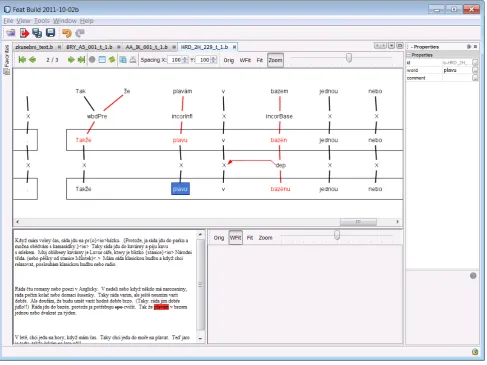
anno-tator corrects the text on appropriate levels, modifies rela-tions between elements on adjacent levels (by default all relations are 1:1) and annotates relations with error tags as needed. The context of the annotated text is shown both as a transcribed HTML document and – optionally – as a scan of the original document. Both the editor and the data for-mat accommodate various approaches towards the process of multi-level annotation. Some annotators prefer to anno-tate by paragraphs, first annotating the whole paragraph on Level 1 first and then on Level 2, while others annotate by sentences annotating a sentence on both levels before mov-ing to the next one. The tool is written in Java on top of the Netbeans platform.5 Figure 2 shows the tool’s user
in-terface. It automatically synchronizes withSpeed, the text management system – the user receives (whether an annota-tor, supervisor or adjudicator) the assigned documents into her Inbox, processes them and moves them to Outbox.
6.
Conclusion
We have described the pre-processing work-flow of a learner corpus project, including the error annotation, with a focus on the computational and organizational issues. The annotation scheme has been tested on a doubly-annotated sample of approx. 10,000 words with fair inter-annotator agreement results. At the moment, the annotation is pro-ceeding towards the goal of 1 mil. tokens.
The methods and tools developed within this project are not tied to the specific use and we hope they will be found useful in other projects.
7.
Acknowledgements
We wish to thank our colleagues, namely Milena Hn´atkov´a, Tom´aˇs Jel´ınek, Vladim´ır Petkeviˇc, Hana Skoumalov´a and Svatava ˇSkodov´a for many stimulating ideas, and members of our team of annotators for important feedback. We are also grateful to Karel ˇSebesta, for all of the above and for initiating and guiding this enterprise.
Our thanks are also due to our anonymous reviewers for interesting and helpful comments.
The corpus is one of the tasks of the project Innovation of Education in the Field of Czech as a Second Language (project no. CZ.1.07/2.2.00/07.0259), a part of the opera-tional programme Education for Competitiveness, funded by the European Structural Funds (ESF) and the Czech gov-ernment. The annotation tool was also partially funded by
4
http://purl.org/net/feat/ 5http://platform.netbeans.org/
grant no. P406/10/P328 of the Grant Agency of the Czech Republic.
8.
References
Sylviane Granger. 1998. The computer learner corpus: a versatile new source of data for SLA research. In Syl-viane Granger, editor, Learner English on Computer, pages 3–19. Addison Wesley Longman, London and New York.
Jirka Hana, Alexandr Rosen, Svatava ˇSkodov´a, and Barbora ˇStindlov´a. 2010. Error-tagged learner corpus of Czech. InProceedings of the Fourth Linguistic Annota-tion Workshop, Uppsala, Sweden, July. Association for Computational Linguistics.
Thomas Schmidt, Kai W¨orner, Hanna Hedeland, and Timm Lehmberg. 2011. New and future developments in EX-MARaLDA. InMultilingual Resources and Multilingual Applications. Proceedings of GSCL Conference 2011 Hamburg.
Thomas Schmidt. 2009. Creating and working with spoken language corpora in EXMARaLDA. In Verena Lyding, editor,LULCL II: Lesser Used Languages and Computer Linguistics II, pages 151–164.
Karel ˇSebesta. 2010. Korpusy ˇceˇstiny a osvojov´an´ı jazyka [Corpora of Czech and language acquistion]. Studie z aplikovan´e lingvistiky/Studies in Applied Linguistics, 1:11–34.
Barbora ˇStindlov´a, Svatava ˇSkodov´a, Alexandr Rosen, and Jirka Hana. 2012. Annotating foreign learners’ Czech. In Mark´eta Zikov´a and Mojm´ır Doˇcekal, editors,Slavic Languages in Formal Grammar. Proceedings of FDSL 8.5, Brno 2010, pages 205–219, Frankfurt am Main. Pe-ter Lang.