Identifying paraphrases between technical and lay corpora
Louise Del´eger, Pierre Zweigenbaum
LIMSI-CNRS BP133, F-91403 Orsay, France [email protected], [email protected]
Abstract
In previous work, we presented a preliminary study to identify paraphrases between technical and lay discourse types from medical corpora dedicated to the French language. In this paper, we test the hypothesis that the same kinds of paraphrases as for French can be detected between English technical and lay discourse types and report the adaptation of our method from French to English. Starting from the constitution of monolingual comparable corpora, we extract two kinds of paraphrases: paraphrases between nominalizations and verbal constructions and paraphrases between neo-classical compounds and modern-language phrases. We do this relying on mor-phological resources and a set of extraction rules we adapt from the original approach for French. Results show that paraphrases could be identified with a rather good precision, and that these types of paraphrase are relevant in the context of the opposition between technical and lay discourse types. These observations are consistent with the results obtained for French, which demonstrates the portability of the approach as well as the similarity of the two languages as regards the use of those kinds of expressions in technical and lay discourse types.
1.
Introduction
Paraphrases can be a useful resource for many natural language processing applications, including information retrieval (Ibrahim et al., 2003), information extraction (Shinyama and Sekine, 2003), text simplification (Elhadad and Sutaria, 2007) and authoring aids (Max, 2008). Most existing approaches (Barzilay and Lee, 2003; Shinyama and Sekine, 2003; Pasca and Dienes, 2005) aim at extract-ing undifferentiated paraphrases, regardless of the kind of discourse they belong to. A more fine-grained characteri-zation of paraphrases would give insight into their context of use. In this regard, distinguishing between technical and lay discourse types would be especially helpful for text sim-plification or authoring aid, as it would allow to choose one paraphrase over another according to the target audience. This is the goal of the present work.
Very few studies have looked for paraphrases between dif-ferent discourse types. In a medical context, Elhadad and Sutaria Elhadad and Sutaria (2007) extracted lay para-phrases of technical terms from a comparable corpus of medical abstracts. We presented a preliminary study to identify paraphrases between technical and lay discourse types, also from medical corpora, and dedicated to the French language (Del´eger and Zweigenbaum, 2009). In this paper, we test the hypothesis that the same kinds of paraphrases as for French can be detected between English technical and lay discourse types and report the adaptation of our method from French to English, including variations to improve the original approach.
Several approaches are possible when dealing with para-phrase extraction from corpora. We classify them accord-ing to the type of corpora they rely on. Methods can use plain corpora, such as (Jacquemin, 1999) who detects term variants or (Pasca and Dienes, 2005) who extract para-phrases from random Web documents. Some approaches rely on parallel corpora (i.e. different translations or ver-sions of the same texts) which can be either monolingual (Barzilay and McKeown, 2001) or bilingual (Bannard and
Callison-Burch, 2005; Max, 2008). Comparable corpora are another useful source of paraphrases (Barzilay and Lee, 2003; Shinyama and Sekine, 2003; Elhadad and Sutaria, 2007). In this regard, only closely related corpora have been used, especially and almost exclusively corpora of news sources reporting the same events (Barzilay and Lee, 2003; Shinyama and Sekine, 2003).
Here, the nature of the paraphrases we are interested in (i.e. paraphrases between two types of discourse) calls for cor-pora with specific properties contrasting a set of documents (here, documents written in a technical discourse) to an-other (here, documents written in a lay discourse). This set of documents can be either parallel corpora or compara-ble corpora. As parallel corpora are very scarce resources, especially in our domain of application (the medical field) and with documents from two different discourse types, the natural choice was to use comparable corpora.
We describe our experiment, starting from the constitution of monolingual comparable corpora (section 2), then detail-ing the extraction of technical vs. lay paraphrases (section 3). We expose our results (section 4) and discuss them (sec-tion 5).
2.
Building comparable corpora
Following our methodology in (Del´eger and Zweigenbaum, 2009), we built two monolingual comparable corpora of English-language medical specialized and lay texts from the Web, in the domains of cancer and diabetes. The can-cer corpus was directly compiled from a website provid-ing comparable texts: the National Institute for Health and Clinical Excellence website1 which publishes guidelines for physicians and their lay versions for the general pub-lic. We only selected documents dealing with the cancer topic. This corpus is parallel at the document level (but not at the sentence or word level). Since such ready-made com-parable corpora are rare resources, we also gathered a sec-ond corpus from various sources through a guided search:Original French rule Adapted English rule (DET)N1PREP (DET)N2→V1(DET)N2 (DET)N2N1→V1(DET)N2
(DET)N1PREP (DET)N2A3→V1(DET)N2A3 (DET)A3N2N1→V1(DET)A3N2
(DET)N1A2→(DET)N2V1 (DET)A2N1→(DET)N2V1
Table 2: Rule adaptation (a shared index indicates equality or synonymy. N=noun, V=verb, A=adjective, PREP=preposition, DET=determiner, 1 in index = pair of deverbal noun and verb)
Original French rule Adapted English rule C→( N (A) (PREP) )C1W0−4C2 C→( (A) N (PREP) )C1W0−4C2
Table 3: Rule adaptation (C is a neo-classical compound,C1andC2are the modern-language equivalents of the components
of C, N is a noun, PREP a preposition, A an adjective and W an arbitrary word)
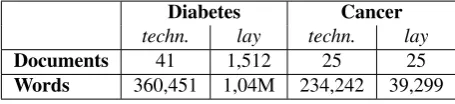
we thus identified and queried a number of relevant web-sites, including the search engine for biomedical articles PubMed2, the online medical manual Merck3, and clinical guidelines from the National Guideline Clearinghouse4for the technical side of the corpus; and websites dedicated to the general public (MedlinePlus5, WebMD6, NetDoctor7) for the lay side of the corpus. Table 1 gives the sizes of the corpora, in terms of documents and words for each side of the corpora.
Diabetes Cancer
techn. lay techn. lay
Documents 41 1,512 25 25
Words 360,451 1,04M 234,242 39,299
Table 1: Corpus sizes (techn.=technical)
3.
Extracting paraphrases
In our previous study, we identified two types of poten-tially relevant paraphrases between technical and lay dis-course types corresponding to two linguistic hypotheses. The first one, which is a common hypothesis (Fang, 2005), is that specialized language uses more nominal construc-tions where lay language uses more verbs instead. A sec-ond hypothesis is that medical language contains a fair pro-portion of words from Latin and Greek origins, which are referred to as neo-classical compounds. The meaning of these words may be quite obscure to non-experts readers. So one would expect to find less of these words in lay texts and instead some sort of paraphrases in common language. We therefore tried to detect paraphrases between nominal constructions in the technical side (such as treatment of the disease) and corresponding verb phrases in the lay side (such as the disease is treated), and paraphrases between neo-classical compounds (e.g. gastritis) and correspond-ing modern-language phrases (e.g. stomach inflammation). For French, the first kind of paraphrases proved interesting whereas the second type brought inconclusive results. We
2
http://www.ncbi.nlm.nih.gov/pubmed/
3http://www.merck.com/mmpe/index.html 4http://www.guideline.gov/
5http://medlineplus.gov/ 6
http://www.webmd.com/
7http://www.netdoctor.co.uk/
adapt here our extraction method for those two types so as to compare results and conclusions.
3.1. Pre-processing
As pre-processing steps, the two corpora were tokenized and segmented into sentences. Part-of-speech tagging was also performed using Treetagger. Our initial approach for French included an additional preliminary step consisting in segmenting the corpus into topic segments and in select-ing only the most similar pairs of technical and lay seg-ments according to a similarity measure (Cosinus). Here we took a slightly different stand and chose to look for paraphrases anywhere in the corpus, i.e. between any pair of technical and lay sentences. This decision was based on a comparative evaluation conducted for French which seemed to indicate that reducing the search to similar topic segment pairs was not conclusive.
3.2. Nominalisation paraphrases
This type of paraphrases involves nominalizations of ver-bal phrases and is built around the relation between a de-verbal noun (e.g. treatment) and its base verb (e.g. treat). The general method was to look for corresponding con-tent words (mainly nouns and adjectives) in the contexts of a pair of deverbal noun and corresponding verb. A set of extraction rules was thus defined, relying on a lexicon of deverbal nouns and verbs, a lexicon of synonyms, and a stemming phase. The English extraction rules were di-rectly adapted from the original French rules. This mainly involved adjustments to take care of syntactic differences between French and English. Examples of adapted rules are given in Table 2. The left side of a rule represents a pattern to be found in the technical side and the right side a pattern to be found in the lay side. We also used Word-Net8instead of lexicons to detect noun / verb pairs and syn-onyms. Approximately 20 rules were used to extract this type of paraphrases.
The patterns thus designed are close to the transformation rules of (Jacquemin, 1999) who detects morpho-syntactico-semantic variants of terms in plain monolingual corpora. One difference is that our patterns are built around one spe-cific type of morphological variation (noun to verb vari-ation) that seemed relevant in the context of the special-ized/lay opposition, as opposed to any possible variation.
We also identify the paraphrases by comparing the two sides of a comparable corpus while (Jacquemin, 1999) starts from a given list of terms and searches for their vari-ants in a plain monolingual corpus. Finally, we do not ap-ply our method to terms specifically but to any expression corresponding to the patterns.
3.3. Paraphrases of neo-classical compounds
The second type of paraphrases we extracted were paraphrases between neo-classical compounds and their modern-language equivalents. In the French version of our method, we used a morphosemantic analyzer (D´eriF (Namer, 2009)) to detect neo-classical compounds in the technical side of the corpora and to decompose them into their constituent parts, each part being assigned its modern-language equivalent word (e.g. gastrititis = gastr+itis =
stomach+inflammation). Simple search patterns to look for the modern-language components of the neo-classical compounds were then applied to the lay side. Here again, transposition of the French patterns to English was eas-ily performed with a few syntactic modifications (see Ta-ble 3 for some examples). Detection and decomposition of neo-classical compounds was also performed through mor-phosemantic analysis, for which we used the English ver-sion of D´eriF (adapted from French in the context of an-other experiment (Del´eger et al., 2009)). A total of 8 pat-terns were used.
3.4. Evaluation method
We examined the results of our experiment at two levels:
1. the precision of the extracted paraphrases;
2. the coherence of the initial linguistic hypotheses (hy-pothesis on nominalizations and hy(hy-pothesis on neo-classical compounds).
3.4.1. Precision
We evaluated the quality of the extracted paraphrases by measuring their precision, that is, the percentage of cor-rect results over the entire results. For the cancer corpus we evaluated precision on the whole results. In the case of the diabetes corpus, however, results being more numerous, we computed precision on a subset of 500 paraphrases (for each paraphrase type).
3.4.2. Coherence of the initial hypotheses
As explained above, this work relies on the following two linguistic hypotheses:
1. technical language tends to prefer nominalizations while lay language favours verbal constructions;
2. technical language tends to prefer neo-classical com-pounds while lay language favours modern-language equivalents;
To verify these two hypotheses, we relied on the para-phrases extracted with our method and computed fre-quency measures (in the same line as (Cartoni, 2008) for prefix alternation). More precisely, we looked at the proportion of a type of expression (nominalizations for
the first hypothesis, neo-classical compounds for the sec-ond hypothesis) compared to possible cases (nominaliza-tions+verbal constructions for the first hypothesis, neo-classical compounds+modern-language equivalents for the second hypothesis) in the technical side of the corpora and in the lay side. This proportion is referred to as the pref-erence indexof an expression. For each paraphrase identi-fied through our method, we measured a preference index in each side (technical, lay) of the corpora. We then com-puted the mean of the indexes for each side of the corpora, so as to compare their values.
Formally, the preference index of a nominalization is com-puted as follows:
I= N bN
N bN +N bV
withN bN the number of occurrences of the nominalization andN bV the number of occurrences of the verbal construc-tion.
Given our initial hypothesis that technical language uses more nominalizations whereas lay language uses verbal constructions, we would expect the preference index to be strong (close to 1) in the technical side of the corpora and low (close to 0) in the lay side of the corpora.
In the same way, the preference index of a neo-classical compound is written as:
I= N bC
N bC+N bM
with N bC the number of occurrences of a neo-classical compound and N bM the number of occurrences of its modern-language equivalent. As for nominalizations we expect the index to be high in the technical part of the cor-pora and low in the lay part of the corcor-pora if our second hypothesis is confirmed.
4.
Results
Table 4 shows the number of extracted paraphrases of each type, as well as their ratio per word of the corpora. We extracted many more occurrences of nominalization para-phrases than of parapara-phrases of neoclassical compounds.
Diabetes Cancer
Nb Ratio Nb Ratio
Nominalization paraphrases
3,136 0.224h 435 0.159h
Paraphrases of neoclassical compounds
883 0.063h 14 0.005h
Table 4: Number of extracted paraphrases (types)
4.1. Precision
Paraphrases Correct paraphrases
Precision
Diabetes 500 (sample) 370 74%
Cancer 435 337 77.4%
Table 5: Precision results for nominalizations
Paraphrases Correct paraphrases
Precision Diabetes 500 (sample) 267 53.4%
Cancer 14 12 85.7%
Table 6: Precision results for neo-classical compounds
the limited number of paraphrases. These results are simi-lar to those obtained for French: a precision ranging from 71.4% to 78.5% for nominalization paraphrases, and from 61.5% to 100% for neo-classical compounds. The num-ber of paraphrases of neo-classical compounds is also very small for the smallest corpora. However the largest En-glish corpus produced many more compound paraphrases than the French equivalent diabetes corpus. We attribute this difference to the restriction to similar text segments in our former French-language experiment.
Tables 7 and 8 give examples of extracted paraphrases for each type of paraphrase. The last lines of both tables show incorrect paraphrases, due to a synonymy link not valid in this particular context in the first case and to an only partial equivalence in the second case.
Technical Lay
blood replacement replaced blood confirmation of diagnosis confirm a diagnosis
absorption of insulin insulin is absorbed blood glucose fluctuations blood glucose fluctuates
removal by surgery removed in an operation removal of the entire
prostate
remove the whole of the prostate gene carriers carry a gene
*practice recommendations exercise is recommended
Table 7: Example nominalization paraphrases (* = incor-rect paraphrase)
4.2. Coherence of the initial hypotheses
Table 9 shows the mean preference index computed for each type of paraphrases in each side of the corpora. As expected, the index is high in the technical side and low in the lay side, for both paraphrase types. This seems to indicate that technical language has indeed a tendency to prefer nominalizations, while lay language favours verbal constructions, which was our first hypothesis. In the same way, technical language seems to use more neo-classical compounds than lay language which uses more modern-language equivalents, which corresponds to our second hy-pothesis. However, note that the smaller number of cases
Technical Lay
pancreatitis inflammation of the pancreas haematuria blood in the urine erythrocyte red blood cell
acidaemia acid builds up in the blood angiopathy disease of the blood vessels hyperglycaemic blood has excess sugar
amylase enzymes that digest starches
*normoglycemic blood sugar levels rising above the normal
Table 8: Example paraphrases for neo-classical compounds (* = incorrect paraphrase)
for neo-classical compounds (only 12 in the cancer corpus) tempers this observation.
Diabetes Cancer
technical lay technical lay
Nominalization paraphrases
0.84 0.23 0.77 0.07
Paraphrases of neoclassical compounds
0.98 0.28 0.84 0.14
Table 9: Mean preference index for each side of the cor-pora, and each type of paraphrase
5.
Discussion
The results of this experiment are close to those obtained for French with our initial approach. This shows that a same simple rule-based technique can be applied to two lan-guages such as French and English to extract paraphrases between two different discourse types. Furthermore, the adaptation of the method was performed with minimal ef-fort and did not require a new corpus study, which definitely saved time.
This study also illustrates that relevant paraphrasing pat-terns in the context of the opposition between technical and lay discourse types are not necessarily language-specific. From the two paraphrasing patterns studied here, similar conclusions are drawn in English and French. That is, para-phrases between nominalization and verbal constructions seem to be an interesting direction as regards the tech-nical/lay opposition. Paraphrases between neo-classical compounds and modern-language phrases are less relevant given their smaller number. However, results for these paraphrases are more numerous for English, due to the implementation of the approach. Indeed, while French paraphrases are obtained from pairs of similar text seg-ments, English paraphrases are extracted from any sentence pair in the corpus, which consequently brought more para-phrases. Besides, there is no significant difference in preci-sion, which advocates the use of an unrestricted search as we performed for English.
containing rather dissimilar documents, as opposed to most existing approaches which often use closely related corpora (e.g. news corpora). We previously showed that this type of corpora could give good results for French. Here, we extend the conclusion to English, as we did not notice any significant difference in precision between the two corpora we used (the cancer corpus with closely related documents and the diabetes corpus with heterogeneous documents). Future work includes applying the method again on French without restricting it to similar text segments, refining and increasing paraphrasing rules for nominalization para-phrases, identifying new patterns of relevant paraphrases between the two discourse types and testing less con-strained paraphrase extraction methods (i.e. without neces-sarily predefining specific paraphrasing patterns to extract).
6.
Conclusion
In this paper, we presented the adaptation of a method to ex-tract paraphrases between technical and lay discourse types from French to English. Results show that paraphrases could be identified with a rather good precision, and that these types of paraphrase are relevant in the context of the opposition between technical and lay discourse types. These observations are consistent with the results obtained for French, which demonstrates the portability of the ap-proach as well as the similarity of the two languages as re-gards the use of those kinds of expressions in technical and lay discourse types.
7.
References
Colin Bannard and Chris Callison-Burch. 2005. Para-phrasing with bilingual parallel corpora. InProceedings of the 43rd Annual Meeting on Association for Compu-tational Linguistics, pages 597–604.
Regina Barzilay and Lillian Lee. 2003. Learning to paraphrase: An unsupervised approach using multiple-sequence alignment. InHLT-NAACL, pages 16–23, Ed-monton, Canada.
Regina Barzilay and Kathleen McKeown. 2001. Extract-ing paraphrases from a parallel corpus. InProceedings of the 39th Annual Meeting of the Association for Computa-tional Linguistics (ACL), pages 50–57, Toulouse, France. Bruno Cartoni. 2008. Mesure de l’alternance entre pr´efixes pour la g´en´eration en traduction automatique. InTALN, Avignon, France.
Louise Del´eger and Pierre Zweigenbaum. 2009. Extract-ing lay paraphrases of specialized expressions from monolingual comparable medical corpora. In Proceed-ings of the 2nd Workshop on Building and Using Compa-rable Corpora: from Parallel to Non-Parallel Corpora, pages 2–10, Singapore. Association for Computational Linguistics.
Louise Del´eger, Fiammetta Namer, and Pierre Zweigen-baum. 2009. Morphosemantic parsing of medical com-pound words: transferring a French analyzer to English.
Int. J. Med. Inform, 78(Supplement 1):48–55.
Noemie Elhadad and Komal Sutaria. 2007. Mining a lex-icon of technical terms and lay equivalents. In ACL BioNLP Workshop, pages 49–56, Prague, Czech Repub-lic.
Zhihui Fang. 2005. Scientific literacy: A systemic functional linguistics perspective. Science Education, 89(2):335–347.
Ali Ibrahim, Boris Katz, and Jimmy Lin. 2003. Extract-ing structural paraphrases from aligned monolExtract-ingual cor-pora. InProceedings of the second international work-shop on Paraphrasing, pages 57–64, Sapporo, Japan. As-sociation for Computational Linguistics.
Christian Jacquemin. 1999. Syntagmatic and paradigmatic representations of term variation. InProceedings of the 37th annual meeting of the Association for Computa-tional Linguistics on ComputaComputa-tional Linguistics, pages 341–348, College Park, Maryland.
Aur´elien Max. 2008. Local rephrasing suggestions for supporting the work of writers. In Proceedings of Go-TAL, pages 324–335, Gothenburg, Sweden.
Fiammetta Namer. 2009. Morphologie, lexique et traite-ment automatique des langues : l’analyseur D´eriF. Lavoisier, Paris.
Marius Pasca and Peter Dienes. 2005. Aligning needles in a haystack: Paraphrase acquisition across the web. In
Proceedings of IJCNLP, pages 119–130.