Online Temporal Language Model Adaptation for a Thai Broadcast News
Transcription System
Kwanchiva Saykham
1,2, Ananlada Chotimongkol
1, Chai Wutiwiwatchai
11
National Electronics and Computer Technology Center (NECTEC) 112 Phahonyothin Rd., Klong Nueng, Klonng Luang, Pathumthani 12120, Thailand
2School of Information and Computer Technology,
Sirindhorn International Institute of Technology Thammasat University, Pathumthani, 12000, Thailand
E-mail: [email protected], [email protected], [email protected]
Abstract
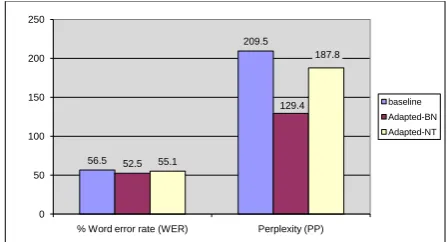
This paper investigates the effectiveness of online temporal language model adaptation when applied to a Thai broadcast news transcription task. Our adaptation scheme works as follow: first an initial language model is trained with broadcast news transcription available during the development period. Then the language model is adapted over time with more recent broadcast news transcription and online news articles available during deployment especially the data from the same time period as the broadcast news speech being recognized. We found that the data that are closer in time are more similar in terms of perplexity and are more suitable for language model adaptation. The LMs that are adapted over time with more recent news data are better, both in terms of perplexity and WER, than the static LM trained from only the initial set of broadcast news data. Adaptation data from broadcast news transcription improved perplexity by 38.3% and WER by 7.1% relatively. Though, online news articles achieved less improvement, it is still a useful resource as it can be obtained automatically. Better data pre-processing techniques and data selection techniques based on text similarity could be applied to the news articles to obtain further improvement from this promising result.
1.
Introduction
Broadcast news transcription is a challenging task due to the spontaneous nature of the input speech and the richness of the language in the news domain. In this paper, we are interested in the second issue, the richness of the news language, specifically, how to create an efficient language model for a Thai broadcast news domain.
Figure 1: Type-token curves of English and Thai broadcast news data
In Figure1, the vocabulary growth in broadcast news data is represented by a type-token curve. We can see that the vocabulary of the Thai broadcast news, taken from the LOTUS-BN corpus (Chotimongkol et al., 2009), grows slightly faster than the vocabulary of the English broadcast news, taken from the LDC-1996 English Broadcast News Transcripts (HUB4) corpus (Graff & Alabiso, 1997). Nevertheless, the vocabularies of both
languages continue to grow even when the sizes of the corpora reach half a million words. In the news domain, new names (e.g. Barack Obama and Port-au-Prince) and new terms (e.g. Facebook and Twitter) are introduced every day. This poses a problem even for a language with rich resources such as English. For a resource-limited language such as Thai, this problem becomes more severe. The number of language corpora, both speech and text, in Thai is quite small. Apart from the high cost in developing a corpus, the lack of word and sentence boundaries is another obstacle as additional pre-processing steps of sentence segmentation and word segmentation are required when dealing with Thai texts.
Our goal is to build an effective language model for a speech recognizer in a broadcast news transcription task. Automatic broadcast news transcription can be applied in many applications such as closed captioning and audio indexing for news search. As new words are introduced every day, as shown in Figure 1, it is quite challenging to develop an efficient language model in a broadcast news domain.
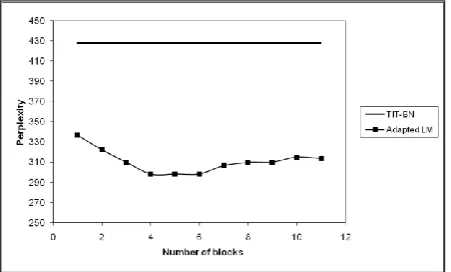
programs broadcasted many months ago. To verify this assumption, we separated the adaptation data (NECTEC-BN) into small blocks according to their broadcast dates and trained a small language model (LM) from each block. The adapted LM was then created by linearly interpolating this LM with the base LM trained from the TIT-BN set. For simplicity, we assigned both LMs equal interpolation weights. The effectiveness of the adaptation data was measured by the perplexity of each adapted language model with respect to the Test-BN set as shown in Figure2. All the LMs are a trigram model and are estimated by the CMU-Cambridge Statistical Language Modeling Toolkit (Clarkson & Rosenfeld, 1997).
Since the news programs in LOTUS-BN are not evenly distributed over time, the time boundaries of each block were adjusted so that it contains about the same amount of data (4,000 utterances). Block1 is a set of adaptation data that is furthest away (in time) from the test set while Block11 is the closest one.
The base LM (TIT-BN) has the highest perplexity as it was trained from the news programs broadcasted more than one year prior to the test set. The graph in Figure2 shows that more perplexity reduction can be achieved when the base LM was adapted with a data set that is closer to the test set. Relative perplexity reduction of 21.2% is achieved when the transcription of the news programs broadcasted just before the test set was used. Perplexity reduction is the result of both the reduction in the out of vocabulary (OOV) rate and the increase in the 3-gram hit rate as shown in Figure 3. The LM that was adapted with more recent data has a lower OOV rate and a higher 3-gram hit rate, thus has a lower perplexity.
Figure 2: The perplexities of the base LM (TIT-BN) and the adapted LMs
Figure 3: The OOV rates and the 3-gram hit rates of the base LM (TIT-BN) and the adapted LMs
Since a larger amount of adaptation data might contribute to more perplexity reduction, we conduct another experiment to identify an appropriate amount of adaptation data. In this experiment, we accumulated data from consecutive blocks. Since the data that is closer to the test set is better adaptation data, we started with Block11. Figure4 shows the perplexities of the adapted LMs when more data from earlier news programs were utilized. The last data point presents the perplexity when all data in the NECTEC-BN set was used.
More adaptation data can further reduce perplexity up to one point. We found that the optimal number of adaptation data is four blocks (200K words) which can achieve 30.3% relative perplexity reduction from the base, uninterpolated, LM. After this point more adaptation data did not seem to help and even slightly increased the perplexity. This finding also confirms that the data that are much further away are less useful for temporal adaptation which makes us consider adjusting the base LM over time in the future.
8.
References
Chen, L., Gauvain, J., Lamel, L., and Adda, G. (2004). Dynamic Language Modeling for Broadcast News. In
Proceedings of INTERSPEECH 2004-ICSLP.
Chotimongkol, A., Saykhum, K., Chootrakool, P., Thatphithakkul, N., and Wutiwiwatchai, C. (2009). LOTUS-BN: A Thai Broadcast News Corpus and Its Research Applications. In Proceedings of Oriental-COCOSDA'09.
Clarkson, P. and Rosenfeld, R. (1997). Statistical Language Modeling Using the CMU-Cambridge Toolkit. In Proceedings of EuroSpeech'97.
Federico, M., and Bertoldi, N. (2004). Broadcast news LM adaptation over time. Computer Speech and Language, 18(4), pp. 417—435.
Graff, D. and Alabiso, J. (1997). 1996 English Broadcast News Transcripts (HUB4). Linguistic Data Consortium, Philadelphia
Haruechaiyasak, C., and Kongyoung, S. (2009). TLex: Thai Lexeme Analyser Based on the Conditional Random Fields. In Proceedings of SNLP’09.
Jongtaveesataporn, M., Wutiwiwatchai, C., Iwano, K., Furui, S. (2008). Thai broadcast news construction and evaluation. In Proceedings of International Conference on Large Resources and Evaluation.
Matsui, A., Segi, H., Kobayashi, A., Imai, T., and Ando, A. (2001). Speech Recognition of Broadcast Sports News. Laboratories Note No. 472. NHK Laboratories. Thangthai, A., Wutiwiwatchai, C., Rugchatjaroen, A., and
Saichum, S. (2007). A Learning Method for Thai Phonetization of English Words. In Proceedings of INTERSPEECH'07.