R
OOTS
: a toolkit for easy, fast and consistent processing
of large sequential annotated data collections
Jonathan Chevelu, Gw´enol´e Lecorv´e, Damien Lolive
IRISA / Universit´e de Rennes 16, rue de Kerampont, Lannion, France
{jonathan.chevelu, gwenole.lecorve, damien.lolive}@irisa.fr
Abstract
The development of new methods for given speech and natural language processing tasks usually consists in annotating large corpora of data before applying machine learning techniques to train models or to extract information. Beyond scientific aspects, creating and managing such annotated data sets is a recurrent problem. While using human annotators is obviously expensive in time and money, relying on automatic annotation processes is not a simple solution neither. Typically, the high diversity of annotation tools and of data formats, as well as the lack of efficient middleware to interface them all together, make such processes very complex
and painful to design. To circumvent this problem, this paper presents the toolkit ROOTS, a freshly released open source toolkit
(http://roots-toolkit.gforge.inria.fr) for easy, fast and consistent management of heterogeneously annotated data.
ROOTSis designed to efficiently handle massive complex sequential data and to allow quick and light prototyping, as this is often
required for research purposes. To illustrate these properties, three sample applications are presented in the field of speech and language
processing, though ROOTScan more generally be easily extended to other application domains.
Keywords:Toolkit, corpus management, speech and language processing, annotated data representation
1.
Introduction
The development of new methods for given speech and nat-ural language processing (NLP) tasks usually faces, beyond scientific aspects, various technical and practical data man-agement problems. First, the sets of required annotated fea-tures and their desired distribution in the training data are rarely the same for two different tasks. For instance, in the field of NLP, developing a named entity extractor on texts mainly requires morphosyntactic and syntactic annotations, and relies on corpora with a high proportion of named enti-ties. At the opposite, a word phonetizer is trained on align-ments between graphemes and phonemes, eventually aug-mented with etymological information, whereas word and phoneme distributions are of lesser importance. Second, many dedicated systems or expert resources exist to pro-vide annotations, e.g., part of speech (POS) taggers, named entity extractors, pronunciation dictionaries, list of proper names, etc. However, most of these tools use different file formats, time scales, or alphabets of tags. This assessment also stands for manual annotation tools since many of them coexist without sharing interoperable formats.
This heterogeneity frequently causes wastes of time when addressing elaborate tasks since a significant part of their resolution is spent in repeatedly converting data represen-tations to others, and in aligning information coming from various tools. Possibly, some information is altered, sim-plified or even lost, while some other is redundantly stored over different files. Beyond the waste of time, this data management complexity can lead to errors in programs and in results, all the more frequently that addressed tasks are nowadays more and more elaborate.
The objective of this paper is to introduce a toolkit, called ROOTS, which homogenizes the management of such anno-tated data and thus simplifies application developments, es-pecially for research purposes, in the frame of speech pro-cessing and NLP. ROOTShas been recently released on the
Internet1under the terms of the GNU Lesser General Public
Licence (LGPL) v3.0. This paper presents this first public version of the toolkit.
Precisely, after positioning ROOTS according to related tools in Section 2, the main features of the proposed toolkit are detailed in Section 3. Following sections then illus-trate its performances on three sample tasks. An unsu-pervised process to create an annotated corpus of e-books is presented in Section 4, while Section 5 demonstrates how simply statistics can be extracted from this corpus using ROOTS, and how it can be interfaced with a more advanced application, namely corpus reduction over a set of constraints.
2.
Positioning
In order to homogenize and to synchronize different anno-tation levels, (Barbot et al., 2011) have initially proposed ROOTSas a theoretical solution based on matrix algebraic relations. A Perl prototype of this solution has been vali-dated in (Bo¨effard et al., 2012) by implementing an audio-book corpus construction process for text-to-speech (TTS). This process was taking advantage of ROOTS to consis-tently represent numerous annotation levels ranging from speech signal segments to syntactic information. Since, a new implementation in C++ has been developed, and ROOTSis now a real complete user-friendly toolkit able to efficiently process large data collections.
Other tools share this ability in the speech, NLP and multi-media communities. Among them, GATE (Cunningham et al., 2002) proposes a framework to develop NLP pipelines. However, GATE rather focuses on delivering tools for (manual or automatic) data labeling through an integrated development environment, but does not provide facilities to
1http://roots-toolkit.gforge.inria.fr
Item 1 Item 2 ... Sequence 1
Sequence 2 ... Utterance 1
Sequence k - 1 Sequence k
...
... Utt. i Utt. i+1 Utt. n
Layer 1
Layer 2
Chunk 1 Chunk 2
... Corpus
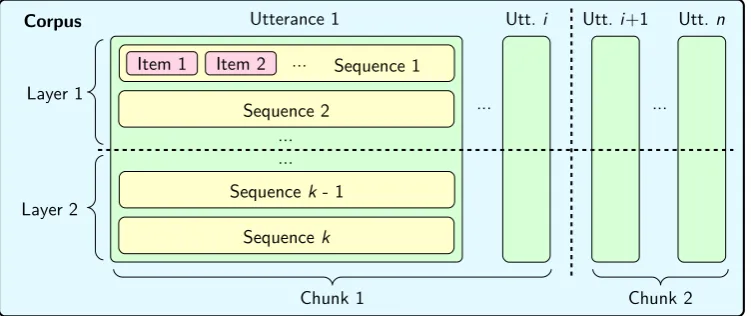
Figure 1: Hierarchical organization of data in ROOTS.
switch between bundled processing components and exter-nal tools.
More recently, the NITE XML Toolkit, or NXT, has been proposed to manage multimodal corpora (Carletta et al., 2005; Calhoun et al., 2010). NXT proposes a generic data organization model able to represent large corpora with a wide range of annotation types. Its philosophy is to con-sider corpora as databases from which data is accessed through a query language. On the contrary, in ROOTS, the user browses data as he sees fit. Furthermore, mechanisms to link heterogeneous annotations are not optimized in NXT whereas this is central in ROOTS.
In a more general approach, UIMA (Ferrucci and Lally, 2004; Ferrucci et al., 2006) proposes software engineering standards for unstructured data management, including an-notation and processing. While this project is supported by the Apache Software Fundation, UIMA is technically too advanced for fast and light prototyping. It is rather de-voted to industrial developments. Moreover, UIMA’s com-mitment stands in imposing a common format to data pro-cessing tools whereas ROOTS’ philosophy rather aims at bridgingad hocformats to easily pipeline data processing tools.
In this spirit, ROOTSis close to work done within the TTS system Festival (Black et al., 2002). This system relies on a formalism called HRG, standing for Heterogenous Rela-tion Graphs, which offers a unique representaRela-tion of differ-ent information levels involved in the TTS system (Taylor et al., 2001). HRG proposes a C++ library with classes for many linguistic, phonological, acoustic, etc., structures and the relations between them. Our tool is different from HRG in the sense that the latter is part of the TTS system Festi-val whereas ROOTSis completely autonomous. Moreover, ROOTScomes along with a true application programming interface (API), in C++ and Perl for the moment.
Finally, handling and analyzing massive collections of an-notated data—which is nowadays often referred to as the “big data” problem—also implies problems to store very large amounts, e.g., petabytes, of information (Jacobs, 2009). Solutions exist to deal with such storage issues, e.g., the system Hadoop (Shvachko et al., 2010). However, this aspect is voluntarily left aside in this paper, as well as in ROOTSin general terms.
the lazy dog
Determiner Adjective Noun
ð ə l eɪ z i d ɔ ɡ
POS
Words
Phonemes
R
wposR
wphFigure 2: Example of three sequences linked by two rela-tions.
The next section draws an overview of the toolkit ROOTS.
3.
Presentation of the toolkit Roots
ROOTS stems from Rich Object Oriented Transcription System. Basically, it provides many mechanisms enabling annotated sequential data generation, management and pro-cessing. This section gives a broad description of ROOTS by presenting the proposed architecture of data, the storage capabilities, and facilities made available to users through the API and wrappers. Finally, a minimal example of code is presented.
3.1.
Logical architecture
As summarized in Figure 1, data are organized hierarchi-cally in ROOTS, starting from fine grain information in items and moving to macroscopic representations as cor-pora.
As a fundamental concept, data in ROOTS is modeled as sequences of items. These items can be of many types, e.g., words, graphemes, named entity classes, signal seg-ments, etc., and can thus represent various annotation lev-els of the same data. Correspondences between items from different sequences are then defined as algebraic relations, leading to a graph where nodes are items and edges are de-rived from relations. An example of a sequence of words along with corresponding POS and phonemes is given in Figure 2. Relations Rwpos andRwph, respectively between
words and POS, and between words and phonemes, are im-plemented as (sparse) matrices. For instance, Rw
1 use roots;
2
3 my $corpus = new roots::Corpus();
4 my $utterance = new roots::Utterance();
5 my $word = new roots::linguistic_Word();
6 my $lemma = new roots::linguistic_Word();
7 my $word_sequence = new roots::WordSequence(” Word ”);
8 my $lemma_sequence = new roots::WordSequence(”Lemma”);
9 my $word2lemma = new roots::Relation($word_sequence, $lemma_sequence);
10
11 $utterance->add_sequence($word_sequence);
12 $utterance->add_sequence($lemma_sequence);
13 $utterance->add_relation($word2lemma);
14
15 while (<>) {
16 chomp;
17 if ($_ ne ” ”) {
18 my ($word_str, $lemma_str) = split(/\t/, $_);
19 $word->set_label($word_str);
20 $lemma->set_label($lemma_str);
21 my $m = $word_sequence->add($word);
22 my $n = $lemma_sequence->add($lemma);
23 $word2lemma->link($m, $n);
24 }
25 elsif ($word_sequence->count() > 0) {
26 $corpus->add_utterance($utterance);
27 $word_sequence->clear();
28 $lemma_sequence->clear();
29 }
30 }
31 if ($word_sequence->count() > 0) { $corpus->add_utterance($utterance); }
32 $corpus->save(” MyCorpus . j s o n ”);
33
34 for (my $i = 0; $i < $corpus->count_utterances(); $i += 1){
35 $utterance = $corpus->get_utterance($i);
36 print $utterance->get_sequence(” Word ”) ->to_string().”\n ”;
37 print $utterance->get_sequence(”Lemma”) ->to_string().”\n ”;
38 print ”−−\n ”;
39 $utterance->destroy();
40 }
Algorithm 1: Sample code using ROOTS’ Perl API.
instance, a binding for Python, which is very popular in the scientific community, is scheduled.
Furthermore, the toolkit comes with various wrapping scripts developed using the Perl API. Those scripts pro-vide facilities for simple operations, e.g., merges of cor-pora and layers, statistics extraction, search, textual and graphical visualization, etc. Other scripts enable command-line imports and exports with the standard speech and language processing tools HTK (Young et al., 2009), Praat (Boersma, 2002), Transcriber (Barras et al., 2001), and WaveSurfer (Sj¨olander and Beskow, 2000).
All sources, scripts and documentations, as well as tutorials, are freely available on http://roots-toolkit.gforge.inria.fr.
The API is illustrated on a first minimal example of code in the next section.
3.4.
Sample code
Let us assume a text file containing sentences where words are given with their lemma. The considered input format is one word per line, words and lemmas are separated by a tabulation, and the end of a sentence is marked by an empty line or the end of file. One wants to write a program which converts the text into a ROOTScorpus and prints the con-tent of this corpus sentence by sentence. An example of input and the corresponding expected output are shown in Table 1.
1 use roots;
2
3 sub count_last_syllables {
4 my $p_frequency = shift;
5 my $utterance = shift;
6
7 my $word_seq = $utterance->get_sequence(” Word ”);
8
9 foreach my $word (@{$word_seq->get_all_items()}) {
10 my @syllables = @{$word->get_related_items(” S y l l a b l e ”)};
11 if($#syllables > 0) {
12 my $last_syllable = pop(@syllables) ->to_string();
13 if(!exists($$p_frequency{$last_syllable}))
14 { $$p_frequency{$last_syllable} = 1; }
15 else { $$p_frequency{$last_syllable} += 1; }
16 }
17 }
18 }
19
20 my %frequency;
21
22 my $corpus = new roots::Corpus(” M y R o o t s F i l e . j s o n ”);
23 for (my $i = 0; $i < $corpus->count_utterances(); $i++) {
24 my $utterance = $corpus->get_utterance($i);
25 count_last_syllables(\%frequency, $utterance);
26 $utterance->destroy();
27 }
28
29 while (my ($syl,$freq) = each(%frequency)) {
30 print ”$s y l\t$f r e q\n ”;
31 }
Algorithm 2: Perl script for syllable frequency computation based on ROOTS.
Syllable Frequency /m˜A/ 1,098,968 /te/ 1,041,858
/tE/ 885,349
/vE/ 822,038
/sj˜O/ 649,986
/se/ 495,601
/ne/ 430,312
/si/ 418,720
/rE/ 417,144
/ve/ 338,582
Table 3: List of the 10 syllables which most frequently end words in the corpus of French e-books.
current utterance, are read (l. 4-5). Then, the word sequence of this utterance is retrieved (line 7) and all the words are browsed (l. 9). For each word, the list of related syllables is computed (l. 10). After checking if the word is not mono-syllabic (l. 11), the last syllable is accessed and its string value is got (l. 12). Finally, the frequency of the current syllable is either initialized or updated (l. 13-15).
This script has been applied on the ROOTS corpus of e-books from Section 4 using the same parallelized com-putational setup as previously. The overall execution has lasted about20min, with a duration of1min and a300MB
memory usage on average per e-book. The resulting top 10 most frequent syllables is given in Table 3. A quick anal-ysis on these results show that most words end with/m˜A/, which is a typical ending for adverbs in French, or with/e/ or/E/, which are verb inflection marks in French for past participles and the imperfect tense, respectively. Hence, the results are consistent with the narrative style of the corpus.
5.2.
Corpus reduction
Besides simplicity, delivering efficient processing skills is a key aspect. This section now shows that ROOTSis perfectly suited for such a demand by addressing a corpus reduction problem as a second sample task. Corpus reduction con-sists in extracting from a huge corpus a minimal sized sub-set which satisfies a sub-set of constraints over features of the corpus. Corpus reduction is a prerequisite for some tasks where the quality of results mainly depends on the diver-sity of the reference corpus content but where considering a very large corpus is prohibitive.
To illustrate the work flow, corpus reduction has been ap-plied to the annotated corpus of e-books of Section 4. Two constraints for the target reduced corpus were considered:
• every phoneme paired with its corresponding POS should appear at least twice;
• and every trigram of phonemes, independently of their related POS, should appear at least once.
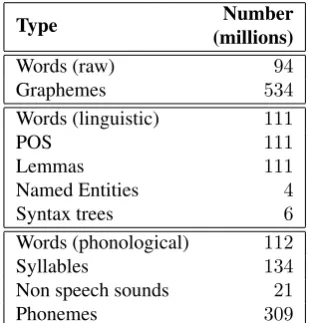
The corpus covers10,246unique phoneme-POS pairs and 31,612unique phoneme trigrams. Using the same experi-mental setup as previously, the process compiled informa-tion from e-books during about3h30min (ROOTS) before computing a solution in only2min40s (specialized algo-rithm). As a result, while the full corpus is made of6.2 mil-lion sentences and sizes309million phoneme instances, the returned solution contains only17,846sentences (0.3% of the full corpus) and547,111phoneme instances (0.2% of the full corpus). A major interest of ROOTS is that this work flow can be applied to any corpus without changing anything except the names of sequences under study and requested minimal frequencies of their items.
6.
Conclusion and further developments
In this paper, we have presented a powerful toolkit called ROOTSwhich enables easy, fast and consistent generation, management and processing of large annotated sequential data collections. After presenting the toolkit itself, these abilities have been demonstrated through three application examples. This toolkit is efficient, fully operational, open source, widely documented, and easily extensible.Further developments are already planed for future re-leases. First, a graphical user interface to allow manual editing and annotation correction will be added. New file formats should be integrated to optimize read/write perfor-mances for time-critical applications, or to become com-pliant with standards from various communities. Likewise, more wrappers for existing automatic taggers and data pro-cessing tools will be integrated. More fundamentally, se-quences should be extended to lattices in order to enable information uncertainty modeling when needed. Finally, corpora generated using ROOTSon free data sets should be made available. Especially, the corpus of French e-books should be published in the near future.
7.
Acknowledgements
This work has been partially funded by the Agence Na-tionale de la Recherche (France) as part of the project ANR-CONTINT 2011 Phorevox.
8.
References
Barbot, N., Barreaud, V., Bo¨effard, O., Charonnat, L., Del-hay, A., Le Maguer, S., and Lolive, D. (2011). Towards a versatile multi-layered description of speech corpora using algebraic relations. InProceedings of Interspeech, pages 1501–1504.
Barras, C., Geoffrois, E., Wu, Z., and Liberman, M. (2001). Transcriber: development and use of a tool for assist-ing speech corpora production. Speech Communication, 33(1-2):5–22.
Black, A. W., Taylor, P., Caley, R., and Clark, R. (2002). The Festival speech synthesis system. Technical report, University of Edinburgh.
Boersma, P. (2002). Praat, a system for doing phonetics by computer. Glot international, 5(9/10):341–345.
Bo¨effard, O., Charonnat, L., Le Maguer, S., Lolive, D., and Vidal, G. (2012). Towards fully automatic annotation of audiobooks for TTS. InProceedings of LREC, pages 975–980.
Calhoun, S., Carletta, J., Brenier, J. M., Mayo, N., Ju-rafsky, D., Steedman, M., and Beaver, D. (2010). The nxt-format switchboard corpus: a rich resource for investigating the syntax, semantics, pragmatics and prosody of dialogue. Language Resources and Evalua-tion, 44(4):387–419.
Carletta, J., Evert, S., Heid, U., and Kilgour, J. (2005). The NITE XML toolkit: Data model and query language.
Language Resources and Evaluation, 39(4):313–334. Chevelu, J., Barbot, N., Bo¨effard, O., and Delhay, A.
(2008). Comparing set-covering strategies for optimal corpus design. In Proceedings of LREC, pages 2951– 2956.
Cunningham, H., Maynard, D., Bontcheva, K., and Tablan, V. (2002). GATE: an architecture for development of ro-bust HLT applications. Proceedings of the Annual Meet-ing of the ACL, pages 168–175.
Ferrucci, D. and Lally, A. (2004). UIMA: an architectural approach to unstructured information processing in the corporate research environment. Natural Language En-gineering, 10(3-4):327–348.
Ferrucci, D., Lally, A., Gruhl, D., Epstein, E., Schor, M., Murdock, J. W., Frenkiel, A., Brown, E. W., Hampp, T., Doganata, Y., et al. (2006). Towards an interoperability standard for text and multi-modal analytics.
Jacobs, A. (2009). The pathologies of big data. Communi-cations of the ACM, 52(8):36–44.
Shvachko, K., Kuang, H., Radia, S., and Chansler, R. (2010). The Hadoop distributed file system. In Proceed-ings of the IEEE 26th Symposium on Mass Storage Sys-tems and Technologies (MSST), pages 1–10.
Sj¨olander, K. and Beskow, J. (2000). Wavesurfer - an open source speech tool. InProceedings of Interspeech, pages 464–467.
Taylor, P., Black, A. W., and Caley, R. (2001). Hetero-geneous relation graphs as a formalism for representing linguistic information. Speech Communication, 33(1-2):153–174.