Towards an Encyclopedia of Compositional Semantics:
Documenting the Interface of the English Resource Grammar
Dan Flickinger
♣, Emily M. Bender
♦, and Stephan Oepen
♠♥ ♣Stanford University, Center for the Study of Language and Information♦University of Washington, Department of Linguistics ♠University of Oslo, Department of Informatics ♥Potsdam University, Department of Linguistics
[email protected],[email protected],[email protected]
Abstract
We motivate and describe the design and development of an emerging encyclopedia of compositional semantics, pursuing three objec-tives. We first seek to compile a comprehensive catalogue of interoperable semantic analyses—i.e. a precise characterization of meaning representations for a broad range of common semantic phenomena. Second, we operationalize the discovery of semantic phenomena and their definition in terms of what we call their semantic fingerprint, a formal account of the building blocks of meaning representation involved and their configuration. Third, we ground our work in a carefully constructed semantic test suite of minimal exemplars for each phenomenon, along with a ‘target’ fingerprint that enables automated regression testing. We work towards these objectives by codifying and documenting the body of knowledge that has been constructed in a long-term collaborative effort, the development of the LinGO English Resource Grammar. Documentation of its semantic interface is a prerequisite to use by non-experts of the grammar and the analyses it produces, but this effort also advances our own understanding of relevant interactions among phenomena, as well as of areas for future work in the grammar.
Keywords:Semantic phenomena; grammar engineering; English Resource Grammar
1.
Motivation
In this work, we pursue three objectives, one theoretical, one methodological, and one practical. First, we seek to compile acomprehensive catalogueof semantic analyses— i.e. a precise characterization of meaning representations for a broad range of common semantic phenomena—that are mutually compatible. Second, we operationalize the
discovery and definitionof semantic phenomena in terms of what we call theirsemantic fingerprint, a formal account of the building blocks (of meaning representation) involved and their configuration. Third, we ground our work in a carefully constructedsemantic test suiteof minimal exem-plars for each phenomenon, paired with a free-text discus-sion of relevant properties, as well as a ‘target’ fingerprint that enables automatedregression testingin a grammar en-gineering context.
We work towards these objectives by codifying and doc-umenting the body of knowledge that has been constructed in a long-term collaborative effort, the development of the LinGO English Resource Grammar (ERG; see §2.). As a general-purpose, linguistically motivated resource, the ERG is designed to provide a declarative, bidirectional mapping between form and meaning, i.e. between natural language utterances and associated logical-form semantic analyses. Reflecting some twenty-five person years of de-sign and development to date, the grammar encompasses a large body of design decisions about the syntax–semantics interface, all implemented jointly in one consistent formal system and interacting in subtle ways.1 Documentation of
the semantic interface of the ERG is a prerequisite to use
1We particularly acknowledge the sustained contributions of
Ann Copestake and Ivan Sag over the years to the designs of the semantic analyses implemented in the ERG; Copestake also had a key role in developing a closely related semantic test suite, which our exemplar construction (in §8.) extends in various dimensions.
of the resource by non-experts, but this effort also advances our own understanding of relevant interactions among phe-nomena, as well as of areas for future work in the grammar.
2.
Background
The ERG is an implementation of the grammatical theory of Head-driven Phrase Structure Grammar (HPSG; Pollard & Sag, 1994) for English, i.e. a computational grammar that can be used for parsing and generation. Development of the ERG started in 1993, building conceptually on earlier work on unification-based grammar engineering for English at Hewlett Packard Laboratories (Gawron et al., 1982). The ERG has continuously evolved through a series of R&D projects (and two commercial applications) and today al-lows the grammatical analysis of running text across do-mains and genres, using an inventory of 222 syntactic rules, and 84 lexical rules for inflection, derivation, and punctua-tion. The hand-built ERG lexicon of some 38,000 lemmata, organized in a rich hierarchy of lexical types, aims for com-plete coverage of function words and open-class words with ‘non-standard’ syntactic properties (e.g. argument struc-ture). Built-in support for light-weight named entity recog-nition and an unknown word mechanism typically enable the grammar to derive complete syntactico-semantic analy-ses for85–95percent of all utterances in standard corpora, including newspaper text, the English Wikipedia, or bio-medical research literature (Flickinger et al., 2012, 2010; Adolphs et al., 2008).
available). In mid-2013, the current version of Redwoods encompasses gold-standard ERG analyses for 85,400 ut-terances (∼1.5 million tokens) of running text from half a dozen different genres and domains, including the first 22 sections of the venerable Wall Street Journal (WSJ) text in the Penn Treebank (PTB; Marcus et al., 1993).
A core element of the design of HPSG ensures that de-scriptions of signs (words or phrases) include not only syntactic but also semantic constraints. Consistent with the underlying grammatical theory, ERG analyses main-tain semantic compositionality, with the meaning of a given phrase consisting of the meanings of its components, to-gether with any semantic contribution of the syntactic or lexical rule used to construct the phrase. These analyses also preserve monotonicity, so that any semantic contribu-tion of a sign remains present in any larger containing con-stituent.
3.
MRS Fundamentals
Meaning representation and composition in the ERG builds on the formal framework of Minimal Recursion Semantics (MRS; Copestake et al., 2005), a description language for logical-form semantics that affords scope underspecifica-tion. Our focus in this work, however, is on representa-tion (and composirepresenta-tion) more than on logic, and we will not dwell on details such as scope underspecification or inter-pretation.
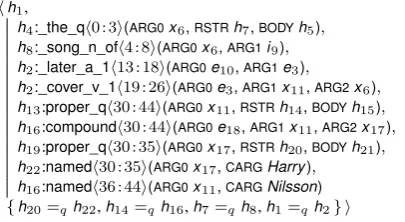
We illustrate key properties of MRS with Figure 1, the semantic analysis derived by the ERG for (1):
(1) The song was later covered by Harry Nilsson.
Basic Building Blocks The representation in Figure 1 formally is a triplehT, R, Ci, withTbeing the (global) top handle, R a set ofelementary predications, and C a set of handle constraints. Each elementary predication (EP) is comprised of apredicate(an identifier of the relation) and a set ofrole–argumentpairs, where the roles draw from a small, fixed inventory of role lables: ARG0, . . . , ARG4for ‘regular’ arguments;RSTRandBODYon generalized quan-tifiers; and a few others in more specialized constructions). Role values (i.e. arguments) are variables. Predicates can be optionally parameterized by a constant argument, and these parameters are noted as aCARGpseudo-role. Finally, handle constraints are an element of the MRS mechanics of scope underspecification, expressing a binary relation be-tween two handles. The ERG limits itself to only one type of handle constraint, called=q, representing handle equal-ity modulo quantifier insertion.
Variable Types There are three types of variables in MRS, event(ualitie)s (of typeei), instances(of typexj), and labels or handles (of type hk; shown as prefixes on predicates in Figure 1). Of these, the latter serve a formalism-internal role, to identify groups of conjoined predications, designate scopal arguments, and facilitate scope underspecification; assuming a suitable variant of predicate logic as the object language, MRS handles will not map onto logical variables. Eventualities and instances, on the other hand, prototypically correspond to the seman-tics of verbal and nominal expressions, respectively, i.e.
hh1,
h4:_the_qh0 : 3i(ARG0x6,RSTRh7,BODYh5), h8:_song_n_ofh4 : 8i(ARG0x6,ARG1i9), h2:_later_a_1h13 : 18i(ARG0e10,ARG1e3),
h2:_cover_v_1h19 : 26i(ARG0e3,ARG1x11,ARG2x6), h13:proper_qh30 : 44i(ARG0x11,RSTRh14,BODYh15), h16:compoundh30 : 44i(ARG0e18,ARG1x11,ARG2x17), h19:proper_qh30 : 35i(ARG0x17,RSTRh20,BODYh21), h22:namedh30 : 35i(ARG0x17,CARGHarry),
h16:namedh36 : 44i(ARG0x11,CARGNilsson)
{h20=qh22,h14=qh16,h7=qh8,h1=qh2} i
Figure 1: MRS meaning representation for example (1).
eventuality variables denote states or activities, while in-stance variables will typically correspond to (referential or abstract) entities.
In addition to these most specific variable types, there are underspecifications as follows:i(forindividual) is a super-type of eventualities and instances; p(the half-way mark in the alphabet betweenh andx) is a supertype of labels and instances; andu(forunspecificor maybe unbound) is a supertype of all of the above.
Although not shown in Figure 1, non-label variables can be ‘refined’ with what we call variable properties, e.g.
TENSEorSF(sentence force) on eventualities, andNUM(ber) or PERS(on) on instances. Variable properties record se-mantic reflexes of morpho-syntactic information and range over a fixed inventory of possible values, organized in a multiple-inheritance hierarchy to allow underspecification.
Construction Semantics While most EPs correspond to particular lexical items, EPs can also be contributed by grammar rules. In Figure 1 for example, the two-place
compoundrelation provides the bracketing of the complex proper nameHarry Nilsson. Syntax, however, does not nec-essarily determine the exact internal structure of complex nominals, e.g. the (likely) interpretation ofHarryas a first name, in this case. We return to the analysis of underspeci-fied compound structures and to the notion of construction semantics in §4. and §6. below, respectively.
Argument Identification In the ERG, all elementary predications have anARG0role, providing theintrinsic ar-gumentof a relation, e.g. the instance variable introduced by the semantics of a nominal expression, or the eventuality corresponding to the semantics of a verbal expression in a (Neo-)Davidsonian representation.2For what is quite likely
a blend of linguistic and technical reasons, the ERG also introduces intrinstic variables in the semantics of, among others, adjectives, adverbs, and prepositions—eventualities in all three cases.
In addition toARG0, most EPs will take additional argu-ments, labeledARG1,ARG2etc. Note that these labels are not intended to evoke consistent roles across different pred-icates, though within a predicate their interpretation is con-sistent. In particular, observe how role assignment is nor-malized at the level of semantics: the mapping of syntactic functions to semantic arguments is reversed in the passive
2The distinguished nature of the
construction, but in ERG ouputs the passive and active vari-ants receive identical semantics: the instance variable asso-ciated withHarry Nilsson,x11, is theARG1(‘deep subject’)
of the_cover_v_1predication—as would be the case with other diathesis alternations analyzed by the grammar, e.g. the dative shift inKim gave Sandy a book.vs.Kim gave a book to Sandy.For a more in-depth motivation of these de-sign decisions in ERG semantics, please see the discussion of ‘slacker semantics’ by Copestake (2009).
4.
Semantic Fingerprints
We characterize individual semantic phenomena in terms of their ‘fingerprints’, i.e. those pieces of a full MRS which uniquely identify the phenomenon. We utilize a compact template language for fingerprints that closely resembles the query language defined by Kouylekov & Oepen (2014) for searching large MRS collections. In our fingerprint lan-guage, irrelevant roles, handles, and other information like character spans can be left unspecified, and we further al-low wild-carding over predicate symbols, role labels, and variable properties. As an example, (2) shows the seman-tic fingerprint for basic nominal compounding, as in e.g.
garden dog:
(2)
h
h0:compound(ARG1x1,ARG2x2), h0: (ARG0x1),
(ARG0x2)
{ } i
This phenomenon is characterized by the appearance of the underspecified two-place compound relation, linking to-gether another two EPs in the configuration indicated by the shared label h0 (of the compound head and the
two-place modifier relation) and the shared instance variables
x1andx2. Comparing (2) to Figure 1, the fingerprint match
operationalizes the generalization that the ERG analysis of complex names constitutes an instance of the semantic phe-nomenon of (nominal) compounding.
Besides their use in making explicit (and operational) how we define individual semantic phenomena in the space of meaning representations available from the ERG, we anti-cipate that the fingerprint template language and automated comparison of fingerprints to full MRSs will have engineer-ing utility in various contexts. For example, the approach to searching very large collections of MRSs developed by Kouylekov & Oepen (2014) can be combined with our in-ventory of semantic phenomena and associated fingerprints to retrieve and aggregate instances of these phenomena in naturally occurring text, e.g. ERG treebanks or treecaches. Such statistics could serve, for example, to approximate relative frequencies of phenomena, quantitative patterns of interaction with other phenomena, and also an estimate of what proportion of an average ERG analysis is covered (i.e. matched by fingerprints) by explicit documentation.
5.
A Near-Complete Example
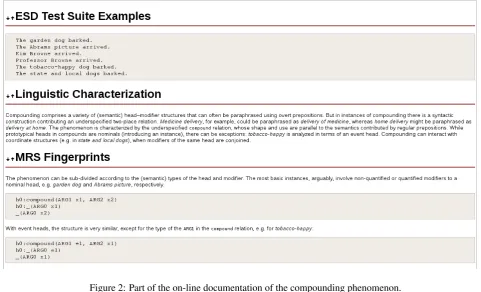
To give an idea of what the documentation for each phe-nomenon looks like, Figure 2 shows about two thirds of the current page for compounding. This documentation is grounded in a collection of test suite examples (see §8. be-low), and each page instantiates a templatic structure, with
a pre-defined set and ordering of section headers. In addi-tion to the ones shown in Figure 2, the template comprises sections for (a) additional Motivating Examples, building on richer context or more specialized vocabulary than is generally used in the test suite, or contrasting with neg-ative examples; (b) a discussion of (non-trivial) Interac-tions with other semantic phenomena; and (c) compara-tively free-form reflections on the phenomenon, the devel-opment status of its semantic analysis, or relevant aspects of composition and the syntax–semantics interface.
There is of course great variation in the complexity and internal sub-division of different phenomena and, thus, the appropriate breadth and depth of documentation. Our run-ning compounding example ranges somewhere in the mid-dle of this (intuitive) scale. At the level of meaning rep-resentation, the underspecified semantic analysis assigned by the ERG is comparatively simple and very regular. At the same time, there is non-trivial syntactic variation (in-volving for example common nouns, proper names, and titles, as well as non-nominal heads) in this construction. Likewise, the same two-placecompoundrelation is intro-duced (twice) in a little-studied but not infrequent construc-tion that Bender et al. (2011) term N-ed, as for example in
rabbit-eared dog. Here, despite the seemingly verbal in-flection oneared, the analysis is in terms of nested inter-sective modification between three instance variables, i.e. analogous to a paraphase using two prepositions:dog with ears like a rabbit. Thus, in this example, there is a compar-atively high degree of normalization in mapping between a range of syntactic structures and an underspecified meaning representation.
6.
Phenomena Discovery
The first step in the creation of the encyclopedia is the de-velopment of an inventory of analyses of phenomena to document. The delineation of linguistic phenomena is a notoriously difficult problem, as linguistic categories tend to have central prototypes and fuzzy boundaries, and fur-thermore can be classifed at verious levels (e.g. coordina-tion subsumes NP coordinacoordina-tion, VP coordinacoordina-tion, S coordi-nation, etc. as well as coordination of unlike constituents). However, as our task is to document the analyses developed within the ERG, we do not need ana priorilisting of phe-nomena but rather can work from the grammar to discover how it equates and distinguishes different sentence types. This process isdata-drivenon two levels: On a conceptu-ally prior level, the analyses in the ERG were developed in the context of and to account for naturally occurring lin-guistic data. Building on that, we extract parts of the ERG encoding semantic analyses and classify them according to common properties in order to arrive at our notion of ‘phe-nomena’. We thus developed a discovery procedures that starts from what we call grammar entities: phrase struc-ture rules, lexical rules, and lexical entries. This discov-ery procedure can be understood as a means to classify the syntactic building blocks in the grammar according to their semantic effects; the set of categories that emerge from that classification are the first pass at our set of phenomena.
Figure 2: Part of the on-line documentation of the compounding phenomenon.
semantic analyses that go ‘beyond the basics’. For phrase structure and lexical rules, we identify all instances which contribute predications of their own. For the lexical entries, we work from what the ERG calls lexical types, i.e. a hand-built collection of around a thousand fine-grained lexical categories. In our search for non-basic semantic phenom-ena that manifest themselves in lexical types, we included those that (a) contribute more than one predication, i.e. have lexically decomposed semantics; or (b) take at least one scopal argument.
Each grammar entity (or type) activated by these discov-ery heuristics is then associated with a signature, for the time being just its (multi-)set of semantic predicates. We then create rough clusters based on shared signatures, clus-tering only within broad entity classes (phrase structure rules, lexical rules, or lexical types). Each such cluster presents a candidate semantic phenomenon. The ERG (in its 1212 release) distinguishes 222 phrase structure and 84 lexical rules; of these, 135 and 27, respectively, were ac-tivated as potentially interesting grammar entities, and the corresponding semantic signatures form 39 and 18 distinct clusters, respectively.
The next step in the procedure is to manually inspect the clusters to determine whether they are internally consistent and whether any should be combined into larger clusters. We found that this step was greatly facilitated by looking at examples of actual sentences (from running text) that illus-trate the functioning of the grammar entities in question. To find these examples, we indexed the items in the Redwoods Treebank by their usage of relevant grammar entities and then extracted the three shortest examples for each gram-mar entity. An example showing the results of this proce-dure for two rules in the compounding cluster is shown in Figure 3.
J-N_N-ED_C: compound udef_q
|Is Dumbo four-legged?| 1 3 fracas |She is good-natured.| 1 3 rtc000
|These cookies are star-shaped.| 1 4 rtc000 Total instances in all corpora: 73
N-HDN_TTL-CPD_C: compound udef_q
|Bus stop/parking at Borgund Stave church.| 1 6 rondane |Fondsbu tourist lodge was opened in 1993.| 1 7 jh2 |Olavsbu self-service cabin was opened in 1952.| 1 7 jh2 Total instances in all corpora: 31
Figure 3: Examples extracted for compounding cluster.
Working from the candidate clusters derived for the phrase structure rules and lexical rules and their associ-ated examples, we derived an initial set of about two dozen high-level semantic phenomena to validate and document. These range from the mundane (including, for example, the semantics associated with complex literal numbers or foreign-language expressions, fragmentary utterances, or parentheticals) to the intricate, as for example the seman-tics of measure phrases, partitives, conditionals, or coor-dination. Some of our candidate phenomena identified by MRS signatures straddle the semantics–pragmatics divide, in the sense of providing what to us seems like an MRS-based encoding of quasi-semantic or para-semantic infor-mation, e.g. the foregrounding effects of topicalization orit
clefts.
lexical types that should be explored. In future work, we plan to refine the discovery procedure as applied to lexical types in order to develop a more comprehensive inventory of semantic phenomena to document. In the meantime, we have identified an initial set of a dozen or so phenomena whose semantic analyses are encoded in lexical types, in-cluding such elements as cardinal adjectives, control rela-tions, pro-verbs (e.g. ‘do so’), and identity copulae.
7.
Towards an Inventory of Semantic
Phenomena
Our emerging encyclopedia is currently implemented as a set of wiki pages,3populated with an initial list of phenom-ena that emerged from the discovery procedure described above, including 22 that are tied to syntactic or lexical rules. These encompass frequently occurring phenomena such as coordination, compounds, and nominalization, as well as less frequently encountered phenomena such as vocatives or instrumental relative clauses. At present, there are sep-arate pages now in place for more than a third of these phenomena, providing for each a brief linguistic character-ization, some motivating examples, the MRS fingerprint(s), discussion of interactions with other phenomena, and a set of open questions about the chosen MRS representation, to assist in further refinements of either the documentation or the grammar.
Already, the process of recording these descriptions has in several instances led to the identification of unneces-sary differentiation in the MRSs assigned to closely related variants, pointing the way to desirable improvements to the ERG toward more uniformity. For example, the implemen-tation of the rules for some of the types of compounds in-troduced slightly different names for the two-place relation added by the constructions, and in the absence of any ob-served benefit for these varient names, we arrived at a ben-eficial normalizing of the predicate name across the range of compounding phenemena.
We expect to have completed the documentation of these 22 rule-anchored phenomena within a matter of weeks, and will then turn our attention to the refinement and documen-tation of the list of phenomena anchored in lexical types. The existing wiki page already includes a list of some 16 such phenomena, including comparative and superlative adjectives, possessives, control predicates, and verb particle constructions. This inventory will grow as we improve our discovery procedure for identifying distinctive MRS finger-prints among the 1000 lexical types employed in the ERG.
8.
Semantic Test Suite
As we examine each semantic phenomenon in turn, we identify phenomenon-internal semantic variation and con-struct an emerging test suite of minimal sentences, to include at least one canonical exemplar of each sub-phenomenon. Test suite entries are constructed by simpli-fication of running-text examples found through the dis-covery procedure sketched above, eliminating irrelevant syntactic complexity and minimizing vocabulary variation. The test suite is parsed with the ERG and disambiguated
3http://moin.delph-in.net/ErgSemantics
using the standard Redwoods methodology. Careful study of the MRS that the ERG assigns in the intended analysis of each exemplar informs our documentation effort, and is the basis for a four-way classification of our degree of confi-dence in the actual analysis. In some cases, current analyses reflect a careful design process (e.g. building on supporting literature or revisions of earlier attempts); in other cases, there may be known minor deficiencies; and for yet another group of semantic phenomena, current ERG analyses may be mere placeholders (‘sewing things together’ somehow, without a deep commitment to the analysis); or an analy-sis may simply be broken, i.e. formally not well-formed or otherwise indefensible.
The current test suite consists of some 65 sentences, each exhibiting some distinctive single semantic phenomenon which derives some aspect of its composition from a syn-tactic construction or lexical rule which is not semantically transparent. For conditionals, for example, the test suite in-cludes the pairIf Abrams arrived, Browne barked.andHad Abrams arrived, Browne would have barked. These exem-plars yield structurally isomorphic semantics but differ in the specific predicate encoding the (lexical or structural) conditional. However, syntactic variants that result from merely re-ordering the two clauses are not represented in our test suite, as they are semantically equivalent.
More generally, the test suite may for a given phe-nomenon include multiple examples for which the ERG as-signs the same MRS, in order to confirm that differing paths of composition (due to different syntactic structures) do in fact arrive at the same MRS when desired. For example, we may include for the partitive construction not onlyAll of the dogs barkbut alsoAll the dogs barkto ensure that the gram-mar produces the same MRS for both variants. The test suite can also include multiple MRS-equivalent examples for constructions where that semantic equivalence may be unexpected or not obvious. For example, the ERG assigns nearly identical MRS representations for the following two examples illustrating possessive constructions in English:
(3) My old friends arrived. Old friends of mine arrived.
Here the ERG is rather carefully designed to assign (nearly) the same MRS to both the lexical and the periphrastic pos-sessives, and the inclusion of both in the test suite helps to ensure the preservation of that equivalence as the grammar develops further.
correction of the grammar. Once we expand our documen-tation to include lexicalized non-basic semantic effects, this test suite will grow significantly in size.
9.
Related Work
Where most theoretical work on compositional seman-tics focuses on fundamentals (e.g. the representation of predicate–argument structure or of scopal operators), han-dling compositional semantics in a broad-coverage gram-mar also requires working out representations of many different phenomena which are encountered in naturally occurring language, working out which syntactically dis-parate phenomena should in fact map to the same seman-tic representations, and finally making sure the analyses of various individual phenomena are interoperable with each other. It is in this sense that the analyses implemented in the ERG have been developed in a data-driven fashion and as such it is of interest to compare the collection of analyses we document in the encyclopedia with other collections of descriptions of semantic phenomena which have been de-veloped on the basis of exploration of naturally occurring text.
The only such collections we have been able to identify are the annotation guidelines for large-scale semantic an-noation projects, including the English PropBank Annota-tion Guidelines (Bonial et al., 2012), the FrameNet annota-tion guidelines (Ruppenhofer et al., 2010), and the Abstract Meaning Representation (AMR) Specification (Banarescu et al., 2014). One fundamental difference between tic annotation guidelines and our encyclopedia of seman-tic analyses is that the guidelines were developed to guide humans to consistently annotate the phenomena of interest in the same way, whereas we are documenting the analy-ses that are programmatically produced by the ERG. These analyses are manually developed, but their progammatic application raises the bar for both interoperability of the analyses with each other and comprehensiveness: for the grammar to work in both parsing and generation, every component of every analyzed sentence must either make a specific contribution to the semantic representation or be explicitly designated as semantically empty. On the other hand, while the underlying grammar must meet this bar of comprehensiveness, the encyclopedia itself is a work in progress with only partial coverage over the phenomena an-alyzed.
PropBank and FrameNet in particular are only focused on annotating specific parts of semantic representations (the identification of a subset of predicates and their argu-ments and modifiers). For example, PropBank does not ad-dress the issue of noun-noun compounds (though FrameNet does, looking to identify specific roles for the non-head if the head noun is ‘frame-evoking’); neither PropBank nor FrameNet specify representations for conditionals. AMR on the other hand does strive for spanning analyses, though unlike PropBank, FrameNet and the semantic representa-tions produced by the ERG, AMR incorporates a design decision to create representations that are not closely tied to the syntactic structure of the strings being annotated. This abstraction from the actual utterance among other things leaves room to not annotate the contribution of particular
elements.
Nonetheless, all of these resources represent discussions of design decisions about semantic representations, and one scientific benefit of the existence of the documentation is the possiblity for detailed comparison where there is over-lap. One example of a phenomenon that is addressed by all the resources is infinitival purpose clauses (‘quasi-modal infinitives’, in our resource).
10.
Outlook & Future Work
We believe the methodology sketched above offers a good balance of automation and expert analysis. We are currently working through our initial inventory of semantic phenom-ena represented in the ERG, in each instance reviewing cur-rent analyses and relevant literature, to then provide a high-level textual discussion of the phenomenon (and any sub-phenomena) as well as its formal fingerprint. For maximum accessibility, we prepare an on-line, open-source repository of documentation and supporting data,4which we hope will grow over time into a community-supported ‘encyclopedia’ of ERG semantic analyses. As with other long-term open-source projects of non-trivial complexity, we anticipate that an organizational challenge may arise in balancing commu-nity involvement vs. correctness and authority of the avail-able information. With a relatively small core group of developers and a large remaining body of implicit shared knowledge, we believe the ‘open collaborative’ authoring model of a resource like Wikipedia may not be the ideal setup, and we will probably rather look for methodological inspiration in a (much larger) project like the Linux kernel. However, our ambitions transcend improvement and doc-umentation of one grammar. There is growing interest in parsing into formal representations of meaning, often us-ing the label ‘semantic parsus-ing’ (e.g. Yahya et al., 2012, Cai & Yates, 2013, and Kwiatkowski et al., 2013, inter alios). Some of this work frames the task in terms of map-ping from surface strings to application-specific represen-tations of meaning. Our approach instead involves craft-ing general-purpose, application-independent semantic rep-resentations which strive to capture all and only the cues tospeaker meaningencoded as the conventionalsentence meaningof a given utterance.
Formal semantic representations as a generic interface to parsing are subject to constraints from multiple disciplines: (computational) linguistics capitalizes on representational adequacy and compositional compatibility with syntax and morphology; formal semantics traditionally has its focus on aspects of mathematical logic, truth conditions, and support for inference; application development, finally, emphasizes more practical requirements—for example that represen-tations are sufficiently detailed, yet easy to comprehend,
4
and stable over time. Reconciling such different points of view remains a major challenge and, we believe, a bar-rier to wider uptake of broad-coverage parsing into general-purpose semantic target representations. Once there is suf-ficient critical mass of manually reviewed, documented, exemplified, and fingerprinted ERG analyses, we will in-vite others to pair our semantic test suite with alternative views on phenomena characterization and semantic analy-sis. Ideally, this community exercise will result in cross-framework, parallel, aligned semantic annotations and will thus further the scholarly discourse about balancing re-quirements on computational semantics along the above three dimensions.
References
Adolphs, P., Oepen, S., Callmeier, U., Crysmann, B., Flickinger, D., & Kiefer, B. (2008). Some fine points of hybrid natural language parsing. InProceedings of the 6th International Conference on Language Resources and Evaluation. Marrakech, Morocco.
Banarescu, L., Bonial, C., Cai, S., Georgescu, M., Griffitt, K., Hermjakob, U., . . . Schneider, N. (2014). Abstract Meaning Representation (AMR) 1.1 specification. Re-trieved from http://www.isi.edu/~ulf/amr/ help/amr-guidelines.pdf (Version of February 11, 2014)
Bender, E. M., Flickinger, D., Oepen, S., & Zhang, Y. (2011). Parser evaluation over local and non-local deep dependencies in a large corpus. In Proceedings of the 2011 Conference on Empirical Methods in Natural Lan-guage Processing(p. 397 – 408). Edinburgh, Scotland, UK.
Bonial, C., Hwang, J., Bonn, J., Conger, K., Babko-Malaya, O., & Palmer, M. (2012). English PropBank annotation guidelines. Retrieved from
https://verbs.colorado.edu/propbank/ EPB-Annotation-Guidelines.pdf
Cai, Q., & Yates, A. (2013). Large-scale semantic parsing via schema matching and lexicon extension. In Proceed-ings of the 51th Meeting of the Association for Computa-tional Linguistics(p. 423 – 433). Sofia, Bulgaria: Asso-ciation for Computational Linguistics.
Copestake, A. (2009). Slacker semantics. Why superficial-ity, dependency and avoidance of commitment can be the right way to go. InProceedings of the 12th Meeting of the European Chapter of the Association for Computa-tional Linguistics(p. 1 – 9). Athens, Greece.
Copestake, A., Flickinger, D., Pollard, C., & Sag, I. A. (2005). Minimal Recursion Semantics. An introduction.
Research on Language and Computation, 3(4), 281 – 332.
Flickinger, D., Oepen, S., & Ytrestøl, G. (2010). WikiWoods. Syntacto-semantic annotation for English Wikipedia. InProceedings of the 7th International Con-ference on Language Resources and Evaluation. Malta. Flickinger, D., Zhang, Y., & Kordoni, V. (2012).
Deep-Bank. A dynamically annotated treebank of the Wall Street Journal. InProceedings of the 11th International Workshop on Treebanks and Linguistic Theories(p. 85 – 96). Lisbon, Portugal: Edições Colibri.
Gawron, J. M., King, J., Lamping, J., Loebner, E., Paulson, E. A., Pullum, G. K., . . . Wasow, T. (1982). Processing English with a Generalized Phrase Structure Grammar. In Proceedings of the 20th Meeting of the Association for Computational Linguistics(p. 74 – 81). Toronto. Kouylekov, M., & Oepen, S. (2014). Semantic
technolo-gies for querying linguistic annotations. An experiment focusing on graph-structured data. In Proceedings of the 9th International Conference on Language Resources and Evaluation. Reykjavik, Iceland.
Kwiatkowski, T., Choi, E., Artzi, Y., & Zettlemoyer, L. (2013). Scaling semantic parsers with on-the-fly ontol-ogy matching. In Proceedings of the 2013 Conference on Empirical Methods in Natural Language Processing
(p. 1545 – 1556). Seattle, WA, USA: Association for Computational Linguistics.
Marcus, M., Santorini, B., & Marcinkiewicz, M. A. (1993). Building a large annotated corpora of English: The Penn Treebank.Computational Linguistics,19, 313 – 330. Oepen, S., Flickinger, D., Toutanova, K., & Manning, C. D.
(2004). LinGO Redwoods. A rich and dynamic treebank for HPSG. Research on Language and Computation,
2(4), 575 – 596.
Oepen, S., & Lønning, J. T. (2006). Discriminant-based MRS banking. InProceedings of the 5th Inter-national Conference on Language Resources and Evalu-ation(p. 1250 – 1255). Genoa, Italy.
Pollard, C., & Sag, I. A. (1994). Head-Driven Phrase Structure Grammar. Chicago, USA: The University of Chicago Press.
Ruppenhofer, J., Ellsworth, M., Petruck, M. R. L., Johnson, R., Christopher, & Scheffczyk, J. (2010). FrameNet II: Extended theory and practice. Retrieved from
https://framenet2.icsi.berkeley.edu/ docs/r1.5/book.pdf