The LRE Map Disclosed
Riccardo Del Gratta, Gabriella Pardelli, Sara Goggi
ILC-CNRConsiglio Nazionale delle Ricerche Via Moruzzi, 1 - Pisa, Italy [email protected]
Abstract
This paper describes a serialization of the LRE Map database according to the RDF model. Due to the peculiar nature of the LRE Map, many ontologies are necessary to model the map in RDF, including newly created and reused ontologies. The importance of having the LRE Map in RDF and its connections to other open resources is also addressed.
Keywords: Language Resource, LOD, Metadata
1.
Introduction
The LRE Map is an initiative started in conjunction with LREC2010.1 It was conceived as a campaign for collecting information about the language resources and technologies (Calzolari et al., 2010) underlying the scientific work presented at that conference. The initiative continued with LREC2012, where the role of a coherent and rich documentation of Language Resources (LRs) was clearly identified and pushed to the community, (Calzolari et al., 2012). The rationale behind the LRE Map is the indisputable need of accurate and reliable documentation of LRs to make them really “existing” and available. In this paper we present a new “vision” for the LRE Map, moving the data of the map from the database2towards the world of the (Linguistic) Linked Open Data ((L)LOD).3 (L)LOD are still quantitatively a minority within the linked data cloud, (Chiarcos et al., 2011; Chiarcos et al., 2012) but they are growing (Lezcano et al., 2013) and becoming a central modality for linguistic data publication. The LRE Map, though not big in number of triples, has a significant specific weight since it contains a manually developed/checked normalization of all data contained in the database.
The advantage of rendering the LRE Map in RDF/XML (in the following RDF) is the immediate connection to big resources, (Wikipedia, Dbpedia etc.) that are in nuce in some metadata of the map, namely the URL and the documentation.
In addition, as a component of the linguistic cloud, the LRE Map will be visible and accessible to a wider community.
2.
The LRE Map: from limited To
quasi-open semantics
The LRE Map database collects the set of metadata (type, name, use, status and other information) the authors assign to the Language Resources they use and/or describe during
1This initiative has been partially funded by the FLaReNet
Thematic Network (http://www.flarenet.eu).
2The LRE Map database is currently accessible through a basic
interface, available at http://www.resourcebook.eu.
3http://linguistics.okfn.org/resources/llod/.
the submission procedure of conferences.
The rationale behind the LRE Map is to let authors to ride the tide of their judgments about the LRs. The power and the novelty of the map is the fact that it collects, for example, as many WordNets as authors decide to describe, in different conferences, in different years and for different purposes.
As a database, the semantics in the map is limited: no complex assertions can be explicitly formalized and no reasoning can be performed, excluded the one that the SQL languages provides.
The intrinsic importance of the metadata is left to the list of values a specific metadata can assume. For examples, aggregates such as how many freely available Language Resources, of which resource type and how these numbers change in time and over conferences are essential for people interested in studying such specific trends.
2.1.
The LRE Map is submission-centric
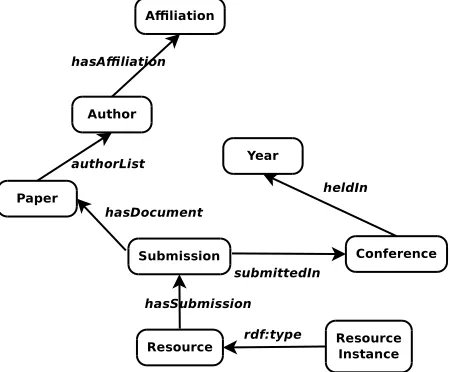
Because of the collecting methods we have used to popu-late the LRE Map, the resulting map is submission-centric, the submission being a link among authors, papers and Language Resources: a given submission presents a pa-per (along with its authors) and describes one or more LRs. From a logical point of view, we can assert that is the pa-per which is linked to the described Language Resources, but it was necessary to distinguish between submission and paper since some conferences only provide data containing anonymous submissions -together with the resources they are linked to- while in other cases (notably LREC) a full description of the papers is also available. Hence the neces-sity of a simple submission object, which is only identified by a code and by the reference to its related conference, and which may or may not be enriched by further informa-tion on the actual paper. As a consequence, the records in the database reflect this organization and are arranged as in Figures 1 and 2, in which the objects have been logically grouped.
3.1.
Reused and/or customized ontologies
This section briefly describes the available ontologies that have been reused within the LRE Map frame.
Author Ontology [Model: obj auth; Instance Collec-tion: lremap auth] We have modelled the Author object usingfoaf5for addressing aspects such as email, first and last name and affiliations. The latter (Affiliations) have been enriched with geographical features such as their countries according togeonames6for managing properties in terms of geographical figures.
The records of the database of the LRE Map which con-tain the Author data (the Author instances) are inserted into a different documents lremap auth which, on the hand im-ports obj auth, and on the other defines the property hasAf-filiation used to connect authors’ instances to afhasAf-filiations. In principle authors can have more than one affiliation.
Paper Ontology [Model and Instance Collection: lremap paper] We have modelled the Paper object us-ingbibo7 for addressing aspects such as title, list of au-thors, status, topics, etc. The lremap paper ontology im-ports lremap auth to manage the connections between thors and papers. Formally we have used the property au-thorList, which is abiboproperty to connect a paper in-stance to the list of its authors.
3.2.
Newly defined ontologies
Year Ontology [Model and Instance Collection: lremap year] The temporal dimension of the ontology is pretty much straightforward: it is the year when the Language Resource has been described. The lremap year ontology is the simplest year ontology which is coherent with the LRE Map entries: a list of years.
Conference Ontology [Model and Instance Collection: lremap conf] The conference ontology (lremap conf) has a list of conferences as individuals. They represent the conferences which used the LRE Map for their submission phase. If the year ontology addresses the question “when the resourceXhas been described”, this ontology handles the spatial dimension, that is “in which conference(s) the resourceXhas been described”.
The object property heldIn has been defined to connect Conference and Year ontologies;
Submission Ontology The submission ontology, lremap subs, is a simple list of identifiers. Submissions are the bridge between Papers, Conferences and Resources to which they are connected through the properties, hasDocument and submittedIn respectively. Resources and Submissions are connected through the “hasSubmission” relation;
Resource Ontology [Model: lremap resource; Instance Collection: lremap ri] Language Resources instances (lremap ri) describe the LRs (lremap resource) in terms of descriptive metadata in the same way that blueprints de-scribe the items that form buildings. Just as a blueprint can be used to create multiple buildings, a single Resource can
5
http://xmlns.com/foaf/0.1/.
6
http://www.geonames.org/ontology/ontology v3.1.rdf.
7http://purl.org/ontology/bibo/.
be used to model as many instances as authors provided during the conference submission phase, cf. section 4.
4.
The Language Resource model and
instances
We decided to base the lremap resource schema on the set of metadata provided to the authors for the submission phase of their articles. This means that we have created a static schema which formalizes those values. In addition we took apart the type metadata from the others, this be-cause we are aware that the specific type of a LR is more significant than the other set of metadata. In other words we decided to identify the type with the hierarchical axis:
resource i is-atypeandhasSomeM etadataMd i (1)
Assertion 1 establishes that the resource i inherits some specific features from its type and it is enriched with the collection of its metadata.
The example reported in Figure 4 is the same of Figure 1 but we have added properties to metadata to make assertion 1 clearer:
Submission: S1 “hasSubmission”
Name: WordNet
“hasName” Type: Lexicon is-A Availability: Freely Available
“hasAvailability”
Use: Summarization
“hasUse” Modality: Written
“hasModality”
....: ....
Figure 4: WordNet example along with hasMetadata i properties
In building the lremap resource schema from the records of the database we agreed on the following strategy:
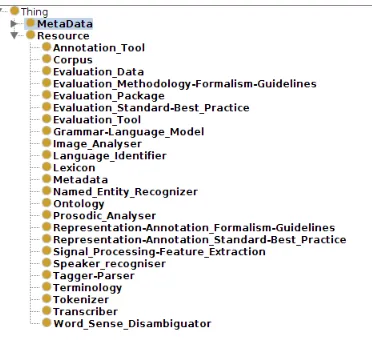
Keep the type apart from other metadata The classes of the proposed model have been structured according to Figure 5. The class Resource has as many sibling sub-classes as the different types which have been provided to the authors at the submission stage: Corpus, Lex-icon, Tokenizer and so on. These subclasses do not contain individuals;
Figure 5: Resources types and other Metadata
Populate the remaining metadata with standard values Each metadata is a specific Class which contains the static set of values provided to the authors during the submission stage, see Figure 6;
Figure 6: Metadata: list of individuals
Define properties to link resources to their metadata Each metadata M di is connected to the Resource through the correspondinghasM diproperty.
Figure 7 reports the definition of the hasModality property
Figure 7: hasModality: domain and range
4.1.
Gathering data from authors
The process of gathering Language Resources data through the conference submission phase is quite complex since au-thors have been left free to ride their judgments about the resources they describe. In other words they are neither
constrained to pick metadata values from the list we pro-vide, nor to select one of the provided Types. They can add Types as well as metadata values.
We call the Language Resources they describe Resource In-stances since they instantiate the abstract Resource adding concrete information. In the blueprint-paradigm, these in-stances are the different buildings extracted from the same blueprint. For the sake of clarity, the comparison is not fully exact, since two different situations can occur:
Authors use provided type and metadata In this case the Resource Instance individual is a true instance of the Resource, since the author have simply used the data provided and added a new record to the database which is then rendered as an instance, see Figure 8.
Figure 8: True Instance
Only one or none out of type and metadata is used In this case the Resource Instance is both an instance and an extension of the Resource. As an instance it instantiates the provided values; as an extension it adds new Type and/or metadata, as in Figure 9.
Figure 9: Instance and extension
4.2.
The complete picture
The lremap ri schema collects the resources as they come out from the authors’ submissions and imports the submis-sion ontology (lremap subs) to manage connections to Pa-pers and Authors.
Figure 10 is the Prot´eg´e8rendered graph of Figure 3.
8
http://protege.stanford.edu/.
Figure 10: lremap ri and the set of ontologies
5.
Before modelling the LRE Map Ontology:
what is in the data
In this section we briefly explain what we actually have in the records of the database. If we focus on name and on description of the resource authors provide, they contain terms that identify and describe the Language Resources in natural language. Often they contain (or are only) acronyms: for example the “British National Corpus” can be found as “BNC”, as “British National Corpus” or as “British National Corpus (BNC)” and as any other possible combination. In (luckily) few case, authors provide short-ened forms or abbreviations that are hardily resolved to the correct name.
The noisy data we have represent an issue that we have to solve before providing the data to the community, but (at the same time) they represent also a challenge, an opportu-nity. The data as they have been natively submitted must be stored somewhere and taken into account for further analy-sis.
The strategy we have followed to address the previous issue is to carry on a normalization process of the values con-tained in the metadata provided by the authors9and to link original values to normalized ones.10
ResourceName Normalization of resource names consists in acronym addition and capitalization of the first let-ter;
ResourceType As explained before, this metadata is es-sential in classifying the LRs. The normalization pro-cess must be accurately carried out: a typical normal-ization is substituting a provided Corpora with the of-ficial Corpus;
ResourceUse The use of the resource is very important within the LRE Map, since it describes what authors think the resource should be used for. In this case, very often, authors decide to insert a free description
9
Remember that authors can either select one provided value or type the one they like in natural language. The process of nor-malization we are going to describe is related to the latter data.
10The list below is not exhaustive, it simply reports the main
metadata that need an accurate investigation during the normaliza-tion process. Metadata such as modality contain only the provided values.
instead of using provided values. The normalization is quite heavy since sentences like “disambiguate the correct sense” must be mapped onto the value Word Sense Disambiguation and so on;
ResourceLanguage This is most normalized metadata. To uniform the languages we decided to add the three-letter ISO code11 to the language: “English”→ “En-glish (eng)”. Data are very noisy since they contain typos [Chinse instead of Chinese] and errors such as “C++” which clearly is not a language in the sense we have in mind.
The normalization process is time-consuming and it must be carefully carried out. In synthesis it complies to the fol-lowing steps:
Work on a Conference We decide to normalize confer-ence by conferconfer-ence, in order to have small data to work on;
Duplicate the database entries Each LR is copied onto a corresponding resource whose metadata contain only normalized values. In terms of ontologies we create a lremap nri collection of instances;
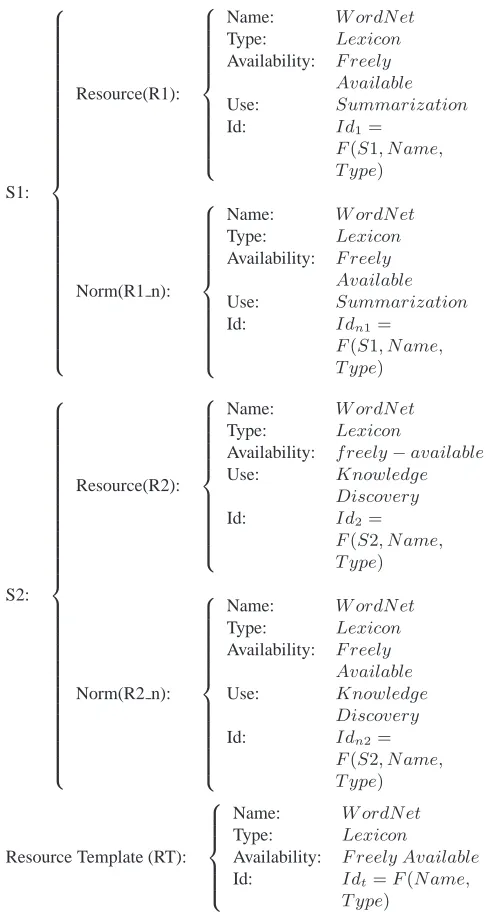
Creation of a sort-of-template Once normalized, the (normalized) resources are analyzed to extract com-mon features in order to define a sort-of-template for LRs. This template collects common metadata values from the normalized values and creates a grid that can be used to generate new Language Resources.
6.
modelling the LRE Map Ontology
In this section we present the strategy we have defined for converting the LRE Map database into RDF.
Language Resources are collected during the paper sub-mission procedures and then gathered into the LRE Map database.
Given these peculiarities, we need a more complicated strategy which allows us to model ontologies for the three types of LRs below:
The Standard LR This is the LR with its original set of metadata,Mr;
The Normalized LR This is the LR whose original set of metadata has been normalized,Mnr;
The Template LR This is an abstract LR which contains a subsetMt⊆Mrof metadata and represents a sort of grid that can be used to fill the metadata of LRs. The subset Mt contains metadata whose value is unique over the whole database.
with additional constraints:
- Not all resources have their template;12
11The ISO codes for languages are extracted from
http://www.iso.org/iso/language codes taking into account the tables 639-2 and 639-3.
12
From LRs which appear only once in the database, the tem-plate has not been extracted.
are responsible for extracting the data from the database and create the individuals according to the rules described above.
7.
Serialization of LRE Map and (L)LOD
7.1.
Data Availability
Table 1 summarizes the URLs where schemas and individ-uals can be found. In what follows by mapbase we mean the URL http://www.resourcebook.eu/lremap/owl/.
Object URI
Year mapbase/lremap year Conference mapbase/lremap conf Submission mapbase/lremap subs Author mapbase/lremap auth Paper mapbase/lremap paper Resource mapbase/lremap resource Resource
Instance
mapbase/lremap ri
Normalized Resource Instance
mapbase/lremap nri
Template Resource Instance
mapbase/lremap tri
Table 1: LRE Map set of ontologies and URLs
7.2.
Serializing the Resource Instances
There are a lot of tools designed to help transforming struc-tured data into RDF14 and providing additional outcomes. For example, csv2rdf4lod makes the conversion simple and straightforward, while sparqlify15 adds one SPARQL end-point which is surely a positive aspect. We know that using tools will save a lot of work but writing conversion from scratch will help us to get more confident with the data, at least in the early stages of the conversion process. So we decided to proceed from scratch using ad-hoc scripts for two main reasons:
• The LRE Map is a complex database: to be more pre-cise, it is at least 3 databases: Authors, Papers and Resources. They are interconnected and need manip-ulation before a tool such as csv2rdf4lod can manage the data;
• We have a lot of codes that communicate with the database and produce triples as reported (Del Grattaet al., 2013; Bartolini et al., 2013). We decided to reuse what we had so that the codes could be improved and made more general.
In this section we focus on a fictional example which clari-fies the two different situations in section 4.
14
An exhaustive list of such tools can be found at https://en.wikipedia.org/wiki/Knowledge extraction
#Survey of Methods .2F Tools.
15http://sparqlify.org/
As described above, two different situations can arise dur-ing the submission phases of the conferences: either the au-thors select one of the value the submission interface pro-vides or they insert new values. And this is valid for any type of metadata, including the type of resource. The Re-source schema contains the proposed values as instances,16 while Resource Instance extends Resource with the capa-bility of adding new values for metadata as well as new types of resources.
The serialization process needs to manage these issues and correctly switch the output.
@ p r e f i x s u b s : <map b ase / l r e m a p s u b s #> . @ p r e f i x p a p e r : <map b ase / l r e m a p p a p e r#>
.
@ p r e f i x c o n f : <map b ase / l r e m a p c o n f #> . @ p r e f i x a u t h : <map b ase / l r e m a p a u t h #> . @ p r e f i x r i : <map b ase / l r e m a p r i #> . @ p r e f i x r e s : <map b ase / l r e m a p r e s o u r c e #>
.
r e s : C o r p u s a owl : C l a s s ;
r d f s : s u b C l a s s O f : R e s o u r c e .
<r i #6 d c 5 d 1 f 9 2 2 3 9 d c 5 7 9 d 4 c 4 c c 9 9 7 2 b f 5 e c>
r e s : h a s A v a i l a b i l i t y r e s : F r e e l y A v a i l a b l e ;
r e s : h a s L a n g u a g e <h t t p : / / www . l e x v o . o r g / p a g e / i s o 6 3 9−3/ eng> ;
r e s : h a s L a n g u a g e T y p e r e s : Mono ;
r e s : h a s M o d a l i t y r e s : Sp eech−W r i t t e n ; r e s : hasName : resName ;
r e s : h a s S t a t u s r e s : E x i s t i n g−u s e d ; r e s : h a s U s e r e s : S p e e c h R e c o g n i t i o n−
U n d e r s t a n d i n g ; r i : h a s I n n e r I D ”6
d c 5 d 1 f 9 2 2 3 9 d c 5 7 9 d 4 c 4 c c 9 9 7 2 b f 5 e c ” ; r i : h a s S u b m i s s i o n <s u b s # 1 0 0 0X−xxxx> ;
a r e s : Co rp u s , owl : N a m e d I n d i v i d u a l .
: E v a l i t a 2 0 1 1 F A c o r p u s
a r e s : Name , owl : N a m e d I n d i v i d u a l .
. . . . .
. . . . .
Figure 13: Resource Instance with type “Corpus”, one of the values proposed.
16
Essentially the provided types of the resource are classes that identify the resources, while other metadata are individuals: “Cor-pus” is-a Resource, while “freely-available” is an individual of the class Availability.
@ p r e f i x s u b s : <map b ase / l r e m a p s u b s #> . @ p r e f i x p a p e r : <map b ase / l r e m a p p a p e r#>
.
@ p r e f i x c o n f : <map b ase / l r e m a p c o n f #> . @ p r e f i x a u t h : <map b ase / l r e m a p a u t h #> . @ p r e f i x r i : <map b ase / l r e m a p r i #> . @ p r e f i x r e s : <map b ase / l r e m a p r e s o u r c e #>
.
: T e x t−t o−S p e e c h S y n t h e s i z e r a owl : C l a s s ;
r d f s : s u b C l a s s O f r e s : R e s o u r c e .
<r i #9 c a 2 5 e 1 0 5 7 e 7 a 2 9 5 9 5 d a d 1 0 7 9 3 7 5 b 1 0 0>
h a s S u b m i s s i o n <s u b s # 1 0 0 0X−xxxx> ; a : T e x t−t o−S p e e c h S y n t h e s i z e r , owl :
N a m e d I n d i v i d u a l . . . . . .
. . . . .
Figure 14: Resource Instance with type “Text-to-Speech Synthesizer”, a new resource type.
The type of Resource Instance individual identified by
6dc5d1f... in Figure 13 is a “Corpus”, which is a value provided by the submission interface. The serial-ization tools set this instance as a res:Corpus. On the contrary, the instance identified by 9ca25e1... in figure 14 has “Text-to-Speech Synthesizer” as type. This value is a new one, thus it needs to be firstly defined as a Resource and then assigned to the instance (indi-vidual). The serialization tools define this new value as a rdfs:subClassOf res:Resource, then as-sert that this specific Resource Instance individual is
a :Text-to-Speech_Synthesizer.
8.
Conclusion and Future Work
In this paper we have presented the strategy to convert the LRE Map database into RDF. We used Prot´eg´e to create the schemas and a set of ad-hoc scripts to populate the schemas with proper instances. We preferred this solution instead of using available serializing tools17 because of the peculiar nature of the data in the LRE Map database and in order to maintain a full control over the serializing process, in terms of data coherence. However, the csv2rdf4lod tool18 has been used to create a benchmark for the future serial-ization.
The work will be completed by the identification of theIdt with the ISLRN (Choukri et al., 2012). In such a way, in-stances of the ontology for LR templates will be of the fol-lowing form:
mapbase/lremap ri#islrn 1
17https://en.wikipedia.org/wiki/
Knowledge extraction.
18
http://logd.tw.rpi.edu/technology/csv2rdf4lod
9.
References
Bartolini, R., Del Gratta, R., and Frontini, F. (2013). To-wards the establishment of a linguistic linked data net-work for Italian. In Proceedings of the 2nd Workshop On Linked Data in Linguistic, Collocated with the 6th International Conference on Generative Approaches to the Lexicon, Pisa, Italy, September.
Del Gratta, R., Frontini, F., Khan, F., and Monachini, M. (2013). Converting the PAROLE SIMPLE Clips Lexi-con into RDF with lemon. Semantic Web Journal (Sub-mitted).
Calzolari, N., Soria, C., Gratta, R. D., Goggi, S., Quochi, V., Russo, I., Choukri, K., Mariani, J., and Piperidis, S. (2010). The LREC Map of Language Resources and Technologies. In Proceedings of the Seventh Interna-tional Conference on Language Resources and Evalua-tion (LREC’10), pages 949–956, Valletta, Malta, May. European Language Resources Association (ELRA). Calzolari, N., Gratta, R. D., Francopoulo, G., Mariani,
J., Rubino, F., Russo, I., and Soria, C. (2012). The LRE Map. Harmonising Community Descriptions of Resources. In Proceedings of the Eight International Conference on Language Resources and Evaluation (LREC’12), pages 1084–1089, Istanbul, Turkey, May. European Language Resources Association (ELRA). Chiarcos, C., Hellmann, S., and Nordhoff, S. (2011).
To-wards a Linguistic Linked Open Data cloud: The Open Linguistics Working Group. TAL, 52(3):245–275. Chiarcos, C., Hellmann, S., and Nordhoff, S. (2012).
Linked Data in Linguistics. Springer.
Choukri, K., Arranz, V., Hamon, O., and Park, J. (2012). Using the International Standard Language Resource Number: Practical and Technical Aspects. In Proceed-ings of the Eight International Conference on Language Resources and Evaluation (LREC’12), pages 50–54, Is-tanbul, Turkey, May. European Language Resources As-sociation (ELRA).
Lezcano, L., Sanchez, S., and Roa-Valverde, A. J. (2013). A survey on the exchange of linguistic resources: Pub-lishing linguistic linked open data on the Web. Program: electronic library and information systems, 47(3):3–3.