Crowd-sourcing evaluation of automatically acquired,
morphologically related word groupings
Claudia Borg and Albert Gatt
University of Malta
claudia.borg / albert.gatt @um.edu.mt
Abstract
The automatic discovery and clustering of morphologically related words is an important problem with several practical applications. This paper describes the evaluation of word clusters carried out through crowd-sourcing techniques for the Maltese language. The hybrid (Semitic-Romance) nature of Maltese morphology, together with the fact that no large-scale lexical resources are available for Maltese, make this an interesting and challenging problem.
Keywords:computational morphology, segmentation, machine learning
1. Introduction
Automatic morphological clustering or grouping of words is an interesting task that can lead to the boot-strapping of a morphological analyser. This is useful for an under-resourced language such as Maltese, for which added difficulties arise due to its hybrid system that evolved from an Arabic stratum, a Romance (Si-cilian/Italian) superstratum and an English adstratum (Brincat, 2011). The Semitic component follows a non-concatenative, root-and-pattern strategy familiar from languages such as Arabic and Hebrew, with con-sonantal roots combined with a vowel melody and pat-terns to derive forms, plus inflectional affixes for mor-phosyntactic features such as person, number and gen-der. By contrast, the Romance/Anglo-Saxon deriva-tional component is concatenative (i.e. exclusively stem-and-affix based).
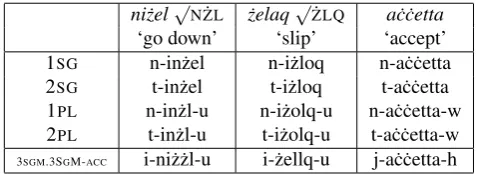
Table 1 displays examples of verb inflection and bound pronoun attachment for two verbs of Semitic origin (ni˙zel‘to descend’ and ˙zelaq‘to slip’) and one of Romance origin (a˙c˙cetta‘to accept’). The final row includes an example of the use of bound pronouns (glossed as ACC) to mark the direct object of a tran-sitive verb, in addition to inflectional affixes.
ni˙zel√NZL˙ ˙zelaq√ZLQ˙ a˙c˙cetta
‘go down’ ‘slip’ ‘accept’ 1SG n-in˙zel n-i˙zloq n-a˙c˙cetta 2SG t-in˙zel t-i˙zloq t-a˙c˙cetta 1PL n-in˙zl-u n-i˙zolq-u n-a˙c˙cetta-w 2PL t-in˙zl-u t-i˙zolq-u t-a˙c˙cetta-w
3SGM.3SGM-ACC i-ni˙z˙zl-u i-˙zellq-u j-a˙c˙cetta-h
Table 1: Root-based and stem-based morphology exam-ples. All verbs are in the imperfective.
The work reported here is part of a broader effort to develop morphological resources for Maltese, which has received very little systematic computational treat-ment (Farrugia, 2008; Camilleri, 2013), despite a sig-nificant body of descriptive and theoretical research (Fabri, 2009; Schembri, 2006; Spagnol, 2011). The aims of the present paper are twofold. It describes an unsupervised method for morphological cluster-ing in Maltese, takcluster-ing a wordlist extracted from the MLRS corpus of Maltese (Gatt and ˇC´epl¨o, 2013)1 as a starting point. The approach relies on a variety of relatedness heuristics which have been used suc-cessfully in previous work on other languages. In an effort to approach the problem in a completely un-supervised manner, we do not incorporate informa-tion about the historical origin (Semitic/root-based vs Romance/stem-based) of words. The second goal of this paper is to describe the evaluation method used for the output of our clustering method. While de-velopments in this field have often been aided by the existence of gold-standard lexical resources (e.g. as used for the Morpho Challenge evaluations), no such resources currently exist for Maltese. Hence, we adopt a crowd-sourcing strategy, evaluating output with ex-perts as well as non-exex-perts, thereby also laying the grounds for the development of future gold standards. In section 2. we describe related work to this task, whilst in section 3. we provide a description of our technique. Section 4. reports on the evaluation carried out and the results achieved. Finally in section 5. we discuss the future directions of our work.
2. Related Work
Learning of morphological relations can be split into subtasks — segmenting words into morphemes,
asso-1
ciating labels to the individual morphemes, and group-ing morphologically related words together (Roark and Sproat, 2007). The focus of this paper is on group-ing together morphologically related words in Maltese through segmentation, orthographic and semantic sim-ilarity of words.
Goldsmith (2001) uses an unsupervised algorithm that separates stems from suffixes using minimal descrip-tion length. Creutz and Lagus (2002; 2004; 2005) adopt a Maximum a Posteriori framework to segment words from unannotated texts; this has become the baseline evaluation for the Morpho Challenge com-petition (Kurimo et al., 2010). Schone and Jurafsky (2000; 2001) and Baroni et al. (2002) use ortho-graphic and semantic similarity to detect morpholog-ically related word pairs. Yarowsky and Wicentowski (2000) use a combination of alignment models with the aim of pairing inflected words. However this tech-nique relies on part-of-speech, affix and stem informa-tion. Can and Manandhar (2012) create a hierarchi-cal clustering of morphologihierarchi-cally related words using both affixes and stems to combine words in the same clusters. In most of these approaches, evaluation relies on a gold standard, against which algorithms are com-pared using familiar metrics such as accuracy, preci-sion, recall and f-measure.
For Semitic languages, the main issue in computa-tional morphology tends to be that of disambiguation between multiple possible analyses. Habash and Ram-bow (2005) learn classifiers to identify different mor-phological features, used specifically to improve part-of-speech tagging. Snyder and Barzilay (2008) tackle morphological segmentation for multiple languages in the Semitic family and English by creating a model that maps frequently occurring morphemes in differ-ent languages into a single abstract morpheme.
Transitional probabilities are also used to determine word boundaries and discover affixes (Keshava and Pitler, 2006; Dasgupta and Ng, 2007), using an effi-cient Trie structure to calculate the probabilities. The technique is very intuitive, and posits that the most likely place for a segmentation to take place is at nodes in the trie with a large branching factor. The result is a ranked list of affixes which can then be used to seg-ment words.
In the present paper, we give a brief overview of the clustering method which is based on some of the above techniques, before turning to the evaluation study, which is the main focus of the present paper.
3. Grouping Morphologically Related Words
Our starting point is a wordlist obtained from the MLRScorpus of Maltese, which contains 125 million tokens. Excluding function words, numbers, punctua-tion marks, proper nouns, determiners, foreign words and those words with a token count of less than 10, the resulting list has 67,434 word types. Function words were identified through frequency counts and checked manually, whilst the other words were iden-tified through simple rule-based heuristics and further manual checking.
The clustering method described below is based on the identification of words with similar stems (whether these are integral stems of Romance origin, or are of Semitic origin and consist of root-and-pattern amal-gams). In other words, our aim is to group to-gether lexical items in the manner exemplified by the columns in Table 1. One of the challenges here, aris-ing from the hybrid nature of the morphology, is that semitic stems frequently undergo allomorphy (Fabri, 2009); hence, even if an adequate segmentation pro-cess to strip inflectional affixes were present, it is not possible simply to group words based on stem iden-tity. Thus, before comparing word types to deter-mine their morphological relatedness, we first identify their likely affixes. We then apply clustering heuristics based on orthographic and semantic similarity on the resulting stems.
3.1. Segmentation-based Clustering
Words are segmented using a technique similar to Ke-shava and Pitler (2006), which determines where the most likely split should occur by calculating tran-sitional probabilities of all possible boundaries in a word. The wordlist is modelled as a Trie structure which represents common sequences of characters in a single sequence, with branching whenever they di-verge. HavingαABβ be a word representation2, the sequenceBβis considered as a likely suffix if (i)αA is itself a type in the wordlist; (ii)P(A|α)≈1(i.e. all occurrences ofαAstart withα, no substantial branch-ing at this point); (iii) P(β|αA) < 1, i.e. not all oc-currences ofαAend withβ, substantial branching oc-curs. All potential splits are considered and scored ac-cording to their probability, resulting in a ranked list of prefixes and suffixes from which we use the top
10% (200 prefixes and 400 suffixes) to proceed with the segmentation process.
Words are segmented using the resulting list of affixes. However, the technique used can find more than one possible segmentation for a word. For instance, for
ipparkja ‘he parked’, the method finds three poten-tial segmentations: i-pparkja, ip-park-ja and ippark-ja. These complications may arise due to homographs in the wordlist. For instance, the stemparkis both a part of the verb meaning ‘to park’ and the noun mean-ing ‘public space’. Similarly,spi˙c˙ca‘to finish’ might be wrongly segmented into s-pi˙c˙c-a, where the stem
pi˙c˙c‘pitch’ exists, but never takes the prefixs-. A more subtle case is the presence of initial conso-nant gemination in Maltese as part of the inflection process: in this case, a perfective verb in the third person singular masculine duplicates the initial conso-nant (e.g. park-ja→p-park-ja) and, if it is preceded by a word ending in a consonant, takes the epenthetic voweli(i.e. i-ppark-ja). As these examples illustrate, the problem is to determine when a word should not
be segmented.
In order not to restrict the system, all possible seg-mentations are taken into consideration, and each po-tential stem is taken as the basis of forming word clus-ters which share the same stem; the resulting cluster is headed by that stem. This initial clustering pro-cess produces 21,381 clusters, with a word potentially present in multiple clusters.
3.2. Improvement of Clusters
Semantic relatedness and orthographic similarity of words is then introduced to improve the quality of the clusters and reduce their number. Latent Semantic Analysis (LSA) is a technique that analyses the rela-tionship between words by comparing the context in which they appear. For example, the wordsgreenand
blue would be expected to be surrounded by similar words since they are both colours. This is also plau-sible for morphologically related words, such asblue
andbluish. LSA creates a vector representing the sur-rounding words for each word present in the corpus. It then computes the semantic similarity of two words by comparing the similarity in their individual vectors. The more likely two words are to appear in similar contexts, the more semantically related they are. In or-der to apply LSA, we chose to use the semantic space library implemented by Jurgens and Stevens (2010). The purpose of applying semantic similarity between words is twofold. First, clusters with a high number of unrelated words should be disregarded completely, under the assumption that morphological relatedness should be correlated with semantic relatedness in all
but the most unproductive morphological processes. In the latter case, of course, two words which may be morphologically related may have lost their semantic relatedness completely.
Second, clusters which might be morphologically re-lated but were clustered separately, especially due to stem variation, should be considered for merging. For both cases we devised a metric that measures a clus-ter’ssemantic cohesiveness. The idea is that the more semantically related the words are within a cluster, the tighter or more ‘compact’ it is. Although se-mantic relatedness does not necessarily imply mor-phological relatedness, the clusters so far have been formed through the identification of potential stems, thus already limiting this measure to words which al-ready have a strong orthographic similarity between them. Semantic cohesiveness is calculated by taking the standard deviation of the semantic similarity be-tween the stem heading a cluster and every other word in the cluster. LetCi be a cluster headed by stemsi,
and letSemsiwj be the semantic relatedness ofsiand wj ∈Ci. The cohesiveness,σCi is computed as
σCi =
s X
w1...n∈Ci
(Semsiwj−µ) 2
whereµis the mean pairwise semantic relatedness in Ci. The intuition here is that, the wider the dispersion
within the cluster, the less cohesive it is.
So far, our initial clustering technique was based on the identification of a potential stem, and thus pro-duces errors (e.g. by grouping together iebes ‘hard’ andliebes‘he is wearing’) where morphologically un-related words are clustered together due to high or-thographic similarity. We posit that in the cases were words were wrongly clustered together, the seman-tic cohesiveness will be negatively impacted, whilst those clusters that contain only morphologically re-lated words will have a tighter semantic cohesion value. We can then utilise this value to tackle the two problems identified above with the intention of retain-ing our clusterretain-ing technique fully automated without any human intervention.
The merging of clusters is then carried out in two phases. First, we rank pairs of clusters that can be merged; this avoids the problem of merging clusters iteratively in a random order, which may result inCi
being merged withCj, when a later clusterCkwould
have been a better candidate to merge withCi.
Rank-ing depends on:
1. The semantic similarity between the two stems of the two candidate clusters,Semsisj, wheresi is
Cj. We use an empirically determined minimal
threshold of 0.4.
2. The orthographic similarity between the two stems, a function of their minimum edit distance M ed. We use a weighted version ofM ed, which favours character matches over deletions and in-sertions. This is important given the fact that words formed by non-concatenative processes with a common root will often share consonants, but have different patterns (e.g. kiteb‘he wrote’ and nkitbu ‘they were written’, with common root √KTB). In our implementation, we assign costs as follows: match 4.0; insertion -6.0; dele-tion -6.0; substitudele-tion -12.0. The threshold is 0, meaning that the two stems have some matching characters.
3. The improvement in semantic cohesiveness should the two clusters be merged, where ImpCiCj =σCi∪Cj−min(σCi, σCj). IfσCi∪Cj
is lower than the cohesion for either cluster, then there is an improvement (lower dispersion).
We combine all the three values described above into a single weighted measure, referred to as Combined Value (ComV al): ComV alCi∪Cj = αSemsisj + βM edsisj+γImpCiCj, where the weights were
em-pirically determined as α = 0.2, β = 0.2, and γ = 0.6.
The process of merging clusters involves three possi-ble cases:
1. Two clusters are encountered that so far have not been merged. In this case, the merging is carried out.
2. Two clusters are encountered, one of which has already been merged, but the other hasn’t. In this case, the system checks whether merging an-other cluster with the existing merged clusters would result in an acceptable improvement (us-ing the same threshold described above). If yes, the merge is carried out.
3. Two clusters are encountered that have already been merged with other clusters. In this case the decision was not to consider these two for further merging, in order to avoid the creation of inor-dinately large word clusters created through suc-cessive merging.
The resulting operation leaves us with 4,524 clusters, a substantial reduction from the initial 21,381 clusters.
4. Evaluation and Results
Since large-scale lexical resources are not available for Maltese, the evaluation must be carried out using hu-man experts and non-experts. The evaluation focused on two groups of participants: (i) three linguists with postgraduate training (experts) and (ii) general native Maltese speakers (non-experts) sourced from the stu-dent population of the University of Malta, as well as through social networks. In total, 248 people visited the website, of which 151 carried out the evaluation. The clusters presented for the expert evaluation were purposely chosen to represent a mixture of root-and-pattern and stem-and-affix based morphology. A to-tal of 51 clusters were presented to each expert, 25 of which were shared amongst all experts so that the inter-annotator agreement between them could be measured. Experts were also given the opportunity to give textual feedback/comments on each of the clus-ters. The crowd sourcing evaluation had no limit on the number of participants. 300 clusters were ran-domly chosen, and our aim was to have at least 3 participants per cluster, especially for the calculation of inter-annotator agreement. A further 2 test clus-ters that were purposely put together to test any strate-gies used by participants in giving their judgements on clusters (for example, treating inflection and deriva-tion differently).
The system to carry out the evaluation was built as a website3 through which participants were provided with instructions in both written format and as a video, with an informal explanation of the concept of mor-phological relatedness through the use of examples. The evaluation itself presented a list of words together with the highlighted head word of a cluster, and partic-ipants could remove any words from this list (Figure 1(a)). They were also asked to rate the quality of the word cluster using a likert-type scale ranging from taj-jeb ¯hafna‘very good’ to¯ha˙zin ¯hafna‘very bad’ (Fig-ure 1(b)). Participants in the crowd-sourcing evalu-ation were exposed to clusters randomly; they could stop whenever they wished.
4.1. Removal of words
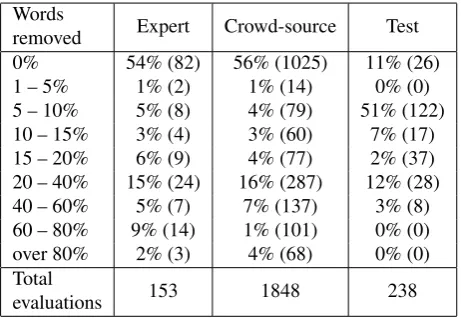
One of our main objectives in this evaluation is to have unrelated words removed from clusters so as to have clusters with only morphologically related words. From a quantitative perspective, analysing the percentage of words that were removed from a cluster provides insight into how well the clustering technique preforms. Table 2 divides the clusters into bins reflect-ing the range percentage of words removed, and
dis-3http://mlrs.research.um.edu.mt/cmexperiment/
(a) Removal of words (b) Cluster rating (top) and addition of words (bottom)
Figure 1:Screenshot of the evaluation procedure
plays the percentage of clusters that fall into each bin. Separate columns are shown for Expert and Crowd-source evaluations and for the two Test clusters shared among all participants in the crowd-sourcing experi-ment.
Words
removed Expert Crowd-source Test 0% 54% (82) 56% (1025) 11% (26) 1 – 5% 1% (2) 1% (14) 0% (0) 5 – 10% 5% (8) 4% (79) 51% (122) 10 – 15% 3% (4) 3% (60) 7% (17) 15 – 20% 6% (9) 4% (77) 2% (37) 20 – 40% 15% (24) 16% (287) 12% (28) 40 – 60% 5% (7) 7% (137) 3% (8) 60 – 80% 9% (14) 1% (101) 0% (0) over 80% 2% (3) 4% (68) 0% (0) Total
evaluations 153 1848 238
Table 2:Proportion of clusters with a given range of words removed by evaluators.
From the evaluations carried out, just over half (54% & 56% for experts and non-experts respectively) had no words removed. This is a positive indication given that the clusters were created fully automatically with-out any predetermined knowledge built into the pro-gram. At the other end of the scale, we have a very small percentage of evaluations where clusters had a rather large number of words removed. A manual analysis of these clusters indicates that there is general agreement between annotators that a particular clus-ter contained several unrelated words. For instance, one cluster that particularly stands out is for headed by the stemittra‘letter’. This cluster contained sev-eral unrelated words due to ittra occurring as a sub-string in other unrelated words or having very close orthographic similarity — such astittradu˙ci‘to trans-late’, ittratat ‘to be treated’, ittardja‘to be delayed’. These types of errors were expected from this type of automatic system.
One of the problems is to achieve a balance between high precision (hence, stricter heuristics on
establish-ing and mergestablish-ing clusters) and high recall (i.e. allowestablish-ing a looser clustering involving more potentially related words). This balance tends to be achieved rather ar-bitrarily, based on empirically determined parameters. On the other hand, the overall percentages of words removed from the clusters are indicative that a rather acceptable balance was achieved with the majority of clusters having a reasonable percentage of words re-moved.
The test clusters provide us with further insight into how participants tackled the task. Very few eval-uators appeared to distinguish between inflectional and derivational variants, for example, by removing derivations from a cluster and keeping only inflected forms of a stem. The vast majority preferring to leave both inflective and derived words in the cluster, a de-sirably outcome from our perspective. Each test clus-ter had at least one word which should have been re-moved from the given list to test for consistency. How-ever in 11% of the evaluations participants did not remove any words. This can be due to not carrying out the task attentively, potentially reflecting a broader tendency on the part of these evaluators to make er-rors in removal. Thus it is important to look at the agreement between participants on which words were removed.
4.2. Inter-Annotator Agreement
We computed Inter-annotator agreement (IAA) be-tween participants using Krippendorff’s Alpha-Reliability (Krippendorff, 2011; Artstein and Poe-sio, 2008), a generalisation of several other reliabil-ity indices that take into account the likelihood of an-notators exhibiting chance agreement and, crucially, is adapted to multiple raters (unlike, say, Cohen’s Kappa). Mathematically, agreement is actually calcu-lated by evaluating the observed disagreement (Do) in
relation to the expected disagreement (De) and
sub-tracting this from 1, which would be full agreement. The basic formula is
α= 1−Do
The coefficient ranges between 0 and 1, with 1 indi-cating full agreement.
We computed agreement over words, rather than over clusters, that is, for a given word that our algorithm places in a certain cluster, we are interested in the ex-tent to which annotators agree that it should be in that cluster (based on the proportion of times an annotator removes it from the cluster). This makes agreement a binary classification: an annotator either keeps the word in the cluster, or not.
Let C be a cluster, consisting of words w1, . . . , wn.
For every evaluator, we represent the cluster as a vec-torv of binary values, so thatvi = 1if word wi was
left in the cluster by the evaluator, and vi = 0 if it
was removed. The resulting matrix of vectors repre-senting the evaluators’ decisions for clusterC is then used to calculate the IAA using an implementation of Krippendorff’s alpha4in R5.
Description Experts Crowd-source
No. of Clusters 26 300
No. of Evaluations 78 1848 Avg. no. Evaluators 3 6.16 Avg. Agreement 0.908 0.598 Lowest Agreement -0.0126 -0.166
Highest Agreement 1.0 1.0
Bins:
Negative 4% (1) 23% (68)
less than 0.20 0% (0) 7% (21) 0.21 - 0.40 0% (0) 7% (20) 0.41 - 0.60 7% (2) 5% (16) 0.61 - 0.80 4% (1) 8% (24) 0.81 - 1.00 84% (22) 50% (151)
Table 3:Inter-Annotator Agreement
The first set of IAA results presented in Table 3 shows the number of clusters in the different evaluations car-ried out, the average number of evaluators per clus-ter and the average agreement achieved overall in the respective evaluation. The highest and lowest agree-ments are given, together with the percentage of clus-ters spread into bins according to the range of IAA achieved.
The expert group has the highest average agreement of 0.908, with 84% of the clusters having very high agreement between annotators. On the other hand, the average agreement of 0.598 for the crowd-sourcing evaluation is lower; this is expected, given gaps in lin-guistic knowledge and expertise of the general Mal-tese native speaker. The agreement between
partic-4The implementation used is part of the IRR library
http://rss.acs.unt.edu/Rdoc/library/irr/html/ kripp.alpha.html.
5http://www.r-project.org/
ipants is however adequately high, especially when considering that 50% of the clusters have a very high agreement (between 0.81 and 1).
Somewhat surprisingly, there were some cases on which Krippendorff’s alpha returned a negative value (meaning that evaluators are agreeing at a rate worse than chance). This is known to occur in case there is a minority of evaluators in the task who use one or more of the available categories, while the majority of eval-uators do not use them. In fact, this result invariably arose when one evaluator excluded a small number of words from a cluster, while others didn’t (i.e. there was only one evaluator whose decisions contained 0 values). In examining further the agreement of an-notators in other clusters, we noted that there were quite a few cases where the negative or very low al-pha was due tooutliers, that is, cases where there is a strong agreement amongst the majority of the eval-uators with one evaluator providing a different evalu-ation from the other participants. Thus we decided to recalculate IAA by excluding such outliers.
Outliers were detected as follows. We calculated the pairwise agreement between evaluators. An out-lier was defined as an evaluator who consistently dis-played low agreement with all other evaluators. If less than a third of the evaluators were outliers for a given cluster, then the IAA was re-calculated without the outliers. If more than a third of the evaluators were outliers, then all evaluators were included (as per the original IAA calculation), meaning that there is over-all considerable disagreement between participants re-garding which words should be removed. Overall, 210 (11%) evaluations were identified as outliers using this definition.
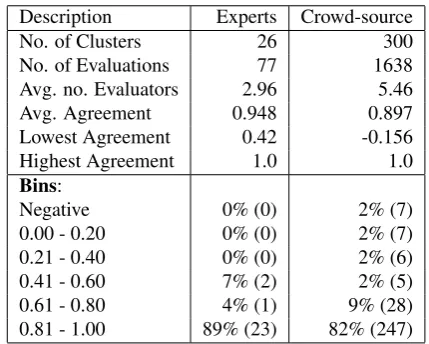
Table 4 shows the agreement results when such out-liers are not included in the evaluation.
Description Experts Crowd-source
No. of Clusters 26 300
No. of Evaluations 77 1638 Avg. no. Evaluators 2.96 5.46 Avg. Agreement 0.948 0.897 Lowest Agreement 0.42 -0.156
Highest Agreement 1.0 1.0
Bins:
Negative 0% (0) 2% (7)
0.00 - 0.20 0% (0) 2% (7)
0.21 - 0.40 0% (0) 2% (6)
0.41 - 0.60 7% (2) 2% (5)
0.61 - 0.80 4% (1) 9% (28) 0.81 - 1.00 89% (23) 82% (247)
The most interesting change is in the crowd-source evaluation where the overall agreement has increased substantially, from an average of 0.598 to an average of 0.897. This is quite high considering that partici-pants in this group in general have no linguistic knowl-edge regarding morphological relations.
4.3. Quality Ratings
Participants were also given the opportunity to rate a cluster in terms of its perceived quality. Although this is a rather subjective judgement, we were particularly interested in the correlation between the quality rat-ing and the number of words removed for any given cluster. Aperfectcluster is one which would have no words removed and given a high quality rating. Abad
cluster would be one which would have a large num-ber of words removed and given a low quality rating. Table 6 provides an overview of the quality ratings for each evaluation carried out, and the overall correla-tion coefficient between the quality rating and the per-centage of words removed from a cluster. Correlations were computed using Spearman’s rank-correlation co-efficient, since one of our variables (rating) is ordinal.
Quality
ratings Experts Crowd-source Very Good 22% (34) 44% (810) Good 35% (53) 30% (546) Average 26% (40) 15% (272) Bad 13% (20) 7% (128) Very Bad 4% (6) 5 % (92)
Correlation: 0.737 0.788
Table 5: Quality ratings per evaluation, and Spearman’s rank correlation coefficient between the quality rating and the percentage of words removed from a cluster. All corre-lations are significant atp < .001.
We note that overall, the majority of the clusters are rated ‘good’ or ‘very good’ (57% in the expert eval-uation, and 74% in the crowd-source evaluation) in terms of their quality, and the overall correlation in both evaluations is rather high. It is interesting to note that the expert group were less inclined to give high quality ratings, whereas the non-expert group seemed more liberal with this rating. One possibility is that experts not only rate clusters based on the words they contain, but also implicitly consider thecompleteness
of a cluster. This means that if a cluster contained few words that were all morphologically related, whilst a non-expert would probably give a high quality rating to such a group, an expert would give a lower quality rating in case the cluster had several missing, related words.
4.4. Hybrid morphology and the clustering technique
We now turn to one of the questions raised at the start of this paper, namely, the adequacy of the clustering technique for a hybrid morphological system in which different (concatenative and non-concatenative) pro-cesses are at work. Here, we briefly focus on the ex-pert evaluation where, as mentioned above, the clus-ters were selected to be roughly balanced between the two processes.
#Clusters Average
quality #Intact Concatenative 80 2.3 49 (61%) Non-concatenative 73 2.55 33 (45%)
Table 6: Overview of performance of the clustering tech-nique on different morphological processes.
Dividing the clusters according to their morphological processes, we have 80 concatenative clusters, and 73 non-concatenative clusters. Analysing the results, the main difference between the two groups is the percent-age of clusters that had no words removed. 61% of the concatenative clusters had no words removed, against 45% of the non-concatenative clusters. This indicates that the technique performs better on the concatena-tive processes, nonetheless providing adequate results for non-concatenative processes. The percentage of clusters that had more than a third of their words moved is approximately the same (19% and 18% re-spectively), which shows that the system fails in both cases at approximately the same rate.
5. Conclusion
This paper briefly described a fully automatic tech-nique that groups together morphologically related words using a combination of probabilities, seman-tic and orthographic similarity of words. The clusters were evaluated by linguists and native speaking non-experts. The results are rather promising, providing a basis for the bootstrapping of a morphological anal-yser. The evaluation dataset will be made available since it can be a useful resource for further analysis. The clusters, together with their underlying segmenta-tion, can also be used as an input to a semi-supervised machine learning technique in an attempt to introduce labels to the segments, as part of the process of devel-oping a fully fledged morphological analyser. Given the existence of manually evaluated clusters, it is also conceivable that they might provide a basis for super-vised clustering methods.
the lack of resources against which to evaluate, though The latter scenario is slowly improving. We plan to in-tegrate new resources into semi-supervised techniques to incrementally learn labels for morphological seg-ments. Finally, we also plan to evaluate our techniques on other languages.
6. Acknowledgements
The research work disclosed in this publication is par-tially funded by the Malta Government Scholarship Scheme grant.
7. References
Artstein, R. and Poesio, M. (2008). Inter-Coder Agree-ment for Computational Linguistics. Computational Linguistics, 34(4):555—596.
Baroni, M., Matiasek, J., and Trost, H. (2002). Unsuper-vised discovery of morphologically related words based on orthographic and semantic similarity. InProceedings of the ACL-02 workshop on Morphological and phono-logical learning - Volume 6, MPL ’02, pages 48–57. As-sociation for Computational Linguistics.
Brincat, J. M. (2011). Maltese and other Languages. Mid-sea Books, Malta.
Camilleri, J. J. (2013). A Computational Grammar and Lexicon for Maltese. Master’s thesis, University of Gothenburg, September.
Can, B. and Manandhar, S. (2012). Probabilistic hierar-chical clustering of morphological paradigms. In Pro-ceedings of the 13th Conference of the European Chapter of the Association for Computational Linguistics, pages 654–663, Avignon, France, April. Association for Com-putational Linguistics.
Creutz, M. and Lagus, K. (2002). Unsupervised discovery of morphemes. InProceedings of the ACL-02 workshop on Morphological and phonological learning - Volume 6, MPL ’02, pages 21–30. Association for Computational Linguistics.
Creutz, M. and Lagus, K. (2004). Induction of a simple morphology for highly-inflecting languages. In Proceed-ings of the Seventh Meeting of the ACL Special Interest Group in Computational Phonology, pages 43–51. Asso-ciation for Computational Linguistics.
Creutz, M. and Lagus, K. (2005). Inducing the morpholog-ical lexicon of a natural language from unannotated text. InProceedings of AKRR’05, International and Interdis-ciplinary Conference on Adaptive Knowledge Represen-tation and Reasoning, pages 106–113.
Dasgupta, S. and Ng, V. (2007). High-performance, language-independent morphological segmentation. In
NAACL HLT 2007: Proceedings of the Main Conference, pages 155–163.
Fabri, R. (2009). Stem allomorphy in the Maltese verb. In
Ilsienna - Our Language, volume 1, pages 1–20, Ger-many. Brockmeyer Verlag.
Farrugia, A. (2008). A computational analysis of the Maltese broken plural. Bachelor’s Thesis, University of Malta.
Gatt, A. and ˇC´epl¨o, S. (2013). Digital Corpora and Other Electronic Resources for Maltese. InProceedings of the Corpus Linguistic Conference, Lancaster, UK.
Goldsmith, J. (2001). Unsupervised learning of the mor-phology of a natural language. Computational Linguis-tics, 27:153–198, June.
Habash, N. and Rambow, O. (2005). Arabic tokenization, part-of-speech tagging and morphological disambigua-tion in one fell swoop. InProceedings of the 43rd An-nual Meeting on Association for Computational Linguis-tics, ACL ’05, pages 573–580, Stroudsburg, PA, USA. Association for Computational Linguistics.
Jurgens, D. and Stevens, K. (2010). The S-Space Package: An Open Source Package for Word Space Models. In
System Papers of the Association of Computational Lin-guistics.
Keshava, S. and Pitler, E. (2006). A simpler, intuitive ap-proach to morpheme induction. In PASCAL Challenge Workshop on Unsupervised Segmentation of Words into Morphemes, pages 31–35.
Krippendorff, K. (2011). Computing Krippendorff’s Alpha-Reliability.
Kurimo, M., Virpioja, S., Turunen, V., and Lagus, K. (2010). Morpho challenge competition 2005–2010: evaluations and results. InProceedings of the 11th Meet-ing of the ACL Special Interest Group on Computational Morphology and Phonology, SIGMORPHON ’10, pages 87–95. Association for Computational Linguistics. Roark, B. and Sproat, R. (2007).Computational Approach
to Morphology and Syntax. Oxford University Press. Schembri, T. (2006). The Broken Plural in Maltese: An
Analysis. Bachelor’s Thesis, University of Malta. Schone, P. and Jurafsky, D. (2000). Knowledge-free
in-duction of morphology using latent semantic analysis. In
Proceedings of the 2nd workshop on Learning language in logic and the 4th conference on Computational nat-ural language learning - Volume 7, ConLL ’00, pages 67–72. Association for Computational Linguistics. Schone, P. and Jurafsky, D. (2001). Knowledge-free
in-duction of inflectional morphologies. InProceedings of the second meeting of the North American Chapter of the Association for Computational Linguistics on Language technologies, NAACL ’01, pages 1–9. Association for Computational Linguistics.
Snyder, B. and Barzilay, R. (2008). Unsupervised multilin-gual learning for morphological segmentation. In Pro-ceedings of ACL-08: HLT, pages 737–745, Columbus, Ohio, June. Association for Computational Linguistics. Spagnol, M. (2011). A tale of two morphologies. Verb
structure and argument alternations in Maltese. Ph.D. thesis, University of Konstanz.