© 2018 IJSRCSEIT | Volume 3 | Issue 3 | ISSN : 2456-3307
Fault Locating and Identifying with minimal Interaction in
Testing of Software Engineering Applications
Muzammil H Mohammed1,Faiz Baothman2
1
Department of Information Technology College of Computers and Information Technology, Taif University, Taif, Saudi Arabia
2Department of Computer Science College of Computers and Information Technology, Taif University, Taif, Saudi Arabia
ABSTRACT
Combinatorial testing method may additionally substantially cut again checking out fee and increase software program exceptional. By victimisation at suite generated with the aid of Combinatorial testing as input to conduct black-container trying out towards a machine, at some stage in a action at regulation, there may also be entirely part of all its parameters relevant to the defects in system and consequently the interaction by using the ones partial parameters is critical trouble of triggering fault. If we can discover those parameters appropriately, this could facilitate the software program package deal and checking out technique. This paper proposes a completely unique algorithmic program named Fault Interaction Location to find those interactions that cause device’s disasters and intervening time By applying this technique, testers will analyze and locate the factors applicable to defects, so creating the approach of software program package trying out and debugging simpler and further low-budget. The consequences of our study suggest that Fault Interaction Location plays better compared with fault place techniques in combinatorial trying out due to its advanced effectiveness and exactness.
Keywords: Test Suite, localization, Detection, Arrays, Debugging, Fault Interaction, Algorithm
I.
INTRODUCTION
Combinatorial checking might considerably scale back test price and increase quality of code [1]. it's been verified to be effective particularly during a code wherever faults return from the interactions of its parameters [2]. Combinatorial testing might observe the parameter interactions that trigger the faults instead of localize it. If a test suit triggers the fault of a system, it reflects that there exists one or a lot of defects within the program [3–5]. However, not all parameters within the test suit square measure relevant to defects. If we tend to square measure able to find a parameter within the test suit that's relevant to the fault, we are able to apply this handy data to
Volume 3, Issue 3 | March-April-2018 | http:// ijsrcseit.com
1805
Theorem one we all know that subSet(𝐼) ⊂ subSet(𝑇). So |subSet(𝐼) − subSet(𝑇)| = 2𝑛− 2𝑡.
III.
FAULT INTERACTION LOCATION
ALGORITHM
3.1. Description of FIL. Theorem three and Definition five give a screening technique for getting the set of all token fault interactions from the set of candidate fault interactions; once an interaction 𝐼
proves to be the fault interaction, we delete all the pair of phases. Generate the canFIS for fault location. Firstly, the formula counts the amount of times that the fault interaction exists in passed or unsuccessful actions on an individual basis (steps (2) to (12)); then the canFIS is screened out from take a look at case set CA (steps (13) to (15)).Generate the token fault interaction set (steps (16) to (20)). Steps (17) and (18) describe the following: if a schema I may be a fault interaction, then we have a tendency to delete all its super interaction apart from I in canFIS. Steps (19) ANd (20) describe the following: if an interaction isn't a fault interaction, then we have a tendency to
delete all components in its sub interaction in canFIS. (1) Implementation of set. The input of perform set is AN interaction 𝐼, and its output is that the generating addition action 𝑇, we'll 1st make sure that there's no token fault interaction in 2𝑛− 2𝑡
subinteractions. However, if 𝑛 is extremely massive and 𝑡 is comparatively tiny, the numbers of interactions to be examined and extra take a look at cases to be generated ar terribly massive. For convenience, we have a tendency to assume every parameter features a worth, that doesn't go with any fault (i.e., this worth doesn't belong to any token fault interaction).This worth is denoted as safe worth. The number of times that every interaction seems in passed take a look at cases and unsuccessful take a look at cases has to be recorded. For a unidirectional interaction, that is, a worth of a parameter, the worth
𝑓/(𝑓 + 𝑝) is known as the fault quantitative relation of the worth. We merely think about that the smaller the fault quantitative relation of a parameter’s worth is, the additional probably this worth would be the
Output: canFIS: the minimal fault interaction set of CA. Process:
(1) Set canFIS = Φ, AllSet = Φ
//canFIS save Candidate Fault Interaction Set;
//AllSet save elements of CA, each element has 2 properties 𝑝, 𝑓. //phase I, Generate Candidate Fault Interaction Set
Volume 3, Issue 3 | March-April-2018 | http:// ijsrcseit.com
1807
(4) for (each element 𝑖 in subSet(𝑇)){
//subSet() is a key function, we will explain it later. (5) if (𝑖∉ AllSet){
(6) AllSet = AllSet ∪ {𝑖} }
(7) AllSet[𝑖].𝑓 + +
//𝑓 is the number of test cases which include interaction and triggered system fault; }
(8) }else{
(9) for (each_ element 𝑖 in subSet(𝑇)){ (10) if (𝑖∉ AllSet){
(11) AllSet = AllSet ∪ {𝑖} }
(12) AllSet[𝑖].𝑝 + +
//𝑝 is the number of test cases which include interaction but not trigger system fault; }
}
(13) for(each_element 𝑖 in AllSet){ (14) if (𝑖.𝑝 == 0){
(15) canFIS = canFIS ∪ {𝑖} }
}
//phase II, Generate the minimal fault interaction set (16) while(there_are_ element 𝑖 not tested in canFIS){ (17) if (𝑅(addTF(𝑃1.IE)) == fail){
//addTF() is another key function, we will implement it later. (18) canFIS = canFIS − {𝐼 | 𝐼∉ canFIS, 𝑖⊆𝐼}
(19) }else{
(20) canFIS = canFIS − subSet(𝐼) }
}
(21) return canFIS
First, if a value of a parameter (1 ≤ 𝑖 ≤ 𝑛) appears in interaction 𝐼, the value of 𝑝𝑖 in additional test case 𝑇
is 𝑝𝑖 itself; otherwise it will be assigned by the value that has the smallest safe value. If many values of 𝑝𝑖
have the same smallest safe value, then 𝑝𝑖 will be assigned randomly among these values.
Second, to check 𝑇, if it does not belong to test suite CA, then 𝑇 is used as an additional test case;
Algorithm 2: A Fault algorithm
--- (1) public static int foo (int 𝑎, int 𝑏, int 𝑐, int 𝑑)
(2) {
(3) int 𝑟 = 1; (4) 𝑏+ = 𝑎 + 𝑐; (5) switch (𝑎) (6) {
(7) case 0:
(8) if (𝑐 < 1‖𝑑 > 2) (9)
(10) //should be: 𝑟+ = (𝑏 − 𝑑)/(𝑎+ 2); (11) 𝑟 = (𝑏 − 𝑑)/(𝑎+ 2); (12) else
(13) 𝑟 = 𝑏/(𝑐 + 2); (14) break;
(15) case 1:
(16) 𝑟 = 𝑐∗ (𝑎 −𝑑); (17) break;
(18) } (19) return 𝑟; (20) }
---
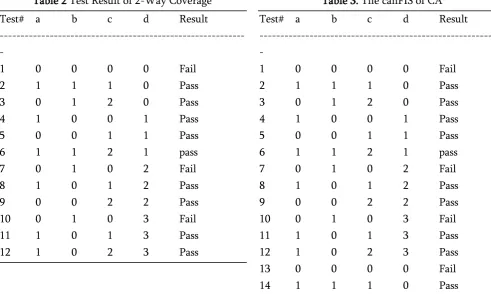
Table 2 Test Result of 2-Way Coverage
Test# a b c d Result
---
1 0 0 0 0 Fail
2 1 1 1 0 Pass
3 0 1 2 0 Pass
4 1 0 0 1 Pass
5 0 0 1 1 Pass
6 1 1 2 1 pass
7 0 1 0 2 Fail
8 1 0 1 2 Pass
9 0 0 2 2 Pass
10 0 1 0 3 Fail
11 1 0 1 3 Pass
12 1 0 2 3 Pass
Table 3. The canFIS of CA
Test# a b c d Result
---
1 0 0 0 0 Fail
2 1 1 1 0 Pass
3 0 1 2 0 Pass
4 1 0 0 1 Pass
5 0 0 1 1 Pass
6 1 1 2 1 pass
7 0 1 0 2 Fail
8 1 0 1 2 Pass
9 0 0 2 2 Pass
10 0 1 0 3 Fail
11 1 0 1 3 Pass
12 1 0 2 3 Pass
13 0 0 0 0 Fail
Volume 3, Issue 3 | March-April-2018 | http:// ijsrcseit.com
1809
0
15 0 1 2 0 Pass
16 1 0 0 1 Pass
17 0 0 1 1 Pass
18 1 1 2 1 pass
19 0 1 0 2 Fail
20 1 0 1 2 Pass
21 0 0 2 2 Pass
22 0 1 0 3 Fail
23 1 0 1 3 Pass
Table 3 shows the results of first process, in which the first column refers to the number of interactions while the first row represents the parameter of each interaction and the remaining rows represent the
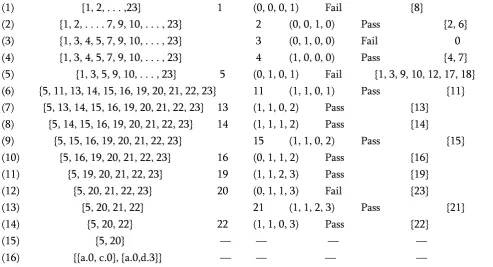
respective value of the parameters. Each row in Table 3 indicates an interaction from row 2 on. For example, interaction 1 {𝑎.0, 𝑏.0, 𝑐.0} is shown in row 2 (I # 1).The second process is to generate minimal fault interaction set, as shown in Table 4. The second column of Table 4describes the interactions contained by canFIS in each step.The third column in Table 4 shows the interactions under testing. The fourth column shows the additional test cases for under testing interactions. Columns 5 and 6 show the outputs of additional test cases and the set consisting of the elements deleted from canFIS, respectively.
Table 4. The step of computing canFIS.
---
Step # canFIS I T= addTF(i) R(T) Delete from canFIS ---
(1) {1, 2, . . . ,23} 1 (0, 0, 0, 1) Fail {8}
(2) {1, 2, . . . . 7, 9, 10, . . . , 23} 2 (0, 0, 1, 0) Pass {2, 6} (3) {1, 3, 4, 5, 7, 9, 10, . . . , 23} 3 (0, 1, 0, 0) Fail 0 (4) {1, 3, 4, 5, 7, 9, 10, . . . , 23} 4 (1, 0, 0, 0) Pass {4, 7} (5) {1, 3, 5, 9, 10, . . . , 23} 5 (0, 1, 0, 1) Fail {1, 3, 9, 10, 12, 17, 18} (6) {5, 11, 13, 14, 15, 16, 19, 20, 21, 22, 23} 11 (1, 1, 0, 1) Pass {11} (7) {5, 13, 14, 15, 16, 19, 20, 21, 22, 23} 13 (1, 1, 0, 2) Pass {13}
(8) {5, 14, 15, 16, 19, 20, 21, 22, 23} 14 (1, 1, 1, 2) Pass {14}
(9) {5, 15, 16, 19, 20, 21, 22, 23} 15 (1, 1, 0, 2) Pass {15} (10) {5, 16, 19, 20, 21, 22, 23} 16 (0, 1, 1, 2) Pass {16}
(11) {5, 19, 20, 21, 22, 23} 19 (1, 1, 2, 3) Pass {19} (12) {5, 20, 21, 22, 23} 20 (0, 1, 1, 3) Fail {23}
(13) {5, 20, 21, 22} 21 (1, 1, 2, 3) Pass {21} (14) {5, 20, 22} 22 (1, 1, 0, 3) Pass {22}
(15) {5, 20} — — — —
(16) {{a.0, c.0}, {a.0,d.3}} — — — —
We can conclude from Table 4 that the whole process takes 14 steps and each step generates an additional test case. The minimal fault interaction set {5, 20} is screened out at step (15) at last. Meanwhile
22},then the minimal fault interaction set could be generated directly. The whole process only takes 13 steps and needs only 13 test cases. Therefore, an optimized interaction test order could reduce the generating of test cases. In this paper, we do not carry on the discussion and simply consider the order is random. The method presented by Ghandehari et al. [13] give the result that contains 9 interactions in the set; however, the minimal fault interaction set contains 2 interactions. This shows that the method comFIL is more precise than the method proposed by Ghandehari et al.
IV.
EXPERIMENT AND TESTING
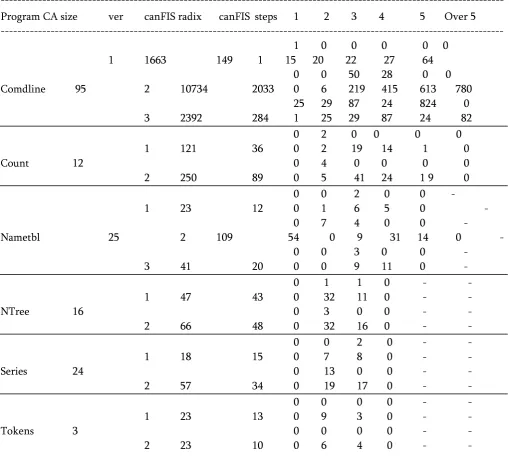
Evaluation Criteria. We use fault quantitative relation as our analysis criteria. In FIL algorithmic rule, we'd like to record range |the amount|the quantity} 𝑝 of every interaction that exists in passed take a look at cases and therefore the number 𝑓 of isn't a priority during this paper, they're assumed to be correct. Then the quality and fault versions are (comdline,count, nametbl, ntree, series, and tokens [12]) as take a look at samples and input parameter model conferred by Z. Zhang and J. Zhang [12]. Table five shows the essential info of those programs.The second column represents the amount of lines while not comments in every program,while column3 refers to their input models. for instance, comdline (9; (21, 34, 41, 62, 151))means comdline has nine parameters, within which four parameters have three values, a pair of parameters have only one
Volume 3, Issue 3 | March-April-2018 | http:// ijsrcseit.com
1811
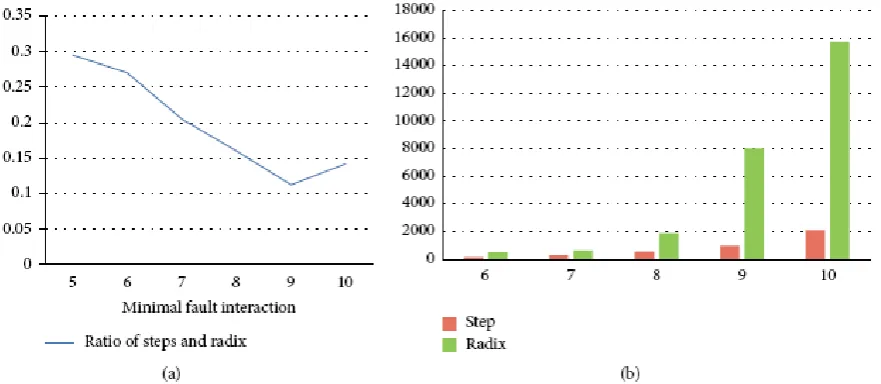
which is zero.The numbers of interactions being tested for computing every canFIS square measure 1; 15; 20; 22; 27; sixty four, respectively. The simulated experiment result bestowed by Figures one and a couple of shows the quantity of further check cases is decreasing whereas the program may higher match the three assumptions of this paper. moreover, with the increment of marginal fault interactions’ count, the magnitude relation becomes smaller; this implies the upper likelihood of
obtaining safe price for input parameters. However, once the marginal fault interaction will increase to a special price like nine in Figure 2(b), the magnitude relation would rise; this can be as a result of once the quantity of input parameters becomes large, too several further check cases are going to be generated; this may have an effect on the potency and lead the magnitude relation to rise.
Table 6. Test result of standard program.
--- Program CA size ver canFIS radix canFIS steps 1 2 3 4 5 Over 5 ---
1 0 0 0 0 0
1 1663 149 1 15 20 22 27 64
0 0 50 28 0 0
Comdline 95 2 10734 2033 0 6 219 415 613 780
25 29 87 24 824 0
3 2392 284 1 25 29 87 24 82
0 2 0 0 0 0
1 121 36 0 2 19 14 1 0
Count 12 0 4 0 0 0 0
2 250 89 0 5 41 24 1 9 0
0 0 2 0 0 -
1 23 12 0 1 6 5 0 -
0 7 4 0 0 -
Nametbl 25 2 109 54 0 9 31 14 0 -
0 0 3 0 0 -
3 41 20 0 0 9 11 0 -
0 1 1 0 - -
1 47 43 0 32 11 0 - -
NTree 16 0 3 0 0 - -
2 66 48 0 32 16 0 - -
0 0 2 0 - -
1 18 15 0 7 8 0 - -
Series 24 0 13 0 0 - -
2 57 34 0 19 17 0 - -
0 0 0 0 - -
1 23 13 0 9 3 0 - -
Tokens 3 0 0 0 0 - -
VI.
CONCLUSION AND FUTURE WORK
6.1. Conclusion. During this paper, we have a tendency to gift a replacement combinatorial testing formula named Fault Interaction Location formula that may sort the tokenish fault interaction set of check cases. the most contributions of this paper area
unit listed as follows:
(1) Summarizing the fundamental plan of the
previous fault interaction location techniques, as well as their blessings and downsides. (2) Proposing a completely unique fault interaction location technique named Fault Interaction Location formula that has additional powerful functionalities and performs additional exactly compared with different fault location techniques.
Figure 1. Test result of Simulated Experiment 1. (a) Ratio of steps and radix. (b) Step and radix.
Figure 2. Test result of Simulated Experiment 2. (a) Ratio of steps and radix. (b) Step and radix
If we have a tendency to cannot get the safe worth of every parameter before testing, the value in generating an extra legal action for associate interaction is extremely high. However, if there are solely a couple of bugs in an exceedingly program,
Volume 3, Issue 3 | March-April-2018 | http:// ijsrcseit.com
1813
don't satisfy Assumption three. Even for a legal action generated for associate interaction indiscriminately, its chance that it doesn't satisfy Assumption three is quite low. therefore nearly each testing technique in combinatorial testing may solely work effectively once applied in program with comparatively less faults the speculation and experiments indicate that FIL is a lot of correct in fault localization compared with different algorithms in terms of combinatorial testing. The future work can embody 3 aspects: uncountable extra take a look at cases ought to be generated; but, the order of the interactions being take a look ated can influence the quantity of extra test cases generated. therefore optimizing the order of interactions being take a look ated to scale back the quantity of extra test cases are going to be the target of formula is to get the stripped-down fault interaction set, whereas the way to use the stripped-down fault interaction set to additional find bugs also will be a big topic to check additional later. N. Kacker,―Introducing combinatorial testing in a large organization,‖Computer, vol. 48, no. 4, pp. 64–72, 2015.
[2]. W.-J. Zhou, D.-P. Zhang, and B.-W. Xu, ―Locating error interactions based on partial covering array,‖ Chinese Journal of Computers, vol. 34, no. 6, pp. 1126–1136, 2011.
[3]. C. Nie and H. Leung, ―The minimal failure-causing schema of combinatorial sting,‖ACMTransactions
onSoftwareEngineering and Methodology, vol. 20, no. 4, article 15, 2011.
[4]. B. Garn and D. E. Simos, ―Eris: a tool for combinatorial testing of the Linux system call interface,‖ in Proceedings of the 7th
IEEEInternational Conference on Software Testing, Verification and Validation Workshops (ICSTW ’14), pp. 58–67, Cleveland, Ohio,USA, April 2014.
[5]. S. K. Khalsa andY.Labiche, ―An orchestrated survey of available algorithms and tools for combinatorial testing,‖ in Proceedings of the 25th IEEE International Symposium on Software ReliabilityEngineering (ISSRE ’14), pp. 323–334, IEEE, Naples, Italy,November 2014.
[6]. A. Gupta and C.H. Scholz, ―A model of normal fault interaction based on observations and theory,‖ Journal of Structural Geology,vol. 22, no. 7, pp. 865–879, 2000.
[7]. D. C. P. Peacock, ―Propagation, interaction and linkage innormal fault systems,‖ Earth-Science Reviews, vol. 58,no. 1-2, pp.121–142, 2002. ―Algorithms to locate errors using covering arrays,‖ in LATIN 2008:Theoretical Informatics, pp. 504–519, Springer, Berlin,Germany, 2008.
[10]. J. Piton-Gonc¸alves and S. M. Alu´ısio, ―An architecture for multidimensional computer adaptive test with educational purposes,‖ in Proceedings of the 18th Brazilian symposium onMultimedia and the web (WebMedia ’12), pp. 17–24, ACM, S˜aoPaulo, Brazil, 2012. [11]. A. Zeller and R.Hildebrandt, ―Simplifying and
isolating failureinducing input,‖ IEEE Transactions on Software Engineering, vol.28, no. 2, pp. 183–200, 2002.
[13]. L. Ghandehari, J. Chandrasekaran, Y. Lei, R. Kacker, and D. Kuhn, ―Short paper: BEN: a combinatorial testing-based fault localization tool,‖ in Proceedings of the 4th InternationalWorkshop on Combinatorial Testing (in Junction with 8th IEEEInternational Conference on Software Testing, Verification andValidation), April 2015.
[14]. Wei Zheng, Xiaoxue Wu, Desheng Hu, and Qihai Zhu College of Software & Micro-Electronics, Northwestern Polytechnical University, Xi’an 710072, China
[15]. L. S. Ghandehari, Y. Lei, D. Kung, R. N. Kacker, and D. R. Kuhn,―Fault localization based on failure-inducing combinations,‖ inProceedings of the 24th IEEE International Symposium on SoftwareReliability Engineering (ISSRE ’13), pp. 168–177, Pasadena,Calif, USA, November 2013.