International Journal of Scientific Research in Computer Science, Engineering and Information Technology © 2018 IJSRCSEIT | Volume 3 | Issue 4 | ISSN : 2456-3307
A Greedy Algorithm Approach for Influential Node Tracking on
Dynamic Social Network
P. Maheswari1, K. Jaya Krishna2
1Student of MCA in ,QIS College of Engineering & Technology, Ongole, Andhra Pradesh, India
2Associate Professor in Dept. of MCA, QIS College of Engineering &Technology, Ongole Andhra Pradesh, India
ABSTRACT
A mobilesocial network assumes a critical part as the spread of data and influence as "informal". It is essential thing to discover little arrangement of powerful individuals in a mobilesocial network with the end goal that focusing on them at first. It will expand the spread of the influence.The issue of finding the most powerful nodes in arranges is NP-hard. It has been demonstrated that a Greedy algorithm with provable estimate certifications can give great guess. Group based Greedy algorithm is utilized for mining top-K persuasive nodes. It has two parts: partitioning the mobilesocial network into a few groups by considering data dissemination and choosing groups to discover powerful nodes by a dynamic programming. Location Based community Greedy algorithm is utilized to discover the influencenode in view of Location and consider the influence spread inside Particular region. Examinations result on genuine expansive scale mobile informal organizations demonstrate that the proposed location based insatiable algorithm has higher effectiveness than past group greedyalgorithm. Keywords : Influence maximization, Mobile social network, community greedy algorithm, and Location based community greedy algorithm.
I. INTRODUCTION
Mobilesocial network assumes an essential part in informal community. It's a primary issue to look out an arrangement of powerful individuals in a mobile informal organization. It will boost the influence. An association might truly want to advance a substitution item, trusting it'll be received by an outsized portion of the system. The corporate plans to at first target little assortment of "Powerful" individuals of the system by giving them free examples of the item. The corporate expectations that initially chose clients can advocate the item to their companions; their companions can influence their companions'. Companions and after that on, consequently a few people can eventually embrace the new item through the intense talked affect.
scale mobile informal organizations demonstrate that the proposed algorithm is faster than past algorithms with high precision.
The new algorithm is known as Location based group Greedy algorithm. Here we need to discover most persuasive node in Particular location. The general population in same territory is more influence as contrast with the general population in various region or state. People in same territory dependably have more contact than people in various regions. Correspondence Time between people and location of individual these two parameters are considered in Location Based Community Greedy algorithm.Experimentally demonstrates that Location Based communitygreedyalgorithm have higher exactness and proficiency than existing group based Greedy algorithm.
II. Related Work
Free course demonstrate and direct limit show are two broadly examined influence dispersions models originally outlined by Kempe et al .It demonstrate that the summed up renditions of these two models are same. In view of the IC and LT show, Kempe et al propose an insatiable algorithm to take care of the influence amplification issue (realized by Richardson) to boost the spreading of thoughts and advancements under these two models. Numerous subsequent investigations propose elective heuristics and attempt to take care of the influence amplification issue all the more productively. The thought in of finding productive nearby chart structures is utilized to accelerate the algorithm. CLDAG algorithm is like the LDAG algorithm, which is likewise in light of the DAG algorithm. Our CLDAG algorithm is novel in managing aggressive influence dispersion utilizing the dynamic programming strategy. Number of concentrates on focused influence dispersion is finished. Bharathi et al, stretch out the IC model to demonstrate focused influence, however they just give a polynomial estimation algorithm to trees.
The social influence investigation issue represents an interesting arrangement of difficulties: First, how to use both node particular subject conveyance and system structure to measure social influence. In another word, a client's influence on others relies upon their own particular point circulation, as well as depends on what sorts of social connections they have with others. The objective is to outline a bound together way to deal with use both the neighborhood qualities (theme conveyance) and the worldwide structure (organize data) for social influence investigation.
we formalize the social influence issue in a topical factor diagram show and propose at optical proclivity proliferation on the reality or chart to naturally distinguish the subject particular social influence. Our primary thought is to use proclivity spread at the subject level for social influence recognizable proof. The approach depends on the hypothesis of factor chart, in which the perception information is strong on both nearby qualities and connections. In our setting, the node compares to the perception information in the factor diagram and the social relationship compares to edge between the perception information in the chart. At last, we propose two distinctive proliferation rules: one in view of message passing on graphical models, the other one is a parallel refresh decides that is appropriate for Map-Reduce system.
III. Methodology
Our communitygreedyalgorithm utilizes group discovery algorithm to fine group. Group identification algorithm comprises of segment and blend.
1) Partition. We broaden the algorithm with the data influence component in view of Independent Cascade demonstrate. The algorithm, an about direct algorithm for group identification, is intended for undirected and unweighted chart. It isn't straightforwardly relevant.
2) Combination. The produced groups by the parcel step are little and scattered; we build up a technique to consolidate groups to such an extent that the distinction between influence level of a node in its group and its influence degree in the entire system is limited.
CGA Implementation
• Top-K Influential Nodes Mining • Precision Analysis of CGA LCGA Implementation • Location based Mechanism • Top-K Influential Nodes Mining • Precision Analysis of LCGA • Regional Factor-
I) Location Based community Greedy Algorithm considerslocation Factor.
• Node in same locale has more contact. • Region factor is meant as SR=2 algorithms and existing CGA algorithm for influence expansion. Algorithm and parameter are recorded as take after:
Autonomous Cascade Model- The model is initially proposed by Lopez Pintado. It is the most well-known dynamic model in data dispersion. It is broadly utilized as a part of influence amplification issue. We allot two states to nodes: dynamic and idle in the model. Dynamic nodes are those that are affected by other dynamic nodes. These dynamic nodes can influence their inert neighbors; dormant nodes are those that are not affected by their dynamic neighbors. The condition of a node can be changed from being idle to being dynamic, however not turn around.
Diffusion Speed- The algorithm has a vital parameter called dissemination speed λ. At the point when a dynamic nodevi contacts a latent nodevj, the idle node winds up dynamic at a likelihood (rate) λ. In a viral showcasing, dissemination speed models the inclination of people to acknowledge an item. In this way the dispersion is influenced by dissemination speed, node degree, and the quantity of starting dynamic nodes.
Influence Degree- Let A be the underlying arrangement of dynamic nodes. The influence level of set An is registered as:
R(A) = VA/N
VA is the quantity of nodes affected by An amid data dissemination process.
CGA:
compelling nodes inside groups. People inside a group have visit contact and in this manner will probably influence each other; interestingly, people crosswise over groups have considerably less contact with each other and along these lines are less inclined to influence each other. This property recommends that it may be a decent guess to pick powerful nodes inside groups rather than the entire system. This algorithm considers into account the dispersion demonstrate.
V. Location Based Community Greedy Algorithm Approach
Given a mobilesocial network G = (V, E, W), we expect to mine an arrangement of best K Influential nodes I on the system with the end goal that R (I) is amplified utilizing the Independent Cascade data dispersion demonstrate. It has been demonstrated that the advancement issue is NP-hard. In any case, the group s ravenous algorithm is utilized as a part of entire system for tackling the influence expansion issue on a vast scale organizes. We propose Location Based community voracious algorithm which mine the Influential nodes in every group as opposed to the entire system considering location factor. Location territory is signified with location no. This algorithm is utilized to mine an arrangement of best k powerful nodes specifically region.
Fig 1: Location Based community Greedy Algorithm Illustration
Algorithm LCGA
1) Network G = (V, E, W), size of result k, influence speed, size of result, Location_Id
2. Recognize community and Find out influence degree utilizing dynamic Programming algorithm 3. Compute maximal increment of influence degree with respect to group.
4. Sort as indicated by location degree.
5. Pick community what yields the biggest increment of influence degree among all groups.
6. Select community from first m groups to mine compelling node.
6. Experimental Setup
Data SetWe have CDR (call detailed record) information of Mobile. We extricate a Mobile Social Network from the CDR information utilizing the CGA and LCGA exhibited in this Paper. We assess algorithm in Mobile Social Networks datasets having 1000 records.
Experimental ResultsThis investigation is to assess the execution of the proposed Location Based community Greedy algorithm on a Mobile Social Network.
We need to think about after parameter.
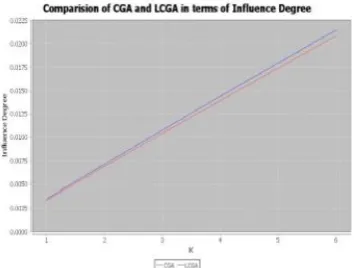
1. Varying K This examination is to assess the distinction of the parameter K on the influence degree and proficiency of CGA and LCGA algorithms. We change K from 1 to 6. The outcomes are appeared in Figure 2. It can be found in Figure 2 that 1) LCGA technique is vastly improved than CGA strategy. This is Because of Location parameter.
Fig 2: Comparison of CGA and LCGA in terms of Influence Degree.
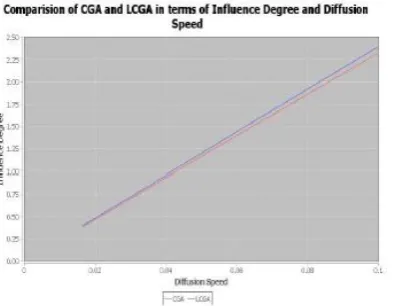
about specific region. Influence speed specifically region is more than various territory.
Fig 3: Comparison of CGA and LCGA in terms of Influence Degree & Diffusion Speed.
VI.Conclusion
In this paper, Location Based Community Greedy algorithm (LCGA) is proposed. It is utilized for mining top-K definitive nodes in an exceedingly MSN. Free Cascade display is required to consider weight edge of Mobile informal organization. LCGA has two fundamental components; a recipe is utilized for analyst work groups by thinking about information dissemination. Dynamic programming equation is utilized for picking groups to discover legitimate nodes. LCGA algorithm considers both persuasive time and Location Factor. Exact examinations on mobilesocial network demonstrate that LCGA algorithms have extraordinary change on both productivity and exactness contrasted and CGA techniques.
VII. REFERENCES
[1]. JLeskovec,J.Kleinberg,andC.Faloutsos,“Graphso vertime:densificationlaws,shrinking diameters and possible explanations,” in KDD, 2005, pp. 177–187.
[2]. JLeskovec,J.M.Kleinberg, and C. Faloutsos,“Graphevolution: Densificationand shrinking diameters,”TKDD, vol. 1, 2007. [3]. JLeskovec, L.Backstrom, R. Kumar, and
A.Tomkins,“Microscopic evolution of social networks,” in KDD, 2008, pp. 462–470.
[4]. C Zhou, P Zhang, J Guo, X.Zhu, and L.Guo,“Ublf: An upper bound based approach todiscover influential nodes in social networks,” in ICDM, 2013.
[5]. M Richardson and P. Domingos, “Mining knowledge-sharing sites for viral marketing,” in KDD, 2002, pp. 61–70.
[6]. JLeskovec,A.Krause,C.Guestrin,C. Faloutsos, J. VanBriesen, and N. S. Glance,“Cost-effective out break detection in networks.” in KDD, 2007, pp. 420–429.
[7]. Q Jiang, G. Song, G. Cong, Y. Wang, W. Si, and K. Xie, “Simulated annealing based influence maximization in social network,” in AAAI, 2011.
[8]. K Jung, W. Heo, and W. Chen, “Irie: Scalable and robust influence maximization in social networks,” in ICDM, 2012, pp. 918–923.
[9]. M G. Rodriguez and B. Scholkopf, “Influence maximization in continuous time diffusion networks,” arXiv preprint arXiv:1205.1682, 2012
[10]. W. Chen, Y. Wang, and S. Yang, “Efficient influence maximization in social network,” in KDD, 2009, pp. 199–208.
[11]. P. Domingos and M. Richardson, “Mining the network value of customers,” in KDD, 2001, pp. 57–66.
[12]. D. Kempe, J. Kleinberg, and E. Tardos, “Maximizing the spread of inffluence through a social network,” in KDD, 2003, pp. 137–146. [13]. M. Kimura and K. Saito, “Tractable models for
information diffusion in social networks,” in PKDD, 2006, pp. 259–271.
[14]. W.Yu, G.Cong, G.Song, and K.Xie, “Community-based greedy algorithm for mining top-k influential nodes in mobile social networks,” in KDD, 2010, pp. 1039–1048. [15]. W.Chen, C.Wang, and Y.Wang, “Scalable
[16]. W. Chen, W. Lu, and N. Zhang, “Time-criticalinfluence maximization in social networks with time-delayed diffusion process,” in AAAI, 2012
About Authors:
P.Maheswari is Currently Pursuing Master of Computer Applications In QIS College of Engineering & Technology, Ongole. AP. She is area of interested her MCA in Department of Master of Computer Applications from QIS College of Engineering & Technology, Ongole . AP.
Mr. K.Jaya Krishna is Currently Working as anAssociate Professor in