The Use of Parallel and Comparable Data
for Analysis of Abstract Anaphora in German and English
Stefanie Dipper
∗, Melanie Seiss
†, Heike Zinsmeister
†∗Ruhr University Bochum
[email protected] †Konstanz University
heike.zinsmeister, [email protected]
Abstract
Parallel corpora — original texts aligned with their translations — are a widely used resource in computational linguistics. Translation studies have shown that translated texts often differ systematically from comparable original texts. Translators tend to be faithful to structures of the original texts, resulting in a “shining through” of the original language preferences in the translated text. Translators also tend to make their translations most comprehensible with the effect that translated texts can be more explicit than their source texts. Motivated by the need to use a parallel resource for cross-linguistic feature induction in abstract anaphora resolution, this paper investigates properties of English and German texts in the Europarl corpus, taking into account both general features such as sentence length as well as task-dependent features such as the distribution of demonstrative noun phrases. The investigation is based on the entire Europarl corpus as well as on a small subset thereof, which has been manually annotated. The results indicate English translated texts are sufficiently “authentic” to be used as training data for anaphora resolution; results for German texts are less conclusive, though.
Keywords:Abstract anaphors, comparable corpora, parallel corpora
1.
Introduction
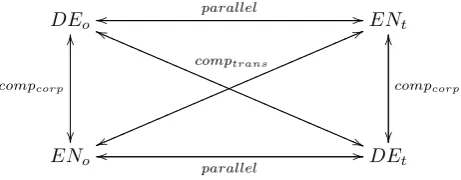
This paper presents a validation of parallel texts in com-parison to comparable texts in the Europarl corpus (Koehn, 2005). Parallel textsrefer to bi-texts in a source language (Lo, the original language) and its translation to a target lan-guage (Lt), which have been aligned at the sentence level.
Comparable textsare texts in different languages or vari-eties that deal with the same overall topic.
Our domain of application is the resolution of abstract anaphora. We address the question whether translated texts (e.g., translations into English: ENt) are sufficiently similar to original texts of the same language (ENo) to be used as empirical evidence for feature induction in this domain, or whether original texts only should be used for this purpose.
Abstract anaphora denote anaphoric relations between some anaphoric expression and an antecedent that refers to an abstract object like an event, fact or proposition (cf. Asher (1993)). In the classical example by Byron (2002), the pronoun it (underlined in (1a)) refers to an
event: the migration of penguins to Fiji. In (1b), the demon-strative pronounthatrefers to thefactthat penguins migrate to Fiji in the fall.
(1) a. Each Fall, penguins migrate to Fiji. It happens just be-fore the eggs hatch.
b. Each Fall, penguins migrate to Fiji. That’s why I’m go-ing there next month.
In (1), the anaphoric elements are pronouns. In this pa-per, we mainly consider anaphoric noun phrases, as in (2), which is taken from the Europarl corpus. In this example, the NP this taskrefers to the activity (a specific type of event) of investigating the best ways of promoting a sys-tem.
(2) The Commission will investigate the best ways of promot-ing this system across the Community and will involve the European Parliament in this task.
This study is motivated by a larger project of analyzing ab-stract anaphora (Dipper and Zinsmeister, 2010; Dipper and Zinsmeister, to appear; Dipper et al., 2011; Zinsmeister et al., submitted), which pursues an approach of bootstrapping annotation from German to English and vice versa. The paper is organized as follows. Section 2 provides the background of our study: we define the core concepts of parallel and comparable data, address findings of transla-tion studies on how translated texts differ from comparable original data, and present related work on the use of parallel and comparable corpora. Section 3 introduces our corpora, and Section 4 presents results from comparing general and anaphora-related properties. Section 5 concludes the paper.
2.
Background
2.1. Parallel and comparable data
(ENo) and their German translations (DEt).4 The transla-tions have been aligned with their originals on the basis of Europarl’s align units. Our corpus consists of 12,800 Ger-man original turns with 4.9 M tokens, and 11,500 English original turns with 3.4 M tokens.
3.1. Automatic preprocessing
Automatic preprocessing of the German and English sub-corpora included POS tagging and chunking by the Tree-Tagger (Schmid, 1994), with German and English language models as provided by the official TreeTagger website.5 In addition, we automatically marked selected abstract noun chunks, which possibly function as abstract anaphors. Noun chunks that would be selected fulfill two conditions: first, they contain a demonstrative determiner — such noun phrases are usually used anaphorically. Second, the head noun is part of a pre-defined set of so-calledlabel nouns.6 The label nouns are highly inspired by the list of English abstract nouns provided by Francis (1994).
For the English data, the set comprises 211 types of label nouns, which have been extracted in their singular and plu-ral forms. Examples for English label nouns in the Europarl corpus are report, proposal, agreement, issue, point, etc. For the German data, the most probable German transla-tions of the English label nouns have been used. This re-sulted in 452 German types of label nouns for which the inflected forms have been marked in the German data. (For more details on the selection of label nouns, see Zinsmeis-ter et al. (submitted).)
3.2. Manual annotation of a subcorpus
Most of the label nouns described above are unambigu-ously abstract, with some exceptions such as areaor re-port. In contrast, pronominal anaphors are (mostly) am-biguous and can refer to entities other than abstract objects. We created a small manually-annotated subcorpus called
Anaphora Corpus of approximately 100 turns for each language, in which annotators disambiguated pre-marked pronominals and demonstrative label-noun chunks. Manual annotation also provided information about the antecedent of pronominal anaphors, and about the position, function, etc. of the anaphoric element. (For a more detailed de-scription of the manual annotation of pronominal abstract anaphors, see Dipper et al. (2011), for the annotation of label nouns, see Zinsmeister et al. (submitted).)
4
The original language of each turn was determined by means of the language tags provided in the Europarl corpus, and comple-mented by a lookup in databases listing the members of the EU Parliament along with their nationalities.
5
http://www.ims.uni-stuttgart.de/
projekte/corplex/TreeTagger/. The German chunker
was trained on the Tiger Treebank (Brants et al., 2004), the English chunker on the Penn Treebank (Marcus et al., 1993). The POS tagsets used in these annotations are the STTS tagset for German (Schiller et al., 1999), and the UPenn Treebank tagset for English (Santorini, 1990).
6In the biomedical literature, label nouns are referred to as
‘sortal nouns’, e.g. Casta˜no et al. (2002).
4.
Results
The texts that we investigate are highly similar in the sense that they are all from the same text type, namely parliament debates. They deal with different topics, depending on the agenda of the current session, but our basic assumption is that the choice of topic should have no significant impact on low-level properties such as, e.g., the number of nouns. In this study, we focus on features that are considered rele-vant for anaphora resolution, and the resolution of abstract anaphora in particular. That is, we mainly investigate the distributions of noun phrases, in particular demonstrative label-noun chunks, which are likely to be abstract anaphors. The investigations are based on the parallel and comparable corpora described in Section 3.
As the study aims at testing the similarity of original and translated texts, the main focus is on differences between comparabletransturns, i.e., we compareDEowithDEt, and
ENowithENt. In addition, we compare the language pair-ings DEo–ENo withDEo–ENt, andENo–DEo withENo–
DEt. This can shed light on translational effects: if, e.g., the pairingDEo–ENtturns out more similar than the pair-ingDEo–ENo, this could be a shining through effect. The comparison would profit from deep linguistic process-ing (as has been shown by authorship attribution studies, e.g., Kaster et al. (2005)). Such processing is only provided in the manually annotatedAnaphora Corpus. For investi-gating anaphora-related properties of the complete Europarl data, we therefore have to use approximations, such as the ratio of definite or demonstrative noun chunks as rough ap-proximations of anaphoric elements.7
4.1. Sentence length
We start by comparing the average sentence length as a highly general measure for similarity. The average sen-tence length is calculated as the average number of tokens per sentence, as identified in the preprocessing.8
Corpus #Sent Tok/Sent 95% CI SD
DEo 220,609 22.2 22.1 . . 22.3 13.8
DEt 162,528 24.2 24.1 . . 24.2 13.2
ENo 147,375 26.6 26.5 . . 26.6 14.1
ENt 184,579 28.8 28.7 . . 28.9 16.2
Table 1: Average sentence lengths: total number of sen-tences, average number of tokens per sentence, 95% confi-dence interval, and standard deviation
On average, English sentences are clearly longer than Ger-man sentences, as can be seen in Table 1. This could be, among others, attributed to the different realizations of compound nouns in both languages.
ComparingDEowithDEt, andENowithENt, we observe that in both languages, sentences of translated texts tend to
7
Fraurud (1992) showed that 60.9% of the definite noun phrases in her sample were first mentions, i.e. not used anaphor-ically. However, it is clear that definite anaphors are the default: only 8.3% of the indefinite noun phrases were anaphoric.
8
be longer than sentences of original texts. This could be viewed as an effect of explicitation.
The differences in average sentence length between the sub-corpora are all statistically significant, as can be seen from the non-overlapping 95% confidence intervals. However, the confidence intervals are very small. This is an effect of the large sample size, i.e., the large number of sentences that contribute to the mean.
It is a general problem in corpus linguistics that statisti-cal hypothesis testing becomes hard to interpret when the sample size is large. Gries (2005) suggests to employ mea-sures ofeffect size, in particularCohen’s d9 (also called
standarized mean difference), to quantify the amount of ob-served differences in means independently of the sample size. Cohen’sdranges fromd= 0, if no effect is observed, to infinity. An effect size ofdbetween0.2to0.3is consid-eredsmall,d= 0.5medium, andd= 0.8to infinitylarge
(Cohen, 1988). Negative polarity means that the second mean in the equation is larger than the first one.
Corpora x¯1 x¯2 Cohen’sd
DEo–DEt 22.2 24.2 –0.14
ENo–ENt 26.6 28.8 –0.15
DEo–ENo 22.2 26.6 –0.31
DEo–ENt 22.2 28.8 –0.44
ENo–DEo 26.6 22.2 0.31
ENo–DEt 26.6 24.2 0.18
Table 2: Sentence lengths;x¯1arex¯2are the means of the
two corpora (cf. Table 1)
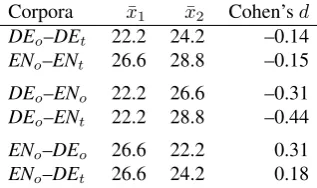
The first two rows in Table 2 show that the effect sizes of the standardized mean difference betweenDEoandDEton the one hand, andENo andENton the other hand, are small (d = −0.14, d = −0.15). These differences can be ig-nored.
The comparablecorp pairDEo–ENoshows medium differ-ences between the languages (d=−0.31).10 This confirms the significant results displayed in Table 1.
Turning to the parallel pairs (DEo–ENt, andENo–DEt), the medium effect could either become more pronounced than in the comparablecorp pair, which could indicate an effect of explicitation, or it could become less pronounced, which would rather indicate an effect of shining through. Inter-estingly, we find indications for explicitation inENt(d in-creases from –0.31 to –0.44) and for shining through inDEt (ddecreases from 0.31 to 0.18).
4.2. Nouns in general
We start our task-related comparison by looking at the dis-tribution of nouns and noun chunks (NC) in general. To compare the frequencies between the different subcorpora, we normalize the observed noun frequencies by token fre-quencies. In addition, we compare the ratios of nouns per
9Cohen’sdaccording to R package
MAd(functionmean to d)
d= x¯1−x¯2
sdwithin, withsdwithin= q
(n1−1)sd12+(n2−1)sd22
n1+n2−2 . 10This difference is of course expected in different languages
like German and English.
Corpora Nouns/Tok Nouns/Cl Def/NC Dem/Def
DEo–DEt –0.34 –0.17 –0.38 –0.04
ENo–ENt 0.10 –0.01 0.12 –0.03
DEo–ENo 0.55 –1.53 0.72 –0.72
DEo–ENt 0.66 –1.64 0.85 -0.76
ENo–DEo –0.55 1.53 –0.72 0.72
ENo–DEt –0.91 1.39 –1.13 0.69
Table 4: Cohen’sd: nouns normalized by the number of tokens and clauses; definite and demonstrative NCs nor-malized by the number of NCs. Important effect sizes are given in boldface.
clause, definite NCs per NCs in general and the proportion of demonstrative NCs among definite NCs.11
Our null hypothesis is that the number of nouns, noun chunks, definite and demonstrative noun chunks should be similar across comparabletrans corpora, i.e., across DEo andDEt, and acrossENoandENt, respectively. Statistical significance tests (Welch’s t-test) reject the null hypothesis in most cases, as is shown in Table 3.12
However, as we have seen above (Section 4.1), such signif-icance scores are hard to interpret with large sample sizes. Hence, we again turn to Cohen’sdas an alternative mea-sure. Table 4 depicts the effect sizes of the comparisons. Looking first at the comparabletrans corpora, we see that the effect sizes for English are small for all features— despite the significant differences shown in Table 3. In contrast, the distribution of nouns (Nouns/Tok) and definite NCs (Def/NC) in German clearly differ in both subcorpora. Turning to the comparablecorp and parallel pairs, the pic-ture is similar: The effect sizes ofENoandENtdo not in-crease or dein-crease considerably. In German, however, the distribution of nouns and definite NCs in translated texts, again, deviates considerably from the distribution in origi-nal texts. In particular, we observe an overuse of nouns and definite NCs, which could be an expliciteness effect (as-suming that definite NCs are more explicit than indefinite NCs).
11The corresponding approximations for the German and
En-glish corpora are:
• Nouns: DE:pos="NN"; EN:pos="(NN|NNS)". The nominal tags cannot be easily compared across both lan-guages, though. For instance, English gerunds are usually tagged as verbs, whereas nominalized infinitives in German are tagged as nouns.
• NCs: DE:cat="(NC|PC)"; EN:cat="NC"
• Definite NCs: DE: (pos="ART" & word="d.*" | pos="(APPART|PPOSAT)"); EN: (pos="DT" & word="the" | pos="PP$"), plus demonstrative NCs
• Demonstrative NCs: DE:pos="PDAT"; EN:pos="DT" & word="(this|these|that|those")
As a heuristics to determine the number of clauses, we counted verb chunks (VC) (for German and English:cat="VC").
12
Corpus Nouns/Token Nouns/Clause Def/NC Dem/Def
DEo 19.2±3.5 78.8±28.3 36.9±9.1 9.9±8.7
DEt 20.3±3.2
}***
83.6±28.3}***
40.4±9.2}***
10.3±8.3}***
ENo 17.3±3.5 140.7±50.5 30.7±7.8 17.2±11.5
ENt 16.9±3.4
}***
141.0±45.5}
n.s. 29.9±7.3}***
17.5±11.1}*
Table 3: Average frequencies (in %) and standard deviation in comparabletranscorpora. Nouns/Token: nouns per tokens; Nouns/Clause: nouns per clause; Def/NC: definite (incl. demonstrative) noun chunks per noun chunks; Dem/Def: demon-strative noun chunks per definite noun chunks. Significance tests (Welch’s t-test) refer to pairs of original and translated texts; significance levels: ***p < .001;**p < .01;*p < .05; n.s.not significant.
To sum up the findings of this section, English translated texts are rather similar to English original texts, whereas German translations deviate from German originals.
4.3. Label nouns
We next investigate the use of typical label nouns such as
fact, situation, based on our predefined sets of label nouns (see Sec. 3). InDEo, these label nouns represent 3.48% of all nouns, inENo, 4.07%. For both languages, the ratios are higher in translated texts: 4.01% inDEt, 4.25% inENt. We next compare the individual frequencies of these nouns across all corpora, normalized against the total number of nouns in the respective subcorpus (and multiplied by 1 mil-lion).13 Only nouns with (normalized) frequencies greater than 100 were considered; outliers have been removed.14 Fig. 2 displays the results for German (left plot) and En-glish (right plot). The solid lines denote the number of la-bel nouns that occur more often in translations (overuse), the dashed lines nouns that occur less often in transla-tions (underuse). The plots show that in both languages, overuse dominates underuse: In German, 22% (100 out of 452) nouns show overuse vs. 17% (75 out of 452) nouns show underuse. In English, there are 39% (83 out of 211) overuse vs. 33% (69 out of 211) underuse nouns. The dif-ference scores (y-axis) indicate the (normalized) ratios be-tween original and translated frequencies. For instance, a score of 2 for an overuse noun indicates that the noun oc-curs twice as often in the translated than in the original texts. Especially with overuse nouns, the differences be-tween the frequencies can be enormous, see below. We now turn to individual frequencies of label nouns rather than general tendencies. Pairwise comparison of label nouns frequencies in original and translated texts shows that they are clearly correlated.15
Fig. 3 show the frequencies of label nouns in German (left plot) and English (right plot), comparing original and
trans-13
The total number of nouns (tokens) in the subcorpora are:
DEo: 890k (4.7m);DEt: 1.2m (5.7m);ENo: 660k (3.8m);ENt: 860k (5.0m). As an example of normalized frequencies, consider the nounAussprache‘debate’: raw frequencies inDEo: 226, in
DEt: 2106; normalized frequencies inDEo: 255, inDEt: 1803, cf. Table 5.
14
Outliers are defined as data points which are more than 1.5 * the interquartile range (Q3-Q1) away from the interquartile boundaries.
15For German, Kendall’s tau yields: τ = .81 (.82); for
En-glish: τ = .83 (.82)(figures in parentheses: with outliers re-moved).
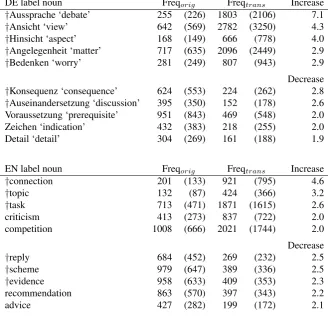
lated texts. Again, only nouns with more than 100 (normal-ized) occurrences in both texts have been included. Fur-thermore, outliers with extremely high frequencies in either the original or translated corpus and outliers with extreme differences between both corpora are not displayed. The heights of the boxplots clearly illustrate the overuse of la-bel nouns in translations, already mentioned above. Table 5 lists the label nouns with most extreme overuse and underuse. For instance, the noun Aussprache ‘de-bate’ occurs 7.1 times more often in DEt than in DEo. The figures show that the differences between original and translated noun frequencies are much more important with overuse (“Increase”) than with underuse (“Decrease”). These overuses result in some sort of constricted vocabu-lary in the translations.
Disregarding individual noun preferences, the overall dis-tributions of increasing and decreasing frequencies of label nouns are rather similar and they turn out not to be sig-nificantly different.16 Taken that label nouns are approx-imations for abstract anaphora, we conclude that the use of abstract anaphora as such is comparable in original and translated texts. This does not hold for the lexical real-izations, though. Further investigations are needed to de-cide whether the lexical overuse and underuse of particular nouns also effects the distribution of the semantic types of abstract anaphors, such as fact or event.
4.4. Anaphora corpus
The findings for the manually annotated Anaphora Corpus are mainly in line with the findings of the entire Europarl corpus. As an overall tendency, the differences between translated and original texts are not significant.
We found no significant difference for function (subject, object, other) in the original and translated versions (for both German and English). For position, the only statis-tical significant difference concerns the discourse-linked left periphery (“pre-field”) in German: compared toDEo,
DEtuses abstract anaphors less often in the pre-field. The difference could be due to shining through of English in-formation structure, and possibly reflects the fact that En-glish does not have a corresponding discourse-linked posi-tion that can be easily occupied by abstract anaphors. (For a more detailed discussion of the results of the Anaphora
16
Figure 2: Number of nouns that occur more often (solid line) or less often (dashed line) in translations than in original texts (left plot: German, right plot: English). The score indicates the ratio between original and translated uses.
Figure 3: Boxplots of label noun frequencies in original and translated texts (left plot: German, right plot: English), with outliers not displayed.
Corpus, see Dipper et al. (2011) and Zinsmeister et al. (submitted).)
5.
Conclusion
In this paper, we compared parallel and comparable subcor-pora of Europarl with respect to the distribution of general features as well as features that we used for approximat-ing abstract anaphora. Applyapproximat-ing standard corpus lapproximat-inguis- linguis-tic methods of significance testing resulted in highly sig-nificant differences in most of the cases. Following Gries (2005), we attributed the significance effects rather to the large sample sizes than to real differences in the
DE label noun Freqorig Freqtrans Increase
†Aussprache ‘debate’ 255 (226) 1803 (2106) 7.1
†Ansicht ‘view’ 642 (569) 2782 (3250) 4.3
†Hinsicht ‘aspect’ 168 (149) 666 (778) 4.0
†Angelegenheit ‘matter’ 717 (635) 2096 (2449) 2.9
†Bedenken ‘worry’ 281 (249) 807 (943) 2.9
Decrease
†Konsequenz ‘consequence’ 624 (553) 224 (262) 2.8
†Auseinandersetzung ‘discussion’ 395 (350) 152 (178) 2.6
Voraussetzung ‘prerequisite’ 951 (843) 469 (548) 2.0
Zeichen ‘indication’ 432 (383) 218 (255) 2.0
Detail ‘detail’ 304 (269) 161 (188) 1.9
EN label noun Freqorig Freqtrans Increase
†connection 201 (133) 921 (795) 4.6
†topic 132 (87) 424 (366) 3.2
†task 713 (471) 1871 (1615) 2.6
criticism 413 (273) 837 (722) 2.0
competition 1008 (666) 2021 (1744) 2.0
Decrease
†reply 684 (452) 269 (232) 2.5
†scheme 979 (647) 389 (336) 2.5
†evidence 958 (633) 409 (353) 2.3
recommendation 863 (570) 397 (343) 2.2
advice 427 (282) 199 (172) 2.1
Table 5: German and English top-5 label nouns that show most extreme overuse (top tables) and underuse (bottom tables). Freqorigand Freqtransare normalized (raw) frequencies in the original and translated texts. Increase and Decrease indicate the normalized factor of overuse and underuse. Nouns marked by†are considered outliers due to extreme overuse/underuse.
corrupt the “naturalness” of the data. Since the effect sizes are only of medium size, we would not completely refrain from using the translated texts, but further investigations are necessary.
In addition to the general considerations, we also investi-gated the distribution of label nouns as an approximation of abstract anaphora. The subcorpora show similar overall distributions of label nouns but differ with respect to their lexical choices. It seems that translators employ a more re-stricted vocabulary than the original speakers. It has to be evaluated independently whether tools that are sensitive to lexical choice differ in performance when trained on either the original or translated subcorpora.
6.
References
Lars Ahrenberg, J¨org Tiedemann, and Martin Volk, editors. 2010. Proceedings of the Workshop on Annotation and Exploitation of Parallel Corpora, volume 10 ofNEALT proceedings series, Tartu, Estonia.
Nicholas Asher. 1993. Reference to Abstract Objects in Discourse. Kluwer Academic Publishers, Boston MA. Mona Baker. 1993. Corpus linguistics and translation
stud-ies: implications and applications. In Mona Baker, Gill Francis, and Elena Tognini-Bonelli, editors, Text and Technology: In Honour of John Sinclair, pages 233–250. John Benjamins, Amsterdam/Philadelphia.
Viktor Becher. 2011. Explicitation and implicitation in translation. A corpus-based study of English–German and German–English translations of business texts. Ph.D. thesis, Universit¨at Hamburg.
Luisa Bentivogli and Emanuele Pianta. 2005. Exploiting parallel texts in the creation of multilingual semantically annotated resources: the MultiSemCor corpus. Natural Language Engineering, 11(3).
Shoshana Blum-Kulka. 1986. Shifts of cohesion and co-herence in translation. In Juliane House and Shoshana Blum-Kulka, editors,Interlingual and intercultural com-munication, pages 17–35. T¨ubingen: Gunter Narr. Sabine Brants, Stefanie Dipper, Peter Eisenberg,
Sil-via Hansen, Esther K¨onig, Wolfgang Lezius, Chris-tian Rohrer, George Smith, and Hans Uszkoreit. 2004. TIGER: Linguistic Interpretation of a German Corpus.
Journal of Language and Computation, 2(4):597–620. Special Issue.
Donna K. Byron. 2002. Resolving pronominal reference to abstract entities. InProceedings of the ACL-02 con-ference, pages 80–87.
Jos´e Casta˜no, Jason Zhang, and James Pustejovsky. 2002. Anaphora resolution in biomedical literature. In Pro-ceedings of the International Symposium on Reference Resolution for NLP.
Jacob Cohen. 1988. Statistical Power Analysis for the Be-havioral Sciences. Lawrence Erlbaum Associates, Hills-dale, New Jersey, 2nd edition.
Oliver ˇCulo, Silvia Hansen-Schirra, Stella Neumann, and Mihaela Vela. 2008. Empirical studies on language con-trast using the English-German comparable and parallel CroCo corpus. InProceedings of LREC 2008.
Stefanie Dipper and Heike Zinsmeister. 2010. Towards a standard for annotating abstract anaphora. In Pro-ceedings of the LREC-Workshop Language Resource and Language Technology Standards — state of the art, emerging needs, and future developments.
Stefanie Dipper and Heike Zinsmeister. to appear. Anno-tating abstract anaphora. Language Resources and Eval-uation, Online First Sep 2011.
Stefanie Dipper, Christine Rieger, Melanie Seiss, and Heike Zinsmeister. 2011. Abstract anaphors in German and English. In Iris Hendrickx, Sobha Lalitha Devi, Ant´onio Branco, and Ruslan Mitkov, editors, Anaphora Pro-cessing and Applications: 8th Discourse Anaphora and Anaphor Resolution Colloquium, DAARC 2011. Revised selected papers, pages 96–107. Springer.
Bonnie J. Dorr. 1994. Machine translation divergences: A formal description and proposed solution. Computa-tional Linguistics, 20(4):597–633.
Gill Francis. 1994. Labelling discourse: an aspect of nom-inal group lexical cohesion. In Malcolm Coulthard, ed-itor, Advances in Written Text Analysis, pages 83–101. London: Routledge.
Kari Fraurud. 1992. Situation reference: What does ’it’ refer to? GAP Working Paper No 24, Fachbereich Infor-matik, Universit¨at Hamburg.
Stephan Th. Gries. 2005. Null-hypothesis significance testing of word frequencies: A follow-up on Kilgarriff.
Corpus Linguistics and Linguistic Theory, 1:277–294. Hans van Halteren. 2008. Source language markers in
EU-ROPARL translations. InProceedings of the 22nd Inter-national Conference on Computational Linguistics COL-ING 08, pages 937–944.
Andreas Kaster, Stefan Siersdorfer, and Gerhard Weikum. 2005. Combining text and linguistic document repre-sentations for authorship attribution. In SIGIR Work-shop: Stylistic Analysis of Text for Information Access (STYLE).
Kinga Klaudy. 2008. Explicitation. In Mona Baker and Gabriela Saldanha, editors, Routledge Encyclopedia of Translation Studies, pages 104–108. London and New York: Routledge, 2nd edition.
Philipp Koehn. 2005. Europarl: A parallel corpus for sta-tistical machine translation. InProceedings of MT Sum-mit.
Iørn Korzen and Morten Gylling. 2011. What can con-trastive linguistics tell us about translating discourse structure? InBook of Abstracts of the GSCL Workshop
on Contrastive Linguistics, Translation Studies, Machine Translation — what can we learn from each other?
Mitchell Marcus, Beatrice Santorini, and Mary Ann Marcinkiewicz. 1993. Building a large annotated corpus of English: The Penn Treebank. Computational Linguis-tics, 19(2):313–330.
Costanza Navarretta and Sussi Olsen. 2008. Annotating abstract pronominal anaphora in the DAD project. In
Proceedings of LREC-08.
Costanza Navarretta. 2008. Pronominal types and abstract reference in the Danish and Italian DAD corpora. In Pro-ceedings of the Second Workshop on Anaphora Resolu-tion, pages 63–71.
Sameer Pradhan, Lance Ramshaw, Ralph Weischedel, Jes-sica MacBride, and Linnea Micciulla. 2007. Unre-stricted coreference: Identifying entities and events in OntoNotes. InProceedings of the IEEE-ICSC.
Marta Recasens. 2008. Discourse deixis and coreference: Evidence from AnCora. In Proceedings of the Second Workshop on Anaphora Resolution, pages 73–82. Beatrice Santorini. 1990. Part-of-speech tagging
guide-lines for the Penn Treebank Project. Technical Report MS-CIS-90-47, Department of Computer and Informa-tion Science, University of Pennsylvania.
Anne Schiller, Simone Teufel, Christine St¨ockert, and Christine Thielen. 1999. Guidelines f¨ur das Tagging deutscher Textcorpora mit STTS (kleines und großes Tagset). Technical report, University of Stuttgart and University of T¨ubingen.
Helmut Schmid. 1994. Probabilistic part-of-speech tag-ging using decision tree. InProceedings of International Conference on New Methods in Language Processing. Kiril Simov, Petya Osenova, Radovan Garabik, and J¨org
Tiedemann, editors. 2011. Proceedings of The Second-Workshop on Annotation and Exploitation of Parallel Corpora, Hissar, Bulgaria.
Elke Teich. 2003.Cross-linguistic Variation in System and Text: A Methodology for the Investigation of Translations and Comparable Texts. Mouton de Gruyter, Berlin. Renata Vieira, Susanne Salmon-Alt, and Caroline
Gasperin. 2002. Coreference and anaphoric relations of demonstrative noun phrases in a multilingual corpus. In
Proceedings of DAARC-2002.
Jean-Paul Vinay and Jean Darbelnet. 1995. Comparative stylistics of French and English: A methodology for translation. John Benjamins, Amsterdam/Philadelphia. Ralph Weischedel et al. 2010. OntoNotes Release 4.0,
with OntoNotes DB Tool v. 0.999 beta. Technical report, Raytheon BBN Technologies et al.