A proposal for improving WordNet Domains
Aitor Gonz´alez-Agirre, Mauro Castillo
?, German Rigau
IXA group UPV/EHU, Donostia Spain, Donostia Spain [email protected], [email protected]
?UTEM, Santiago de Chile, Chile, [email protected]
Abstract
WordNet Domains (WND) is a lexical resource where synsets have been semi-automatically annotated with one or more domain labels from a set of 165 hierarchically organized domains. The uses of WND include the power to reduce the polysemy degree of the words, grouping those senses that belong to the same domain. But the semi-automatic method used to develop this resource was far from being perfect. By cross-checking the content of the Multilingual Central Repository (MCR) it is possible to find some errors and inconsistencies. Many are very subtle. Others, however, leave no doubt. Moreover, it is very difficult to quantify the number of errors in the original version of WND. This paper presents a novel semi-automatic method to propagate domain information through the MCR. We also compare both labellings (the original and the new one) allowing us to detect anomalies in the original WND labels.
Keywords:WordNet, WordNet Domains, Lexical Semantics
1.
Introduction
Building large and rich knowledge bases is a very costly effort which involves large research groups for long peri-ods of development. For instance, hundreds of person-years have been invested in the development of wordnets for var-ious languages (Vossen, 1998).
WordNet Domains1 (WND) is a lexical resource where synsets have been semi-automatically annotated with one or more domain labels from a set of 165 hierarchically or-ganized domains (Magnini and Cavagli`a, 2000; Bentivogli et al., 2004). WND allows to reduce the polysemy degree of the words, grouping those senses that belong to the same domain (Magnini et al., 2002).
But the semi-automatic method used to develop this re-source was not free of errors and inconsistencies. By cross-checking the ontological content of the MCR it is possible to find some of these problems. For instance, noun synset
<diver 1 frogman 1 underwater diver 1>defined as some-one who works underwaterhas domainhistorybecause it inherits from its hypernym<explorer 1 adventurer 2>. We suggest a novel graph-based approach for improving WND. As a result we obtained a new semantic resource derived from WordNet Domains and aligned to WordNet 3.0.
After this short introduction, Section 2. describes a very simple method of inheritance used to fill the gaps that have arisen due to the porting process from WordNet 1.6 to 3.0. In section??we describe our novel graph-based method, based on the UKB algorithm, used to generate new domain labels aligned to WordNet 3.0. Section proposes a discus-sion about the new labelling. Finally, section 4. presents an example of how to evaluate in a semi-automatic way the quality of the domain labels assigned in the original WND.
2.
Domain inheritance
WND was developed using WordNet 1.6. One consequence of the automatic mapping that we used to upgrade version
1http://wndomains.fbk.eu/
Figure 1: Example of inheritance of domain labels.
1.6 to 3.0 is that many synsets were left unlabeled (because there are new synsets, changes in the structure, etc.). One of the first tasks undertaken has been to fill these gaps. For them, we have carried out a propagation of the labels by inheritance of nominal and verbal synsets. In WordNet, the adjectives are organized in terms of binary oppositions (antonymy) and similarity of meaning (synonymy). The structure of WordNet for adjectives and adverbs makes this spread not trivial. Therefore this simple process has been not carried out neither for adjectives nor for adverbs. Consider the example shown in Figure 1. For nouns and verbs, we have worked on the assumption that synsets are mostly correctly labeled, and therefore we have worked ex-clusively on those synsets that had no labels at all. We in-herited the label or labels from its hypernyms. If a synset has more than one hypernym, the domain labels are taken from all of them. During this phase has been taken into ac-count the incompatibility between domains, preventing the same synset can be bothfactotumandbiology.
This process increased our domain information by nearly a 18-19%, as shown in Tables 1 and 2:
Figure 2: View of the format of a context file.
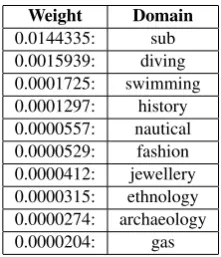
Figure 3: Result of a PPV ranking sorted by weight (only the first lines are shown).
Weight Domain
0.0144335: sub 0.0015939: diving 0.0001725: swimming 0.0001297: history 0.0000557: nautical 0.0000529: fashion 0.0000412: jewellery 0.0000315: ethnology 0.0000274: archaeology 0.0000204: gas
Table 4: PPV weight rankings for sensediver1 n.
4.
Analyzing ranking changes
It seems that the algorithm is able to generate a ranking in which the most appropriate labels obtain larger weights and also that avoiding the own labels of a synset reduces the weights for incorrect domain labels.
In the next experiment we study how to evaluate in a semi-automatic way the quality of the original labelling. To do that we check the domain labels of the synsets, taking into account the position they occupy in the weight vector. If a synset has ’n’ domain labels, the displacement is calcu-lated for every label. For example, if a synset has two la-bels and one of the domains occupies the first position and the other the third one, they receive an offset of +0 and
+1 respectively. That is, we calculate how many positions they moved from its original place. All those labels with an offset of six or greater are considered in the same group. Possibly, this test will allow us to discover wrong labeled synsets (or at least delimit the search) or to create a group of labels with a high value of reliability.
Therefore we tested the process for each PoS. The results obtained are in the Table 5.
Detecting the labels that have been displaced six or more positions (Table 5) allows us to recognize possible synset that have been labeled incorrectly. An example can be seen in Table 6.
Results for ’ili-30-00747215-n’:
• Variants: pornography 1 porno 1 porn 1 erotica 1 smut 5
• Gloss: creative activity (writing or pictures or films etc.) of no literary or artistic value other than to stim-ulate sexual desire
• Domains:law
Method WN+gloss
Weight Domain
0.000123453: sexuality 0.000112444: cinema 0.000077780: theatre 0.000075525: painting 0.000062377: telecommunication 0.000060640: publishing 0.000050370: psychological features 0.000047003: photography 0.000046853: artisanship 0.000040458: graphic arts
Table 6: Method WN+gloss: UKB weight rankings for sense 1 of ”porno”.
The example in Table 6 shows how the label law (incor-rectly assigned) disappears from the first ten positions of the list. Instead, the algorithm suggestssexualityand cin-ema, which in this case seems to be much more appropriate.
5.
Discussion
Offset
PoS 0 1 2 3 4 5 6+
Nouns 55.52% 18.51% 10.06% 5.19% 1.95% 1.95% 6.82%
Verbs 40.46% 15.95% 13.39% 7.69% 4.56% 0.85% 17.09%
Adjectives 51.04% 21.35% 8.85% 2.60% 1.56% 4.17% 10.42%
Adverbs 60.40% 13.86% 5.94% 0.99% 4.95% 2.97% 10.89%
Total 54.48% 18.60% 10.07% 5.04% 2.06% 2.10% 7.65%
Table 5: Method WN+gloss: Displacement of domain labels regarding their current position (separated by PoS).
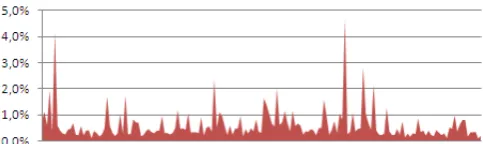
the PPV algorithm using WN as a graph (Figure 5), and ap-plying the PPV algorithm using WN+gloss as a graph (Fig-ure 6). Since some of the percentages are too high, the ta-bles only presents distributions of 5% at most. The domains that have percentajes exceeding 5% are the following: biol-ogy(14.72% for WND),animals(6.59% for WND),plants
(6.07% for WND) and plastic arts(6.42% for PPV using WN).
Figure 4: Distribution of original WND labels in alphabet-ical order (left to right).
Figure 5: Distribution of new domain labels using PPV with WN as KB, in alphabetical order (left to right).
Figure 6: Distribution of new domain labels using PPV WN enriched with gloss relations as KB, in alphabetical order (left to right).
Aparently, the number of synsets per domain has been smoothly distributed across the domains in both PPV prop-agations. Some of the most frequent domains are now much less frequent. In contrast, many domains with very few
synsets are now much better represented. This effect is a consecuence of the PPV algorithm which normalizes de page rank vector: the sum of all vector weights is one for every domain.
We can also analize which domains have modified its rep-resentation. Figures 7 (applying PPV using WN as KB) and 8 (applying PPV using WN enriched with glosses as KB) show the total percentage of increment/decrement of representation for each domain with respect to the original domains. As can be seen, in both cases, most of the do-mains appear to be in the positive side (top), indicating that they increased their representation.
Figure 7: Percentage increment/decrement for domains ap-plying PPV using WN, compared to the original domains.
Figure 8: Percentage increment/decrement for domains ap-plying PPV using WN+gloss, compared to the original do-mains.
If most of the domains have increased their representation, necessarily a few domains have decreased much of their representation. Figures 9 (for PPV and WN) and 10 (for PPV and WN+gloss) show respectively the five domains that have increased more their representation, and the five ones that have decreased more their representacion. Using WN as a knowledge base, the five domains show-ing the largest increment of representation areplastic arts,
veterinary,sub,topologyandphilately. Possibly, these do-mains are now over represented. The five dodo-mains showing the largest decrement aregastronomy,geography,religion,
biology,fashion. Possibly, these domains were over repre-sented in the original labelling.
Figure 9: Percentage of increment (green) and decrement (red) for the five more affected domains using PPV and WN as KB
largest increment of representation are veterinary, so-cial science,sub,topographyandgas. Possibly, these do-mains are now over represented. In fact, some of them seems to be over represented also in the previous labelling (veterinaryandsub). The five domains showing the largest decrement aremetrology,sport,administration,geography,
biology. Possibly, these domains were over represented in the original labelling. In fact, some of them seems to be over represented also in the original labelling (geography
andbiology).
These imbalances should need to be further studied in a near future.
6.
Concluding Remarks
We have presented a new robust graph-based method which propagates domain information through WordNet. Firstly, we described a simple inheritance mechanism to complete unlabelled synsets from WordNet 3.0. Secondly, we pro-vide some examples of the new domain labellings focussing on those synsets which provided larger variations.
After these initial qualitative tests, we drawn some prelim-inary conclusions:
1. The propagation method seems to provide some inter-esting results which deserve more research.
2. The gloss relations seems to provide useful knowledge for the propagation of domain labels through Word-Net.
Figure 10: Percentage of increment (green) and decrement (red) for the five more affected domains using PPV and WN enriched with gloss relations as KB
Obviously, some improvements and further investigation are needed with these new resources. For instance, we need to develop an automatic method to select which label or labels finally assign to a particular synset. Moreover, not all domains affect in the same way due to its initial dis-tribution through the WordNet structure. We also need to investigate different combinations of relations for creating the knowledge base used by UKB. For instance, using only gloss relations, or a particular subset of WordNet relations. We also plan to try different combinations of methods and resources to improve the final result. For instance, we also plan to derive domain information from Wikipedia by ex-ploiting WordNet++ (Navigli and Ponzetto, 2010). We already have carried out an empirical evaluation in a common Word Sense Disambiguation task. On this task, the new labeling clearly outperforms by a large margin the original WordNet Domains (Gonzalez-Agirre et al., 2012). Additionaly, we need to empirically evaluate the new Word-Net Domains in some additional semantic tasks.
7.
Acknowledgements
8.
References
Agirre, E., Cuadros, M., Rigau, G., and Soroa, A. (2010). Exploring Knowledge Bases for Similarity. In Pro-ceedings of the Seventh conference on International Language Resources and Evaluation (LREC10). Euro-pean Language Resources Association (ELRA). ISBN: 2-9517408-6-7. Pages 373–377.”.
Agirre, E. and Soroa, A. (2009). Personalizing PageR-ank for Word Sense Disambiguation. InProceedings of the 12th conference of the European chapter of the As-sociation for Computational Linguistics (EACL-2009), Athens, Greece.
Bentivogli, L., Forner, P., Magnini, B., and Pianta, E. (2004). Revising wordnet domains hierarchy: Seman-tics, coverage, and balancing. In in Proceedings of COLING 2004 Workshop on Multilingual Linguistic Re-sources, pages 101–108.
Gonzalez-Agirre, A., Castillo, M., and Rigau, G. (2012). A graph-based method to improve WordNet Domains. InProceedings of 13th International Conference on In-telligent Text Processing and Computational Linguistics (CICLING’12), New Delhi, India.
Magnini, B. and Cavagli`a, G. (2000). Integrating subject field codes into WordNet. InProceedings of the Second Internatgional Conference on Language Resources and Evaluation (LREC), Athens. Greece.
Magnini, B., Satrapparava, C., Pezzulo, G., and Gliozzo, A. (2002). The Role of Domains Informations. InIn Word Sense Disambiguation, Treto, Cambridge.
Navigli, R. and Ponzetto, S. P. (2010). Building a very large multilingual semantic network. InProceedings of the 48th Annual Meeting of the Association for Compu-tational Linguistics, pages 216–225, Uppsala, Sweden. Vossen, P. (1998). EuroWordNet: A Multilingual Database