Iterative Refinement and Quality Checking of Annotation Guidelines —
How to Deal Effectively with Semantically Sloppy Named Entity Types, such as
Pathological Phenomena
Udo Hahn, Elena Beisswanger, Ekaterina Buyko, Erik Faessler
Jenny Traum ¨uller, Susann Schr¨oder, Kerstin Hornbostel
Jena University Language & Information Engineering (JULIE) Lab Friedrich-Schiller-Universit¨at Jena
F¨urstengraben 30, 07743 Jena, Germany
Abstract
We here discuss a methodology for dealing with the annotation of semantically hard to delineate, i.e., sloppy, named entity types. To illustrate sloppiness of entities, we treat an example from the medical domain, namely pathological phenomena. Based on our experience with iterative guideline refinement we propose to carefully characterize the thematic scope of the annotation by positive and negative coding lists and allow for alternative, shortvs.long mention span annotations. Short spans account for canonical entity mentions (e.g., standardized disease names), while long spans cover descriptive text snippets which contain entity-specific elaborations (e.g., anatomical locations, observational details, etc.). Using this stratified approach, evidence for increasing annotation performance is provided byκ-based inter-annotator agreement measurements over several, iterative annotation rounds using continuously refined guidelines. The latter reflects the increasing understanding of the sloppy entity class both from the perspective of guideline writers and users (annotators). Given our data, we have gathered evidence that we can deal with sloppiness in a controlled manner and expect inter-annotator agreement values around 80% for PATHOJEN, the pathological phenomena corpus currently under development in our lab.
Keywords:Corpus annotation, annotation guidelines, named entity recognition, life sciences
1.
Introduction
The assignment of linguistic meta data to natural language corpora is typically based on elaborate annotation guide-lines. Such documents (rarely discussed in depth in the literature, for recent exceptions see (Wilbur et al., 2006), (Bada et al., 2010) and (Cohen et al., 2010)) contain opera-tional definitions of the annotation task and instructions for human coders to consistently assign the desired linguistic meta data to natural language utterances. Usually,iterative training rounds are necessary to develop a shared under-standing of the annotation task among the annotators. In this process, only marginal changes, if at all, of the under-lying annotation guidelines are made. Both, the clarity of the guidelines as instruction texts and effective training of coding behavior on the basis of these guidelines are prereq-uisites for consensual annotation results.
Training human coders on semantic annotations is a par-ticularly challenging task. Yet, the annotation of named entities and semantic relations connecting them differs in terms of their intrinsic task complexity. WhilePersons, Or-ganizationsor Locationsfrom the newspaper domain, for instance, constitute named entity types for which fairly un-controversial and stable annotation guidelines can be set up quite easily, other named entity types, such as the no-toriously difficult to nail downGene/Proteinclasses from the life sciences domain need much more efforts already for operational instructions (see, e.g., (Hatzivassiloglou et al., 2001)). Different degrees of annotation complexity are mirrored in different degrees of inter-annotator agreement (IAA), ceteris paribus(more than 10% when, e.g., IAAs forPersonsandGenes/Proteinsare compared).
In our current annotation efforts, we focus on a named en-tity class from the life sciences which is well-known for its difficulty—pathological phenomena, including diseases, for different species. Upon inspection of the documents re-lated to this topic, it soon turned out that we were deal-ing with an entity class whose intension (what qualifies as a pathological phenomenon in the domain of discourse?) and extension (what constitute true mentions of intended pathological phenomena in raw texts?) were hard to spec-ify. What constitutes a pathological phenomenon (and what not) is already hard to decide for professional pathologists, so much the more for human annotators. Obviously, e.g., an appendicitis is clearly a disease but is “a person with
high blood pressure”, certainly not being a disease state-ment, nevertheless describing a pathological phenomenon? Trying to deal with such borderline cases, we claim that pathological phenomena belong to a class of named entity types we here refer to assemantically sloppy.
paper. As a proof of concept, this methodology will be ap-plied to create a trustable corpus annotated for pathological phenomena, work which is on-going in our lab.
2.
Domain Briefing:
Pathological Phenomena
Pathological phenomena cover a wide range of medical ob-servations which indicate deviations from ‘normal’ healthy states of an organism, typically a human being. In the med-ical community, the least controversial subclass of patho-logical phenomena are known asdiseaseswith more or less clearly defined deviation criteria from the ‘normal’ state. Examples for diseases are“Alzheimer’s Disease”,“Lung Cancer”, or“Appendicitis”.
Annotation of canonical diseases can be based on a large variety of established disease terminologies. The
Systematized Nomenclature for Medicine-Clinical Terms
(SNOMED CT)1 is considered to be the most
compre-hensive, multilingual clinical healthcare terminology in the world. Currently, SNOMED CT contains more than 311,000 active concepts with unique meanings and formal logic-based definitions organized into multiple hierarchies. TheDiseasehierarchy is available under the “Clinical Find-ing” root node. Another widely used disease terminology is the National Cancer Institute thesaurus(NCIt).2 The
NCIt provides definitions, synonyms, and other informa-tion about nearly 10,000 cancers and related diseases, 8,000 single agents and combination therapies, and a wide range of other topics related to cancer and biomedical research. The Disease hierarchy is available under the “Diseases, Disorders and Findings” root node. The most widely used disease terminology, which also includes a wide variety of signs, symptoms, abnormal findings, complaints, etc., is the International Classification of Diseases(ICD), which is part of the WHO Family of International Classifications. Version 10 of ICD contains 155,000 different codes.3
Dis-ease terminologies are updated regularly (consider, e.g., growth areas like viral diseases) although changes are not dramatic. Note that in medical documents the mention of a disease often comes with the mention of its anatomical locus, as well as tests and treatments, including therapies, related to it.
Beyond the terminologically clear-cut borderline of dis-eases the sloppy part of ‘non-normality’ of observations begins. Clinical notes kept in electronic health records (EHRs) or research papers (such as journal publications, etc.) contain a wide range of descriptive statements that characterize disorders and other descriptions of non-normalities (e.g., descriptions of symptoms such as “bleed-ing nose”or“high temperature”). Furthermore, there are mentions of observations that can be considered as an ab-normal sign or finding, or merely a patient’s complaint (e.g.,“facial rashes”,“heavy coughing”or even“patient felt weak”) but by no means already indicate a concrete
1http://www.nlm.nih.gov/research/umls/
Snomed/snomed_main.html
2http://www.cancer.gov/cancertopics/
cancerlibrary/terminologyresources 3http://www.cdc.gov/nchs/icd/icd10.htm
disease. Since the diagnostic tracing (determination or ex-clusion) of a disease requires to refer to critical conditions and potentially indicative single observations of a patient, all these are relevant bits of information for a comprehen-sive disease tracking system. Descriptive statements of this weaker type constitute the broad and hard to delineate class of what we refer to asPathological Phenomenawhich holds
Diseasesas a proper subclass.
3.
Guideline Development
In this section, we briefly outline the conduct of our guideline development activities. We started by querying the MEDLINE/PUBMEDBaseline Repository42011 for all
records that come with an abstract and are indexed with the MeSH5heading “Disease” (or a subordinate heading). The
query resulted in a set of over 65,000 documents that be-came the basis for our annotation project.
From this document set (in the following also called the “base corpus”) we drew a random sample of 200 abstracts. Screening these abstracts for mentions of pathological phe-nomena we compiled the first draft of our annotation guide-lines. Next, we trained two expert biologists on this draft and taught them how to use our annotation tool.6 Overall,
we ended up in three iteration rounds for the definition of the annotation guidelines and training of the annotators. In each iteration we collected a random sample of 50 docu-ments from the base corpus and let both annotators mark all mentions of pathological phenomena, requesting them to strictly adhere to the respective guideline version of that iteration round.
The main messages we learned from these three iterations can be summarized as follows:
• Guideline Refinement after Iteration 1: Thematic Annotation Scope. We formulated a positive list
of desired annotation topics (standard disease names, mentions of disorders, wounds and injuries, aller-gies, etc.) and a complementarynegative listof non-annotation topics (e.g., causes for diseases like genetic mutations, viruses, or bacteria). It turned out that it was particularly difficult for the annotators to distin-guish between pathological phenomena on the pheno-type level and non-canonical genetic conditions that cause phenotypic changes or disease patterns.
• Guideline Refinement after Iteration 2: Annota-tion MenAnnota-tion Span. Analyzing the annotation be-haviour clearly revealed that the annotators tended to switch between short and long form span annotation for pathological phenomena. Longer text spans in-cluded, e.g., additional mentions of species specifica-tions or statements about anatomical sites in the anno-tations. Both phenomena occur systematically for lots of mentions of pathological phenomena, for disease mentions in particular. In addition, the annotators still
4http://mbr.nlm.nih.gov/ 5http://www.nlm.nih.gov/mesh/
6All annotations were carried out with theActive Learning
did not annotate borderline cases of pathological phe-nomena mentions consistently (such as “patient felt weak”).
As a consequence, we decided to extend the annota-tion to a 2-category decision task, introducing two cat-egories to be annotated,viz.“short” and “long” patho-logical phenomenon mentions, instead of the previ-ously used singleton category. The “long” category is used for both, extended annotation spans (see below), and the annotation of borderline cases. The annotators were instructed to annotate mentions of pathological phenomena either with the category “short” (in case of a concise mention, such as disease names), or with the category “long” (in borderline cases), or with both categories in a nested way, in case of an unclear or ambiguous text span. In the latter case, the shortest possible but still pathology-indicative part of the men-tion should be labeled as “short”, while the longest possible, yet still only pathology-indicative text span should be labeled as “long”. Consider, for example, the sentence “She had [[clumsiness]short in her left extremities]long.” While“clumsiness”is annotated as
“short” pathological phenomenon, according to our re-vised guidelines, a second annotation of type “long” has to be introduced that includes the short annota-tion and the anatomical specificaannota-tion“in her left ex-tremities”. Long annotations have various linguistic appearances. They occur, amongst others, as prepo-sitional phrases (as, e.g., in “[absence of auditory canals]long”), coordinations (as, e.g., in “[markedly decreased serum IgG, IgA , and IgE levels]long”), and
even entire sentences (as, e.g., in“[The mass is com-pressing her trachea.]long”.
Our decision to annotate raw text based on the short – long category split is motivated by two considerations. First, there is no undisputed ground truth whatsoever concerning the ‘true’ textual extension of a pathological phenomenon statement. Rather we believe that the two categories meet a well-justifiable distinction. Whenever possible, annota-tors shall encode clear and fully evident cases of pathologi-cal phenomena mentions (e.g.,“Alzheimer’s disease”) with first-order priority. Whenever this is not possible, annota-tors shall encode the longest stretch of text that carries a statement clearly related to pathological phenomena (long category) with second-order priority and, in addition, mark in the long stretch any occurrences of concise pathological phenomena (short category).
While this distinction does not resolve the intrinsic prob-lems of proper additional splits (e.g., further distinguishing the locus, symptoms, tests, etc. from the disease proper in a long span) it does, however, resolve the issue to demar-cate stretches of text that are relevant for pathological phe-nomena and those that are definitely not. This idea should then be reflected in higher IAA values on this two-way dis-tinction compared with previous annotation studies dealing directly with more detailed annotations.
Second, the two-way category system should allow re-searchers in follow-up studies to focus on their specific pathological phenomena interests since they only have to
take into account the long stretch annotations. This way, our annotation exercise provides some sort of layered an-notation where the long layer is open to further refinement. In order to impose stringent quality control on the pro-posed procedure we measured inter-annotator agreement over several iterations of annotations, each round with dif-ferent annotation guidelines. IAA was measured token-wise using Siegel & Castellan’s κ (Siegel and Castellan, 1988). In the first two iterations, only one annotation cat-egory was used. In this case,κis determined by the num-ber of tokens for which the annotators agreed on annotat-ing or not annotatannotat-ing them. After the second iteration, two annotation categories were used (“short” vs. “long”), and nested annotations were allowed. Consequently, for mea-suring IAA we had to define what we count as token-wise agreement between the annotators. We decided to consider as agreement (1) if both annotators assigned the same an-notation categories (multiple assignments of the same cat-egory are not conflated) (2) if both annotators assigned at least once the category “short”, and (3) if no annotation was assigned at all.
We also measured IAA ignoring the distinction between an-notation categories and called the resulting value κrelaxed.
The κrelaxed value is determined by the number of tokens
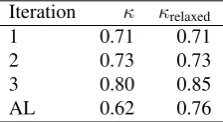
that have been annotated by both annotators with at least one category, or that have not been annotated at all. The κ andκrelaxed-values measured for all three iterations are
summarized in Table 1.
Iteration κ κrelaxed
1 0.71 0.71
2 0.73 0.73
3 0.80 0.85
AL 0.62 0.76
Table 1: Inter-annotator agreement of the three iterative an-notation rounds and an active learning (AL) round using Siegel & Castellan’sκ. The valueκrelaxedresults from
ig-noring the distinction between annotation categories (short
vs.long). (Note that in Iteration 1 and 2 we only used one annotation category, resulting in the same values forκand κrelaxed.)
As Table 1 reveals the first three iterations provide evidence for the increasing approximation of a common understand-ing among the annotators concernunderstand-ing the sloppy named en-tity typePathological Phenomena, with IAA moving from 0.71 via 0.73 to 0.80. Values for κrelaxed even peak at κ = 0.85 (Iteration 3). These numbers indicate that se-mantically sloppy named entities can be dealt with in an ef-fective way given discriminative thematic and mention span criteria. After the third iteration, IAA values had reached a reasonably high level (κ= 0.80andκrelaxed= 0.85). Thus,
the guidelines were frozen for further annotation.
the annotation process at (almost) no negative costs in terms of annotation quality (Tomanek et al., 2007a). AL targets the most uncertain and thus most tricky annotation samples and selects it for annotation by the annotators. We applied this biased sampling technique to the base corpus (com-posed of 530,000 sentences). For concrete annotation work we used the JANEsystem, a dedicated annotation software framework developed at our lab (Tomanek et al., 2007b). In order to screen the quality of annotations using the AL approach, we also measured IAA on a document set from five subsequent AL rounds, where each round contained 50 sentences to be annotated (thus, the overall set con-tains 250 sentences). The IAA results reveal that agree-ment values drop for the AL approach—0.62 considering both categories and 0.76, if we consider annotation spans only (see Table 1). This result comes at no surprise because an AL system, in general, always prefers samples with a much higher annotation complexity than encountered in a random-based selection approach. Thus, agreement should be predictably lower than in the random-selection case which selects complex but also ‘easy’ annotation instances.
4.
Discussion
In terms of a shaping methodology for dealing with se-mantically sloppy named entity types, such as Patho-logical Phenomena, we propose two main steps. First, clear thematic demarcation lines have to be drawn to sin-gle out annotation-relevant from annotation-irrelevant lan-guage data by supplying thematically positive and negative lists, respectively. Second, strict and lazy mention span cri-teria have to be defined in case of span-ambiguous textual mentions of semantically sloppy named entities, while in non-ambiguous cases the standard annotation procedure for named entities still applies.
These principles have emerged from observations of the lin-guistic appearance of pathological phenomena. We found that standard diseases, a proper subset of pathological phe-nomena, are named, while pathological phenomena tend to be verbally described on various axes, e.g., involving species characteristics or anatomical regions and locations. Since we intend to leave it to the development of future named entity taggers and relation extractors to differenti-ate between such properties (species, locations), we have opted a priori for a perspective on annotation which fo-cuses on the textual extension of descriptions rather than pre-structure a set of complex entities and relations. As an example of the latter type of annotation strategy consider the CLEF(Clinical E-Science Framework) corpus (Roberts et al., 2009) which is composed of clinical nar-ratives, histopathology reports, and imaging reports from 20,000 cancer patients. For each of these three genres, 50 documents were meticulously annotated with several disease-specific types of clinical entities, namely Condi-tion (including symptom, diagnosis, complication, condi-tions, problems, funccondi-tions, processes, and injury), Result
(the numeric or qualitative finding of an investigation, ex-cludingCondition), andLocus(the anatomical structure or location, body substance, or physiological function, typi-cally the locus of a Condition). Very often, Conditions
are mentioned in relation to Locus as, for example, in
“[melanoma]Condition located in [groin]Locus” or “[left
breast]Locus [cancer]Condition.” Furthermore, several re-lation types are annotated, includingHasFinding, HasIndi-cation,HasLocation,HasTarget, andModifies, as well as temporal annotations (such as Before,After, Overlap, In-cludes) for time-sensitive named entities. Thus, the annota-tion process for diseases is broken down into the annotaannota-tion of many fundamental clinical and anatomical entities and their relationships. A wide range of IAA scores are reported for such a relational decomposition of annotation (ranging, e.g., from 29% to 95% at the named entity level for differ-ent types types of clinical documdiffer-ents) which suggests that this fine-grained relationship annotation for clinical entities is a really hard task (Roberts et al., 2007). The latest round of the i2b2 Challenge (Uzuner et al., 2011) led to the cre-ation of an entity/relcre-ationship corpus also made of clinical documents, which is similar in thematic scope though not comparable in annotation depth to the CLEFeffort. A far more restricted perspective on the pathological phe-nomenon annotation task underlies the Disease Corpus from EBI (Jimeno et al., 2008) or the Arizona Disease Cor-pus (AZDC) (Leaman et al., 2009). Both only deal with
Disease type annotations, a proper subset of Pathologi-cal Phenomena. The EBI corpus contains 600 sentences from the Online Mendelian Inheritance in Man (OMIM) database,7 for which an IAA of 0.51 kappa (which is low, even by biomedical standards) is reported for two anno-tators. AZDC provides 3,228 disease mention annota-tions (1,202 unique disease names) for 2,856 MEDLINE ab-stracts. Mentions of organisms and species are explicitly excluded from the disease annotation span. So for “human insulin-dependent diabetes mellitus”, the span “ insulin-dependent diabetes mellitus” would be annotated as Dis-ease. Furthermore, there exist several corpora which deal with particular disease types, such as the PENNBIOIE ON -COLOGYcorpus,8 which is composed of 1,414 MEDLINE
abstracts annotated for the molecular genetics of cancer. In a similarly over-constrained way, disease-focused cor-pora have been annotated using established terminologies as the target tag language. (Ogren et al., 2008) report on a corpus which contains 1,556 annotations on 160 clinical notes using 658 unique concept codes from SNOMED-CT corresponding to human disorders. IAA for four annota-tors is reported, among others, for span (0.91) and map-ping to concept code (0.82). In earlier work, (Pestian et al., 2007) describe a clinical notes corpus composed of al-most 2,000 documents annotated at the document level for billing codes (45 categories taken from the disease classifi-cation ICD-9CM).9
Accordingly, our approach (unlike the EBI and AZDC cor-pora) explicitly deals with a wide range of pathological phenomena and, thus, includes diseases as a proper sub-set. On the other hand, it also explicitly avoids (unlike CLEF) getting too far into fine-grained decomposition prob-lems of named entity and relational annotations (involving locational and result-type relations). Still, our long-form
7
http://www.ncbi.nlm.nih.gov/omim 8http://www.ldc.upenn.edu/Catalog/
annotation policy marks text spans which can be further in-vestigated by suitableLocusandResulttaggers, if required. On-going work in our lab deals with the creation of a cor-pus of pathological phenomena, called PATHOJEN. It is based on the guidelines of the third iteration and will cover about 100,000 tokens (corresponding to approximately 400 MEDLINE documents). Building on previous experience with Active Learning-based annotation, PATHOJEN will be one of the rare non-toy biomedical corpora which are systematically generated using AL-type biased sampling in order to optimise for cost-efficient, yet high quality annotation results. Once this corpus is at hand, tag-gers for Pathological Phenomena and Diseases will be trained along the lines of GENO (Wermter et al., 2009), a Gene/Proteintagger which performs on a par with the top-ranked gene/protein taggers on the BIOCREATIVE II benchmark.
Acknowledgements. This work is partially funded by a grant from the German Ministry of Education and Research (BMBF) for theJena Centre of Systems Biology of Ageing
(JENAGE) (grant no. 0315581D).
5.
References
Michael Bada, Lawrence E. Hunter, Miriam Eckert, and Martha Palmer. 2010. An overview of the CRAFT concept annota-tion guidelines. InLAW IV – Proceedings of the 4th Linguistic Annotation Workshop at ACL 2010, pages 207–211. Uppsala, Sweden, 15-16 July 2010.
K. Bretonnel Cohen, Arrick Lanfranchi, William Corvey, William A. Baumgartner, Jr., Christophe Roeder, Philip V. Ogren, Martha Palmer, and Lawrence E. Hunter. 2010. An-notation of all coreference in biomedical text: Guideline selec-tion and adaptaselec-tion. InProceedings of the 2nd Workshop on Building and Evaluating Resources for Biomedical Text Min-ing (BioTxtM) at the 7th Language Resources and Evaluation Conference (LREC 2010), pages 37–41. Valletta, Malta, March 18, 2010.
Vasileios Hatzivassiloglou, Pablo A. Dubou´e, and Andrey Rzhet-sky. 2001. Disambiguating proteins, genes, and RNA in text: A machine learning approach. Bioinformatics, 17(Suppl 1):S97–S106.
Antonio Jimeno, Ernesto Jimenez-Ruiz, Vivian Lee, Sylvain Gaudan, Rafael Berlanga, and Dietrich Rebholz-Schuhmann. 2008. Assessment of disease named entity recognition on a corpus of annotated sentences. BMC Bioinformatics, 9(Suppl. 3):S3.
Robert Leaman, Graciela Gonzalez, and Christopher Miller. 2009. Enabling recognition of diseases in biomedical text with machine learning: Corpus and benchmark. InLBM 2009 – Pro-ceedings of the 3rd International Symposium on Languages in Biology and Medicine, pages 82–89. Seogwipo-si, Jeju Island, South Korea, November 8-10, 2009.
Philip V. Ogren, Guergana K. Savova, and Christopher G. Chute. 2008. Constructing evaluation corpora for automated clinical named entity recognition. In LREC 2008 – Proceedings of the 6th International Conference on Language Resources and Evaluation, pages 3143–50. Marrakech, Morocco, 29-30 May 2008.
John P. Pestian, Christopher Brew, Pawel Matykiewicz, D. J. Hovermale, Neil Johnson, and K. Bretonnel Cohen. 2007. A shared task involving multi-label classification of clinical free text. InBioNLP 2007 – Proceedings of the ACL 2007
Work-shop on Biological, Translational, and Clinical Language Pro-cessing, pages 97–104. Prague, Czech Republic, June 29, 2007. Angus Roberts, Robert Gaizauskas, Mark Hepple, Neil Davis, George Demetriou, Yikun Guo, Jay (Subbarao) Kola, Ian Roberts, Andrea Setzer, Archana Tapuria, and Bill Wheeldin. 2007. The CLEFcorpus: Semantic annotation of clinical text. InAMIA 2007 – Proceedings of the Annual 2007 Symposium of the American Medical Informatics Association, pages 625– 629. Chicago, Illinois, USA, 10-14 November 2007.
Angus Roberts, Robert J. Gaizauskas, Mark Hepple, George Demetriou, Yikun Guo, Ian Roberts, and Andrea Setzer. 2009. Building a semantically annotated corpus of clinical texts.
Journal of Biomedical Informatics, 42(5):950–966.
Sidney Siegel and John N. Castellan. 1988. Nonparametric Statistics for the Behavioral Sciences. New York: McGraw-Hill, 2nd edition.
Katrin Tomanek, Joachim Wermter, and Udo Hahn. 2007a. An approach to text corpus construction which cuts annotation costs and maintains corpus reusability of annotated data. In
EMNLP-CoNLL 2007 – Proceedings of the Joint Conference on Empirical Methods in Natural Language Processing and Com-putational Natural Language Learning, pages 486–95. Prague, Czech Republic, June 28-30, 2007.
Katrin Tomanek, Joachim Wermter, and Udo Hahn. 2007b. Efficient annotation with the Jena ANnotation Environment (JANE). InThe LAW at ACL 2007 – Proceedings of the Linguis-tic Annotation Workshop, pages 9–16. Prague, Czech Republic, June 28-29, 2007.
¨
Ozlem Uzuner, Brett R. South, Shuying Shen, and Scott L. Du-Vall. 2011. 2010 i2b2/VA challenge on concepts, assertions, and relations in clinical text. Journal of the American Medical Informatics Association, 18(5):552–6.
Joachim Wermter, Katrin Tomanek, and Udo Hahn. 2009. High-performance gene name normalization with GeNo. Bioinfor-matics, 25(6):815–821.