K-repeating Substrings: a String-Algorithmic Approach to
Privacy-Preserving Publishing of Textual Data
Yusuke Matsubara and Kˆoiti Hasida
Social ICT Research Center, School of Information Science and Technology, The University of Tokyo
7-3-1 Hongo, Bunkyo-ku, Tokyo, Japan
Abstract
De-identifying textual data is an important task for publishing and sharing the data among researchers while protecting privacy of indi-viduals referenced therein. While supervised learning approaches are successfully applied to the task in the clinical domain, existing methods are hard to transfer to different do-mains and languages because they require a considerable cost and time for preparation of linguistic resources. This paper presents an efficient unsupervised algorithm to detect all substrings occurring less than ktimes in the input string, based on the assumption that such rare sequences are likely to contain sensitive information such as names of people and rare diseases that may identify individuals. The proposed algorithm works in asymptotically and empirically linear time against the input size whenk is a constant. Empirical evalua-tion on the i2b2(Informatics for Integrating Biology and Bedside) dataset shows the ef-fectiveness of the algorithm in comparison to baselines that use simple word frequencies.
1 Introduction
The increasing amount of electronically available and searcheable texts poses an increasing need for privacy protection. Adversaries may extract previ-ously unconnected information about a person by aggregating different data sources. IDs such as so-cial security numbers in the United States are obvi-ous means to aggregate data sources, but full names, residential addresses, and other attributes about in-dividuals and their combinations may also work as
pseudo identifiers from which one may be able to identify persons, or to raise the probability of suc-cessful identification (Sweeney, 2002)(Fung et al., 2010). While researchers and service providers wish to publish and share such textual data with the com-munity to help facilitate further research, it is costly to do so while preserving utility of non-sensitive part of the data.
In response to the demand for efficient and ac-curate automatic methods to help removing sensi-tive material from textual data, the last decade has seen progress in automatic anonymization and de-identification of text (Liu, 2012; Fung et al., 2010; Uzuner et al., 2007). For example, health care indus-try puts efforts in utilizing electronic health record data that is accumulated daily while ensuring pa-tients’ privacy (Kushida et al., 2012; Meystre et al., 2010). Nevertheless, two major problems re-main unaddressed: 1) How to reduce human la-bor to prepare resources for automatic methods, in-cluding pattern-matching rules and training data for supervised-learning systems. 2) How to increase utility of published text by requiring less preprocess-ing of the input text.
Our work explores aplicability of string algo-rithms into privacy-preserving publishing of textual data that reduce resource requirements. We pro-pose using new variations of maximum repeats algo-rithms to unsupervisedly suggest spans to be hidden. We argue that our approach brings new assets to pre-vious studies in text anonymization by requiring less linguistic resources and preprocessing; these points will be discussed in more detail in Section 3.
a b r a c a d a b r a x r a c
Figure 1: The repeats and maximum re-peats (=2-repeating substrings) in the string “abracadabraxrac”. Maximum repeats are indicated as intervals with thicker black lines. Non-maximum repeats are in thinner gray lines. Note that every non-maximum repeats is subsumed by at least one maximum repeat.
• We formalize the notion of k-repeating sub-strings (Section 4).
• We present a natural and simple generalization to algorithms for finding maximum repeats, al-lowing arbitrary choice of the frequency thresh-oldk, and provide theoretical guarantees to the computational complexity. (Section 5)
• We present an efficient algorithm to cover a given string with itsk-repeating substrings, en-suring every continuous substring in it haskor more occurrences. (Section 5)
• We show effectiveness and scalability of the proposed algorithm by providing empirical per-formance analyses of the new algorithms, and release our software implementation. (Sections 6)
2 Approach
Our hypothesis in this paper is that sensitive infor-mation is more likely to reside in texts with lower frequency than in those with higher frequency, be-cause if a piece of information is frequently men-tioned, it is likely to be already known to the public. Given statistics of a corpus that is large enough to represent a (sub-)language, we assume that phrases
with a larger number of occurrences are more likely to express common knowledge rather than private information.
We explore computationally practical ways to im-plement algorithms to test the hypothesis above. We give a formal definition ofk-repeating substrings in Section 7, based on the hypothesis above. It will be followed by an efficient algorithm, described in Section 5, to computek-repeating substrings, as il-lustrated in Figure 1, utilizing devices of algorithms on strings.
It is important to note that the concept of k -repeating substrings itself is not intended to yield a theoretical guarantee of anonymity. Rather, our ap-proach is expected to capture statistical tendencies and our assumptions are justified by the experimen-tal evaluation using a real-world dataset, described in Section 6.
We anticipate further research on how to combine strengths and complement weaknesses of our work and other approaches including pattern-based ones and supervised ones. One of the strengths of our approach is that it is resource-free and assumption-free; it works on a unprocessed string and require no external knowledge sources. We anticipate this method to be used as an informed baseline before building a full stack anonymization system. On the other hand, our approach may be prone to false pos-itives, because rare sequences do not necessarily ex-press private information, especially when the given source of the text statistics is small.
proposed in this paper addressed these problems by automatically choosing appropriate length of sub-strings under a certain condition defined in Section 7, without having to rely on linguistic resources.
3 Related work
To put our work in context, we give a brief overview of studies on privacy-preserving text publishing 1, describing some of their shortcomings. For more comprehensive surveys, we refer readers to (Liu, 2012), (Uzuner et al., 2007) and (Kushida et al., 2012).
Local methods Text de-identification has been in-tensively studied in the context of protected health information (PHI) in medical informatics (Meystre et al., 2010; Kushida et al., 2012). Most of them use “local” context by matching with predefined pat-terns or features with weights learned from train-ing data by a supervised learntrain-ing algorithm. In the firsti2b2challenge (Uzuner et al., 2007), it has been shown that machine learning methods utilizing PHI-annotated texts by human are effective, while use of lexical resources such as lists of names and UMLS (Unified Medical Language System) Meta thesaurus (Aronson, 2001) play a key role to boost-ing up the performance. While the state-of-the-art de-identification methods provide high accuracy (F-measure=0.98) that almost matches average hu-man perforhu-mance (Uzuner et al., 2007), they require a high cost for data preparation. Top systems of the first i2b2 (Uzuner et al., 2007) challenge re-quires various resources: texts in the same domain with gold-standard annotations, manually curated patterns and rules, and lexical resources of terms in the domain (Meystre et al., 2010).
Global methods Another line of research has ap-plied the idea of k-anonymity (Sweeney, 2002),
originated in the study of anonymizing structured data, into textual data which is inherently unstruc-tured. We call here them “global”, because, unlike local methods described above, they rely on statis-tics extracted from a data collection to find docu-ments with rare combination of features. Such rare 1We include studies on privacy-preserving data publishing
related to text, text sanitization, and text de-identification here, and do not discuss slight differences among them, if any.
combination could work as pseudo identifiers that help adversaries to identify the individuals a given document describes. Most of the existing methods ofk-anonymity for texts and strings assume strings
as inseparable values or assume bag-of-words repre-sentations (Aggarwal and Yu, 2007; Chakaravarthy et al., 2008; Jiang et al., 2009; Anandan et al., 2012) as surveyed in (Liu, 2012). While these methods in-herit theoretical strengths ofk-anonymization, they
do not fit well with free-form text, especially when no thesaurus is assumed to be available.
3.1 Maximum repeats
In string algorithms, finding maximum repeats has been a focus of attention, in part for its practical applications including DNA sequencing in bioinfor-matics. Ilie and Smyth (2011) showed a simple liner-time algorithm to compute maximal substrings that occur at least twice in the given string, utiliz-ing suffix arrays (Manber and Myers, 1993; Nong et al., 2011) and longest common prefix arrays. In Section 5 we show that how our method general-izes their MAXREPEATSalgorithm, while
maintain-ing the time complexity linear whenkis constant.
We consider this generalization of maximum re-peats as a key contribution to make this approach applicable to a wider range of textual data including free-text natural language. This is because noises ubiquitously found in natural-language text collec-tions, including duplicates and near-duplicates, limit usefulness of the definition of repeats as substrings with two or more occurrences. It is natural to con-sider different thresholds for web-scale document collections and for a collection containing less than a hundred authors. Our generalized algorithm pro-vides a way to tune the threshold frequencykto be
better adjusted to the nature of the datasets in con-cern.
4 Definitions
In this section, we give formal definitions and nota-tions to nonota-tions that we use throughout the paper.
LetT 2 ⌃n denote the input substring wheren the length ofT. Let? 2/ ⌃is the suppression sym-bol. The character at the i-th position inT is
are both inclusive). We callf ansuppression func-tion on ⌃and? when f : ⌃n ! (⌃[{?})n ful-fills(f(T))i = Ti or?. Regions on a stringT are denoted by pairs of integersr = (i, j). iandjare called the beginning and end of the regionr, denoted byr.lef tandr.right.
We say that a string T fulfills substring k
-anonymitywhen every substring ofT that does not contain the suppression symbol ?, occurs at least
(k 1)times elsewhere in the string, allowing over-laps. For example, whenT =abracadabraand f1(T) =abra*a*abra,f1(T)is a2-anonymized string ofT because all substrings with no “*” in it, i.e.,abraanda, occur twice or more inT. This is formally defined as follows.
Definition 4.1. Letf an suppression function on⌃ and?. LetS(T0) an a set of substrings ofT0 such that S(T0) , {(T0)i...j | 0 i j < n,8c 2 Ti...j0 c 6= ?}. A stringf(T) 2 (⌃[?)nor is a k
-anonymized stringofT 2 ⌃n, or fulfillssubstring
k-anonymity, if8s2S(f(T))has at leastk occur-rences inT.
In what follows, we refer to strings that fulfill the above definition of substringk-anonymity as k-anonymized strings. If for 8T 2 ⌃n f(T) is a k-anonymized string, we call f a k-anonymity sup-pression functionork-anonymizer function. We say that a substring S0 of an anonymized string S 2 (⌃[{?})niscontinuouswhenS0 2⌃n.
5 Method
In this section we introduce a method for realiz-ing the suppression function usrealiz-ingk-repeating sub-strings defined in Section 4. In order to make it prac-tical, our objective is to have an algorithm with fol-lowing properties: it is an efficient ans scalable al-gorithm, which always transforms the input string into ak-anonymized string (i.e., no continuous sub-string will occur less thanktimes therein), suppress-ing only a reasonably small number of characters.
These properties are proven in the later part of this section, and empirically evaluated in Section 6.
We divide the problem of finding substring k -anonymity suppression into two steps. We first iden-tify all parts of the input stringTthat havekor more occurrences in T, and then fill the original strings with these repeats so that no pair of repeats
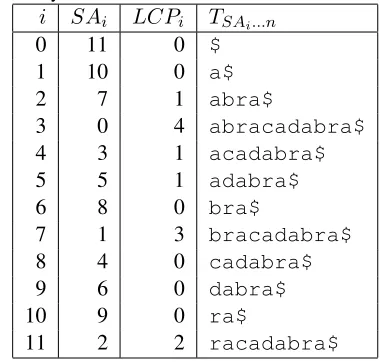
neigh-Table 1: Example of the suffix array and longest common prefix array ofT =abracadabra$
i SAi LCPi TSAi...n
0 11 0 $
1 10 0 a$
2 7 1 abra$
3 0 4 abracadabra$
4 3 1 acadabra$
5 5 1 adabra$
6 8 0 bra$
7 1 3 bracadabra$
8 4 0 cadabra$
9 6 0 dabra$
10 9 0 ra$
11 2 2 racadabra$
bors each other. More specifically, the two compo-nents are: (1) findinggeneralized maximum repeats that occurs at leastktimes in the input string, and (2) translating generalized maximum repeats into a set of regions on the input string that need to be sup-pressed.
5.1 Generalized maximum repeats
We define generalized maximum repeats of the stringTand the thresholdkas a set of repeating sub-strings that have at leastkoccurrences inT, allow-ing overlaps. Once these repeats are identified in the string, it is straightforward to derive a greedy algo-rithm for finding suppression that ensures substring k-anonymity by a greedy algorithm, as we will de-scribe in Section 5.2.
Our algorithm for generalized maximum repeats is inspired by the maximum-repeatsalgorithm pro-posed by Ilie and Smyth (2011) and contains it as a special case where k = 2. We start by briefly re-visiting their method and then we describe how to generalize it for generalk’s.
re-peat any more). Their algorithm achieves linear-time complexity, based on the fact that suffix arrays and LCP arrays can be constructed inO(n)time. We show that by introducing generalized common pre-fix arrayswe can induce a generalized algorithm to extract substring regions that occur at leastktimes.
Let us first recall properties of LCPs in relation to repeats. LCPs are defined on lexicographically sorted suffixes of the string in concern (Crochemore et al., 2007). LCPi is defined as the length of the maximum common prefix of two lexicographically neighboring suffixesTSAi 1..nandTSAi..n, whereT is the string in concern andSAis the suffix array of T. When using LCPs for finding repeats, an impor-tant property to be utilized is that LCP arrays rep-resent substrings that repeats twice or more in the given string (or corpus). Let us see how it works by the example shown in Table 1. The entries with
LCPi = 0 do not contain any repeats in prefixes of their corresponding suffixes. The entries with
LCPi > 0 corresponds to repeats, which may or may not be textitmaximum; non-maximum repeats are entirely contained by at least one larger repeat, and may be considered redundant. For example, in Table 1, the entry ati = 2implies a repeatT10...10 =T7...7 =a, and the entry ati= 2a repeatT7...10=
T0...3 =abra. OnlyT7...10is maximum among the substringsT7...7andT7...10.
We define generalized LCP arrayGLCPi ofT 2 ⌃n and k as the lengths of common prefixes of
(TSAi 1...n, TSAi 2...n, . . . TSAi k+1...n). Intuitively, just like LCPi > 0 corresponds to existence of a repeat (with at least 2 occurrences), an entry with
GLCPi >0indicates the substring ofT starting at
SAi with lengthGLCPi has length kor more oc-currences inT.
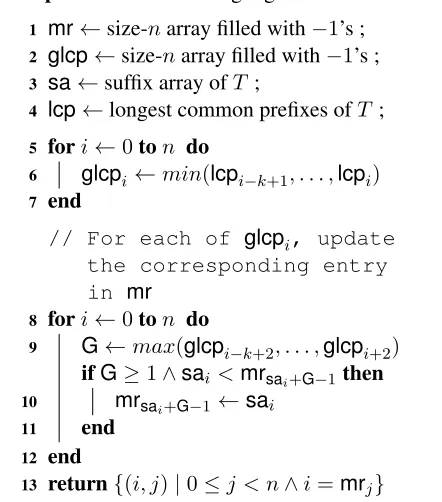
We present Algorithm 1 for finding generalized maximum repeats ofT andk. The main objective of this algorithm is to obtain spans onT that are
maxi-mum repeats as an integer array,mr, wheremrj =i
denotes a maximum repeat wheni >= 0.
First, suffix arrays and longest common prefix (LCP) are constructed at Line 1. Note that the con-struction of suffix arrays requires O(n) time and space. Likewise, LCP arrays can be constructed in linear time and space. For their details, we re-fer readers to (Nong et al., 2011) and (Kasai et al., 2001). In the experiments, we use a
publicly-Algorithm 1:Finding generalized maxi-mum repeats ofT andk
input : A stringT 2⌃n, an integerk
output: A set of substring regions 1 mr size-narray filled with 1’s ;
2 glcp size-narray filled with 1’s ; 3 sa suffix array ofT;
4 lcp longest common prefixes ofT ;
5 fori 0ton do
6 glcpi min(lcpi k+1, . . . ,lcpi) 7 end
// For each of glcpi, update
the corresponding entry
in mr
8 fori 0ton do
9 G max(glcpi k+2, . . . ,glcpi+2) ifG 1^sai <mrsai+G 1then 10 mrsai+G 1 sai
11 end 12 end
13 return{(i, j)|0j < n^i=mrj}
available implementationjsuffixarrays2.
At Line 5 we create the generalized longest com-mon prefix array of T and k, mr. This array
in-dicates existence of substrings that occur at leastk
times by taking the minimum ofkconsecutive
val-ues on longest common prefixes. An valuemrj of mr, when it is non-negative, indicates a repeat be-ginning atmrj and (inclusively) ending ati.
At Line 8, for each generalized common prefix, entries ofmrare overwritten when the newly found repeat is longer than the corresponding span the en-try stores.
At Line 13, we collect maximum repeats as spans from non-negative values ofmr.
Sketch of proof. It is trivial to show the result of Al-gorithm 1 contains substrings that ocurrsktimes or
more. We show that they are maximum by con-tradiction. Assume a span T[i . . . j] in the result of Algorithm 1 is not a maximum k-repeat. Then T[i 1. . . j]orT[i . . . j + 1] must be ak-repeat.
If the former, there existsnwhereM R[i]> n and LCP[n] k. As some point in iteration,M R[i] be-comesn. BecauseM R[i]monotonically increases,
when the algorithm terminates, M R[i] n. The
same can be derived similarly for he latter case. This is a contradiction.3
5.1.1 Analysis
The time complexity of Algorithm 1 is given by: Theorem 5.1. Algorithm 1 isO(kn)in time, where
kis the minimum frequency of the maximum repeats in the output, andnis the size of the input string. Sketch of proof. Construction of suffix arrays and longest common prefix arrays takes O(n) time (Nong et al., 2011; Kasai et al., 2001). The loop starting from Line 5 is O(kn), because it iterates
over size-narray and each iteration takesO(k)time
for finding the minimum among the k elements.
Similarly, the loop starting from Line 8 isO(kn)for
there areniterations and each iteration takesO(k)
for themax operation. By summing these up, the
Algorithm 1 isO(kn)in time.
Note that, in practice, we can usually assume that
kis a small constant. According to our experiments,
typically preferred values ofkare less than 10. Yet
we expect that the larger the corpus size is, the larger the optimal value ofkslowly becomes.
5.2 Translating maximum repeats into suppression
As seen in Figure 1, maximum repeats may overlap with each other. In Algorithm 2, we present a greedy algorithm translate a set of regions on T into a set of non-overlapping suppressed regions, conforming the substringk-anonymity we defined in Section 4.
Assuming that hash maps and hash sets work in
O(1)time for each operation, we have the following
time complexity of Algorithm 2:
3To empirically evaluate the correctness of the Algorithm 3, we naively enumerate all continuous substrings in the processed string and count their frequencies in the original string. When, due to its quadratic time complexity, exhaustive trial is unre-alistic (for example, when the input size is larger than tens of megabytes), we perform the test for a randomly selected sample of continuous substrings. We performed the test above against samples are taken fromMEDin Section 6, varying sizes be-tween 1% and 10%, all of whose results passed the condition of the substringk-anonymity.
Algorithm 2:Greedy algorithm for turn-ing repeats into suppression
input : A set of regionsS output: A set of positions inT
1 map a hash map from integer to a hash set of pairs of integers ;
2 regions an empty list of integers; 3 flags a all-falseBoolean array ;
4 add8r2Stomapr.right r.lef t
5 regions map.values
6 foreach(s, e)2regionsdo
7 if(s== 0_flagss 1 =
false)^flagse+1 =falsethen
8 fori stoedo
9 flagsi true
10 end 11 end 12 end
13 return{i|0i < n^flagsi =true}
Theorem 5.2. Whenmax({r.right r.lef t |r 2 S})isO(1), Algorithm 2 isO(|S|)in time.
Sketch of proof. In Algorithm 2, every operation on the hash map and list takesO(1)in time. Line 4-5 takesO(|S|)andO(1)operations. Line 6-12 takes
O(|S|+ 1) =O(|S|)operations as per assumption.
Summing these up, Algorithm 2 is O(|S|) in time.
We end this subsection by noting that the condi-tion in Theorem 5.2 often holds in natural language in practice. For example, in a preliminary exper-iment we obtained 63 regions for a 3 mega-byte string in Japanese. In fact, unless one deals with strings that are hardly found in natural language, such as de Bruijn strings(Crochemore et al., 2007)4
as inputs, it is reasonable to think each repeat occu-pies only a small region of the parent string, making
r.right r.lef tsmall.
5.3 Covering withk-repeating substrings
rithm 3. A length thresholdlfor repeats may be set
to filter out too-short repeats. The default value of
lis 1, which allows repeats of all lengths. It works
also as a parameter to prefer whether scattered sup-pression (lowerl) or continuous suppression (higher
l).
Algorithm 3: Algorithm for covering
with k-repeating substrings based on
generalized longest common prefixes
input : A stringT 2⌃n, a frequency
thresholdk 2, a lower-boundl
for the length of repeats
output: A string retaining itsk-repeating
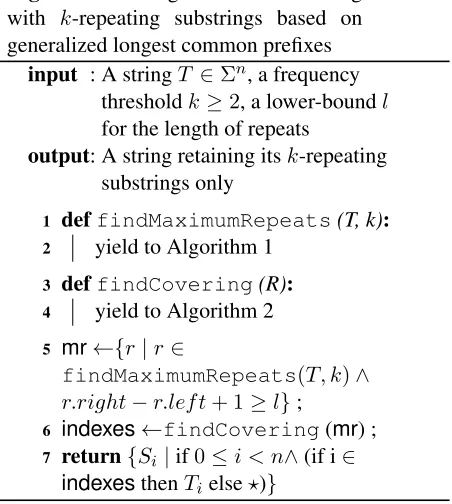
substrings only
1 deffindMaximumRepeats(T, k):
2 yield to Algorithm 1
3 deffindCovering(R):
4 yield to Algorithm 2
5 mr {r|r 2
findMaximumRepeats(T, k)^
r.right r.lef t+ 1 l};
6 indexes findCovering(mr) ; 7 return{Si |if0i < n^(if i2
indexesthenTi else?)}
Two theorems 5.1 and 5.2 imply that our anonymization method of covering withk-repeating
substrings, which simply calls Algorithm 1 and then feeds its result to 2, is O(kn). When kis
consid-ered constant, it isO(n) in time. In order to derive this conclusion, we suffice it to note that the size of the input to Algorithm 2, which is the output of Al-gorithm 1, is O(n)wherenis the size of the input
string, because the size of the array MR in Algo-rithm 1 isn.
6 Experiments
We empirically evaluate the efficiency and scalabil-ity of the proposed method, described in Section 5.
6.1 Materials
We use following materials and implementation for the experiments.
Corpora Table 2 summarizes statistics of the
cor-pora we used for the following experiments. In
ad-Table 2: Statistics of the corpora used to evaluate thek -repeating substrings method based on generalized longest common prefixes (the proposed method). Sizes are in characters. E: English. J: Japanese.
Name Size Content type
DEID 1,283,481 diagnostic reports (E)
MED 7,192,989 research papers (E)
WKT 45,838,626 dictionary (J)
dition to a de-identification dataset, our primary tar-get, we add corpora of Japanese, a language without word boundary in its orthography, and corpora of differing sizes for comparison and scalability eval-uation. DEID is a part of the datasets used in the i2b2shared task of text de-identification (Uzuner et al., 2007), containing diagnostic reports written in English. The portion of the i2b2 dataset we eval-uate on is taken from its training set, and consists of 388 records. The remaining 283 of the training set were used to find the optimal parameter values of the length lower-bound l (described in Section
5.3) and percentage R (described in Section 6.2).
MED refers to a corpora composed of 50,000 En-glish abstracts, extracted from the publicly-available MEDLINE abstracts 5 containing abstracts of re-search paper in the biomedical domain in English.
WKT refers to an approximately 38% sample an XML dump of a publicly-available multilingual dic-tionary, containing 31,894 entries 6. All corpora were preprocessed to remove XML tags expressing meta information.
Implementation We implemented our method
us-ing Scala in 714 lines excludus-ing comments and blank lines. We usedjsuffixarrays2, a suffix array and longest common prefixes library, and a standard Java virtual machine7. As soon as this work is published, we will provide our implementation as a Java library, publicly available through our website89. We ran the
5The MEDLINE abstracts are available athttp://mbr. nlm.nih.gov/.
6We used the dump of its Japanese edition with current ver-sions only, available athttp://dumps.wikimedia.org/ jawiktionary/20130202/.
7We used Java Standard Edition Runtime Environment 1.6.0 22, Java HotSpot 64-Bit Server VM.
8http://www.yusuke.matsubara.name
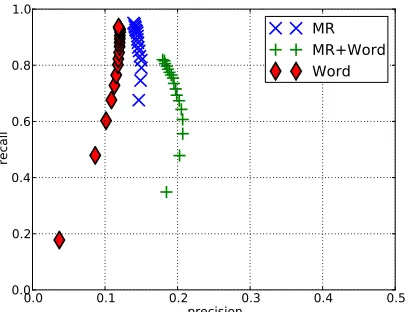
Figure 2: Recall-Precision curves of the proposed gen-eralized maximum repeats algorithm (“MR”), the base-line word-based method (“Word”), and their hybrid (“MR+Word”) against thei2b2dataset DEIDdescribed in Table 2. Each plot point corresponds to different k ranging from2to18. Parameters were chosen with a de-velopment set werel= 6andR= 0.2(See Sections 5.3 and 6.2 for their definitions).
program on Java 1.6.0 22 on Linux 2.6.26-2-amd64. All experiments were performed on a computer with
Intel Xeon E5410 2.33 G Hz (2⇥4cores) CPU and
24GB memory.
6.2 Evaluation metrics
Precision-Recall We use token-based
precision-recall against the de-identification dataset of i2b2
(Uzuner et al., 2007) to measure the utility of the algorithms. We take tokens labeled as “PHI”
(pro-tected health information) in thei2b2dataset as
pos-itive examples, and the others negative examples. To decide whether a partially suppressed token by an algorithm should be protected or not, we introduce
a parameter R (0% R 100%) and interpret
tokens with more thanR% of its component
char-acters suppressed as protected (or positive) tokens in the system’s output. We also introduce a set of white-space characters and other symbols which are to be unsuppressed regardless of the judgement by the algorithm. This is necessary in order to ensure that all token boundaries are kept consistent to al-low comparison, and to ensure that most obvious to-kens with only one character are caught. The set is composed of 16 characters including space, new line
Figure 3: Computational time of the proposed method (gen. max. repeats) for covering withk-repeating sub-strings against the input size where k = 4. (WKT in Table 2)
Figure 4: Ratio of the number of positions unsuppressed by the proposed method (gen. max. repeats) to cover the input string with itsk-repeating substrings wherek= 4, against the input length. (WKTin Table 2)
character, tab, parentheses, etc.
Time To evaluate the scalability, we measure the
wall-clock time elapsed while running the program.
Unsuppressed ratio We measure the ratio of
un-suppressed positions on the input string T against
the length n = |T|. Larger values are preferred
because it preserves a larger part of the text, offer-ing better readability and usefulness of the published text.
6.3 Results
Figure 2 shows precision-recall curves of the
meth-ods against the DEID dataset, with plot points
ob-tained by varying the threshold value of k of
gave higher precisions with a similar level of recall. Moreover, a hybrid method “MR+Word”, which we will discuss in Section 7, provides an alternative in-clined towards even better precision with a slight drop in recall.
We measured the running time varying the input from less than 1% to 100% of the corpora. Figure 3 shows the running time for samples with different
sizes taken from the corpusWKT. It is reasonable
to say the running time is linear to the input size. The fluctuations found in the elapsed times are con-sidered to be due to locality in the repetitiveness of the text, and fluctuations in IO responses of the com-puter.
Figure 4 shows how much portion of the input
string survives after covering withk-repeating
sub-strings wherek = 4. Notice, except for the initial
fluctuations for the inputs of less than 10 mega bytes, that the ratio consistently raises along the increase of
the input. This is natural because, havingkfixed, the
larger the original string is, the more substrings may
have frequencies higher than or equal tok.
7 Discussions and future work
Here we discuss the theoretical and empirical results given in Sections 5 and 6, and describe possible im-provements of the proposed method.
7.1 Effectiveness
We consider that precision and recall shown in Fig-ure 2 are a promising indication that our approach using generalized maximum repeats provides a ba-sic unsupervised baseline and complementary infor-mation that might be unavailable with existing ap-proaches. Higher precision values combined with similar recall values of the proposed method against the word-based baseline mean that the proposed method gives a less noisy hint to indicate regions with information that should be suppressed.
It was unsurprising to see that the performance of the unsupervised methods discussed so far is not close to that of supervised methods which score at more than 90% in F-measure as reported in (Meystre et al., 2010). We argue again that our goal is to find a promising unsupervised way to augment existing supervised methods, and that our results support our
hypothesis that covering withk-repeating substrings
yields a useful result, when no word boundary or morphological boundary is assumed.
A manual inspection of the results revealed that the proposed maximum repeats algorithm not only outperformed the word-based baseline, but also it produced a suppression pattern that was signifi-cantly different from the baseline. To demonstrate this, we implemented a simple hybrid method of the two; the hybrid method is a simple consensus of the word-based baseline and the maximum repeats method. Its results shown in Figure 2 demonstrates that this re-examination step yields better precision scores, by a considerable margin, that were unattain-able by any of the two.
7.2 Document-aware anonymity
Natural language data may have informal structure with units such as documents where repeats inside of a unit may be ignored in the context of anonymiza-tion, because those occurrences are may not inde-pendent; without a notion of document it is hard to properly treat cases where a patient name is repeat-edly mentioned in one document which describes the patient itself, but does not occur elsewhere in a document collection. One way to incorporate docu-ment boundaries in our framework may be employ-ing ideas of pseudo characters for document bound-aries from (Yamamoto and Church, 2001).
7.3 Computational efficiency
We consider the computational time of the proposed method is satisfactorily small both in theory (Theo-rems 5.1 and 5.2), and in practice (Figure 3) up to the scale of 60 megabytes. We also note that our Scala implementation is not fully optimized, allowing a room for further software optimization for speedup. Nevertheless, for massive text data, which may be larger than the typical RAM size, our method may still need to introduce a way to reduce the memory footprint. Although we believe that the space
com-plexity of the proposed algorithm isO(n) as well,
8 Conclusion
In this paper, we have introduced the problem of covering a string with its k-repeating substrings, and given efficient algorithm to solve it. Based on the hypothesis that rare substrings are likely to contain sensitive information, we have applied it to the task of text de-identification. Analyses on its computational complexity and empirical evaluations using real-world data have shown that the method may augment traditional ones for privacy-preserving publishing of textual data.
Acknowledgments
We thank Prof. Eiji Aramaki for his inspiring sug-gestions. We thank anonymous reviewers for their valuable comments.
References
Charu C. Aggarwal and Philip S. Yu. 2007. On
privacy-preservation of text and sparse binary data with sketches. In Proceedings of SIAM International Conference on Data Mining (SDM07).
Balamurugan Anandan, Chris Clifton, Wei Jiang, Mum-moorthy Murugesan, Pedro Pastrana-Camacho, and Luo Si. 2012. t-plausibility: Generalizing words to desensitize text. Trans. Data Privacy, 5(3):505–534, December.
Alan R Aronson. 2001. Effective mapping of biomedical text to the umls metathesaurus: the metamap program. In Proceedings of the AMIA Symposium, page 17. American Medical Informatics Association.
Timo Bingmann, Johannes Fischer, and Vitaly Osipov. 2012. Inducing suffix and lcp arrays in external mem-ory. In Proceedings of Meeting on Algorithm Engi-neering and Experiments (ALENEX).
Venkatesan T. Chakaravarthy, Himanshu Gupta, Prasan Roy, and Mukesh K. Mohania. 2008. Efficient tech-niques for document sanitization. In Proceedings of the 17th ACM conference on Information and knowl-edge management, CIKM ’08, pages 843–852, New York, NY, USA. ACM.
Maxime Crochemore, Christophe Hancart, and Thierry Lecroq. 2007. Algorithms on Strings. Cambridge University Press.
Benjamin Fung, Ke Wang, Rui Chen, and Philip S Yu. 2010. Privacy-preserving data publishing: A survey of recent developments. ACM Computing Surveys (CSUR), 42(4):14.
Lucian Ilie and W. F Smyth. 2011. Minimum unique substrings and maximum repeats. Fundamenta Infor-maticae, 110(1–4):183–195.
Wei Jiang, Mummoorthy Murugesan, Chris Clifton, and Luo Si. 2009. t-plausibility: Semantic preserving text sanitization. InComputational Science and Engineer-ing, 2009. CSE’09. International Conference on, vol-ume 3, pages 68–75. IEEE.
Toru Kasai, Gunho Lee, Hiroki Arimura, Setsuo Arikawa, and Kunsoo Park. 2001. Linear-time longest-common-prefix computation in suffix arrays and its applications. In Proceedings of the 12th An-nual Symposium on Combinatorial Pattern Matching, number 2089 in Lecture Notes in Computer Science, pages 181–192.
Fabian Kulla and Peter Sanders. 2007. Scalable par-allel suffix array construction. Parallel Computing, 33(9):605–612.
Clete A Kushida, Deborah A Nichols, Rik Jadrnicek, Ric Miller, James K Walsh, and Kara Griffin. 2012. Strategies for de-identification and anonymization of electronic health record data for use in multicenter re-search studies. Medical Care, 50:S82–S101.
Junqiang Liu. 2012. Privacy preserving disclosing of unstructured data. Journal of Information and Com-putational Science, 9(1):75–83.
Udi Manber and Gene Myers. 1993. Suffix arrays: a new method for on-line string searches. SIAM Journal on Computing, 22(5):935–948.
Stephane M Meystre, Forrest J Friedlin, Brett R South, Shuying Shen, and Matthew H Samore. 2010. Au-tomatic de-identification of textual documents in the electronic health record: a review of recent research.
BMC Medical Research Methodology, 10(70). Ge Nong, Sen Zhang, and Wai Hong Chan. 2011. Two
efficient algorithms for linear suffix array construction.
IEEE Transactions on Computers, 60(10):1471–1484.
Latanya Sweeney. 2002. k-anonymity: A model
for protecting privacy. International Journal of Un-certainty, Fuzziness and Knowledge-Based Systems, 10(05):557–570.
¨Ozlem Uzuner, Yuan Luo, and Peter Szolovits. 2007. Evaluating the state-of-the-art in automatic de-identification.Journal of American Medical Informat-ics Association, 14(5):550–563.