Copyright 2012 by Quanchao Liu, Chong Feng, and Heyan Huang
Emotional Tendency Identification for Micro-blog Topics Based on
Multiple Characteristics
Quanchao Liu
Chong Feng
Heyan Huang
Department of Computer Science and Technology
Beijing Institute of Technology
Beijing, China
{liuquanchao, fengchong, hhy63} @bit.edu.cn
Abstract
Public opinion analysis for micro-blog post is a new trend, and wherein emotional tendency analysis on micro-blog topic is a hot spot in the sentiment analysis. According to the characteristics of contents and the various relations of Chinese micro-blog post, we construct the dictionaries of sentiment words, internet slang and emoticons respectively, and then implement the sentiment analysis algorithms based on phrase path and the multiple characteristics for emotional tendency of micro-blog topics. Using micro-blogs’ forwarding, commentaries, sharing and so on, We take a future step to optimize the algorithm based on the multiple characteristics. According to the experimental results, our approach greatly improves the performance of emotional tendency identification on micro-blog topic.
1
Introduction
As the fast development of New media, the internet gradually advocates open architecture philosophy that users participate in actively, and has been developed from a simple “reading webpage” to “writing webpage”, “building webpage together” for users. So a huge user generated content (UGC) has been developed, especially the emergence of micro-blog post. According to the reports1, users applying
1
The Eleventh China Network Media Forum
blog have exceeded 300,000,000. As a result of releasing diversely and writing randomly, micro-blog post is more and more popular in China, and it has brought a tremendous effect on network opinions and human society.
Micro-blog contents formed on internet express people’s various emotion and sentiment, such as joy, anger, grief, praise, criticism and so on. More and more people like to use micro-blog post to share their views or experience, which makes people’s opinion information expanded rapidly. So it is very difficult to rely on the artificial method to deal with the micro-blog information’s collection and processing, there is an urgent need to help user analyse the massive information using computer.
Chinese micro-blog post has multiple characteristics as following:
1) Due to the short text message, micro-blog post has terms’ sparsity. Feature extraction based on terms is not suitable for micro-blog post.
2) There exist many homophonic words, abbreviated words, internet slang in micro-blog post, such as “杯具” standing for “悲
剧”, “亲” standing for “亲 爱 的”, “3Q” standing for “谢谢”, or using emoticons to express emotion and so on.
3) Many popular new words made by network events would appear in micro-blog post. Taking “皮鞋很忙” for example, it appeared because the news report that the materials for producing shoes are processed into edible gelatin.
4) There are a variety of relations between micro-blogs. It is very convenient to forward, comment and share micro-blog post.
According to the above characteristics of micro-blog post, we analyse emotional tendency on micro-blog topic, and obtain a set of feasible and effective emotional tendency identification algorithm on micro-blog topic.
The remainder of this paper is structured as follows. In section 2, we briefly summarize related work. Section 3 gives an overview of data construction, including emotional symbol library, emotional dictionary and network slang dictionary. In order to improve the rate of target coverage, the target extended algorithm is described in section 4. We design the different emotional tendency identification algorithms on micro-blog topic in sections 5 and 6 respectively. In section 7, sentiment optimization algorithm is described. Experimental results are reported in section 8 and section 9 concludes our work.
2
Related Work
In the research domain of sentiment analysis, emotional tendency for twitter has been concerned for some time, such as Tweetfeel1, Twendz2, Twitter Sentiment3. In previous related work, (Go et al., 2009) use distant learning to acquire sentiment data. They use tweets ending in positive emoticons like“:)” as positive and negative emoticons like“:(” as negative. They build models using Naives Bayes(NB), MaxEnt(ME) and Support Vector Machines(SVM), and they report SVM outperforms other classifiers. In terms of feature space, they try a Unigram, Bigram model in conjunction with parts-of-speech (POS) features. They note that the unigram model outperforms all other models. However, the unigram model isn’t suitable for Chinese micro-blog post, and we make full use of new emoticons which appear frequently in Chinese micro-blog post.
Another significant effort for sentiment classification on Twitter data is by (Barbosa and Feng, 2010). They use polarity predictions from three websites as noisy labels to train a model. They propose the use of syntax features of tweets like retweet, hashtags, link, punctuation and exclamation marks in conjunction with features like prior polarity of words and POS of words. In
1
http://www.tweetfeel.com/ 2
http://twendz.waggeneredstrom.com/ 3
http://teittersentiment.appspot.com/
order to improve target-dependent Twitter sentiment classification, (Long et al., 2011) incorporate target-dependent features and take the relations between twitters into consideration, such as retweet, reply and the twitters published by the same person. We extend their approach by adding a variety of Chinese dictionaries of sentiment, internet slang and emoticons, and then by using syntactic parser4 and LIBSVM5 respectively to achieve the sentiment analysis algorithms based on phrase path and the multiple characteristics for emotional tendency of micro-blog topic. Using micro-blogs’ forwarding, commentaries and sharing, we take a future step to optimize the algorithm based on the multiple characteristics.
The problem we address in this paper is to determine emotional orientation for micro-blog topic. So the input of our task is a collection of micro-blogs containing the topic and the output is labels assigned to each of the micro-blogs.
3
Data Description
Micro-blog post is a social networking that allows users to post real time messages, and its content is restricted to 140 Chinese characters. Our data set comes from Sina6 and Tencent7 micro-blog, and micro-blogs are commonly displayed on the Web as shown in figure 1. “# #” identifies the micro-blog topic, “//” labels user’s forwarding relation, “@” specified the user who we speak to, and “V” labeling on the user shows the user’s information is identified by the Sina or Tencent.
Fig.1 Micro-blog post example
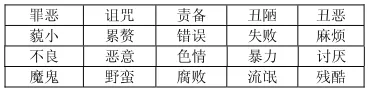
People usually use sentiment words, internet slang and emoticons to express their opinions and sentiment in micro-blog post. In order to obtain
4
http://nlp.stanford.edu/downloads/lex-parser.shtml 5
http://www.csie.ntu.edu.tw/~cjlin/libsvm 6
http://s.weibo.com/ 7
Table 3 Part of the dictionary of internet slang
Internet slang Meaning Polarity
达人 高人 Positive
狂顶 强烈支持 Positive
萝莉 16岁以下的可爱小女孩 Positive
灰常桑心 非常伤心 Negative
菜鸟 网上低手 Negative
3.2 The dictionary of emoticons
We construct the dictionary of emoticons by combining emotional symbol library in micro-blog post with other statistical methods. The former is used to select obvious emotion symbols in blog post, such as Sina, Tencent micro-blog et al. The latter choose emoticons used in other social network, containing user-generated emoticons.
Firstly, two laboratory personnel obtain emotional symbol library, and keep the emoticons with the same emotional orientation after their analysis, and then get rid of emotional symbols with ambiguous orientation, the result is described in Table 4.
Table 4 Part of the dictionary of emoticons
Emoticons Meaning Polarity
good Positive
给力 Positive
鄙视 Negative
怒骂 Negative
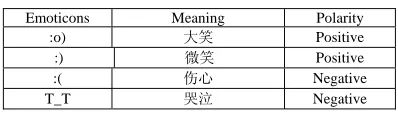
Secondly, in order to enrich the dictionary of emoticons, especially user-generated emoticons in social network, two laboratory personnel collect and analyse emotional orientation, and finally obtain the result shown in Table 5.
Table 5 Part of the dictionary of user-generated
emoticons
Emoticons Meaning Polarity
:o) 大笑 Positive
:) 微笑 Positive
:( 伤心 Negative
T_T 哭泣 Negative
In order to deal with the content conveniently, we pre-process all the micro-blogs and replace all the emoticons with a their sentiment polarity by looking up the dictionary of emoticons.
4
Extended Topics
People usually express their sentiment about object by commenting not on the object itself but on some related things of the object. (Yao et al., 2006) expresses the sentiment about automobile by commenting on the attributes or functionalities of the automobile. As shown in the micro-blog post below, user expresses a positive sentiment about Nokia 5800 by expressing a positive sentiment directly about its screen, keyboard et al.
“#诺基亚 5800#屏幕很好,键盘操作也很方便,
质量不错哦~亲:)”
It is assumed that user can clearly infer the sentiment about the topic based on those sentiments about the related things. We define those related things as Extended Topics. In order to obtain more micro-blogs’ emotional orientation on the topic, we design topic’s expansion algorithm, and expand the extended topic set with formula (2). Formula (2) describes the correlation between two words, the greater PMI value, the stronger the correlation. So we identify the top 10 nouns and noun phrases which have the strongest association with the topic in micro-blog set, and then take them as the original topic’s extended set.
5
Sentiment Analysis Based on Phrase Path
for Micro-blog Topic
Chinese syntactic analysis has been considered to be an important technique in the process of Chinese information processing. It can be divided into two methods: one is the phrase structure parsing described in (Zhou and Zhao, 2007), namely splits the sentence into phrases, and analyses hierarchical relations among phrases. The other is dependency structure analysis described in (Cheng et al., 2005), namely parse the dependency relations between words. In terms of social network, because the content is brief, and the meaning of the expression is centered relatively, the distance between the sentiment words and evaluation objectives usually is short, and we can use the phrase structure tree to evaluate objectives’ emotional orientation.
Take the micro-blog post in section 4 for example, its phrase structure tree is described in figure 2, and its original topic is “诺基亚5800”, we obtain the topic’s extended set {屏幕, 键盘,
we can confirm the emotional orientation of “诺基 亚 5800” by analyzing the sentiment of the element of extended set. At first, starting from evaluation objectives, we find out the shortest phrase path between topic (extended topics) and sentiment word. Phrase path defined in (Zhao et al., 2011) is to link any two phrase nodes in the phrase structure tree. Such as “诺基亚 5800— CD—QP—NP—IP—VP—VP—VA—好”, “屏
幕—NN—NP—NP—IP—VP—VP—VA—好”
et al. Secondly, according to the dictionary of sentiment words, we confirm emotional orientation of the last word in the shortest phrase path. Phrase structure tree is divided into several sub tree by the punctuations, starting from each sub tree, we find out the shortest phrase path, and determine emotional orientation of the topic.
Fig.2 Phrase structure tree of micro-blog example
However, the negative word makes the internal sentiment words tend to shift. Such as “整个店面
的装修不是很漂亮”, “表演极不自信” et al. “漂
亮” and “自 信” originally are commendatory terms, but after adding “不 是” and “不”, the whole sentence semantic changes as a pejorative. In this paper, we adopt matching negative rules method, sentiment words matched by the rules adopt opposite emotional orientation to properly reflect the sentiment. At first, we select negative sentences 6,639 from 20,000 micro-blogs which come from the lab1, and then accomplish the rule set containing high frequency negative rules 227. Secondly, the rule set is used to match the test sentence, and if sentiment words are the focus of
1
www.nlpir.org
negation, we take the opposite emotional orientation.
The negative words used in this algorithm are acquired through HowNet. We select the concepts containing negative sememe, such as {neg|否}, {impossible|不会}, {OwnNot|无}, {inferior|不如} et al, and obtain 21 negative words after filtering.
6
Multiple
Characteristics-based
Senti-ment Classification for Micro-blog Topics
Based on supervised classification is our another method to determine emotional orientation on micro-blog topic. According to previous related studies (Go et al., 2009; Bermingham and Smeaton, 2010; Agrawal et al., 2003; Pang et al., 2002), NB, ME and SVM are mainly classifiers for text classification, (Go and Barbosa et al.) have ever performed sentiment classification of twitter data, and summarize that SVM is more suitable for short text sentiment classification than other classification models.
We use LIBSVM to achieve sentiment classification based on multiple characteristics for micro-blog topic. LIBSVM is an integrated software for support vector classification, and makes everything automatic—from data scaling to parameter selection. We propose the following procedure:
1) Transform data to the format of an SVM package;
2) Conduct simple scaling on the data;
3) Consider the RBF kernel K(x,y)=e−γ||x−y||2; 4) Use cross-validation to find the best
parameter C and
γ
;5) Use the best parameter Cand
γ
to train the whole training set;6) Test the whole corpus.
Table 6 The comparisons of algorithms
Precision(%) Recall(%) F-measure(%)
Extending
topic Sentiment analysis Positive Negative Neutral Positive Negative Neutral Positive Negative Neutral
Coverage
(%)
Based on phrase path 80.5 53.2 23.9 43.9 31.3 73.4 56.8 39.4 36.1 Multiple
characteristics-based 87.4 62.5 54.7 80.9 70.3 65.8 84.0 66.2 59.7 Before
extending
Based on relation
features 90.8 59.1 73.0 86.7 70.3 76.0 88.7 64.2 74.5 68.7
Based on phrase path 81.8 55.0 43.9 68.5 58.9 69.6 74.6 56.9 53.8 Multiple
characteristics-based 92.9 69.0 69.2 83.3 78.4 90.5 87.8 73.4 78.4 After
extending
Based on relation
features 93.6 60.9 82.9 91.1 75.7 77.2 92.3 67.5 79.9 82.6
Table 8 The proportion of micro-blogs having at least
one related micro-blog in the collection
Relations features Proportion(%)
Forwarding 39.8 Commentaries 32.7
Sharing 22.3 Published by the same person 25.9
All 80.3
According to Table 8, for 80.3% of the tweets concerning the topics, we can use optimization algorithm to determine their emotional orientation. That means our sentiment optimization based on relation features is potentially useful for most of the micro-blogs. The results reported in Table 9 show that every kind of relation influences on the precision of emotional orientation.
Table 9 Comparison of contributions made by every
kind of relations
Relation features Precision(%)
Forwarding 67.3 Commentaries 61.5
Sharing 78.8 Published by the same person 70.9
All 86.7
(Long Jiang et al., 2011) 83.9
As shown in Table 9, compared to 85.6% in (Long Jiang et al., 2011), the precision of our optimization algorithm is increased by more than one percentage points. This mainly attributed to three aspects: firstly, taking internet slang and emoticons as Micro-blog’s characteristics is greatly suitable for Micro-blog’s sentiment analysis. Secondly, the relations between micro-blogs also play an import role to determine emotional orientation, especially the sharing relation. Thirdly, to some extent the different data
set can also influence the precision. We also apply the same data set into (Long Jiang et al., 2011), and the precision is 83.9% which is still lower than our algorithm.
What’s more, as a result of micro-blog content published with time characteristic, we can use time characteristic to analyse and forecast micro-blog topic’s emotion tendency. We do experiment for the topic “北京爱情故事” published within one week, as shown in Figure 4, the horizontal axis represents time characteristic, and the vertical axis represents the numbers of micro-blogs having emotional orientation.
0 50 100 150 200 250 300 350 400
2012-5-1 2012-5-2 2012-5-3 2012-5-4 2012-5-5 2012-5-6 2012-5-7
Positive Negative Neutral
Fig.4 Emotion tendency of the topic “北京爱情故事”
9 Conclusions and Future Work
With the emergence of new media, sentiment analysis for new media is becoming more and more important. In this paper, we make full use of multiple characteristics on micro-blog post, and design two kinds of algorithms to achieve micro-blog topic’s sentiment analysis. In future the work will focus on the following two aspects:
1) Micro-blog topic’s expansion algorithm. 2) The effect produced by the attention relation
The relations between micro-blog users have equal importance with the multiple characteristics came from micro-blog post itself, they also play a positive effect for micro-blog’s sentiment analysis.
Acknowledgments
This paper is financially supported by National Natural Science Foundation of China (No. 61132009) and National Key Technology R&D Program (No. 2012BAH14F06). We would like to thank the anonymous reviewers for many valuable comments and helpful suggestions.
References
Apoorv Agarwal, Xie Boyi, Ilia Vovsha, et al. Sentiment Analysis of Twitter Data [C]. Proceedings of the Workshop on Language in Social Media (LSM 2011). Portland, Oregon, 2011: 30-38
Rakesh Agrawal, Sridhar Rajagopalan, Ramakrishnan Srikant, et al. Mining Newsgroups Using Networks Arising From Social Behavior [C]. Proceedings of the 12th international conference on World Wide Web. Budapest, Hungary: WWW’03, 2003: 529-535 Ralitsa Angelova, Gerhard Weikum. Graph-based Text
Classification: Learn from Your Neighbors [C]. Proceedings of the 29th annual international ACM SIGIR conference on Research and development in information retrieval. Seattle, Washington, USA: SIGIR’06, 2006: 485-492
Luciano Barbosa and Feng Junlan. Robust Sentiment Detection on Twitter from Biased and Noisy Data. Proceedings of COLING 2010. Beijing, China, 2010: 36-44
Adam Bermingham, Alan Smeaton. Classifying Sentiment in Microblogs: Is Brevity an Advantage? [C]. Proceedings of the 19th ACM international conference on Information and knowledge management. Toronto, Ontario, Canada: CIKM’10, 2010: 1833-1836
Cheng Yuchang, Masayuki ASAHARA, Yuji MATSUMOTOY. Machine Learning-based Dependency Analyzer for Chinese [C]. Proceedings of the International Conference on Chinese Computing 2005. Singapore: COLIPS Publication, 2005: 66-73
Du Weifu, Tan Songbo, Yun Xiaochun, et al. A New Method to Compute Semantic Orientation [J]. Journal of Computer Research and Development, 2009, 46(10): 1713-1720
Alec Go, Richa Bhayani, Huang Lei. Twitter Sentiment Classification using Distant Supervision. CS224N Project Report, Stanford, 2009
Jiang Long, Yu Mo, Zhou Ming, et al. Target-dependent Twitter Sentiment Classification [C]. Proceedings of the 49th Annual Meeting of the Association for Computational Linguistics. Portland, Oregon, 2011: 151-160
Pang B, Lee L, Vaithyanathan S. Thumbs up? Sentiment Classification using Machine Learning Techniques [C]. Proceedings of the Conference on Empirical Methods in Natural Language Processing (EMNLP). Philadelphia, PA: Association for Computational Linguistics, 2002: 79-86
Turney P D, Littman M L. Measuring praise and criticism: inference of semantic orientation from association [J]. ACM Trans on Information Systems, 2003, 21(4): 315-346
Wang Suge, Li Deyu, Wei Yingjie. A Method of Text Sentiment Classification Based on Weighted Rough Membership [J]. Journal of Computer Research and Development, 2011, 48(5): 855-861
Yao Tianfang, Nie Qingyang, Li Jianchao, et al. An opinion mining system for Chinese automobile reviews. In: Cao Youqi, Sun Maosong, eds. Proceedings of the Frontiers of Chinese Information Processing. Beijing: Tsinghua University Press, 2006: 260-281 (in Chinese with English abstract)
Zhou Qiang, Zhao Yingze. Automatic Parsing of Chinese Functional Chunks [J]. Journal of Chinese Information Processing. 2007, 21(5): 18-24
Zhao Yanyan, Qin Bing, Che Wanxiang, et al. Appraisal Expression Recognition Based on Syntactic Path [J]. Journal of Software. 2011, 22(5): 887-898