Selecting Contextual Peripheral Information for Answer Presentation: The
Need for Pragmatic Models
Rivindu Perera, Parma Nand
School of Computer and Mathematical Sciences Auckland University of Technology
Auckland, New Zealand
{rivindu.perera, parma.nand}@aut.ac.nz
Abstract
This paper explores the possibility of pre-senting additional contextual information as a method of answer presentation Question An-swering. In particular the paper discusses the result of employing Bag of Words (BoW) and Bag of Concepts (BoC) models to retrieve contextual information from a Linked Data resource, DBpedia. DBpedia provides struc-tured information on wide variety of entities in the form of triples. We utilize the QALD question sets consisting of a 100 instances in the training set and another 100 in the testing set. The questions are categorized into single entity and multiple entity questions based on the number of entities mentioned in the ques-tion. The results show that both BoW (syn-tactic models) and BoC (semantic models) are not capable enough to select contextual infor-mation for answer presentation. The results further reveals that pragmatic aspects, in par-ticular, pragmatic intent and pragmatic infer-ence play a crucial role in contextual informa-tion selecinforma-tion in the answer presentainforma-tion.
1 Introduction
Answer Presentation is the final step in Question Answering (QA) which focuses on generating an an-swer which closely resemble with a human provided answer (Perera, 2012b; Perera, 2012a; Perera and Nand, 2014a). There is also a requirement to asso-ciate the answer with additional contextual informa-tion when presenting the answer.
This paper focus of exploring methods to extract additional contextual information to present with the
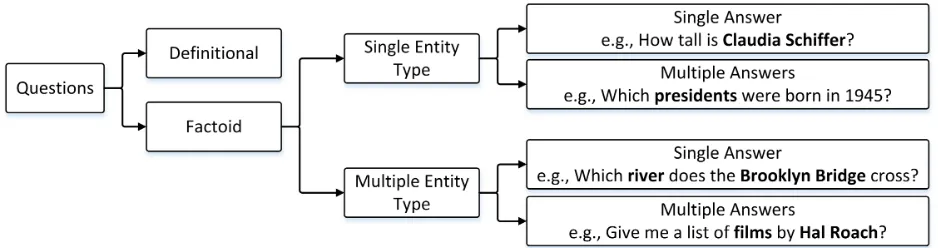
extracted factoid answer. We provide a classifica-tion if quesclassifica-tions based on the type of the answer re-quired and the number of entities that mentioned in the questions. The question classification is illus-trated in Fig. 1. Firstly, question can be categorized based on the information need where questions may require a definition as the answer or a factoid an-swer which is an information unit (Perera, 2012a; Perera and Nand, 2014a). The definitional questions need definitions which include both direct and re-lated background information and there is no need to further expand the answer with contextual informa-tion. So far the way factoid questions presentation involved only the answer itself without contextual information. Recently, Mendes and Coheur (2013) argued that even factoid questions need to present additional information. An advantage of presenting contextual information is that answer is justified by the information provided, so that users can conclude that the answer that is acquired by the system is one that they are searching for.
The rest of the paper is structured as follows. Sec-tion 2 explores BoW and BoC models to rank con-textual information. Section 3 focuses on presenting the experimental framework. Section 5 presents in-formation on related work and we conclude the pa-per in Section 6.
2 Content selection using weighted triples
This section presents models to rank triples focusing on open domain questions as communicative goals. Open domain questions require knowledge from dif-ferent domains to be aggregated which making it more challenging compared to simply generating a
197
Figure 1: Classification of common question types
content for given single theme topic. Our objective is to select a set of triples which can be used to gen-erate a more informative answer for a given ques-tion.
We investigate the problem from two perspec-tives; as a Bag of Words (BoW) and as a Bag of Concepts (BoC). In the following sections, we dis-cuss the strategy used for ranking and the details on the supporting utilities including domain corpus, ref-erence corpus, triple retrieval, and threshold based selection.
The high level design of the framework used to experiment BoW and BoC is shown in the Fig. 2. The model utilizes two corpora (domain and refer-ence) and selectively used based on the requirement. The domain corpus is constructed using search snip-pets collected from the web by using information from the question and answer as query terms. The reference corpus represents knowledge about gen-eral domain. The model also has utility functions to retrieve triples using SPARQL queries, filter the duplicates, and to perform basic verbalization.
2.1 The problem as a Bag of Words
We utilized token similarity, Term Frequency - In-verse Document Frequency (TF-IDF), and Resid-ual Inverse Document Frequency (RIDF) in two flavours which are widely used in information re-trieval tasks. The following sections describes these models in detail.
2.1.1 Token similarity
Token similarity ranks the triples based on the ap-pearance of the terms in triple and the question be-ing considered. In particular we employ the cosine
similarity (1) to calculate the similarity between the tokenized and stopwords removed question/answer and the triple.
simcosine(
− →
Q ,−→T) =
− →
Q·−→T
|−→Q||−→T|
= Σ
n i=1QiTi
q
Σn i=1Q2i
q
Σn i=1Ti2
(1)
Here, Q and T represent the question and the triple respectively.
2.1.2 Term Frequency – Inverse Document
Frequency (TF-IDF)
The TF-IDF (2) is used to rank term (t) from the question and answer present in the triple (T). A triple is then associated with a weight which is the sum of the weights assigned to the triple terms.
T F −IDF(Q, T) = X i∈Q,T
tfi.idfi
= X
i∈Q,T
tfi.log2 N dfi
(2)
Figure 2: The schematic representation of the content selection framework
2.1.3 Okapi BM25
Okapi ranking is an extension to the TF-IDF that is based on the probabilistic retrieval framework.
The Okapi ranking function can be defined as fol-lows:
Okapi(Q, T) = X i∈Q,T
logN dfi
.
(k1+ 1)tfi,T
k1
(1−b) +b LT
Lave
+tfi,T
.(k3+ 1)tfi,Q k3+tfi,Q
(3)
Where, LT andLave represent the length of the triple and average of length of a triple respectively. The Okapi also uses set of parameters where b is usually set to 0.75 andk1andk3range between 1.2 and 2.0. Thek1 andk3 can be determined through optimization or can be set to range within 1.2 and 2.0 in the absence of development data (Manning and Schutze, 1999).
2.1.4 Residual Inverse Document Frequency
(RIDF)
The idea behind the RIDF is to find content words based on actual IDF and predicted IDF. The widely used methods to IDF prediction is Poisson and K mixture. However, K mixture tends to fit very well with content terms. On the other hand, Poisson de-viates from the IDF remarkably and provides non-content words. Given term frequencies in triple col-lection, predicted IDF can be used to measure the RIDF for a triple as follows:
RIDF =X i∈T
idfi−didfi
=X
i∈T
idfi−log 1 1−P(0;λi)
(4)
Where λi represents the average number of oc-currences of term andP(0;λi)represents the Pois-son prediction ofdf where term will not be found in a document. Therefore,1−P(0;λi)can be inter-preted as finding at least one term and can be mea-sured using:
P(k;λi) =e−λi λk
i
k! (5)
Based on the same RIDF concept, we can mod-erate this to work with term distribution models that fits well with actualdf such as K mixture. The defi-nition of the K-mixture is given below.
P(k;λi) = (1−α)δk,0+ α β+ 1
β β+ 1
k
(6)
In K-mixture based RIDF we interpreted the devi-ation from predicateddf to mark the term as a non-content term.
2.2 The problem as a Bag of Concepts
two widely accepted BoC models; Latent Seman-tic Analysis (LSA) and adoption of Log Likelihood Distance (LLD) using two corpora. The following sections describe them in detail.
2.2.1 Latent Semantic Analysis
This method analysed how triples in the collec-tion can be ranked concept-wise and retrieved re-lated to the question and answer where triples are represented in a semantic space. Such a ranking can expose the original semantic structure of the space and its dimensions (Manning and Schutze, 1999). In particular, we employed the Latent Semantic In-dexing (LSI) for each collection of triples associated with the question.
2.2.2 Corpus based Log Likelihood Distance
(LLD)
The idea behind the implementation of this method is to identify domain specific concepts (compared to the general concepts) and rank triples which contain such concepts. For this we employed a domain corpus (see Section 2.3) and a general ref-erence corpus (see Section 2.4). The model extracts concepts which are related to the domain on the ba-sis of their frequency in domain corpus and general reference corpus. A term that is more frequently seen in a domain corpus compared to the general ref-erence corpus implies that the term is a concept that is used in the domain being considered (Perera and Nand, 2014b; Perera and Nand, 2014c). We utilized the log likelihood distance (He et al., 2006; Gelbukh et al., 2010) to measure the importance as mentioned below:
Wt = 2×
ftdom×log
ftdom f expdom
t
+
ftref×log f ref t f expreft
!!!
(7)
where,ftdomandftref represent frequency of term (t) in domain corpus and reference corpus respec-tively. Expected frequency of a term (t) in domain (f expdomt ) and reference corpora (f expreft ) were calculated as follows:
f expdomt =sdom×
ftdom+ftref sdom+sref
!
(8)
f expreft =sref ×
fdom t +f
ref t sdom+sref
!
(9)
where, sdom and sref represent total number of tokens in domain corpus and reference corpus re-spectively. Next, we can calculate the weight of a triple (hsubject, predicate, objecti) by summing up the weight assigned to each term of the triple
2.3 Domain Corpus
The domain corpus is a collection of text related to the domain of the question being considered. How-ever, finding a corpus which belongs to the same do-main as the question is challenge on its own. To overcome this, we have utilized an unsupervised do-main corpus creation based on a web snippet extrac-tion. The input to this process is a set of extracted key phrases from a question and its answers.
2.4 Reference Corpus
The reference corpus is an additional resource uti-lized for the LLD based contextual information se-lection. We used the British National Corpus (BNC) as the reference corpus. The selection is influenced by the language used in the DBpedia, British En-glish. However, what is important for the LLD cal-culation is a term frequency matrix. We have first performed stopword filtering on the BNC and this operation reduced the original size of BNC (100 mil-lion words) to 52.3 milmil-lion words. Next, the term frequency matrix is built using a unigram analysis.
2.5 Triple retrieval
The model employs the Jena RDF framework for the triple retrieval. We have implemented a Java li-brary to query and automatically download neces-sary RDF files from DBpedia.
2.6 Threshold based selection
Table 1: Dataset statistics. Invalid questions are those that are already marked by dataset providers as invalid and questions where for which triples cannot be retrieved from DBpedia
Training Test
All questions 100 100
Invalid questions 5 10
Single entity questions 47 42 Multiple entity questions 48 48
to the absence of knowledge to measure theθat this stage, it is considered as a factor that needs to be tuned based on experiments. Further discussion on selecting theθcan be found in Section 4.
3 Experimental framework
3.1 Dataset
We used the QALD-2 training and test datasets, but removed questions which marked as “out of scope” by dataset providers and those for which DBpedia triples did not exist. Table 1 provides the statistics of the dataset, including the distribution of questions in two different question categories, single entity and multiple entity questions.
We have also built a gold triple collection for each question for the purpose of evaluation. These gold triples were selected by analysing community pro-vided answers for the questions in our dataset. Table 1 shows the statistics for both training and testing datasets.
3.2 Results and discussion
The evaluation is carried out using gold triples as de-scribed in Section 3.1. The definitions of precision (P), recall (R) and F-score (F*) are given below:
P = |triplesselected∩triplesgold|
|triplesselected|
(10)
R= |triplesselected∩triplesgold|
|triplesgold|
(11)
F∗= 2P R
P +R (12)
The threshold (θ) (measure as a percentage from the total triple collection) value for the ranked triples was experimentally chosen to using the training
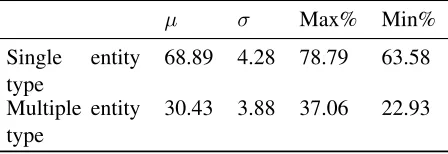
Table 2: Statistics related to the gold triple percentage in total triple collection in training dataset. Theµ rep-resents the mean percentage of gold triples included in the total collection. Theσshows the standard deviation. TheMax%andMin%represent maximum and minimum percentage of gold triples from the total collection respec-tively.
µ σ Max% Min%
Single entity type
68.89 4.28 78.79 63.58
Multiple entity type
30.43 3.88 37.06 22.93
dataset. This threshold value was then used to select triples which were relevant for the testing dataset. The value was experimentally determined by using a combination of precision and recall value form the training data. For an accurate model, the pre-cision is expected to remain constant until it starts selecting the irrelevant triples after which the preci-sion will gradually decrease. Correspondingly, the recall value will increase until the threshold point after which the model will start selecting irrelevant triples, which will start pushing the recall value down. Hence the optimumθvalue will be the point at the maximum point for both recall and precision which is the maximum score.
Using the θ identified from training set, we can then test the model using testing dataset. When mea-suring the θbased on the training dataset it is also important to measure the proportion of gold triples compared to the number of total triples. A set of statistics related to this calculation is shown in Table 2.
65 70 75 80 85 90 95 100
0.65 0.7 0.75
Threshold (θ)
F-Score CosineTFIDF Okapi RIDF-Poisson RIDF-Kmixture
Figure 3: F-score gained by Bag of Words models plotted against threshold for questions with single entity type
30 35 40 45 50 55 60 65 70 75 80 85 90 95 100 105 0.65
0.7 0.75 0.8
Threshold (θ)
F-Score
LSI LLD
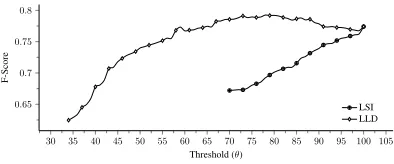
Figure 4: F-score gained by Bag of Concepts models plotted against threshold for questions with single entity type
20 30 40 50 60 70 80 90 100
0.4 0.45 0.5
Threshold (θ)
F-Score
Cosine TFIDF RIDF-Poisson
Figure 5: F-score gained by Bag of Words models plotted against threshold for questions with multiple entity types. Okapi and K-mixture based ranking methods completely failed to identify relevant triples.
30 35 40 45 50 55 60 65 70 75 80 85 90 95 100 105 0.45
0.46 0.47 0.48
Threshold (θ)
F-Score
LLD
Figure 6: F-score gained by Bag of Concepts models plotted against threshold for questions with multiple en-tity types. The LSI method failed completely in identify-ing relevant triples.
are 68.89% for single entity types and 30.43% from the multiple entity types. Furthermore, the maxi-mum and minimaxi-mum percentages are also near val-ues to the receptive mean valval-ues. This encompasses that there is a possibility to find a threshold value for both single and multiple entity types questions. Fig. 3 depicts the evaluation performed on the single en-tity question category in training dataset using five BoW models under investigation. The results show that the maximum F-score obtained whenθis set to 100%. This shows that these models unable to accu-rately differentiate between the relevant and relevant triples. The BoW models consider only the words
Table 3: Performance of LLD on single entity type ques-tion test dataset with 78% threshold
Precision Recall F-score
LLD on Test Dataset (Single Entity)
0.72 0.84 0.76
as features and therefore every entity is assigned the same importance.
The corresponding evaluation performed on the single entity question category in training dataset us-ing BoC models is shown in Fig. 4. Latent Seman-tic Indexing (LSI) has performed poorly and has not managed to identify a global maximum. However, the Log Likelihood Distance (LLD) has identified a global maximum with aθ value of 78%. Further-more, it has also shown the expected behaviour with an increase inθ value. When this threshold value was used to extract triples from the test dataset the results were encouraging. Table 3 shows that LLD has achieved F-score of 0.76 for the testing dataset with a 0.72 precision value. The LLD model out-performs the other models in this context mainly because it also incorporates the domain knowledge (provided through a domain corpus as explained in Section 2.2.2).
Fig. 5 and Fig. 6 depict the evaluation performed on the multiple entity question category from train-ing dataset, for both Bag of Words and Bag of Con-cepts models. RIDF-Kmixture and Okapi have com-pletely failed without any success in identifying the relevant triples. The Cosine, TF-IDF, and RIDF-Poisson have also not identified the optimum thresh-old (see Fig. 5). From the BoC models, the LSI method has also failed entirely. The LLD mode has identified a local maximum atθ = 48, however the model has not behaved as expected. Furthermore, the global maximum identified atθ = 100 implies that the model can identify all relevant triples only when the total triple collection is retrieved. This confirms that although a Bag of Concepts model such as LLD performed well in the single entity type questions, none of the models performed well in contextual information selection for multiple en-tity type questions.
experi-ment revealed that for multiple entity type questions it is important to identify the intent entity from the question. The information from the intent of the question can be used to factor in a weight correction for the triples. This leads to the study the Bag of Narrative (Cambria and White, 2014) model which is essentially based on pragmatic aspects of the lan-guage. Section 4 discusses this aspect in detail.
4 Pragmatic aspect in contextual information selection
We introduce two pragmatic based concepts that need to be studied in contextual information selec-tion approaches, derived from psycholinguistics.
• Pragmatic intent (Byram and Hu, 2013) of a question in the perspective of contextual infor-mation and,
• Pragmatic inferences (Byram and Hu, 2013; Tomlinson and Bott, 2013) that can be drawn based on already known information.
4.1 Pragmatic Intent
The pragmatic intent of a question in our problem can be defined as the entity that a user is actually in-tending to know more about. This concept deviates from the two early approaches in query classifica-tion; Broder’s taxonomy (Broder, 2002) (classifying queries as informational, transactional, and naviga-tional) and question typologies (Li and Roth, 2006) (determining the answer type for a question).
Consider the examples given in Table 4, where in each question multiple entities are mentioned. The entities are numbered and pragmatic intent is tagged (with code :i).
In Q1, Marc Mezvinsky is the pragmatic intent of the question which is also the expected answer. The same rule applies for Q2, Q3, and Q4. How-ever, in Q5 and Q6 the pragmatic intent is a part of the question ([MI6] and [Natalie Portman]), but not the answer. This variation makes it difficult to iden-tify the pragmatic intent of a question compared to the question target identification. When presenting contextual information to the user, the information related to the pragmatic intent together with infor-mation that is shared by pragmatic intent and other entities need to be given the priority.
Table 5: Example question to illustrate the pragmatic in-ference used in the information elimination
Q7 Which river does the Brooklyn Bridge in New York cross?
Answer East River
Triple hEast River, flow through, New Yorki
4.2 Pragmatic inference
The pragmatic inference is the interpreting informa-tion based on the context that it operates on. For ex-ample, a storyteller will not mention every incident or fact that happened in a narrative, thus some parts may be left for the reader to interpret using com-mon sense knowledge, open domain knowledge, and knowledge that is already mentioned in the narrative. Applying this well-established psycholinguistic the-ory in our approach, we noticed several scenarios where we can improve the contextual information by eliminating information that can be pragmatically inferred and prioritizing information that needs for the context.
Consider the question (Q7), answer and the triple provided in Table 5. Using the question and its an-swer we can infer the following two facts encoded in the triples.
• F1: Brooklyn Bridge, located in, New York
• F2: Brooklyn Bridge, crosses, East River
As humans, we can infer that if Brooklyn Bridge is located in New York and if it crosses the East River, then East river must flow through New York, hence it is co-located. Therefore, the triple in Table 5 becomes unimportant for the context because it is already inferred by F1 and F2 which can be derived from question and its answer.
The pragmatic inference can also be used to pri-oritize the information using semantic relations that entities contain. For example consider the two sce-narios illustrated in Table 6 where important contex-tual information can be inferred based on the seman-tic relationship of the pragmaseman-tic intent and entities.
cur-Table 4: Example questions to illustrate the pragmatic intent variation in different questions. Entities are numbered and intent is marked with codei
# Question Answer
Q1 Who is the daughter of [Bill Clinton]1married to? [Marc Mezvinsky]i2 Q2 Which river does the [Brooklyn Bridge]1in [New York]2cross? [East river]i3 Q3 Which bridge located in [New York]1is opened on 19th March 1945? [Brooklyn Bridge]i2 Q4 What is the highest place in [Karakoram]1? [K2]i2
Q5 In which [UK]1 city is the headquarters of the [MI6]i2? [London]3 Q6 Was [Natalie Portman]i1born in the [United States]2? No
Table 6: Examples illustrate the use of pragmatic infer-ence in information prioritization
# Question Answer
Q8 Who is the founder of [Virgin Group]1?
[Richard Branson]i2 and [Nik Powell]i3 Q9 How often was
[Michael Jordan]i1 divorced?
2
rent positions which are held by its co-founders to be prioritized over other information which is not strongly related to the context of the question. Next, Q9 is related to Michael Jordan’s marriage. When retrieving contextual information for this question the basic information about his wives such as per-sonal names becomes more important for the context of the question.
5 Related work
Benamara and Dizier (2003) present the coopera-tive question answering approach which generates natural language responses for given questions. In essence, a cooperative QA system moves a few steps further from ordinary question answering systems by providing an explanation of the answer. How-ever, this research lacks the investigation to the in-formation needs of different questions and the pro-cess of utilizing cohesive information for the expla-nation, without redundant text.
Bosma (2005) incorporates the summarization as a method of presenting additional information in QA systems. He coins the term, an intensive answer to refer to the answer generated from the system. The process of generating an intensive answer is
based on the summarization using rhetorical struc-tures. Several other summarization based methods for QA such as Demner-Fushman and Lin (2006) and Yu et al. (2007) also exist with slightly vary-ing techniques.
Vargas-Vera and Motta (Vargas-Vera and Motta, 2004) present an ontology based QA system, AQUA. Although AQUA is primarily aimed at ex-tracting answers from a given ontology, it also con-tributes to answer presentation by providing an en-riched answer. The AQUA system extracts ontology concepts from the entities mentioned in the question and present those concepts in aggregated natural lan-guage.
6 Conclusion
References
Farah Benamara and Patrick Saint Dizier. 2003. Dy-namic generation of cooperative natural language re-sponses in webcoop. In 9th European Workshop on Natural Language Generation, Budapest, Hungary. ACL.
Wauter Bosma. 2005. Extending answers using dis-course structure. InRecent Advances in Natural Lan-guage Processing, Borovets, Bulgaria. Association for Computational Linguistics.
Andrei Broder. 2002. A Taxonomy of Web Search.ACM SIGIR Forum, 36(2):3–10.
Michael Byram and Adelheid Hu. 2013. Routledge Encyclopedia of Language Teaching and Learning. Routledge, Taylor & Francis Group, London, UK. Erik Cambria and Bebo White. 2014. Jumping NLP
Curves: A Review of Natural Language Processing Research. IEEE Computational Intelligence Maga-zine, 9(2):48–57, May.
Dina Demner-Fushman and Jimmy Lin. 2006. Answer extraction, semantic clustering, and extractive summa-rization for clinical question answering. In Proceed-ings of the 21st International Conference on Compu-tational Linguistics and the 44th annual meeting of the ACL - ACL ’06, pages 841–848, Morristown, NJ, USA, July. Association for Computational Linguistics. Alexander Gelbukh, Grigori Sidorov, and Liliana
Lavin-Villa, Eduardo Chanona-Hernandez. 2010. Automatic Term Extraction Using Log-Likelihood Based Com-parison with General Reference Corpus. In Natural Language Processing and Information Systems, pages 248–255. Springer Berlin Heidelberg.
Tingting He, Xiaopeng Zhang, and Ye Xinghuo. 2006. An Approach to Automatically Constructing Domain Ontology. In 20th Pacific Asia Conference on Lan-guage, Information and Computation, pages 150–157, Wuhan. Association for Computational Linguistics. Xin Li and Dan Roth. 2006. Learning question
classi-fiers: the role of semantic information. Natural Lan-guage Engineering, 12(3):229.
Christopher D. Manning and Hinrich Schutze. 1999. Foundations of statistical natural language process-ing. Massachusetts Institute of Technology.
Ana Christina Mendes and Luisa Coheur. 2013. When the answer comes into question in question-answering: survey and open issues. Natural Language Engineer-ing, 19(01):1–32, January.
Rivindu Perera and Parma Nand. 2014a. Interaction his-tory based answer formulation for question answering. InInternational Conference on Knowledge Engineer-ing and Semantic Web (KESW), pages 128–139. Rivindu Perera and Parma Nand. 2014b. Real text-cs
- corpus based domain independent content selection
model. In IEEE International Conference on Tools with Artificial Intelligence (ICTAI), pages 599–606. Rivindu Perera and Parma Nand. 2014c. The role of
linked data in content selection. In Pacific Rim In-ternational Conference on Artificial Intelligence (PRI-CAI), pages 573–586.
Rivindu Perera and Parma Nand. 2015a. Generat-ing lexicalization patterns for linked open data. In Second Workshop on Natural Language Processing and Linked Open Data collocated with 10th Recent Advances in Natural Language Processing (RANLP), pages 2–5.
Rivindu Perera and Parma Nand. 2015b. A multi-strategy approach for lexicalizing linked open data. In International Conference on Intelligent Text Process-ing and Computational LProcess-inguistics (CICLProcess-ing), pages 348–363.
Rivindu Perera and Parma Nand. 2015c. Realtext-asg: A model to present answers utilizing the linguistic struc-ture of source question. In29th Pacific Asia Confer-ence on Language, Information and Computation. Rivindu Perera, Parma Nand, and Gisela Klette. 2015.
Realtext-lex: A lexicalization framework for linked open data. In14th International Semantic Web Con-ference.
Rivindu Perera. 2012a. Ipedagogy: Question answer-ing system based on web information clusteranswer-ing. In IEEE Fourth International Conference on Technology for Education (T4E).
Rivindu Perera. 2012b. Scholar: Cognitive Computing Approach for Question Answering. Honours thesis, University of Westminster.
John Tomlinson and Lewis Bott. 2013. How intonation constrains pragmatic inference. In35th Annual Con-ference of the Cognitive Science Society, Berlin, Ger-many. Cognitive Science Society.
M Vargas-Vera and E Motta. 2004. Aqua-ontology-based question answering system. InMexican Inter-national Conference on Artificial Intelligence, Mexico City, Mexico. Springer-Verlag.