Construction of Semantic Collocation Bank Based on Semantic
Dependency Parsing
Liu Shijun
1, Shao Yanqiu
1Zheng Lijuan
1, Ding Yu
21
Information Science School, Beijing Language and Culture University, Beijing, China
2Computer Science and Technology School,Harbin Institute of Technology, Harbin, China
Correspondent Author
Abstract
This paper extracts collocationbasing on semantic dependency parsing, and then constructs a collocation bankwith two levels according to frequency: the instance-level and semantic level. Compared with conventional extracting ways, the collocationsextracted in this paper have closer relationship and higher quality both on the lexical structure and semantic structure.
1
Introduction
Collocation has always been an important issue in language research, especially in Chinese language researches. Chinese is an isolated language, which lacks morphological changes.Establishing a relatively complete dictionary of Chinese collocation will be a great contribution to Chinese study and research.
Collocation plays a significant supporting role in many fields of NLP, such as information retrieval, machine translation, information extraction, and so on. Ding and Bai proposed a method of query expansion based on local co-occurrence[1]; Lin put relationship ofcollocation into language model for query expansion, which got over the deficiency of insufficient relationShips caused by lacking context in tradition query[2]. In the basic
research field of NLP, such as syntax, semantics, etc., collocation also plays an important role.Based on the comparison of different patterns in adjective collocation between the Chinese English learners and native speakers, Zhang analyzed the typical characteristics of different learners when using adjective collocations[3]; Xingemphasized on the importance of collocation in the second language learning[4].
The early research of automatic collocation extraction was made by Choueka, Klein and Neuwtiz,they defined collocation as adjacent words, and used co-occurrence frequency to extract collocation[6];Church and Hanks improved the automatic extraction technology and put forward mutual information as the index ofcollocationevaluating[7].By proposing a formula for calculating strengthbetweencollocation,introducing
dispersion formula,as well as integrating with the automatic speech tagging technology, the Xtract system of Smadja improved the extraction accuracy rate of collocation extraction up to 80%[8]; Lin extracted collocation based on shallow syntactic parsing[9];Shouxun YANG applied the method of decision tree to extract collocation by integrating frequency, likelihood ratio, point mutual information, variance and other statistical indicators[10].
In China, there werea number of outstanding dictionaries had been published,
232
following characteristics: 1.there must be semantic dependency relations between words. 2. Reaching the threshold of frequency of co-occurrence. In this paper, there are two kinds of collocationforms: “word + word” and “word + Semantic Category”.
3
Corpus and Semantic Dictionary
Our research of collocation is based on SDP and semantic dictionary. Before the introduction of the bank, we should make a brief introduction to the SDP corpus we built and the semantic dictionary “HowNet” applied in this paper.
3.1 Corpus of Semantic Dependency
Graph(SDG)
Chinese is a parataxis languagewith flexible word order and diverse function of word class. In real language context Chinese
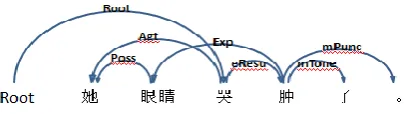
word often depends on several words simultaneously [12], which means in the same sentence one word can be semantically related to several other words. It also may exist in the non-projection phenomenon of crossed arcs. These phenomenon cannot be explained by the traditional dependency trees[15]. In order to express these phenomenon and also take the advantages of dependency expression, this paper break through the limitation of the dependency tree and express the semantics of the sentence by using the dependency graph, namely we connected two words to a dependency arc as long as there is a semantic relationship between them, which means the situation that a word with multiple parent nodes and crossed arcs will be reasonable. For example, “她(she) 眼 睛(eyes) 哭(cry) 肿 (swollen) 了(already)”, its dependency graph is shown in Fig. 1.
Fig. 1. An example of dependency graph
As shown in Fig. 1, the node “她(she)” has semantic relations with both “哭(cry)” and “眼
睛(eyes)”, which means that there are two heads for “她(she)”: “哭(cry)” and “眼 睛 (eyes)” , separately indicates Agent of “哭(cry)” and Possessor of “眼睛(eyes)”Meanwhile, arcs (哭(cry)->她 (she), Agt) and (肿(swollen)->
眼 睛 (eyes),Exp)cross. Such a multi father node and the crossed arcs express the true
meaning of sentence.In addition, the meaning cannot be comprehensively expressed by dependency tree. “哭(cry)” is the core word of whole sentence, and the result of dependency tree parsing is as follows: (哭->她,Agt),(她 ->眼睛,Bleg),(哭->肿,eResu),(肿->了, mTone),so as to lose the semantic relationship between "眼睛(eyes)" and "肿(swollen)". As in Fig. 2:
Fig. 2. An example of dependency tree
On the basis of this system, we built a semantic dependency graph corpus, which contains 30,000 sentences.We have completed correcting 10,038 sentences. These data are from different areas, including the news corpus (10,068), Chinese textbooks (10,038), Sina Weibo corpus (5,000) and corpus for machine
translation (4,900).This semantic dependency graph database aims at solving some Chinese phenomenon perfectly by introducing the non-projective phenomenon, as well as improving the automatic semantic dependency tagging.
3.2 Corpus for Collocation Extraction
In order to reflect the truth of language more accurately, we chose a 4G news corpus to extract collocation. After carryingout the word segmentation and POS tagging to the corpus, we conducted the automatic SDP to the sentences.The results of the analysis are
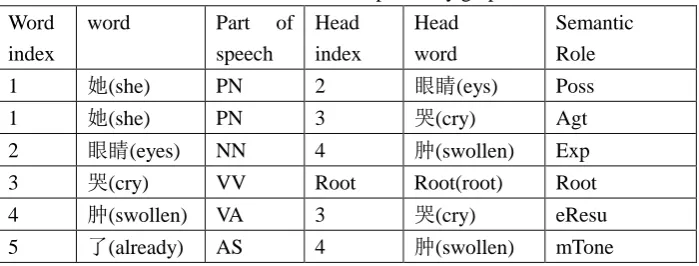
represented in the form of CoNLL data format
[16]
, which is shown in Table 1.
The meaning of the semantic tags in Table 1 are:Agt-agent , Poss-possessor , Exp-experiencer,Root-root(core word), eResu-result,mTone-tone mark.
Table 1. Table form of dependency graph
Word
index
word Part of
speech
Head
index
Head
word
Semantic
Role
1 她(she) PN 2 眼睛(eys) Poss
1 她(she) PN 3 哭(cry) Agt
2 眼睛(eyes) NN 4 肿(swollen) Exp
3 哭(cry) VV Root Root(root) Root
4 肿(swollen) VA 3 哭(cry) eResu
5 了(already) AS 4 肿(swollen) mTone
3.3 HowNet
HowNet, built by Dong, is a knowledge base of common sense, aiming at revealing the relationship between the concepts and between the attributes of concept.
The semantic knowledge dictionary is the basic file system of HowNet, and the concept and description of the word in this dictionary form a record. Each record consists of several items.Each item has two parts separated by "=". The left part of the "=" representsthe domain name of the data, the right is the value. Set the word "eye" as an example, the data recorded in HowNetis shown in Table 2.Each line in Table 2 represents a record item, the meanings of itemareas follows: word index(No.), word(W_C), part of speech and
pronunciation(G_C), English explanation(W_E), part of speech in English(G_E), concept(DEF). The first position of the concept of DEF is the main characteristic, specified in HowNet, which is the most distinguishing characteristic from other words and usually expressed by the sememe. We extracted this main characteristic as the foundation for classifying semantic category. As shown in Table 2, we defined the semantic category of “眼睛(eyes)” as “part(部
件)”.
(“NN”) in the instance collocation bank, generalizing the collocation into the form of
“VV + semantic category”, so as to establish the semantic collocation bank.
4
Construction of Collocation Bank
4.1 Framework of System
Table 2.An representation example of HowNet
NO.=131783
W_C=眼睛
G_C=N [yan3 jing1]
W_E=eye
G_E=N
DEF={part|部件:PartPosition={eye|眼},whole={AnimalHuman|动物}}
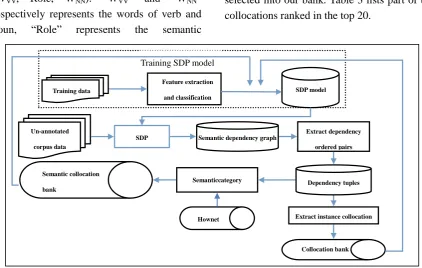
This paper takes the “VV+NN” as an example to build a collocation bank.There are two levels of bank; one is the instance collocation bank with collocation of “word + word”, which was extracted based on SDP, the other is semantic collocation bankwith collocation of “word + semantic category”, which is the result from generalization of the instance bank based on HowNet. The system framework is shown in Figure 3.The upper section of the framework is the training part of the SDP model.We used this model to do SDP to the original corpus and got the semantic dependency graph. Then we extracted the ordered pairs with semantic dependency relations as the candidate set of collocation; on the basis of the candidate set, we extract the collocation of “VV + NN”, and introduce HowNet to construct the semantic collocation bank. Finally, the results of these two types of collocation database can be fed back to train the SDP model, to improve the effectiveness of the semantic dependency parsing system.
4.2 Construction of Instance Collocation
Bank
4.2.1 Principles for Extracting the Semantic
tuplesThe structures of “NN + VV” and “VV +
NN”are different in traditional syntactic analysis. The former is a subject-predicate structure, while the latter is a verb-object structure. In semantic analysis, the parent node of the noun “NN”is verb“VV”insubject predicate structure and predicate object structure, and the direction of the dependency arcs is from verb to nouns, the dependency pairs are all “VV + NN” structure. For instance, “政 府(government)打 击(beat)盗 版(piracy)” and “盗版(piracy)被(been)政府(government)
打 击(beat)”, in these two sentences, the extracted dependency pairs (打击(beat),政府 (government),Agt) 和 ( 打 击 (beat), 盗 版 (piracy),Pat), are both in“VV + NN” structure. This paper mainly researches on the predicate-object structure, which can better reflect the collocation relationship between verbs and nounscompared with the subject-predicate.
According to the above analysis, we got rid of the ordered pairs which contains semantic subject roles, such as “Agt(agent), Poss(possessor), Aft(affection), Exp(experience), to obtain the candidateinstances of “VV+NN” collocations in the predicate object structure.
4.2.2 Steps for Extracting Collocation Instance
Step 1: According to the result of POS tagging and SDP, draw out thesets of tuple (WVV, Role, WNN). “WVV” and “WNN”
respectively represents the words of verb and noun, “Role” represents the semantic
relationship between these two dependency words.
Step 2: Get rid of the tuple of which the “Role” remarked with subject role such as “Agt, Poss, Aft, Exp”, to get tuple in the predicate object structure as candidate collocation. In the meantime, as collocation is not only to meet the requirements of the semantics, but also to achieve a certain frequency, we set a threshold value for the frequency of co-occurrence, the pair with co-occurrence frequency> 50 can be selected into our bank. Table 3 lists part of the collocations ranked in the top 20.
Fig. 3.system framework of collocation extraction
Table 3: part of the collocation ranked in the top 20
Verb Noun Semantic
role
Frequency of
co-occurrency
采取(take) 措施(measure) Cont 4669
解决(solve) 问题(problem) Pat 4473
出席(attend) 会议(meeting) Cont 3469
举行(hold) 会谈(interview) Cont 2921
充满(be filled with) 信心(confidence) Cont 2910
发挥(play) 作用(role) Cont 2251
交换(exchange) 意见(opinion) Cont 2075
拉开(pull) 帷幕(curtain) Cont 1886
处于(be) 状态(status) Loc 1662
赶到(arrive) 现场(spot) Dir 1537
Training SDP model
Training data
Un-annotated
corpus data
Semantic collocation
bank
Hownet
Collocation bank Feature extraction
and classification
SDP Extract dependency
ordered pairs SDP model
Semanticcategory
concluding
Extract instance collocation Semantic dependency graph
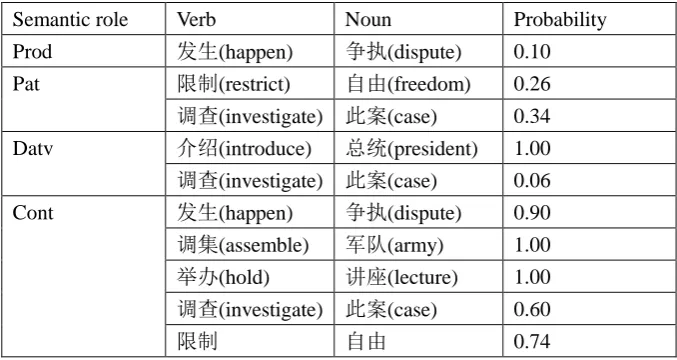
Step 3: the same combination can be labeled with different semantic role by automatic SDP, we adopted probability to distinguish same pairs with different semantic labels. As shown in Table 4, the frequency of “ 争 执 (dispute)”marked as “Cont” in “发生(happen) + 争执(dispute)” is 181, marked as “Prod” is 21.We calculated the probability on the basis of frequency, and formed thecollocation as the
structure of "WVV+ WNN+ semantic role +
probability".After the semantic role’s classification, the part of the "vocabulary + vocabulary" instance of collocation is shown in table 4.
In accordance with the above steps, this paper has a total of 67912 “VV+NN” structure as the collocation examples.
Table 4: instance bank of “word+word”
Semantic role Verb Noun Probability
Prod 发生(happen) 争执(dispute) 0.10
Pat 限制(restrict) 自由(freedom) 0.26
调查(investigate) 此案(case) 0.34
Datv 介绍(introduce) 总统(president) 1.00 调查(investigate) 此案(case) 0.06
Cont 发生(happen) 争执(dispute) 0.90
调集(assemble) 军队(army) 1.00 举办(hold) 讲座(lecture) 1.00 调查(investigate) 此案(case) 0.60
限制 自由 0.74
4.3 Construction of Semantic Collocation
Bank
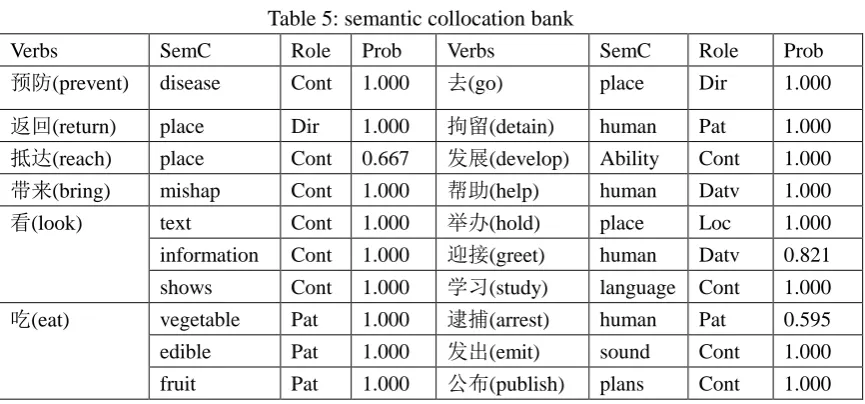
To make up the deficiency of data sparse of instance bank, we generalized “VV + NN” collocation in instance bankto construct “Word + semantic category”bank. This kind of semantic bank represents semantic relations between verb and semantic category. For example, “吃(eat)+食 物(edible)”, “食 物 (edible)” refers to semantic category, this semantic collocation labeled with “Pat”can cover all collocation consisting of all edible nouns and the verb“吃(eat)”. We need to applya semantic knowledge dictionary to determine whether a noun belongs to a certain semantic category. This paper introduced “HowNet”.The constructive algorithm of the semantic collocation bank is shown in Fig.3.
By algorithm 1, we generalized the semantic collocation from the candidate instance, and add the probability to each
semantic collocation in accordance with the method used in the extraction of instance collocation bank.The result is shown in Table 5. We totally extracted 1446“word + semantic category” collocation.
5
Conclusions
semantic structure. Therefore, the quality of the collocations is better than those extracted by the traditional way.
In the actual process, we find that not all nouns can be classified, for example, “吃(eat)
定心丸(assurance)”, this kind of collocation lacks similarity, main feature of “定 心 丸 (assurance)” in HowNet is “Text”. It is obvious that the nouns in “Text” category almost cannot
be matched with the verb “吃(eat)”. We put them into the instance collocation bank.
Two kinds of collocation bankhave been automatically established in this paper.The quality of the bank has not been evaluated. Besides, these two banks can be used to improve the accuracy of SDP,which will be our next work.
Fig. 3.algorithm 1
Table 5: semantic collocation bank
Verbs SemC Role Prob Verbs SemC Role Prob
预防(prevent) disease Cont 1.000 去(go) place Dir 1.000
返回(return) place Dir 1.000 拘留(detain) human Pat 1.000 抵达(reach) place Cont 0.667 发展(develop) Ability Cont 1.000 带来(bring) mishap Cont 1.000 帮助(help) human Datv 1.000
看(look) text Cont 1.000 举办(hold) place Loc 1.000
information Cont 1.000 迎接(greet) human Datv 0.821
shows Cont 1.000 学习(study) language Cont 1.000 吃(eat) vegetable Pat 1.000 逮捕(arrest) human Pat 0.595
edible Pat 1.000 发出(emit) sound Cont 1.000
fruit Pat 1.000 公布(publish) plans Cont 1.000
Acknowledgement
We appreciatively acknowledge the support of the National Natural Science Foundation of China (NSFC) via Grant 61170144, Major Program of China’s National Linguistics work
Committee during the twelfth five-year plan (ZDI125-41), important special fund of Beijing Language and Culture University (13ZDY03) and young and middle aged academic cadre support plan of Beijing Language and Culture University (501321303). algorithm 1:Constructing semantic bank
input 1:set of tuple with semantic relation,each of which represented as(WVV,WNN,Role,Freq),Role refers to the semantic labels of dependency pair (WVV,WNN),Freq refers to frequency of dependency
pair with semantic label “Role”. Input 2:Hownet(as shown in Table 2).
Output:semantic collocation bank. Every item is in represented by the form of (WVV,SemC,Role, Prob), SemC refers to semantic category of nouns,Role refers to semantic role.
Process:
For each tuple in tuple set, Do{ If WNNin the tuple is in the Hownet:
Add SemC represented by WNN to the Four-dimensional tuple(WVV,WNN,Role,Freq),extending the tuple into five-dimension(WVV,WNN,Role,Freq,SemC)
If Freq>= 4
References
[1] Ding Guodong, Baishuo, Wang Bin. Local Co-occurrence Based Query Expansion for
Information Retrieval. Journal of Chinese Information, 2006, 20(3): 84-91.
[2] Lin Jianfang. Research on Collocation
Extraction and Its Application in Information Retrieval. Harbin: Harbin Institute of Technology,
2010.
[3] Sun Haiyan. A Corpus-Based Study of
Semantic Characteristic of Adjective Collocations in CLEC. Modern Foreign Language, 2004 (4). [4] Xing Hongbin. Collocation Knowledge and
Second Language Lexical Acquisition. Applied Linguistics, 2013(4).
[5] Lin Xingguang. Research on Collocation. Chinese Teaching & Studies, 1994(4).
[6]Choueka, YandKlein, TandNeuwitz, E.
Automatic Retrieval of Frequent Idiomatic and Collocational Expressions in A Large Corpus.
Journal of Literary and Linguistic Computing, 1983,4.
[7]K.church, P.Hanks. Word Association
Norms.Mutual information and Lexicography. Computational Linguistics, 1990, 16 (1) : 22-29.
[8]Smadja,F. Retrieving Collocation from Text : Xtract. Computational Linguistic, 1993, 19(1) : 143-177.
[9]Lin D. Extracting Collocations from Text Corpora[C]. In First Workshop on Computational
Terminology, Montreal, Canada, 1998: 8-12.
[10]Yang S. Machine Learning for Collocation
Identification. In 2003 IEEE International Conference on Natural Language Processing and
Knowledge Engineering (NLP-KE 03). Beijing, 2003: 315-320.
[11] Sun Maosong. Preliminary study on
quantitative analysis of Chinese Collocation. Studies of The Chinese Language, 1997(1).
[12] Sun Honglin. Generalizing Grammar Rules from Annotated Corpus: analysis of “V + N”. The Forth China National Conference on
Computational Linguistics, 1997. Beijing: TsinghuaUniversity Press.
[13] Qu Weiguang, Chen Xiaohe, Ji Genlin. A Frame-based Approach to Chinese Collocation
Automatic Extracting. Computer Engineering, 2004.12.
[14] CheWanxiang, Liu Ting, Qin Bing. A
Method to Fetch Collocations Orienting Dependency Grammar. The sixth China National
Conference on Computational Linguistics, 2001. Beijing: TsinghuaUniversity Press.
[15] Zheng Lijuan, Shao Yanqiu, Yang Erhong.
Analysis of the Non-projective Phenomenon in Chinese Semantic Dependency Graph. Journal of
Chinese Information Processing, 2014.11. [16] Ding Yu, Shao Yanqiu, CheWanxiang, Liu Ting. Dependency Graph based Chinese