Compositionality of NN Compounds: A Case Study on
[N
1+Artifactual-Type Event Nouns]
Shan Wang1, 2 Chu-Ren Huang1 Hongzhi Xu1
1
Dept. of Chinese and Bilingual Studies, The Hong Kong Polytechnic University, Hung Hom, Kowloon, Hong Kong
2
Department of Computer Science, Volen Center for Complex Systems, Brandeis University
{wangshanstar, churenhuang, hongz.xu} @gmail.com
Abstract
Generative Lexicon theory (GL) establishes three mechanisms at work when a predicate selects an argument, i.e. pure selection, accommodation and type coercion. They are widely used in verbal selection of nouns in the entity domain. However, little attention has been devoted to the compositionality of [N1+event noun] type NN compounds. This
paper extends the usage of these mechanisms in two ways: 1) the eventive nominal head selection of a nominal modifier, and 2) their use in the eventive domain, through the case study on [N1+↨䋑bsài ‘competition’]. Moreover, it
reveals a new compositional mechanism sub-composition. It also discovers the domain contribution in type coercion. This work enriches the study on compositionality and GL.
1 Introduction
Event nouns in Mandarin Chinese have generated extensive interest (Han 2007, 2011; Liu 2004; Ma 1995; Wang & Huang 2011a, 2011b, 2012a, 2012c, 2012d). However, little research has concerned about the compositional mechanisms at work in [N1+event noun] type [N1N2]N compounds. Generative Lexicon theory (GL) provides a rich compositional representation through generative devices (Pustejovsky 1993, 2001, 2006, 2011; Pustejovsky & Jezek 2008). Under a tripartite system of the domain of individuals, including natural types, artifactual types and complex types (Pustejovsky 2001, 2006; Pustejovsky & Jezek 2008), GL establishes three mechanisms at work when a predicate selects an argument.
1) Pure Selection (Type Matching): the type a function requires is directly satised by the argument;
2) Accommodation: the type a function requires is inherited by the argument;
3) Type Coercion: the type a function requires is imposed on the argument type. This is accomplished by either:
(i) Exploitation: taking a part of the argument’s type to satisfy the function; (ii) Introduction: wrapping the argument with the type required by the function. Following Pustejovsky (2001, 2006) and Pustejovsky & Jezek (2008), Wang & Huang (2012e) establish a type system for event nouns, including natural types, artifactual types, natural complex types and artifactual complex types. The current paper only focuses on artifactual-type event nouns and explores the compositional mechanisms of nominal modification to these nouns in NN compounds. Furthermore, the domain information contribution to the reading of a NN compound is surveyed.
2 Data Collection
The data of this study are mostly extracted from Chinese Gigaword (second edition)1 and Sinica Corpus2 accessed through Chinese Word Sketch Engine3, with a few examples collected online through the search engines Google and Baidu.
1
http://www.ldc.upenn.edu/Catalog/catalogEntry.jsp?catalogId =LDC2009T14
2
http://db1x.sinica.edu.tw/kiwi/mkiwi/
3
3 Compositional Mechanisms of [N1 + Artifactual-Type Event Nouns]
The internal structure of NN compounds has been widely investigated (Jackendoff 1975; Laurie Bauer 2008; Packard 2004; Warren 1978). In recent years, some research uses GL to analyze the relation between N1 and N2 (Johnston & Busa 1996; Lee et al. 2010; Qi 2012). The research using the GL gives a compositional treatment to capture the N1 and N2 relations, but it only concerns the situation when N1 is a qualia role of N2. It does not explain cases when N2 is a qualia role of N1. Moreover, it does not give a generalization for the qualia modification relation. The following section analyses the compositional mechanisms of NN compounds. To make the discussion more concentrate, Section 3.2 and 3.3 use [N1+ֺ bsài ‘competition’] as a case study. To introduce a new way of compositionality, sub-composition, Section 3.4 uses a wider range of data.
3.1 Interpreting ֺbsài ‘competition’
A ֺbsài ‘competition’ is an activity in which one try to win against the opponents. Its semantic type system is depicted below.
ֺbsài ‘competition’
ARGSTR = D-ARG1 = x: individual D-ARG2 = y: individual D-ARG3 = z: organizer D-ARG4 = r: rule EVENTSTR = E1 = e1: process QUALIA = FORMAL = a: activity
CONSTITUTIVE = {x, y, z, r, c } TELIC = [e1 satisfies r (x ש y) win]
AGENTIVE = organize (z, a) A competition usually sets rules so that the participant who has the best performance will be the winner. Therefore, the purpose of ֺ bsài
‘competition’, which is the telic role, is to win with some rules satisfied during the competing process e1.
A competition could be either on the process of an event that participants involved in or the resultative product made during an event. In an [N1+ֺ bsài ‘competition’] compound, N1 specifies the subject of the competition. That is, it signifies the process on which people are judged or the product that people create in a competition. Wang & Huang (2012b) classify nouns into pure event nouns, nominals (event nominals and result nominals) and entity nouns. Following this classification, the following will examine which kinds of nouns fit the N1.
If the competition is about the process, then the competition is based on the behavior of participants during the event. Three kinds of N1 fit this case: 1) pure event nouns: ᧯ ᖙ tco
‘gymnastics’, ್ mshù ‘horsemanship’, ᠧݾ
zájì ‘acrobatics’, എᖙqunco ‘hoop gymnastics’; 2) event nominals: ᜰૹ jzhòng ‘weightlifting’,
ᆲ sàitng ‘boat racing’, ᡙ pnyán ‘rock climbing’; 3) entities: ᚊۣlóngzhu ‘dragon boat’,
ڡํfnchuán ‘yacht’4.
If the competition is about the final product, then the rule to decide the winners will be based on the quality of the product. Two kinds of N1 fit such as a case: 1) event nominals: ᥊ ᐙ shèyng
‘photography’; 2) entities: shhuà ‘painting and calligraphy’, ᑓhángmó ‘model airplane’. Summarizing, this section has illustrated the semantic type system of ֺbsài ‘competition’. A competition can be either on the process or result. If the competition is about the process, N1 can be a pure event noun, an event nominal or an entity. If the competition is about the result, N1 can be an event nominal or an entity (coerced to be an event). To achieve the goal of a competition (the telic role), usually to win, one should satisfy some rules.
4
ane
ᑓ ী
móxí ng
mod
el 111 22.48
agentive (zuò
‘make’) +telic Table 4: Examples of Type Coercion with Ordered
Events: Agentive > Telic
For example, in Table 4, 㟾 ↨ 䋑 hángmó bsài ‘model airplane competition’ first requires the creation of a model airplane (the agentive role), and then the function of different models (the telic role) is compared.
3.3.1.2 Type Coercion with one Individual Event
In ֽ堽ֺshujio bsài ‘dumpling competition’,
ֽ堽shujio ‘dumpling’ can be coerced to three events, eating, making, or tasting through the telic role, agentive role, and formal role respectively, as illustrated below.
ֽ堽shujio ‘dumpling’ EVENTSTR = E1= e1: process E2= e2: process
D-E3 = e3: state ARGSTR = ARG1= x: human ARG2= y: dumplings QUALIA= TELIC = eat (e2, x, y) AGENTIVE = make (e1, x, y) FORMAL = taste (e3, y)
ֽ堽ֺshujiobsài ‘dumpling competition’ has three readings through type coercion of dumplings’ different qualia roles: 1) through the telic role: x wins if x eats most dumplings; 2) through the agentive role: x wins if x makes most dumplings; 3) through the formal role: x wins if x’s dumplings tastes best. These readings indicate that the context for ֽ 堽 ֺ shujio bsài
‘dumpling competition’ is that if you meet some rules, then you win. This can be depicted below: Telic role forֽ堽ֺshujiobsài ‘dumpling competition’: R [] win
R: rules
For ֽ 堽 ֺ shujio bsài ‘dumpling competition’, [] is competing by eating or making or tasting. That is, ֽ堽shujio ‘dumpling’ can be coerced to any of the three events. Reading 1) and
2) have only one event involved respectively, while reading 3) comprises of an agentive event and the following formal role related event. 3.3.2 N1 as a Pure Event Noun
Similar to N1 as a entity in Section 3.3.1, when N1 is a pure event noun, coercion is still at work. That is because just like an entity, an artifactual event comes into being (the agentive role) for some purpose (the telic role). Different from the diversity of N1-as-an-entity coercion (including ordered events or an individual event), in [N1+ֺ
bsài ‘competition’], N1-as-a-pure event noun coercion normally only has one coerced event through the agentive role.
For example, in ᧯ ᖙ ֺ tco bsài
‘gymnastics competition’, the coerced event ‘perform gymnastics’ is through exploiting the agentive role of ᧯ᖙtco ‘gymnastics’. During a gymnastics competition, the existence of the gymnastics is the same as the process of the performance. Other examples of such N1 include
್mshù ‘horsemanship’, ᠧݾzájì ‘acrobatics’, and എᖙqunco ‘hoop gymnastics’.
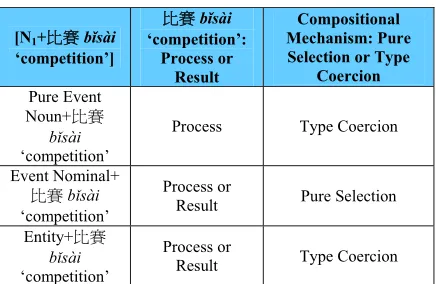
Summarizing, pure selection and type coercion have been used in verbal selection of nouns in the entity domain (Pustejovsky 1993, 2001, 2006, 2011; Pustejovsky & Jezek 2008). Section 3.2 and 3.3 have extended their usage in two ways: 1) nominal head selection of a nominal modifier, and 2) their use in the eventive domain, though a case study on [N1+ֺ bsài ‘competition’]. The results are shown in Table 5.
[N1+ֺbsài ‘competition’]
ֺbsài ‘competition’:
Process or Result
Compositional Mechanism: Pure Selection or Type
Coercion Pure Event
Noun+ֺ bsài
‘competition’
Process Type Coercion
Event Nominal+ ֺbsài
‘competition’
Process or
Result Pure Selection
Entity+ֺ bsài
‘competition’
Process or
Result Type Coercion
Table 5 shows that a competition can be either about the process or the result. For a process competition, N1 can be a pure event noun, an event nominal or an entity. For a result competition, N1 can be an event nominal or an entity. When N1 is an event nominal, pure selection is usually at work, while when N1 is a pure event noun or an entity, type coercion happens.
3.4 Sub-Composition
Pustejovsky (1995, 2012) introduces co-compostion. A typical example is bake the cake. The operation of co-composition results in a qualia structure for the VP that reflects aspects of both constituents. These include: 1) the governing verb
bake applies to its complement; 2) the complement co-specifies the verb; 3) the composition of qualia structures results in a derived sense of the verb, where the verbal and complement agentive roles match, and the complement formal quale becomes the formal role for the entire VP.
This section introduces a new way of compositionality, sub-composition, through exploring [N1+Artifactual-Type Event Noun]. There are two types of sub-composition: 1) N1 as an argument and N2 as a function, and 2) N1 as a function and N2 as an argument.
y = f (x)
A function f is a relationship which links a set of input and a set of potential output. The input x is called a variable or an argument, while the output y
is named as a dependent variable. The requirement of a function is that each variable should have and only have exactly one output.
We define the qualia role of a word as a function. Pustejovsky (1995) analyses how lexical items encode semantic information in the qualia structure. This structure has four roles, each with some values. 1) The constitutive role is about the relation between an object and its constituents or parts. Its role values include material, weight, parts and component elements. 2) The formal role can distinguish an object within a larger domain. Orientation, magnitude, shape, dimensionality,
color, and position are its role values. 3) The telic role is about the purpose and function of the object. 4) The agentive role describes factors involved in the origin of an object, such as creator, artifact, natural kind, and causal chain.
We treat the four qualia roles as the four functions of a word:
f 1 : FORMAL f 2 : CONSTITUTIVE f 3 : TELIC
f 4 : AGENTIVE
In some cases, there is a verb in the telic or agentive role. For example, the telic role of ᙇࢸ
xunbásài ‘selection contest’ is [TELIC=select(x)], where x is an argument that is selected. Therefore the function of ᙇ ࢸ xunbásài ‘selection contest’ is fi:[TELIC=select(x)]. For convenience, we will hide the predicate ‘select’ and use the qualia role to represent the function, i.e.
fi:TELIC(x).
In a sub-compositional NN compound, either N1 or N2 can be a function, remaining the other as an argument (variable). The following section examines both Argument-Function Type and Function-Argument Type [N1+Artifactual-Type Event Noun].
3.4.1 Argument-Function Type [N1+
Artifactual-Type Event Noun]
Qualia structure encodes the lexical information of a lexical item. When N1 has qualia modification to an NN, N1 is the argument and N2 is function. 1) fi, N2: FORMAL
N1N2 = N2[FORMAL (N1)]
ڤஜᚰtàishì quánjí ‘Thai-style boxing’ xy [boxing (x) ר Tai-style(y) ר a style of (y, x)]
ஜᚰquánjí ‘boxing’
QUALIA = FORMAL = style
2) fi, N2 : CONSTITUTIVE N1N2 = N2[CONSTITUTIVE (N1)]
ᠣ ᣂ ሏ ᚭ chunggun yóuxì
‘crashing-through-barrier game’
xy [game (x) ר crashing-through-barriers (y) ר subevent-of (y, x)]
ሏᚭyóuxì ‘game’
EVENTSTR= E1=e1:process={subevent1,subevent2, ……}
QUALIA = CONSTITUTIVE = e1
A ሏ ᚭ yóuxì ‘game’ is an activity that is composed of some subevents. In the above compound, the N1 ᠣ ᣂ chunggun ‘crashing through a barrier’ is a subevent of the N2 ሏᚭ
yóuxì ‘game’, so this compound can be represented as Competition [CONSTITUTIVE (Crashing-through-Barriers)].
3) fi, N2 : TELIC
N1N2 = N2 [TELIC (N1)]
ᐜ פ Ꮪ ڤ qìnggng yíshì ‘celebrating-victory
ceremony’
xy [ceremony (x) ר celebrating-a-victory (y) ר purpose-of (y, x)]
A ceremony is a formal event held with certain purpose. In the compound ᐜ פ Ꮪ ڤ qìnggng yíshì ‘celebrating-victory ceremony’, the N1 ᐜפ
qìnggng ‘celebrating a victory’ states the aim of the N2Ꮪڤyíshì ‘ceremony’, so N1 is the telic role of N2. This compound can be represented as Ceremony [TELIC (Celebrating-a-Victory)]. 4) fi, N2 : AGENTIVE
N1N2 = N2[AGENTIVE (N1)]
ᄐఐzhíyè bìng ‘occupational disease’
xy [disease (x) רoccupation (y) ר cause (y, x)] A disease is an illness caused by some reasons. In the compoundᄐఐzhíyè bìng ‘occupational disease’, the N1 ᄐ zhíyè ‘‘occupation’ is the cause of the N2ఐbìng ‘disease’, so N1 acts as the agentive role of N2. This compound can be represented as Disease [AGENTIVE (Occupation)]. 1)-4) illustrate four types of argument-function type N1N2, with N1 as an argument and N2 as a function. N1 is a qualia role of N2 and thus has qualia modification to N2.
3.4.2 Function-Argument Type [N1 +
Artifactual-Type Event Noun]
When N2 is a qualia role of N1, N1 is the function and N2 is the argument.
1) fi, N1: FORMAL
N1N2 = N1[FORMAL (N2)]
ீᐜ೯ xiàoqìng huódòng ‘school celebration activity’
xy[activity(x) ר school-celebration (y) ר a kind of (y, x)]
ீᐜxiàoqìng ‘school celebration’ QUALIA = FORMAL = activity
The N1ீᐜ xiàoqìng ‘school celebration’ is a kind of activity, so it has a formal role ‘activity’, which is the N2 ೯ huódòng ‘activity’. This compound can be represented as School-Celebration [FORMAL (Activity)].
2) fi, N1 : CONSTITUTIVE N1N2 = N1[CONSTITUTIVE (N2)]
ሎ೯ᄎၲኟڤ yùndònghuì kimùshì ‘sports meet
opening ceremony’
xy[opening ceremony (x) ר sports meet (y) ר part of (x, y)]
ሎ೯ᄎyùndònghuì ‘sports meet’
QUALIA= CONSTITUTIVE={opening ceremony, ……} ሎ೯ᄎ yùndònghuì ‘sports meet’ is an event that includes many subevents, such as the opening ceremony, competitions and the closing ceremony. Therefore, in the compound ሎ ೯ ᄎ ၲ ኟ ڤ
yùndònghuì kimùshì ‘sports meet opening ceremony’, the N2 ၲ ኟ ڤ kimùshì ‘opening ceremony’ is a constituent of the N1 ሎ ೯ ᄎ
yùndònghuì ‘sports meet’. This compound can be represented as Sports-Meet [CONSTITUTIVE (Opening-Ceremony)].
3) fi, N2 : TELIC
N1N2 = N1[TELIC (N2)]
־߫ሎᙁhuch yùnsh ‘train transportation’ xy[transportation (x) ר train (y) ר purpose-of (x, y)]
־߫huch ‘train’
־߫ huch ‘train’ is a vehicle that is usually used for transportation, carrying people and goods from one place to another. Thus, in the compound
־߫ሎᙁhuch yùnsh ‘train transportation’, the N2ሎᙁyùnsh ‘transportation’ is the telic role of the N1־߫huch ‘train’. This compound can be represented as Train [TELIC (Transportation)]. 4) fi, N2 : AGENTIVE
N1N2 = N1[AGENTIVE (N2)]
ሽᐙࣁ᥊diànyng pishè ‘movie shooting’ xy[shooting (x) ר movie (y) ר produce (x, y)]
ሽᐙdiànyng ‘movie’
ARGSTR = D-ARG1 = z: human QUALIA = FORMAL = r: event·physobj AGENTIVE = shoot (z, r)
ሽ ᐙ diànyng ‘movie’ is produced by the shooting action. Hence in the compoundሽᐙࣁ᥊
diànyng pishè ‘movie shooting’, the N2 ࣁ ᥊
pishè ‘shooting’ is the agentive role of the N1ሽ
ᐙ diànyng ‘movie’. This compound can be represented as Movie [AGENTIVE (Shooting)]. It is common that NN compounds are ambiguous. For example, ־ ߫ ሎ ᙁ huch yùnsh ‘train transportation’ may have these readings: 1) trains are used for transportation; and 2) trains are a means of transportation.
Section 3.4.2 of this paper has dealt with the reading 1), treating it as a Function-Argument relation. The semantic representation is Train [TELIC (Transportation)]. For reading 2), the N1
־߫huch ‘train’ is taken as the formal role of N2 ሎᙁ yùnsh ‘transportation’. Thus this is an Argument-Function relation, and this compound can be represented as Transportation [FORMAL (Train)].
In sum, this section has introduced a new mechanism of compositionality sub-composition. The structure N1N2 has two ways of sub-composition: 1) argument-function, when N1 has qualia modification to N2; and 2) function-argument, when N2 is a qualia role of N1. Because NN compounds are often ambiguous, they can
have various relations according to different readings.
4 Domain Relevance of Type Coercion
Wang & Huang (2011a) has established the relation between type coercion and domain information. They reveal that type coercion can be dependent on a specific domain, because 1) intuitively, each domain often establishes a different type of event convention and NN compounds are always domain specific terms; 2) domain information can help to predict coercion types. Following this analysis, we argue that the coerced event is also domain relevant for eventive NN. We further observe that some domains have well-known conventional events, while some others do not. The former leads to a most probable and default reading, while the latter results in ambiguity. This point can be explained by the examples ߩ ֺ zúqiú bsài ‘football competition’ and ྏႽֺ tngyuán bsài ‘rice ball competition’.
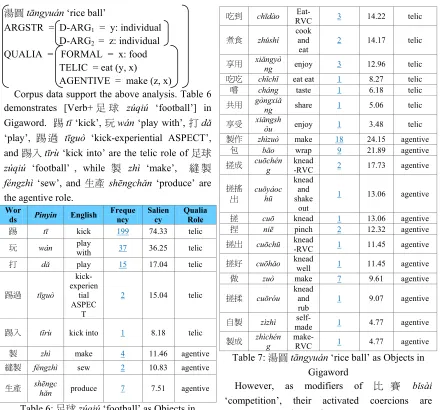
Through qualia exploitation, both ߩ zúqiú
‘football’5 and ྏႽtngyuán ‘rice ball’ have the events demonstrated by the telic and agentive role.
ߩ zúqiú ‘football’ has the playing event and producing event, while ྏႽ tngyuán ‘rice ball’ has the eating event and making event as illustrated below.
ߩzúqiú ‘football’
ARGSTR = D- ARG1 = y: manufacturer D-ARG2 = z: human QUALIA = FORMAL = x: ball
TELIC = play (z, x)
AGENTIVE = produce (y, x)
5 In Mandarin Chinese,
Event tal Hi
ts Hit
s Freq uenc y
H i t s
Freq uenc y
ߩֺzúqiú bsài
‘football competition’ 443
2 100.0
0% 0 0.00
% 44 32 ྏႽֺtngyuán
bsài ‘rice ball competition’
2 28.57
% 5
71.43
% 7
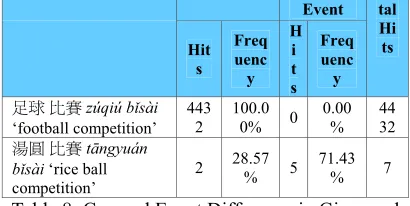
Table 8: Coerced Event Difference in Gigaword In Table 8, ߩ ֺ zúqiú bsài ‘football competition’ has 4432 occurrences, with all of them indicating telic events and none as agentive events. ྏ Ⴝ ֺ tngyuán bsài ‘rice ball competition’ has seven hits in total, with two as telic events and five as agentive events, so this compound do not show strong tendency towards any of the two events.
5 Conclusions and Future Work
This paper discovers that [N1+Artifactual-Type Event Noun] type compounds usually get a syntagmatic relation through three mechanisms: pure selection, type coercion and sub-composition. In GL, pure selection and type coercion have been used when a predicate selects an argument (Pustejovsky 1993, 2001, 2006, 2011; Pustejovsky & Jezek 2008). This paper extends their usage in two directions: 1) nominal head selection of a nominal modifier, and 2) their usage in the nominal event domain, though the case study on [N1+ֺbsài ‘competition’].
Moreover, this paper proposes a new compositional mechanism sub-composition. It is a relation between a function and an argument. The four qualia roles are treated as four functions. Two kinds of [N1+ artifactual-type event noun] type [N1N2] compounds are composed through
sub-composition: 1) N1 as an argument and N2 as a function, and 2) N1 as a function and N2 as an argument. In type 1), N1 is a qualia role of N2, and thus N1 has enriched the function behavior; in type 2), N2 is a qualia role of N1, and thus N2 has enriched the function behavior. Because a NN compound is often ambiguous, it may have several
kinds of relations. The theorem for sub-composition can be generalized as follows.
In order for and to combine as [], you need to extract some sub-elements from or depending on which is the function. If [] is an argument-function relation, then [] = [fi ()]. If [] is a function-argument relation, then [] = [fi ()].
Following Wang & Huang (2011a), this paper further demonstrates that some domains have strong conventional events, while some others do not. The former gives a default reading, while the latter brings about ambiguity.
This research has not only enriches the study on compositionality and GL, but also reveals the domain information contribution in type coercion. In future work, we would extend the compositional mechanisms discussed here in two directions: 1) their usage to other types of event nouns, i.e., natural types, natural complex types and artifactual complex types, and 2) their usage to other constructions, such as ‘adjective + noun’.
Acknowledgements
We are very grateful to Prof. James Pustejovsky for sharing his ideas during the discussions on this project. The remaining errors are ours. This research is funded by The Student Attachment Program of The Hong Kong Polytechnic University.
References
Han, Lei. 2007. The Selection of Event Nouns and Classifiers——A Case Study of y. Journal of East China Normal University (Philosophy and Social Sciences), 39 (3). P64-68.
Han, Lei. 2011. Classification and Categorization of
Event Nouns. Paper presented at The 6th
International Conference on Contemporary Chinese Grammar (ICCCG-6), I-Shou University, Kaohsiung, Taiwan.
Jackendoff, Ray. 1975. Morphological and Semantic Regularities in the Lexicon. Language, 51 (3). P639-671.
Compounds. Proceedings of the ACL SIGLEX workshop on breadth and depth of semantic lexicons, P77-88. Santa Cruz, California.
Laurie Bauer. 2008. When is a Sequence of Two Nouns
a Compound in English?
English Language and Linguistics 2 (1). P65-86. Lee, Chih-yao, Chia-hao Chang, Wei-chieh Hsu &
Shu-kai Hsieh. 2010. Qualia Modification in Noun-Noun Compounds: A Cross-Language Survey. Proceedings of the 22nd Conference on Computational Linguistics and Speech Processing (ROCLING-2010), P379-390. National Chi Nan University, Puli, Nantou, Taiwan. Liu, Shun. 2004. A Study of Temporality of Common
Nouns. Language Teaching and Linguistic Studies
(4).P25-35.
Ma, Qingzhu. 1995. Verbs with denotational Meaning and Nouns with Statement Meaning. Research and Exploration of the Grammar. Beijing: The Commercial Press.
Packard, Jerome L. 2004. The Morphology of Chinese: A Linguistic and Cognitive Approach. Cambridge: Cambridge University Press.
Pustejovsky, James. 1993. Type Coercion and Lexical Selection. Semantics and the Lexicon, ed. by James Pustejovsky, P73-94. Dordrecht, The Netherlands: Kluwer Academic Publishers.
Pustejovsky, James. 1995. The Generative Lexicon. Cambridge, MA: MIT Press.
Pustejovsky, James. 2000. Events and the semantics of opposition. Events as grammatical objects: the converging perspectives of lexical semantics and syntax, ed. by Carol Tenny & James Pustejovsky, P445-482. Stanford: CSLI Publications.
Pustejovsky, James. 2001. Type Construction and the Logic of Concepts. The Language of Word Meaning, ed. by Pierrette Bouillon & Federica Busa, P91-123: Cambridge University Press.
Pustejovsky, James. 2006. Type Theory and Lexical Decomposition. Journal of Cognitive Science 7 (1). P39-76.
Pustejovsky, James. 2011. Coercion in a General Theory of Argument Selection. Linguistics 49 (6). P1401–1431
Pustejovsky, James. 2012. Co-compositionality in Grammar. The Oxford Handbook of Compositionality, ed. by Markus Werning, Wolfram Hinzen & Edouard Machery, P371-382. New York: Oxford University Press.
Pustejovsky, James & Elisabetta Jezek. 2008. Semantic Coercion in Language: Beyond Distributional Analysis. Distributional Models of the Lexicon in
Linguistics and Cognitive Science, special issue of Italian Journal of Linguistics/Rivista di Linguistica. Qi, Chong. 2012. The Semantic Relations of Internal
Construction in NN Modifier-Head Compounds. The 13th Chinese Lexical Semantics Workshop (CLSW-13), ed. by Yanxiang He & Donghong Ji, P211-215. Wuhan University, China.
Wang, Shan & Chu-Ren Huang. 2011a. Domain Relevance of Event Coercion in Compound Nouns.
Paper presented at The 6th International Conference on Contemporary Chinese Grammar (ICCCG-6), I-Shou University, Kaohsiung, Taiwan.
Wang, Shan & Chu-Ren Huang. 2011b. Event Classifiers and Their Selected Nouns. Paper presented at The 19th Annual Conference of the International Association of Chinese Linguistics (IACL-19), Nankai University, Tianjin, China.
Wang, Shan & Chu-Ren Huang. 2012a. A Constraint-based Linguistic Model for Event Nouns. Paper presented at Forum on ‘Y. R. Chao and Linguistics’, Workshop of The 20th Annual Conference of the International Association of Chinese Linguistics (IACL-20), The Hong Kong Institute of Education, Hong Kong.
Wang, Shan & Chu-Ren Huang. 2012b. A Preliminary Study of An Event-based Noun Classification System. The 13th Chinese Lexical Semantics Workshop (CLSW-13), ed. by Yanxiang He & Donghong Ji, P4-9. Wuhan University, China.
Wang, Shan & Chu-Ren Huang. 2012c. Qualia Structure of Event Nouns in Mandarin Chinese. Paper presented at The Second International Symposium on Chinese Language and Discourse Nanyang Technological University, Singapore.
Wang, Shan & Chu-Ren Huang. 2012d. Temporal Properties of Event Nouns in Mandarin Chinese.
Paper presented at The 57th Annual International Linguistic Association Conference (ILA-57) New York, USA
Wang, Shan & Chu-Ren Huang. 2012e. Type Construction of Event Nouns in Mandarin Chinese.
Paper presented at The First Workshop on Generative Lexicon for Asian Languages (GLAL-1), Workshop of The 26th Pacific Asia Conference on Language, Information and Computation (PACLIC-26), Bali, Indonesia.
Warren, Beatrice. 1978. Semantic Patterns of Noun-Noun Compounds. Göteborg: Acta Universitatis Göthoburgensis.