CSEIT1831109 | Received : 10 Jan 2018 | Accepted : 25 Jan 2018 | January-February-2018 [(3) 1 : 453-458 ]
International Journal of Scientific Research in Computer Science, Engineering and Information Technology © 2018 IJSRCSEIT | Volume 3 | Issue 1 | ISSN : 2456-3307
453
Ensuring an Efficient and Reliable Quality of Service for
Customer Satisfaction in Cloud Computing
Adabala Kotesh1, Mohammed Alisha2, Dr. D. Mohan Reddy3
1PG Scholar, Department of Computer Science and Engineering, Amalapuram Institute of Management Sciences and College of Engineering, Mummidivaram, East Godavari District, Andhra Pradesh, India
2Associate Professor & Head of the Department, Computer Science and Engineering, Amalapuram Institute of
Management Sciences and College of Engineering, Mummidivaram, East Godavari District, Andhra Pradesh, India
3Professor & Principal, Amalapuram Institute of Management Sciences and College of Engineering,
Mummidivaram, East Godavari District, Andhra Pradesh, India
ABSTRACT
As a feasible and profitable way to deal with give registering resources and services to customers on intrigue, cloud computing has ended up being better known. From cloud authority organization's perspective, benefit is a champion among the most fundamental considerations, and it is transcendently directed by the outline of a cloud organization arrange under given business segment ask. In any case, a solitary whole deal leasing plan is ordinarily gotten to outline a cloud organize, which can't guarantee the organization quality however prompts bona fide resource squander. In this paper, a twofold resource leasing plan is laid out right off the bat in which brief leasing and whole deal leasing are joined going for the present issues. This twofold leasing arrangement can reasonably guarantee the idea of organization of all requesting what's more, reduce the advantage misuse massively. Additionally, an organization structure is considered as a M/M/m+D queuing model and the execution pointers that impact the benefit of our twofold leasing arrangement are analyzed, e.g., the typical charge, the extent of requesting that need improvised servers, and so forth. Thirdly, a benefit enhancement issue is anticipated the twofold leasing arrangement and the streamlined course of action of a cloud organize is gotten by dealing with the benefit support issue. Finally, a movement of algorithms coordinated to break down the benefit of our proposed design with that of the single leasing plan. The results exhibit that our arrangement can't simply guarantee the organization idea of all sales, furthermore get more benefit than the last.
Keywords : Cloud Computing, Profit Maximization, Guaranteed Service Quality, Queuing Model, Service-Level Agreement, Waiting Time.
I.
INTRODUCTION
As a convincing and capable way to deal with consolidate handling resources and preparing administrations, cloud computing has ended up being more predominant. Cloud computing unites organization of assets and administrations, besides, passes on encouraged administrations over the
structure provider keeps up the fundamental hardware and programming workplaces. An authority co-op rents assets from the system providers and offers administrations to customers. A customer displays its sales to an authority co-op and pays for it considering the aggregate and the idea of the gave benefit. In this paper, we go for looking at the multiserver course of action of an authority co-op with the end goal that its benefit is boosted.
Like all business, the benefit of an authority co-op in cloud figuring is related to two segments, which are the cost and the income. For an authority co-op, the cost is the renting cost paid to the framework suppliers notwithstanding the power incurred significant injury expedited by imperativeness usage, and the wage is the administration charge to customers. At the point when all is said in done, an authority co-op rents a particular number of servers from the foundation supplier and develops unmistakable multiserver structures for different application spaces. Each multiserver structure is to execute an exceptional sort of administration sales and applications. In this way, the renting cost is in respect to the amount of servers in a multi server system. The power usage of a multiserver system is straightly relating to the quantity of servers and the server utilize, and to the square of execution speed. The pay of an authority co-op is related to the measure of administration and the idea of administration. To gather, the benefit of an authority organization is generally managed by the outline of its administration stage.
II.
Literature Survey
Cloud computing and Emerging IT Platforms this paper, author describe Cloud processing and give the auxiliary wanting to making Clouds with business division orchestrated asset portion by using progressions, for instance, Virtual Machines (VMs). Authors furthermore give bits of learning on showcase based asset organization frameworks that join both customer driven administration and
computational hazard organization to oversee Service Level Agreement (SLA) - orchestrated asset appropriation. Furthermore, authors reveal our underlying insights on interconnecting Clouds for continuously making overall Cloud exchanges and markets. By then, we show some illustrative Cloud
stages, especially those made in business
Spillage Aware Multiprocessor Scheduling this paper, spillage mindful arranging heuristics are presented that chooses the best tradeoff between these three strategies: DVS, processor shutdown, and finding the perfect number of processors. Exploratory outcomes got using an open benchmark set of task graphs and bona fide parallel applications exhibit that our strategy reduces the total essentialness use by up to 46% for tight due dates and by up to 73% for nothing due dates pondered to an approach that just uses DVS. Writer moreover consider the imperativeness ate up by our booking computations to two preeminent lower limits, one for the circumstance where all processors incessantly continue running at a similar repeat, and one for the circumstance where the processors can continue running at various frequencies and these frequencies may change after
some time. The results exhibit that the
imperativeness diminishes achieved by our best approach is close to these speculative points of confinement. Benefit drive plan for cloud administrations with information get to mindfulness this paper, authors address the bargain of these planning in order to conflict targets benefit requests with the component generation of administration cases. Specifically, writer booking computations try to extend advantage inside the pleasing level of administration quality showed by the administration purchaser. Writers responsibilities consolidate (1) the change of an assessing model using processor-sharing for cloud, (2) the utilization of this evaluating model to composite administrations with dependence thought, (3) the headway of two game plans of administration sales booking counts, and (4) the progression of a prioritization course of action for information benefit intending to open up the advantage of information benefit. Vitality and Performance Management of Green Data Centers this paper, author attempt to deal with this insufficiency by proposing an exact method to manage enhance green server ranch's advantage, i.e., wage short cost. In such way, authors unequivocally consider sensible administration level assertion (SLAs) that starting at now exist between data
centers and their customers. This model also combines distinctive components, for instance, availability of neighborhood inexhaustible power period at server ranches and the stochastic method for server homesteads' workload. In addition, authors propose a novel headway based advantage development methodology for server ranches for two assorted cases, without and with behind-the-meter inexhaustible generators. Authors exhibit that the figured headway issues in the two cases are angled tasks; in this way, they are tractable and fitting for sensible execution. Using distinctive test data what's more, by methods for PC propagations, writers assess the execution of the proposed progression based advantage development strategy and show that it on a very basic level outmaneuvers two basically indistinguishable imperativeness and execution organization figuring’s that are starting late proposed in the written work.
III.
Proposed System
In this paper, a twofold asset leasing plan is outlined right off the bat in which here and now leasing and long haul leasing are joined going for the present issues. This twofold leasing arrangement can feasibly guarantee the idea of organization of all requesting what's more, reduce the asset misuse tremendously. Additionally, an administration structure is considered as a M/M/m+D queuing model and the execution pointers that impact the benefit of our twofold leasing arrangement are dismembered, e.g., the typical charge, the extent of requesting that need alternative servers, and so forth.
IV.
Implementation Modules
A. Queuing model: We consider the cloud benefit stage as a multi-server framework with an administration asks for line. The mists give assets to employments as virtual machine (VM). Likewise, the clients present their business to the cloud in which a vocation queuing framework, for example, SGE, PBS, or Condor is utilized. All employments are booked by the activity scheduler and allotted to various VMs centralized. Consequently, we can consider it as an administration asks for line. For instance, Condor is a particular workload administration framework for register escalated occupations and it gives an
occupation queuing instrument, planning
arrangement, need conspire, asset observing, and asset administration. Clients present their business to Condor, and Condor places them into a line, picks when and where to run they in light of an approach. An M/M/m+D queuing model is work for our multi-server framework with differing framework measure. And afterward, an ideal design issue of benefit boost is planned in which many elements are taken into contemplations, for example, the market request, the
workload of solicitations, the server-level
understanding, the rental cost of servers, the cost of vitality utilization, et cetera. The ideal arrangements are unraveled for two unique circumstances, which are the perfect ideal arrangements and the genuine ideal arrangements.
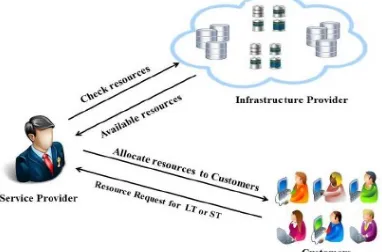
B. Business Service Providers Module: Service suppliers pay framework suppliers for leasing their physical assets, and charge clients for preparing their administration demands, which produces cost and income, individually. The benefit is produced from the hole between the income and the cost. In this module the authority co-ops considered as cloud merchants since they can assume a critical part in the middle of cloud clients and framework suppliers, and he can set up a backhanded association between cloud client and foundation suppliers.
C. Cloud Customers: A client presents an administration demand to an authority co-op which conveys benefits on request. The client gets the
coveted outcome from the authority co-op with certain administration level assertion, and pays for the administration in view of the measure of the administration and the administration quality. D. Framework Service Provider Module: In the three-level structure, a foundation supplier the essential equipment and programming offices. An authority co-op rents assets from foundation suppliers and prepares set of administrations as virtual machine (VM). Framework suppliers give two sorts of asset leasing plans, e.g., long haul leasing and here and now leasing. By and large, the rental cost of long haul leasing is substantially less expensive than that of here and now leasing.
V.
Conclusion
VI.
REFERENCES
[1]. U. Lehtinen and J. R. Lehtinen, Service quality: a study Of quality dimensions. Service Management Institute, 1982.
[2]. C. Gronroos, "A service quality model and its marketing implications," European Journal of marketing, vol. 18, no. 4, pp. 36-44, 1984. [3]. N. Kano, N. Seraku, F. Takahashi, and S. I.
Tsuji, "Attractive quality and must-be quality," Journal of the Japanese Society for Quality Control, vol. 14, no. 2, pp. 39 - 48, April 1984. [4]. X. Chang, B. Wang, J. Muppala, and J. Liu,
"Modeling active virtual machines on iaas clouds using an m/g/m/m+k queue," IEEE Transactions on Services Computing, pp. 408 - 420, 2014.
[5]. A. P. Chandrakasan, S. Sheng, and R. W. Brodersen, "Low-power cmos digital design," IEICE Transactions on Electronics, vol. 75, no. 4, pp. 371-382, 1992.
[6]. S. Skiena and S. Skiena, The Algorithm Design Manual (2. ed.). Springer, 2008.
[7]. E. Sauerwein, F. Bailom, K. Matzler, and H. H. Hinterhuber, "The kano model: How to delight your customers," IX International Working Seminar on Production Economics, vol. 5, no. 1, pp. 6 - 18, 1996.
[8]. S. Marston, Z. Li, S. Bandyopadhyay, J. Zhang, and A. Ghalsasi, "Cloud computing the business perspective," Decision Support Systems, vol. 51, no. 1, pp. 176-189, 2011.
[9]. B. S. Skeina, "The algorithm design manual," no. 3, pp. 351-358, 2013.
[10]. K. Hwang, J. Dongarra, and G. C. Fox, Cloud
andCloud Computing. Elsevier/Morgan
Kaufmann, 2012.
[11]. J. Cao, K. Hwang, K. Li, and A. Y. Zomaya, "Optimalmultiserver configuration for profit maximization in cloudcomputing," IEEE Trans. Parallel Distrib. Syst., vol. 24, no. 6,pp. 1087-1096, 2013.
[12]. A. Fox, R. Griffith, A. Joseph, R. Katz, A. Konwinski,G. Lee, D. Patterson, A. Rabkin, and
I. Stoica, "Above the clouds: A Berkeley view of cloud computing," Dept.lectrical Eng. and Comput. Sciences, vol. 28, 2009.
[13]. R. Buyya, C. S. Yeo, S. Venugopal, J. Broberg, andI. Brandic, "Cloud computing and emerging it platforms:Vision, hype, and reality for delivering computing as the5th utility," Future Gener. Comp. Sy., vol. 25, no. 6, pp. 599-616, 2009.
[14]. P. Mell and T. Grance, "The NIST definition of cloud computing. National institute of standards and technology, "Information Technology Laboratory, vol. 15, p. 2009, 2009. [15]. J. Chen, C. Wang, B. B. Zhou, L. Sun, Y. C. Lee,
andA. Y. Zomaya, "Tradeoffs between profit
and customer satisfaction for service
provisioning in the cloud," in Proc.20th Int’l
Symp. High Performance Cloud
Computing.ACM, 2011, pp. 229-238.
[16]. P. de Langen and B. Juurlink, "Leakage-aware multiprocessor scheduling," J. Signal Process.Sys., vol. 57, no. 1, pp.73-88, 2009.
ABOUT AUTHORS:
ADABALA KOTESH is
currently pursuing his M.Tech
Computer Science &
Engineering at Amalapuram
Institute of Management
Sciences and College of
Department of Computer Science and Engineering at Amalapuram Institute of Management Sciences and College of Engineering,
Mummidivaram. He is a Post
Dr. D. MOHAN REDDY received the B.Tech. Degree
from Jawaharlal Nehru
Technological University,
Hyderabad, India and he
received the M.E from Anna University, Chennai and Ph.D
from Sri Venkateswara