CSEIT1831262 | Received : 02 Feb 2018 | Accepted : 13 Feb 2018 | January-February-2018 [(3) 1 : 1141-1146 ]
International Journal of Scientific Research in Computer Science, Engineering and Information Technology © 2018 IJSRCSEIT | Volume 3 | Issue 1 | ISSN : 2456-3307
1141
To Assess the Performance of EAHC Algorithm Using Sensor
Discrimination Dataset for the Improvement of Data Mining
System
K. Thulasiram1, Dr. S. Ramakrishna2, Dr. M. Jayakameswaraiah3
1Research Scholar Department of Computer Science, Sri Venkateswara University, Tirupati, Andhra Pradesh,
India
2Professor, Department of Computer Science, Sri Venkateswara University, Tirupati, Andhra Pradesh, India
3Assistant Professor, School of Computer Science and Applications, Reva University, Bangalore, Karnataka,
India
ABSTRACT
The process of grouping a set of physical or intangible objects into classes of similar objects is called clustering. A cluster is a group of data objects that are related to one another within the similar cluster and are dissimilar to the objects in other clusters. It is suitable method for the innovation of data distribution and patterns the fundamental data. There are various clustering methods in data mining system, such as hierarchical clustering method. Most of the approaches to the clustering of variables encountered in the literature are of hierarchical category. This research work represents comprehensive discussion on the performance of our proposed Enhanced Agglomerative Hierarchical Clustering algorithm. This experiential evaluation shows that Enhanced Agglomerative Hierarchical Clustering (EAHC) algorithm contributes decent performance and decreases the runtime of construction by several orders of size, while generating stable and quality hierarchies.
Keywords : Clustering algorithms, Data Mining, Hierarchical Clustering and Enhanced Agglomerative Hierarchical Clustering (EAHC) algorithm
I.
INTRODUCTION
A. Data Mining
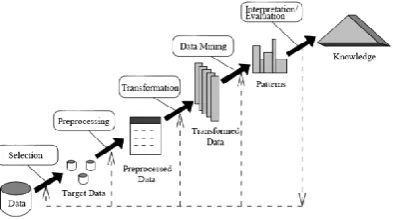
Data mining comprises the usage of sophisticated data analysis tools to ascertain previously unknown valid patterns and relationships in large dataset. Data mining tools forecast imminent trends and behaviors, helps organizations to take preemptive knowledge driven decision. The queries that were usually tedious to settle can be settled by data mining tools. Data mining is also known as knowledge discovery in Database (KDD) and is the nontrivial extraction of hidden previously unknown and potentially suitable information from data in databases. However, databases are commonly treated data mining and
Figure 1. Knowledge Discovery Process
B. Clustering
Clustering is an essential data mining task. It can be defined as the process of organizing objects into groups whose members are similar in some way. Clustering can also be define as the process of grouping the data into classes or clusters, so that Hierarchical objects within a cluster have high similarity in association to one another but are very dissimilar to objects in other clusters[3,12]. Generally clustering can be done by two methods: Hierarchical and Partitioning method. In data mining hierarchical clustering works by grouping data objects into a tree of cluster. Hierarchical clustering methods can be further categorized into agglomerative and divisive hierarchical clustering. Hierarchical methods suffer from the fact that once we have accomplished either merge or split step, it can never be undone. This inflexibility is useful in that it leads to smaller computation costs by not having to worry about a combinatorial number of dissimilar selections[2,8]. However, such methods cannot correct incorrect decisions that once have taken. There are two methodologies that can help in improving the feature of hierarchical clustering:
1. Initially to accomplish careful analysis of object associations at every hierarchical partitioning or 2. By integrating hierarchical agglomeration and
further methods by first using a hierarchical agglomerative algorithm to group objects into micro clusters[6,9]. Then implement macro clustering on the micro clusters using alternative clustering method such as iterative relocation.
II.
LITERATURE REVIEW ON HIERARCHICAL
CLUSTERING
Hierarchical clustering is a technique of cluster analysis which seeks to construct a hierarchy of clusters. The worth of a pure hierarchical clustering technique suffers from its incompetence to achieve adjustment, once a merge or split decision has been executed. Then it resolves neither undo what was prepared previously, nor perform object swapping between clusters. Thus merge or split decision, if not well selected at some step, may lead to somewhat low-quality clusters. One favorable direction for refining the clustering quality of hierarchical methods is to integrate hierarchical clustering with new methods for multiple phase clustering. So in this research, we designate a rare improved hierarchical clustering algorithm that overcomes the boundaries that occur in pure hierarchical clustering algorithms. Hierarchical clustering algorithms are either top-down or bottom-up. Bottom-up algorithms requisite every file as a singleton cluster at the outset and then sequentially combine (or agglomerate) pairs of clusters until all clusters have been merged into a single cluster that contains all files. Bottom-up hierarchical clustering is therefore called hierarchical agglomerative clustering or HAC. Top-down clustering needs a process for splitting a cluster[5,7,10]. It proceeds by splitting clusters recursively until distinct archives are reached.
A. Hierarchical clustering
of C[j][i] and C[j][m]. We will now refine this algorithm for the different similarity measures of single-link and complete-link clustering and group average and centroid clustering. The merge criteria of these four variants of Hierarchical Clustering are presented.
Algorithm: HC(d1, . . . , dN)
Step-1: for n ← 1 to N Step-2: do for i ← 1 to N Step-3: do C[n][i] ← SIM(dn, di)
Step-4: I[n] ← 1 (keeps track of active clusters) Step-5: A ← [ ] (assembles clustering as a sequence of merges)
Step-6: for k ← 1 to N – 1
Step-7: do (i, m) ← arg max{i,m:I ≠ m∧I[i]=1∧I[m]=1} C[i][m]
Step-8: A.APPEND (i, m) (store merge) Step-9: for j ← 1 to N
Step-10: do C[i][j] ← SIM(i, m, j) Step-11: C[j][i] ← SIM(i, m, j)
Step-12: I[m] ← 0 (deactivate cluster) Step-13: return A
III.
ENHANCED AGGLOMERATIVE
HIERARCHICAL CLUSTERING ALGORITHM
A. Cluster Divergence
In order to choose which clusters should be combined (for agglomerative), or where a cluster should be split (for divisive), a measure of dissimilarity between sets of clarifications are required. In furthermost methods of hierarchical clustering, this is achieved by use of an appropriate metric (a measure of distance between pairs of clarifications), and a linkage criterion which identifies the dissimilarity of sets as a function of the pairwise distances of observations in the sets. Here we applied a metric function to integrate the performance of the proposed algorithm using squared Euclidean distance formula[13,14]. The Enhanced Agglomerative Hierarchical Clustering comprises of the following three parameters need to be considered.
1. Single Linkage 2. Complete Linkage 3. Group Average
Algorithm
Step-1: Scan the Entire Database
Step-2: Collects the reduced data set by using agglomerative technique.
Step-3: Partition the reduced dataset. Step-4: Eliminate Outliers.
Step-5: Cluster Labeled data as Partial Cluster using Squared Euclidean distance equation.
∑
Setp-6: Initially each item x1, . . . , xn is in its own cluster C1, . . . , Cn.
Step-7: Repeat until there is only one cluster left: Step-8: Merge the nearest clusters, say Ciand Cj. The
result is a cluster. One can cut the tree at any level to produce different clustering. A little thought reveals that the nearest clusters are not well-defined, since we only have a distance measure d(x, x′) between items. This is where the variations come in:
d(Ci, Cj) = min x∈Ci,x’∈Cj d(x, x′)
This is known as single-linkage. It is identical to the minimum spanning tree algorithm. Single can set a threshold and stop clustering once the distance between clusters is above the threshold. Single-linkage tends to produce long and skinny clusters.
d(Ci, Cj) = max x∈Ci,x’∈Cj d(x, x′).
This is known as complete-linkage. Clusters tend to be compact and roughly equal in diameter.
( ) ∑ ∈
Step-9: The result is the average Euclidean distance between items. Somewhere in between single-linkage and complete-single-linkage and a million other ways you can think of.
IV.
EXECUTION WITH RESULTS
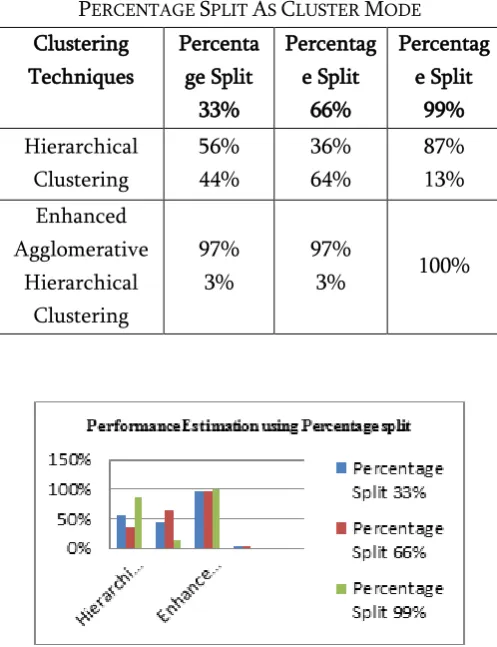
In this experimental research we used WEKA as a data mining tool to estimate the cluster performances[15]. The accuracy of different algorithms has been analyzed then we designed a new algorithm called Enhanced Agglomerative Hierarchical Clustering, it is the superlative proper algorithm having better clustering performance. In this research work we applied proposed algorithm on Sensor Discrimination dataset to estimate the performance. The experiment has been conducted with Sensor Discrimination dataset available on UC Irvine Machine Learning Repository. Authors have implemented various clustering algorithms on this dataset using WEKA tool which is developed by Machine Learning Group at the University of Waikato. The dataset used for the analysis and implementation purpose is having 2212 instances and 12 attributes and one class attribute. The
Figure 2. Performance Estimation using Percentage Split
Figure 3. Performance Estimation of Clusterer
V.
CONCLUTION
we proposed and developed an innovative algorithm called Enhanced Agglomerative Hierarchical Clustering (EAHC) is a bottom-up clustering method where clusters have sub-clusters, which in turn have sub-clusters, etc. There are many clustering methods, such as hierarchical clustering method, can further classify into agglomerative hierarchical methods and divisive hierarchical methods. The process of Enhanced Agglomerative Hierarchical Clustering starts with these single observation clusters and gradually combines pairs of clusters, forming smaller numbers of clusters that contain more observations. Then clusters successively merged until the desired cluster structure is obtained. In this research we estimated the performance of Hierarchical Clustering and our proposed Enhanced Agglomerative Hierarchical Clustering with results using Sensor Discrimination dataset from the UCI Machine Learning Repository. The proposed method gives admirable performance when compared the results with other algorithms. In future work if we develop, integrate and embed the EAHC algorithm with another utmost clustering algorithm called Farthest First on sensor discrimination dataset. It gives tremendous performance when compared to other clustering algorithms in the data mining system.
VI.
REFERENCES
[1]. Mukhopadhyay, U. Maulik, S. Bandyopadhyay, and C. A. C. Coello, "A survey of multi objective evolutionary algorithms for data mining: part I," IEEE Transactions on Evolutionary Computation, vol. 18, no. 1, pp. 4-19, 2014.
[2]. Jiawei Han and Micheline Kamber, "Data Mining: Concepts and Techniques", the Morgan Kaufmann/Elsevier India, 2006.
[3]. Marjan Kuchaki Rafsanjani, Zahra Asghari Varzaneh, Nasibeh Emami Chukanlo, "A survey of hierarchical clustering algorithms", The Journal of Mathematics and Computer Science,5,3, pp.229- 240, 2012.
[4]. L. Feng, M-H Qiu, X. Wang, Q-L. Xiang, Y-F. Yang and K. Liu, "A fast divisive clustering algorithm using an improved discrete particle swarm optimizer", Pattern Recognition Letters, 31, pp. 1216-1225, 2010.
[5]. Pal N.R, Pal K, Keller J.M. and Bezdek J.C, "A Possibilistic Clustering Algorithm", IEEE Transactions on Fuzzy Systems, Vol. 13, No. 4, Pp. 517- 530, 2005.
[6]. Chim H and X. Deng, "Efficient Phrase-Based Document Similarity for Clustering," IEEE Trans. Knowledge and Data Eng., vol. 20, no. 9, pp. 1217-1229 Sept. 2008.
[7]. Chee Keong Chan, Duc Thang Nguyen, Lihui Chen and Senior Member, IEEE, "Clustering with Multi viewpoint-Based Similarity Measure", IEEE transactions on knowledge and data engineering, Vol. 24, No. 6, 2012.
[8]. K. Huang, C. Chang, and K. Lin, "Prowl: an efficient frequent continuity mining algorithm on event sequences", in Data Warehousing and Knowledge Discovery,vol.3181of Lecture Notes in Computer Science, pp. 351-360, Springer, Berlin, Germany,2004.
[9]. Modha D and I. Dhillon, "Concept Decompositions for Large Sparse Text Data Using Clustering," Machine Learning, Vol. 42, nos. 1/2, pp. 143-175, Jan. 2001.
[10]. S. Huang, "A study of the application of data mining on the spatial landscape allocation of crime hot spots", in Geo-Informatics in Resource Management and Sustainable Ecosystem, vol. 398 of Communications in Computer and Information Science, pp. 1274-286, Springer, Berlin, Germany, 2013.
[11]. X. Wu, X. Zhu, G.Q. Wu, and W. Ding, "Data mining with big data," IEEE Transactions on Knowledge and Data Engineering, vol. 26, no. 1, pp. 97-107, 2014
Science, pp. 214- 227, Springer, Cham, Switzerland, 2014.
[13]. Dr.M.Jayakameswariah, Mr.M.Veeresh Babu, Dr.S.Ramakrishna,Mrs.P.Yamuna,
"Computation Accuracy of Hierarchical and Expectation Maximization Clustering Algorithms for the Improvement of Data Mining System", International Research Journal of Engineering and Technology (IRJET), Volume: 03 Issue: 12, ISO 9001:2008, Page 1580-1585, e-ISSN: 2395-0056, p-ISSN: 2395-0072, Dec-2016.
[14]. M.Jayakameswaraiah and S.Ramakrishna, "A Study on Prediction Performance of Some Data Mining Algorithms", International Journal of Advanced Research in Computer Science and Management Studies, Volume 2, Issue 10, ISSN: 2321-7782, October 2014.