994
Enhancing Unsupervised Sentence Similarity Methods with Deep
Contextualised Word Representations
Tharindu Ranasinghe, Constantin Or˘asan and Ruslan Mitkov Research Group in Computational Linguistics
University of Wolverhampton, UK
{t.d.ranasinghehettiarachchige, c.orasan, r.mitkov }@wlv.ac.uk
Abstract
Calculating Semantic Textual Similarity (STS) plays a significant role in many applications such as question answering, document summarisation, information re-trieval and information extraction. All modern state of the art STS methods rely on word embeddings one way or an-other. The recently introduced contextu-alised word embeddings have proved more effective than standard word embeddings in many natural language processing tasks. This paper evaluates the impact of several contextualised word embeddings on un-supervised STS methods and compares it with the existing supervised/unsupervised STS methods for different datasets in dif-ferent languages and difdif-ferent domains.
1 Introduction
Measuring Semantic Textual Similarity (STS) is calculating the degree of semantic equivalence be-tween two snippets of text (Agirre et al., 2016). Earlier, STS tasks largely focused on similarity between short texts such as abstracts and prod-uct descriptions (Li et al., 2006;Mihalcea et al.,
2006). Recently, STS tasks at the International Workshops on Semantic Evaluation (SemEval) fo-cused on measuring STS between full sentence pairs. The introduction of competitive STS tasks led to the development of standard datasets like the SICK corpus (Bentivogli et al.,2016) and stan-dardised the similarity score as a numerical value between 1 and 5 (Agirre et al.,2014).
Having a good STS metric is crucial for many natural language processing applications such as information retrieval (IR) (Majumder et al.,2016), text summarisation (Aliguliyev,2009;Steinberger and Jezek, 2004), question answering (Mohler
et al., 2011) and text classification (Rocchio,
1971). Semantic similarity also contributes to many semantic web applications like community extraction, ontology generation and entity disam-biguation (Li et al.,2006), and it is also useful for Twitter search (Salton et al.,1997), where it is re-quired to accurately measure semantic relatedness between concepts or entities (Xu et al.,2015). STS is not limited only to natural language processing. For example in Biomedical Informatics, it can be used to compare genes (Ferreira and Couto,2010). Given the growing importance of having a good STS metric and as a result of the SemEval work-shops, researchers have proposed numerous STS methods. Most of the early approaches were based on traditional machine learning and in-volved heavy feature engineering (B´echara et al.,
2015). With the advances of word embeddings, and as a result of the success neural networks have achieved in other fields, most of the methods pro-posed in recent years rely on neural architectures (Tai et al.,2015;Shao,2017). Neural networks are preferred over traditional machine learning mod-els as they generally tend to perform better than traditional machine learning models. They also do not rely on explicit linguistics features which have to be extracted before the ML model is learnt. De-termining the best linguistic features for calculat-ing STS is not an easy task as it requires a good understanding of the linguistic phenomenon and relies on researchers’ intuition. In addition, calcu-lating these features is usually not an easy task, es-pecially for languages other than English. There-fore, in contrast to traditional ML methods, mod-els based on neural networks can be easily applied to other languages.
can-not be trained properly. Given the amount of hu-man labour required to produce datasets for STS, it is not possible to have high quality large train-ing datasets. As a result researches worktrain-ing in the field have also considered unsupervised methods for STS. Recent unsupervised approaches use pre-trained word/sentence embeddings directly for the similarity task without training a neural network model on them. Such approaches have used cosine similarity on sent2vec (Pagliardini et al., 2018), InferSent (Conneau et al., 2017), Word Mover’s Distance (Kusner et al., 2015), Doc2Vec (Le and Mikolov, 2014) and Smooth Inverse Frequency with GloVe vectors (Arora et al., 2017). While these approaches have produced decent results in the final rankings of shared tasks, they have also provided strong baselines for the STS task.
Word vectors are used to determine a rep-resentation of a sentence in approaches like Word Mover’s Distance (Kusner et al.,2015) and Smooth Inverse Frequency (Arora et al., 2017). The main weakness of word vectors is that each word has the same unique vector regardless of the context it appears. For an example, the word ”play” has several meanings, but in stan-dard word embeddings such as Glove ( Penning-ton et al., 2014), FastText (Mikolov et al.,2018) or Word2Vec (Mikolov et al.,2013) each instance of the word has the same representation regardless of the meaning which is used. However, contex-tualised word embedding models such as ELMo (Peters et al., 2018), BERT (Devlin et al., 2018) etc. generate embeddings for a word based on the context it appears, thus generating slightly differ-ent embeddings for each of its occurrence. The recent applications in areas such as question an-swering and textual entailment show that contex-tualised word embeddings perform better than the traditional word embeddings (Devlin et al.,2018).
This paper explores the performance of several contextualised word embeddings in three unsuper-vised STS methods - cosine similarity using aver-age vectors, Word Mover’s Distance (Kusner et al.,
2015) and cosine similarity using Smooth Inverse Frequency (Arora et al., 2016). The rest of the paper is organised as follow. Section 2 contains information about the settings of the experiments carried out in this paper including the datasets em-ployed here and the different contextualised word embedding models explored. Each of the con-textualised word embedding models against each
method are evaluated in Section4. Further experi-ments are conducted on Spanish sentence similar-ity and Bio-medical sentence similarsimilar-ity to observe the portability of the model to other languages and domains in section5. Section6would briefly de-scribe the related work done for STS. The paper finishes with conclusions.
2 Settings of the Experiments
2.1 Data Sets
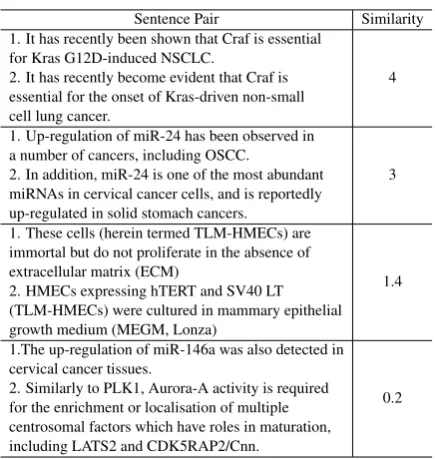
The experiments presented in this paper were car-ried out using several datasets which will be ex-plained in next subsections. In order to prove the portability of the approaches, the proposed archi-tectures were also tested on an English Biomedical STS dataset. In addition, the language indepen-dence of the method is tested by applying it to a Spanish STS dataset.
2.1.1 English-English STS Data Set
For the experiments carried out on English STS, we used the SICK dataset. (Bentivogli et al.,
2016). The SICK data contains 9927 sentence pairs with a 5,000/4,927 training/test split which were employed in the SemEval tasks. Each pair is annotated with a relatedness score between 1 and 5, corresponding to the average relatedness judged by 10 different individuals. Table1 shows a few examples from the SICK training dataset.
Sentence Pair Similarity 1. A little girl is looking at a woman in costume.
2. A young girl is looking at a woman in costume. 4.7 1. A person is performing tricks on a motorcycle.
2. The performer is tricking a person on a motorcycle. 2.6 1. Someone is pouring ingredients into a pot.
2. A man is removing vegetables from a pot. 2.8 1. Nobody is pouring ingredients into a pot.
2. Someone is pouring ingredients into a pot. 3.5
Table 1: Example sentence pairs from the SICK training data
2.1.2 Spanish-Spanish STS Data Set
For the Spanish STS experiments we used the dataset provided for Spanish STS subtask in Se-mEval 2015 Task 2 (Agirre et al.,2015). The train-ing set has 1250 sentence pairs annotated with a relatedness score between 0 and 4. There were two sources for test set - Spanish news and Span-ish Wikipedia dump having 500 and 250 sentence pairs respectively. Both datasets were annotated with a relatedness score between 0 and 4. Table2
2.2.2 BERT
BERT was introduced inDevlin et al. (2018). It is based on a bidirectional transformer architec-ture rather than a unidirectional transformer used in Open AI GPT (Radford et al.,2019). In contrast to ELMo which uses a shallow concatenation layer (Devlin et al.,2018), BERT employs a deep con-catenation layer. As a result BERT is considered a very powerful embedding architecture. We used pre-trained ’bert-large-uncased’ model and repre-sented each word as a 4096 lengthened vector.
2.2.3 Stacked Embeddings
Stacked Embeddings are obtained by concatenat-ing different embeddconcatenat-ings. According to Akbik et al. (2019) stacking the embeddings can pro-vide a powerful embeddings to represent words. We represent the stacked embeddings in section
4 with ’+’ between the used models. As an ex-ample if the model name says ELMo + BERT, it is a stacked embedding of ELMo and BERT. For ELMo + BERT model we used pre-trained ’bert-large-uncased’ model and ’original’ pre-trained ELMo model to represent each word as a 4096 + 3072 vector.
2.2.4 Flair
Flair is another type of popular contextualised word embeddings introduced in Akbik et al.
(2018). It takes a different approach by using a character level language model rather than the word level language model used in ELMo and BERT. The recommended way to use Flair em-beddings is to stack pre-trained ’news-forward’ embeddings and pre-trained ’news-backward’ em-beddings with Glove (Pennington et al., 2014) word embeddings (Akbik et al., 2018). We used the stacked model to represent each word as a 4196 lengthened vector.
2.3 Standard Word Representations
In order to compare the results of contextualised word embeddings, we used a standard word rep-resentation model in each experiment as a base-line. In this research we used word2vec embed-dings (Mikolov et al.,2013) pre-trained on Google news corpus. We represented each word as a 300 lengthened vector using this model.
3 Experiments
This section describes the actual methods used to calculate the STS score between a pair of
sen-tences and their variants we used. Each experi-ment was conducted using all three contextualised word embedding models - ELMo, BERT and Flair and one standard word representation model -word2vec (Mikolov et al.,2013).
3.1 Cosine Similarity on Average Vectors
The first unsupervised STS method that we used to estimate the semantic similarity between a pair of sentences, takes the average of the word em-beddings of all words in the two sentences, and calculates the cosine similarity between the result-ing embeddresult-ings. This is a common way to acquire sentence embeddings from word embeddings. Ob-viously, this simple baseline leaves considerable room for variation. We have investigated the ef-fects of ignoring stopwords and computing an av-erage weighted by tf-idf in particular and reported them in the4section.
3.2 Word Mover’s Distance
The second baseline that we have considered is Word Mover’s Distance introduced by Kusner et al. (2015). Word Mover’s Distance uses the word embeddings of the words in two texts to mea-sure the minimum distance that the words in one text need to “travel” in semantic space to reach the words in the other text as shown in Figure1. Kus-ner et al.(2015) says that this is a good approach than vector averaging since this technique keeps the word vectors as it is through out the opera-tion. We have investigated the effects of consid-ering/ ignoring stop words before calculating the word mover’s distance.
Figure 1: The Word Mover’s Distance between two documents
3.3 Cosine Similarity Using Smooth Inverse Frequency
pro-posed byArora et al.(2016) and then calculate the cosine similarity between those sentence embed-dings. Semantically speaking, taking the average of the word embeddings in a sentence tends to give too much weight to words that are quite irrelevant. Smooth Inverse Frequency tries to solve this prob-lem in two steps.
1. Weighting: Smooth Inverse Frequency takes the weighted average of the word embed-dings in the sentence. Every word embedding is weighted by a+p(w)a , whereais a parame-ter that is typically set to 0.001 andp(w)is the estimated frequency of the word in a ref-erence corpus.
2. Common component removal: After that, Smooth Inverse Frequency computes the principal component of the resulting embed-dings for a set of sentences. It then subtracts their projections on first principal compo-nent from these sentence embeddings. This should remove variation related to frequency and syntax that is less relevant semantically.
As a result, Smooth Inverse Frequency down-grades unimportant words such as but, just, etc., and keeps the information that contributes most to the semantics of the sentence. After acquiring the sentence embeddings for a pair of sentences, the cosine similarity between those two vectors were taken to represent the similarity between them.
4 Evaluation on English SemEval Data
This section describes the evaluation results of En-glish SemEval data for all the unsupervised STS methods we described above.
All the experiments were evaluated using the three evaluation metrics normally employed in the STS tasks: Pearson correlation (τ), Spearman cor-relation (ρ) and Mean Squared Error (MSE). Fol-lowing sub-sections will discuss the results in de-tail.
4.1 Cosine Similarity on Average Vectors
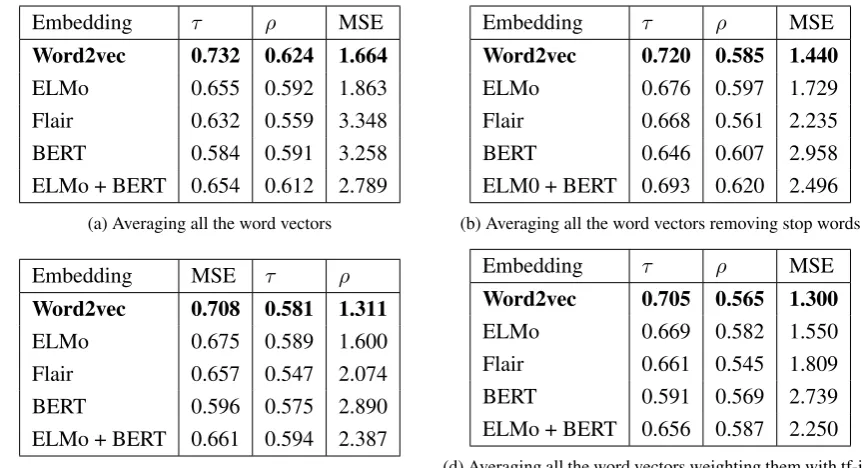
Vector averaging results are shown in Table 4. Since we calculated the similarity as the cosine similarity between two vectors our predicted simi-larity lies between∈[0,1]. Since the GOLD stan-dards are between∈[1,5] we re-scaled the predic-tions to be∈[1,5] in order to allow comparison.
Following variations were considered and re-ported in each sub-table.
1. All the word vectors were considered for av-eraging. Results are shown in table4a.
2. All the word vectors except the vectors for stop words were considered for averaging. Table4bshows the results.
3. All the word vectors were weighted from its tf-idf scores and considered averaging. Re-sults are shown in table4c
4. Stop words were removed first and remain-ing word vectors were weighted from its tf-idf scores and considered averaging. Table
4dshows the results.
As shown in table 4 the contextualised word vectors did not perform better than the standard word embeddings in all the variations. The only model that came close to word2vec performance was ELMo. All the contextualised word embed-ding models we considered have more than 3000 dimensions for the word representation which is significantly higher than the number of dimen-sions for the word representation we had for stan-dard embeddings - 300. As the vector averaging model is highly dependent on the number of mensions that a vector can have, the curse of di-mensionality might be the reason for the poor per-formance of contextualised word embeddings.
4.2 Word Mover’s Distance
The results for the Word Mover’s Distance is shown in5. Following variations were considered and reported in each sub-table.
1. Considering all the words to calculate the Word Mover’s Distance. Results are shown in5a
2. Removing stop words before calculating the Word Mover’s Distance. Table5bshows the results.
Embedding τ ρ MSE
Word2vec 0.732 0.624 1.664 ELMo 0.655 0.592 1.863
Flair 0.632 0.559 3.348 BERT 0.584 0.591 3.258 ELMo + BERT 0.654 0.612 2.789
(a) Averaging all the word vectors
Embedding τ ρ MSE
Word2vec 0.720 0.585 1.440 ELMo 0.676 0.597 1.729
Flair 0.668 0.561 2.235 BERT 0.646 0.607 2.958 ELM0 + BERT 0.693 0.620 2.496
(b) Averaging all the word vectors removing stop words
Embedding MSE τ ρ
Word2vec 0.708 0.581 1.311 ELMo 0.675 0.589 1.600
Flair 0.657 0.547 2.074 BERT 0.596 0.575 2.890 ELMo + BERT 0.661 0.594 2.387
(c) Averaging all the word vectors weighting them with tf-idf
Embedding τ ρ MSE
Word2vec 0.705 0.565 1.300
ELMo 0.669 0.582 1.550 Flair 0.661 0.545 1.809 BERT 0.591 0.569 2.739
ELMo + BERT 0.656 0.587 2.250
(d) Averaging all the word vectors weighting them with tf-idf removing stop words
Table 4: Vector averaging results for SICK training set
Embedding τ ρ MSE
Word2vec 0.642 0.593 1.051
ELMo 0.584 0.559 1.210 Flair 0.592 0.561 1.166
BERT 0.605 0.578 1.145 ELMo + BERT 0.595 0.568 1.189
(a) Considering all the word vectors
Embedding τ ρ MSE
Word2vec 0.636 0.573 1.156
ELMo 0.600 0.549 1.416 Flair 0.615 0.557 1.254
BERT 0.639 0.580 1.177 ELMo + BERT 0.619 0.565 1.299
(b) Considering all the word vectors removing stop words
Table 5: Word moving distance results for SICK training set
4.3 Cosine Similarity Using Smooth Inverse Frequency
Table6 shows the results for the Smooth Inverse Frequency method. As shown there, all the con-textualised word representations have improved the results significantly over the standard word representations. Since the first principle compo-nent is removed in the process, curse of dimen-sionality has not affected this method. The stacked embeddings of ELMo and BERT provided the best results to the experiment. Also, it is important to notice that the Smooth Inverse Frequency us-ing the stacked embeddus-ings of ELMo and BERT showed the best results from all three methods for all three evaluation metrics.
As shown in the above tables, contextualised word embeddings did not improve the results of vector averaging and word movers distance. But contextualised word embeddings showed a great
Embedding
τ
ρ
MSE
Word2vec
0.734
0.632
0.604
ELMo
0.740
0.654
0.593
Flair
0.731
0.634
0.601
BERT
0.746
0.661
0.456
ELMo + BERT
0.753
0.669
0.446
Table 6: Smooth Inverse Frequency results for SICK training set
improvement over standard word embeddings in Smooth Inverse Frequency STS method which also provided the best results among the consid-ered unsupervised STS methods.
4.4 Further Experiments and Results
contex-tualised word representations provided the best re-sult. However, since we used the cosine similarity between two vectors, the predictions of our model are constrained to follow the cosine curve and are thus not suited for these evaluation metrics. For this reason, we applied a parametric regression step to obtain better-calibrated predictions. We trained a regression model on the SICK train data and predicted on the SICK test data. This cali-bration step served as a minor correction for our restrictively simple similarity function. However, this regression calibration improved the Pearson correlation by 0.01 for the SICK test set.
Our unsupervised method had 0.762 Pearson correlation score, whilst the best result in the Inter-national Workshop on Semantic Evaluation 2014 Task 1 had 0.828 Pearson correlation (Marelli et al.,2014). Our approach would be ranked on the ninth position from the top results out of 18 participants, and it is the best unsupervised STS method among the results. Our method even out-performed systems that rely on additional feature generation (e.g. dependency parses) or data aug-mentation schemes. As an example, our method is just above the UoW system which relied on 20 linguistics features fed in to a Support Vector Machine and obtained a 0.714 Pearson correlation (Gupta et al.,2014). Compared to these complex approaches our simple approach provides a strong baseline to STS tasks.
5 Portability of the Method to Other Languages and Domains
Our approach has the advantage that it does not rely on language dependent features and it does not need a training set as the approach is unsuper-vised. As a result, the approach is easily portable to other languages and domains given the avail-ability of ELMo and BERT models in that partic-ular language or domain. In order to observe how well the method performs in other languages and domains we applied it to Spanish STS dataset and Biomedical STS dataset described in section3.
5.1 Spanish STS
We run all the unsupervised STS methods de-scribed in section 2 on the Spanish STS dataset explained in section2.1.2. For the ELMo embed-dings we used Spanish ELMo embedembed-dings pro-vided in Che et al. (2018), while for the BERT embeddings we used ”BERT-Base, Multilingual
Cased” 1 model which has been built on the top 100 languages with the largest Wikipedias which includes Spanish language too.
The predictions from the experiment were re-scaled to lie ∈ [0,4] as the GOLD standards. Organisers have used only one evaluation met-ric in this Spanish STS task: Pearson correlation (τ) against the predictions and GOLD standard. They have calculated Pearson correlation for each test set: Spanish news and Spanish wiki, sepa-rately and has taken the weighted average to give the final rankings in the leader board. We took the same procedure in order to evaluate our ap-proach with the other apap-proaches in the task. Also we applied parametric regression step we did to English-English STS experiment to obtain better-calibrated predictions. Parametric regression step improved the Pearson correlation by 0.01 for both Wikipedia and Newswire datasets.
From the experiments, Smooth Inverse Fre-quency with ELMo and BERT stacked embed-dings gave the best results, similar to the English STS experiments we conducted. Our approach had 0.660 Pearson correlation for Wikipedia dataset, 0.547 Pearson correlation for Newswire dataset and 0.570 weighted mean from both of them. The best performing model that participated in SemEval 2015 task 2, had 0.705 Pearson cor-relation for Wikipedia, 0.683 for Newswire and 0.690 weighted mean (Agirre et al.,2015). Our ap-proach would rank fifth out of 17 team in the final results, which is the best result for an unsupervised approach. As with the English model, this one also surpasses other complex supervised models. As an example RTM-DCU-1stST.tree uses a su-pervised machine learning algorithm with Refer-ential Translation Machines(Biici and Way,2014) and our fairly simple unsupervised approach out-perform them by a significant margin. Comparing the results we can safely assume that our approach works well with Spanish language STS too.
5.2 Bio-Medical STS
In order to evaluate our approach in a different domain, we experimented it on Bio-medical STS dataset explained in2.1.3. As in the previous ex-periments we applied all unsupervised approaches mentioned. We used ELMo embeddings trained on a biomedical domain corpora (e.g., PubMed abstracts, PMC full-text articles) (Peters et al.,
2018) and BioBERT: BERT embeddings trained on biomedical domain corpora (Lee et al.,2019). We did not apply Parametric regression step to this dataset since there was not enough data for the training. The predictions from the experi-ment were re-scaled to lie ∈ [0,4] as the GOLD standards. Organisers have used only one evalua-tion metric in this Bio-medical STS task: Pearson correlation (τ) against the predictions and GOLD standard.
Same as English and Spanish experiments, Smooth Inverse Frequency with ELMo and BERT stacked embeddings performed best with this dataset too. It had 0.680 Pearson correlation, whilst the best performing method had 0.836 Pear-son correlation. This would rank our approach seventh out of 22 teams in the final results of the task (Sogancioglu et al.,2017). It should be also noted that it outperforms many complex methods that sometimes uses external tools too. As an example, the UBSM-Path approach is based on-tology based similarity which uses METAMAP (Aronson, 2001) for extracting medical concepts from text and our simple unsupervised approach outperform them by a significant margin. UBSM-Path only has 0.651 Pearson correlation. Compar-ing the results we can safely assume that our ap-proach works well in bio medical domain too.
6 Related Work
Given that a good STS metric is required for a variety of natural language processing fields, re-searchers have proposed a large number of such metrics. Before the shift of interest in neural net-works, most of the proposed methods relied heav-ily on feature engineering. With the introduction of word embedding models, researchers focused more on neural representation for this task.
There are two main approaches which employ neural representation models: supervised and un-supervised. Unsupervised approaches use pre-trained word/sentence embeddings directly for the similarity task without training a neural network model on them while supervised approaches uses a machine learning model trained to predict the similarity using word embeddings. ConvNet (He et al., 2015), Skip Thought vectors (Kiros et al.,
2015), Dependency Tree-LSTM (Tai et al.,2015) and Siamese Neural Networks (Mueller and Thya-garajan, 2016) can be considered as the most successful architectures employed for calculating
STS. These supervised approaches always suffer from less training data problem which is common in STS tasks. As a result the researches have also considered unsupervised approaches.
The three unsupervised STS methods explored in this paper: Cosine similarity on average vectors, Word Mover’s Distance and Cosine similarity us-ing Smooth Inverse Frequency are the most com-mon unsupervised methods explored in STS tasks. Apart from them cosine similarity of the output from Infersent (Conneau et al., 2017), sent2vec (Pagliardini et al., 2018) and doc2vec (Le and Mikolov, 2014) have been used to represent the similarity between two sentences. All these ap-proaches relies on pre-trained sentence embed-dings.
7 Conclusions
This paper experimented three unsupervised STS methods namely cosine similarity using average vectors, Word Mover’s Distance and cosine simi-larity using Smooth Inverse Frequency with con-textualised word embeddings for calculating se-mantic similarity between pairs of texts and com-pared them with other unsupervised/ supervised approaches. Contextualised word embeddings could not improve cosine similarity using aver-age vectors and Word Mover’s Distance methods, but the results when using Smooth Inverse Fre-quency method were improved significantly with contextualised word embeddings, instead of stan-dard word embeddings. Further more we learned that stacking ELMo and BERT provides a strong word representation rather than individual repre-sentations of ELMo and BERT. The results in-dicated that calculating cosine similarity using Smooth Inverse Frequency with stacked embed-dings of ELMo and BERT is the best unsupervised method from the available approaches. Also, our approach finished on the top half of the final re-sults list surpassing many complex and supervised approaches.
References
Eneko Agirre, Carmen Banea, Claire Cardie, Daniel M. Cer, Mona T. Diab, Aitor Gonzalez-Agirre, Weiwei Guo, I˜nigo Lopez-Gazpio, Montse Maritxalar, Rada Mihalcea, German Rigau, Larraitz Uria, and Janyce Wiebe. 2015. Semeval-2015 task 2: Semantic tex-tual similarity, english, spanish and pilot on inter-pretability. InSemEval@NAACL-HLT.
Eneko Agirre, Carmen Banea, Claire Cardie, Daniel M. Cer, Mona T. Diab, Aitor Gonzalez-Agirre, Weiwei Guo, Rada Mihalcea, German Rigau, and Janyce Wiebe. 2014. Semeval-2014 task 10: Multilingual semantic textual similarity. InSemEval@COLING.
Eneko Agirre, Carmen Banea, Daniel M. Cer, Mona T. Diab, Aitor Gonzalez-Agirre, Rada Mihalcea, Ger-man Rigau, and Janyce Wiebe. 2016. Semeval-2016 task 1: Semantic textual similarity, monolingual and cross-lingual evaluation. In SemEval@NAACL-HLT.
Alan Akbik, Tanja Bergmann, and Roland Vollgraf. 2019. Pooled contextualized embeddings for named entity recognition. In NAACL 2019, 2019 Annual Conference of the North American Chapter of the Association for Computational Linguistics. page to appear.
Alan Akbik, Duncan Blythe, and Roland Vollgraf. 2018. Contextual string embeddings for sequence labeling. InCOLING 2018, 27th International Con-ference on Computational Linguistics. pages 1638– 1649.
Ramiz M. Aliguliyev. 2009. A new sentence similar-ity measure and sentence based extractive technique for automatic text summarization. Expert Syst. Appl.
36:7764–7772.
Alan R. Aronson. 2001. Effective mapping of biomedi-cal text to the umls metathesaurus: the metamap pro-gram. Proceedings. AMIA Symposiumpages 17–21.
Sanjeev Arora, Yingyu Liang, and Tengyu Ma. 2016. A simple but tough-to-beat baseline for sentence em-beddings .
Sanjeev Arora, Yingyu Liang, and Tengyu Ma. 2017. A simple but tough-to-beat baseline for sentence em-beddings. InICLR 2017.
Hanna B´echara, Hernani Costa, Shiva Taslimipoor, Ro-hit Gupta, Constantin Orasan, Gloria Corpas Pastor, and Ruslan Mitkov. 2015. Miniexperts: An svm ap-proach for measuring semantic textual similarity. In
SemEval@NAACL-HLT.
Luisa Bentivogli, Raffaella Bernardi, Marco Marelli, Stefano Menini, Marco Baroni, and Roberto Zam-parelli. 2016. Sick through the semeval glasses. les-son learned from the evaluation of compositional distributional semantic models on full sentences through semantic relatedness and textual entailment.
Language Resources and Evaluation50:95–124.
Ergun Biici and Andy Way. 2014. Rtm-dcu: Referen-tial translation machines for semantic similarity. In
SemEval@COLING.
Wanxiang Che, Yijia Liu, Yuxuan Wang, Bo Zheng, and Ting Liu. 2018. Towards better UD pars-ing: Deep contextualized word embeddings,
en-semble, and treebank concatenation. In
Pro-ceedings of the CoNLL 2018 Shared Task: Mul-tilingual Parsing from Raw Text to Univer-sal Dependencies. Association for Computational Linguistics, Brussels, Belgium, pages 55–64.
http://www.aclweb.org/anthology/K18-2005.
Ciprian Chelba, Tomas Mikolov, Mike Schuster, Qi Ge, Thorsten Brants, and Phillipp Koehn. 2013. One bil-lion word benchmark for measuring progress in sta-tistical language modeling. InINTERSPEECH.
Alexis Conneau, Douwe Kiela, Holger Schwenk, Lo¨ıc Barrault, and Antoine Bordes. 2017. Supervised learning of universal sentence representations from natural language inference data. InEMNLP.
Jacob Devlin, Ming-Wei Chang, Kenton Lee, and Kristina Toutanova. 2018. Bert: Pre-training of deep bidirectional transformers for language understand-ing.arXiv preprint arXiv:1810.04805.
Jo˜ao D. Ferreira and Francisco M. Couto. 2010. Se-mantic similarity for automatic classification of chemical compounds. InPLoS Computational Bi-ology.
Rohit Gupta, Hanna B´echara, Isma¨ıl El Maarouf, and Constantin Orasan. 2014. Uow: Nlp techniques developed at the university of wolverhampton for semantic similarity and textual entailment. In Se-mEval@COLING.
Hua He, Kevin Gimpel, and Jimmy J. Lin. 2015. Multi-perspective sentence similarity modeling with con-volutional neural networks. InEMNLP.
Ryan Kiros, Yukun Zhu, Ruslan R. Salakhutdinov, Richard S. Zemel, Antonio Torralba, Raquel Urta-sun, and Sanja Fidler. 2015. Skip-thought vectors. InNIPS.
Matt J. Kusner, Yu Sun, Nicholas I. Kolkin, and Kil-ian Q. Weinberger. 2015. From word embeddings to document distances. InICML.
Quoc V. Le and Tomas Mikolov. 2014. Distributed rep-resentations of sentences and documents. InICML.
Jinhyuk Lee, Wonjin Yoon, Sungdong Kim, Donghyeon Kim, Sunkyu Kim, Chan Ho So, and Jaewoo Kang. 2019. Biobert: a pre-trained biomedical language representation model for biomedical text mining. CoRRabs/1901.08746.
Goutam Majumder, Partha Pakray, Alexander F. Gel-bukh, and David Pinto. 2016. Semantic textual sim-ilarity methods, tools, and applications: A survey.
Computaci´on y Sistemas20.
Marco Marelli, Luisa Bentivogli, Marco Baroni, Raf-faella Bernardi, Stefano Menini, and Roberto Zam-parelli. 2014. Semeval-2014 task 1: Evaluation of compositional distributional semantic models on full sentences through semantic relatedness and textual entailment. InSemEval@COLING.
Rada Mihalcea, Courtney Corley, and Carlo Strap-parava. 2006. Corpus-based and knowledge-based measures of text semantic similarity. InAAAI.
Tomas Mikolov, Edouard Grave, Piotr Bojanowski, Christian Puhrsch, and Armand Joulin. 2018. Ad-vances in pre-training distributed word representa-tions. InProceedings of the International Confer-ence on Language Resources and Evaluation (LREC 2018).
Tomas Mikolov, Ilya Sutskever, Kai Chen, Gregory S. Corrado, and Jeffrey Dean. 2013. Distributed repre-sentations of words and phrases and their composi-tionality. InNIPS.
Michael Mohler, Razvan C. Bunescu, and Rada Mihal-cea. 2011. Learning to grade short answer questions using semantic similarity measures and dependency graph alignments. InACL.
Jonas Mueller and Aditya Thyagarajan. 2016. Siamese recurrent architectures for learning sentence similar-ity. InAAAI.
Matteo Pagliardini, Prakhar Gupta, and Martin Jaggi. 2018. Unsupervised learning of sentence embed-dings using compositional n-gram features. In
NAACL-HLT.
Jeffrey Pennington, Richard Socher, and Christo-pher D. Manning. 2014. Glove: Global vectors for
word representation. InEmpirical Methods in
Nat-ural Language Processing (EMNLP). pages 1532– 1543.http://www.aclweb.org/anthology/D14-1162.
Matthew E. Peters, Mark Neumann, Mohit Iyyer, Matt Gardner, Christopher Clark, Kenton Lee, and Luke Zettlemoyer. 2018. Deep contextualized word rep-resentations. InProc. of NAACL.
Alec Radford, Jeff Wu, Rewon Child, David Luan, Dario Amodei, and Ilya Sutskever. 2019. Language models are unsupervised multitask learners .
J. J. Rocchio. 1971. Relevance feedback in information retrieval. In G. Salton, editor, The Smart retrieval system - experiments in automatic document pro-cessing, Englewood Cliffs, NJ: Prentice-Hall, pages 313–323.
Gerard Salton, Amit Singhal, Mandar Mitra, and Chris Buckley. 1997.Automatic text structuring and
sum-marization. Inf. Process. Manage. 33(2):193–207.
https://doi.org/10.1016/S0306-4573(96)00062-3.
Yang Shao. 2017. Hcti at semeval-2017 task 1: Use convolutional neural network to evaluate semantic textual similarity. InSemEval@ACL.
Gizem Sogancioglu, Hakime ¨Ozt¨urk, and Arzucan ¨
Ozg¨ur. 2017. Biosses: a semantic sentence similar-ity estimation system for the biomedical domain. In
Bioinformatics.
Josef Steinberger and Karel Jezek. 2004. Using latent semantic analysis in text summarization and sum-mary evaluation.
Kai Sheng Tai, Richard Socher, and Christopher D. Manning. 2015. Improved semantic representations from tree-structured long short-term memory net-works. InACL.