578
Study on Unsupervised Statistical Machine Translation for
Backtranslation
Anush Kumar1, Nihal V. Nayak2, Aditya Chandra1and Mydhili K. Nair1 1Department of Information Science and Engineering, Ramaiah Institute of Technology
2Department of Computer Science, Brown University
[email protected], [email protected], [email protected], [email protected]
Abstract
Machine Translation systems have drastically improved over the years for several language pairs. Monolingual data is often used to gener-ate synthetic sentences to augment the training data which has shown to improve the perfor-mance of machine translation models. In our paper, we make use of an Unsupervised Sta-tistical Machine Translation (USMT) to gen-erate synthetic sentences. Our study com-pares the performance improvements in Neu-ral Machine Translation model when using synthetic sentences from supervised and un-supervised Machine Translation models. Our approach of using USMT for backtranslation shows promise in low resource conditions and achieves an improvement of 3.2 BLEU score over the Neural Machine Translation model.
1 Introduction
Neural Machine Translation systems with encoder-decoder architecture have significantly improved the state-of-the-art for several language pairs (Bahdanau et al., 2015; Vaswani et al.,
2017). A majority of the systems in WMT18 used a Transformer approach with varying number of encoder-decoder layers (Bojar et al.,2018).
Supervised Neural Machine Translation sys-tems are data-hungry as they require huge amounts of aligned parallel corpora (Koehn and Knowles,
2017). Additionally, obtaining parallel corpora is expensive and requires expert knowledge in both - source and target languages. To overcome this bottleneck, recent research has focused on unsu-pervised machine translation where only mono-lingual corpus is required, eliminating the need for a bilingual parallel corpora. The approaches in unsupervised machine translation have shown promise (Lample et al.,2018;Artetxe et al.,2018,
2019). Nonetheless, the performance of traditional
Neural Machine Translation is still better than Un-supervised Machine Translation.
Often monolingual data is used to further im-prove the performance of a Neural Machine Trans-lation model (Sennrich et al., 2016a; Currey et al., 2017). Backtranslation is one such popu-lar method in which monolingual data is utilized to improve the model performance. In this technique, a model is initially trained in one of the direc-tions (say target to source) and the trained model is used to translate a monolingual corpora to obtain synthetic sentences in the source language. These synthetic sentences are then included in the train-ing set and a new model is trained from source to target. We take advantage of Unsupervised Ma-chine Translation model for backtranslation (i.e. to generate synthetic sentences).
In our paper, we use Unsupervised Machine Translation Model ( USMT) to generate the syn-thetic sentences for Russian-English language pair. Our aim is to improve the performance of the machine translation model using synthetic sen-tences from USMT model. Additionally, we look provide information on the settings and scenarios which benefit from USMT model and NMT model based backtranslation. To the best of our knowl-edge, there has been no study on using unsuper-vised machine translation models for backtransla-tion.
Our experiments indicated an improvement of 3.2 BLEU points for Russian to English language pair in a low resource setting while using synthetic sentences generated from an USMT model. How-ever, we observed that NMT based backtransla-tion is superior when sufficient data is available and significantly improves the overall model per-formance.
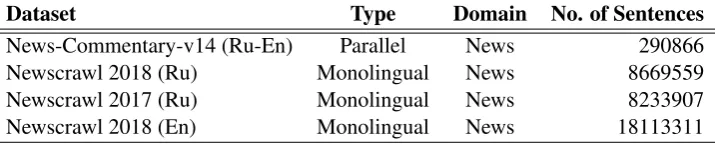
Dataset Type Domain No. of Sentences
News-Commentary-v14 (Ru-En) Parallel News 290866 Newscrawl 2018 (Ru) Monolingual News 8669559 Newscrawl 2017 (Ru) Monolingual News 8233907 Newscrawl 2018 (En) Monolingual News 18113311
Table 1: Statistics about the data
describe the datasets that we used for our experi-ments. Next, we describe our experimental setup for carrying out the experiments. We then analyze the results for NMT, USMT and other models on Russian - English dataset. We conclude the paper with discussion on future work.
2 Related Works
In this section, we will describe the main ideas and experiments using backtranslation and mono-lingual data.
Backtranslation was popularized by Sennrich et al. (2016a) where they improved the state-of-the-art in several language pairs. They trained a target to source machine translation model on the aligned parallel corpus. The model was later used to translate target-side monolingual sentences to the source language. These new synthetic sen-tences were added to the training set and a new model is trained.
On similar lines, Zhang and Zong (2016) use the source-side monolingual data to train the NMT model. They build a baseline NMT model and then use that model to generate the synthetic paral-lel data. They experiment on self-training as well as multitask learning.
He et al. (2016) introduced a dual learning mechanism for neural machine translation. They train translation models in both directions and use monolingual data to provide feedback on the qual-ity of the translation. Their main contribution was to treat machine translation as a reinforcement learning problem.
Hoang et al. (2018) proposed a simple tech-nique. They do show that iterative backtranslation improves the performance of the system on large datasets. However, they observe that the improve-ments in low resource datasets were not signifi-cant.
As mentioned earlier, obtaining aligned paral-lel corpora is expensive and cumbersome. Recent efforts in Unsupervised Machine Translation indi-cate that it is possible to develop a competitive
sys-tem using only monolingual corpus (Lample et al.,
2018;Artetxe et al.,2018).
In our study, we use an unsupervised statisti-cal machine translation system based onArtetxe et al.(2018)1. In their paper, they describe a novel method to build a statistical machine translation model using monolingual data without any paral-lel data. The main idea is to learn word embed-dings for each language independently and use lin-ear transformations to bring them to shared space. These embeddings are used to generate the phrase table and then, the SMT is fine-tuned on a syn-thetic training set. In our work, we make use of this model to generate more synthetic data to be added to the parallel corpora.
3 Data
We perform our experiments on the Russian - En-glish language pair. For training the supervised model (both the back-translated model and re-trained model), we use the Russian - English par-allel corpus from WMT 19 2. To train our unsu-pervised model, we used monolingual corpora for Russian3and English4from Newscrawl 2017 and 2018 datasets. For English, we consider only the Newscrawl 2018 as the monolingual data where as for Russian we combine both Newscrawl 2017 and 2018 for the monolingual data.
We provide more details regarding the data in Table1.
3.1 Preprocessing
For normalizing punctuation in the parallel cor-pora, we use the default scripts provided by Moses
5. We then perform true-casing followed
byte-1We use this method as it did not require huge amounts of resource to train compared to other methods such asArtetxe et al.(2019)
2http://www.statmt.org/wmt19/index.html 3
http://data.statmt.org/news-crawl/ru/ 4
http://data.statmt.org/news-crawl/en/ 5
pair encoding while training the NMT6(Sennrich et al.,2016b).
3.2 Postprocessing
We remove byte pair encodings, detrucase and detokenize all the translated sentences before val-idating the predictions against the test set.
4 Experimental Setup
We describe our experimental setup in this section. For our unsupervised statistical machine trans-lation model, we use Monoses (Artetxe et al.,
2018). We use the defaults for training the unsu-pervised model from the Monoses code. We train the model on both Russian to English (ru-en) and English to Russian (en-ru) monolingual corpus.
Monoses frameworks trains the model in 8 steps. Steps 1-7 involves training the word embed-dings and bringing them to a shared space to build an initial phrase table. In step 8, 2M sentences are generated through backtranslation in both the directions. The phrase table is fine-tuned for 3 it-erations using the synthetic sentences to obtain the final model.
We use OpenNMT for training the supervised machine translation models (Klein et al., 2017). We use the default architecture in OpenNMT, which includes an LSTM layer for encoding and another LSTM layer for decoding. Furthermore, we do not use the pretrained word embeddings. For both NMT and retraining the NMT model, we use the same architecture with default values.
To train the USMT model and NMT models, we used a system with 4x vCPUS, NVIDIA Tesla K80 GPU and 61 GB of RAM. The USMT model took about 2 weeks to complete training where as the NMT model usually took about 4-5 hours.
5 Experiments
Our primary aim is to show that we can use an un-supervised machine translation model to improve the performance of NMT systems. At the same time, we want to have a fair validation and investi-gate numerous scenarios where our approach per-forms well.
Therefore, in this experiment, we use mono-lingual data to generate synthetic sentences using both NMT and USMT separately and then, each of them is used to augment the training data for the
6 https://github.com/rsennrich/subword-nmt/tree/master/subword nmt
Neural Machine Translation model. For example, we use back-translated Russian monolingual cor-pus to generate synthetic English sentences. These English sentences are added to the training corpus (with varying training corpora sizes) with English as the source and Russian as the target. We then train an NMT model from scratch and report our performance on an unseen test set.
In the case USMT, we backtranslate the mono-lingual corpus using the USMT model and aug-ment the sampled training data. The training data is used to build the NMT model.
25% 50% 75%
10 15 20
Sample Size BLEU Score
EN-RU
NMT USMT
Figure 1: BLEU scores for NMT backtranslation and USMT backtranslation for EN-RU
6 Results
We perform all the experiments mentioned in the Table2. Each row has a key which corresponds to the type of training corpora. The training corpora includes Only Parallel corpora, Only Monolingual Corpora and a sampled combination of the Parallel Corpora and the backtranslated Monolingual Cor-pora.
We obtain the baseline NMT model using the parallel corpus without any additional synthetic sentences. As mentioned earlier, we train the pallel corpora using the default encoder-decoder ar-chitecture from OpenNMT. Furthermore, we train a baseline USMT model using the monolingual corpora of English and Russian. We report the re-sults in Table2.
ru-en en-ru
Training Corpus NMT USMT NMT USMT
Only Parallel Corpora 17.65 - 15.54 -Only Monolingual Corpora - 15.58 - 8.07
10% (∼29K) + Backtranslated Corpora 13.17 16.34 9.31 11.57
25% (∼72.5K) + Backtranslated Corpora 14.81 17.17 12.02 12.63
50% (∼145K) + Backtranslated Corpora 19.63 18.46 14.67 13.18 75% (∼217K)+ Backtranslated Corpora 20.17 19.34 15.74 13.97
Table 2: The BLEU scores for the different experiments. The training corpus with x% indicates the percentage of aligned training pairs randomly sampled from the parallel corpora.
there is sufficient data available.
To train the NMT backtranslation models, we sample the parallel corpora in batches of 10%, 25%, 50%, and 75% and train the NMT back-translation model i.e. NMT model in the reverse direction (target to source). The synthetic data is generated by translating the monolingual corpora in English to Russian and Russian to English re-spectively. In Table 2, we refer to the synthetic sentences as Backtranslated Corpora. These sen-tences are combined with the sampled parallel cor-pora and retrained in the correct direction. In the case of USMT, we directly translate the monolin-gual corpora and include these synthetic sentences as a part of the training for NMT model in the cor-rect dicor-rection.
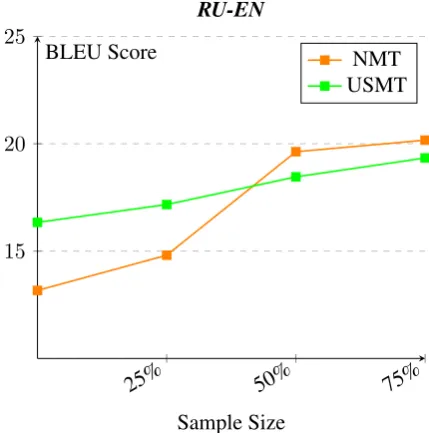
Our results indicate the following - It can be seen that in critically low resource scenarios, the USMT backtranslated model performs better than the NMT backtranslated model (By 2.4 to 3.2 BLEU points for Russian to English and 0.61 to 2.26 BLEU points for English to Russian). How-ever, the performance of the NMT system dra-matically increases with the availability of parallel data. This shows that USMT as a backtranslation model works well mostly in low resource settings. We can infer that the quality of the backtransla-tion model has a significant impact on the perfor-mance of the model. Additionally, we can see that the NMT model with small amount parallel data combined USMT model improves over the USMT baseline performance.
7 Discussion
In our future experiments, we would like to in-vestigate the effect on lexical properties such as Named Entities and numbers in the predictions. We would also like to experiment our approach with newer techniques from Unsupervised
Ma-25% 50% 75%
15 20 25
Sample Size BLEU Score
RU-EN
NMT USMT
Figure 2: BLEU scores for NMT backtranslation and USMT backtranslation for RU-EN
chine Translation (Artetxe et al.,2019). Addition-ally, we would like to extend our approach to other languages to comprehensively test our hypothesis.
8 Code
To facilitate reconstruction of our pa-per, we are releasing the code
-https://github.com/anush6/USMT For Backtranslation
9 Acknowledgement
We would like to thank our anonymous reviewers for their helpful feedback and comments.
References
Mikel Artetxe, Gorka Labaka, and Eneko Agirre. 2018. Unsupervised statistical machine translation. In Proceedings of the 2018 Conference on Empirical Methods in Natural Language Processing, Brussels, Belgium. Association for Computational Linguis-tics.
Mikel Artetxe, Gorka Labaka, and Eneko Agirre. 2019. An effective approach to unsupervised ma-chine translation. InProceedings of the 57th Annual Meeting of the Association for Computational Lin-guistics (Volume 1: Long Papers), Florence, Italy. Association for Computational Linguistics.
Dzmitry Bahdanau, Kyunghyun Cho, and Yoshua Ben-gio. 2015. Neural machine translation by jointly learning to align and translate. In 3rd Inter-national Conference on Learning Representations, ICLR 2015, San Diego, CA, USA, May 7-9, 2015, Conference Track Proceedings.
Ondˇrej Bojar, Christian Federmann, Mark Fishel, Yvette Graham, Barry Haddow, Philipp Koehn, and Christof Monz. 2018. Findings of the 2018 con-ference on machine translation (WMT18). In Pro-ceedings of the Third Conference on Machine Trans-lation: Shared Task Papers, pages 272–303, Bel-gium, Brussels. Association for Computational Lin-guistics.
Anna Currey, Antonio Valerio Miceli Barone, and Kenneth Heafield. 2017. Copied monolingual data improves low-resource neural machine translation. In Proceedings of the EMNLP 2017 Second Con-ference on Machine Translation (WMT17), Copen-hagen, Denmark.
Di He, Yingce Xia, Tao Qin, Liwei Wang, Nenghai Yu, Tie-Yan Liu, and Wei-Ying Ma. 2016. Dual learning for machine translation. In D. D. Lee, M. Sugiyama, U. V. Luxburg, I. Guyon, and R. Garnett, editors, Advances in Neural Information Processing Systems 29, pages 820–828. Curran Associates, Inc.
Vu Cong Duy Hoang, Philipp Koehn, Gholamreza Haffari, and Trevor Cohn. 2018. Iterative back-translation for neural machine back-translation. In Pro-ceedings of the 2nd Workshop on Neural Machine Translation and Generation, pages 18–24, Mel-bourne, Australia. Association for Computational Linguistics.
Guillaume Klein, Yoon Kim, Yuntian Deng, Jean Senellart, and Alexander Rush. 2017. OpenNMT: Open-source toolkit for neural machine translation. In Proceedings of ACL 2017, System Demonstra-tions, pages 67–72, Vancouver, Canada. Association for Computational Linguistics.
Philipp Koehn and Rebecca Knowles. 2017. Six chal-lenges for neural machine translation. In Pro-ceedings of the First Workshop on Neural Machine Translation, pages 28–39, Vancouver. Association for Computational Linguistics.
Guillaume Lample, Myle Ott, Alexis Conneau, Lu-dovic Denoyer, and Marc’Aurelio Ranzato. 2018. Phrase-based & neural unsupervised machine trans-lation. In Proceedings of the 2018 Conference on Empirical Methods in Natural Language Processing (EMNLP).
Rico Sennrich, Barry Haddow, and Alexandra Birch. 2016a. Improving neural machine translation mod-els with monolingual data. In Proceedings of the 54th Annual Meeting of the Association for Compu-tational Linguistics (Volume 1: Long Papers), pages 86–96, Berlin, Germany. Association for Computa-tional Linguistics.
Rico Sennrich, Barry Haddow, and Alexandra Birch. 2016b. Neural machine translation of rare words with subword units. InProceedings of the 54th An-nual Meeting of the Association for Computational Linguistics (Volume 1: Long Papers), pages 1715– 1725, Berlin, Germany. Association for Computa-tional Linguistics.
Ashish Vaswani, Noam Shazeer, Niki Parmar, Jakob Uszkoreit, Llion Jones, Aidan N. Gomez, Lukasz Kaiser, and Illia Polosukhin. 2017. Attention is all you need. InNIPS.