Proceedings of Recent Advances in Natural Language Processing, pages 360–366, Varna, Bulgaria, Sep 2–4, 2019.
https://doi.org/10.26615/978-954-452-056-4_042
360
Abstract
This paper describes an automatic text-to-phonetics conversion system. The system was constructed to primarily serve as a research tool. It is implemented in a general-purpose linguistic software, which allows it to be incorporated in a multifaceted linguistic research in essentially any language. The system currently relies on two mechanisms to generate phonetic transcriptions from texts: (i) importing ready-made phonetic word forms from external dictionaries, and (ii) automatic generation of phonetic word forms based on a set of deterministic linguistic rules. The current paper describes the proposed system and its potential application to linguistic research.
1
Introduction
There are currently many commercial and academic works dealing with automatic conversion of text to phonetics (G2P). Existing solutions are based on some combination of language-specific phonetic dictionaries, corpus-based statistical models (e.g., Hidden Markov Models), deterministic models based on linguistic rules, and machine learning techniques (see review in Tomer, 2012). Importantly, most available tools are closed-source, support only a limited number of languages, and are often available only for commercial use (e.g., Baytukalov, 2019).
The current paper describes a new, open-source system that generates phonetic transcriptions from texts. Its design allows it to apply, in principle, to any language. At present, the system relies on two mechanisms to generate the transcriptions: (i)
1 Website: https://chengafni.wordpress.com/cpa/
2 The code is written in Visual Basic for Applications for
MS Excel and is available under the GNU General Public License. A version of this system for LibreOffice Calc is
importing ready-made phonetic word forms from external dictionaries, and (ii) automatic generation of phonetic word forms based on a set of deterministic linguistic rules. The following sections describe the transcription mechanisms and additional relevant tools.
2
Preliminaries
The described system is implemented in the Child Phonology Analyzer software (CPA; Gafni, 2015)1, which was built in MS Excel due to its popularity and user-friendly interface.2 Nevertheless, the concepts behind the system are general and can be implemented in various environments. The following subsections describe the general organization of the system and guidelines for working with the data.
2.1 Tables
The system uses a set of tables of definitions and rules to guide its operation. The tables are stored in separate spreadsheets in the CPA file and can be edited according to the properties of the language in question. Moreover, variants of these tables can be stored in separate files and imported by the system when needed. This feature allows users to maintain sets of definitions and rules for multiple languages.3
2.2 Organizing the Data
The transcription procedures (“macros”) operate on a vector of words. Thus, the input text should be converted into a vector format prior to running the transcription macros. This can be done using the “Corpus tokenization” option of CPA’s “Data
planned to appear in the future in order to free it from dependency on proprietary software.
3 The system is accompanied by an external resource
containing proposed sets of rules for several languages.
A Universal System for Automatic Text-to-Phonetics Conversion
361 preparation” macro, which segments the text into words.
Segmentation is performed on the basis of blank spaces and additional word-dividing characters, which can be defined in CPA’s “Word dividers” table (Figure 1). There are two types of word dividers, which can be used for separating words even at the absence of a blank space: punctuation
marks (e.g., comma) are deleted during segmentation, while final letters are not (final letters are special letter forms appearing only at word endings. See some examples from Hebrew in Figure 1). Once the text is transformed into a vector format, transcription can be performed. One of CPA tools (“Reconstruct corpus”) can then be used to recombine the phonetic word forms according to the structure of the original text.
3
Phonetic Dictionaries
For languages with irregular spelling or high proportion of homographs, such as English, Hebrew, and Arabic, automatic phonetic transcription requires a source of ready-made phonetic forms (i.e., a phonetic dictionary) for irregular and ambiguous words. CPA has a built-in macro that can import such ready-made forms. The macro receives as input a vector of written words to-be-transcribed and a phonetic dictionary – a table of written word forms and corresponding phonetic forms. The macro matches phonetic forms from the dictionary to written words in the vector. For words that are not found in the phonetic dictionary, transcription needs to be generated, either manually or with the automatic linguistic model (see next section). However, once the additional phonetic word forms are supplied, CPA
4The tables of rules are generated manually, in principle.
CPA has a set of editable tables that contain proposed rules for several languages (see also 2.1).
can add them to the phonetic dictionary for future use.
4
The Linguistic Model
For languages with some degree of regular mapping between spelling and sound, phonetic transcription of text can be generated automatically on the basis of deterministic rules. This section describes a multi-stage model of automatic phonetic transcription, guided by linguistic principles. Underlying this model is the assumption that, for any regular orthographic system, phonetic transcription rules can be defined in terms of a small set of general operations. The general operations themselves are hard-coded in the software, but an unlimited number of language-specific rules can be defined on the basis of these operations. This flexible method allows the system to produce automatic phonetic transcription for every language that has, at least partly, regular orthography.
The proposed model has four components, which will be described in the following subsections. The components operate independently of one another, but they should be applied in the order in which they are listed. The first component alone produces sufficient results for most purposes. If needed, the additional three components can be used, together, for fine-tuning.
4.1 Pre-Prosody Transcription
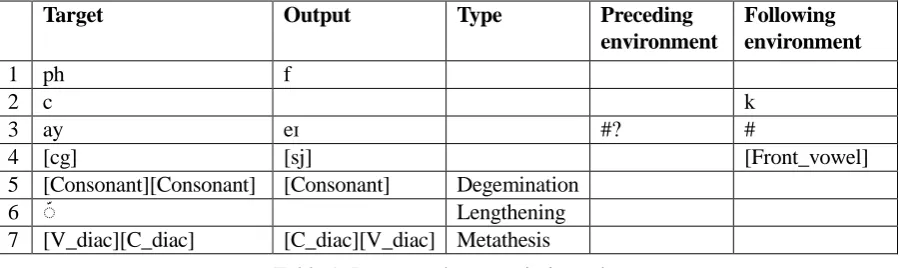
This component takes as input the vector of words to-be-transcribed, a table of pre-prosody transcription rules (Table 1), and a table containing sets of symbols and strings, called “phono-orthographic groups” (Table 2).4 The pre-prosody transcription5 applies the transcription rules in successive order to the list of words. Entities
5 The term ‘pre-prosody’ indicates that the transcription
rules applied by this component disregard the prosodic properties of the word, including syllable structure and stress pattern.
363 collapses sequences of identical consonants (e.g.,
mm is pronounced as a single m in hammer).
Lengthening realizes the function of diacritical marks of lengthening/gemination. For example, rule 6 in Table 1 realizes the function of the Arabic Shaddah (e.g., the letter م is pronounced /m/ in its plain form, but as /mm/ when modified by a Shaddah, i.e.,مّ ).
Finally, metathesis switches the order of elements in sequences of two phono-orthographic groups (i.e., if the target contains a member of group 1 followed by a member of group 2, they are switched in the output). For example, in pointed Hebrew scripts, diacritics are used for indicating vowels as well as for modifying the phonetic value of consonants. A single letter can host both consonant and vowel diacritics (the C_diac and V_diac groups in Table 2, respectively). Thus, the string ָבּ, pronounced /ba/, is composed of the letter ב (representing the consonants /b/ and /v/), a consonant diacritic ּ◌ (specifying the consonant /b/), and a vowel diacritic ָ◌ (representing the vowel /a/). Although the order in which these diacritics are attached to the letter does not affect the visual form of the text, it is important for the purpose of phonetic transcription – consonant diacritics must be attached before vowel diacritics. For example, the string ָבּ can be formed by combining the three elements in two ways: ב+ּ◌+ ָ◌, or ב+ָ◌+ּ◌. However, only the first order reflects the phonological structure of the string. A rule of metathesis can be defined to switch the order in sequences of vowel diacritics + consonant diacritic to guarantee correct ordering (rule 7 in Table 1).
After performing the pre-prosody transcription, certain modifications might be needed due to phonological processes related to prosodic structure. This post-prosody transcription (see 4.4) requires that the phonetic forms be parsed into syllables and have stress markers assigned to them. These components are described below.
4.2 Syllabification
This component takes as input a vector of phonetic word forms, a list of binary parameters and parameter weights, and a phonetic table. The output is a vector of syllabified phonetic word forms (Figure 3). The basic sites of syllable boundaries are around local sonority minima (e.g., the boldfaced consonants in fæməli ‘family’ → fæ.mə.li).
In order to determine sites of sonority minimum, the syllabification procedure converts the phonetic word forms into strings of sonority levels. Sonority levels are non-negative integers specified for each phone in the phonetic table of CPA (Figure 4). For example, if fricatives, nasals, liquids, and vowels have sonority levels of 1, 2, 3, and 5, respectively, the sonority-level representation of fæməli will be 152535. In this representation, 2 and 3 are local sonority minima (Sonority minima at word edges are ignored).
Figure 4: The phonetic table
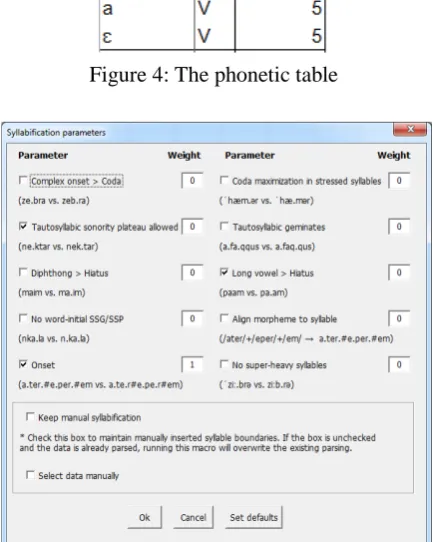
364 The basic sites of syllable boundaries can be adjusted by a set of binary parameters, which handle various cases, such as consonant sequences (e.g., whether /dɪspleɪ/ ‘display’ should be parsed as dɪs.pleɪ or dɪ.spleɪ). The system currently has 10 built-in parameters, which can be switched on and off according to the properties of the examined language (Figure 5). Some of the parameters require phones to be recognized as vowels or consonants. This information is also specified in CPA’s phonetic table (Figure 4). For example, if the
Complex onset > Coda parameter is switched on, consonant sequences will be parsed as complex onsets (dɪ.spleɪ). If the parameter is switched off, consonant sequences will be split between coda and onset positions (dɪs.pleɪ).
When two parameters are potentially in conflict, they can be ranked relative to each other by assigning different integer weights to them. For example, if the Onset parameter is on, onsetless syllables will be dispreferred (e.g., ˈmʌni → ˈmʌ.ni ‘money’). This can be overridden (e.g., ˈmʌn.i) by switching on the Coda maximization in stressed syllables parameter and giving it a higher weight than the onset parameter (this requires that stress would be marked on the word before running syllabification).
4.3 Stress Assignment
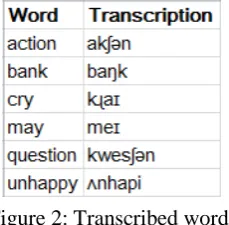
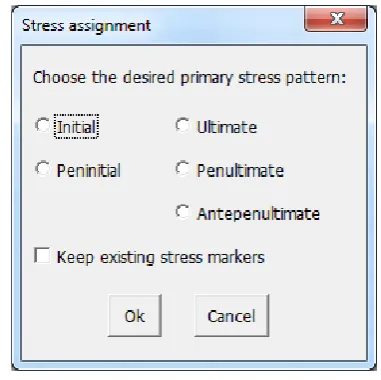
When the phonetic transcription requires modifications due to processes related to stress (e.g., reduction of unstressed vowels), stress markers should be added to the phonetic word forms. The stress assignment component of the software takes as input a vector of syllabified words and the desired stress pattern. The output is a vector of syllabified words with stress markers inserted at the appropriate positions (e.g., for the input word ak.ʃən ‘action’ and penultimate stress pattern, the output will be ˈak.ʃən; Figure 6).
The software has five built-in stress patterns (at present, only primary stress is handled): Initial, Peninitial, Ultimate, Penultimate, and Antepenultimate (Figure 7). For languages with a non-fixed stress pattern (e.g., English), this procedure can be used for applying the most
frequent stress pattern. Manual corrections can be made afterwards. If stress position depends on the number of syllables, it is possible to run stress assignment multiple times, starting with the rule for the longer words. Checking the ‘Keep existing stress markers’ option will prevent stress rules for shorter words from applying to longer words, for which stress has been assigned already.
4.4 Post-Prosody Transcription
This components modifies phonetic word forms according to phonological rules related to prosodic structure. It takes as input a vector of phonetic word forms, a table of post-prosody transcription rules (Table 3), and a phonetic table. The procedure applies the transcription rules in successive order to the list of words.
The table of post-prosody transcription rules has five fields (Table 3): (1) Trigger: the phonological
Trigger Tier Position Process Result
1 [+STRID][+STRID] Features Coda Vowel epenthesis ə
2 Unstressed vowel CV Vowel reduction ə
3 Sonority decrease Sonority Onset Vowel epenthesis ə
Table 3: Post-prosody transcription rules
366
References
Daniel Asherov, Alon Fishman, and Evan-Gary Cohen. 2016. Vowel Reduction in Israeli Heritage Russian. Heritage Language Journal, 2:113–133.
Timur Baytukalov. 2019. EasyPronunciation.com: All-in-one solution to learn pronunciation online.
Moon Jung Chae, Kyubyong Park, Linhyun Bang, Soobin Suh, Longhyuk Park, Namju Kimt, and Longhun Park. 2018. Convolutional sequence to sequence model with non-sequential greedy decoding for grapheme to phoneme conversion. In Proceedings of the 2018 IEEE International Conference on Acoustics, Speech and Signal Processing (ICASSP 2018), pages 2486–2490.
Chen Gafni. 2015. Child Phonology Analyzer: processing and analyzing transcribed speech. In The Scottish Consortium for ICPhS 2015, editor, Proceedings of the 18th International Congress of Phonetic Sciences., page 1–5, paper number 531, Glasgow, UK: the University of Glasgow.
Chen Gafni. 2019. General Lexicons of Hebrew: Resources for Linguistic and Psycholinguistic Research (version 1.0).
Ian Smythe, John Everatt, Nasser Al-Menaye, Xianyou He, Simone Capellini, Eva Gyarmathy, and Linda S. Siegel. 2008. Predictors of word-level literacy amongst Grade 3 children in five diverse languages. Dyslexia, 14(3):170–187.
Eran Tomer. 2012. Automatic Hebrew Text