Proceedings of Recent Advances in Natural Language Processing, pages 130–138,
Mining Association Rules from Clinical Narratives
Svetla Boytcheva Ivelina Nikolova
Institute of Information and Communication Technologies Bulgarian Academy of Sciences
25A Acad. G. Bonchev Str., 1113 Sofia, Bulgaria
[email protected] {iva,galia}@lml.bas.bg Galia Angelova
Abstract
We propose a method that processes raw informal medical texts (from health fo-rums) and formal texts (outpatient records) in Bulgarian language in order to extract typical word co-occurrences in the form of association rules. When mining these rules we use some context information and small terminological lexicons to general-ize the extracted frequent patterns. This allows to study informal expressions of medical terminology and to identify auto-matically typical descriptions of types of patient statuses. The paper presents asso-ciation rules generated from 300,000 out-patient records and 1,425 forum postings and discusses their evaluation and useful-ness. Employing this unsupervized data mining approach we hope to overcome the lack of linguistic resources that can sup-port successful NLP analysis of clinical narratives in Bulgarian.
1 Introduction
Clinical narratives written by medical experts are a growing source of patient-related information that can be used in medical research and healthcare management. In addition, informal medical texts and conversations in social networks and popular TV broadcasts increase significantly. Public fo-rums for medical consultations exist as well where doctors provide opinions and answer questions. In this case medical experts abandon the profes-sional style of clinical writings (brief reports in cryptic form with medical terminology and spe-cific words, abbreviations, acronyms, and phrases of their professional jargon). They switch to in-formal, conversational style (avoiding terminol-ogy, using casual words for popular explanations,
with shorter and simpler sentences etc.). Differ-ences between informal and formal communica-tion are often addressed in translacommunica-tion where the objective is to reproduce language in all its vari-ety. In (Lozano and Matamala,2009) the authors analyse how the original English medical termi-nology, used to give a special atmosphere and to reproduce a real professional context in the televi-sion series E.R., was translated in colloquial lan-guage to reach a broad audience of Spanish na-tive speakers in the Spanish dubbed version. The original English terms were manually categorized based on their degree of formality in order to dif-ferentiate between formal and informal medical language. Then rules for selecting translations in different settings were elaborated. This structuring enabled to approach systematically the evaluation of translation. Many mistakes have been found in the translation of medical terminology, hence low-ering the realism of the dubbed version. The con-clusion is that terminology misuse is rather often in informal communication.
Here we also consider formal and informal medical texts but as input data for mining Asso-ciation Rules (AR) that explicate stable colloca-tional patterns of terms and words. The overall objective is to find frequent patterns of lexical co-occurrences which, as we suppose, will help to structure patient descriptions. In general there are no standard templates how patients are to be ex-amined, e.g. in diabetes there is no predefined structured questionnaire how to document the sta-tus of a diabetic patient in the form of indicators and their values. Earlier attempts to structure pa-tient status descriptions took us months to study a large number of patient records and weeks of man-ual work to produce feature-value templates that were discussed with medical experts (Boytcheva et al., 2010). Now we believe that ARs will dis-cover automatically attributes and their values as
the latter are expressed by lexical units in the free text descriptions. Therefore it is important to con-sider patient-related texts in records produced by medical doctors as well as informal texts written by the patients themselves. In addition for low re-source languages like Bulgarian, Data Mining pro-vides better instruments to discover new knowl-edge than Text Mining via shallow analysis and information extraction techniques. We propose a method that processes raw formal clinical narra-tives (outpatient records, OR) and informal texts (postings in health forums) in Bulgarian language. Some context information is taken into consider-ation when mining the ARs, which is an original aspect of the proposal. Small terminological lex-icons provide generalization of extracted frequent patterns. This approach allows to map informal expressions of medical terminology to the formal ones and to study in parallel both the professional and colloquial medical language.
The paper is structured as follows. Section 2 overviews related work. Section 3 presents the materials used and Section 4 - the methods. Sec-tion 5 details the experiments. SecSec-tion 6 contains the conclusion and plans for future work.
2 Related Work
Almost no electronic resources with medical ter-minology exist for Bulgarian language (except for terms in standard medical nomenclatures) so we are interested in terminology extraction for low resource languages. For Polish, linguistic analy-sis and statistical methods identify automatically phrases that cover 84% of the occurring medical terms in over 1,200 discharge letters (Marciniak and Mykowiecka, 2014). At the top of the ranked list, only 4% out of 400 terms were in-correct. Another work deals with term extrac-tion from sparse, ungrammatical and informally-written texts with domain-specific contents (Ittoo and Bouma, 2013). This paper focuses on rare (low frequency) terms, detects multi-word terms of arbitrarily lengths which are often disregarded by existing term extraction systems, and involves external resources (Wikipedia) to support domain-specific term extraction and assessment of accu-racy. A rather high F1-measure is achieved (88% against a baseline of 77%) and successful extrac-tion of terms regardless of their length.
Discovering frequent word sequences also pro-vides useful hints about analysis of units in
for-mal and inforfor-mal texts. A method for extraction of all maximal frequent word sequences, which allows for gaps, is presented in (Ahonen-Myka, 1999). The algorithms in (Ahonen-Myka, 2002) include pruning of all stop words, which might be problematic in case of terminological expres-sions. No stemming is applied since inflexion end-ings might be meaningful, moreover their removal will combine sequences and in this case some low-frequency variations can exceed together the se-lected frequency threshold. In (Ahonen-Myka and Doucet,2005) the discovery of maximal frequent word sequences is re-considered in the light of collocation discovery, where “collocation” is a re-current, stable multiword expression without gaps. The authors assume that most existing methods for collocation discovery cannot be straightforwardly extended to find sequences with length more than 5 words, when applied to large corpora.
Text mining extracts essential information from texts while data mining (in particular ARs) dis-covers novel knowledge about the subject. ARs that are found in texts are used in various kind of document-processing applications, for instance:
(i)Text classiffication based on ARs: sentences of documents are viewed as basic text units (Har-alambous and Lenca,2014). This approach is en-riched by linguistic knowledge (delivered by the Stanford dependency parser). Words are replaced by their hyperonyms in WordNet, to optimize the itemsets. In the training phase ARs are mined from sentences. At the classification stage, for each sentencesin a document dthe system finds the most confident AR that can be applied to it (i.e., such that the itemset of the rule is entirely contained in the itemset of the sentence). An aggregation procedure classifies the document by taking class by class the sum of rule confidence and selecting the class with the highest sum. The evaluation was done on 7,000 texts of Reuters cor-pus. The experiments show that using dependency property (nsubj) to select a word is a better choice than the one provided by thetf-idf-based method. However, no alternative classification techniques are applied in parallel to the same text collection so no real conclusion can be drawn about the ef-fectiveness of the suggested approach.
in Turkish language. Then-gram method was used for discovering terms co-occurrences. A dataset of concept candidates has been generated for the validation step and then the Predictive Apriori al-gorithm for AR mining was applied to validate the candidate concepts.
(iii) Explication of relations among text units: (Sizov and Öztürk,2012) present the SmoothApri-ori algSmoothApri-orithm that finds association relations be-tween sentences which may reveal a cause-effect type of relation or have a more implicit nature. SmoothApriori uses similarity between items; compared to a previously proposed SoftApriori al-gorithm, which also makes use of similarity, it is able to utilize similarity values directly rather than reducing them to binary values similar/not-similar. The evaluation was done on “Findings as to Risk” section of 208 Air Investigation Reports, published by the Transportation Board of Canada. Many top confidence rules, automatically gener-ated by SmoothApriori, are interesting and make sense. Some rules connect consecutive sentences in the same text but the implicit discourse relation of causality is explicated. This application illus-trates the potential of using ARs in various areas.
The results presented here integrate text and data mining ideas, extending further our previous developments (Boytcheva et al.,2017).
3 Materials
We work with two data sources: ORs submit-ted to the Bulgarian National Health Insurance Fund (NHIF) and content from the online medi-cal portalpuls.bg1. The ORs concern 10,000
dia-betic patients and were produced by Endocrinol-ogists (ESs) (set S00) and General Practitioners (GPs) (set S05) in 2012–2013. In total these are 330,666 records, semi-structured files with pre-defined XML-format. We use only two free text fields of these ORs: "Anamnesis" and "Patient Sta-tus". The corpus of informal medical texts in-cludes postigns atpuls.bgforum (setSF). We pro-cess all questions and comments from three sub-forums2amounting to 1,425 records.
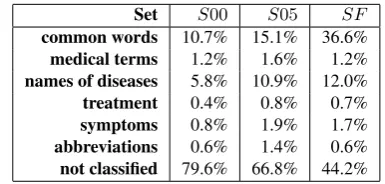
Fig.1presents the distribution of words (items) in the sets after stemming and stop words removal. We analyzed how the sources vocabularies are distributed in different categories using available lexicons. Table1presents the distribution of
cate-1http://puls.bg
2Diabetes, Smoking cessation, Thyroid gland
Figure 1: Corpus vocabulary
gories in subsets of 20% of the vocabulary inS00, 35% inS05and 55% inSF.
Set S00 S05 SF common words 10.7% 15.1% 36.6% medical terms 1.2% 1.6% 1.2% names of diseases 5.8% 10.9% 12.0% treatment 0.4% 0.8% 0.7% symptoms 0.8% 1.9% 1.7% abbreviations 0.6% 1.4% 0.6% not classified 79.6% 66.8% 44.2%
Table 1: Vocabulary distribution in training sets
The items of SF are mainly general lexica (36.6%) and names of diseases (12.2%). The most frequent units are stop words (43%) followed by numerical values (5%), some common words like have/has, year, value, month, examination, prob-lem, result etc. signaling for the duration of the symptoms and medical terms signaling for the lo-cation of the finding - endocrine, hormon, thyroid gland.
The items of S00 are mainly common words and names of diseases. The most frequent units are stop words (19.84%), numerical values (7.54%), names of anatomic organs and systems as well as their conditions: breath, abdomen, liver, rhytmic, soft, RR (Riva Roci), vesicular, pulmo, limbs.
Similarly to S00, the items of S05are mainly common words and names of diseases. Some of the most frequent units are stop words (17.12%), numerical values (12.60%), and indicators related to diabetes concepts like: sugar, treatment, activ-ity, diabetes, rythmic, type, breath, BSP (blood sugar profile).
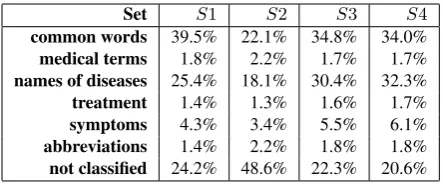
Set S1 S2 S3 S4
common words 39.5% 22.1% 34.8% 34.0% medical terms 1.8% 2.2% 1.7% 1.7% names of diseases 25.4% 18.1% 30.4% 32.3% treatment 1.4% 1.3% 1.6% 1.7% symptoms 4.3% 3.4% 5.5% 6.1% abbreviations 1.4% 2.2% 1.8% 1.8% not classified 24.2% 48.6% 22.3% 20.6% Table 2: Common vocabulary in the training sets, whereS1 = S00∩SF, S2 = S00∩S05, S3 = S05∩SF, S4 =S00∩S05∩S0F
10,000 most frequent words in Bulgarian, names of diseases (32.2%), symptoms (6.1%), abbrevia-tions (1.8%) and other medical terms (1.7%).
The common items for SF and S05 represent terminology related to diabetes. This is not sur-prising because the forum topic is about diabetes andS00 contains ORs written by Endocrinology specialists. Examples of such items are: enlarged, weight, hemoglobin, insulin, examination, pain, control, glycated, treatments, blood, sugar, con-sisting, profile, diabetes etc.
The common items forSF andS00are mainly terms related to medical examinations. This is also easy to explain sinceSF consists of informal texts and S00 contains clinical notes of General Practitioners. Examples of items common forSF and S00 are: treatment, procedure, drugs, com-plains, pain, examination, condition, consultation, normal, increased, control, changed, etc.
The common items for S05 and S00 are mainly terms concerning patient status - names of anatomic organs and systems. Examples of such items are: succusio renalis, palpated, non-painful, enlarged, ripple, pink, terminal, height, weight, limbs, pulmonary, good, breathe, family, edema, vesicular, complained, RR, liver, neck, rhythmi-cally, peripheral, diabetes, control, heart, etc.
4 Text Analysis Methods
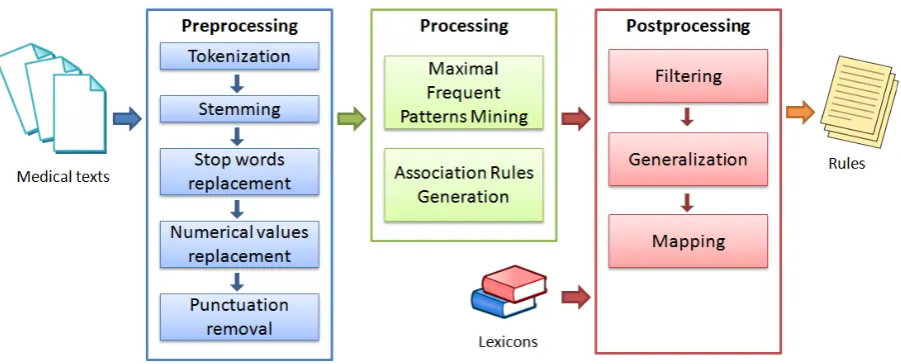
Our approach has three main phases: preprocess-ingwhich converts the text documents into item-sets, processing based on frequent pattern min-ing (FPM) techniques and elicitation of ARs, and postprocessing that filters, maps and generalizes rules by using context information and small lex-icons (Fig. 2). The system processes input texts in unicode format and is language independent in principle (stemming and stopword filtering can be replaced by modules for another language).
4.1 Preprocessing
We have three text collections:SF- questions and comments in forum postings, S05 and S00 - the free texts of "Anamnesis" and "Patient Status" sec-tions of ORs written by ESs and GPs correspond-ingly. Each text inSF,S05, andS00is turned to a sequence of word stems in their original order, using blank spaces and punctuation delimiters as tokenization separators. Stop words and numbers may be essential for some patterns so they are pre-served and generalized - replaced by the constants STOP and NUM correspondingly. After this step the punctuation is eliminated because it is often er-roneosly written or missing in both forums and in ORs.
Let S be one collection. The vocabulary used in all documents ofS will be called items W =
{w1, w2, ..., wn}. For the collection S we
ex-tract the set of all different documents P =
{p1, p2, ..., pN}, where pi ⊆ W. This set
cor-responds to transactions; the associated unique transaction identifiers (tids) shall be called pids
(patient identifiers). Each patient interaction with a doctor (question or comment inSFor an anam-nesis or patient status section of an OR inS00and S05) is viewed as a single document inP.
4.2 Processing
Our documents are written in different styles: the forum texts have quite informal syntax structure while the ORs are written in telegraphic style with phrases rather than full sentences. Usually the ORs list attribute-value (A-V) pairs - anatomic or-gans/systems and their status/condition:
A1V1, ..., AnVn|V1A1, ..., VnAn.
E.g.: Кор - ритмична нормофреквентна сърдечна дейност, Крайници- хипестезия от дистален тип, везикуларно дишане.(Cardiovascular system - rhythmic norm frequent heartrate, limbs - hypoesthesia distal type, vesicular breath.)
whereA1=Cardiovascular system,A2=limbsand
A3=breath are attributes and their corresponding
values areV1=rhythmic norm frequent heartrate, V2=hypoesthesia distal type followingA1andA2
andV3=vesicularpreceedingA3.
Attribute names contain phrases and abbrevia-tions in Cyrillic and Latin. Values can be long de-scriptions in case of status complications.
The order ofA-V pairs can vary and parts of the value descriptions can surround the attributes:
Figure 2: System Architecture
E.g.:Об.везикуларно дишане, средни и дребни хрип-чета в белодробните основи...(Ac.vesicular breathing, moderate and small wheezes in the lungs’ bases...)
whereA=breathingand the surrounding words de-scribe the status (attribute value).
It is also possible that some attributes share the same value:
A1, A2, ..., AnV|V A1, A2, ..., An.
E.g.: хепар ет лиен неувеличени, Глава и шия -б.о., Кожа и видими лигавици бледорозови, ... (liver and spleen not enlarged, Head and neck - without peculiarities, Skin and visible mucous membranes pale pink, ...)
At the same time the informal texts in the health forum contain descriptions of patient status in a rather sparse form with much richer language and wider context around the triggering terms.
E.g.: Здравейте, моля ви кажете какво да правя, сърцето ми прескача от над 3 часа и то доста чес-то...(Hello, please tell me what to do, my heart skips over three hours and quite often...)
Thus, when searching for frequent patterns, we consider a window of more than 10-12 words around each attribute. The rich terminology and flexible syntax structure hinder the application of traditional methods for extraction of collocations with gaps. These approaches would rather find the OR clishe phrases as collocations with highest fre-quency, moreover manyA-V pairs would be erro-neously considered asn-grams.
E.g.:Positive examples:
(forum)електронна цигара(electronic cigar) (forum)щитовидна жлеза(thyroid gland) (ORs)общо състояние(general condition) (ORs)щитовидна жлеза(thyroid gland)
Negative examples:
(forum)имам Хашимото(I have Hashimoto) (ORs)диабет тип(diabetes type)
(ORs)мек неболезнен(soft non-painful)
Therefore we treat documents as bag of words rather than sequences, they are transformed to itemsets with single word occurrences only.
Given a set of pidsS, support of an itemsetIis the number of pids inSthat containI. We denote it as supp(I). We define a threshold called min-sup(minimum support). A frequent itemset (FI) I is one with at least minimum support count, i.e. supp(I) ≥ minsup. The task of FPM ofS is to find all possible frequent itemsets inS.
Most FPM algorithms generate all possible fre-quent patterns (FPs). The search space grows ex-ponentially with the size ofW. Summarized infor-mation for data relations can be extracted as max-imal frequent itemsets (MFI). The condensed in-formation not only accelerates the process, reduc-ing redundancy, but also decreases significantly the number of frequent patterns for post-analysis.
An implication in the formI ⇒J is called as-sociation rule, whereI ⊂W, J ⊂W, I∩J =∅. I is called antecedent or ancestor and J is called consequent. Support of a rule is the number of pids inSthat containI∪J, i.e.
sup(I ⇒J) =sup(I ∪J) =P(I∪J). IfC%of the documents inSthat containI, con-tain alsoJ, then the association ruleI ⇒ J holds withconfidence C inS, i.e. this is the condition probability
However, even for reasonable values of minconf and minsup, big datasets yield huge sets of strong ARs. Thus we can use an additional filter called liftthat is defined as the ratio of the confidence of the rule and the confidence of its consequent.
lift(I ⇒J) = PP(I(I)P∪(JJ)).
The lift represents the strenght of the relation between the consequent and its antecedent. A lift value< 1 indicates independence between them. If the lift value is> 1, this indicates that the an-tecedent and consequent appear together more of-ten than expected, i.e. are correlated. Such rules are potentially usefull for predicting the conse-quent in new sets.
For ARs generation we use algorithms for min-ing all ARs with the lift measure in a transac-tion database (Agrawal and Srikant, 1994) with implementation at SPMF3. In the experiments we
applied the FPmax algorithm (Grahne and Zhu, 2003) for MFI and All Association Rulse with FP-Growth with lift (Han et al.,2004).
4.3 Postprocessing
In order to find certain correlation among rare items, the minimal support needs to be set rather low. This causes generation of a huge amount of ARs and most of them are redundant. Adapting methods of Ashrafi et al. (2007), we apply some techniques for redundant ARs removal. In addi-tion we select only those ARs that fulfill the re-quirements to have support, confidence and lift above predefined thresholds minsup and minconf. The lift value is very important because it gives additional information about the usefulness of the generated rules. Thus we filter only ARs with lift > 1. This is a necessary condition but not a sufficient one. For instance we obtain ARs like:
везикулар кожа=> STOP
where STOP is a marker for a stop word, " ве-зикулар" means "vesicular" (concerning breath)
and "кожа" means "skin". This rule has high
sup-port (about 8%), confidence (0.999) and although its lift (1.429) is quite high, obviously it is use-less. Thus we add some additional constraints, like removing all ARs with consequent that contains only theST OP constant.
At the next step we perform AR generalization, based on small lexicons. We use some terms as seeds and rule based prediction about the features
3
http://www.philippe-fournier-viger.com/spmf/index.php?link=algorithms.php
of other words that appear in similar rules at the same position. Initially generalization is applied for symptoms/conditions and complains:
• For association rulesR1 : I ∪X ⇒ J and
R2 : I ∪ Y ⇒ J in case X and Y are
symptoms/conditions for the same anatomic organ/systems C, we replace them by the marker "ST AT US(C)" and define a more general ruleRC :I∪ST AT US(C)⇒J.
• For association rulesR1 : I ⇒ J ∪X and
R2 : I ⇒ J ∪ Y in case X and Y are
symptoms/conditions for the same anatomic organ/systems G, we replace them by the marker "ST AT US(G)" and define a more general ruleRG:I ⇒J∪ST AT US(G). E.g.: R1:лигавици=>розови(Oral mucosa => pink)
R2:лигавици=>бледи(Oral mucosa => pale) RG:лигавици=>STATUS(G)
(Oral mucosa => STATUS(G)) G=лигавици(Oral mucosa)
The variety of all status conditions is huge but some complications are rare and it is unlikely to have them all included in ARs. The main gener-alization advantage is that more general rules will help to predict/recognize some status conditions in the text that are not included in our original lexi-con. The main disadvantage is that not all mark-ersST AT US(i)are equivalent, i.e. the status de-scriptions for different anatomic systems and or-gans can differ. Thus we can not apply further generalization of already generalized rules.
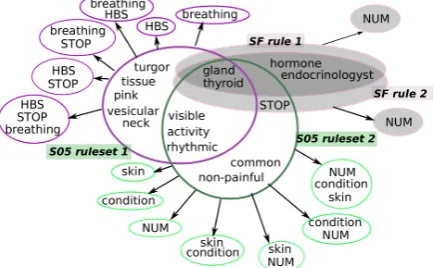
Finally the ARs generated for different collec-tions are mapped to each other in order to study the specifics of the extracted collocations in for-mal and inforfor-mal medical language. As result we are able to enrich the possible contexts of the med-ical terminology occurring in both types of text (Figure 3). Thus we can define word embed-dings for some terms included in ARs for all three sets. For some item wi ∈ W and collection S
we define its context for all ARs in S such that: CS(wi) = {I|I ⇒J ∪wi}. In particular when
I ⇒ J ∪wi holds in S then it also holds that
I ⇒wi. ThusC(wi) =SCS(wi)is the observed
context of itemwi for all collections. The
obser-vation of the terminology context will help for fur-ther study of its nature.
5 Experiments and Findings
Set S05.1 S05.2 S05.3 S00.1 S00.2 S00.3 SF.1 SF.2 SF.3
pids 48,129 48,129 48,129 215,326 215,326 215,326 1,141 1,141 1,141 FI 465,454 359,032 342,118 421,238 386,132 344,215 2,161 1,977 1,977
MFI 759 500 388 1,659 1,619 1,605 453 455 439
AR 4,985,268 3,084,677 3,482,135 1,596,953 1,455,634 1,345,088 202 147 176
minsup 0.05 0.05 0.05 0.04 0.04 0.04 0.02 0.02 0.02
Table 3: Generated association rules with minconf=1.0 and minlift=1.1 for 9 training sets
Set S05.1 S05.2 S05.3 S00.1 S00.2 S00.3 SF.1 SF.2 SF.3
pids 12,032 12,032 12,032 53,831 53,831 53,831 284 285 285 all 99.98% 99.99% 99.98% 99.99% 99.99% 99.99% 95.43% 96.01% 97.34% max 2,000 99.96% 100.00% 99.95% 100.00% 100.00% 99.99% 95.43% 96.01% 97.34%
Table 4: Evaluation of the generated association rules for 9 test sets
text and is rather small.S00andS05contain sec-tions of ORs. S00 corresponds to ORs produced by GPs and is significantly larger than the other two collections. It presents more sparse informa-tion thanS05which contains more focused infor-mation about the specific domain of diabetes. For each of SF, S00 andS05 three experiments are provided by non-exhaustive cross-validation (3 it-erations on sets in ratio 4:1 training to test). The sets are denoted by their original set name and the number of experiment, e.g. for the setS05 there are three training setsS05.1,S05.2, andS05.3.
Table 3 presents numbers of constructions found in the FPM experiments: pids, frequent itemsets, MFI and ARs. In ARs generation for all collections we used minconf=1.0 but different minsup depending on the sets’ size. We consid-ered only ARs with lift>1.1.
Filter the rules with lift <1.1 and consequent STOP automatically reduced approx. 50% of the ARs forS05andS00, where language is more for-mal with limited vocabulary and strong support. The same constraints lead to about 40% reduction of the ARs inSF which has rich vocabulary and small support. The distribution of the lift measure values in these two types of sets - formal vs infor-mal was also quite different. Lift variation inS05 andS00is much smaller than inSF.
Table 4presents the evaluation of the generated ARs. Two types of tests are performed: with all generated ARs and for the top 2,000 ARs accord-ing to their antecedents’ cardinality. High preci-sion in consequent prediction is seen for all sets.
Some ARs bring new knowledge about patient status description:
корем ==> мек неболезн
(abdomen => soft non-painful)
This rule has not too high support (about 5%) but its lift is higher than 1.1. It is a reasonable rule which connects lexical units describing an anatomic organ and its typical status.
The following AR has also very high lift - 12.21 and represents a set of attributes and values de-scribing the condition of a diabetic patient. All of them are terms or typical phrasal expressions in the domain of diabetes.
тургор видим шия ссс запаз общо състояни ==> розов кожа
(turgour visible neck ccc preserved general condition => pink skin)
In the following OR excerpt, items from the AR antecedent are highlighted in blue and the pre-dicted consequent items are highlighted in pink:
Запазено общо състояние. Глава - склери чис-ти. Видими лигавици - розови. Кожа - розова
, норм. тургор. Шия. -щит.жлеза- увеличена 1А. Не се палпират увеличени лимфни възли. Дихат. с-ма-чисто везикуларно дишане. ССС - ритмична нормофреквентна сърдечна дейност.
(Preserved general condition. Head - clear ciliary body. Visible tissue - pink. Skin - pink,normal turgor. Neck -thyroid gland- enlarged 1A. Lymph nodes do not palpate enlarged. Respiratory system-clear vesicular breathing.
Circulatory system - normal heart rhythm.)
The support sets of the ARs present patients with different profiles. In general several ARs can represent the conditions of different anatomic or-gans and systems of one patient and thus the ini-tial profiling groups can be partitioned into pro-filing subgroups. Thus patients can be clustered in groups with similar health condition. A more detailed analysis of patients that belong to several profile groups is a task for further investigation.
rules help to process unseen status descriptions in other collections of medical documents.
ARs mapping. By collapsing equal ancestors of the ARs generated from the respective data sets we observe regularities which describe the med-ical language in the ORs on the one hand and the informal language from the medical forum on the other hand. Figure 3 presents ARs whose ancestor contain "thyroid gland". The larger el-lipses denote the ancestors of the rules and the smaller ones linked through arrows are the conse-quents.SF rule1andSF rule2(in gray) are result of processing the SF dataset; S05ruleset1 and S05ruleset2 come from the dataset S05. Each of the rule sets represents several rules with equal ancestor.
Figure 3: Mapping of ARs from forum data and ORs from Endocrinology professionals.
Among the extracted ARs from SF only 21 contain the terms "thyroid" and "gland" either in the ancestor or in the consequent whereas in the ARs resulting fromS05there are 3,985 ARs con-taining both terms. This shows that the informal language of non-specialists, although in medical topics, is rather difficult to formalize. The patterns inSFare short with up to 5 tokens in the ancestor vs. up to 14 tokens in the ARs coming fromS05. Only 3 rules inSF have equal ancestors, in con-trary the ancestors often can be collapsed inS05 and the same ancestor can have up to 62 differ-ent consequdiffer-ents. The ARs coming from S05are also much longer, they describe related symptoms and/or diseases. As shown on Figure3the various consequents may be numerous but their vocabu-lary is not so rich. InS05ruleset1there are only 3 tokens in the union of consequent vocabularies. Finally we note that the circles of mappings, as il-lustrated in Fig. 3, also suggest different profiles of patients experiencing eventual changes of
thy-roid.
6 Conclusion and Further Work
By fusing information from ORs written in a formal language with informal medical forum texts and applying frequent pattern matching tech-niques, we manage to extract and generalize ARs describing the context of medical terminology in the domain of diabetes. The obtained patterns have the means of stable term subsets which oc-cur in the documents with a window longer than the usually utilized ones. In this sense our ap-proach delivers higher benefits for generating re-sources that describe the terminology in the Dia-betes domain in comparison to the word frequency based techniques such as tf,tf-idf. Moreover, the FP matching techniques have the advantage of be-ing unsupervised thus they do not require any ex-ternal knowledge or annotated data and can suc-cessfully deal with big data.
We generalize ARs for the common terms in three sets: terms related to diabetes generated by processingSFandS05as well as terms related to medical examinations obtained by processing of SF andS00. We generalize also rules describing the context of terms describing the patient status, output from the processing ofS05andS00. These resources shall be further employed for automatic analysis of formal and informal medical records, symptoms and condition recognition.
Acknowledgments
The research presented here is partially sup-ported by the grant SpecialIZed Data MIn-ing MethoDs Based on Semantic Attributes (IZIDA), funded by the Bulgarian National Sci-ence Fund in 2017–2019, and the project DFNP-100/04.05.2016 "Automatic analysis of clinical text in Bulgarian for discovery of correlations in the Diabetic Registry" funded by the Bulgarian Academy of Sciences in 2016-2017. The team ac-knowledges also the support of Medical Univer-sity – Sofia, the Bulgarian Ministry of Health and the Bulgarian National Health Insurance Fund.
References
Morgan Kaufmann Publishers Inc., San Fran-cisco, CA, USA, VLDB ’94, pages 487–499. http://dl.acm.org/citation.cfm?id=645920.672836. Helena Ahonen-Myka. 1999. Finding all maximal
fre-quent sequences in text. InMladenic and Grobelnik (Eds.), Proc. 16th Int. Conf. on ML ICML-99, Work-shop on ML in Text Data Analysis, J. Stefan Institute, Ljubljana. pages 11–17.
Helena Ahonen-Myka. 2002. Discovery of fre-quent word sequences in text. In Proceed-ings of the ESF Exploratory Workshop on Pattern Detection and Discovery. Springer-Verlag, London, UK, UK, pages 180–189. http://dl.acm.org/citation.cfm?id=647915.738872. Helena Ahonen-Myka and Antoine Doucet. 2005.
Data Mining Meets Collocations Discovery. In
Inquiries into Words, Constraints and Contexts, Festschrift in the Honour of Kimmo Koskenniemi, CSLI Publications, Center for the Study of Lan-guage and Information, University of Stanford, pages 194–203. https://hal.archives-ouvertes.fr/hal-00324775.
Mafruz Zaman Ashrafi, David Taniar, and Kate Smith. 2007. Redundant association rules reduction tech-niques. Int. J. Bus. Intell. Data Min. 2(1):29–63. https://doi.org/10.1504/IJBIDM.2007.012945. Svetla Boytcheva, Galia Angelova, Zhivko Angelov,
and Dimitar Tcharaktchiev. 2017. Mining comor-bidity patterns using retrospective analysis of big collection of outpatient records.Health Information Science and Systems(to appear). Springer Int. Pub-lishing. https://link.springer.com/journal/13755. Svetla Boytcheva, Ivelina Nikolova, Elena Paskaleva,
Galia Angelova, Dimitar Tcharaktchiev, and Nadia Dimitrova. 2010. Obtaining status descrip-tions via automatic analysis of hospital patient records. Informatica 34(3):269–278. http:// www.informatica.si/index.php/informatica/article/ view/301/300.
Gosta Grahne and Jianfei Zhu. 2003. High perfor-mance mining of maximal frequent itemsets. In6th Int. Workshop on High Performance Data Mining. pages 135–143.
Jiawei Han, Jian Pei, Yiwen Yin, and Runying Mao. 2004. Mining frequent patterns without candidate generation: A frequent-pattern tree approach. Data mining and knowledge discovery8(1):53–87. Yannis Haralambous and Philippe Lenca. 2014. Text
classification using association rules, dependency pruning and hyperonymization. Proc. of DMNLP, Workshop at ECML/PKDD, Nancy, France, CEUR Workshop Proceedings 1202, pp. 65-80.
Ashwin Ittoo and Gosse Bouma. 2013. Term
extraction from sparse, ungrammatical domain-specific documents. Expert Sys-tems with Applications 40(7):2530 – 2540.
https://doi.org/https://doi.org/10.1016/j.eswa.2012. 10.067.
Dolores Lozano and Anna Matamala. 2009. The trans-lation of medical terminology in tv fiction series: the spanish dubbing of e.r. Vigo International Journal of Applied Linguistics6:73–87.
Małgorzata Marciniak and Agnieszka Mykowiecka. 2014. Terminology extraction from medical texts in polish. Journal of Biomedical Semantics5(1):24. https://doi.org/10.1186/2041-1480-5-24.
Gleb Sizov and Pinar Öztürk. 2012. Mining of asso-ciation relations in text. Proc. Norsk informatikkon-feranse, 2012, pp. 37-48, http://www.nik.no/2012/1-4-sizov12MiningOfAssociationRelationsInText.pdf . Basak Oguz Yolcular. 2011. Concepts extraction from discharge notes using association rule mining.