CSEIT1833269 | Received : 12 March 2018 | Accepted : 24 March 2018 | March-April-2018 [ (3 ) 3 : 845-850 ]
© 2018 IJSRCSEIT | Volume 3 | Issue 3 | ISSN : 2456-3307
845
PERT Based CPR Machine
Ankit Tiwari1, Ajinkya Tekawade1, Akshay Bhagat1, Vivek Srivastav2
1Student, Department of Electronics & Telecommunication Engineering, Dr D Y Patil SOET, Pune,
Maharashtra, India
2Ass. prof, Department of Electronics & Telecommunication Engineering, Dr D Y Patil SOET, Pune,
Maharashtra, India
ABSTRACT
PERT is Personal Emergency Response Technique.CPR is an emergency procedure in which the heart and lungs are made to work by compressing the chest overlying the heart and forcing air into the lungs. CPR is used to give compressions to the patient in an emergency. Current CPR machines are only present in ambulances and need heavy and huge machinery and arrangements. Hence, it increases the cost and complexity. Sudden Cardiac Arrest (SCA) is a leading cause of death in India. It is estimated by the WHO census statistics that approximately 4280 out of every one lakh people die every year from SCA in India. The design we are going to make would be adjustable in accordance to the patient’s requirement and will have the maximum pumping capacity of 105 compressions/min. This CPR will be domestic device and can be used without any specialised knowledge / experience.
Keywords: Cardiac Arrest, Cardio Pulmonary Resuscitation, Automatic CPR devices.
I.
INTRODUCTION
Personal Emergency Response Technique is Derived From “An Overview Of PERS Based Domestic Cardio-Pulmonary Resuscitation Machine.
Cardiopulmonary resuscitation combines
compressions of the chest with rescue breathing to keep blood flowing through the body and brain while delivering oxygen to the bloodstream. CPR is the first step in treating cardiac arrest in hopes of providing time for first responders to arrive.
CPR supports and maintains breathing and circulation for an infant, child, or adolescent who has stopped breathing (respiratory arrest) and/or whose heart has stopped functioning.[1] Cardiac arrests are very common, and they can happen to anyone at any time. Nearly 383,000 out-of-hospital sudden cardiac arrests occur annually, and 88 % of cardiac arrests occur at home. Many victims appear healthy with no
II.
SURVEY ANALYSIS
Figure 1
Cardiac arrest impacts too many lives to be ignored. We must employ multiple strategies simultaneously. We not only need more trained lifesaving bystanders, we also need to train the next generation of lifesaving bystanders. Part of the answer to solving this puzzle lies in recognizing that CPR training is a crucial life skill that everyone must possess. As such, CPR must become part of American education similar to, for example, the "3Rupee"- reading, writing and arithmetic .Training high school students is a particularly efficient way to increase the number of bystander rescuers. Several studies have shown that students can quickly become proficient in CPR, even with brief video-based and skills training .This means that, in less time than the average TV program, high school students can learn CPR and save someone's life.
Teaching CPR to high school students results in communities saturated with trained bystanders, not just in any given year, but generation after generation. Over time, this will change mind sets and culture around CPR and profoundly increase the number of trained young adults everywhere. Ultimately, it will increase the probability that if a parent, sibling, grandparent or co-worker experiences cardiac arrest, someone nearby will be able and willing to save a life by calling 9-1-1,
then starting and continuing CPR until emergency personnel arrive. The AHA has embraced this approach with the launch of its CPR in Schools campaign. This nationwide advocacy effort began in 2011 with the aim of legislating mandatory CPR training for high school students in every state .The AHA has worked tirelessly with its local affiliates and other stakeholders (e.g., first responders, doctors' associations, public health departments and parent-teacher associations) in their effort to pass legislation. All told, 37 U.S. states now require the training for high school with more on the way.
When it comes to cardiac arrest, seconds count and bystanders need to act to save a life. Investing in today's students creates tomorrow's lifesaving bystander rescuers and will save countless lives.
Figure 2. American Heart Association Map Showing States Requiring The Teaching Of Cpr In Schools (In
Red)
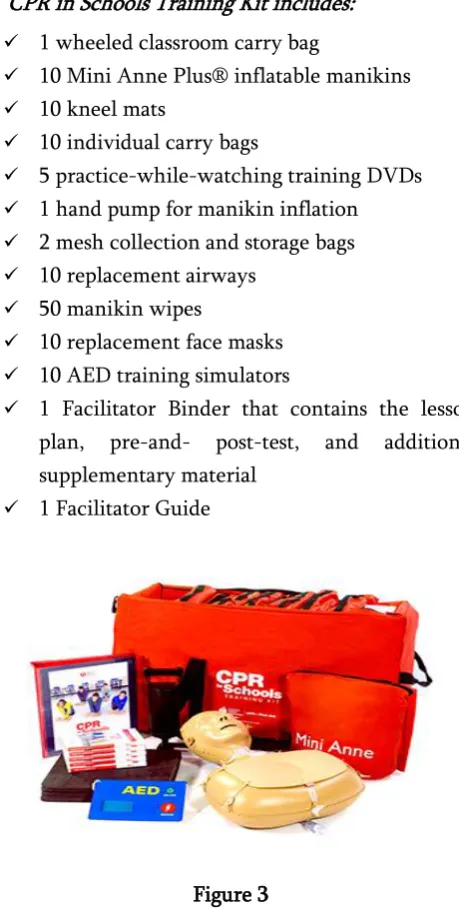
CPR In Schools Training Kits:
double or triple a person’s chance of survival. Sadly, most of the time it doesn’t happen that way. The American Heart Association wants all students and educators to learn CPR, putting more qualified lifesavers in our communities. The stress-free CPR in Schools Training Kit is designed precisely for educational environments and can be facilitated by anyone. The kit contains everything needed to train 10 to 20 people at once in CPR. Repeat the process to train a class, a grade - or even your entire campus.
CPR in Schools Training Kit includes:
1 wheeled classroom carry bag
10 Mini Anne Plus® inflatable manikins
10 kneel mats
10 individual carry bags
5 practice-while-watching training DVDs
1 hand pump for manikin inflation
2 mesh collection and storage bags
10 replacement airways
50 manikin wipes
10 replacement face masks
10 AED training simulators
1 Facilitator Binder that contains the lesson plan, pre-and- post-test, and additional supplementary material
1 Facilitator Guide
Figure 3
III.
OBJECTIVE BEHIND THIS PROJECT
In India, approximately 4280 out of every one lakh people die every year from sudden cardiac arrest.The Prime cause of Such a Low Success Rate is delay in
getting Medical Assistance.Our Device Cardio Pulmonary Resuscitation (CPR) is going to provide temporary relief to the Patients who suffer from Cardiac Attack due to the delay timing of ambulance.Our project will give chest compressions in case of sudden cardiac arrest. It is an automatic, cost effective and portable, emergency alert based CPR device which will automatically compress the chest.
IV.
SYSTEM ARCHITECTURE
Figure 4
In this project we have used Atmel’s AVR Atmega 16 Microcontroller. We have used Potentiometer to Varry pumping of CPR machine. Response switch is used to alert family in case of emergency patch sensor is used to provide ampere in body of patient in given proportion as per depend on situation.by adjusting value we can control up-down action of solenoid and provide CPR to patient.L293D Driver is used to Drive Solenoid.
Sensor Value and heart beat will be display on LCD. By Serial port we can access output data on android phone, laptop.
V.
ALGORITHM
1. Start 2. Initialize
3. Check Patient hear beats
4. If normal, Check emergency switch 5. If switch on then turn on alarm 6. Wait for Potentiometer value 7. ADC conversion
8. Set solenoid
10. Send data to serial port
11. Check data on Laptop/sms/android app. 12. Stop
VI.
HARDWARE REQUIRED
1. Atmega 16: Controller of Device 2. Base Plate and Shaft
3. Potentiometer 4. Solenoid
5. Motor Driver L293D 6. LCD 16x2
7. Patch Sensor(24-25v and 0.8 to 1 A) 8. Power Supply
9. Switch (For alert system)
VII.
FUTURE SCOPE
It can be made battery operated, so there won’t be any need to find electric connection in case of emergency .
Whole device can be made operator voiced so that the operator’s commands can provide assistance to people operating the instrument.
The whole device can be made into Artificial Intelligence where it can give the depths of the compression and how much compression it has to give according to the BMI of the patient .
VIII.
FLOWCHART
IX.
CONCLUSION
PERT Based Domestic Cardio-Pulmonary
Resuscitation Machine is a very useful Bio-medical Product which combats the problems associated with sudden Cardiac arrest and provides temporary relief to the patient. This product can be used as First – Aid for the Cardiac Patient. Although, there are several products available in the market being used for avoiding Cardiac Arrest but have limitations like cost effectiveness, bulky products which is not portable, need of trained staff for operation. We are focusing on designing a product that eliminates the drawbacks of the CPRM available in market presently. We are trying to design a cost effective, slim and portable CPRM which is extremely user friendly.
X.
REFERENCES
compression device", Resuscitation, Volume 73, Issue 1, April 2016, Pg. 86- 95
[2]. Aufderheide,T.P, Pirrallo, R.G et al, "Incomplete chest wall decompression: A clinical evaluation of CPR performance by trained laypersons and an assessment of alternative manual chest compression- decompression techniques", Resuscitation, Volume 71, Issue 3, December 2006, Pages341-351
[3]. Ornato, J.P, Peberdy M. "A Cardiopulmonary Resuscitation" Springer, Nov.2016
[4]. Wik L, Kiil S, "Use of an Automatic Mechanical chest compression device (LUCAS) as a bridge to establishing cardiopulmonary bypass for a patient with hypothermic cardiac arrest" Resuscitation Volume 66, Issue 3, September 2016, Pages 391-394.
[5]. Herrero S, Varon J, Sternbach GL, Fromm RE: "History of the Cardiopulmonary resuscitation. 2011 " Pearls in Intensive Care Medicine 2012. Vol. 25 7. Safar P Lourdes A. E, Elam J,O, "A Comparison of the Mouth-to-Mouth and Mouth-to-Airway Methods of Artificial Respiration with the Chest-Pressure Arm-Lift Methods", N Engl J Med 1958; 258:671-677April 3, 1958
[6]. European Resuscitation Council Guidelines for
Resuscitation 2015. Resuscitation
2015;67:S1190.
[7]. 2016 International Consensus on
Cardiopulmonary Resuscitation and
Emergency Cardiovascular Care Science with Treatment Recommendations. Resuscitation 2016; 67:157-341.
[8]. Tortora, G.J, Derrickson, B.H., "Principles of Anatomy and Physiology, 14th Edition, Wiley, 2016, Pg.118-136.
[9]. Chehardy P, Doherty A, Dracup K, Handley AJ, Hawkins H, Juarbe TC, Kloeck WG, Lynch BC, Mancini MB, Mason P, Palmer EL,
Stapleton ER, Terndrup TE, Wilson
E;American Heart Association; International
Liaison Committee on
Resuscitation.Cardiopulmonary resuscitation
and emergency cardiovascular care.
Education.Ann Emerg Med. 2001 Apr;37(4 Suppl):S49- 59. PubMed PMID: 11290970. [10]. "CPRStatistics
http://www.heart.org/HEARTORG/CPR ECC/WhatisCPR/CPRFactsandStats/CPRStatist ics_UCM_ 307542_Article.jsp
[11]. "2005 American Heart Association Guidelines for Cardiopulmonary Resuscitation and Emergency Cardiovascular Care", Circulation 2005;112:IV1-IV-5
[12]. Cordier,D.G, "Methods of Artificial
Respiration, Br Med J Br 1943
Sep25;2(4316):381-3.
[13]. Lee R.V., "Cardiopulmonary resuscitation in the eighteenth century. A historical perspective on present practice". 1972;27:418-433.
[14]. Babbs,C.F, "CPR Techniques That Combine Chest and Abdominal Compression and Decompression, Circulation. 1999; 100: 2146- 2152 17. Manual chest compression v/s use of an automated chest compression device duringn resuscitation following out-of-hospital cardiac arrest a randomizedtrial (http:// www.ncbi.nlm.nih.gov/pubmed/16772625) [15]. Akshay B, Ankit T, Ajinkya T, Vivek S RE:
"An Overview of PERS Based Domestic Cardio-Pulmonary Resuscitation Machine " International Research Journal of Engineering and Technology (IRJET) Volume: 04 Issue: 10 | Oct -2017.
Biographies :
“Student, E&TC, Dr.D.Y.Patil School of Engineering & Technology, Lohegaon, Pune-412105, India.”
“Student, E&TC, Dr.D.Y.Patil School of Engineering & Technology, Lohegaon, Pune-412105, India.”