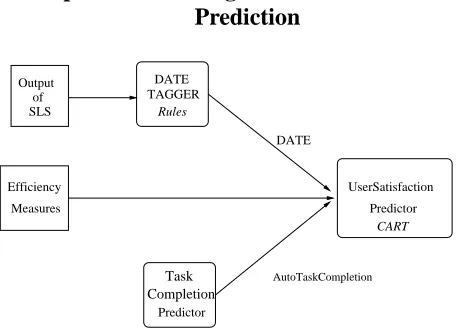
Automatic Evaluation: Using a DATE Dialogue Act Tagger for User
Satisfaction and Task Completion Prediction
Helen Wright Hastie, Rashmi Prasad, Marilyn Walker
AT& T Labs - Research
180 Park Ave, Florham Park, N.J. 07932, U.S.A. hhastie, rjprasad, [email protected]
Abstract
The objective of the DARPA Communicator project is to support rapid, cost-effective development of multi-modal speech-enabled dialogue systems with advanced conversational capabilities. During the course of the Communicator program, we have been involved in developing methods for measuring progress towards the program goals and assessing advances in the component technologies required to achieve such goals. Our goal has been to develop a lightweight evaluation paradigm for heterogeneous systems. In this paper, we utilize the Communicator evaluation corpus from 2001 and build on previous work applying the PARADISE evaluation framework to establish a baseline for fully automatic system evaluation. We train a regression tree to predict User Satisfaction using a random 80 of the dialogues for training. The metrics (features) we use for prediction are a fully automatic Task Success Measure, Efficiency Measures, and System Dialogue Act Behaviors extracted from the dialogue logfiles using the DATE (Dialogue Act Tagging for Evaluation) tagging scheme. The learned tree with the DATE metrics has a correlation of 0.614 ( of 0.376) with the actual user satisfaction values for the held out test set, while the learned tree without the DATE metrics has a correlation of 0.595 ( of 0.35).
1.
Introduction
The objective of the DARPA Communicator project is to support rapid, cost-effective development of multi-modal speech-enabled dialogue systems with advanced conversa-tional capabilities. During the course of the Communica-tor program, we have been involved in developing methods for measuring progress towards the program goals and as-sessing advances in the component technologies required to achieve such goals. Our goal has been to develop an evaluation paradigm that supports continuous, lightweight, data collection and evaluation for heterogeneous systems. We have carried out two evaluation experiments within the Communicator program, one in June of 2000 resulting in 662 dialogues from 9 different Communicator travel plan-ning systems, and a second evaluation carried out over six months in 2001, resulting in 1242 dialogues.
One problem with evaluation is that it is extremely costly. It often involves recruiting paid subjects to partici-pate in dialogues with the system. In addition to carrying out some real or fixed tasks in dialogue with the system, subjects may be required to fill out a user profile and a user satisfaction survey, answer questions about task comple-tion, or provide comments about the system’s performance. The dialogues must be transcribed and some features of the interaction hand-labelled, such as aspects of the user’s be-havior, the task type, and task completion or reasons for no completion.
In this paper, we build on previous work applying the PARADISEevaluation framework to examine whether infor-mation useful for evaluation can be extracted from a corpus of dialogues using totally automatic means (Walker et al., 2000; Walker et al., 2002). It has been shown that dia-logue acts can be useful for evaluation (Cattoni et al., 2001). Our work relies on an automatic dialogue act tagger DATE (Dialogue Act Tagging for Evaluation), that we developed for the Communicator domain that achieves 98.4% cover-age and 96% accuracy on system utterances (Walker et al.,
2001; Prasad and Walker, 2002). We experiment with us-ing dialogue act labels in combination with other features as predictors of task completion (TaskCompletion) and user satisfaction (UserSatisfaction). We achieve 85% accuracy for predicting TaskCompletion; the UserSatisfaction pre-dictor achieves a correlation of .61 with actual UserSatis-faction values (R of 0.37) in a held out test set.
Section 2. briefly summarizes thePARADISEframework and describes our novel application of PARADISE in this work. Section 3. describes the experimental corpus. Sec-tion 4. presents the DATE dialogue act tagger which is used as the primary source of features for the automatic UserSa-tisfaction predictor. Section 5. describes how we extract a feature for automatically predicting TaskCompletion. Sec-tion 6. describes the experimental design for UserSatisfac-tion predicUserSatisfac-tion and SecUserSatisfac-tion 7. presents the predicUserSatisfac-tion re-sults. We postpone the discussion of previous work until Section 8. for comparison purposes and present the conclu-sion and future developments in Section 9..
2.
PARADISE Evaluation Framework
MEASURES QUALITATIVE KAPPA
MEASURES EFFICIENCY
INAPPROPRIATE UTTERANCE RATIOAGENT RESPONSE DELAY MINIMIZE COSTS
DIALOGUE TIME NUMBER UTTERANCES
ETC. REPAIR RATIOETC. SUCCESS
MAXIMIZE TASK
MAXIMIZE USER SATISFACTION
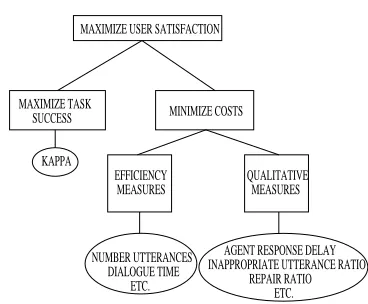
The PARADISE evaluation framework uses methods from decision theory (Keeney and Raiffa, 1976; Doyle, 1992) to combine a disparate set of performance measures (i.e., user satisfaction, task success, and dialogue cost, all of which have been previously noted in the literature) into a single performance evaluation function (Walker et al., 2000). The use of decision theory requires a specifica-tion of both the objectives of the decision problem and a set of measures (known as attributes in decision theory) for operationalizing the objectives. The PARADISE model is based on the structure of objectives shown (in rectangles) in Figure 1; it posits that performance can be correlated with a meaningful external criterion such as usability, and thus that the overall goal of a spoken dialogue agent is to maximize an objective related to usability. UserSatisfaction ratings (Kamm, 1995; Shriberg et al., 1992; Polifroni et al., 1992) have been frequently used in the literature as an ex-ternal indicator of the usability of a dialogue agent. The model further posits that two types of factors are potential relevant contributors to UserSatisfaction (namely Task Suc-cess and Dialogue Costs), and that two types of factors are potential relevant contributors to costs (namely Efficiency Measures and Dialogue Quality Measures).
PARADISE has been broadly applied in previous work (Walker et al., 2000; Lamel and Rosset, 2000; Bonneau-Maynard et al., 2000). Several uses have been made of the models derived by applying PARADISE. First, the overall performance metric can be used to automatically train the dialogue manager (Walker, 2000). Second, if metrics rep-resenting dialogue strategies are included in the Dialogue Quality Measures, then the significant predictors of User-Satisfaction can indicate which dialogue strategies are opti-mal. In our work, the purpose of the DATE tagging scheme is to extract such metrics (Walker et al., 2001; Prasad and Walker, 2002). Third, the models predict to what extent improvements in system components will increase UserSa-tisfaction. For example, if ASR (automatic speech recog-nition) performance has a +.25 correlation with UserSatis-faction in a standardized model, the prediction is that each unit change in ASR performance will result in a .25 unit increase in user satisfaction.
Our approach differs from previous work applying PARADISE in several respects. First, previous work has used both hand-labelled and automatically extracted met-rics, but we look at utilizing only fully automatic metrics to explore the potential of fully automatic evaluation of di-alogue systems. We believe there are a number of appli-cations for a module that can predict UserSatisfaction au-tomatically. For example, such a prediction can be used for deciding which dialogues in a large corpus are worth transcribing, or it could be factored into the dialogue man-ager and ASR modules to support online adaptation of the system. Second, rather than linear models, we apply Clas-sification and Regression Trees (CART) to the prediction of UserSatisfaction (Brieman et al., 1984).
3.
Experimental Corpus
The corpus used in these experiments is a corpus of 1242 dialogues collected for a Communicator evaluation experiment during six months of 2001. Three types of tasks
are represented in the corpus:
350 Complex Trips (multiple legs and car, hotel ar-rangements)
694 Real Trips, of user’s choice
198 Round Trips
Eight different systems participated in the evaluation. All sites implemented a logfile standard supporting a stan-dard set of dialogue metrics such as number of system and user turns, dialogue duration, and time spent in each sys-tem module. The sites also provided both ASR and hand-labelled transcriptions for each user utterance.
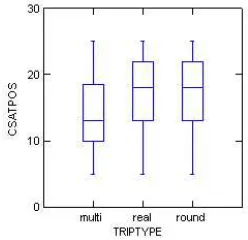
On completion of each dialogue, the user was asked to fill-out a survey indicating the user’s satisfaction (UserSa-tisfaction) with the system and perception of TaskComple-tion. UserSatisfaction is calculated by summing the de-gree of the user’s ade-greement on a five point Likert scale to five statements about the systems performance: (1) In this conversation, it was easy to get the information that I wanted (TaskEase); (2) I found the system easy to under-stand in this conversation (TTSPerf); (3) In this conversa-tion, I knew what I could say or do at each point of the dialogue (UsrExpertise); (4) The system worked the way I expected it to in this conversation (ExpectedBehavior); (5) Based on my experience in this conversation using this tem to get travel information, I would like to use this sys-tem regularly (FutureUse). Figure 2 gives the distribution of UserSatisfaction for the three types of trips showing that the complex tasks resulted in lower UserSatisfaction.
Figure 2: UserSatisfaction by TripType
The user’s perception of TaskCompletion and the task requirements are used to define a ternary TaskCompletion metric: 0 indicates task failure; 1 indicates completion of an airline itinerary; 2 indicates completion of both air-line and car/hotel arrangements. We also defined a Binary TaskCompletion metric where task failure is 0 and any level of TaskCompletion (airline and optionally car/hotel) is 1.
The goal of our experiments is to train and test a fully automatic predictor of UserSatisfaction using this evalua-tion corpus. The training set consists of a random 80
of the dialogues (994 dialogues) and the test set the remain-ing 20
the response variable. There are two types of input fea-tures whose extraction from the original logfiles required substantive work. First, as described above, we label all the system utterances in the logfiles with the DATE dialogue act tagging scheme. Secondly, we train a fully automatic TaskCompletion predictor whose output can be used as a fully automatic input feature for the prediction of UserSa-tisfaction. Section 4. first describes how we label the dia-logues with the DATE tags and Section 5. describes how we use the dialogue act tags to predict TaskCompletion, before describing the training of the UserSatisfaction predictor in more detail in Section 6..
4.
Dialogue Act Tagging for Evaluation
(DATE)
The dialogue act labelling of the Communicator cor-pus follows the DATE tagging scheme (Walker et al., 2001). DATE classifies each utterance along three cross-cutting orthogonal dimensions of utterance classification: (1) a SPEECH ACT dimension; (2) a CONVERSATIONAL -DOMAIN dimension; and (3) a TASK-SUBTASK dimen-sion. TheSPEECH ACTandCONVERSATIONAL-DOMAIN dimensions are general across domains, while the TASK -SUBTASKdimension involves a task model that is not only domain specific, but could vary from system to system be-cause some systems might make finer-grained subtask dis-tinctions.
Speech-Act Example
REQUEST-INFO And, what city are you flying to?
PRESENT-INFO The airfare for this trip is 390 dol-lars.
OFFER Would you like me to hold this
op-tion?
STATUS-REPORT Accessing the database; this
might take a few seconds.
EXPLICIT
-CONFIRM
You will depart on September 1st. Is that correct?
IMPLICIT
-CONFIRM
Leaving from Dallas.
INSTRUCTION Try saying a short sentence.
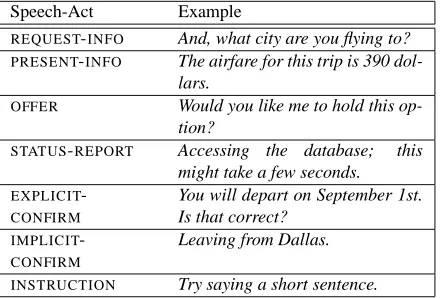
Figure 3: Example Speech Act utterances
The SPEECH ACT dimension captures distinctions be-tween communicative goals such as requesting information (REQUEST-INFO), presenting information (PRESENT-INFO) and making offers (OFFER) to act on behalf of the caller. Some examples are in Figure 3.
The CONVERSATIONAL-DOMAIN dimension involves the domain of discourse that an utterance is about. DATE distinguishes three domains within this dimension. Exam-ples of each domain are given in Figure 4. The ABOUT -TASK domain is necessary for evaluating a dialogue sys-tem’s ability to collaborate with a speaker on achieving the task goal. It supports metrics such as the amount of time/effort the system takes to complete a particular phase of making an airline reservation, and any ancillary hotel/car reservations. The ABOUT-COMMUNICATION domain re-flects the system goal of managing the verbal channel of communication and providing evidence of what has been
understood. Utterances of this type are frequent in human-computer dialogue, where they are motivated by the need to avoid potentially costly errors arising from imperfect speech recognition. All implicit and explicit confirma-tions are about communication. The ABOUT-SITUATION -FRAMEdomain pertains to the goal of managing the user’s expectations about how to interact with the system.
Conversational Domain Example
ABOUT-TASK And what time didja wanna
leave?
ABOUT
-COMMUNICATION
Leaving from Miami.
ABOUT-SITUATION
-FRAME
You may say repeat, help me out, start over, or, that’s wrong
Figure 4: Example utterances distinguished within the Con-versational Domain Dimension
TheTASK-SUBTASK dimension focuses on specifying which subtask of the travel reservation task the utterance contributes to. This dimension distinguishes among 28 sub-tasks, some of which can also be grouped at a level below the top level task. TheTOP-LEVEL-TRIPtask describes the task which contains as its subtasks theORIGIN,DESTINA -TION,DATE,TIME,AIRLINE,TRIP-TYPE,RETRIEVALand ITINERARYtasks. TheGROUNDtask includes both theHO -TELandCAR-RENTALsubtasks. TheHOTELtask includes both theHOTEL-NAMEandHOTEL-LOCATIONsubtasks.1
4.1. Implementation and Metrics Derivation
To label the system utterances in the 2001 Communi-cator corpus with the DATE dialogue acts, we first applied the dialogue act tagger that was developed for labelling the 2000 Communicator data (Walker et al., 2001). In this tag-ger, an utterance or utterance sequence is identified and la-belled automatically by reference to a database of utterance patterns that are hand-labelled with DATE tags. The col-lection and DATE labelling of the utterances for the pat-tern database was done in cooperation with the site devel-opers. Since the systems use template based generation and have only a limited number of ways of saying the same con-tent, very few utterance patterns needed to be hand-labelled when compared to the actual number of utterances occur-ring in the corpus. Further abstraction on the patterns was done with a named-entity labeler which replaces specific tokens of city names, airports, hotels, airlines, dates, times, cars, and car rental companies. For example, what time
do you want to leave AIRPORT on DATE-TIME ?
is the typed utterance for what time do you want to leave
Newark International on Monday?. For the 2000 tagging,
the number of utterances in the pattern database was 1700 whereas the total number of utterances in the 662 dialogues was 22930. The named-entity labeller was also applied to the system utterances in the corpus. We collected vocab-ulary lists from all the sites for the named-entity task. In
1
most cases, systems had preclassified the individual tokens into generic types.
The tagger implements a simple pattern matching algo-rithm to do the dialogue act labelling. Utterance patterns in the pattern database are matched in the corpus and the DATE label of that pattern is assigned to the matching pat-tern in the corpus. The matching ignores punctuation since systems vary in the way they record punctuation.2
Certain utterances have different communicative func-tions depending on the context in which they occur. For example, phrases like leaving in the DATE-TIME are
implicit confirmations when they constitute an utterance on their own, but are part of the flight information presentation when they occur embedded in utterances such as I have one
flight leaving in the DATE-TIME . To prevent incorrect
labelling for such ambiguous cases, the pattern database is sorted so that sub-patterns are matched after the patterns within which they are embedded.
While this tagger was 100
accurate for the 2000 data, when applied to the 2001 data it was able to label only 60
of the data, where the coverage is calculated on the char-acter counts of the utterances. On examination of the un-labelled utterances, we found that many systems had aug-mented their inventory of vocabulary items as well as utter-ances for the 2001 data collection. As a result, there were many new patterns unaccounted for in the existing named-entity lists as well as the pattern database. In an attempt to cover the remaining 40
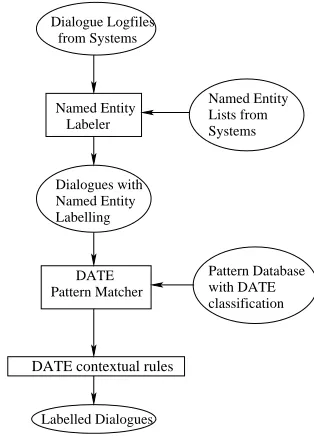
of the data, we therefore aug-mented the named-entity lists by obtaining a new set of pre-classified vocabulary items from the sites, and added 800 hand-labelled patterns to the pattern database. For the la-belling of any additional unaccounted for patterns, we im-plemented a contextual rule-based postprocessor that looks at the surrounding dialogue acts of an unmatched utterance within a turn and attempts to label it. Figure 5 shows the current DATE tagging system. The contextual rules are in-tended to capture rigid system dialogue behaviors that are reflected in the DATE sequences within a turn.3 For exam-ple, one very frequently occurring DATE sequence within system turns is present info:flight, present info:price, of-fer:flight, and some of the rules use this contextual infor-mation to tag unlabelled utterances: if the postprocessor en-counters a turn in which the first two utterances have been labelled with present info:flight and present info:price, and the third utterance is left unlabeled by the pattern matcher, it uses the above rule to assign the third utterance with the present info:price label.4 Not all turn-internal DATE se-quences could be used as contextual rules, however, be-cause many of them are highly ambiguous. For example,
2
Ignoring punctuation does not, however, create an utterance segmentation problem for the tagger. The utterances in the pattern database provide the reference points for utterance boundaries.
3The logfile standard distinguishes system and user turns
within the dialogues.
4
The DATE labels have three fields separated by “:” corre-sponding to the three dimensions of the DATE scheme. The first field describes the utterance in the conversational domain dimen-sion, the second in the speech act dimendimen-sion, and the third in the task-subtask dimension. For the about-task dimensions, only the second and the third fields are given in the labels.
about comm:apology:meta slu reject can be followed by a system instruction as well as any kind of request for infor-mation (typically) repeated from the previous system utter-ance.
Labelled Dialogues
classification with DATE
DATE contextual rules
Pattern Database Named Entity
from Systems Dialogue Logfiles
Systems Lists from Named Entity
Labeler
Pattern Matcher DATE
Dialogues with Named Entity Labelling
Figure 5: The DATE Dialogue Act Tagger
The tagger, augmented with the new named entity lists, the new pattern database, and the postprocessor, covers 98.4
of the 2001 data. A hand evaluation of 10 ran-domly selected dialogues from each system shows that we achieved a classification accuracy of 96
at the utterance level.
For future evaluations, we would like to avoid the ex-pensive and tedious process that we faced with the 2001 tagging. In (Prasad and Walker, 2002), we have experi-mented with a machine learning method for DATE tagging. The learner uses a total of 19 features which are either de-rived directly from the logfiles, dede-rived from the human transcription of the user utterances, or represent aspects of the dialogue context in which the utterance occurs. The di-alogue context features include the left unigram and bigram DATE context which extends to the previous system turn, the number of dialogue acts in the turn, the position of the target utterance in the turn, the system utterances to the left and right of the target utterance, and the previous user utter-ance. The use of all these features is designed to reduce the ambiguity of the dialogue act context. We have trained and tested the automatic DATE tagger on various combinations of the Communicator 2000 and 2001 human-computer cor-pora. The accuracy of a DATE tagger trained and tested on the 2000 corpus is 98.5
. On the 2001 corpus, it achieves an accuracy of 71.8
, but the accuracy improves to 93.8
Task Success Features
– Hand-labelled
HLTaskCompletion
– Automatic
AutoTaskCompletion
Efficiency Measures
– Hand-labelled
WERR, SERR
– Automatic
TimeOnTask, TurnsOnTask, NumOverlaps, MeanUsrTurnDur, MeanWrdsPerUsrTurn, Mean-SysTurnDur, MeanWrdsPerSysTurn, DeadAlive
Phone-type, SessionNumber
Qualitative Measures
– Automatic DATE Unigrams
present info:flight, present info:price etc..
– Automatic DATE Bigrams
present info:flight+present info:price etc..
Figure 8: Features used to train the UserSatisfaction Pre-diction Tree
Finally, the quality of the dialogue is captured by the different DATE dialogue act frequencies. We found that the distribution of DATE acts were better captured by using the frequency normalized over the total number of dialogue acts. In addition to these unigram proportions, the bigram frequencies of the DATE dialogues acts were also calcu-lated.
7.
Results for UserSatisfaction Prediction
The results of the UserSatisfaction prediction Regres-sion Tree are given in terms of the correlation between the predicted UserSatisfaction and actual UserSatisfaction as calculated from the survey. Here, we also quote correlation and R for comparison with previous studies.
Table 1 gives the correlation results for UserSatisfaction prediction using different sets of features and hand-labelled or automatically predicted TaskCompletion. The first col-umn gives the results using only the automatically extracted Efficiency Measures which give a correlation of 0.5955 (
) using hand-labelled TaskCompletion. Adding
the hand-labelled Efficiency Measures increases this result to 0.607 (
). This, however, is not as good as just
using the automatic Efficiency Measures and the DATE fea-tures in combination with TaskCompletion which yields a correlation of 0.614 (
). This result is the same as
using all the groups of features as given in the final column. As the DATE features are chosen over the hand-labelled Ef-ficiency Measures, this shows that they are more discrimi-natory in determining UserSatisfaction.
The discriminatory use of the DATE features is seen more when used in conjunction with the automatic TaskCompletion. Here, we see an increase from 0.4593 (
) to 0.484 (
) when the DATE features
are added to the automatic Efficiency and TaskCompletion
features. This is likely due to the fact that the DATE features compensate for the inaccuracies of the automatic TaskCompletion by marking landmarks in the dialogue where parts of the task have been completed, such as about communication:implicit confirm:depart arrive time or request info:price, as illustrated in the Regression Tree given in 9, 10 and 11. This tree is formed using the automatic Efficiency and DATE features which has a correlation of 0.614/0.484. The interpretation of the tree is given in the following section.
7.1. Regression Tree Interpretation
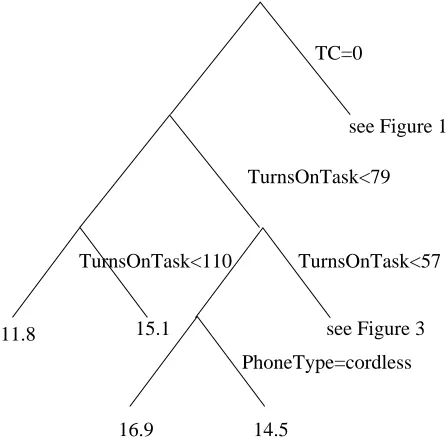
Diagrams of the trained decision trees are given below. At any junction, if the query is true then one takes the path down the right-hand side of the tree, otherwise one takes the left-hand side. The leaf nodes contain the predicted value.
Figure 9 illustrates that TaskCompletion is at the top of the tree and is, therefore, the most queried fea-ture. The phone-type is an important part of User-Satisfaction prediction, whereby dialogues conducted over corded phones have higher satisfaction. This is likely to be due to better recognition performance from corded phones. The rule containing the bigram re-quest info:depart arrive date+USER states that if there is more than one occurrence of this request then UserSatis-faction will be lower. A repetition of this DATE act indi-cates that a misunderstanding occurred the first time it is requested or that the task is multi-leg in which case User-Satisfaction is generally lower.
Figure 10 gives part of the left side of the tree where TaskCompletion 0 i.e. some level of TaskCompletion has
been achieved. This portion of the tree shows how impor-tant dialogue length is to UserSatisfaction. TurnsOnTask is the number of turns which are task-oriented, for example, initial instructions on how to use the system are not taken as a TurnOnTask. The tree indicates that dialogues which are long (TurnsOnTask 110 ) are satisfactory
(UserSatis-faction = 15.2) if some task is completed (TC 0). Again,
if the phone-type is not corded UserSatisfaction is lower. Figure 11 gives the final, lower part of the tree. If there has been more than three acknowledgments of bookings, this indicates that several legs of a journey have been suc-cessfully booked and, therefore, UserSatisfaction is high, in particular if the system has asked if the user would like a price for their itinerary. This request is one of the final dialogue acts a system does before the task is completed.
The DATE act about comm:apology:meta slu reject is a measure of the system’s level of misunderstanding. Therefore, the more of these dialogue act types the lower UserSatisfaction. This part of the tree uses length in a similar way described earlier, whereby long dialogues are only allocated lower UserSatisfaction if they do not involve ground arrangements. In longer dialogues, users seem to prefer systems that include a number of implicit confirma-tions as these dialogues have higher UserSatisfaction.
Feature Auto Eff. Auto Eff. Auto Eff. Auto Eff. + HL Eff.
used +HL Eff. + DATE + DATE
HLTaskCompletion 0.5955 0.607 0.614 0.614
AutoTaskCompletion 0.4593 0.476 0.484 0.484
Table 1: Correlation results using Automatic Efficiency Measures (Eff.), adding DATE features and hand-labelled Effi-ciency Measures, for trees tested on either hand-labelled or automatically derived TaskCompletion
11.4 9.8
+USER<1.2 see Part 2
request_info:depart_day_month_date
12.5 TC=0
phone_type=corded
Figure 9: Sub-tree (part 1) of the Regression Tree for User-Satisfaction (TC is binary TaskCompletion)
PhoneType=cordless
14.5 16.9
15.1
11.8 see Figure 3 see Figure 1
TurnsOnTask<57 TurnsOnTask<110
TurnsOnTask<79 TC=0
Figure 10: Sub-tree (part 2) of the Regression Tree for UserSatisfaction (TC is binary TaskCompletion)
A figure known as Feature Usage Frequency can be cal-culated from the CART tree. This metric reflects which fea-tures are the most discriminatory in the tree. Specifically, this measure is the number of times a feature is queried dur-ing the regression calculation of each data point. The figure is normalized so that the feature usage sums to one for each tree. It reflects the position in the Regression Tree as the higher the feature is in the tree, the more times it is queried. Efficiency Measures are the most discriminatory feature set covering 47% of the queries. The Dialogue Act Quality Measures account for 32% of the tree’s discriminatory fea-tures. Task Success is the feature queried at the top of the tree and accounts for 21% of the feature usage.
15.7
18.4 21.3
16.5
18 see Part 2
implicit_confirm:arrive_depart_time<1 acknowledge:flight_booking < 3
request_info:price<1
request_info:top_level_trip <2 request_info:hotel<1
19.9
meta_slu_reject+USER <1 about_comm:apology:
19.9 21.8
TimeOnTask<280
Figure 11: Sub-tree (part 3) of the Regression Tree for UserSatisfaction
8.
Previous Work
Previous work looks at predicting UserSatisfaction us-ing multi-variate linear regression usus-ing non-automatic ef-ficiency, quality and task success metrics (Walker et al., 2000; Walker et al., 2001). This work looks at predicting UserSatisfaction for the 2000 Communicator data and finds that adding the counts for the DATE to the logfile standard metrics yields an increase from .37 to 0.42 (
).
These results are not directly comparable as they are performed on different data. However, a qualitative com-parison is interesting. Their multi-variate linear regression experiments give coefficients for each feature which indi-cate the magnitude and whether the metric is a positive or negative predictor of UserSatisfaction. Some of the metrics which are heavily weighted are comparable to the ones the Regression Tree finds. For example, TaskCompletion has the highest magnitude coefficient and comes at the top of our regression tree. Task duration is negatively weighted. This is also the case in our Regression Tree, although the decision tree also captures non-linear interactions between features. For example, longer dialogues are only penalized if a more simple task is being performed.
DATE acts used in both systems include acknowledg-ment:flight booking, request info:depart arrive date and request info:top level trip. Explicit confirmations have a higher weighting than implicit confirmations in the linear-regression model, whereas our CART tree tends to favor implicit confirmations. This may indicate that the spoken dialogue systems are tending towards more natural conver-sations where implicit confirmations are preferred.
“Prob-lematic dialogues” (Walker et al., 2002). The goal of these Problematic Dialogue Predictors is to determine which di-alogues are likely to fail before the end of the dialogue so that the system can be adapted on-line, and the user can be transferred to a human customer care agent if there is a problem. This is similar to our TaskCompletion predictor in the Communicator domain. They use features from a num-ber of sources, such as acoustic features and features from the natural language understanding and dialogue manager components. The most important features come from the Natural Language Understanding system (such as interpre-tation confidence measures). For the Communicator Data, such detailed metrics are not available for interpretation, al-though the DATE act about comm:apology:meta slu reject does approximate this. In our study, predicting TaskCom-pletion prior to dialogue comTaskCom-pletion is also a possibility. However, more sophisticated features (such as ASR and NLU confidence scores) would need to be used in order for this to be a possibility.
9.
Conclusion
In summary, we have presented results for automati-cally evaluating system performance in the October-2001 corpus of 1242 Communicator dialogues in the travel plan-ning domain. In this study, performance is measured either with a Task Success metric or with UserSatisfaction. As predictors of UserSatisfaction, we examined the utility of three different types of features: Task Success Features, Ef-ficiency Measures and Dialogue Act Quality metrics. We described how we automatically labelled the dialogues in order to create the dialogue act features that were input for our automatic prediction task. We showed that using these features, we can predict TaskCompletion with an accuracy of 85
and model UserSatisfaction with a correlation of up to 0.614.
A possible extension to this work is the automatic pre-diction of the user’s dialogue act type. The user’s utterance would be predicted using a set of dialogue act type spe-cific language models run over the ASR output and a dia-logue model (Wright, 2000). This diadia-logue model would be highly predictive, given that we have an accurate DATE tagger for the system’s turns combined with the fact that users do not take the initiative frequently in the Communi-cator dialogues. A further extension of this work is to look at the intonation of the user. For example, if the system is expecting a short yes/no answer and the user replies with a long utterance with a rising intonation contour then this is more likely to be a question, indicating a breakdown in the initial dialogue strategy.
10.
Acknowledgments
The work reported in this paper was partially funded by DARPA contract MDA972-99-3-0003.
11.
References
Bonneau-Maynard, H., L. Devillers, and S. Rosset, 2000. Predictive performance of dialog systems. In Language
Resources and Evaluation Conference.
Brieman, Leo, Jerome H. Friedman, Richard A. Olshen, and Charles J. Stone, 1984. Classification and
Regres-sion Trees. Wadsworth and Brooks, Monterey
Califor-nia.
Cattoni, Roldana, Morena Danieli, Andrea Panizza, V. San-drini, and C. Soria, 2001. Building a corpus of annotated dialogues: the ADAM experience. In Proc. of the
Con-ference Corpus-Linguistics-2001, Lancaster, U.K..
Doyle, Jon, 1992. Rationality and its roles in reasoning.
Computational Intelligence, 8(2):376–409.
Kamm, Candace, 1995. User interfaces for voice applica-tions. In David Roe and Jay Wilpon (eds.), Voice
Com-munication between Humans and Machines. National
Academy Press, pages 422–442.
Keeney, R. and H. Raiffa, 1976. Decisions with Multiple
Objectives: Preferences and Value Tradeoffs. John
Wi-ley and Sons.
Lamel, Lori and Sophie Rosset, 2000. Considerations in the design and evaluation of spoken language dialog sys-tems. In ISCLP.
Polifroni, Joseph, Lynette Hirschman, Stephanie Seneff, and Victor Zue, 1992. Experiments in evaluating inter-active spoken language systems. In Proceedings of the
DARPA Speech and NL Workshop.
Prasad, Rashmi and M. Walker, 2002. Training a dialogue act tagger for human-human and human-computer travel dialogues. In submission to ACL.
Shriberg, Elizabeth, Elizabeth Wade, and Patti Price, 1992. Human-machine problem solving using spoken language systems (SLS): Factors affecting performance and user satisfaction. In Proceedings of the DARPA Speech and
NL Workshop.
Walker, M., I. Langkilde-Geary, H. Wright Hastie, J. Wright, and A. Gorin, 2002. Automatically training a problematic dialogue predictor for a spoken dialogue system. JAIR.
Walker, M., R. Passonneau, and J. Boland, 2001. Quanti-tative and qualiQuanti-tative evaluation of darpa communicator spoken dialogue systems. In Proceedings of the 39rd
An-nual Meeting of the Association for Computational Lin-guistics (ACL/EACL-2001).
Walker, M. A., 2000. An application of reinforcement learning to dialogue strategy selection in a spoken dia-logue system for email. Journal of Artificial Intelligence
Research, 12:387–416.
Walker, M. A., C. A. Kamm, and D. J. Litman, 2000. To-wards developing general models of usability with PAR-ADISE. In Natural Language Engineering: Special
Is-sue on Best Practice in Spoken Dialogue Systems.
Wright, H., 2000. Modelling Prosodic and Dialogue
Infor-mation for Automatic Speech Recognition. Ph.D. thesis,