Clinical Interventions in Aging 2016:11 1609–1622
Clinical Interventions in Aging
Dove
press
submit your manuscript | www.dovepress.com 1609
O r I g I n A l r e s e A r C h
open access to scientific and medical research
Open Access Full Text Article
Efficacy and safety of prostate artery embolization
on lower urinary tract symptoms related to
benign prostatic hyperplasia: a systematic
review and meta-analysis
Xiao-yan Wang huan-tao Zong Yong Zhang
Department of Urology, Beijing Tian Tan Hospital, Capital Medical University, Beijing, People’s Republic of China
Background: Prostate artery embolization (PAE) is emerging and is a promising minimally invasive therapy that improves lower urinary tract symptoms (LUTS) related to benign prostatic hyperplasia (BPH). The purpose of this article was to evaluate the efficacy and safety of PAE on LUTS related to BPH.
Materials and methods: A literature review was performed to identify all published articles of PAE for BPH. The sources included MEDLINE, EMBASE and Cochrane Library from 1980 to 2016. A systematic review and meta-analysis was conducted. The outcome measurements were combined by calculating the mean difference with 95% confidence interval. Statistical analysis was carried out using Review Manager 5.3.0.
Results: Twelve studies involving 840 participants were included. Compared with baseline, the International Index of Erectile Function (IIEF-5; International Prostate Symptom Score)
scores, the quality of life scores, peak urinary flow rate (Qmax) and postvoid residual volume all
had significant improvements during the 24-month follow-up (all P,0.00001). Both prostate volume (PV) and prostate-specific antigen had significant decrease during the 12-month follow-up (P,0.00001 and P=0.005, respectively), except postoperative 24 months (P=0.47
and P=0.32, respectively). The IIEF-5 short form scores had significant increase at
postopera-tive 6 months (P=0.002) and 12 months (P,0.0001), except postoperapostopera-tive 1 month (P=0.23)
and 24 months (P=0.21). For large volume (PV $80 mL) BPH, the results were similar. There
were no life-threatening complications.
Conclusion: PAE is an effective, safe and well-tolerable treatment for LUTS related to BPH, including large volume (PV $80 mL) BPH, with a good short-term follow-up. Studies with large number of cases and longer follow-up time are needed to validate our results.
Keywords: lower urinary tract symptoms, benign prostatic hyperplasia, meta-analysis, prostate artery embolization
Introduction
Lower urinary tract symptoms (LUTS) are main complaints resulting from benign
prostatic hyperplasia (BPH), which is one of the most common diseases of aging men.1
LUTS can range in severity and have a significant impact on the quality of life (QoL). The current treatment options include watchful waiting, medical therapy and surgical intervention. The patients refractory to preliminary treatments can be treated with surgical intervention. Transurethral resection of the prostate (TURP) is the gold standard therapy for LUTS/BPH and, for many years, has been considered the surgical treatment
Correspondence: Yong Zhang Department of Urology, Beijing Tian Tan Hospital, Capital Medical University, No 6 Tiantan Xi Li, Dong Cheng District, Beijing 100050, People’s Republic of China
Tel +86 10 6709 8393 Fax +86 10 6709 6611 email [email protected]
Journal name: Clinical Interventions in Aging Article Designation: Original Research Year: 2016
Volume: 11
Running head verso: Wang et al
Running head recto: Prostate artery embolization for benign prostatic hyperplasia DOI: http://dx.doi.org/10.2147/CIA.S119241
Clinical Interventions in Aging downloaded from https://www.dovepress.com/ by 118.70.13.36 on 20-Aug-2020
For personal use only.
Number of times this article has been viewed
This article was published in the following Dove Press journal: Clinical Interventions in Aging
Dovepress Wang et al
of choice and the standard of care when other treatment
methods fail.2 However, TURP has significant
complica-tions, including short-term bleeding, dilutional hyponatremia, sexual dysfunction and incontinence. The complication rate
is higher for patients with large volume BPH.3
Recently, prostate artery embolization (PAE) has started emerging and is a promising minimally invasive therapy that improves LUTS related to BPH and is associated with
a decrease in prostate volume (PV).4 However, it is reported
that as many as 25% of patients show no significant improve-ment in symptoms and peak flow rate. In addition, the average
reduction rate in the PV after PAE was only 20%.5
The aim of this meta-analysis was to evaluate the efficacy and safety of PAE on LUTS related to BPH, which may help urologists make better choices in the case of elderly patients with large volume BPH.
Materials and methods
Search strategy
A comprehensive literature search was carried out by two independent reviewers using MEDLINE (from 1980 to 2016), EMBASE (from 1980 to 2016) and the Cochrane Central Register of Controlled Trials. The reference lists of the retrieved studies were also checked. The following search terms were used: “prostate artery embolization”, “lower urinary tract symptoms” and “benign prostatic hyperplasia”.
Inclusion criteria
Studies that met the following criteria were included: 1) a study design that included PAE for BPH; 2) a study that provided data on International Prostate Symptom Score (IPSS), QoL, PV, prostate-specific antigen (PSA), peak
urine flow rate (Qmax), postvoid residual (PVR) volume and
International Index of Erectile Function (IIEF-5) short form at different follow-up times, and 3) a study where its full text could be accessed. If these inclusion criteria were not met, then the study was excluded.
Trial selection
When the same study was published in various journals or in different years, the most frequently cited one was used. If the same group of researchers studied a group of subjects with multiple experiments, then each study was included. Together, we discussed each of the studies that were included and excluded.
Quality assessment
The quality of included studies was assessed using the Newcastle–Ottawa scale generating a maximum of nine
stars to each study, including four stars for the selection of participants, two stars for the comparability of participants and three stars for the assessment of outcomes. Quality was assigned according to the scores so that seven to nine stars indicated high quality, four to six stars indicated middle quality and zero to three stars indicated low quality.
Data extraction
Two independent reviewers extracted the data using a predesigned form. The following information was collected from each study: 1) the name of the first author and the publication year; 2) the sample size; 3) the country in which the study was conducted; 4) data on IPSS, QoL, PV, PSA,
Qmax, PVR volume and IIEF-5 at different follow-up times
and 5) the number of participants with complications. Any disputes were resolved by group consensus.
Statistical analysis
Statistical analysis was carried out using Review Manager 5.3.0. The changes in seven functional indexes were deter-mined as differences between baseline and study completion. Outcome measurements were combined by calculating the mean difference with 95% confidence interval (CI). To
quantify the effect of heterogeneity test result, I2
heteroge-neity test was used. A random-effects model was used if
I2 value was .50%; if not, a fixed-effects model was used.
Publication bias was evaluated using the funnel plot.
Results
Characteristic and quality assessment
of eligible studies
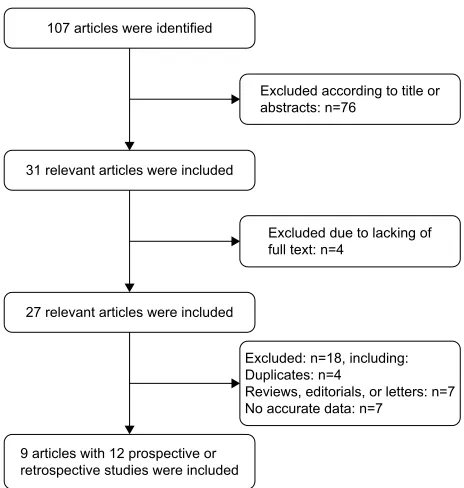
Figure 1 shows the flow diagram of the study selection process. Finally, there were nine articles involving 12 studies eligible for this meta-analysis.6–14 All of the 12 studies
reported the baseline IPSSs, QoL scores, PV, PSA levels,
Qmax, PVR volume and IIEF-5 scores. All 12 studies excluded
patients with malignancy, advanced atherosclerosis and tor-tuosity of the iliac arteries and/or prostate arteries, secondary renal insufficiency, large bladder diverticula or stones, neu-rogenic bladder, detrusor muscle failure, active urinary tract infection and unregulated coagulation parameters. The main characteristic and quality assessment of eligible studies are presented in Table 1.
Changes after PAE
IPSSsSix studies involving 582 participants, five studies involving 451 participants, six studies involving 479 participants and three studies involving 117 participants included
Clinical Interventions in Aging downloaded from https://www.dovepress.com/ by 118.70.13.36 on 20-Aug-2020
Dovepress Prostate artery embolization for benign prostatic hyperplasia
data representing IPSS changes at postoperative 1 month (Figure 2A), 6 months (Figure 2B), 12 months (Figure 2C) and 24 months (Figure 2D), respectively.
Compared with baseline, the IPSSs had significant decreases at postoperative 1 month (weighted mean
differ-ence (WMD) −12.74, 95% CI −15.10 to −10.39, P,0.00001),
6 months (WMD −14.13, 95% CI −17.73 to −10.54,
P,0.00001), 12 months (WMD −16.07, 95% CI −18.16
to −13.98, P,0.00001) and 24 months (WMD −15.62, 95%
CI −17.41 to −13.82, P,0.00001).
Qol scores
Nine studies involving 660 participants, eight studies involving 528 participants, six studies involving 414 participants and three studies involving 117 participants included data representing QoL score changes at postopera-tive 1 month (Figure 3A), 6 months (Figure 3B), 12 months (Figure 3C) and 24 months (Figure 3D), respectively.
Compared with baseline, the QoL scores had significant
decreases at postoperative 1 month (WMD −2.07, 95%
CI −2.37 to −1.76, P,0.00001), 6 months (WMD −2.15, 95%
CI −2.44 to −1.86, P,0.00001), 12 months (WMD −2.81,
95% CI −3.45 to −2.17, P,0.00001) and 24 months
(WMD −2.15, 95% CI −2.60 to −1.69, P,0.00001).
Prostate volume
Five studies involving 507 participants, five studies involv-ing 386 participants, six studies involvinvolv-ing 366 participants and three studies involving 106 participants included
data representing PV changes at postoperative 1 month (Figure 4A), 6 months (Figure 4B), 12 months (Figure 4C) and 24 months (Figure 4D), respectively.
Compared with baseline, PV had significant decreases
at postoperative 1 month (WMD −17.33, 95% CI −21.19
to −13.47, P,0.00001), 6 months (WMD −31.62, 95%
CI −46.75 to −16.48, P,0.0001) and 12 months (WMD −30.72,
95% CI −42.91 to −18.53, P,0.00001). Although PV was
also less at postoperative 24 months (WMD −16.89, 95%
CI −62.61 to −28.83), the difference was not statistically significant (P=0.47).
Prostate-specific antigen
Five studies involving 520 participants, five studies involving 383 participants, six studies involving 379 participants and three studies involving 104 participants included data repre-senting PSA changes at postoperative 1 month (Figure 5A), 6 months (Figure 5B), 12 months (Figure 5C) and 24 months (Figure 5D), respectively.
Compared with baseline, PSA had significant decreases
at postoperative 1 month (WMD −0.80, 95% CI −1.44
to −0.16, P=0.01), 6 months (WMD −1.15, 95% CI −1.69
to −0.60, P,0.0001) and 12 months (WMD −0.97, 95%
CI −1.65 to −0.29, P=0.005). Although PSA was also less
at postoperative 24 months (WMD −0.80, 95% CI −2.37
to −0.77), the difference was not statistically
signifi-cant (P=0.32).
Qmax
Six studies involving 502 participants, five studies involving 368 participants, six studies involving 368 participants and three studies involving 104 participants included data
repre-senting Qmax changes at postoperative 1 month (Figure 6A),
6 months (Figure 6B), 12 months (Figure 6C) and 24 months (Figure 6D), respectively.
Compared with baseline, Qmax had significant
increases at postoperative 1 month (WMD 4.40, 95%
CI 3.00–5.80, P,0.00001), 6 months (WMD 4.71, 95%
CI 2.62–6.81, P,0.0001), 12 months (WMD 5.60, 95% CI
4.19–7.02, P,0.00001) and 24 months (WMD 5.89, 95%
CI 5.08–6.7, P,0.00001).
PVR volume
Six studies involving 476 participants, five studies involv-ing 348 participants, six studies involvinvolv-ing 369 participants and three studies involving 104 participants included data representing PVR volume changes at postoperative 1 month (Figure 7A), 6 months (Figure 7B), 12 months (Figure 7C) and 24 months (Figure 7D), respectively.
([FOXGHGQ LQFOXGLQJ 'XSOLFDWHVQ
5HYLHZVHGLWRULDOVRUOHWWHUVQ 1RDFFXUDWHGDWDQ
([FOXGHGGXHWRODFNLQJRI IXOOWH[WQ
DUWLFOHVZLWKSURVSHFWLYHRU UHWURVSHFWLYHVWXGLHVZHUHLQFOXGHG
UHOHYDQWDUWLFOHVZHUHLQFOXGHG UHOHYDQWDUWLFOHVZHUHLQFOXGHG
DUWLFOHVZHUHLGHQWLILHG
([FOXGHGDFFRUGLQJWRWLWOHRU DEVWUDFWVQ
Figure 1 The flow diagram of the study selection process.
Clinical Interventions in Aging downloaded from https://www.dovepress.com/ by 118.70.13.36 on 20-Aug-2020
Dovepress Wang et al
Table 1
The main characteristic and quality assessment of eligible studies
Studies
Sample size
Study design
Country
Age (years)
PV (mL)
Other inclusion criteria
Outcome measures
Follow-up (month)
Quality assessment
a
Gabr et al
6 22 Retrospective study Saudi Arabia . 50 n
BPH patients with LUTS refractory to BPH- related medical therapy or those who had an indwelling urethral catheter due to refractory urine retention IPSS, QoL, PV, PSA, Qmax
, PVR
volume,
IIEF-5
1, 3, 9
Four stars
Bilhim et al
7 186 Retrospective study Portugal . 55 . 30
BPH patients, IPSS
.
18 and Qo
l scores
$
3,
refractory to medical treatment for at least 6 months;
Qmax
#
12
mL/s or those with acute
urinary retention
IPSS, QoL, PV, PSA, Qmax
, PVR
volume,
IIEF-5
1, 6, 12, 18, 24
seven stars
Wang et al
8 47 Prospective study China $ 75 . 40
BPH patients, IPSS
.
18 and Qo
l scores
$
3,
refractory to medical treatment for at least 6 months;
Qmax
#
12
mL/s or those with acute
urinary retention
IPSS, QoL, PV, PSA, Qmax
, PVR
volume,
IIEF-5
12
Five stars
Wang et al
8
100
,
75
seven stars
Isaacson et al
9 12 Prospective study U sA . 40 80–150
Previous trial of BPH medication, IPSS
$ 18, life expectancy . 1 year
IPSS, QoL, PV, PSA, Qmax
, PVR
volume,
IIEF-5
1, 3
Three stars
Bagla et al
10 16 Prospective study U sA . 45 , 50
BPH patients with moderate- or severe-grade symptoms
QoL, IIEF-5
1, 3, 6
Four stars
Bagla et al
10
26
50–80
Four stars
Bagla et al
10
36
.
80
Four stars
li et al
11 22 Prospective study China . 65 . 80
BPH patients, IPSS
. 12, Qmax , 15 mL/s, PSA , 4
ng/mL or PSA level between 4 and
10
ng/mL but negative prostate biopsy
IPSS, QoL, PV, PSA, Qmax
, PVR
volume,
IIEF-5
1, 3, 6, 12
Four stars
Wang et al
12 109 Prospective study China . 50 . 80
BPH patients, IPSS
.
18 and Qo
l scores
.
3,
refractory to medical treatment for at least 6 months,
Qmax
,
12
m
l/s
IPSS, QoL, PV, PSA, Qmax
, PVR
volume,
IIEF-5
1, 3, 6, 12, 24
six stars
Pisco et al
13 250 Prospective study Portugal . 45 . 40
BPH patients, IPSS
.
18, and QoL score
$
3,
refractory to medical treatment for at least 6 months;
Qmax
,
12
mL/s, sexual dysfunction
or accepting the risk of developing sexual dysfunction after treatment IPSS, QoL, PV, PSA, Qmax
, PVR
volume,
IIEF-5
1, 3, 6, 12, 18, 24
Eight stars
Pisco et al
14 14 Prospective study Portugal . 60 n
BPH patients, IPSS
.
18 and Qo
l score
$
3,
refractory to medical treatment for at least 6 months;
Qmax
,
12
mL/s or those with acute
urinary retention
IPSS, QoL, PV, PSA, Qmax
, PVR volume, IIEF-5 6 Three stars Notes:
aSeven to nine stars indicated high quality, four to six stars middle quality and zero
to three
stars low quality. “N” indicates not applicable.
Abbreviations: AUA, American Urological Association Symptom Index; BPH, benign prostatic hyperplasia; IIEF-5, International Index of Erectile Function; IPSS, International Prostate Symptom Score; LUTS, lower urinary tract
symptoms; PSA, prostate-specific antigen; PV, prostate volume; PVR, postvoid residual;
Qmax
, peak urinary flow rate; QoL, quality of life.
Clinical Interventions in Aging downloaded from https://www.dovepress.com/ by 118.70.13.36 on 20-Aug-2020
Dovepress Prostate artery embolization for benign prostatic hyperplasia
+HWHURJHQHLW\
τ
χ
GI
3
,
7HVWIRURYHUDOOHI
IHFW
=
3
+HWHURJHQHLW\
τ
χ
GI
3
,
7HVWIRURYHUDOOHI
IHFW
=
3
+HWHURJHQHLW\
τ
χ
GI
3
,
7HVWIRURYHUDOOHI
IHFW
=
3
+HWHURJHQHLW\
τ
χ
GI
3
,
7HVWIRURYHUDOOHI
IHFW
=
3
3RVWRSHUDWLRQ
6WXG\RU VXEJURXS %LOKLPHWDO 7RWDO&, 7RWDO&, 7RWDO&, 7RWDO&,
*DEUHWDO
,VDDFVRQHWDO
/LHWDO
3LVFRHWDO
3LVFRHWDO
:
DQJHWDO
%LOKLPHWDO
%LOKLPHWDO
:
DQJHWDO
/LHWDO
3LVFRHWDO
3LVFRHWDO
:
DQJHWDO
:
DQJHWDO
%LOKLPHWDO
:
DQJHWDO
/LHWDO
3LVFRHWDO
:
DQJHWDO
0HDQ
6'
±
±
)DYRUVEDVHOLQH
)DYRUVSRVWRSHUDWLRQ
%DVHOLQH
7RWDO
6'
7RWDO
:
HLJKW
±±
WR±
±±WR± ±±WR± ±±WR±
±
±
WR±
±±WR± ±±WR± ±±WR± ±±WR± ±±WR±
±±WR± ±±WR± ±±WR± ±±WR± ±±WR± ±±WR± ±±WR± ±±WR± ±±WR± ±±WR± ±±WR± ±±WR± ±±WR±
±±WR±
0HDQGLIIHUHQFH,9
UDQGRP&,
0HDQGLIIHUHQFH,9
UDQGRP&,
0HDQ
$
%
&
'
Figure 2
A forest plot about IPSS changes after PAE at postoperative 1
month (
A
), 6
months (
B
), 12
months (
C
), and 24
months (
D
).
Abbreviations:
CI, confidence interval; IPSS, International Prostate Symptom Score; IV, intravenous; PAE, prostate artery embolization; SD, standard deviation.
Clinical Interventions in Aging downloaded from https://www.dovepress.com/ by 118.70.13.36 on 20-Aug-2020
Dovepress Wang et al
3RVWRSHUDWLRQ
+HWHURJHQHLW\
τ
χ
GI
3
,
7HVWIRURYHUDOOHI
IHFW
=
3
+HWHURJHQHLW\
τ
χ
GI
3
,
7HVWIRURYHUDOOHI
IHFW
=
3
+HWHURJHQHLW\
τ
χ
GI
3
,
7HVWIRURYHUDOOHI
IHFW
=
3
+HWHURJHQHLW\
τ
χ
GI
3
,
7HVWIRURYHUDOOHI
IHFW
=
3
6WXG\RU VXEJURXS %DJOD 7RWDO&, 7RWDO&, 7RWDO&, 7RWDO&,
HWDO
%DJOD
HWDO
%DJOD
HWDO
%LOKLP
HWDO
*DEUHWDO
,VDDFVRQHWDO
/LHWDO
3LVFRHWDO
:
DQJHWDO
%DJOD
HWDO
%DJOD
HWDO
%DJOD
HWDO
%LOKLP
HWDO
/LHWDO
3LVFRHWDO
3LVFRHWDO
:
DQJHWDO
%LOKLP
HWDO
%LOKLP
HWDO
/LHWDO
3LVFRHWDO
3LVFRHWDO
:
DQJHWDO
:
DQJHWDO
:
DQJHWDO
:
DQJHWDO
0HDQ
6'
±
±
)DYRUVEDVHOLQH
)DYRUVSRVWRSHUDWLRQ
%DVHOLQH
6'
7RWDO
7RWDO
:
HLJKW
±±WR± ±±WR± ±±WR± ±±WR± ±±WR± ±±WR± ±±WR± ±± ±±WR± ±±WR± ±±WR± ±±WR± ±±WR± ±±WR± ±±WR±
WR±
±±WR± ±±WR± ±±WR± ±±WR± ±±WR± ±±WR± ±±WR± ±±WR± ±±WR± ±±WR± ±±WR± ±±WR± ±±WR± ±±WR± ±±WR±
0HDQGLIIHUHQFH,9
UDQGRP&,
0HDQGLIIHUHQFH,9
UDQGRP&,
0HDQ
$
%
&
'
Figure 3
A forest plot about QoL score changes after PAE at postoperative 1
month (
A
), 6
months (
B
), 12
months (
C
), and 24
months (
D
).
Abbreviations:
CI, confidence interval; IV, intravenous; PAE, prostate artery embolization; SD, standard deviation; QoL, quality of life.
Clinical Interventions in Aging downloaded from https://www.dovepress.com/ by 118.70.13.36 on 20-Aug-2020
Dovepress Prostate artery embolization for benign prostatic hyperplasia
+HWHURJHQHLW\
τ
χ
GI
3
,
7HVWIRURYHUDOOHI
IHFW
=
3
+HWHURJHQHLW\
τ
χ
GI
3
,
7HVWIRURYHUDOOHI
IHFW
=
3
+HWHURJHQHLW\
τ
χ
GI
3
,
7HVWIRURYHUDOOHI
IHFW
=
3
+HWHURJHQHLW\
χ
GI
3
,
7HVWIRURYHUDOOHI
IHFW
=
3
$
%
&
'
±
±
)DYRUVEDVHOLQH
)DYRUVSRVWRSHUDWLRQ
7RWDO&,
7RWDO&,
7RWDO&,
7RWDO&,
:
DQJHWDO
3LVFRHWDO
/LHWDO
*DEUHWDO
D%LOKLP
HWDO
:
DQJHWDO
3LVFRHWDO
3LVFRHWDO
/LHWDO
%LOKLPHWDO
:
DQJHWDO
:
DQJHWDO
3LVFRHWDO
3LVFRHWDO
:
DQJHWDO
:
DQJHWDO
/LHWDO
%LOKLPHWDO
%LOKLPHWDO
6WXG\RU VXEJURXS
±±
WR
±±
WR
±±
WR
±±
WR±
±±
WR±
±±
WR±
±±
WR±
±±
WR±
±±
WR±
±±
WR±
±±
WR±
±±
WR±
±±
WR±
±±
WR±
±±
WR±
±±
WR±
±±
WR±
±WR ±WR ±±
WR±
±±
WR
±±
WR±
±±
WR±
0HDQGLIIHUHQFH,9
UDQGRP&,
6'
0HDQ
6'
0HDQ
:
HLJKW
7RWDO
7RWDO
3RVWRSHUDWLRQ
%DVHOLQH
0HDQGLIIHUHQFH,9
UDQGRP&,
Figure 4
A forest plot about PV changes after PAE at postoperative 1
month (
A
), 6
months (
B
), 12
months (
C
), and 24
months (
D
).
Note:
aUsing the fixed-effects model.
Abbreviations:
CI, confidence interval; IV, intravenous; PAE, prostate artery embolization; PV, prostate volume; SD, standard deviation.
Clinical Interventions in Aging downloaded from https://www.dovepress.com/ by 118.70.13.36 on 20-Aug-2020
Dovepress Wang et al
±
±
+HWHURJHQHLW\
τ
χ
GI
3
,
7HVWIRURYHUDOOHI
IHFW
=
3
+HWHURJHQHLW\
τ
χ
GI
3
,
7HVWIRURYHUDOOHI
IHFW
=
3
+HWHURJHQHLW\
τ
χ
GI
3
,
7HVWIRURYHUDOOHI
IHFW
=
3
+HWHURJHQHLW\
τ
χ
GI
3
,
7HVWIRURYHUDOOHI
IHFW
=
3
%DVHOLQH
3RVWRSHUDWLRQ
0HDQGLIIHUHQFH,9
UDQGRP&,
%LOKLPHWDO
*DEUHWDO
/LHWDO
3LVFRHWDO
:
DQJHWDO
7RWDO&,
%LOKLPHWDO
3LVFRHWDO
3LVFRHWDO
/LHWDO
:
DQJHWDO
%LOKLPHWDO
:
DQJHWDO
%LOKLPHWDO
/LHWDO
:
DQJHWDO
:
DQJHWDO
:
DQJHWDO
3LVFRHWDO
3LVFRHWDO
7RWDO&,
7RWDO&,
7RWDO&,
6WXG\RU VXEJURXS
$
%
&
'
0HDQ
0HDQ
6'
6'
7RWDO
7RWDO
:
HLJKW
±±WR± ±±WR ±±WR± ±±WR± ±WR ±±WR± ±±WR± ±±WR± ±±WR ±±WR± ±±WR± ±±WR± ±±WR± ±±WR± ±±WR ±WR ±±WR± ±±WR± ±±WR± ±±WR± ±WR ±±WR ±±WR
0HDQGLIIHUHQFH,9
UDQGRP&,
)DYRUVSRVWRSHUDWLRQ
)DYRUVEDVHOLQH
Figure 5
A forest plot about PSA changes after PAE at postoperative 1
month (
A
), 6
months (
B
), 12
months (
C
), and 24
months (
D
).
Abbreviations:
CI, confidence interval; IV, intravenous; PAE, prostate artery embolization; PSA, prostate-specific antigen; SD, standard deviation.
Clinical Interventions in Aging downloaded from https://www.dovepress.com/ by 118.70.13.36 on 20-Aug-2020
Dovepress Prostate artery embolization for benign prostatic hyperplasia
±
±
+HWHURJHQHLW\
τ
χ
GI
3
,
7HVWIRURYHUDOOHI
IHFW
=
3
+HWHURJHQHLW\
τ
χ
GI
3
,
7HVWIRURYHUDOOHI
IHFW
=
3
+HWHURJHQHLW\
τ
χ
GI
3
,
7HVWIRURYHUDOOHI
IHFW
=
3
+HWHURJHQHLW\
χ
GI
3
,
7HVWIRURYHUDOOHI
IHFW
=
3
%DVHOLQH
3RVWRSHUDWLRQ
0HDQGLIIHUHQFH,9
UDQGRP&,
%LOKLPHWDO
*DEUHWDO
%LOKLPHWDO
,VDDFVRQHWDO
/LHWDO
3LVFRHWDO
:
DQJHWDO
7RWDO&, 3LVFRHWDO 7RWDO&, 7RWDO&, 7RWDO&,
3LVFRHWDO
/LHWDO
:
DQJHWDO
%LOKLPHWDO
D%LOKLPHWDO
/LHWDO
:
DQJHWDO
:
DQJHWDO
:
DQJHWDO
:
DQJHWDO
3LVFRHWDO
3LVFRHWDO
6WXG\RU VXEJURXS
$
%
&
'
0HDQ
0HDQ
6'
6'
7RWDO
7RWDO
:
HLJKW
WR WR WR WR WR WR WR WR WR WR WR WR WR WR WR WR WR WR WR WR ±WR
WR
WR WR
0HDQGLIIHUHQFH,9
UDQGRP&,
)DYRUVSRVWRSHUDWLRQ
)DYRUVEDVHOLQH
Figure 6
A forest plot about
Qmax
changes after PAE at postoperative 1
month (
A
), 6
months (
B
), 12
months (
C
), and 24
months (
D
).
Note:
aUsing the fixed-effects model.
Abbreviations:
CI, confidence interval; IV, intravenous; PAE, prostate artery embolization; SD, standard deviation;
Qmax
, peak urinary flow rate.
Clinical Interventions in Aging downloaded from https://www.dovepress.com/ by 118.70.13.36 on 20-Aug-2020
Dovepress Wang et al
0HDQGLIIHUHQFH,9
UDQGRP&,
±
±
)DYRUVSRVWRSHUDWLRQ
)DYRUVEDVHOLQH
3RVWRSHUDWLRQ
$
%
&
'
6WXG\RU VXEJURXS %LOKLPHWDO
*DEUHWDO
%LOKLPHWDO
,VDDFVRQHWDO
/LHWDO
3LVFRHWDO
:
DQJHWDO
7RWDO&, 3LVFRHWDO 7RWDO&, 7RWDO&, 7RWDO&,
3LVFRHWDO
/LHWDO
:
DQJHWDO
%LOKLPHWDO
%LOKLPHWDO
/LHWDO
:
DQJHWDO
:
DQJHWDO
:
DQJHWDO
:
DQJHWDO
3LVFRHWDO
3LVFRHWDO
0HDQ
6'
7RWDO
7RWDO
:
HLJKW
0HDQGLIIHUHQFH,9
UDQGRP&, ±±
WR±
±±
WR±
±±
WR±
±±
WR±
±±
WR±
±±
WR±
±±
WR±
±±
WR
±±
WR±
±±
WR±
±±
WR±
±±
WR±
±±
WR±
±±
WR±
±±
WR±
±±
WR±
±±
WR±
±±
WR±
±±
WR±
±±
WR±
±±
WR±
±
±
WR±
±±
WR±
±
±
WR±
%DVHOLQH 0HDQ
6'
+HWHURJHQHLW\
τ
χ
GI
3
,
7HVWIRURYHUDOOHI
IHFW
=
3
+HWHURJHQHLW\
τ
χ
GI
3
,
7HVWIRURYHUDOOHI
IHFW
=
3
+HWHURJHQHLW\
τ
χ
GI
3
,
7HVWIRURYHUDOOHI
IHFW
=
3
+HWHURJHQHLW\
τ
χ
GI
3
,
7HVWIRURYHUDOOHI
IHFW
=
3
Figure 7
A forest plot about PVR volume changes after PAE at postoperati
ve 1
month (
A
), 6
months (
B
), 12
months (
C
), and 24
months (
D
).
Abbreviations:
CI, confidence interval; IV, intravenous; PAE, prostate artery
embolization; PVR, postvoid residual; SD, standard deviation.
Clinical Interventions in Aging downloaded from https://www.dovepress.com/ by 118.70.13.36 on 20-Aug-2020
Dovepress Prostate artery embolization for benign prostatic hyperplasia
$
%
&
'
%DVHOLQH 3RVWRSHUDWLRQ 0HDQGLIIHUHQFH,9 IL[HG&, %DJODHWDO %DJODHWDO %DJODHWDO %DJODHWDO %DJODHWDO %DJODHWDO %LOKLPHWDO *DEUHWDO %LOKLPHWDO ,VDDFVRQHWDO /LHWDO 3LVFRHWDO :DQJHWDO 7RWDO&, 6WXG\RU VXEJURXS 7RWDO&, 7RWDO&, 7RWDO&, 3LVFRHWDO 3LVFRHWDO /LHWDO :DQJHWDO %LOKLPHWDO %LOKLPHWDO /LHWDO :DQJHWDO :DQJHWDO :DQJHWDO :DQJHWDO 3LVFRHWDO 3LVFRHWDO 0HDQ 0HDQ 6' 6' 7RWDO 7RWDO ± ± :HLJKW )DYRUVSRVWRSHUDWLRQ )DYRUVEDVHOLQH 0HDQGLIIHUHQFH,9 UDQGRP&, ±WR WR WR ±±WR ±±WR ±±WR ±WR ±WR ±WR WR ±WR ±WR ±WR ±WR ±±WR WR ±WR ±WR ±WR ±±WR ±WR ±WR ±WR ±±WR WR ±±WR ±WR WR ±WR ±±WR+HWHURJHQHLW\χ GI 3 ,
7HVWIRURYHUDOOHIIHFW= 3
+HWHURJHQHLW\χ GI 3 ,
7HVWIRURYHUDOOHIIHFW= 3
+HWHURJHQHLW\χ GI 3 ,
7HVWIRURYHUDOOHIIHFW= 3
+HWHURJHQHLW\χ GI 3 ,
7HVWIRURYHUDOOHIIHFW= 3
Figure 8 A forest plot about IIEF-5 score changes after PAE at postoperative 1 month (A), 6 months (B), 12 months (C), and 24 months (D).
Abbreviations: CI, confidence interval; IIEF-5, International Index of Erectile Function; IV, intravenous; PAE, prostate artery embolization; SD, standard deviation.
Compared with baseline, PVR volume had significant
decreases at postoperative 1 month (WMD −56.23, 95%
CI −76.02 to −36.34, P,0.00001), 6 months (WMD −66.82,
95% CI −89.34 to −44.29, P,0.00001), 12 months
(WMD −82.69, 95% CI −113.64 to −51.74, P,0.00001) and
24 months (WMD −49.07, 95% CI −97.67 to −0.47, P=0.05).
IIEF-5 scores
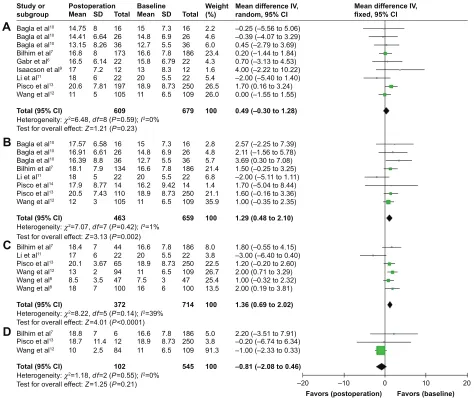
Nine studies involving 609 participants, eight studies involv-ing 463 participants, six studies involvinvolv-ing 372 participants and three studies involving 102 participants included data representing IIEF-5 score changes at postoperative 1 month (Figure 8A), 6 months (Figure 8B), 12 months (Figure 8C) and 24 months (Figure 8D), respectively.
Compared with baseline, the IIEF-5 scores were slightly increased at postoperative 1 month (WMD 0.49, 95%
CI −0.30–1.28), but the difference was not statistically
significant (P=0.23). There were significant increases at postoperative 6 months (WMD 1.29, 95% CI 0.48–2.10,
P=0.002) and 12 months (WMD 1.36, 95% CI 0.69–2.02,
P,0.0001). However, a slight decrease turned up at
postop-erative 24 months (WMD −0.81, 95% CI −2.08–0.46), which
was not statistically significant (P=0.21).
Changes after PAE on large volume
(PV
$
80 mL) BPH
Four studies, involving 179 participants, included data
rep-resenting changes in the large volume BPH (PV.80 mL).9–12
All the results matched the earlier findings, except that PSA had no obvious decrease during the 3-month follow-up and that the IIEF-5 scores had no significant changes during the 12-month follow-up. The comparison of changes after
Clinical Interventions in Aging downloaded from https://www.dovepress.com/ by 118.70.13.36 on 20-Aug-2020
Dovepress Wang et al
Table 2
Comparison of changes after PAE on large volume (PV
$
80
mL) BPH with baseline
9–12 Variables 1 month 3 months 6 months 12 months
MD (95% CI)
P
-value
MD (95% CI)
P
-value
MD (95% CI)
P
-value
MD (95% CI)
P -value IPSSs − 15.97 ( − 17.25 to − 14.68) , 0.00001 − 17.97 ( − 19.00 to − 16.94) , 0.00001 − 18.61 ( − 19.74 to − 17.48) , 0.00001 − 18.32 ( − 19.54 to − 17.09) , 0.00001 Qo l scores − 2.51 ( − 2.74 to − 2.29) , 0.00001 − 2.64 ( − 3.30 to − 1.98) , 0.00001 − 2.45 ( − 3.10 to − 1.80) , 0.00001 − 2.50 ( − 2.83 to − 2.17) , 0.00001 PV − 13.11 ( − 20.63 to − 5.60) 0.0006 − 43.39 ( − 49.92 to − 36.85) , 0.00001 − 47.05 ( − 53.50 to − 40.60) , 0.00001 − 47.58 ( − 53.94 to − 41.21) , 0.00001 PSA − 0.23 ( −
1.21 to 0.74)
0.64 − 0.45 ( − 1.41 to − 0.52) 0.36 − 0.74 ( − 1.15 to − 0.33) 0.0004 − 0.42 ( − 0.82 to − 0.03) 0.04 Qmax
5.42 (4.73 to 6.12)
,
0.00001
6.66 (5.9 to 7.43)
,
0.00001
7.00 (5.95 to 8.05)
,
0.00001
6.00 (5.14 to 6.86)
, 0.00001 PVR volume − 76.64 ( − 84.98 to − 68.29) , 0.00001 − 82.73 ( − 91.10 to − 74.36) , 0.00001 − 88.35 ( − 96.39 to − 80.31) , 0.00001 − 76.80 ( − 121.87 to − 31.72) 0.0008 IIEF-5 scores − 0.04 ( −
1.31 to 1.22)
0.95
−
0.65 (
−
1.93 to 3.23)
0.62
0.85 (
−
1.70 to 3.41)
0.51
−
0.24 (
−
5.12 to 4.63)
0.92
Note:
Data from Isaacson et al,
9 Bagla et al, 10 Li et al, 11 and Wang et al.
12 Abbreviations: BPH, benign prostatic hyperplasia; CI, confidence interval; IIEF-5, International Index of Erectile Function; IPSS, International Prostate Symptom Score; MD, mean difference; PAE, prostate artery embolization; PSA,
prostate-specific antigen; PV, prostate volume; PVR, postvoid residual;
Qmax
, peak urinary fl
ow rate; QoL, quality of life.
PAE on large volume (PV $80 mL) BPH with baseline is
presented in Table 2.
Complications
There were no life-threatening complications. Only one serious adverse event was seen in the study by Pisco et
al:14 a case of a small area (1.5 cm2) of bladder wall
isch-emia in the right side of the base without involvement of the urethra or urethral orifices. The area of ischemia at the bladder base was removed by surgery without further complications.
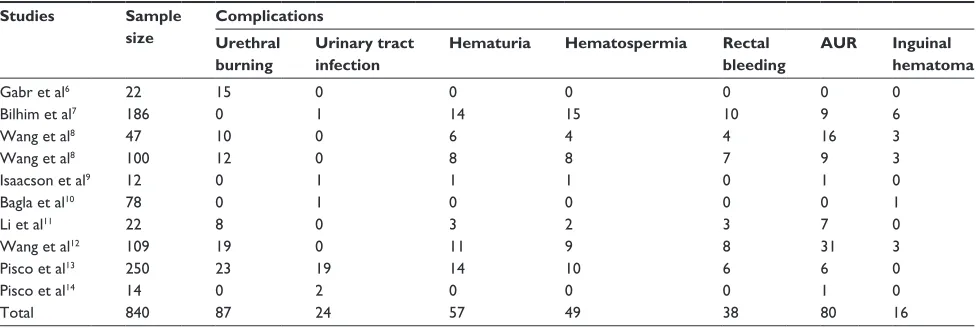
Burning sensation in urethra (87/840, 10.4%) dur-ing the procedure seemed to be the main complication. Hematuria occurred in 57/840 (6.8%) participants, hema-tospermia in 49/840 (5.8%), a small rectal bleeding in 38/840 (4.5%) and inguinal hematoma in 16/840 (1.9%). All these complications disappeared spontaneously without any treatment. In all, 21/840 (2.9%) participants developed urinary tract infection and all responded to suitable antibiotics. A total of 80/840 (9.5%) participants had acute urinary retention (AUR) at 1–3 days after PAE. For relief, a temporary bladder catheter was placed, and they were able to void spontaneously before discharge. There were no cases of sexual impotence or retrograde ejaculation. Complications reported in the eligible studies are presented in Table 3.
Discussion
PAE was first utilized in the 1970s to treat refractory bleeding following prostatic interventions as well as for intractable
hematuria.15 It demonstrated a successful reduction in PV
without serious complications in human beings in 2010.2
The rationale for PAE is that prostate ischemia leads to PV
reduction and hence clinical improvement.16
In this meta-analysis, compared with baseline, there were
significant improvements in the IPSSs (−12.74 points), QoL
scores (−2.07 points), PV (−17.33 mL), PSA (−0.80 ng/mL),
Qmax (+4.4 mL/s) and PVR volume (−56.23 mL) after PAE
at postoperative 1 month. It implied that PAE could take
effect quickly. Furthermore, the IPSSs (−15.62 points), QoL
scores (−2.15 points), Qmax (+5.89 mL/s) and PVR volume
(−49.07 mL) still had significant improvements during the
24-month follow-up, suggesting that PAE had good control of symptoms within 2 years.
For PV and PSA, significant decreases were found during the 12-month follow-up, but not at postoperative 24 months. We thought that the effect of PAE cannot be maintained in the long-term period. Besides prostate size increasing with
Clinical Interventions in Aging downloaded from https://www.dovepress.com/ by 118.70.13.36 on 20-Aug-2020
Dovepress Prostate artery embolization for benign prostatic hyperplasia
Table 3 Complications reported in the eligible studies
Studies Sample
size
Complications Urethral burning
Urinary tract infection
Hematuria Hematospermia Rectal
bleeding
AUR Inguinal hematoma
Gabr et al6 22 15 0 0 0 0 0 0
Bilhim et al7 186 0 1 14 15 10 9 6
Wang et al8 47 10 0 6 4 4 16 3
Wang et al8 100 12 0 8 8 7 9 3
Isaacson et al9 12 0 1 1 1 0 1 0
Bagla et al10 78 0 1 0 0 0 0 1
li et al11 22 8 0 3 2 3 7 0
Wang et al12 109 19 0 11 9 8 31 3
Pisco et al13 250 23 19 14 10 6 6 0
Pisco et al14 14 0 2 0 0 0 1 0
Total 840 87 24 57 49 38 80 16
Abbreviation: AUR, acute urinary retention.
age, revascularization of the prostatic arteries after PAE
may play a role in prostate regrowth. Pisco et al13 observed
this kind of revascularization in their patients with second PAE. Interestingly, the IPSSs still had a significant decrease despite prostatic enlargement at postoperative 24 months. This may suggest that physical reduction of the obstructing tissue was not the only reason for the improvement in LUTS after PAE.
In terms of the IIEF-5 scores, there was no significant increase until 6 months after PAE. The epidemiological evidence had suggested a clear and clinically meaningful association between LUTS and sexual dysfunction that
was independent of age and comorbidity.17 Along with the
continuous improvement in LUTS, the IIEF-5 scores started to increase.
In addition, patients with large volume (PV $80 mL)
BPH are often elderly and may have severe comorbidi-ties. They have increased operative risk of undergoing TURP/open surgery or refuse any surgical treatment.18 In
this meta-analysis, for large volume (PV $80 mL) BPH,
there were significant improvements in the IPSSs (−18.32
points), QoL scores (−2.50 points), PV (−47.58 mL),
Qmax(+6.00 mL/s) and PVR volume (−76.80 mL) after PAE
during the 12-month follow-up, and there were no life-threatening complications. PAE does offer the ability to treat BPH in these patients, due to its minimally invasive nature with low morbidity and the possibility to use local anesthetic
without sedation.8
Subsequent studies have further compared the clinical
outcome of PAE versus TURP. Carnevale et al19 reported
that both groups experienced significant improvement in
IPSS, QoL, PV, and Qmax during the 12-month follow-up.
TURP resulted in significantly higher Qmax and smaller PV
than PAE but required spinal anesthesia and hospitalization, while IIEF scores were significantly higher in the PAE group. Gao et al20 reported a similar result during the 24-month
follow-up, except that the PAE group showed more compli-cations, mostly related to AUR (25.9%), postembolization syndrome (11.1%) and treatment failures (5.3% technical; 9.4% clinical).
Nevertheless, there are some limitations to our analysis. The major limitations include heterogeneity in the participants chosen, different materials and sizes of embolic agents and bilateral or unilateral embolization. The subgroup and sensitivity analysis or a random-effects model might reduce these limitations, but cannot eliminate. Additionally, the sample sizes of some included studies were small, and there was no long-term follow-up study. Data in the studies covered by this meta-analysis are insufficient to determine whether or not PAE is as good as TURP. Stratified trials with high volume and long follow-up time are awaited to strengthen the evidence and to update our findings.
PAE is an effective, safe and well-tolerable treatment for
LUTS related to BPH, including large volume (PV $80 mL)
BPH, with good short-term follow-up. Studies with large number of cases and longer follow-up time are needed to validate our results.
Disclosure
The authors report no conflicts of interest in this work.
References
1. McVary KT, Roehrborn CG, Avins AL, et al. Update on AUA guide-line on the management of benign prostatic hyperplasia. J Urol. 2011; 185(5):1793–1803.
Clinical Interventions in Aging downloaded from https://www.dovepress.com/ by 118.70.13.36 on 20-Aug-2020
Clinical Interventions in Aging
Publish your work in this journal
Submit your manuscript here: http://www.dovepress.com/clinical-interventions-in-aging-journal
Clinical Interventions in Aging is an international, peer-reviewed journal focusing on evidence-based reports on the value or lack thereof of treatments intended to prevent or delay the onset of maladaptive correlates of aging in human beings. This journal is indexed on PubMed Central, MedLine,
CAS, Scopus and the Elsevier Bibliographic databases. The manuscript management system is completely online and includes a very quick and fair peer-review system, which is all easy to use. Visit http://www.dovepress. com/testimonials.php to read real quotes from published authors.
Dovepress
Dove
press
Wang et al
2. Carnevale FC, Antunes AA, da Motta Leal Filho JM, et al. Prostatic artery embolization as a primary treatment for benign prostatic hyper-plasia: preliminary results in two patients. Cardiovasc Intervent Radiol. 2010;33(2):355–361.
3. Stucki P, Marini L, Mattei A, Xafis K, Boldini M, Danuser H. Bipolar versus monopolar transurethral resection of the prostate: a prospective randomized trial focusing on bleeding complications. J Urol. 2015; 193(4):1371–1375.
4. Jones P, Rai BP, Nair R, Somani BK. Current status of prostate artery embolization for lower urinary tract symptoms: review of world litera-ture. Urology. 2015;86(4):676–681.
5. McWilliams JP, Kuo MD, Rose SC, et al. Society of interventional radiology position statement: prostate artery embolization for treatment of benign disease of the prostate. J Vasc Interv Radiol. 2014;25(9): 1349–1351.
6. Gabr AH, Gabr MF, Elmohamady BN, Ahmed AF. Prostatic artery embolization: a promising technique in the treatment of high-risk patients with benign prostatic hyperplasia. Urol Int. 2016. Epub 2016 Jun 21.
7. Bilhim T, Pisco J, Pereira JA, et al. Predictors of clinical outcome after prostate artery embolization with spherical and nonspherical polyvinyl alcohol particles in patients with benign prostatic hyperplasia.
Radiology. 2016;281(1):289–300.
8. Wang MQ, Wang Y, Yan JY, et al. Prostatic artery embolization for the treatment of symptomatic benign prostatic hyperplasia in men $75 years: a prospective single-center study. World J Urol. 2016; 34(9):1275–1283.
9. Isaacson AJ, Raynor MC, Yu H, Burke CT. Prostatic artery embolization using embosphere microspheres for prostates measuring 80–150 cm(3): early results from a US trial. J Vasc Interv Radiol. 2016;27(5):709–714. 10. Bagla S, Smirniotopoulos JB, Orlando JC, van Breda A, Vadlamudi V.
Comparative analysis of prostate volume as a predictor of outcome in pros-tate artery embolization. J Vasc Interv Radiol. 2015;26(12):1832–1838. 11. Li Q, Duan F, Wang MQ, Zhang GD, Yuan K. Prostatic arterial embo-lization with small sized particles for the treatment of lower urinary tract symptoms due to large benign prostatic hyperplasia: preliminary results. Chin Med J (Engl). 2015;128(15):2072–2077.
12. Wang MQ, Guo LP, Zhang GD, et al. Prostatic arterial embolization for the treatment of lower urinary tract symptoms due to large (.80 mL) benign prostatic hyperplasia: results of midterm follow-up from Chinese population. BMC Urol. 2015;15:33.
13. Pisco JM, Rio Tinto H, Campos Pinheiro L, et al. Embolisation of pros-tatic arteries as treatment of moderate to severe lower urinary symptoms (LUTS) secondary to benign hyperplasia: results of short- and mid-term follow-up. Eur Radiol. 2013;23(9):2561–2572.
14. Pisco JM, Pinheiro LC, Bilhim T, Duarte M, Mendes JR, Oliveira AG. Prostatic arterial embolization to treat benign prostatic hyperplasia.
J Vasc Interv Radiol. 2011;22(1):11–19.
15. Aoun F, Marcelis Q, Roumeguere T. Minimally invasive devices for treating lower urinary tract symptoms in benign prostate hyperplasia: technology update. Res Rep Urol. 2015;7:125–136.
16. Sun F, Sánchez FM, Crisóstomo V, et al. Transarterial prostatic emboliza-tion: initial experience in a canine model. AJR Am J Roentgenol. 2011; 197(2):495–501.
17. Gacci M, Eardley I, Giuliano F, et al. Critical analysis of the relationship between sexual dysfunctions and lower urinary tract symptoms due to benign prostatic hyperplasia. Eur Urol. 2011;60(4):809–825. 18. Choi SY, Kim TH, Myung SC, et al. Impact of changing trends in
medical therapy on surgery for benign prostatic hyperplasia over two decades. Korean J Urol. 2012;53(1):23–28.
19. Carnevale FC, Iscaife A, Yoshinaga EM, Moreira AM, Antunes AA, Srougi M. Transurethral resection of the prostate (TURP) versus origi-nal and perfected prostate artery embolization (PAE) due to benign prostatic hyperplasia (BPH): preliminary results of a single center, prospective, urodynamic-controlled analysis. Cardiovasc Intervent
Radiol. 2016;39(1):44–52.
20. Gao YA, Huang Y, Zhang R, et al. Benign prostatic hyperplasia: prostatic arterial embolization versus transurethral resection of the prostate – a prospective, randomized, and controlled clinical trial.
Radiology. 2014;270(3):920–928.
Clinical Interventions in Aging downloaded from https://www.dovepress.com/ by 118.70.13.36 on 20-Aug-2020