Analysis of Keyless Massive MIMO-based
Cryptosystem Security
Valery Korzhik1, Guillermo Morales-Luna2, Sergei Tikhonov1, and Victor Yakovlev1
1 State University of Telecommunications, St. Petersburg, Russia,
2 Computer Science, CINVESTAV-IPN, Mexico City, Mexico,
Abstract. A cryptosystem for wireless communications, recently pro-posed by T. Dean and A. Goldsmith, is considered. That system can be regarded as a second revolution in cryptography because the confiden-tiality of the messages transmitted over a wireless massive MIMO-based channel is provided by the difference in the space locations of legal and illegal users and it does not require any secret key distribution. How-ever our investigation shows that there is a chance of eavesdropping the cipher texts by using a suboptimal algorithm. Therefore we investigate some additional conditions for channel matrices and additive noises in order to provide a desired security. A combination of wiretap channel coding with a MIMO-based cryptosystem is also considered.
Keywords.Cryptosystem, wireless channel, massive MIMO, lattice hard problems.
1
Introduction
The invention of public key cryptography by W. Diffie and M. Hellman [1] can be thought as a real “revolution in cryptography of the 20-th century”. The au-thors proposed an asymmetric cryptosystem for which encryption and decryption keys were different and, moreover, the decryption key cannot be computationally derived from the encryption key. This approach simplified the problem of key distribution among legitimate users in the presence of eavesdroppers. The use of apublic key algorithm(PKA) solved the problem for a digital signature sce-nario and allowed the creation of many multiparty cryptographic protocols [2]. However, the PKA’s have several drawbacks:
– the encryption or the decryption procedure, even for legitimate users, may be enough complex,
– it is necessary to check the integrity and authenticity of public keys within their storing or distribution,
– private keys can be extracted from tamper resistant modules over side attack channels (say, electrical power or electromagnetic radiation in the environ-ment).
In a recent paper [3], a cryptosystem has been proposed to avoid generic draw-backs belonging to PKA. Although this cryptosystem cannot be used in all situation requiring confidentiality, it is adequate for the case when transmission of secret messages over wireless multipath channels supplied by massive MIMO technology is necessary. On the other hand such wireless channel model was very popular in recent years both as object for theoretical investigations and for practical implementations [4]. Thus, at least for wireless multipath channels, our proposal approach is rather relevant. The main restrictions on the channel model assumed at [3] are:
1. The channel between legitimate users (say Alice (A) and Bob (B)) is de-scribed by anm×n-matrixA= (aij)
1≤j≤n
1≤i≤mof i.i.d. Gaussian random values with zero mean and a given varianceσ2, where eacha
ij is the gain of the
i-th antenna at A to thej-th antenna at B.
2. The eavesdropper channel between A and Eve (E) is properly an n×m -matrixB= (bij)
1≤j≤n
1≤i≤m of i.i.d Gaussian random values with zero mean and a given varianceσ2w, where each bij is the gain of thei-th antenna at A to thej-th antenna at E.
3. All elements of the matrixAare statistically independent of all elements of
B if the legitimate user B is replaced by the eavesdropper E, at least with respect to some reasonable distance (of order about the wave-length). 4. The gain matrices are known exactly by all parties of communications
in-cluding the eavesdropper.
5. The entries of the matrices A and B do not depend statistically on the elements at these matrices on other communication sessions.
These requirements are in line with the experimental results for some wireless channels [5]. At [3] it is claimed that under these conditions, there exists a cryptosystem having the following properties:
1. No secret keys are required to be shared in advance between legitimate users. 2. The proposed cryptosystem (PCS) is provably secure, and it is associated
with a well known hard problem on lattices [6] for the worst case.
3. Encryption and decryption operations are relatively simple and they require just a matrix multiplication over the field of reals.
The above properties (and especially the first one) may assert that PCS is in-deed “the next revolution in cryptography” (at least in the case of MIMO-based channels).
possible to reduce the complexity of deciphering for legitimate users [7]. However this facility may be also of help for potential eavesdroppers, hence we avoid in the current approach the use of any error-correcting code.
2
Description of the encryption/decryption algorithms
for PCS
Following [3], let us recall the mathematical model of a legitimate channel:
z=Ay+e (1)
where y ∈ Zn represents the transmitted vector, A ∈
Zn×n characterises the
channel among legitimate users, and e ∈ Zn represents the legitimate channel noise. Instead, the eavesdropper’s channel is:
z0=By+e0
where B ∈ Zn×n characterises the channel between a legitimate user and an
intruder user, ande0∈Zn represents the eavesdropper’s channel noise.
Alice, A, encrypts a message x∈ZnM, x= [x1 · · · xn]T, with 0≤xk < M andxk∈N, for allk= 1, . . . , n, as:
y=V x (2)
where V is a matrix appearing at the calculation of the singular value decom-position(SVD) of the matrixA, given asA=U SVT, with orthogonal matrices
U and V, and diagonal matrixS (the superindex “T” denotes matrix transpo-sition). By combining (1) with (2) and taking into account the orthogonality of
V, the following version of the ciphertext is obtained
z=Ay+e=U Sx+e.
In order to decrypt the ciphertext, the legitimate user B, knowing the SVD form ofA(see the restriction 4 above), computes
z00=UTz=UTU Sx+UTe=Sx+ ˆe (3)
where ˆe=UTe. On the assumption of Gaussian distribution for ˆe, from (3), the optimal estimation (that is the decryption indeed) of xasx0 givenz00, is:
x0= arg min x
kz00−Sxk (4)
(k · k denotes the Euclidean norm onRn). Since the matrix S is diagonal, say
S= diag[s1 · · · sn], the relation (4) is transformed into:
∀i∈ {1, . . . , n}: x0i= arg min xi
From (5) it follows immediately that the decryption of the messagexhas linear complexity (proportional to n) because it is provided by the calculation of all then coordinates ofx. As a matter of fact, no keys are used for decryption or encryption. Of course, it is possible to call “key” the matrix A but since the eavesdropper E may know this matrix, it is not a secret key at all.
Let us cryptanalyse the case when an eavesdropper tries to follow the strategy of a legitimate user. Eve, E, receives the vector
z0=By+e0 =BV x+e0 =U0S0(V0)TV x+e0=Cx+e0 (6)
where C =U0S0(V0)TV andU0S0(V0)T =B is the SVD of the matrixB. The eavesdropper E then computes (see (3))
z000= (U0)Tz0 = (U0)TCx+ (U0)Te0=C0x+ ˆe0
where ˆe0 = (U0)Te0 and C0 =S0(V0)TV. Since the matrix C0 is not diagonal, finding an optimal estimation for the vector x in the case of a Gaussian i.i.d. noise vector ˆe0, given the vectorz000, is reduced to:
x00= arg min x
kz000−C0xk. (7)
The problem (7) is known to be a hard problem on lattices [6]. It is shown in [3] (see its main theorem), that it is NP-hard problem under the following condition:
Mpσ2σ˜2 e ≥
√
n, (8)
whereM is the size of the message alphabet,σis the standard deviation of the channel gains in B, ˜σe is the standard deviation of the eavesdropper’s channel noise, and nis the number of antennas in the MIMO system. Indeed, the con-dition (8) entails a larger noise at the attacker side, thus the bounded distant decoding algorithm [8] is not suitable in this context.
We may claim, however, that due to the NP-hardness of the problem (7), this cryptanalysis of PCS renders impractical an attack forn≥100.
In summary, at [3] it is claimed that under the assumptions of
– separated locations of legal users and eavesdroppers, and
– the existence of multipath channels with fading combined with massive MIMO technology,
3
Suboptimal cipher breaking algorithms
Consider the suboptimal decryption algorithm under the not so strong condi-tion that the matrix C in (6) is non-singular, i.e. there exists its inverse C−1. Multiplication of both sides of (6) by the inverse matrix gives:
ˆ
z0=C−1z0=x+C−1e0
C−1 is not necessarily an orthogonal matrix, hence C−1e0 is not necessarily an i.i.d. Gaussian vector. Then
∀i∈ {1, . . . , n}: x000i = arg min xi
kzˆi0−xik (9)
where ˆz0 = [ˆz10 · · · ˆzn0]T is not necessarily an optimal estimation algorithm. Clearly, (9) entails a linear complexity.
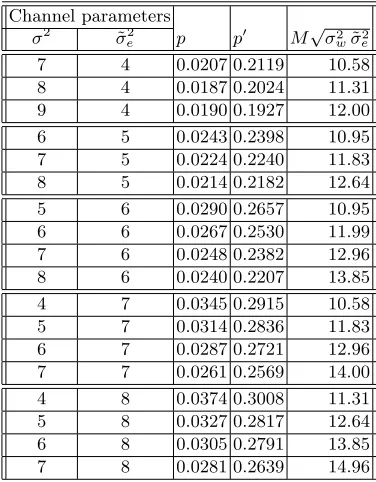
The quality of the cryptanalysis given by (9) can be determined by theerror probability(x000i 6=x). This probability depends on the parametersσw, ˜σeandn. The simulations for both the error probabilities of the legitimate user and the eavesdropper, calculated by (5) and (9), respectively, are presented in Table 1. We consider that the message alphabet is {−1,+1}, thusM = 2, andn= 100.
It can be can seen at Table 1, that for the case of equal legitimate and wiretap channels qualities (σ2=σ2
wandσ2e= ˜σ2e) the error probabilities at a legitimate channel is much lesser than the error probabilities at a wiretap channel. More-over, the error probabilities for a wiretap channel may occur sufficiently large such that it is not possible to recover any meaningful text in some natural lan-guage. In fact, if we assume (for ease of simplicity) that the symbols of some natural language are coded into 5-bits combinations and each bit is transformed independently into an erroneous bit with probability p0 in line with a binary symmetric channel model, then the capacity of such 32-ary symmetric channel without memory can be calculated as follows [9]:
C= 5 + (1−p0)5log 2
(1−p0)5 + 5p0(1−p0)4log
2
p0(1−p0)4 +10(p0)2(1−p0)3log
2
(p0)2(1−p0)3 +10(p0)3(1−p0)2log
2
(p0)3(1−p0)2 + 5(p0)4(1−p0) log
2
(p0)4(1−p0) + (p0)5log
2
(p0)5
(10)
In Table 2 there are presented the results of some calculations by (10) for different values ofp0.
Let us suppose that the entropy of a natural language with 32-letter alphabet is approximately 1.5 bit/letter [10], then forp0 >0.19 it is impossible to recognise the meaningful text correctly by Shannon theorem [10].
Channel parameters
σ2 σ˜2
e p p
0
M√σ2
wσ˜e2
7 4 0.0207 0.2119 10.58 8 4 0.0187 0.2024 11.31 9 4 0.0190 0.1927 12.00 6 5 0.0243 0.2398 10.95 7 5 0.0224 0.2240 11.83 8 5 0.0214 0.2182 12.64 5 6 0.0290 0.2657 10.95 6 6 0.0267 0.2530 11.99 7 6 0.0248 0.2382 12.96 8 6 0.0240 0.2207 13.85 4 7 0.0345 0.2915 10.58 5 7 0.0314 0.2836 11.83 6 7 0.0287 0.2721 12.96 7 7 0.0261 0.2569 14.00 4 8 0.0374 0.3008 11.31 5 8 0.0327 0.2817 12.64 6 8 0.0305 0.2791 13.85 7 8 0.0281 0.2639 14.96
Table 1.The error probabilities for the legitimate user (p) and for eavesdropper (p0). We assumeσ2=σ2wandσ
2
e = ˜σ
2
e andn= 100.
p0 0.1 0.19 0.4 0.49
C 2.655 1.4926 0.1452 0.0014
p0= 0.1
p0= 0.2
p0= 0.3
From this experiment it can be seen that, for p0 > 0.2, it is practically impossible to recover correctly the text. But if it is encrypted, more redundant material (say multiple repetition of the same symbols or words) may appear, thus it could be possible to recover this text even for the error probabilityp0>
0.2. Moreover, Table 1 shows that, for chosen channel parameters, the error probability for a legitimate channel is insufficiently small.
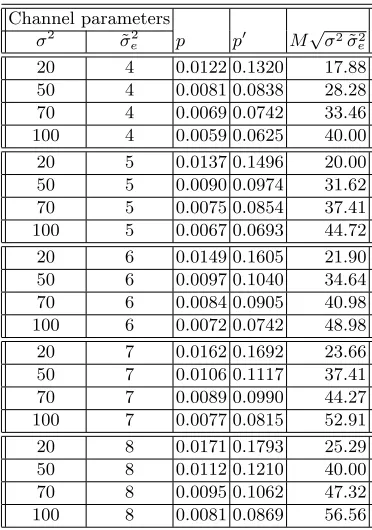
In order to decrease this probability we propose to increase the varianceσ2, say at the cost of increasing the transmitted signal power. The results of such simulation of both channels (legitimate and wiretap, forn= 100) are presented in Table 4. It follows that although the error probabilities for legitimate users can be acceptable, the error probabilities for wiretapper are not sufficiently large. (We stress that this result is valid even under the condition (8)!)
It is possible to decrease the error probability at the legitimate channel keep-ing almost the same error probability for wiretap channel by increaskeep-ing the number n of antennas. So, taking n = 1000, σ2 = σ2
w = 8 and σ2e = ˜σ2e = 5 then necessarily p= 0.00642,p0 = 0.2175 (compare with Table 1,N = 6). How-ever such a large number of antennas obviously creates a technological problem within a MIMO system.
4
A combination of PCS with wiretap channel coding
From Table 1, we find that PCS entails a significant increasing of the error prob-ability for wiretap channel. This fact paves the way for additional application of wiretap coding [11]. It is well known that the so calledsecret capacityof wiretap channel is (in our notation) [12]:
C=h(p)−h(p0)
whereH :x7→h(x) =xlog2x+ (1−x) log2(1−x).
This means that there exist encoding/decoding procedures with code rate
R < C providing a probability of incorrect decoding, by a legitimate channel, as small as desired and simultaneously an amount of Shannon’s information leaking to eavesdropper as small as desired when the length of code blocks approaches to infinity.
In Table 5 there are presented the values ofC calculated for some valuesp
andp0 appearing partly at Table 1.
We see from this table that it is possible to reach sufficiently large code rate in order to provide close to zero eavesdropping and reliable legitimate information transmission. Moreover, changing additive noise variation we can maximise the value of capacityC. The control of additive noise power can be done by sending additive noise with desired power from transmitting side as it was described in [3].
Channel parameters
σ2 σ˜2e p p0 M
√ σ2σ˜2
e
20 4 0.0122 0.1320 17.88 50 4 0.0081 0.0838 28.28 70 4 0.0069 0.0742 33.46 100 4 0.0059 0.0625 40.00 20 5 0.0137 0.1496 20.00 50 5 0.0090 0.0974 31.62 70 5 0.0075 0.0854 37.41 100 5 0.0067 0.0693 44.72 20 6 0.0149 0.1605 21.90 50 6 0.0097 0.1040 34.64 70 6 0.0084 0.0905 40.98 100 6 0.0072 0.0742 48.98 20 7 0.0162 0.1692 23.66 50 7 0.0106 0.1117 37.41 70 7 0.0089 0.0990 44.27 100 7 0.0077 0.0815 52.91 20 8 0.0171 0.1793 25.29 50 8 0.0112 0.1210 40.00 70 8 0.0095 0.1062 47.32 100 8 0.0081 0.0869 56.56
Table 4.The error probabilities for the legitimate user (p) and for eavesdropper (p0). We assumeσ2 =σ2
w andσe2 = ˜σe2 and n = 100, with increased variances of channel
matrices.
p 0.0207 0.0224 0.0248 0.0261 0.0281
p0 0.2119 0.2240 0.2382 0.2569 0.2639
C 0.5997 0.6127 0.6244 0.6476 0.6478
5
Conclusion
We have considered the keyless cryptosystem proposed in [3] and intended for the use in wireless multipath channels based on massive MIMO technology. It seems to be very novel approach to build a provable (for the worst case) secure cryptosystem based on lattice hard problem. We remark that if the condition (8) holds it is sufficient to provide an exponential complexity for the optimal decryp-tion algorithm (7) but it is not enough to exclude suboptimal cipher breaking algorithm (9). Although even so this algorithm is used, it provides in signifi-cant degradation of the eavesdropper’s channel but not for all cases it results in impossibility of plaintext reading. It depends on the parameters of the chan-nel model (σ2, σ2
w, σe2,σ˜e2), which in turn can be unknown exactly for a designer of cryptosystem. The use of wiretap coding in a combination with PCS allows to provide both security and reliability but constructive encoding method that provides the code rate close to channel capacity is still unknown. In order to put PCS into practice, it is also necessary to arrange a procedure of channel matrices estimation based on a sending of testing signals in real time.
And then the first question arises how affects incorrectness of channel matri-ces estimation on the error probability in the legitimate channel?
Thus we can conclude that the proposed cryptosystem is very interesting from the theoretical point of view but its practical implementation requires further investigations.
References
1. Diffie, W., Hellman, M.: New directions in cryptography. IEEE Trans. Inf. Theor.
22(6) (September 2006) 644–654
2. Menezes, A.J., van Oorschot, P.C., Vanstone, S.A.: Handbook of Applied Cryptog-raphy. The CRC Press series on discrete mathematics and its applications. CRC Press, 2000 N.W. Corporate Blvd., Boca Raton, FL 33431-9868, USA (1997) 3. Dean, T., Goldsmith, A.: Physical-layer cryptography through massive MIMO. In:
2013 IEEE Information Theory Workshop, ITW 2013, Sevilla, Spain, September 9-13, 2013, IEEE (2013) 1–5
4. Mukherjee, A., Fakoorian, S.A.A., Huang, J., Swindlehurst, A.L.: Principles of physical layer security in multiuser wireless networks: A survey. CoRR
abs/1011.3754(2010)
5. Clarke, R.H.: A statistical theory of mobile radio reception. Bell Systems Technical Journal47(1968) 957–1000
6. Micciancio, D., Regev, O.: Lattice-based cryptography. In Bernstein, D.J., Buch-mann, J., eds.: Post-quantum Cryptography. Springer (2008)
7. Bellare, M., Tessaro, S., Vardy, A.: Semantic security for the wiretap channel. In Safavi-Naini, R., Canetti, R., eds.: Advances in Cryptology - CRYPTO 2012 - 32nd Annual Cryptology Conference, Santa Barbara, CA, USA, August 19-23, 2012. Proceedings. Volume 7417 of Lecture Notes in Computer Science., Springer (2012) 294–311
SODA ’00, Philadelphia, PA, USA, Society for Industrial and Applied Mathematics (2000) 937–941
9. Gallager, R.G.: Information Theory and Reliable Communication. Wiley (January 1968)
10. Shannon, C.E.: A mathematical theory of communication. Volume 27. (1948) 11. Wyner, A.: Wire-tap channel concept. Bell System Technical Journal54(1975)
1355–1387
12. Csiszar, I., Korner, J.: Broadcast channels with confidential messages. Information Theory, IEEE Transactions on24(3) (May 1978) 339–348
13. Maurer, U.: Secret key agreement by public discussion from common information. IEEE Transactions on Information Theory39(3) (1993) 733–742