
The Fallacy of Composition of Oblivious RAM and Searchable Encryption
Muhammad Naveed
University of Illinois at Urbana-Champaign
ABSTRACT
Oblivious RAM (ORAM) is a tool proposed to hide access pattern leakage, and there has been a lot of progress in the efficiency of ORAM schemes; however, less attention has been paid to study the applicability of ORAM for cloud applications such as symmetric searchable encryption (SSE). Although, searchable encryption is one of the motivations for ORAM research, no in-depth study of the applicability of ORAM to searchable encryption exists as of June 2015. In this work, we initiate the formal study of using ORAM to reduce the access pattern leakage in searchable encryption.
We propose four new leakage classes and develop a systematic methodology to study the applicability of ORAM to SSE. We de-velop a worst-case communication baseline for SSE. We show that completely eliminating leakage in SSE is impossible. We propose single keyword schemes for our leakage classes and show that ei-ther they perform worse than streaming the entire outsourced data (for a large fraction of queries) or they do not provide meaning-ful reduction in leakage. We present detailed evaluation using the Enron email corpus and the complete English Wikipedia corpus.
1.
INTRODUCTION
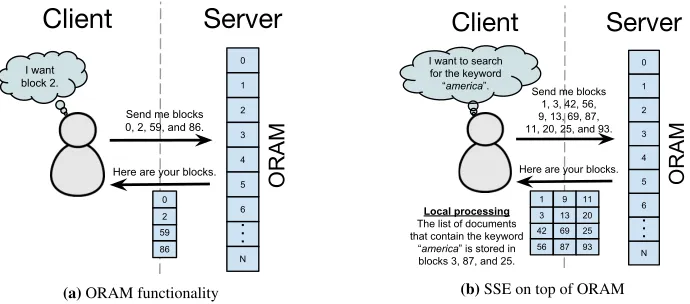
Oblivious RAM (ORAM) enables accessing the memory with-out leaking the access pattern. A lot of effort is underway to make ORAM schemes efficient. Searching for the exact phrase “Oblivi-ous RAM” on the Google Scholar returns671articles,565of them published since 2010. ORAM is a cryptographic primitive that al-lows accessing memory without leaking the access pattern; how-ever, it provides a random access memory (RAM) interface that al-lows accessing a block of memory using its address. Therefore, the access pattern hiding properties of ORAM are only valid if mem-ory is accessed single block at a time, which is not always the case with real applications. Many applications such as searchable en-cryption (SSE) or cloud storage1, requires downloading multiple blocks at a time as illustrated in Figure1, which leaks the number of blocks being accessed for a particular request. The number of blocks in turn leaks partial access pattern information. In SSE, each keyword query requires multiple blocks to be accessed. As differ-ent keywords require differdiffer-ent number of blocks to be retrieved, the number of blocks retrieved leaks some information about the query. Similarly, in cloud storage, a file may consist of multiple blocks; therefore, downloading the file leaks its size (rounded off to the block size). Suppose that a file has a unique size, then every time the client accesses this file, the server observes, from the num-ber of blocks being accessed, that the client is accessing the same file.
Symmetric Searchable Encryption (SSE) enables a client to store encrypted documents on a server and search over her encrypted documents to selectively retrieve the documents. In the SSE set-ting, the client prepares an inverted index for her documents and encrypts it using SSE, encrypts her documents using a symmetric cipher (such as AES), and sends both the encrypted index and the
1By cloud storage, we mean services such as Dropbox and
Google Drive that allow users to store their files.
encrypted documents to the server. The server does not see the contents of the documents or the queries, but for each query it ob-serves some information leakage: the search and document-access patterns (combination of search and document-access patterns is commonly referred to as access pattern). Access pattern is a signif-icant leakage and may enable the server to infer information about the queries or the documents [18].
Preventing the leakage in SSE is one of the motivations for the applied ORAM research; however, no SSE construction that pre-vents the access pattern leakage has been proposed yet. A search for articles on the Google Scholar that contains both exact phrases “Oblivious RAM” and “Searchable Encryption” returns 214 arti-cles. At least18ORAM papers cite Islam et al. 2012 paper ti-tled “Access Pattern disclosure on Searchable Encryption: Ram-ification, Attack and Mitigation” [18] to motivate the importance of eliminating leakage and the capability of ORAM to do so in applications such as SSE. Similarly, it is widespread in the SSE literature that ORAM can completely eliminate leakage in SSE. We show that using ORAM to completely eliminate access pattern leakage or even achieve weaker notions of access pattern hiding either renders the communication performance worse than the triv-ial approach of streaming all of the outsourced data for each query or they do not provide any meaningful reduction in leakage. To the best of our knowledge, this paper is the first work studying the applicability of ORAM to SSE.
1.1
The fallacy of Composition
The fallacy of Composition occurs when one infers that some-thing is true of the whole based on the fact that it is true for a part of the whole, without any justification for the inference. An ex-ample of the fallacy of Composition follows: Atoms are colorless. Cats are made of atoms. Therefore, cats are colorless.
The widespread fallacy of Composition of Oblivious RAM and Searchable Encryption is:Searchable encryption leaks access pat-tern. Oblivious RAM eliminates access patpat-tern. Therefore, there exists a method of using Oblivious RAM to eliminate access pat-tern in searchable encryption. This fallacy is prevalent in ORAM and Searchable Encryption literature; however, for brevity we do not cite all of the papers.
1.2
Overview
0
1
2
3
4
5
6
N
Client
Server
I want block 2.
Send me blocks 0, 2, 59, and 86.
86 59 0
2
Here are your blocks.
ORAM
(a)ORAM functionality
0
1
2
3
4
5
6
N
Client
Server
I want to search for the keyword
“america”. Send me blocks 1, 3, 42, 56, 9, 13, 69, 87, 11, 20, 25, and 93.
56 42 1
3
Here are your blocks.
ORAM
Local processing
The list of documents that contain the keyword
“america” is stored in blocks 3, 87, and 25.
87 69 9
13
93 25 11
20
(b)SSE on top of ORAM
Figure 1:ORAM functionality vs. SSE requirements. For each query, SSE accesses multiple blocks which leaks the number of blocks being accessed. As the
number of blocks accessed depends upon the query, it leaks some information about the access pattern. The ORAM overhead of4shown is just for ease of exposition. (a). The client downloads multiple blocks (e.g.,4in the figure) to access a single block from the ORAM. (b). The client needs to retrieve3blocks from the ORAM and therefore downloads12blocks. The server learns that the client downloaded3blocks.
scheme needs to communicate more data then Linear–LC0–SSE, then it is always better to use Linear–LC0–SSE. Note that Linear– LC0–SSE doesnotrequire ORAM.
We propose four new leakage classes:LC0,LC1,LC2,andLC3. We also discussLC4which is the leakage of standard SSE schemes [20,23]. Each leakage class captures the information leaked to the server, withLC0leaking the least andLC4leaking the most infor-mation among the five classes. We prove thatLC0is impossible to achieve without downloading all outsourced data for each and every query (communication required by Linear–LC0–SSE). We propose single keyword SSE schemes forLC1,LC2,andLC3. We empiri-cally demonstrate that for a large fraction of queries,LC1–SSE and LC2–SSE perform worse than downloading the entire outsourced data. We emphasize that a small fraction of keywords are accessed most frequently (Zipf’s law) and therefore these small number of keywords constitute a large fraction of the queries. Moreover, we demonstrate thatLC3does not provide any meaningful reduction in leakage overLC4.
Contributions. We summarize our contributions below:
• First work on composition of ORAM and SSE.To the best of our knowledge, this is the first work studying the applica-bility of ORAM to reduce the leakage in SSE.
• New Leakage Classes.We propose four new leakage classes for SSE.
• New Systematic Methodology. We develop a new system-atic methodology to study the applicability of ORAM to SSE. Although, we specifically developed the methodology for SSE, we believe that it can be useful for other applications as well. First, we design a baseline scheme, called Linear– LC0–SSE, with a worst-case communication performance. Second, we propose static single keyword schemes forLC1,
LC2,andLC3. Third, we empirically study the communi-cation performance ofLC1–SSE,LC2–SSE,LC3–SSE, and LC4–SSE (Naveed’s et al. scheme [23]) relative to Linear– LC0–SSE.
• Interesting findings. We report interesting findings about the applicability of ORAM to the leakage prevention in SSE. Using our systematic methodology, we show that it is impos-sible to eliminate leakage in SSE without downloading the
entire outsourced data. We show thatLC1–SSE andLC2– SSE have query communication worse than that of Linear– LC0–SSE for a large fraction of queries (a small fraction of keywords make up the large fraction of queries). We also demonstrate thatLC3andLC4leak almost the same amount of information.
• Evaluation. We provide a detailed evaluation of the query communication performance of the single keywordLC1–SSE, LC2–SSE,LC3–SSE, andLC4–SSE schemes using the En-ron Email Corpus and the complete English Wikipedia Cor-pus.
Scope of the paper. We focus only on the applicability of ORAM to reduce access pattern leakage in SSE. ORAM has other applica-tions such as secure multiparty computation and secure co-processor; however, these applications are out of scope of this paper.
Most of the ORAM schemes work with a storage-only server with a few exceptions. Throughout the paper, we assume the server to be a storage-only resource that allows the client to download and upload blocks of data.
Organization. The paper is organized as follows: Section2presents the leakage classes. Section3presents a worst-case communica-tion baseline scheme (Linear–LC0–SSE). Section4presents single keyword constructions for our leakage classes. Section5presents detailed evaluation. Section6presents the related work. Finally, Section7concludes the paper.
2.
LEAKAGE CLASSES
We present five different leakage classes:LC0,LC1,LC2,LC3,
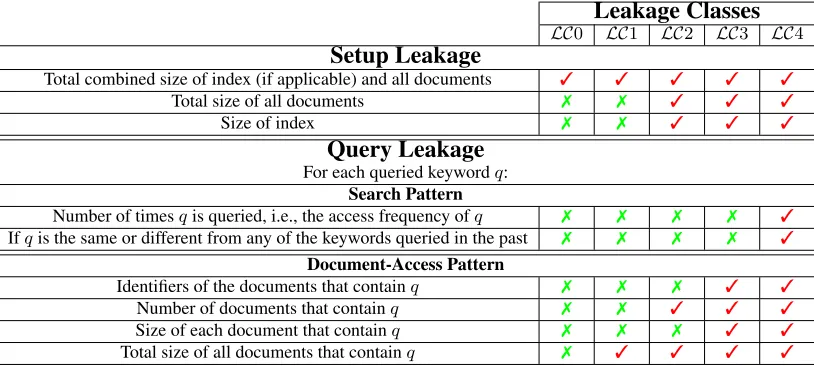
andLC4.LC0represents absolute minimum leakage andLC4 cap-tures the leakage of a typical static symmetric searchable encryp-tion (SSE) scheme (e.g., [20,23]).LC1,LC2,andLC3leak more information thanLC0but less thanLC4. Table1shows all the leakage classes. To clearly explain the leakage, Table1shows the leakage forLC0,LC1,LC2,andLC3relative toLC4which is the prevalent standard for SSE schemes in the literature [20, 23]; we believe that this juxtaposition make the difference in leakage easy to compare and understand.
Leakage Classes
LC0 LC1 LC2 LC3 LC4Setup Leakage
Total combined size of index (if applicable) and all documents 3 3 3 3 3
Total size of all documents 7 7 3 3 3
Size of index 7 7 3 3 3
Query Leakage
For each queried keywordq:Search Pattern
Number of timesqis queried, i.e., the access frequency ofq 7 7 7 7 3 Ifqis the same or different from any of the keywords queried in the past 7 7 7 7 3
Document-Access Pattern
Identifiers of the documents that containq 7 7 7 3 3
Number of documents that containq 7 7 3 3 3
Size of each document that containq 7 7 7 3 3
Total size of all documents that containq 7 3 3 3 3
Table 1:Leakage Classes for Static Single Keyword Searchable Encryption. Padding can be used to hide the exact sizes and leak an upperbound on the sizes
instead.7shows the information that isnot leakedand3shows the information that isleaked.
leakage shows the information leaked by the queries. Query leak-age is divided into search pattern and document-access pattern: search pattern represents the leakage about the query keyword it-self, while document-access pattern represents the leakage about the documents that contain the query keyword. Most of the litera-ture combine search and document-access pattern and call it access pattern, however, for ease of exposition we explain them separately. Paddingcan be used to hide the exact size and leak an upper-bound on the size instead. For simplicity, we omit this fact from this point onwards unless necessary.
Leakage Class 0 (LC0) represents the minimum possible leakage for an SSE scheme. It only leaks the combined size (with padding an upperbound on the size) of all documents and index (only if the SSE scheme uses index) during the initial outsourcing to the server; however, this information is impossible to hide given that the server is storing the data. No information whatsoever is leaked during queries, and hence, there is no query leakage.
Leakage Class 1 (LC1) captures the minimum amount of leak-age of an SSE scheme with the query communication complexity linear in the size of the documents that satisfy the query. As the query communication complexity is linear in the total size of the documents that satisfy the query, an upperbound on the total size of the documents that satisfy the query is inherently leaked. More-over, without appropriate padding, the exact total size of documents being retrieved is leaked; we consider this case for simplicity.
Leakage Class 2 (LC2) leaks the size as well as the number of documents that satisfy the query. Moreover, during the setup the size of the index and total size of all documents is leaked.
Leakage Class 3 (LC3) does not explicitly leak the search pat-tern, but does leak the document-access pattern. Document-access pattern implicitly leaks search pattern except in the following rare situation: If any two keywordsqandq0appears in exactly the same set of documents, then the server is not able to distinguish between
qandq0. This condition is rare in realistic data and thereforeLC3
is almost same asLC4which is leakage of standard SSE schemes. We explainLC3to demonstrate that a straightforward method of obliviously accessing only the index in an SSE scheme is not use-ful, we explain this in detail in Section5. Fig.10shows thatLC3
is almost same asLC4.
Leakage Class 4 (LC4) captures the leakage of a static single key-word SSE scheme (e.g., [20,23]). It leaks the complete search and document-access patterns.
3.
COMMUNICATION BASELINE
In this section, we present a simple Linear–LC0–SSE scheme, an SSE scheme with query communication complexity linear in the total size of all documents, as a communication performance base-line to study the communication performance of our single key-wordLC1–SSE,LC2–SSE, andLC3–SSE schemes we propose in Section4.
Linear–LC0–SSE scheme. We propose a Linear–LC0–SSE scheme in Figure2. The client encrypts her documents with any semanti-cally secure symmetric-key encryption scheme (such as AES) and sends the encrypted documents to the server. Later, when the client wants to search her outsourced documents, she streams all of them. The client streams data in small chunks, searches them locally, and discards the streamed documents that do not satisfy the query.
Our Linear–LC0–SSE scheme has the following properties:
• Absolute minimum leakage (LC0). It has leakage class LC0, which means it leaks absolute minimum information.
• Arbitrary queries.It supports arbitrary type of queries2.
• Worst-case query communication.It streams all outsourced documents to the client for each query.
• Optimal query communication for LC0. It has optimal query communication. Theorem4.1shows that Linear–LC0– SSE has optimal communication required to achieveLC0.
• Constant local storage. It requires the client to store only a single document at any given instant; the client keeps the document if it satisfy the query and discards it otherwise. Therefore, in addition to the documents that satisfy the query, the client only needs to store a single more document.
• It does not need ORAM to achieve access pattern hiding.
2Sublinear SSE schemes are designed for a specific type of
Keygen
• The client generates a symmetric keyKuniformly at random.
Setup
• The client encrypts all the documents as a single file using a seman-tically secure symmetric-key encryption scheme with keyK, and sends it to the server.
Search
• For each search query, the client streams all of the outsourced docu-ments and searches locally. The client stores only a (small) constant amount of data, say a single document, at any given time. All docu-ments that do not satisfy the query are discarded after the completion of local search.
Figure 2:Linear–LC0–SSE Scheme. Baseline for communication
perfor-mance of SSE schemes we propose in Section4.
Baseline Query Communication. Linear–LC0–SSE supports ar-bitrary queries and has absolute minimum leakage (LC0). The only problem Linear–LC0–SSE has is that for each query it re-quires streaming all outsourced data to the client. Therefore, it serves as an excellent worst-case communication baseline for any SSE scheme. Any SSE scheme with query communication worse than the Linear–LC0–SSE scheme can be trivially replaced with the Linear–LC0–SSE scheme.
4.
CONSTRUCTIONS
In this section, we first show that achievingLC0is, in general, impossible with query communication better than that of Linear– LC0–SSE. We construct single keyword SSE schemes forLC1,LC2,
andLC3such that they haveoptimal query communicationfor the respective leakage class. These schemes capture simple ways of using Oblivious RAM as a blackbox to reduce leakage in SSE. We show in section5that query communication ofLC1-SSE andLC2 -SSE is worse than that of Linear–LC0–SSE for a large fraction of queries (only a small number of keywords constitute most of the queries). Moreover,LC3-SSE has acceptable query communica-tion but as explained in seccommunica-tion5it does not provide meaningful reduction in leakage compared toLC4. Security of our schemes follows from the security of the underlying ORAM and ODICT schemes; therefore, we omit the security proofs.
Oblivious Dictionary (ODICT). Sublinear SSE schemes require inverted index to function. Index needs a dictionary data structure and ORAM is not a dictionary data structure. Therefore, we use AVL tree based Oblivious Map scheme of Wang et al. [31] as an Oblivious Dictionary in our schemes. We consider that ODICT stores key value pairs and ODICT.Lookup(key) operation returns the value associated with the key.
4.1
LC
0
–SSE
We show that a scheme with Leakage Class0(LC0) necessar-ily requires downloading the entire outsourced data for each query. Therefore, completely eliminating the leakage with communication less than that of the Linear–LC0–SSE scheme (i.e., streaming all of the outsourced data) is impossible.
THEOREM 4.1. The lower bound on the query communication complexity to achieve the Leakage Class 0 (LC0) is|D|, where|D| is the total size of all outsourced documents.
PROOF. We prove that if for any query the communication is less than|D|, then the information leaked to the server is strictly
Client Server
Send me the list of document identifiers that
contain the keyword “america”. I want to search
for the keyword “america”.
ORAM
Index
ODICT
Documents
1
2
D List of document identifiers
Client retrieves the documents in the list.
(a)Single KeywordLC1-SSE
Send me the list of document identifiers that
contain the keyword “america”. I want to search
for the keyword “america”.
Index
ODICT
Document
ORAM
1
2
D List of document identifiers
Client retrieves the documents in the list.
(b)Single KeywordLC2-SSE
Client Server
Send me the list of document identifiers that
contain the keyword “america”. I want to search
for the keyword “america”.
1
2
D List of document identifiers
Client retrieves the documents in the list.
Documents
Index
ODICT
(c)Single KeywordLC3-SSE
Client Server
Send me the list of document identifiers that
contain the keyword “america”. I want to search
for the keyword “america”.
1
2
D List of document identifiers
Client retrieves the documents in the list.
Documents
Index
(d)Single KeywordLC4-SSE. This captures leakage of standard SSE schemes such as [20,23].
Figure 3:In all the schemes, the client searches for a keyword and retrieves
more thanLC0. Suppose for a queryq, the client retrieves docu-ments with total size|D0|<|D|, then the server learns the size of the documents being retrieved|D0|. Suppose the client has another queryq0that is satisfied by all the documents. For an SSE scheme to be correct, it has to download all the documents for the query
q0, i.e., the size of the documents retrieved for the queryq0needs to be|D|. As the size of the data retrieved for the queryqand the queryq0are different, the server can distinguish the queryqfrom the queryq0, which is strictly more leakage thanLC0. Moreover, the server learns an upperbound on the total size|D0|of the doc-uments that match the queryq. This shows that the only way to prevent this leakage is to retrieve all documents for every query. Therefore, we conclude that|D|is the optimal communication for the Leakage Class 0 (LC0).
4.2
LC
1
–SSE
LC1-SSE prevents as much leakage as possible while keeping the query communication less than the communication of Linear– LC0–SSE. We propose a single keywordLC1-SSE scheme to study the query communication required to achieveLC1.
Single KeywordLC1–SSE Scheme. We present our Single Key-wordLC1–SSE scheme in fig.4. The client uses an ORAMOto store both the index ODICT and the documents. To query a key-word, the client looks up the inverted index stored in ODICTDO
to retrieve the listLof document identifiers that contain the query keyword. She then retrieves all the documents in the listLfrom the ORAMO.
Query Communication. Letnanddbe the number of documents and the total size of the documents that satisfy a query,ebe the size ofndocument identifiers,obe the overhead of the ORAM,cobe the overhead of the ODICT (wherecshows the number of ORAM accesses required for a single ODICT lookup), andBbe the block-size used in ORAM and ODICT, then the communication overhead ofLC1-SSE isco×max(B,de
Be) +o×max(B,d d
Be). We prove
in appendixA.1that for the fixed values ofoandc, this is the op-timal query communication required to achieveLC1. We demon-strate using real datasets in Section5that the optimal communi-cation single keywordLC1–SSE scheme requires more communi-cation than Linear–LC0–SSE for a large fraction of the queries (a small number of keywords constitute a large fraction of queries).
4.3
LC
2
–SSE
We propose a single keywordLC2–SSE scheme to investigate Leakage Class 2 (LC2). Our single keywordLC1–SSE andLC2– SSE schemes differ due the fact that the former stores both index ODICT and documents in the same ORAM while the later stores index ODICT and documents separately as shown in fig.3.
Single KeywordLC2–SSE Scheme. We describe a single key-wordLC2scheme in Figure 5. As shown in Figure3b, it uses an ODICT to store index and an ORAM to store the documents. To search for a keywordq, the client retrieves a listLof docu-ment identifiers of docudocu-ments that satisfyqfrom the ODICTD. Next, the client retrieves the documents in listL from the docu-ment ORAMO.
Query Communication. Letn andd be the number of docu-ments and the total size of the docudocu-ments that satisfy a query,e
be the size ofn document identifiers, obe the overhead of the ORAM,o0 be the overhead of the ODICT, andB be the block-size used in ORAM and ODICT, then the communication overhead ofLC2-SSE iso0×max(B,de
Be) +o×max(B,d d
Be). We prove
in appendixA.2that for the fixed values ofoando0, this is the opti-mal query communication required to achieveLC2. AsLC1–SSE
Keygen.
• The client generates a symmetric keyKOuniformly at random and
use it in all symmetric key operations of ODICTDOand ORAMO.
Setup.
• The client setups an ORAMOon the server. She uses ORAMOto store both an ODICTDOfor the index and the documents.
• The client creates an inverted index for all documents.
• The client writes the index in the ODICTDO. This can be done
during ORAMOsetup.
• The client writes all the documents in the ORAMO. This can also be done during ORAMOsetup.
Search.
• To query a keyword q, the client queries the ODICT DO using
DO.Lookup(q) and retrieves the listLof documents that contain the
keyword.
• The client retrieves all the documents in listLfrom ORAMO.
Figure 4:Single KeywordLC1-SSE Scheme
Keygen.
• The client generates a symmetric keyKuniformly at random, which is used for encrypting blocks of ODICTDand ORAMO.
Setup.
• The client creates an inverted index for all documents.
• The client writes the index in an ODICTDstored on the server. This can be done during ODICTDsetup.
• The client writes all the documents in an ORAMOstored on the server. This can be done during ORAMOsetup.
Search.
• To query keywordq, the client queries ODICTDusingD.Lookup(q) and retrieves the listLof document identifiers that contain the key-word.
• The client retrieves all the documents in listLfrom ORAMO.
Figure 5:Single KeywordLC2-SSE Scheme
stores both index ODICT and documents in the same ORAM and LC2–SSE stores them separately, therefore, the size of the ORAM in LC1–SSE is bigger than index ODICT and document ORAM inLC2–SSE. Moreover, the ORAM and ODICT access increases with their size, theLC2–SSE has slightly better query communi-cation; however, it may not worth the extra amount of information being leaked.
4.4
LC
3
–SSE.
We propose a single keywordLC3–SSE scheme to study Leak-age Class 3(LC3). Our single keywordLC3–SSE scheme uses ODICT for the index but stores document using plain encryption without ORAM.
Single KeywordLC3–SSE Scheme. We present a Single Key-wordLC3–SSE scheme in Figure6. This scheme uses ODICT for the inverted index and symmetric key encryption to store the docu-ments.
Query Communication Complexity. Letnanddbe the num-ber of documents and the total size of the documents that satisfy a query,ebe the size ofndocument identifiers,o0be the overhead of the ODICT, andB be the blocksize used in ODICT, then the communication overhead ofLC3-SSE iso0×max(B,de
Keygen
• The client generates two keysKandK0uniformly at random. K is used to encrypt blocks of ODICTDandK0to encrypts the
docu-ments.
Setup:
• The client creates an inverted index for all documents.
• She writes the index in an ODICTD. This is done during ODICTD setup.
• She encrypts each document with keyKusing a semantically secure symmetric key encryption and send the encrypted documents to the server.
Search:
• To query a keyword q, the client queries the ODICT D using D.Lookup(q) and retrieves the listLof documents that contain the keyword.
• The client retrieves all the documents in the listLfrom the server.
Figure 6:Single KeywordLC3-SSE Scheme
We prove in appendixA.3that for the fixed values ofo0, this is the optimal query communication required to achieveLC3.
5.
EVALUATION
We have implemented our protocols to evaluate the query com-munication; however, we only simulate the ORAM accesses, which we believe is enough to evaluate the query communication over-head. We present detailed and comprehensive experiments.
In the first set of experiments fig.7, which we call realistic exper-iments, we use simulated PathORAM (4 log(N)overhead, where
N represents the total number of blocks) [30] for the document ORAM and the Wang’s et al. AVL tree based Oblivious Map ((4 log(N))2
overhead) [31] for the index ODICT.
In the second set of more conservative experiments fig.8, which we call optimistic experiments, we use simulated ideal ORAM with
log(N)3
overhead for the document ORAM. Furthermore, we as-sume that a single ODICT lookup requires a single ORAM ac-cesses.
We use a blocksize of4KB throughout.
Before presenting our results, we describe the preliminaries re-quired to understand our results.
• Empirical CCDF Plots. We present our evaluation results usingempiricalComplementary Cumulative Distribution Func-tion (CCDF) plots. For example, a point (x, y) in figs.7 and8indicate that the query overhead is at leastxfory frac-tion of the keywords.
• Query overhead. Query overhead of a query is the ratio of the amount of data retrieved in an SSE scheme to the total size of all the outsourced documents. This allows us to com-pare the query communication of our SSE schemes to our baseline Linear–LC0–SSE scheme: if the ratio is greater or equal to 1, then the SSE scheme does not perform better than our baseline Linear–LC0–SSE.
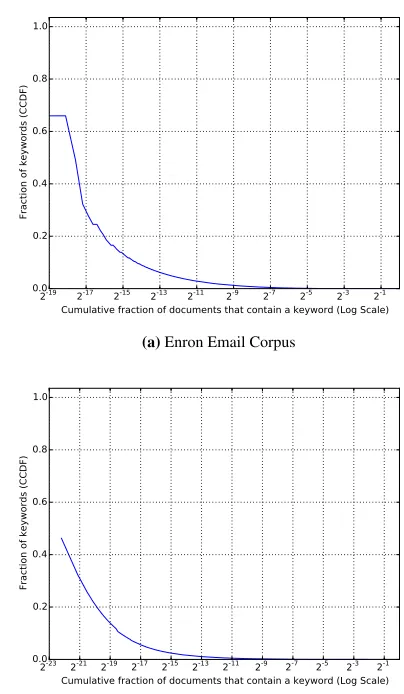
• Keyword Frequency. We plot keyword frequencies of all the keywords in the Enron email corpus and the English Wikipedia corpus in fig.9; which shows that keywords follow Zipf’s law.
3No existing ORAM scheme have this overhead. A loose
ORAM bound proved by [16] islog(N).
2-19 2-17 2-15 2-13 2-11 2-9 2-7 2-5 2-3 2-1 Cumulative fraction of documents that contain a keyword (Log Scale) 0.0
0.2 0.4 0.6 0.8 1.0
Fraction of keywords (CCDF)
(a)Enron Email Corpus
2-23 2-21 2-19 2-17 2-15 2-13 2-11 2-9 2-7 2-5 2-3 2-1 Cumulative fraction of documents that contain a keyword (Log Scale) 0.0
0.2 0.4 0.6 0.8 1.0
Fraction of keywords (CCDF)
(b)English Wikipedia Corpus
Figure 9:Keyword Frequency. A point(x, y)in the plots indicates that the
fraction of the number of documents that contain a keyword is at leastxfor yfraction of the keywords.
• Query Pattern.The more frequent the keyword is the more frequently it will be queried (we have removed all stopwords). As shown in fig.9, a small number of keywords have very high frequency, therefore, these small number of keywords constitutes most of the queries. This fact is important in un-derstanding the query overhead; in addition to query head plots for the all the keywords, we present query over-head plots zoomed in at the tail to clearly show the overover-head for the most frequent keywords that make up a large fraction of the queries.
Datasets. We use two datasets: the complete English Wikipedia corpus and the Enron email dataset. The English Wikipedia cor-pus contains 4,825,180 distinct articles and is 9.8GB in size. En-ron email dataset [1] contains emails from 150 Enron employees, mostly senior managers. The dataset was made public by the Fed-eral Energy Regulatory Commission during its investigation of En-ron. The dataset is 1.32GB in size and has 517,424 emails. Enron dataset has been extensively used to evaluate searchable encryption schemes [20,4,23].
2-23 2-20 2-17 2-14 2-11 2-8 2-5 2-2 21 24 27 Cumulative Query Overhead (Log Scale)
0.0 0.2 0.4 0.6 0.8 1.0
Fraction of keywords (CCDF)
LC1-SSE
LC2-SSE LC3-SSELC4-SSE (Naveed et al. SSE) Baseline (Linear-LC0-SSE)
(a)Enron Email Corpus (all628,908keywords)
2-17 2-15 2-13 2-11 2-9 2-7 2-5 2-3 2-1 21 23 25 27 Cumulative Query Overhead (Log Scale)
0.0 0.2 0.4 0.6 0.8 1.0
Fraction of keywords (CCDF)
LC1-SSE
LC2-SSE LC3-SSELC4-SSE (Naveed et al. SSE) Baseline (Linear-LC0-SSE)
(b)English Wikipedia Corpus (all4,400,034keywords)
2-7 2-5 2-3 2-1 21 23 25 27 Cumulative Query Overhead (Log Scale) 0.0
0.2 0.4 0.6 0.8 1.0
Fraction of keywords (CCDF)
LC1-SSE
LC2-SSE LC3-SSELC4-SSE (Naveed et al. SSE) Baseline (Linear-LC0-SSE)
(c)Enron Email Corpus (most frequent5,000keywords)
2-8 2-6 2-4 2-2 20 22 24 26 28 Cumulative Query Overhead (Log Scale)
0.0 0.2 0.4 0.6 0.8 1.0
Fraction of keywords (CCDF)
LC1-SSE
LC2-SSE LC3-SSELC4-SSE (Naveed et al. SSE) Baseline (Linear-LC0-SSE)
(d)English Wikipedia Corpus (most frequent10,000keywords)
Figure 7:Cumulative Query Overhead using PathORAM for the document ORAM and AVL tree based Oblivious Map [31] for the Index ODICT. Query
overhead of a query is the ratio of the amount of data retrieved in an SSE scheme to the total size of all the outsourced documents. A point(x, y)in the plots indicates that the query overhead is at leastxforyfraction of the keywords.
had 628,908 keywords.
Realistic Experiments. As explained above we use PathORAM for the documents and AVL tree based Oblivious Map for the index ODICT.LC3–SSE does not use document ORAM andLC4–SSE does not use both document ORAM and index ODICT.
Fig.7ashows the query overhead for all keywords in the Enron Email Corpus.LC1–SSE andLC2–SSE have the same query over-head and therefore their curves are overlapping. LC3–SSE query overhead is slightly more than that ofLC4–SSE. Moreover,LC1– SSE andLC2–SSE query overhead is more than1for a large tion of queries (a small number of keywords constitutes a large frac-tion of queries). Fig.7cshows zoomed in view of the tail of fig.7a for5,000most frequent keywords, which shows that for all of the
5,000most frequent keywords the query overhead is at least1.75. Fig.7band fig.7dshows similar results for the English Wikipedia corpus.
Optimistic Experiments. Fig. 8shows results for our optimistic experiments, where we use ideal ORAM and ODICT, both with the communication overhead oflog(N), whereN is the number of blocks. The results are better than our realistic experiments, however, a large fraction of queries still has query overhead of more
than1.
Leakage Analysis ofLC3–SSE andLC4–SSE. Our experiments show thatLC3–SSE query overhead is almost same asLC4–SSE; therefore, we investigate whetherLC3–SSE provide meaningful re-duction in leakage compared toLC4–SSE. As explained in Sec-tion2LC3–SSE prevents explicit leakage of search pattern, but leaks search pattern indirectly from the document access pattern. Specifically, the only information that is not leaked about the search pattern from the document-access pattern is whether the client is querying for two keywords that appear in exactly the same set of documents. Fig.10shows the fraction of keywords for which there are at least a fraction of other keywords appearing in the same set of documents. As it can been seen, a very small fraction of key-words have a very small fraction of other keykey-words that appear in the same set of documents; therefore, we conclude thatLC3leaks almost as much asLC4. This implies that oblivious index accesses alone does not provide a meaningful reduction in leakage if the documents are accessed in a non-oblivious fashion. Therefore, for any meaningful reduction in leakage both the index and documents accesses need to be oblivious.
2-23 2-20 2-17 2-14 2-11 2-8 2-5 2-2 21 24 Cumulative Query Overhead (Log Scale) 0.0
0.2 0.4 0.6 0.8 1.0
Fraction of keywords (CCDF)
LC1-SSE
LC2-SSE LC3-SSELC4-SSE (Naveed et al. SSE) Baseline (Linear-LC0-SSE)
(a)Enron Email Corpus (all628,908keywords)
2-18 2-16 2-14 2-12 2-10 2-8 2-6 2-4 2-2 20 22 24 26 Cumulative Query Overhead (Log Scale)
0.0 0.2 0.4 0.6 0.8 1.0
Fraction of keywords (CCDF)
LC1-SSE
LC2-SSE LC3-SSELC4-SSE (Naveed et al. SSE) Baseline (Linear-LC0-SSE)
(b)English Wikipedia Corpus (all4,400,034keywords)
2-7 2-6 2-5 2-4 2-3 2-2 2-1 20 21 22 23 24 25 26 Cumulative Query Overhead (Log Scale)
0.0 0.2 0.4 0.6 0.8 1.0
Fraction of keywords (CCDF)
LC1-SSE
LC2-SSE LC3-SSELC4-SSE (Naveed et al. SSE) Baseline (Linear-LC0-SSE)
(c)Enron Email Corpus (most frequent5,000keywords)
2-8 2-7 2-6 2-5 2-4 2-3 2-2 2-1 20 21 22 23 24 25 26 Cumulative Query Overhead (Log Scale)
0.0 0.2 0.4 0.6 0.8 1.0
Fraction of keywords (CCDF)
LC1-SSE
LC2-SSE LC3-SSELC4-SSE (Naveed et al. SSE) Baseline (Linear-LC0-SSE)
(d)English Wikipedia Corpus (most frequent10,000keywords)
Figure 8:Cumulative Query Overhead using an ideal ORAM overhead oflog(N), whereNis the total number of blocks, for both the documents ORAM and
index ODICT. We assume that a single ODICT lookup requires a single ORAM access. Query overhead of a query is the ratio of the amount of data retrieved in an SSE scheme to the total size of all the outsourced documents. A point(x, y)in the plots indicates that the query overhead is at leastxforyfraction of the keywords.
0.0 0.2 0.4 0.6 0.8 1.0
Cumulative fraction of keywords appearing in the same set of documents 0.0
0.2 0.4 0.6 0.8 1.0
Fraction of keywords (CCDF)
Figure 10: Leakage Advantage ofLC3–SSE overLC4–SSE for Enron
Email Corpus. A point(x, y)in the plots indicates that the fraction of keywords that appear in the same set of documents is at leastxforyfraction of the keywords.
Oblivious RAM (ORAM). Oblivious RAM was first proposed by Goldreich and Ostrovsky in 1996 [16] in the context of software protection. There has been a lot of progress since then in the effi-ciency of ORAM schemes [24,9,25,13,7,21,2,17,29,30,28,10, 14,11,12] . Tree-based schemes deamortize the cost of shuffling to avoid an occasional linear shuffling overhead. Recently, ORAM has find applications in secure multiparty computation [33,32,13] and secure-coprocessor [22]. Oblivious RAM has also been used to develop oblivious data structure schemes such as tree and linked list [31].
Symmetric Searchable Encryption (SSE). Song et al. first pro-posed the idea of searching on encrypted data [26]. A lot of progress has been made in making SSE practical and many different schemes have been proposed [15,5,8,6,20,20,4,19,3,23]. Curtmola et al. proposed better security definitions for SSE [8]. Searchable en-cryption scheme with support for updates was first proposed by Ka-mara et a. [20]. Naveed et al. proposed a different way of construc-tion SSE schemes with support for updates [23]. Recently, Cash et al. proposed a first sublinear SSE scheme for Boolean queries [4].
re-duces the leakage in addition and deletion of documents, but leaks access pattern for queries just like other SSE schemes [27].
7.
CONCLUSIONS
Oblivious RAM enables a client to access memory without leak-ing the access pattern. However, access pattern hidleak-ing properties of ORAM are limited to a random access memory (RAM) inter-face, which is not always the case with the real applications such as symmetric searchable encryption (SSE). We show that eliminating leakage in SSE is impossible. Moreover, achieving even weaker classes of leakage either requires communication more than down-loading the entire outsourced data or does not provide meaningful leakage reduction.
8.
ACKNOWLEDGMENTS
We thank Vincent Bindschaedler, Carl Gunter, and Manoj Prab-hakaran for their insightful feedback.
9.
REFERENCES
[1] Enron dataset.https://www.cs.cmu.edu/~enron/. [2] D. Boneh, D. Mazieres, and R. A. Popa. Remote oblivious storage:
Making oblivious ram practical. 2011.
[3] D. Cash, J. Jaeger, S. Jarecki, C. Jutla, H. Krawczyk, M.-C. Rosu, and M. Steiner. Dynamic searchable encryption in very large databases: Data structures and implementation. InNDSS, 2014. [4] D. Cash, S. Jarecki, C. Jutla, H. Krawczyk, M.-C. Ro¸su, and
M. Steiner. Highly-scalable searchable symmetric encryption with support for boolean queries. InCRYPTO 2013, pages 353–373. 2013. [5] Y.-C. Chang and M. Mitzenmacher. Privacy preserving keyword
searches on remote encrypted data. InACNS, pages 442–455, 2005. [6] M. Chase and S. Kamara. Structured encryption and controlled
disclosure. InASIACRYPT, pages 577–594. 2010.
[7] K.-M. Chung and R. Pass. A simple oram. Technical report, DTIC Document, 2013.
[8] R. Curtmola, J. Garay, S. Kamara, and R. Ostrovsky. Searchable symmetric encryption: improved definitions and efficient constructions. InCCS, pages 79–88, 2006.
[9] I. Damgård, S. Meldgaard, and J. B. Nielsen. Perfectly secure oblivious ram without random oracles. InTCC, pages 144–163. 2011. [10] J. Dautrich, E. Stefanov, and E. Shi. Burst oram: Minimizing oram
response times for bursty access patterns. InUSENIX Security, volume 14, 2014.
[11] C. W. Fletcher, L. Ren, A. Kwon, M. Van Dijk, and S. Devadas. Freecursive oram:[nearly] free recursion and integrity verification for position-based oblivious ram. 2015.
[12] C. W. Fletcher, L. Ren, A. Kwon, M. Van Dijk, E. Stefanov, and S. Devadas. Tiny oram: A low-latency, low-area hardware oram controller with integrity verification. 2014.
[13] C. Gentry, K. A. Goldman, S. Halevi, C. Julta, M. Raykova, and D. Wichs. Optimizing oram and using it efficiently for secure computation. InPETs, pages 1–18, 2013.
[14] C. Gentry, S. Halevi, C. Jutla, and M. Raykova. Private database access with he-over-oram architecture. Technical report, IACR ePrint, 2014.
[15] E.-J. Goh et al. Secure indexes.IACR ePrint, page 216, 2003. [16] O. Goldreich and R. Ostrovsky. Software protection and simulation
on oblivious rams.JACM, 43(3):431–473, 1996.
[17] M. T. Goodrich, M. Mitzenmacher, O. Ohrimenko, and R. Tamassia. Practical oblivious storage. InCODASPY, pages 13–24, 2012. [18] M. S. Islam, M. Kuzu, and M. Kantarcioglu. Access pattern
disclosure on searchable encryption: Ramification, attack and mitigation. InNDSS, 2012.
[19] S. Jarecki, C. Jutla, H. Krawczyk, M. Rosu, and M. Steiner. Outsourced symmetric private information retrieval. InCCS, pages 875–888, 2013.
[20] S. Kamara, C. Papamanthou, and T. Roeder. Dynamic searchable symmetric encryption. InCCS, pages 965–976, 2012.
[21] J. R. Lorch, B. Parno, J. W. Mickens, M. Raykova, and J. Schiffman. Shroud: ensuring private access to large-scale data in the data center. InFAST, pages 199–213, 2013.
[22] M. Maas, E. Love, E. Stefanov, M. Tiwari, E. Shi, K. Asanovic, J. Kubiatowicz, and D. Song. Phantom: Practical oblivious computation in a secure processor. InCCS, pages 311–324, 2013. [23] M. Naveed, M. Prabhakaran, and C. A. Gunter. Dynamic searchable
encryption via blind storage.IEEE S&P, 2014.
[24] B. Pinkas and T. Reinman. Oblivious ram revisited. InCRYPTO, pages 502–519. 2010.
[25] E. Shi, T.-H. H. Chan, E. Stefanov, and M. Li. Oblivious ram with O((logN)3)worst-case cost. InASIACRYPT, pages 197–214. 2011.
[26] D. X. Song, D. Wagner, and A. Perrig. Practical techniques for searches on encrypted data. InIEE S&P, pages 44–55, 2000. [27] E. Stefanov, C. Papamanthou, and E. Shi. Practical dynamic
searchable encryption with small leakage. 2014.
[28] E. Stefanov and E. Shi. Multi-cloud oblivious storage. InCCS, pages 247–258, 2013.
[29] E. Stefanov and E. Shi. Oblivistore: High performance oblivious cloud storage. InIEEE S&P, pages 253–267, 2013.
[30] E. Stefanov, M. Van Dijk, E. Shi, C. Fletcher, L. Ren, X. Yu, and S. Devadas. Path oram: An extremely simple oblivious ram protocol. InCCS, pages 299–310, 2013.
[31] X. Wang, K. Nayak, C. Liu, E. Shi, E. Stefanov, and Y. Huang. Oblivious data structures. InCCS, page 185, 2014.
[32] X. S. Wang, T. H. Chan, and E. Shi. Circuit oram: On tightness of the goldreich-ostrovsky lower bound, 2014.
[33] X. S. Wang, Y. Huang, T. H. Chan, A. Shelat, and E. Shi. Scoram: Oblivious ram for secure computation. InCCS, 2014.
APPENDIX
A.
PROOF SKETCHES
A.1
Single Keyword
LC
1
–SSE Scheme
THEOREM A.1. For given ORAM and ODICT schemes,LC1– SSE scheme has optimal query communication required to achieve LC1.
We use ORAM as a blackbox in our scheme, therefore we use it as a blackbox in the proof as well.
PROOF. According to LemmaA.4, for a query q, LC1–SSE needs to retrieve the listLof document identifiers that satisfy the queryqand the set of documentsDthat satisfy the queryq.
To achieve Leakage Class 1 (LC1),LC1–SSE uses ODICT for the index accesses and ORAM for the document accesses.
To achieveLC1, LC1–SSE uses single ORAM storing index ODICT and the documents. ODICT for the index and ORAM for the documents are required to achieveLC1, furthermore it is also required that index ODICT and documents are stored in the same ORAM. Otherwise, access pattern leakage from index and document accesses would leak strictly more information thanLC1. The overhead of using ODICT and ORAM is the only overhead incurred byLC1–SSE. Therefore, we conclude that our single key-wordLC1–SSE has optimal communication forLC1leakage.
A.2
Single Keyword
LC
2
–SSE Scheme
THEOREM A.2. For given ORAM and ODICT schemes,LC2– SSE scheme has optimal query communication required to achieve LC2.
To achieveLC2, LC2–SSE use ODICT for the index accesses and ORAM for the document accesses. ODICT for the index and ORAM for the documents are required to achieveLC2. Otherwise, access pattern leakage from index and document accesses would leak strictly more information thanLC2. The overhead of using ODICT and ORAM is the only overhead incurred byLC2–SSE. Therefore, we conclude that our single keywordLC2–SSE has op-timal communication forLC2leakage.
A.3
Single Keyword
LC
3
–SSE Scheme
THEOREM A.3. For a given ODICT construction, LC3–SSE scheme has optimal query communication required to achieveLC3.
PROOF. According to LemmaA.4, for a queryq, single key-wordLC3–SSE needs to retrieve the listLof document identifiers that satisfy the queryqand the set of documentsDthat satisfy the queryq.
To achieveLC3the index needs to be stored in the ODICT, but the documents donotneed any oblivious data structure. If index isnot stored in and accessed from an ODICT then the leakage would be strictly more thanLC3. The overhead of ODICT is the only overhead incurred byLC3–SSE. Therefore, we conclude that our single keywordLC3–SSE has optimal communication forLC3
leakage.
A.4
Sublinear Communication
LEMMA A.4. For a computation-less server and a client with polylog(|D|)local storage, a queryqin anLCX–SSE schemes,
the minimum amount of communication requires retrieving the list of document identifiers that satisfy the queryqand set of documents
Dthat satisfy the queryq.
PROOF. Let|D|be the total size of all outsourced documents. Let the client query beqand letD be the documents that satisfy the queryq.
We require anLCX–SSE scheme to have better performance than our baseline Linear–LC0–SSE. Linear–LC0–SSE has com-munication linear in the total size of all outsourced data, soLCX– SSE scheme is by definition a sublinear scheme. Any sublinear scheme, first requires to find out which documents (e.g., finding the document identifiers) match the query and then retrieve these documents. Client has limited local storage i.e., polylog(|D|); this means that the client cannot locally find out the document identi-fiers that match the query as it would require local storage linear in|D|. So, this information needs to be stored on the server and retrieved for each query.
For anLCX–SSE scheme to be correct4, the minimum amount of communication needs to be the complete list of document iden-tifiers for all documents that satisfy the query (let’s call this listL), otherwise client wouldnotbe able to download all the documents. Next, the client needs to download all the documents in the listL, that is all the documents that satisfy the query. For anLCX–SSE scheme to be correct, client has to download all the documentsD. So, we need to retrieve the list of document identifiersLand all the documentsD.
4Correctness means that the client downloads all the documents

![Figure 7: Cumulative Query Overhead using PathORAM for the document ORAM and AVL tree based Oblivious Map [31] for the Index ODICT](https://thumb-us.123doks.com/thumbv2/123dok_us/7930276.1316786/7.612.86.528.56.427/figure-cumulative-query-overhead-pathoram-document-oblivious-index.webp)

