Supersingular Isogeny Oblivious Transfer
Paulo Barreto1, Anderson Nascimento1, Gl´aucio Oliveira2, and Waldyr Benits3 1
University of Washington, Tacoma, USA
[email protected],[email protected]
http://directory.tacoma.uw.edu/employee/pbarreto,
http://directory.tacoma.uw.edu/employee/andclay
2 Institute of Mathematics and Statistics, University of S˜ao Paulo, Brazil
3 Naval Systems Analysis Center, Brazilian Navy, Brazil
Abstract In this paper we present anOblivious Transfer (OT) protocol that combines an OT scheme together with theSupersingular Isogeny Diffie-Hellman (SIDH) primitive. Our proposal is a candidate for post-quantumsecure OT and demonstrates that SIDH naturally supports OT functionality. We consider the protocol in the simplest configuration of
2 1
-SIOT and analyze the protocol to verify its security.
Keywords: supersingular elliptic curves, isogenies,supersingular isogeny Diffie-Hellman,oblivious transfer.
1
Introduction
The first notion of Oblivious Transfer (OT) was proposed in [18]. Most, if not all, of cryptography protocols can be based on the notion of OT, under the assumption that an efficient OT scheme is available.
Efficient OT protocols are known in aquantum-susceptible scenario [4], where the underlying security assumption is the hardness of computing discrete loga-rithms or factoring integers.
Additionally, many papers have introduced OT in the context of quantum cryptography [3,5,6,16,17,24,29], where the legitimate users manipulate quantum states. Thepost-quantum OT research has gradually increased over time. Thus, some examples could be cited, such as the work done by Raza Kazmi [15] and Vanessa Vitse [26].
In general, in an 21
-OT protocol, a sender sends two messages, say ma and
mb, and the receiver chooses only one of them (for example, the receiver chooses
ma). At the end of the protocol, the sender does not know which of the messages was chosen, and also the receiver learns nothing about the other message (in this case,mb).
application, these types of protocols can be used in electronic auctions processes or even in contract signatures [8] or electronic money transaction schemes [2]. In this work, our main objective was the implementation of 21
-SIOT protocol using the SIDH primitives from [10] for the purpose of providing privacy be-tween sender and receiver, at the same time, providing a resistance against the imminent advent of thequantum computation.
This paper is organized as follows: Section 2 describes our Supersingular Isogeny Oblivious Transfer protocol. In section 3, We discuss about security aspects from 21
- SIOT. In section 4, we present a conclusion of the security analysis of the proposed protocol. An implementation of the proposed protocol is presented in section 5. In section 6, we present a performance estimate between some OT protocols. Finally, we conclude this work in section 7. In addition, we use Appendix A to introduce some crucial background about isogenies of elliptic curves. A simplified presentation of the Supersingular Isogeny Diffie-Hellman (SIDH) of [10] is shown in appendix B. Furthermore, in Appendix C, we present a brief concept of OT protocol and a simplified form of the protocol present in [4]. In Appendix D, we show some definitions about the process that determines linearly independent points used by our proposed protocol. In Appendix E, there is the possibility of applying a symmetric pairing in the security analysis of the SIOT protocol. At last, in Appendix F we will verify that the proposed protocol is able to share certain points that allow to execute the OT functionality.
2
The
21- SIOT protocol
In this section, we will see a new scheme calledSupersingular Isogeny Oblivious Transfer (SIOT) protocol. It is fundamentally inspired on schemes described in [4] and [10]. For readers unfamiliar with issues of isogenies between elliptic curves and OT protocol, we suggest an initial reading in appendices A, B and C.
2.1 Notations
We use the cryptographic primitives of theSupersingular Isogeny Diffie-Hellman key exchange protocol (SIDH) from [10]. In this way, the following notations below will be used.
i. M,K,C → Set of all plaintexts, keys and ciphertexts with binary strings of fixed length, respectively;
ii. p→A prime such thatp= 3 mod 4;
iii. Fp2 →A quadratic extension ofFp, whereFp2 =Fp[i]/hi2+ 1i;
iv. E0[Fp2]→A supersingular elliptic curve overFp2;
v. Z/`Z→A field of integers modulo `, where`is prime and `-p;
vi. PA, QA→Linearly independent points over the supersingular elliptic curve
E0[`eAA];
vii. PB, QB →Linearly independent points over the supersingular elliptic curve
viii. φA, φB→Isogenies betweenE0 andEA, E0andEB, respectively;
ix. φ0A, φ0B →Isogenies betweenEB andEBA,EA andEAB, respectively;
x. GA, HA→Images ofPB andQB under Sender’s private isogenyφA;
xi. GB, HB →Images ofPAandQA under Receiver’s private isogenyφB;
xii. (EAB), (EBA)→−invariants of supersingular elliptic curveEAB and
EBA, respectively;
xiii eA,eB →Positive integers;
xiv. rA, rB →Integers fromZ/`eAAZandZ/` eB
B Z, respectively;
xv. f →Small cofactor to ensure a prime p=`eA
A ` eB
B f±1;
xvi. H → Hash function such that H= {Hk : k ∈ K}. It is a hash function family indexed by a finite setK, where eachHk is a function fromFp2.
xvii. E,D →Encryption and Decryption algorithms, respectively;
xviii. pkA,pkB →Sender’s public key and Receiver’s public key, respectively;
xiv. skA,skB →Sender’s private key and Receiver’s private key, respectively.
xx. O → Special point located at infinity. It acts as a neutral element in the operation of adding points of an elliptic curve over a finite field;
xxi. ker(φ)→ Kernel of an isogeny. In particular, it is a finite subgroup of an elliptic curve over closed fieldFp2. It can also be denoted by hP, Qi, where
P, Q∈E[¯Fp2].
2.2 Public parameters
LetE0be a supersingular elliptic curve defined overFp2. For convenience, assume
a primepof form4 p=`eA
A ` eB
B −1 with`A= 2 andeA>4 (andf = 1), orp= 4`eA
A ` eB
B −1, where both`Aand`Bare odd primes (andf = 4). Hence, either of these choices yieldp= 3 (mod 4), enabling the representation5
Fp2 =Fp[i]/hi2+
1i and ensuring that the curve E0[Fp2] : y2 = x3+x is supersingular, with
group order (`eA
A ` eB
B f)
2. Additionally, letP
A, QA, PB, QB points. Then, E0[`eAA] and E0[`eBB] are generated by kernel hPA, QAiand hPB, QBi, respectively. The appendix D presents some definitions used to compute such linearly dependent points.
2.3 Premises
1. Let (E,D) be a symmetric encryption scheme according to definitions 1 and 2 of [4]. The shared symmetric key is the value of the invariant between two supersingular and isomorphic6 elliptic curves. We will see in figure 1, that the invariant will be submitted to hash functionH={Hk :k ∈ K} indexed by a finite setK, where eachHk is a function ofFp2;
2. Alice wants to encrypt two messages m0, m1 ∈ M and send them to Bob. In turn, Bob will decrypt only one of these two messages and Alice will not be aware of his choice;
4 See [19] that reports a deep research about the choice of SIDH-Friendly Primes. 5
See [13] for more details about this type of representation. 6
3. Alice and Bob use acoin-flippingprotocol from [27] to share a single uniform random string ofw bits. This ensures that neither Alice nor Bob can guess in advance or control the value of w. Thus, they must use, for instance, a hash function in this bit string to get the linearly independent pointsU and
V. Otherwise, they must generate a new stringw.
2.4 Protocol
Figure 1 shows an abstraction of the proposed protocol operation in its simplest form, i.e, 21
- SIOT.
Supersingular Isogeny Oblivious Transfer (SIOT)
Sender Receiver
Input:m0, m1∈ M Input:σ∈ {0,1}
Output: None Output:mσ
rA←Z/`eA
AZ rB←Z/`eB
BZ
φA:E0→EA φB:E0→EB
EA←E0/hPA+rAQAi EB←E0/hPB+rBQBi
GA←φA(PB);HA←φA(QB) GB←φB(PA);HB←φB(QA) pkA←(EA, GA, HA) pkB←(EB, GB, HB)
pkA IfGA, HA∈/EA[` eB B],
then abort (⊥). U, V←$EB[`eAA] then,
ˆ
GB←(GB−σU) ˆ
HB←(HB−σV) ˆ
pkB←(EB,GˆB,HˆB)
If ˆGB,HˆB∈/EB[`eAA],
ˆ pkB
then abort (⊥).
∀i∈ {0,1}andU, V←$EB[`eAA] then, φ
0
B:EA→EAB φ0Ai:EB→EBAi
EBAi← h( ˆGB+iU) +rA( ˆHB+iV)i EAB←EA/hGA+rBHAi
k0=H((EBA0)) kσ=H((EAB))
k1=H((EBA1))
c0← Ek0(m0)
c1← Ek1(m1)
mσ← Dkσ(cσ);
Figure 1. 21
- SIOT protocol.
2.4.1 Generation of key pairs
Setup - Sender
(a) ker(φA) =hPA+rAQAi; (b) φA:E0→EA;
(c) φA(PB) =GA;φA(QB) =HA.
3. Alice creates a pair of keysskA= (φA, rA) andpkA= (EA, GA, HA), i.e, her private and public keys, respectively;
4. Alice sends to Bob pkA = (EA, GA, HA). He checks if GA, HA ∈ EA[`eBB], i.e,`eB
B GA=`eBBHA=OA∈EA, since{PB, QB} ⊂E0[`eBB]. If this check is valid then, Bob will accept the public key of Alice. Otherwise, that public key will be rejected (⊥).
It is denotedEA=E0/hPA+rAQAi, where|ker(φA)|=|hPA+rAQAi|=`eAA,
i.e, a separable7isogeny of degree`eA
A.
Setup - Receiver
1. Bob secretly chooses a value rB ←Z/`eBBZ; 2. He computes:
(a) ker(φB) =hPB+rBQBi; (b) φB:E0→EB;
(c) φB(PA) =GB;φB(QA) =HB;
(d) For a uniqueσ∈ {0,1}, ˆGB= (GB−σU) and ˆHB= (HB−σV). 3. Bob creates a key pair skB = (φB, rB) and ˆpkB = (EB,GˆB,HˆB), i.e, his
private and public key, respectively;
4. He sends ˆpkB to Alice. Then, she performs two checks:
– If ˆGB,HˆB∈EB[`eAA], i.e,` eA
A GB=`eAAHB =OB ∈EBsince{PA, QA} ⊂
E0[`eAA];
– If the pointsU,V ∈EB[`eAA]. This ensure that the pair of points (GB+
U, HB+V) and (GB−U, HB−V) are generated byEB[`eAA]. Otherwise, ˆ
pkBwill be rejected (⊥) and the protocol is restarted to execute another bit stringw.
2.4.2 Generation of secret keys
Setup - Sender
1. Alice computes: (a) ∀i∈ {0,1},ker(φ0A
i) =h( ˆGB+iU) +rA( ˆHB+iV)i;
(b) φ0A
i:EB→EBAi;
(c) i←(EBAi);
(d) ki=H(i). Setup - Receiver
1. Bob computes:
(a) ker(φ0B) =hGA+rBHAi; (b) φ0B:EB→EAB;
(c) σ←j(EAB); (d) kσ=H(σ). 7
2.4.3 Encryption and Decryption
1. ∀i∈ {0,1}, Alice encrypts mi. Then,ci ← E(ki, mi). After that, she sends (c0, c1) to Bob;
2. He decrypts and gets mσ← D(kσ, cσ);
3
Security analysis of the
21-SIOT protocol
In the next sections, we will present some definitions for security analysis of the proposed protocol.
3.1 Preliminaries
Definition 1. A function (·) is negligible inn, or just negligible, if for every positive polynomialp(·)and all sufficiently largenit holds that (·)<1/p(·).
Definition 2. A probability ensemble X ={X(n, a)} is an infinite sequence of random variables indexed by n∈Nand a∈ {0,1}∗. The value nwill represent a security parameter and awill represent the parties’ inputs.
Definition 3. Two distribution ensembles X = {X(n, a)} and Y = {Y(n, a)}
are said to be computationally indistinguishable, denoted by X ≡ Yc , if for ev-ery non-uniform polynomial-time algorithm D there exists a negligible func-tion (·) such that for every n ∈ N and a ∈ {0,1}∗. Then, |Pr[D(X(n, a)) = 1]−Pr[D(Y(n, a)) = 1]|6(n).
3.2 Computational problems of isogenies between supersingular elliptic curves
In this section, we will see some cases of computational problems from supersin-gular elliptic curves that were adapted from [10]. Therefore, let a supersinsupersin-gular curveE0 over Fp2 together with independent bases{PA, QA} and{PB, QB} of
E0[`eAA] and E0[`eBB], respectively. Furthermore, recall that p is a prime of the form defined on section 2.2.
Problem 1 (Decisional Supersingular Isogeny (DSSI) problem). LetEA[Fp2] be
another supersingular curve. Decide whetherEA is`eAA-isogenous toE0. Problem 2 (Computational Supersingular Isogeny (CSSI) problem). Let φA :
E0 → EA be an isogeny whose kernel is RA = h[mA]PA+ [rA]QAi for some
mA, rA∈Z/`eAAZ. Given the public key (EA, GA, HA). DetermineRA.
Problem 3 (Supersingular Computational Diffie-Helmann (SSCDH) problem). Let φA : E0 → EA be an isogeny whose kernel is RA = h[mA]PA+ [rA]QAi for some mA, rA ∈ Z/`eAAZ and let φB : E0 → EB be an isogeny whose kernel is RB = h[mB]PB + [rB]QBi for some mB, rB ∈ Z/`eBBZ. Given the public keys (EA, GA, HA) and (EB, GB, HB). Determine the −invariant of
Problem 4 (Supersingular Decision Diffie-Hellman (SSDDH) problem). Given a tuple sampled with probability 1/2 from one of the following two distributions:
1. (EA, EB, GA, HA, GB, HB, EAB) whereEA, EB, GA, HA, GBand HB are as in the SSCDH problem (Problem 3) then,
EAB 'E0/h[mA]PA+ [rA]QA,[mB]PB+ [rB]QBi,
2. (EA, EB, GA, HA, GB, HB, EC) whereEA, EB, GA, HA, GBand HBare as in the SSCDH problem (Problem 3) then,
EC'E0/h[ ˆmA]PA+ [ˆrA]QA,[ ˆmB]PB+ [ˆrB]QBi
Let mA, rA,mˆA,ˆrA ∈ Z/`eAAZ and mB, rB,mˆB,rˆB ∈ Z/`eBBZ. Determine from which distribution the tuple is sample.
Remark 1. Each sample has a probability 1/2. Thus, for definition 3, we have that:
{EA, EB, GA, HA, GB, HB, EAB}
c
≡ {EA, EB, GA, HA, GB, HB, EC}
3.3 Notations for security analysis
In the security analysis of the proposed protocol, the followings notations will be used:
i. Application of theV´elu0s8f ormula→Velu´ 0s f ormula{ker(φ), E};
ii. According to [14] in an OT protocol, the replacement of either m0 or m1 by another message mmust go unnoticed by the receiver. Let τ ∈ M and
σ ∈ {0,1}. Then, Alice’s view in executing an OT protocol is denoted by
{ΩAlice(Alice(1n, τ), Bob(1n, σ))}, where a security parameter is defined by 1n. Similarly, we denote Bob’s view for {ΩBob(Alice(1n, τ), Bob(1n, σ))};
iii. When Alice or Bob acts like a dishonest user, we denote them by Alice* and Bob*, respectively.
3.4 Some requirements for security analysis
A priori, any secure protocols should resist to any adversarial attack. Thus, to prove that an OT protocol is secure, [12] state that the most important requirements in any security protocol arecorrectness andprivacy.
8
3.4.1 Correctness
Suppose that both Alice and Bob are honest parties taking the 21
-SIOT protocol. Let σ, i ∈ {0,1} such that σ = i. Thus, the correctness follows the identities below.
(EBAi)'(EB/h(GB−σ·U +i·U) +rA·(HB−σ·V +i·V)i)
'(φB(E0)/h(φB(PA)−σ·U+i·U) +rA(φB(QA)−σ·V +i·V)i)
'(φB(E0)/hφB(PA) +rA·φB(QA)i)
'(φB(E0)/hφB(PA+rA·QA)i)
'(φ0Ai(φB(E0)))'(φA(E0)/hφA(PB+rB·QB)i)
'(φ0Ai(φB(E0)))'(EB/hφA(PB) +rB·φB(QB)i)
'(φ0A
i(φB(E0)))'(EB/hGA+rB·HAi)'(φ
0
B(φA(E0)))'(EAB).
3.4.2 Privacy
In the 21
-SIOT protocol, Bob’s choice should not be known to Alice. More-over, at the end of the protocol execution, Bob will not be able to gain any knowledge about the message that he did not decrypt. It should be noted that this privacy stems from the difficulty of solving the computational problems seen in section 3.2. Finally, to complement the security proof of the proposed protocol, Theorem 1 was elaborated as follows:
Theorem 1. Assume that CSSI, SSCDH, SSDDH problems are hard in a group
E(Fp2). Then, 21-SIOT protocol ensures privacy between two parties.
Proof. The proof is to adapt definition 2.6.1 of [12] to 21-SIOT protocol for compatibility with the computational problems mentioned in section 3.2. Let two messages, m0 and m1, between two parts (Alice and Bob). An OT protocol is private if the following requirements are valid:
i. Non-triviality: If Alice and Bob follow the protocol correctly then, after an execution in which Alice has for input anym0,m1 ∈ Mand Bob has input bit σ ∈ {0,1}, the output of Bob is mσ. In other words, Bob receives pkA and the pair (c0, c1) from Alice. Recalling that pkA ← (EA, GA, HA) and
cσ ← E(kσ, mσ) are well defined. Thus, non-triviality follows from the fact that
Velu´ 0s f ormula{hGA+rBHAi, EA} ⇒ EAB ∴
H((EAB))⇒kσ.
ii. Privacy in the case of a dishonest Bob: Let pkˆB ← (EB,GˆB,HˆB) denotes Bob’s public key sent to Alice. Recall thatGˆB←GB,HˆB←HB, if
σ= 0 andGˆB ←(GB−U),HˆB ←(HB−V), if σ= 1. In addition, there is Alice’s public keypkA:= (EA, GA, HA)sent to Bob and a unique value of
−invariant σ=(Velu´ 0s f ormula{hGA+rBHAi, EA})computed by Bob upon receiving Alice’s well-defined public key pkA. After that, ∀i ∈ {0,1}, Alice will computei=(Velu´ 0s f ormula{h( ˆGB+iU)+rA( ˆHB+iV)i, EB}),
i.e,0and1. Moreover, Alice will share a unique secret key with Bob. Thus, Alice’s privacy is based on the following fact: Bob cannot compute both values of the invariants0and1 (06=1), if the hypothesis of the SSCDH problem is difficult. In other words, Bob will be able to compute a unique invariant
σ.
Let σ ∈ {0,1} an auxiliary input and another input with tuple m0, m1,
m ∈ M. Thus, another way to view the Alice’s privacy is that Bob’s first message, denoted by Bob*(1n, σ), determines whether it should receive m0 orm1. For example, if it determines that it should receivem0, then its view when Alice’s input is(m0, m1)is indistinguishable from its view when Alice’s input is(m0, m). Evidently, this implies that Bob cannot learn anything about
m1 when it receivesm0 and vice versa. Hence,
{ΩBob∗(Alice(1n,(m0, m1));Bob∗(1n, σ))}n∈
N
c
≡ {ΩBob∗(Alice(1n,(m0, m));Bob∗(1n, σ))}n∈
N
or
{ΩBob∗(Alice(1n,(m0, m1));Bob∗(1n, σ))}n∈
N
c
≡ {ΩBob∗(Alice(1n,(m, m1));Bob∗(1n, σ))}n∈
N
iii. Privacy in the case of a dishonest Alice: Note that this requirement shows that Alice cannot distinguish Bob’s possible secret choices, i.e, when bitσis set to 0 or 1. In other words, she simply visualizes apkB public key. Then, the receive’s privacy will be checked by following Lemma:
Lemma 1. Alice by inputting pkˆB cannot guess σ with probability greater than1/2 +(n), for some negligible function(n)and∀ n∈N
Proof. We can assume that by receiving pkˆB and not knowing the value of Bob’s bit σ, Alice cannot distinguish the pairs of tuples {(EB, GB, HB)} and {(EB,(GB −U),(HB −V)}, i.e, for some GˆB,HˆB ∈ EB[`eAA] such that Pr[(EB, GB, HB) = (EB,GˆB,HˆB)] = Pr[(EB, GB −U, HB −V) = (EB,GˆB,HˆB))] which is independent of σ . Thus, the difficulty of this in-distinguishability between these tuples is based on SSDDH problem. We have that:
{(EB, GB, HB)}
c
≡ {EB,(GB−U),(HB−V)}
|Pr[Θ(EB, GB, HB) = 1]−Pr[Θ(EB,(GB−U),(HB−V)}) = 1]|>(n), Then, by subtracting and adding the following term,
Pr[Θ(EB,(GB−U−R),(HB−V −S)) = 1]9 We have that
|Pr[Θ(EB, GB, HB) = 1]−Pr[Θ((EB,(GB−U),(HB−V)) = 1]|6|Pr[Θ(EB,
GB, HB) = 1]−Pr[Θ(EB,(GB−U−R),(HB−V−S)) = 1]|+|Pr[Θ(EB,(GB−
U−R),(HB−V −S)) = 1]−Pr[Θ(EB,(GB−U),(HB−V)) = 1]| By contradiction, We suppose that
|Pr[Θ(EB, GB, HB) = 1]−Pr[Θ(EB,(GB−U−R),(HB−V −S)) = 1]|>
(n) 2 (3.1) or
|Pr[Θ(EB,(GB−U−R),(HB−V−S)) = 1]−Pr[Θ(EB,(GB−U),(HB−V)) = 1]|> (n)
2 (3.2) Suppose that (3.1) holds. Thus, we can construct a distinguisher θ˜ for the SSDDH problem that works as follow: Upon input pkˆ B ← {(EB,(GB −
U),(HB −V))}, the distinguisher Θ˜ randomly chooses the pair of points
R, S. Hence, pkˆ 0
B ← {(EB,(GB−U −R),(HB−V −S))}. On the other hand, if pkˆ B ← {(EB, GB, HB)} then, pkˆ B0 ← {EB,(GB−R),(HB −S)}. Note that the pairs of points U and V are not used in the last tuple pkˆ 0B. However, these points as points R and S from to the same group EB[`eAA] and could also be randomly chosen byΘ˜, say pointsU andV. Thus, we can have thatpkˆ 0B← {(EB, GB, HB)} and
|Pr[ ˜Θ(EB, GB, HB) = 1]−Pr[ ˜Θ(EB,(GB−U),(HB−V)) = 1]|=|Pr[Θ(EB,
GB, HB) = 1]−Pr[Θ(EB,(GB−U−R),(HB−V −S)) = 1]|>
(n) 2 , in contradiction to the SSDDH problem. An analogous analysis follows in the case where (3.2) holds. The proof of Bob’s privacy is concluded by noting that{(EB, GB, HB)}, {(EB,(GB−U),(HB−V))}, regardless of the value ofσ, are indistinguishable in Alice’s view. In other words, let τ∈ {0,1}∗ be an auxiliary input. Thus,
{ΩAlice∗(Alice∗(1n, τ), Bob(1n,0))} c
≡ {ΩAlice∗(Alice∗(1n, τ), Bob(1n,1))}.
According to Lemma 1, the privacy of Bob follows from SSDDH problem over
the groupEB[`eAA]. ut
Therefore, the above requirements are related to the computacional problems of isogenies in supersingular elliptic curves and they ensure the privacy of the
2 1
-SIOT protocol ut
9
3.5 Algebraic security analysis of the 21
-SIOT protocol
Considering the case of a dishonest Alice, she will use a Weil pairing-based distinguisher for trying to find out the secret value σfrom honest Bob. In the second situation, the roles will be inverted,i.e, Alice will be considered an honest sender and Bob a dishonest receiver. Thus, an analysis is performed in such a way that some algebraic conditions must be obeyed so that Bob is not able to decipher both of Alice’s messages.
3.5.1 Preventing aWeil pairing-based distinguisher from a possible Alice’s dishonesty
Considering the situation where Alice* (the dishonest sender) receiving the information (EB,GˆB,HˆB) from Bob,a priori, does not know whether to receive (EB, GB, HB) or (EB, GB−U, HB −V). Alice might consider using the Weil pairing to distinguish between these two values.
In what follows, all pairings have order`eA
A . After all, the correct pointsGB=
φB(PA) and HB =φB(QA) are known to satisfye(GB, HB) =e(PA, QA)`
eA A : if
this relation does not hold for both of ( ˆGB,HˆB) or ( ˆGB+U,HˆB+V), it would reveal which key Bob has chosen. More generally, because Alice can add any multiple of (U, V) to ( ˆGB,HˆB) and look for such a mismatch, one must have
e( ˆGB+λU,HˆB+λV) =e(GB, HB) =e(PA, QA)`
eA
A for anyλ∈Z/`eA
A Z. Recall-ing thatU, V, GB, HB∈EB[`eAA] then, they can be wrote as a linear combination, i.e,U =αGB+βHB,V =γGB+δHB such thatα, β, γ, δ∈Z/`eAAZ. Thus, this condition means that:
e(GB+λU, HB+λV) =e(GB+λαGB+λβHB, HB+λγGB+λδHB) =e((1 +λα)GB+λβHB, λγGB+ (1 +λδ)HB) =e((1 +λα)GB, λγGB)
· e((1 +λα)GB,(1 +λδ)HB)
· e(λβHB, λγGB)
· e(λβHB,(1 +λδ)HB) = 1
· e(GB, HB)(1+λα)(1+λδ)
· e(HB, GB)λβλγ
· 1
=e(GB, HB)(1+λα)(1+λδ)−λ
2βγ
=e(GB, HB),
hence it is necessary that (1 +λα)(1 +λδ)−λ2βγ= 1 (mod`eA
A), or equivalently
λ(α+δ) +λ2(αδ −βγ) = 0 (mod`eA
A ). This must hold for any choice of λ, in particular those that are invertible mod `eA
A , and hence it must hold that
λ(αδ−βγ) = −(α+δ) (mod`eA
if αδ−βγ = 0 (mod`eA
A ) and α+δ = 0 (mod` eA
A ), or equivalently, δ = −α (mod `eA
A ) andα
2+βγ = 0 (mod`eA
A ). Therefore, in principle, such conditions should be obeyed to avoid Alice to find out Bob’s choice. ut
3.5.2 Possible decryptions from a possible dishonest Bob
Recalling U, V ∈ EB[`eA
A ] are linearly independent points, and write U =
αGB+βHB,V =γGB+δHB. Suppose Alice receives an information (EB,GˆB, ˆ
HB) from Bob*. Then, Alice will compute actually the degree-`eA
A isogenyφ 0 A0 :
EB →EBA0 whose kernel isker(φ 0
A0) =hGB+rAHBiandφ 0
A1 :EB →EAB1
whose kernel isker(φA1) =h(GB+U) +rA(HB+V)i. It should be noted 10that ifker(φ0A
0)jker(φA1) then, EBA0 is isomorphic to EBA1 i.e.,EBA0 ∼=EBA1.
Moreover, ifφA1 is separable then there is a unique isogeny ˆφA:EBA0 →EBA1.
Now (GB+U) +rA(HB+V) = (GB+αGB+βHB) +rA(HB+γGB+δHB) = (1 +α+γrA)GB+ (rA+β+δrA)HB. Hence, by inspection, this point can only be inhGB+rAHBiwith the following conditions:
1. (1 +α+γrA) is invertible mod`eA
A (i.e. if`A-1 +α+γrA);
2. (rA+β+δrA)/(1 +α+γrA) = rA (mod`eAA), which means γr2A+ (α+
δ)rA−β = 0 (mod`eAA) and henceγr2A+ (α−δ)rA−β= 0 (mod `A). Thus, a simple constraint on the coefficients ensures that the last equation has no solution then, just force`A|γ and`A|(α−δ), but `A-β.
Therefore, it is important that this equation has no solution because, oth-erwise, if Alice and Bob* cannot control the coefficients α, β, γ, δ apart from ensuring conditions as above, Bob* could be able to decrypt both messages from
Alice. ut
3.5.3 Wrapping up the conditions
In this section we will consider the three conditions onα,β,γ, andδbased on the equations obtained in sections 3.5.1 and 3.5.2 to ensure 21-SIOT protocol security in a scenario where Alice and Bob are dishonest parties. Thus, conditions onα, β,γ, andδare obtained that guarantee that Alice will not be able to get the secret choice of Bob’s bit b and he will not be able to decipher both pairs
c0andc1sent by Alice. Combining these relations yieldsγ=−α2/β (mod`eAA) sinceβ is certainly invertible mod`eA
A . In particular, this meansV =−(α/β)U. Additionally, in appendix E we will see the application of a symmetric pairing to analyze other possible conditions relative to the coefficients of points U and
V. Moreover, appendix F shows the process of sharing of these points.
4
Conclusion of the security of the
21-SIOT protocol
The security proof of the SIOT protocol is based on three parts, namely: 10
i. The inherent security characteristics of [10], that is, the computational pro-blems mentioned in section 3.2;
ii. The privacy between a sender and receiver in a communication channel by means of Theorem 1;
iii. An algebraic analysis that usedWeil’s pairing that defined some conditions necessary for a dishonest sender to does not cheat the security against an honest receive andvice versa.
5
Implementation of the
21-SIOT protocol
The 21
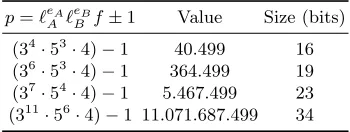
-SIOT protocol was implement in the phyton language, using a Mac-Book Air with a 1.6 GHz Intel Core i.5 processor, 4GB, 1.600MHz and DDR3 memory. Table 1 shows the values of the prime numberspthat were used in the implementation of the proposed protocol.
Table 1.Values used forpin the 21
-SIOT protocol.
p=`eA
A `
eB
B f±1 Value Size (bits)
(34·53·4)−1 40.499 16 (36·53·4)−1 364.499 19 (37·54·4)−1 5.467.499 23 (311·56·4)−1 11.071.687.499 34
In this work, it was only possible to use a maximum value ofpcorresponding the size of 34 bits. Evidently, such p values are insufficient to guarantee the security of the proposed protocol because [19] and [10] consider that the size of thep−valuefor the security of a post-quantum cryptographic protocol based on isogenies of elliptic curves is at least equal to 512 bits. However, this does not invalidate the proof of concept of 21
-SIOT.
6
Performance estimate between some OT protocols
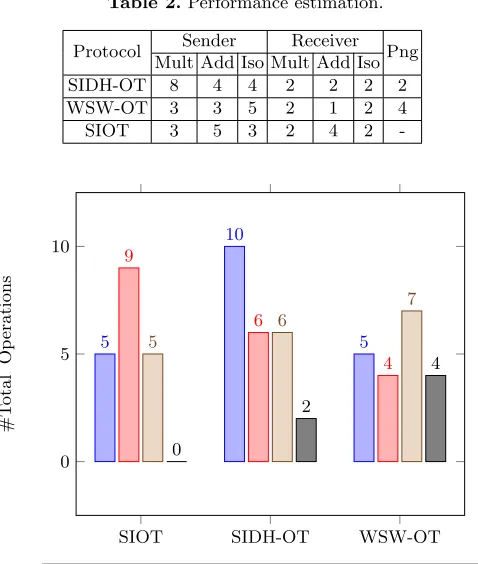
In table 2 and figure 6, the number of types of operations by sender and receiver was verified in 21
-SIOT and both protocols SIDH-OT and WSW-OT from [26]. Thus, multiplications with scalar and point additions are denoted byMulti and Add, respectively. Furthermore, calculations for isogenies and pairing are denoted byIsoandPng, respectively. Therefore, we estimate that the 21
Table 2.Performance estimation.
Protocol Sender Receiver Png Mult Add Iso Mult Add Iso
SIDH-OT 8 4 4 2 2 2 2
WSW-OT 3 3 5 2 1 2 4
SIOT 3 5 3 2 4 2
-SIOT SIDH-OT WSW-OT
0 5 10
5
10
5
9
6
4 5
6
7
0
2
4
#T
otal
Op
erations
Multiplications Additions Isogenies Pairings
Figure 2.Performance estimation.
7
Conclusion
In this paper, a proposal for apost quantum protocol called SIOT is presented. Its security is based on the difficulty of an opponent to calculate isogenies be-tween supersingular elliptic curves and the inspiration of the relative simplicity of the OT protocol of [4] to ensure privacy between the sender and the receiver. With respect to this privacy, it was important to elaborate a theorem, match-ing a privacy definition of [12] with the computational problems of isogenies of [10], considering a hypothetical scenario between a dishonest sender and an honest receiver and vice versa. Finally, an algebraic analysis withWeil pairing defined certain necessary conditions so that there were not security and privacy violations in the proposed protocol.
References
2. Boaz Barak. Oblivious transfer and private informa-tion retrieval. Technical report, Princenton University, https://www.cs.princeton.edu/courses/archive/fall07cos433/lec19.pdf, 2007. 3. Charles H. Bennett, Gilles Brassard, Claude Cr´epeau, and Marie-H´el`ene
Sku-biszewska. Practical quantum oblivious transfer. In Joan Feigenbaum, editor, Advances in Cryptology — CRYPTO ’91: Proceedings, pages 351–366, Berlin, Hei-delberg, 1992. Springer Berlin Heidelberg.
4. Tung Chou and Claudio Orlandi. The simplest protocol for oblivious transfer. In Kristin Lauter and Francisco Rodr´ıguez-Henr´ıquez, editors,Progress in Cryp-tology – LATINCRYPT 2015: 4th International Conference on CrypCryp-tology and Information Security in Latin America, Guadalajara, Mexico, August 23-26, 2015, Proceedings, pages 40–58, Cham, 2015. Springer International Publishing. 5. C. Crepeau and J. Kilian. Achieving oblivious transfer using weakened security
assumptions. In [Proceedings 1988] 29th Annual Symposium on Foundations of Computer Science, pages 42–52, Oct 1988.
6. Ivan Damg˚ard, Serge Fehr, Carolin Lunemann, Louis Salvail, and Christian Schaffner. Improving the security of quantum protocols via commit-and-open. In Shai Halevi, editor,Advances in Cryptology - CRYPTO 2009: 29th Annual In-ternational Cryptology Conference, Santa Barbara, CA, USA, August 16-20, 2009. Proceedings, pages 408–427, Berlin, Heidelberg, 2009. Springer Berlin Heidelberg. 7. A.M.Childs. D.Jao and V. Soukharev. Constructing elliptic curve isogenies in
quantum subexponential time., 2014.
8. Shimon Even, Oded Goldreich, and Abraham Lempel. A randomized protocol for signing contracts. Commun. ACM, 28(6):637–647, June 1985.
9. Luca De Feo. Algorithmes Rapides pour les Tours de Corps Finis et les Isog´enies. PhD thesis, Ecole Polytechnique X, December 2010.
10. Luca De Feo, David Jao, and J´erˆome Plˆut. Towards quantum-resistant cryptosys-tems from supersingular elliptic curve isogenies. Journal of Mathematical Cryptol-ogy, 8(3):209–247, 2014.
11. Steven D. Galbraith. Mathematics of public key cryptography. Cambridge Univer-sity Press, Cambridge, 2012.
12. Carmit Hazay and Yehuda Lindell. Efficient Secure Two - Party Protocols - Tech-niques and Constructions. Springer Berlin Heidelberg, 2010.
13. Jeffrey Hoffstein, Jill Pipher, and Joseph H. Silverman. An introduction to mathe-matical cryptography. Undergraduate Texts in Mathematics. Springer, New York, second edition, 2014.
14. Yael Tauman Kalai. Smooth projective hashing and two-message oblivious transfer. EUROCRYPT, 2005.
15. Raza Ali Kazmi. Cryptography from post-quantum assumptions. Cryptology ePrint Archive, Report 2015/376, 2015. http://eprint.iacr.org/2015/376. 16. D. Mayers and L. Salvail. Quantum oblivious transfer is secure against all
individ-ual measurements. In Physics and Computation, 1994. PhysComp ’94, Proceed-ings., Workshop on, pages 69–77, Nov 1994.
17. Dominic Mayers. Quantum key distribution and string oblivious transfer in noisy channels. In Neal Koblitz, editor, Advances in Cryptology — CRYPTO ’96: 16th Annual International Cryptology Conference Santa Barbara, California, USA Au-gust 18–22, 1996 Proceedings, pages 343–357, Berlin, Heidelberg, 1996. Springer Berlin Heidelberg.
19. Amir Jalali Mehran Mozaffari Kermani Reza Azarderakhsh, Brian Koziel and David Jao. Neon-sidh: Efficient implementation of supersingular isogeny diffe-hellman key exchange protocol on arm. Cryptology ePrint Archive, Report 2016/669., 2016.
20. Phillip Rogaway. On the role of definitions in and beyond cryptography.
21. Joseph H. Silverman. The arithmetic of elliptic curves, volume 106 of Graduate Texts in Mathematics. Springer, Dordrecht, second edition, 2009.
22. Anton Stolbunov.Cryptography Shemes based on Isogenies.PhD thesis, Norwegian University of Science and Technology., 2012.
23. John Tate. Endomorphisms of abelian varieties over finite fields. Invent. Math., 2:134–144, 1966.
24. Dominique Unruh. Universally composable quantum multi-party computation. In Henri Gilbert, editor,Advances in Cryptology – EUROCRYPT 2010: 29th Annual International Conference on the Theory and Applications of Cryptographic Tech-niques, French Riviera, May 30 – June 3, 2010. Proceedings, pages 486–505, Berlin, Heidelberg, 2010. Springer Berlin Heidelberg.
25. Jacques V´elu. Isog´enies entre courbes elliptiques.C. R. Acad. Sci. Paris S´er. A-B, 273:A238–A241, 1971.
26. Vanessa Vitse. Simple oblivious transfer protocols compatible with kummer and supersingular isogenies. Archives-Ouvertes. hal-01981552, 2019.
27. David Wagner. Technical perspective: Fairness and the coin flip. Communications of the ACM., 59(4):75, April 2016.
28. Lawrence C. Washington. Elliptic curves - Number Theory and Cryptography. Taylor & Francis Group. LLC, second edition. edition, 2008.
29. Andrew Chi-Chih Yao. Security of quantum protocols against coherent measure-ments. InProceedings of the Twenty-seventh Annual ACM Symposium on Theory of Computing, STOC ’95, pages 67–75, New York, NY, USA, 1995. ACM.
A
Isogenies
In short, isogeny-based cryptography utilizes unique algebraic maps between elliptic curves that satisfy group homomorphism. This original idea introduced by [22] detailed a Diffie-Hellman cryptosystem based on the hardness of com-puting isogenies between ordinary elliptic curves. Nevertheless, [7] developed a quantum algorithm that could compute isogenies between ordinary curves in subexponential time. This algorithm uses the fact that the structure of the ellip-tical group is commutative. Thus, [10] adapted the isogeny-based key exchange protocol to be based on the difficulty of computing isogenies between supersin-gular elliptic curves, which does not have commutative endomorphism ring.
Definition 4. Let E1 and E2 be elliptic curves overFp. An isogeny over Fp is a morphismφ: E1→E2overFp such thatφ(OE1)=OE2 is a group homomor-phism. The zero isogeny is the constant map φ:E1→E2 given byφ(P) =OE2 for all P ∈E(¯Fp). If there is an isogeny between two elliptic curves E1 andE2 then:
ii. #E1(Fp) = #E2(Fp)11;
iii. E1andE2 have the same−invariantif and only ifE1wE2 overF¯p (i.e. exists an isomorfism fromE1 toE2)12.
Definition 5. Let E1 and E2 be elliptic curves over Fp and φ: E1 →E2 over
Fp. The degree of a non-zero isogeny is the degree of the morphism. The degree of the zero isogeny is 0. If there is an isogeny of degree `between elliptic curves
E1 andE2 then, they are `-isogenous.
Definition 6. Let E1 and E2 be elliptic curves over Fp and φ: E1 → E2 an isogeny. Then, the kernel of an isogeny isker(φ) ={P∈E1( ¯Fp) :φ(P) =OE2}. Remark 2. We can denote E2=E1/ker(φ).
Definition 7. A non-zero isogeny separable φ: E1→E2 over Fp of ` - degree has #ker(φ) =`.
Definition 8. Let φ:E1→E2 andφˆ:E2→E3 be two isogenies with`-degree and`ˆ-degree, respectively. Then, their composition is an isogenyφˆ(φ) :E1→E3 with (`·`ˆ)-degree.
Proposition 1. Let E1 be an elliptic curve over Fp andG a finite subgroup of E1(¯Fp)that is defined over Fp. Then, there is an unique elliptic curveEG and a separable isogenyφ:E1→EG=E1/Gsuch thatker(φ) =G.
Proof. See Theorem 25.1.6 and Corollary 25.1.7 from [11]. ut
B
SIDH key exchange
For a better understanding, see the first diagram in figure 3. The sender and the receiver choose randomly two secret integers rA ← Z/`eAAZ andrB ←
Z/`eBBZ, respectively. Thus, the kernelhPA+rAQAifrom sender has order`eAA and its secret key is computed as the degree`eA
A isogenyφA:E0→EA, and its pkA is the isogenous curveEA together with images GA ←φA(PB) andHA←
φA(QB).
Similarly, the kernelhPB+rBQBifrom receiver has order`eBB and its secret key is computed as the degree `eB
B isogeny φB : E0 → EB, and its pkB is the isogenous curve EB together with images GB ← φB(PA) and HB ←φB(QA). In short, there is a public key exchange, saypkAand pkB.
To compute the shared secretk, sender uses its secret integers and receiver’s public key to compute the degree `A isogeny φ
0
A :EB →EBA whose kernel is the point φB(PA) + rAφB(QA) = φB(PA+rAQA). In the same way, receiver uses its secret integers and sender’s public key to compute the degree`Bisogeny
φ0B : EA → EAB whose kernel is the point φA(PB) + rBφA(QB) = φA(PB+ 11
See [23]. 12
rBQB). It happens thatEBAandEAB are isomorphic. Hence, both sender and receiver can compute a shared secretk, that is, there is the common-invariant
(EBA) =(EAB).
Therefore,H((EBA)) = H((EAB)) = k. After that, the sender computes
c← Ek(m) and sends it to the receiver that computesm← Dk(c). More details, see [10]
Supersingular Isogeny Diffie-Hellman(SIDH)
Sender Receiver
Input:m∈ M Input: none
Output: none Output:m
rA←Z/`eAAZ rB←Z/`eBBZ
φA:E0→EA φB:E0→EB
EA←E0/hPA+rAQAi EB←E0/hPB+rBQBi
GA←φA(PB);HA←φA(QB) GB←φB(PA);HB←φB(QA)
pkA←(EA, GA, HA) pkB←(EB, GB, HB)
pkA φ0B:EA→EAB
φ0A:EB→EBA pkB
EBA←EB/hGB+rAHBi EAB←EA/hGA+rBHAi
k=H((EBA)) k=H((EAB))
c← Ek(m)
m=Dk(c)
Figure 3.SIDH protocol.
C
Oblivious Transfer
protocol
Oblivious Transfer (OT) is a protocol in which a sender transfers one of many pieces of information to a receiver, but remains oblivious as to what piece has been transferred. The original notion of OT was first proposed byMichael Rabin in 1981 [18] in which a sender sends an encrypted message to a receiver and this one could decrypt such message with probability 1/2. After this, [8] presented a general form of OT, named 1-out-of-2 OT, 21
- OT for short, i.e, where a sender sends two encrypted messages to a receiver being able to decrypt only one of them.
Many authors have generalized this to n1
- OT where the receiver chooses one message out ofnand kn
-OT in which the receiver chooses a subset of size
kfrom among nmessages. In this work, we will be focused only on 21
- OT.
C.1 Protocol 21
- OT Chou-Orlandi
Premises
1. The scheme from [4] works in a primitive additive group (G, B,Fp,+) of prime orderp, generated by base pointB;
2. Let s be a safety parameter and ∈ {0,1}. Thus, the hash function H : (G×G)×G→ {0,1}sis used to generate a cryptographic keykfor use in a symmetric cipher defined by the functionsE (encryption) and D (decryp-tion), i.e,c0=E(k0, m0) andc1=E(k1, m1).
3. Abstract view of information exchange from protocol 21- OTChou-Orlandi.
Sender S Receiver
Sender R Receiver
Sender (c0, c1) Receiver
Sender and Receiver
Setup - Sender
1. Sender secretly chooses a valuey ∈Fp; 2. Sender computes:
S=yB (1)
T =yS; (2)
3. Sender sends S to Receiver which refuses ifS /∈G.
Setup - Receiver
1. Receiver secretly chooses a valuex∈Fp;
2. Receiver computes:
R=b.S+x.B (3), where b∈ {0,1}is chosen by Receiver;
3. Receiver sends Rto Sender which refuses ifR /∈G.
Generation of cryptographic keys k, ∈ {0,1}.
Encryption and Decryption
1. Sender encrypts and sendsc= (c0, c1) to Receiver. Recallingc0=E(k0, M0) andc1=E(k1, M1);
2. Receiver decrypts and gets Mb=D(kb, c),∈ {0,1}.
Remark 3. It is verified that a key k,j∈ {0,1}, is computed byH(S,R)[xyB+ (b−j)T]. Hence, at the end of the protocol if both parts are honest then we have thatkb=k. In other words, if= 0 thenc=c0= 0 andk0=kb=H(S,R)(xyB). Otherwise, if= 1 thenc=c1= 1 andk1=kb=H(S,R)(xyB).
k=yR−T;
=y(bS+xB)−T; f rom equation(3) =byS+xyB−T;
=bT +xyB−T; f rom equations(1)and(2) =xyB+ (b−)T.
Therefore, we can conclude that if the Receiver chooses b /∈ , he will not share the secret (cryptographic key) with the Sender.
D
Linearly independent points
In this appendix, we present definitions for the understanding of the process that determines the choice of linearly independent pointsPA, QA, PB andQBin the proposed protocol.
Definition 9 (Frobenius). LetE(Fq)be an ellipic curve, and letE(Fqk)be its
Fqk-rational extension. The Frobeniusmap is the functionΦ:E(Fqk)→E(Fqk)
defined by Φ(x, y) = (xq, yq) for any (x, y) ∈ E(
Fqk). Φi denotes its i-th
self-composition, i.e. for any P ∈ E(Fqk), Φi(P) := P for i = 0, and Φi(P) = Φ(Φi−1(P))fori >0.
Definition 10 (Trace). Let E(Fq) be an ellipic curve, and let E(Fqk) be its
Fqk-rational extension. The trace map is the function tr : E(Fqk) → E(Fqk)
defined bytr(P) = (1/k)Pk−1
i=0 Φ
i(P)where1/kdenotes the inverse ofkmod the order of E(Fqk). In particular,k= 2for a supersingular curve in characteristic p >3, andtr(P) = (1/2)(P+Φ(P)).
Hence, the trace map is important in that its eigenspaces, if nontrivial, form two linearly independent groups that can be used to sample pointsPA,QA,PB,
QBefficiently. Moreover, the trace definition assumes that gcd(k,#E(Fqk)) = 1,
which may not be the case, especially in the important setting where `A = 2. Thus, for this scenario we also define thequasi−tracemap:
Definition 11 (Quasi-trace). Let E(Fq) be an ellipic curve, and let E(Fqk)
be itsFqk-rational extension. The quasi-tracemap is the functiontr:E(Fqk)→ E(Fqk)defined bytr(P) =Pik=0−1Φi(P). In particular,k= 2for a supersingular
E
Possibility of symmetric pairings in the SIOT
Under certain circumstances, it is possible to define a symmetric pairing ˆ
e:EB[`eA
A ]→Fp2. We now analyze the condition under which this can happen.
In what follows, recall that a distortion map is a linear transformation that maps a curve point to a linearly independent point.
The embedding degree for EB[`eA
A ] is only 1, not 2 as it is for E0, because
EB is defined over Fq with q := p2, and since p = (`eAA` eB
B f)
2−1, it follows that #EB[`eAA] = (`
eA
A )
2 | q−1. Hence a distortion map ψ must map a point
P ∈E[`eA
A ](Fq) to a point Q∈E[`eAA](Fq) that is linearly independent fromP, in which caseψlinearly maps a basis (GB, HB) to another basis (G0B, HB0 ).
In particular, all coefficients ofψin basis (GB, HB) must be integers mod`eAA. For such a map to be a distortion map, it must have no eigenvectors (otherwise it would fail to map those points to linearly independent points), so we can simply require the characteristic polynomial to have no roots mod`eA
A.
In that case, the map ψ(uGB+vHB) := vGB −uHB could be a suitable distortion map. Its characteristic polynomial is λ2+ 1 which has no roots mod
`eA
A for a careful choice of `A (e.g. `A = 3). Now define the modified pairing ˆ
e(P, Q) :=e(P, ψ(Q)) wheree(·) is theWeil pairing. Then: ˆ
e(aGB+bHB, cGB+dHB) =e(aGB+bHB, dGB−cHB) =e(aGB,−cHB)·e(bHB, dGB) =e(GB, HB)−ac−bd,
ˆ
e(cGB+dHB, aGB+bHB) =e(cGB+dHB, bGB−aHB) =e(cGB,−aHB)·e(dHB, bGB) =e(GB, HB)−ac−bd,
so this modified pairing is symmetric.
It remains to determine if it is isogeny-equivariant. If it is, a further constraint exists for the coefficients ofU and V, namely:
ˆ
e(GB+λU, HB+λV) = ˆe(GB, HB)(1+λα)(1+λδ)
· ˆe(HB, GB)λβλγ
= ˆe(GB, HB)(1+λα)(1+λδ)+λ
2βγ
=e(GB, HB), so we also need (1 +λα)(1 +λδ) +λ2βγ= 1 (mod`eA
A). ut
E.1 Taking symmetric pairings into account
Coupling the above constraintsγ=−α2/β (mod`eA
A) andδ=−α (mod` eA
A ) with the additional condition (1 +λα)(1 +λδ) +λ2βγ= 1 (mod`eA
A ), we have (1 +λα)(1−λα)−λ2βα2/β = 1−2λ2α2 = 1 (mod `eA
A ) for any λ, or simply 2α2= 0 (mod`eA
A ), which has the solutionα=α0·2beA/2c for`A= 2 and any 06α0<2deA/2e, or α=α0·`d
eA/2e
A for`A6= 2 and any 06α0< ` beA/2c
F
Validating the process of sharing points (U, V)
Now, we are going to verify the sharing of pointsU andV between Bob and Alice. This is important from the point of view of the correct functionality of the
2 1
-SIOT protocol with regard to the oblivious characteristic, i.e, in practical terms, pointsU andV provide the sender to generate two secret keys. Thus, Bob defines pointsU andV as mentioned in section 2.3. Recall that these points can be written as a linear combination. After that, he sends to Alice one of the pairs (GB, HB) or (GB−U, HB −V). Obviously, Alice doesn’t distinguish13 which pair of points she received. Thus, upon receipt of ˆGB and ˆHBpoints from Bob’s public key, say ˆpkB= (EB,GˆB,HˆB), Alice defines ˆU and ˆV yielding ˆU =U and
ˆ
V =V. In other words, Alice and Bob have the assurance that pointsU andV
are being correctly shared between the parties.
Proof.
1. In a first assumption, Alice receives points ˆGB = (GB −U) and ˆHB = (HB−V) from Bob. Evidently, she has not any knowledge about pointsGB andHB. Thus, she performs the algebraic development below.
ˆ
U =α·GˆB+β·HˆB; ˆ
U =α·(GB−U) +β·(HB−V); ˆ
U =α·GB−α·U+β·HB−β·V; ˆ
U =α·GB+β·HB
| {z }
U
−(α·U+β·V);
ˆ
U =U −(α·U+β·V); ˆ
U =U −[α·U+β·(−α β ·U)]
| {z }
0
;
ˆ
U =U.
If Uˆ =U andV =−(α/β)U, then ˆV =V. ut
2. In this second assumption, Alice receives ˆGB=GB e ˆHB=HB points from Bob. Similarly,
13
ˆ
U =α·GˆB+β·HˆB; ˆ
U =α·GB+β·HB; ˆ
U =α·GB+β·HB
| {z }
U
;
ˆ
U =U.
Evidently, in this case, If Uˆ =U then, ˆV =V ut