ISSN: 2319-8753
I
nternational
J
ournal of
I
nnovative
R
esearch in
S
cience,
E
ngineering and
T
echnology
(An ISO 3297: 2007 Certified Organization)
Vol. 2, Issue 10, October 2013
Comparative Studies on Bacterial Consortia
for Hydrocarbon Degradation
Sunita J. Varjani
1and Vivek N. Upasani
2*1
Faculty, Gujarat National Law University (GNLU), Koba, Gandhinagar, Gujarat, India
2
Associate Professor, Department of Microbiology, M. G. Science Institute, Ahmedabad, Gujarat, India
*Corresponding author
Abstract:Globally environmental scientists have shown increased interest in promoting biological methods referred to as “Green technology”
in the clean-up technologies for hydrocarbon-polluted sites. These methods are less expensive and do not introduce additional chemicals/pollutants into the environment. Compared to physico-chemical methods, bioremediation / biodegradation offer a feasible alternative for this purpose to the petroleum industry. One reason is that the majority of the molecules in the crude oil and refined products are biodegradable. We have reported the isolation of Hydrocarbon Utilizing Bacteria (HUB) from crude oil contaminated soil and Untreated Effluent water (UEW) samples collected samples from selected ONGC sites in Gujarat state. Screening for hydrocarbon utilizing capacity of these bacteria was carried out using Bushnell-Hass (BH) medium with crude oil (K#X) and redox indicator 2, 6 - dichlorophenol indophenol (DCPIP). Maximum utilization of hydrocarbons from crude oil was indicated by the total discoloration of DCPIP. In total five consortia (Hydrocarbon Utilizing Bacterial Consortium: HUBC) named HUBC-S, HUBC-W, HUBC, HUBC-Ank, and HUBC-AH were prepared to screen for the most efficient consortium for hydrocarbon degradation. Our results indicated that the consortium HUBC consisting of six
isolates showed best results. Total discolouration of DCPIP by “HUBC” and its individual isolate was about 53 h and 120 h, respectively. The results of this study are presented here.
Key words: BH medium, Biodegradation, Consortia, Crude oil, HUBC, UEW, DCPIP
I. INTRODUCTION
Contamination of soil, water and sediment samples with petroleum hydrocarbons has resulted in environmental and health hazards. Clean up/remediation of such pollutants requires the development and implementation of innovative technology [1]. Bioremediation is proposed as an alternative to various physico-chemical treatments at many hydrocarbon contaminated sites [2]. Biodegradation of petroleum hydrocarbons is a complex process that depends on the type and amount of hydrocarbons present [3]. Diverse microorganisms (strains of bacteria, fungi, yeast, algae etc.) have been reported to have the capability to degrade the hydrocarbon pollutants. Significant role of native flora in biodegradation / bioremediation is also reported in literature. T he most rapid and complete degradation of the majority of organic pollutants is brought about under aerobic conditions [4-9]. Limited range of petroleum compounds is metabolized by individual microorganisms; mixed populations with variety of enzymatic capacities are required to bring the quality and quantity of hydrocarbon utilization /degradation. Microbial populations that consist of strains that belong to various genera have been detected in hydrocarbon-contaminated soil, water or sediment samples. This strongly suggests that each strain or genus has specific role in the degradation processes [1-3, 10-12] Screening of individual microbe / consortium for utilization/degradation of pollutants is an important task to develop the bioremediation processes [13]. 2, 6-dichlorophenol indophenol (DCPIP) based colorimetric assay can be used to study the utilization / degradation of hydrocarbons by microorganisms. In oxidized state the indicator is blue and its reduced state is colourless. The colour change is due to structural change in the molecule, in which the double bond between nitrogen and carbon passes to a single bond. The colour change is directly proportional to utilization / degradation of hydrocarbon compound (s) [7, 9, 13, 14]. Present study represents investigation of utilization of hydrocarbon contaminants / pollutants by indigenous bacterial isolates individually and their consortium. Five bacterial consortia were prepared which were denoted as HUBC-S, HUBC-W, HUBC, HUBC-Ank, and HUBC-AH. The strains were selected based on the criteria that they were able to perform discoloration of DCPIP (utilization of hydrocarbon component (s) of the crude oil in a relatively short time).
II. MATERIALS AND METHODS
ISSN: 2319-8753
I
nternational
J
ournal of
I
nnovative
R
esearch in
S
cience,
E
ngineering and
T
echnology
(An ISO 3297: 2007 Certified Organization)
Vol. 2, Issue 10, October 2013
Screening of HUB: Crude oil contaminated soil, Untreated Effluent water (UEW) were collected with the technical assistance of ONGC authorities from various oil fields of ONGC sites located in Ahmedabad and Ankleshwar Asset of Gujarat. In total 69 HUB were obtained by enrichment culture technique as described elsewhere [9]. The utilization of respective crude oil by all 69 isolates was evaluated using the technique based on the redox indicator DCPIP. Modified Hanson et al. method was used to screen potential HUB [9, 14]. Activated bacterial cultures were inoculated into tubes along with 0.5% v/v DCPIP indicator, and 3% v/v respective crude oil for spectrophotometric analysis. All the tubes were incubated at room temperature for six days. Appropriate controls and substrate / crude oil assays were included as mentioned in Table 1.
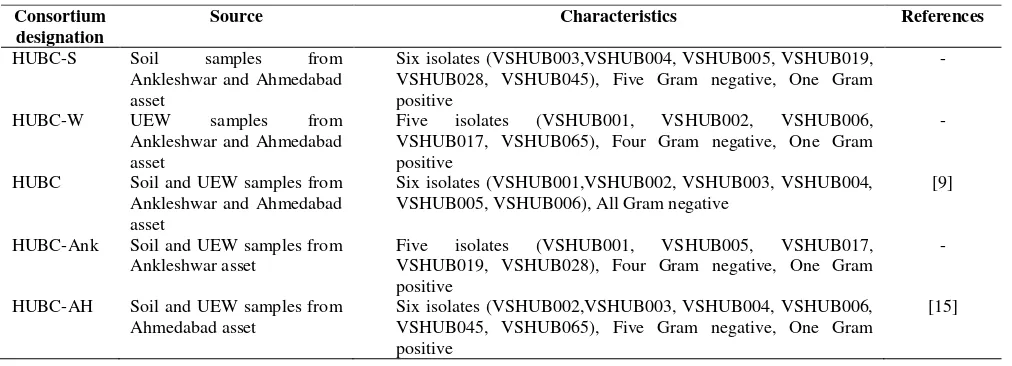
Microbial consortia preparation and Analysis: Based on the time for discolouration of DCPIP one isolate was selected from each sample viz. soil or UEW sample(s). Isolates which decolorized DCPIP in the relatively shortest time (about 120-125h) were chosen for preparing a consortium. Consortium preparation is described elsewhere [15]. Five such consortia were prepared using the most efficient isolates and designated as HUBC-S, HUBC-W, HUBC, HUBC-Ank, and HUBC-AH. For selection of the most effective consortium crude oil from well K#X was used as sole carbon source, rest of the contents of all assay tubes remains the same as shown in Table I. All individual isolates and consortia were studied for decolourization of DCPIP [13]. Discoloration of DCPIP is directly proportional to the hydrocarbons utilization of hydrocarbons by the individual isolate/consortium. The absorbance means optical density of all the assays was measured spectrophotometrically by Hach® DR2500 spectrophotometer at 600nm. Data was collected at regular time interval of 24h till six days.
III. RESULTS AND DISCUSSIONS
Biodegradation studies to check the ability of mixed microbial populations for the utilization of hydrocarbon(s) in crude oil as the sole carbon source have been reported by many authors [1, 3, 7, 11, 15, 16]. Bacteria are the primary degraders and most active agents in petroleum degradation. Several bacteria are even known to grow exclusively on hydrocarbons [17]. Interest in the potential of biodegradation and bioremediation technology was increased after success of bioremediation efforts in the cleanup of the oil spill due to Exxon Valdez oil tanker disaster in 1989 at Prince William Sound, Alaska [16]. The bioremediation of soils and sites contaminated by crude oil is often limited due to the scarcity of indigenous specialized microbes with the complementary substrate specificity required for degrading the different hydrocarbons present at the contaminated site [12]. Many times due to accumulation of recalcitrant compounds and low availability of hydrocarbons complete hydrocarbon degradation is not possible in field conditions [3]. Lubricant oil compounds such as cyclic alkanes are not biodegraded by only one microorganism. Hence, a consortium having a group of potential oil metabolizing microorganisms is required for this purpose [13]. The degradation of petroleum hydrocarbons can be mediated by specific enzyme system, the initial attack on xenobiotics is done by oxygenases. Mainly two mechanisms are reported to show involvement of microbes for biodegradation of hydrocarbon pollutants, one is direct (attachment of microbial cells to the substrates) and the other is indirect (through production of micro nutrients or biosurfactants). The former mechanism is still unknown, but the later has been well studied [16]. Production of biosurfactants (surface-active agents) for the solubilization of aliphatic or aromatic hydrocarbons by Pseudomonas sp. is reported by several authors [8,18,19].
Samples used in this study were collected from ONGC sites located at Ankleshwar and Ahmedabad asset in Gujarat state. Crude oil contaminated subsurface soil samples were collected near oil wells, Gas Gathering Stations (GGS) and Central Tank Farm (CTF); UEW (Untreated Effluent Water) samples were collected from GGS and CTF, whereas Crude oil samples were collected from the mouth / surface opening of oil wells, GGS and CTF. Sixty nine (69) HUB isolates were obtained from six crude oil contaminated soil and five UEW samples of Ankleshwar and Ahmedabad assets in Gujarat state. Out of sixty nine (69) HUB isolates, forty (40) were obtained from Ahmedabad asset. Out of forty (40) HUB isolates, twenty three (23) were obtained from soil samples whereas seventeen (17) were obtained from Untreated Effluent water (UEW) samples. Twenty nine (29) isolates were obtained from Ankleshwar asset, out of which nineteen (19) were obtained from soil samples whereas ten (10) were obtained from UEW samples. Out of sixty nine (69) HUB isolates, forty two (42) isolates were obtained from soil samples, whereas twenty seven (27) were obtained from UEW samples.
ISSN: 2319-8753
I
nternational
J
ournal of
I
nnovative
R
esearch in
S
cience,
E
ngineering and
T
echnology
(An ISO 3297: 2007 Certified Organization)
Vol. 2, Issue 10, October 2013
sample. All isolates were not able to decolorize DCPIP completely in six days. DCPIP discoloration time for individual isolates was varied from 120 - 144h (data not shown). Isolates which decolorized DCPIP in the shortest time (about 120-125h) were chosen for preparing the consortia. Details of the selected isolates and prepared consortia are represented in Table II and Table III, respectively. Selected individual isolates and their consortia were again studied for discoloration of DCPIP using crude oil from well K#X. The crude oil samples contained moisture content, saturates, aromatics, resins and asphaltenes in the range 0 - 24%. 77.2 - 80.8%, 12.4 - 17.8%, 3.2 - 8.8% and 0.8 - 4.3%, respectively, as reported elsewhere [9].
There are various reports available on metabolic versatility of mixed cultures that has demonstrated superiority of mixed cultures to pure cultures [7, 21, 22]. Moneke and Nwangwu (2011) reported isolation of hydrocarbon utilizing Pseudomonas sp, Bacillus
sp. and Klebsiella sp. They performed biodegradation experiment for single and mixed culture using kerosene, engine oil and automotive oil as sole source. They concluded that use of native microorganism(s) for biodegradation is beneficial and profitable [22]. Malik and Ahmed (2012) studied mixed consortium of 15 bacteria, isolated from an oil contaminated site of Pakistan and reported 94.64% and 93.75% removal of aliphatic and aromatics, respectively; of the used crude oil after 24 days of incubation [23]. Necessity of consortium with broad enzymatic capacities for degradation of complex hydrocarbon pollutants such as crude oil or diesel fuel was also reported. Fifty seven (57) bacteria degrading crude oil from the hydrocarbon polluted sites of gasoline and diesel spilled gas stations of Coimbatore, India have been isolated. Screening lead to selection of one
Bacillus sp., one Corynebacterium sp. and two Pseudomonas sp. The bacterial consortium showed better degradation as compared to that of the individual strains. Using 1% crude oil at 30°C after incubation of 25 days mixed bacterial consortium degraded 77% of the crude oil, whereas degradation by individual bacterial strain ranged from 69%- 41%. The variety of microorganisms and their degradative enzymes help in the degradation of aromatic hydrocarbons by a microbial consortium [11]. Bao et al., (2012) reported a consortium of Ochrobactrum sp. and three Brevibacillus parabrevis sp. can degrade 79% of crude oil after 14 days of incubation under standard experimental condition (s) [24]. Varjani and Upasani (2012) reported utilization of crude oil by consortium obtained from crude oil contaminated soil samples of selected ONGC sites of Ahmedabad asset. Under standard experimental conditions the complete discolouration of DCPIP was observed in 72 h of incubation. Two isolates from these six isolates constituting the consortium were identified as Pseudomonas sp [15].
There are several reports available for wide distribution of petroleum-degrading microorganisms in soil, water and sediments but they may not be present in sufficient numbers to achieve contaminant remediation [17]. Contaminant removal can be achieved by inoculation of the polluted area with highly effective hydrocarbon-degrading microbial strains to augment / stimulate the existing ones [2]. Isolation of Acinetobacter sp, Bacillus sp., Micrococcus sp., Pseudomonas sp. Streptomyces sp., and fungi Aspergillus
sp, Trichoderma sp, Penicillin sp. from diesel oil polluted soil sample from Pravara river bed around Sangamner city, Western India and their ability of a consortium of all isolates for biodegradation of crude oil using BH medium and DCPIP has been reported [1].
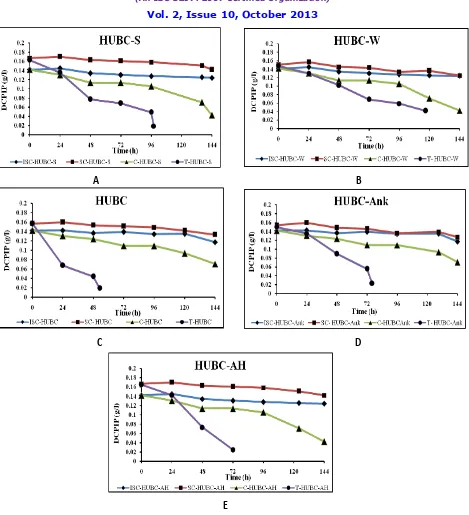
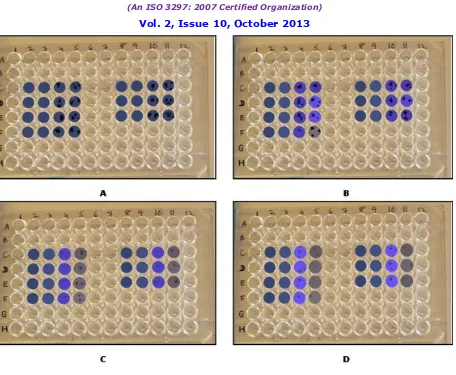
“ISC-HUBX” and “SC-HUBX” did not show discoloration, whereas the substrate assays (“C-HUBX and “T-HUBX”) (from this point X will be referred as C-S, C-W, C, C-Ank, and C-AH for respective consortium) showed remarkable discolouration (in terms of oil utilization). It was interesting to note that the “T-HUBX” assay completely decolourized DCPIP for all the consortia tested. The biodegradation time observed for the consortia HUBC-S, HUBC-W, HUBC, HUBC-Ank, and HUBC-AH was 98 h, 117 h, 53 h, 76 h and 72 h, respectively (Fig. 1A to 1E). Finally “HUBC” and its six isolates were further studied for decolourization of DCPIP spectrophotometrically by measuring absorbance at 600 nm, periodically [13]. The time required for total discoloration of DCPIP for “HUBC” was less than half required by pure cultures of the isolates used for preparation of the consortium (Fig. 2A to 2D). DCPIP concentration below 0.030 g/l was considered as complete discolouration.
Ghazali et al., (2004) reported comparative study of two consortia prepared from the isolates obtained from Center for Research in Enzymes and Microbiology (CREAM), Malaysia. Consortium No. 2 consisted of three Bacillus sp., two P. aeruginosa strains, and one Micrococcus sp. whilst consortium No. 1 consisted of one Bacillus and two Pseudomonas strains. As compared to consortium No. 1, consortium No. 2 proved more efficient for the cleanup of the medium- and long-chain alkanes in the diesel-contaminated soil of Selangor, Malaysia. They proposed the important role of Bacillus strains for more extensive biodegradation. In their study they reported 57% removal of tetradecane by consortium No. 2 after 60 days of study. The use of individual pure cultures and mixed cultures of hydrocarbon degrading microorganisms has been tested with interesting results on hydrocarbons contaminated soils [3].
ISSN: 2319-8753
I
nternational
J
ournal of
I
nnovative
R
esearch in
S
cience,
E
ngineering and
T
echnology
(An ISO 3297: 2007 Certified Organization)
Vol. 2, Issue 10, October 2013
hydrocarbon pollutants require co-presence of different bacterial species, having different metabolic pathways for degradation of specific pollutant present in crude oil.
Table II. Details of Isolates Used in Study
Strain
designation Source Characteristics Reference
VSHUB001 UEW Ank GGS-W Gram negative, Motile, Catalase positive, off-white pigment [9] VSHUB002 UEW AH GGS-X Gram negative, Motile, Catalase positive, Pale yellow pigment [9] VSHUB003 Soil AH L#Z Gram negative, Motile, Catalase positive, Blue green diffusible pigment [15] VSHUB004 Soil AH K#X Gram negative, Motile, Catalase positive, Yellow green diffusible
fluorescent pigment
[15] VSHUB005 Soil Ank CTF Gram negative, Motile, Catalase positive, Yellow green diffusible
fluorescent pigment
[9] VSHUB006 UEW AH GGS-Z Gram negative, Motile, Catalase positive, Pale yellow pigment [9] VSHUB017 UEW Ank CTF Gram negative, Motile, Catalase positive, off-white pigment - VSHUB019 Soil Ank GGS-W Gram positive, Motile, Catalase positive, Golden yellow pigment - VSHUB028 Soil Ank #W Gram negative, Motile, Catalase positive, No pigment - VSHUB045 Soil AH K#Y Gram negative, Motile, Catalase positive, Blue green diffusible pigment - VSHUB065 UEW AH GGS-Y Gram positive, Motile, Catalase positive, No pigment - Ank: Ankleshwar, AH: Ahmedabad
Table III. Details of the Consortia Used in Study
Consortium designation
Source Characteristics References
HUBC-S Soil samples from Ankleshwar and Ahmedabad asset
Six isolates (VSHUB003,VSHUB004, VSHUB005, VSHUB019, VSHUB028, VSHUB045), Five Gram negative, One Gram positive
-
HUBC-W UEW samples from Ankleshwar and Ahmedabad asset
Five isolates (VSHUB001, VSHUB002, VSHUB006, VSHUB017, VSHUB065), Four Gram negative, One Gram positive
-
HUBC Soil and UEW samples from Ankleshwar and Ahmedabad asset
Six isolates (VSHUB001,VSHUB002, VSHUB003, VSHUB004, VSHUB005, VSHUB006), All Gram negative
[9]
HUBC-Ank Soil and UEW samples from Ankleshwar asset
Five isolates (VSHUB001, VSHUB005, VSHUB017, VSHUB019, VSHUB028), Four Gram negative, One Gram positive
-
HUBC-AH Soil and UEW samples from Ahmedabad asset
Six isolates (VSHUB002,VSHUB003, VSHUB004, VSHUB006, VSHUB045, VSHUB065), Five Gram negative, One Gram positive
[15]
Table I. Protocol for Screening of HUB by DCPIP Colorimetric Assay
Tube no. DCPIP (µl)
BH medium (ml) Culture (µl)
Crude oil (µl)
ISC 2000 7.5 - -
SC 2000 7.5 1000 -
C-HUBX 2000 7.5 - 300
T-HUBX 2000 7.5 1000 300
ISSN: 2319-8753
I
nternational
J
ournal of
I
nnovative
R
esearch in
S
cience,
E
ngineering and
T
echnology
(An ISO 3297: 2007 Certified Organization)
Vol. 2, Issue 10, October 2013
A
B
C
D
E
ISSN: 2319-8753
I
nternational
J
ournal of
I
nnovative
R
esearch in
S
cience,
E
ngineering and
T
echnology
(An ISO 3297: 2007 Certified Organization)
Vol. 2, Issue 10, October 2013
Fig. 2: DCPIP decolourization process through time (A, B, C, D: 0 h, 53 h, 120 h, 144 h, respectively) as observed in K#X crude oil biodegradation. Well No. M1, M2, M3, M4 and M5 (where M is C, D, E and F) are BH medium, ISC-n, SC-n, C-n, and T-n (n is VSHUB001, VSHUB003, VSHUB005, HUBC); Well No. M7, M8, M9, M10 and M11 (where M is C, D, E, and F) are BH medium, ISC-n, SC-n, C-n, and T-n (n is VSHUB002, VSHUB004, VSHUB006)
CONCLUSION
The consortia prepared here showed faster utilization of DCPIP than the individual bacterial strain used to prepare it. This could be due to synergistic action of the isolates or due to the different metabolic pathways employed by the individual bacterial
species. Among the five consortia studied “HUBC” consisting six strains isolated from crude oil contaminated soil and UEW
samples gave best results. Under the experimental conditions time required for utilization of crude oil components as sole source
of carbon by “HUBC” was less than half of that required by the individual isolates. Further optimization of this consortium will lead to an effective and eco-friendly technology for the degradation of hydrocarbons from crude oil.
ACKNOWLEDGEMENT
ISSN: 2319-8753
I
nternational
J
ournal of
I
nnovative
R
esearch in
S
cience,
E
ngineering and
T
echnology
(An ISO 3297: 2007 Certified Organization)
Vol. 2, Issue 10, October 2013
REFERENCES
[1] Patil, T. D., Pawar, S., Kamble, P. N., and Thakare, S. V., “Bioremediation of complex hydrocarbons using microbial consortium isolated from diesel oil
polluted soil,” Der Chemica Sinica,Vol. 3 (4),2012,pp.953-958.
[2] Joo, S., Ndegwa, P. M., Shoda, M., and Phaec, C. G., “Bioremediation of oil-contaminated soil using Candida catenulate and food waste”, Env. Pol., Vol. 156, 2008, pp. 891–896..
[3] Ghazali, F. M., Rahman, R. N. Z., Salleh, A. B., and Basri, M., “Biodegradation of hydrocarbons in soil by microbial consortium”, Int. Biodeterio. & Biodeg.,Vol. 54, 2004, pp. 61 – 67.
[4] Afuwale, C., and Modi, H. A., “Study of bacterial diversity of Crude oil degrading bacteria isolated from crude oil”, Life sci. leaflets, Vol. 6, 2012, pp.13-23. [5] Hamzah, A., Rabu, A., Farzarul, R., and Yussoff, N. A., “Isolation and Characterization of Bacteria Degrading Sumandak and South Angsi Oils”, Sains Malaysiana, Vol.39 (2), 2010, pp. 161–168.
[6] Linda, A., and Bouziane, A., “Petroleum-Oil biodegradation by Corynebacterium aquaticum and Pseudomonas aeruginosa strains isolated from the industrial Rejection of the refinery of ARZEW-Algeria”, World App. Sci. J., Vol. 18 (8), 2012, pp. 1119-1123.
[7] Mariano, A. P., Bonotto, D. M., De Angelis, D. F., Pirollo, M. P. S., and Contiero, J., “Biodegradability of commercial and weathered diesel oil”,Brazilian J. of Microbiol., Vol.39, 2008, pp. 133-142.
[8] Mittal, A., and Singh, P., “Isolation of Hydrocarbon degrading bacteria from soils contaminated with crude oil spills”, Indian J. of Expt. Biol., Vol. 47, 2009, pp. 760-765.
[9] Varjani, S. J., Rana, D. P., Bateja, S., and Upasani, V. N., “Isolation and Screening for Hydrocarbon Utilizing Bacteria (HUB) from Petroleum Samples”, Int. J. of Curr. Microbiol. and App. Sci., Vol. 2 (4), 2013, pp. 48-60.
[10] Kim, Y. M., Ahn, C. K., Woo, S. H., Jung, G. Y., and Park, J. M., “Synergic degradation of phenanthrene by consortia of newly isolated bacterial strains”, J. of Biotechnol., Vol. 144, 2009, pp. 293–298.
[11] Muthuswamy, S., Binupriya, A. R., Baik, S., and Yun, S., “Biodegradation of Crude Oil by Individual Bacterial Strains and a Mixed Bacterial Consortium
Isolated from Hydrocarbon Contaminated Areas”, Clean, Vol. 36 (1), 2008, pp. 92 – 96.
[12] Zanaroli, G., Toro, S. D., Todaro, D., Varese, G. C., Bertolotto, A., and Fava, F., “Characterization of two diesel fuel degrading microbial consortia enriched
from a non acclimated, complex source of microorganisms”, Microbial Cell Fact., Vol. 9 (10), 2010, pp. 1-13.
[13] E. D. Bidoia, R. N. Montagnolli and P. R. M. Lopes, “Microbial biodegradation potential of hydrocarbons evaluated by colorimetric technique: a case study”, in A. Mendez-Vilas (ed.), Current Research, Technlology and Education Topics in Applied microbiology and Microbial Biotrechnology, FORMATEX, Spain, pp. 1277-1288, 2010.
[14] Hanson, K. G., Desai, J. D., and Desai, A. J., “A Rapid and Simple Screening technique for potential crude oil Degrading microorganisms”,Biotechnol. Tech.,Vol. 7 (10), 1993, pp. 745-748.
[15] Varjani, S. J., and Upasani, V. N., “Characterization of hydrocarbon utilizing Pseudomonasstrains from crude oil contaminated samples” Int. J. of Scientific Computing, Vol. 6 (2), 2012, pp. 120-127.
[16] Das, N., and Chandran, P., “Microbial Degradation of Petroleum Hydrocarbon Contaminants: An Overview”, Biotechnol. Res. Int., Vol. 2011, 2011, pp.1-13.
[17] Yakimov, M. M., Timmis, K. N., and Golyshin, P. N., “Obligate oil-degrading marine bacteria”, Curr. Opinion in Biotechnol., Vol. 18 (3), 2007, pp. 257– 266.
[18] Das, K., and Mukherjee, A. K., “Characterization of biochemical properties and biological activities of biosurfactants produced by Pseudomonas aeruginosa
mucoid and non-mucoid strains isolated from hydrocarbon-contaminated soil samples”, Appl. Microbiol. Biotechnol., Vol. 69 (2), 2005, pp.192-199.
[19] Deziel, E., Paquette, G., Villemur, R., Lepine, F., and Bisallon, J., “Biosurfactant Production by soil Pseudomonas Strain Growing on Polycyclic Aromatic
Hydrocarbons”, App. and Env. Microbiol., Vol. 62 (6), 1996, pp. 1908-1912.
[20] Joshi, P. A., and Pandey, G. B., “Screening of Petroleum degrading bacteria from cow dung”, Res. J. of Agri. Sci., Vol. 2 (11), 2011, pp. 69-71.
[21] Hamme, J. D., Odumeru, J. A., and Ward, O. P., “Community Dynamics of a Mixed-Bacterial Culture Growing on Petroleum Hydrocarbons in Batch
Culture”, Can. J. Microbiol.,Vol. 46, 2000, pp. 441 – 450.
[22] Moneke, A., and Nwangwu, C., “Studies on the bioutilization of some petroleum hydrocarbons by single and mixed cultures of some bacterial species”, Afr. J. of Microbiol. Res., Vol. 5 (12), 2011, pp. 1457-1466.
[23] Malik, Z. A., and Ahmed, S., “Degradation of petroleum hydrocarbons by oil field isolated bacterial consortium”, Afr. J. of Biotechnol.,Vol.11 (3), 2012, pp. 650-658.
[24] Bao, M. T., Wang, L. N., Sun, P. Y., Cao, L. X., Zou, J., and Li, Y. M., “Biodegradation of crude oil using an efficient microbial consortium in a simulated