An Efficient Routing Protocol for Wireless
Mesh Networks
S. Kuppusamy, R. Harish Kumar
Assistant Professor, Department of ECE, Karpagam College of Engineering, Coimbatore, India
ABSTRAC: The increased usage of directional methods of communications (e.g. directional smart antennas [15], Free-Space Optical transceivers [19], and sector antennas) has prompted research into leveraging directionality in every layer of the network stack. In this paper, we learnt how the concept of directionality can be used in layer 3 to facilitate routing under contexts of 1) wireless mesh networks, 2) highly mobile environments, and 3) overlay networks through virtual directions. In the context of wireless mesh networks, we introduce Orthogonal Rendezvous Routing Protocol (ORRP), a lightweight-but-scalable routing protocol utilizing the inherent nature of directional communications to relax information requirements such as coordinate space embedding and node localization. The ORRP source and ORRP destination send route discovery and route dissemination packets respectively in locally-chosen orthogonal directions. We show that ORRP achieves connectivity with high probability even in sparse networks with voids. ORRP scales well without imposing DHT-like graph structures (eg: trees, rings, torus etc). We show that MORRP achieves connectivity with high probability even in highly mobile environments while maintaining only probabilistic information about destinations. MORRP scales well without imposing DHT-like graph structures (eg: trees, rings, torus etc). We will also show that high connectivity can be achieved without the need to frequently disseminate node position resulting increased scalability even in highly mobile environments. We will also evaluate the metrics of reachability, state maintenance, path stretch, end-to-end latency and aggregate network good put under conditions of varying network densities, number of interfaces, and TTL values
KEYWORDS: Network Simulation (NS2), Mobile Adhoc Networks (MANET), Orthogonal Rendezvous Routing Protocol (ORRP)
I. INTRODUCTION
A wireless mesh network (WMN) is a communications network made up of radio nodes organized in a mesh topology. Wireless mesh networks often consist of mesh clients, mesh routers and gateways. The mesh clients are often laptops, cell phones and other wireless devices while the mesh routers forward traffic to and from the gateways which may but need not connect to the internet. The coverage area of the radio nodes working as a single network is sometimes called a mesh cloud. Access to this mesh cloud is dependent on the radio nodes working in harmony with each other to create a radio network. A mesh network is reliable and offers redundancy. When one node can no longer operate, the rest of the nodes can still communicate with each other, directly or through one or more intermediate nodes. Wireless mesh networks can be implemented with various wireless technology including 802.11, 802.15, 802.16, cellular technologies or combinations of more than one.
II. ORTHOGONALRENDEZVOUSROUTINGPROTOCOL
of direction (i.e. orientation of neighbors is known based on a local North).Notice that this is an even weaker form of information than a global sense of direction (i.e. orientation of neighbors is known based on a global North) which necessitates additional hardware such as a compass.
We will detail the assumptions and specifications of ORRP. Specifically, we will
1) Address assumptions made by ORRP including hardware requirements and other cross-layer abstractions.
Fig 1: ORRP Basic Example: Source sends packets to Rendezvous node which in turn forwards to Destination
2) Details of the proactive and reactive elements of ORRP, and
3) Explain path deviation correction and void traversal with the Multiplier Angle Method (MAM).
A. ASSUMPTIONS
ORRP relaxes many of the assumptions made by position based routing protocols while still providing high connectivity. ORRP makes no assumptions on location discovery and uses packets forwarded in orthogonal directions to find paths to the destination from a given source. To do so, ORRP makes three major assumptions:
Neighbor Discovery: We assume that any given node will know (i) its 1-hop neighbors and (ii) the given direction/interface to send packets to reach this neighbor.
Local Sense of Direction: Each node must have its own local perception of direction (i.e. each antenna/transceiver knows its own orientation with respect to the “local north”).
B. THEORY
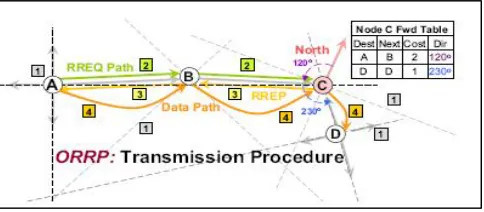
The basic concept behind ORRP is simple knowing that in 2-D Euclidian space, a pair of orthogonal lines centered at different points will intersect at two points at minimum, rendezvous points can be formed to forward packets. To achieve this, ORRP relies on both a proactive element which makes up the “rendezvous-to-destination” path and a reactive element which builds source-to-rendezvous route on demand. Nodes periodically send ORRP announcement packets in orthogonal directions and at each node along the orthogonal route, the node stores the route to the source of the ORRP announcement and the node it received the announcement from (previous hop). When a source node wishes to send to some destination node that it does not know the path for, it sends out a route request packet (RREQ) in its orthogonal directions and each subsequent node forwards in the opposite direction from which it receives the packet. Once a node containing a path toward the destination receives an RREQ, it sends a route reply packet (RREP) in the reverse direction back to the sender and data transmission begins. In the following subsections, we will detail and explain the tradeoffs associated with each element of ORRP.
Fig. 2: ORRP Announcements used to generate rendezvous node-to destination paths 2-3: ORRP RREQ and RREP Packets to generate source to-rendezvous node paths 4: Data path after route generation
Proactive Element: In order for a source and destination to agree upon a rendezvous node, pre-established routes from the rendezvous node to the destination must be in place. Because each node has merely a local sense of direction, making no assumption on position and orientation of other nodes in the network, it can only make forwarding decisions based on its own neighbor list. After a set interval, each node sends ORR announcement packets to its neighbors in orthogonal directions as shown in Figure 2. When those neighbors receive these ORRP announcement packets, it includes the source, previous hop, and hops count into its routing table as a “destination-next hop pair” and forward it out the interface exactly opposite. Although we currently only consider hop-count to be the metric for path selection, it is easy to adapt ORRP to use other heuristics such as ETX [21] among others. It is important to note that each node does not maintain complete picture of the network which limits the state information needed to be updated and thereby increasing scalability. Moreover, only forwarding in orthogonal directions provides enhanced medium reuse. Based on mobility speeds, energy constraints, and other factors, parameters that can be tweaked for higher performance of ORRP announcements include announcement send interval and forwarding entry expiry time. Because the forwarding table only maintains information about destination and next hop, overhead in storage and maintenance is minimized as well.
2) Reactive Element: In order to build the path from source to rendezvous node, an on-demand, reactive element to ORRP is necessary. When a node wishes to send packets to an destination that is not known in its forwarding table, it sends out a route request packet (RREQ) in all four of its orthogonal directions. When neighbor nodes receive this RREQ packet, it adds the reverse route to the source into its routing table and Forwards in the opposite direction. In a 2-D Euclidian plane, by sending a RREQ packet in all 4 of its orthogonal directions, it is highly likely to encounter a node that has a path to the destination. When a node with a path to the destination receives the RREQ, it sends a RREP packet back the way the RREQ came. Because each no dealing the path stored a reverse route to the source, it is able to forward the RREP back efficiently after recording the “next-hop” to send to this particular destination. When the source receives the RREP, it generates a “destination-next hop” routing entry and forwards packets accordingly. Figure 3 illustrates the process of sending RREQ and RREP packets while showing the ORRP path selected. Unlike AODV, DSR or other reactive protocols, RREQ packets are not forwarded until they reach the destination, but only until it intersects a rendezvous node. The proactive element of ORRP takes care of the rendezvous node-to-destination path. It is important to note that ORRP path is not equivalent to the shortest path for most cases. As mentioned earlier, we gained connectivity under relaxed assumptions at the cost of suboptimal path selection (increased path stretch). We will show later, however, that the path selection is close to optimal resulting in a fairly nonexistent cost.
III. PROTOCOLANALYSIS
selection we are trading to utilize ORRP. Note that for all numerical analysis; our model does not consider details such as angle deviation correction and whether a rendezvous node at the particular point exists.
A. REACHABILITY UPPER BOUND ANALYSIS
For our numerical analysis, given a Euclidian area over which nodes are scattered, a source-destination is said to be unreachable if all rendezvous points are outside the boundaries of the topology area. In order to determine the reachability upper bound in this case, it is important to isolate cases where ORRP will fail. Based on source and destination location and orientation. Assuming a Euclidean2-D rectangular topology 0 < y < b and 0 < x < a with nodes randomly oriented with \north" between 0± and 90±, we claim that an upper bound in packet delivery success utilizing ORRP is 99.4%.The general idea behind obtaining the reachability upper bound is to intersections between orthogonal lines between the source and destination. In cases where all the intersections lie outside of the rectangular area for a particular source and destination oriented in a certain way, ORRP fails to a path. Notice that this analysis assumes that ORRP probe packets do not travel along perimeters of the Euclidian area under consideration and therefore inspects a worst-case upper bound on reachability. In actual simulation implementation, we use very simple techniques (see Sections 3.2.2.3 and 3.2.3.2) to achieve 100% reachability in ORRP.
Fig 3: ORRP Reachability for Various Topology Areas: Nodes in darker regions are less reachable. The strength of the darkness of a point shows the probability that a node located on that point will be unreachable by any other node on the area. It can be seen that topology corners and edges suffer from the highest probability of unreached
A. AVERAGE PATH STRETCH
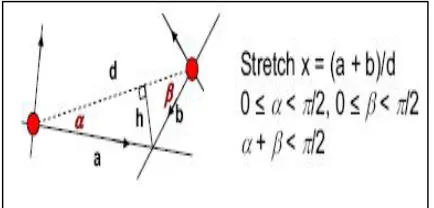
Because ORRP trades off suboptimal paths for connectivity under less information, it is important to see what conditions lead to unacceptable path choices and how much sub optimality we are trading off for connectivity in an unstructured manner. We begin first by attempting to analyze and understand what kind of stretch values we should expect and then move onto Matlab and NS2 [19] simulations for more realistic values.
Fig 4: Average stretch (ORRP Path/Shortest Path) between two nodes
IV.PACKETIZED SIMULATION AND EVALUATION
In this section, we will evaluate the metrics of reachability, state maintenance, path stretch, end-to-end latency and aggregate network good put under conditions of varying network densities, number of interfaces, and TTL values. Unless otherwise noted, all simulations were performed using Network Simulator [19] with n interfaces (divisible by 4) and each interface
having a beam-width of 360=n degrees. All simulations were averaged over 2 runs of 5 different randomly generated flat topologies (total 10 trials) and the 95%confidence intervals of the runs plotted as shown in the figures (5-9).
A. EFFECT OF NUMBER OF INTERFACES ON VARYING NETWORK DENSITIES
One important consideration for nodes with multiple transceivers/antennas is to find a tradeoff between the number of interfaces vs. performance gains. We speculate that by increasing the number of interfaces and
thus increasing the granularity of angle calculations, reachability should increase simply because there are fewer neighbors assigned to reach interface. This allows for tighter control on next hop (instead of randomly choosing a next hop), increasing the odds of an announcement-RREQ “hit”. Furthermore, this tighter control on next hop should theoretically lead to better paths and lower end-to-end latency as well because straight lines are maintained more accurately. State should remain fairly fixed in each experiment because announcement intervals remain fixed across each run.
B. EFFECT OF NUMBER OF INTERFACES ON NETWORK VOIDS
B. EFFECT OF CONTROL PACKET TTL ON VARYING NETWORK DENSITIES
MAM attempts to minimize deviations in path. In sparse networks, however, announcement packets scheduled for orthogonal directions might initially be sent through the same path due to lack of neighbor options. In routing announcements, one of these packets would be dropped to minimize overhead. In ORRP, however, there is a potential for the packets to “split” to different paths as neighbor density increases. ORRP limits a continual flood of announcement and RREQ packets through packet TTL. While in many cases, packet drops would occur at the network perimeter due to ORRP’s MAM forwarding conditions, TTL plays an important role in amount of state needed to be maintained at each node.
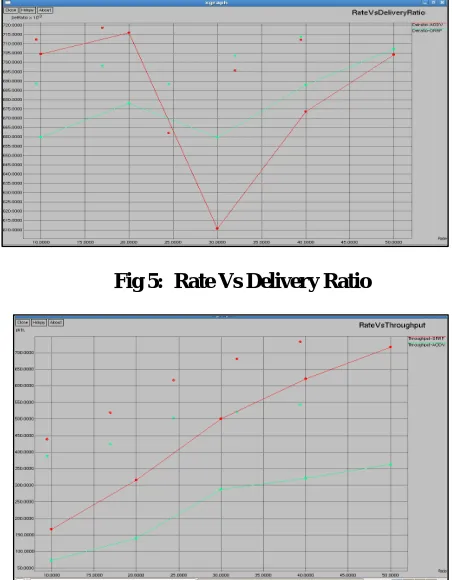
Fig 5: Rate Vs Delivery Ratio
Fig 6: Rate vs Throughput
Fig 8: No. of Interface vs Delivery Ratio
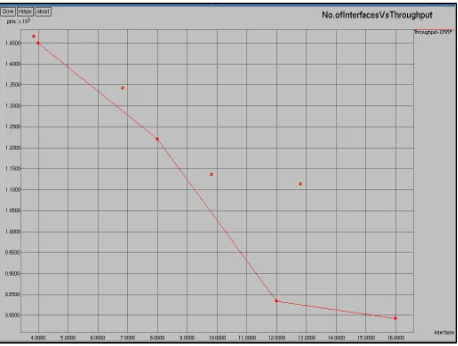
Fig 9: No. of Interface vs throughput
IV. CONCLUSION
For fixed wireless mesh networks, we proposed the Orthogonal Rendezvous Routing Protocol (ORRP), an unstructured forwarding paradigm based on directional communication methods and rendezvous abstractions. By taking the inter-section of orthogonal lines originating from source and destination, packets from the source are forwarded to rendezvous nodes which in turn hand them over to the destination, providing simplified routing. We have shown that ORRP provides connectivity under lessened global information (close to 98% reachability in most general cases), utilizes the medium more efficiently (due to directionality of communications), and state-scales on order N3=2 at the cost of roughly 1.12 times the shortest path length. In addition, simulations performed on random topologies show that state information is distributed rather evenly throughout the system, and, as a result, no single point of failure is evident.
[2] S. Ratnasamy, B. Karp, S. Shenker, D. Estrin, R. Govindan, L. Yin, and F.Yu. Data-centric storage in sensor nets with GHT, a geographic hash
table. MONET, 8(4):427442, 2003.
[3] B. Karp and H.T. Kung, \GPSR: Greedy Perimeter Stateless Routing for Wireless Networks," Proceedings of ACM/IEEE MOBICOM, Boston, MA, August 2000.
[4] J. Li, J. Jannotti, D.S.J. De Couto, D.R. Karger, and R. Morris, \A Scalable Location Service for Geographic Ad Hoc Routing," Proceedings of ACM/IEEE MOBICOM, pp. 120-130, Aug. 2000.
[5] D. Niculescu, B. Nath, \Trajectory Based Forwarding and Its Applications, “Proceedings of ACM/IEEE MOBICOM, 2003.
[6] Hrishikesh Gossain, Tarun Joshi, Carlos De Morais Cordeiro, and Dharma P.Agrawal, \DRP: An Efficient Directional Routing Protocol for Mobile Ad Hoc Networks," IEEE Trans. Parallel and Distributed Systems, vol. 17, no. 12,2006, pp. 1439-1451.
[7] J. Bicket, D. Aguayo, S. Biswas, and R. Morris, Architecture and Evaluation of an Unplanned 802.11b Mesh Network, ACM/IEEE MOBICOM
2005.
[8] C. Perkins and P. Bhagwat. Highly Dynamic Destination- Sequenced Distance-Vector Routing (DSDV) for Mobile Computers. Proceedings of ACMSIGCOMM, pages 234-244, 1994.
[9] C. Perkins and E. M. Royer. \Ad hoc On-Demand Distance Vector Routing."Proceedings of the 2nd IEEE Workshop on Mobile Computing Systems and Applications, New Orleans, LA, February 1999, pp. 90-100.
[10] D. Johnson, D. Maltz, J. Broch. DSR: The Dynamic Source Routing Protocolor Multi-Hop Wireless Ad Hoc .
[11] I.F. Akyildiz, J. Xie, S. Mohanty, A survey of mobility management in next-generation all-IP-based wireless systems, IEEE Wireless Communications 11 (4) (2004)16–28.
[12] S.M. Alam outi, A simple transmit diversity technique for wireless communications, IEEE Journal on Selected Areas in Communications 16 (8) (1998) 1451–1458.[13] J.B. Andersen, Array gain and capacity for known random channels with multiple element arrays at both ends, IEEE Journal on Selected Areas in Communications18 (11) (2000) 2172–2178.
[14] P. Bahl, R. Chandra, J. Dunagan, and SSCH: slotted seeded channel hopping for capacity improvement in IEEE802.11 ad hoc wireless networks, in: ACM Annual International Conference on Mobile Computing and Networking (MOBICOM), 2004, pp. 216–230.
[15] H. Balakrishnan, V.N. Padmanabhan, R.H. Katz, Network asymmetry: the effects of asymmetry on TCP performance, Mobile Networks and Applications 4(1999) 219–241.
[16] E.M. Belding-Royer, P.M. Melliar-Smith, L.E. Moser,An analysis of the optimum node density for ad hoc mobile networks, in: IEEE international Conference on Communications (ICC), vol. 3, June 2001, pp. 857–861.
[17] E.M. Belding-Royer, Multi-level hierarchies for scalable ad hoc routing, ACM/Kluwer Wireless Networks 9 (5)(2003) 461–478.