Efficient Statically-Secure Large-Universe Multi-Authority
Attribute-Based Encryption
Yannis Rouselakis1 and Brent Waters2 1
The University of Texas at Austin [email protected]
2
The University of Texas at Austin [email protected]
Abstract. We propose an efficient large-universe multi-authority ciphertext-policy attribute-based encryption system. In a large-universe ABE scheme, any string can be used as an attribute of the system, and these attributes are not necessarily enumerated during setup. In a multi-authority ABE scheme, there is no central authority that distributes the keys to users. Instead, there are several authorities, each of which is responsible for the authorized key distribution of a specific set of attributes. Prior to our work, several schemes have been presented that satisfy one of these two properties but not both. Our construction achieves maximum versatility by allowing multiple authorities to control the key distribution for an exponential number of attributes. In addition, the ciphertext policies of our system are sufficiently expressive and overcome the restriction that “each attribute is used only once” that constrained previous constructions. Besides versatility, another goal of our work is to increase efficiency and practicality. As a result, we use the significantly faster prime order bilinear groups rather than composite order groups. The construction is non-adaptively secure in the random oracle model under a non-interactive q-type assumption, similar to one used in prior works. Our work extends existing “program-and-cancel” techniques to prove security and introduces two new techniques of independent interest for other ABE constructions. We provide an implementation and some benchmarks of our construction in Charm, a programming framework developed for rapid prototyping of cryptographic primitives.
Keywords: Attribute-Based Encryption, Multi-Authority, Large Universe, Unbounded, q-Type As-sumption, Charm, Implementations
1 Introduction
Public key cryptography allows a sender to encrypt data such that it can only be decrypted by the owner of the corresponding secret key. Encrypting in this manner is useful for when the sender knows the specific identity of the recipient at the time the data is encrypted. However, in many scenarios the data owner might not know the exact recipients that he wishes to target, but instead wish to express sharing of the data in terms of a policy formulated over the credentials or attributes of different users. Here the sender might not even know who the exact recipients are that match this policy or someone might acquire the exact credentials well after the data was encrypted and stored.
The typical scenario presented for ABE is where a single authority issues all private keys. This works well in the setting where data is managed within one organization or trust domain. However, there are many scenarios when one will wish to describe a policy that spans multiple trust domains. For example, U.S. military and defense are several organizations that wish to manage the distribution of their own credentials. If we wished to write an access policy that referenced credentials from both of them using standard ABE, we would require one organization ceding control to another or a third party. To address this issue multi-authority or decentralized [14] ABE systems were introduced where multiple parties could play the role of an authority. Initial attempts at such systems [14, 15] sacrificed a significant amount of expressiveness compared to analogs in the one authority setting. Fairly recently, though Lewko and Waters [27] provided a system that roughly matched the expressiveness. In their system a policy could be expressed as any monotonic boolean formula3 over attributes that can be issued by any authority which publishes a public key. Their main construction technique is to use a hash over a global identifier. Upon decryption this extra component serves as a “blinding factor” that only disappears if the ciphertext is satisfied.
While the expressiveness, of the Lewko-Waters distributed ABE system is relatively strong, there are three major aspects that impact its practical performance compared to single authority systems. First, the construction is set in a group of composite order N where N is the product of three primes. This alone can make certain operations such as exponentiation over an order of magnitude slower (see App. D). Second, each authority in the system can “natively” support only a single attribute. If in practice we would like one party to act as an authority for up tocattributes, the party would have to create a public key consisting ofc native public keys (thus blowing up the size by a factor of c). Furthermore, this only works if the attributes managed by that party can be enumerated ahead of time. This means that the attribute universe is restricted to polynomial size. Finally, the system has the native property that each authority can be used only once in each formula. In practice, if we want to get around this and let it be used up to dtimes we can apply a simple encoding technique due to Lewko et. al. [26].4 This encoding however comes at the cost of blowing up both the parameters of the authority and the private key components issued by the authority by a factor of d. To make things concrete suppose that we wanted a system with an authority that managed 20 attributes each of which appeared at most 10 times in the any formula. Then the published parameters for just that one authority would need to blowup by a factor of 200 (compared to a contemporary single use CP-ABE system [11, 49]) just to deal with the encoding overhead.
We will construct and implement a new decentralized ABE cryptosystem that aims to get performance close to existing single authority constructions. Our approach is to use the LW con-struction as a substrate from which we make two significant changes to improve performance. First, we take the existing construction and pare it down to the prime order setting. This will make it inherently faster, but incompatible with the Dual System Encryption [48] proof techniques used before. (Note we do not simulate subspaces in prime order groups [18, 36, 25] which itself has addi-tional overhead.) Second, we add an addiaddi-tional piece to each ciphertext and private key component which allows us to use any string as an attribute — thus addressing the problem of an authority only supporting a single attribute and the small universe restriction. At the same time, the second change allows the system to utilize each attribute as many times as needed in each policy.
3
Actually, their system is more general in that it allows for monotone span programs.
4The one use restriction is needed to make the security proof of Lewko and Waters go through, if the one use
With these changes we must prove security of our scheme. As mentioned with the removal of subgroups, the Dual System Encryption methodology is no longer available. We will create a proof of security in a static model of security where both the challenge ciphertexts and key queries are issued before the parameters are published. We needed the keys’ queries to be non-adaptive, a property which has not been used in prior work, because the private key for a single user is issued in a piecemeal fashion. Each piece corresponds to a different authority, while in the single authority setting private key requests are naturally atomic. We extend the existing “program and cancel” techniques from two large universe constructions presented in [40] in order to adapt to the multi-authority setting and introduce two new ones. The trade-offs for our performance improvements are the use of the static model and an assumption whose size depends on the complexity of the challenge ciphertext policy.
To demonstrate the abilities of our system we implemented our algorithms in Charm and we provide timing results and comparisons to existing single-authority schemes.
1.1 Related Work
Attribute-Based Encryption was introduced by Sahai and Waters [41]. In this work, the key-policy and ciphertext-policy notions were defined and many selectively secure constructions followed [6, 16, 21, 37, 39, 49]. Most of them work for non monotonic access structures with the exception of the schemes by Ostrovsky, Sahai, and Waters [37], who showed how to realize negation by incorporating specific revocation schemes into the GPSW construction. Fully secure constructions in the standard model were first provided by Okamoto and Takashima [36] and Lewko, Okamoto, Sahai, Takashima, and Waters [26]. The first large universe KP-ABE construction in the standard model was given in [28] (composite order groups). Two large universe constructions in prime order groups were presented in [40] and both techniques, layering and individual randomness, from that paper are extended and utilized in our current cosntruction. Okamoto and Takashima initiated the dual pairing vector space framework in various works [34, 35, 36], which lead to the first large universe KP-ABE construction in prime order group groups by Lewko [25]. Parameterized (non static) assumptions were introduced in [7] and used in several subsequent works [20, 49]. The problem of an environment with multiple central authorities in ABE was considered in [14, 15, 27], while several authors have presented schemes that do not address the problem of collusion resistance [45, 30, 12, 2, 3, 4].
We note that several techniques in ABE schemes have roots in Identity-Based Encryption [42, 8, 17, 7, 47, 20, 9]. Finally, we mention here the related concept of Predicate Encryption introduced by Katz, Sahai, and Waters [23] and further refined in [44, 43, 35, 26, 36, 10].
2 Preliminaries
2.1 Notation
Forn∈N, we define [n] ={1,2, . . . , n}. Also, forn1, n2, . . . , nk∈N: [n1, n2, . . . , nk] = [n1]×[n2]× . . .×[nm]. By {Xi}i∈[n]we denote a sequence of elements X1, X2, . . . , Xn.
When Sis a set, we denote bys←R Sthe fact that the variablesis picked uniformly at random from S. We writes1, s2, . . . , sn
R
←S as shorthand fors1 R
←S, s2 R
←S, . . . , sn
R
←S.
the inner product of vector v withw, where each vector can either be a row or a column vector. Finally, the operation (·)> denotes the transpose vector/matrix.
2.2 Access Structures and Linear Secret - Sharing Schemes
In this subsection, we present the formal definitions of access structures and linear secret-sharing schemes introduced in [5], adapted to match our setting.
Definition 1 (Access Structures [5]) Let U be the attribute universe. An access structure on U is a collection A of non-empty sets of attributes, i.e. A⊆2U \ {}. The sets in A are called the authorized sets and the sets not in A are called the unauthorized sets.
Additionally, an access structure is called monotone if ∀B, C ∈A: if B ∈A and B ⊆C, then
C∈A.
In our construction, we only consider monotone access structures, which means that as a user acquires more attributes, he will not lose his possible decryption privileges. General access structures in large universe ABE can be realized by splitting the attribute universe in half and treating the attributes of one half as the negated versions of the attributes in the other half [22].
Definition 2 (Linear Secret-Sharing Schemes) Letpbe a prime andU the attribute universe. A secret-sharing scheme Π with domain of secretsZp realizing access structures onU is linear over Zp if
1. The shares of a secret z∈Zp for each attribute form a vector overZp.
2. For each access structure A on U, there exists a matrix A ∈Z`p×n, called the share-generating
matrix, and a functionδ, that labels the rows ofA with attributes fromU, i.e.δ: [`]→ U, which satisfy the following:
During the generation of the shares, we consider the column vector v = (z, r2, . . . , rn)⊥, where
r2, . . ., rn
R
← Zp. Then the vector of ` shares of the secret z according to Π is equal to λ =
Av∈Z`×1
p . The share λj withj ∈[`] “belongs” to attribute δ(j).
We will be referring to the pair (A, δ) as the policy of the access structure A.
According to [5], each secret-sharing scheme (not only the linear ones) should satisfy the recon-struction requirement (each authorized set can reconstruct the secret) and thesecurity requirement
(any unauthorized set cannot reveal any partial information about the secret). More concretely, let
S denote an authorized set of attributes and letI be the set of rows whose labels are in S. There exist constants{ci}i∈I inZp such that for any valid shares {λi = (Av)i}i∈I of a secretz according toΠ, it is true that: P
i∈Iciλi =z, or equivalently Pi∈IciAi = (1,0, . . . ,0), whereAi is the i-th row ofA.
On the other hand, for unauthorized setsS0 no such constants exist. In this case, it is also true that ifI0 is the set of rows whose labels are inS0, there exists a vectord∈Z1×p n, such that its first component d1 = 1 and hAi,di= 0 for all i∈I0.
Multi-Authority Attributes In the multi-authority setting, each attribute is controlled by a specific authority θ ∈ UΘ, where UΘ is the set (universe) of all authorities. We assume there is a publicly computable function T:U → UΘ that maps each attribute to a unique authority. Using this mapping a second labeling of rows is defined in a policy (A, δ), which maps rows to attributes via the functionρ(·)def= T(δ(·)).
In our implementation, both the attribute id’s and the authority id’s consist of case-sensitive alphanumeric strings. The full attributes’ names are of the form “[attribute–id]@[authority–id]” and the mappingT just extracts the part after the @ of the attribute string.
2.3 Bilinear Groups and Complexity Assumption
For the following we assume familiarity of the reader with bilinear groups of prime order (see App. B for more information). Our construction, the complexity assumption, and the security proof are all expressed in the simpler setting of symmetric groups and can be generically transformed to the asymmetric setting by substituting roughly half of the scheme’s components with the respective G2 terms (i.e. with the same exponents). Our implementations are all written formally in the
asymmetric setting, since this is what theCharm framework dictates, although 2 out of the 5 test runs were executed with super-singular symmetric groups (see Sec. 5).
For our security proof we will use a q-type assumption on prime order bilinear groups. It is a slightly modified version of theq-Decisional Parallel Bilinear Diffie-Hellman Exponent Assumption [49]. We will be referring to our assumption as q-DPBDHE2 for short. The assumption is defined as follows:
Choose a bilinear group G of order p according to the security parameter κ, which admits a non-degenerate bilinear mappinge:G×G→GT. Picks, a, b1, b2, . . . , bq
R
←Zp and R←R GT. Let
D=
G, p, e, g, gs,{ga
i
}i∈[2q]
i6=q+1
,{gbjai}
(i,j)∈[2q,q]
i6=q+1
,{gs/bi}
i∈[q],{gsa ib
j/bj0}
(i,j,j0)∈[q+1,q,q]
j6=j0
The assumption states that no polynomial-time distinguisher can distinguish the distribution
D, e(g, g)saq+1
from the distribution (D, R) with more than negligible advantage.
The only difference between the q-DPBDHE assumption in [49] and the above assumption is that in the latter the{gsaibj/bj0}terms go up toi=q+ 1 instead ofq. Theq-DPBDHE assumption
was shown generically secure in [49] and following exactly the same proof path, one can prove that the q-DPBDHE2 assumption is also generically secure. Due to lack of space and the similarity to [49], the full proof is omitted.
The assumption is closely related to the two assumptions presented in [40]. Although incompa-rable to both of them, it contains fewer terms, hence it is relatively weaker. This comes in contrast to the fact that our multi-authority construction supports more features than the two ABE schemes of [40]. The reason of the apparent paradox is the use of the static security and random oracle model in this work versus selective security and standard model in [40].
3 Multi-Authority Ciphertext-Policy ABE
3.1 Algorithms
A multi-authority ciphertext-policy attribute-based encryption system consists of the following five probabilistic polynomial-time algorithms:
GlobalSetup(1κ)→ GP: The global setup algorithm takes in the security parameter κ encoded in unary and outputs the public global parameters for the system. We require that descriptions of the attribute universe U, the authority universe UΘ, the global identifier universe GID, and the mappingT are included in the global parameters.
AuthSetup(GP, θ)→ {PKθ,SKθ}: The authorityθ∈ UΘcalls the authority setup algorithm during its initialization with the global parameters GP as input and receives its public / secret key pair {PKθ,SKθ}.
KeyGen(GID,SKθ, u,GP) →SKGID,u: The key generation algorithm takes in the global identifier GID of a user (GID ∈ GID), the secret key of an authority θ, an attribute u controlled by the authorityθ, and the global parameters. It outputs a key for the identity - attribute pair (GID, u).5
Encrypt(M,A,{PKθ},GP) → CT: The encryption algorithm takes in a message M, an access structure A, a set of public keys {PKθ} of the relevant authorities, and the global parameters. It outputs the ciphertext CT.
Decrypt(CT,{SKGID,u},GP) → M: The decryption algorithm takes in a ciphertext CT, the set of keys of a single user GID corresponding to different attributes u, and the global parameters. It outputs either the messageM when the collection of attributes satisfies the access structure of the ciphertext, or decryption fails.
We require that all schemes satisfy the following correctness property:
Definition 1. A multi-authority CP-ABE scheme is correctif for any GPgenerated by the global setup algorithm, for any set of keys {PKθ,SKθ} generated by the authority setup algorithm, for any CT generated by the encryption algorithm using the relevant authorities’ public keys on any messageM and access structureA, and for any set of keys{KGID,u}generated by the key generation
algorithm using the relevant authorities’ secret keys for one user GID on any A-authorized set of attributes, it is true that Decrypt(CT,{SKGID,u},GP) =M.
3.2 Static Security
In this section we will define the static (or non-adaptive) security game between a challenger and an attacker. The difference between this security game and the adaptive one is that all queries done by the attacker are sent to the challenger immediately after seeing the public parameters. As usual, we also allow the attacker to corrupt a certain set of authorities that he can control. These authorities are chosen by the attacker after seeing the global parameters and remain the same until the end of the game.
The game consists of the following phases:
Global Setup: The challenger callsGlobalSetup(1κ) → GP and gives the global parameters GP to the attacker.
Attacker’s Queries: Then the attacker responds with:
5If a user wants a key that corresponds to multiple attributes from the same authority, the key generation algorithm
– A set CΘ ⊆ UΘ of corrupt authorities and their respective public keys {PKθ}θ∈CΘ, which he
might have created in a malicious way6.
– A set NΘ⊆ UΘof the non-corrupt authorities for which the adversary requests the public keys. Obviously, it should be disjoint from the set of corrupt authorities.
– A sequence Q={(GIDi, Si)}mi=1 of the secret key queries, where the global identities GIDi are distinct andSi ⊆ U withT(Si)∩ CΘ=∅.
A pair (GIDi, Si) in this sequence denotes that the attacker requests the secret keys for the user GIDi with attributes from the set Si. That is, for every u ∈ Si the attacker gets a key SKGIDi,u←KeyGen(GIDi,SKT(u), u,GP). According to the restriction T(Si)∩ CΘ=∅, none of these keys come from a corrupt authority.
– Two messages M0, M1 of equal length, and a challenge access structureAencoded in a suitable form. We require that for every i ∈ [m] the set Si∪Sθ∈CΘT
−1(θ) is an unauthorized set of
the access structureA, whereSθ∈CΘT
−1(θ) is the set of all the attributes belonging to corrupt
authorities. This way, the attacker will not be able to trivially win the game by decrypting the challenge ciphertext with a secret key given to him augmented with the key components from the corrupt authorities.
Challenger’s Replies: The challenger flips a random coinb← {R 0,1} and replies with:
– The public keys PKθ ←AuthSetup(GP, θ) for all θ∈ NΘ.
– The secret keys SKGIDi,u ←KeyGen(GIDi,SKT(u), u,GP) for alli∈[m] and for allu∈Si. – The challenge ciphertext CT∗ ← Encrypt(Mb,A,{PKθ},GP) where {PKθ} is the set of all
authority public keys (corrupt and non corrupt).
Guess: The attacker outputs a guess b0∈ {0,1}.
Definition 2. We say that an attacker statically breaks the scheme if it has a non negligible advantage in correctly guessing the bit b in the above security game.
4 Our scheme
Our scheme constitutes an augmented version of the Lewko-Waters [27] CP-ABE construction and shares several of the existing techniques. Namely, in order to allow for multiple authorities and prevent collusion between users’ keys it utilizes a hash function H that maps global identities to group elements. This hash function is modeled as a random oracle in the security proof. As noted in [27], this allows for a totally decentralized construction, since it provides all authorities with a secure way to personalize the secret key given to a specific user. To the best of our knowledge, it is still an open problem whether it is possible to create a multi-authority ABE scheme in the standard model, where no coordination is allowed between the different authorities.
Since we will be working in the random oracle model and we aim for practically deployable schemes, we combined the above technique with the technique from [49] that used a hash function
Fthat hashesattributesto group elements. This way we overcame the restriction that each authority is used only once and at the same time achieved a large universe construction. This is because the random oracle usage naturally overcomes the “one-time” restriction and the policies are not any
6
more controlled by the authorities, but by the underlying attributes. The individual randomness technique from [28, 40] is integrated to the treatment of each attribute by choosing a fresh random exponentt.
Finally in order to “bind” the different ciphertext terms together we use the layering technique of [40]. For the same reason we introduce two secret sharing vectors: one that shares the secret z
of the blinding factor and one that shares 0. In order to decrypt, a user has to use both of them. However, during decryption the “0-shares” are crucially entangled to the global identifier of the secret key of the user. As a result in the event that two or more users collude and try to decrypt the same ciphertext, the “0-shares” will result in a failed decryption, thus preventing collusion attacks.
4.1 Construction
Our proposed scheme consists of the following five algorithms:
GlobalSetup(1κ) → GP: The global setup algorithm takes as input the security parameter κ and chooses a suitable bilinear groupGof prime orderp with generatorg. It also chooses a functionH mapping global identities GID∈ GID to elements ofG,7 and another functionF mapping strings, interpreted as attributes, to elements of G. Both of these functions will be modeled as random oracles in the security proof. Finally, it definesU,UΘ, and Tas in Sec. 2.2. The global parameters are GP ={p,G, g, H, F,U,UΘ,T}.
AuthSetup(GP, θ) → {PKθ,SKθ}: The authority setup algorithm chooses two random exponents
αθ, yθ
R
← Zp and publishes PK = {e(g, g)αθ, gyθ} as its public key. It keeps SK = {α
θ, yθ} as its secret key.
KeyGen(GID, θ, u,SKθ,GP)→ {KGID,u,K0GID,u}: The key generation algorithm takes as input the user’s global identifier GID, the identifierθ of the authority, the attributeu to create a key for, as well as the authority’s secret key and the global parameters. It should be the case thatu∈T−1(θ), i.e. that the attribute is controlled by the specific authority.
The algorithm first chooses a randomt←R Zp and it outputs the secret key: SKGID,u=
KGID,u=gαθH(GID)yθF(u)t,K0GID,u=gt
Encrypt(M,(A, δ),{PKθ},GP)→CT: The encryption algorithm takes in a message M, an access policy (A, δ) withA∈Z`×n
p , the public keys of the relevant authorities, and the global parameters. As always, we define the function ρ : [`] → UΘ as ρ(·) = T(δ(·)), i.e. the mapping of rows to authorities.
The algorithm first creates vectors v= (z, v2, . . . , vn)> and w= (0, w2, . . . , wn)>, where z,v2, . . .,vn,w2,. . .,wn
R
←Zp. We letλx denote the share ofzcorresponding to rowx, i.e.λx=hAx,vi, and ωx denote the share of 0, i.e.ωx =hAx,wi, where Ax is the x-th row of A.
For each row x ofA, it chooses a randomtx
R
←Zp. The ciphertext is computed as:
C0=M e(g, g)z,
n
C1,x=e(g, g)λxe(g, g)αρ(x)tx, C2,x=g−tx, C3,x=gyρ(x)txgωx, C4,x=F(δ(x))tx o
x∈[`]
Decrypt(CT,{KGID,u, KGID0 ,u},GP) → M: Let (A, δ) be the access policy of the ciphertext. If the decryptor has the secret keys {KGID,δ(x), KGID0 ,δ(x)} for a subset of rows Ax of A such that
7The global identifier universe GIDcan be any set that provides a unique identifier for each user and is mapped
(1,0, . . . ,0) is in the span of these rows, then for each such row x he computes:
C1,x·e(KGID,δ(x), C2,x)·e(H(GID), C3,x)·e(K0GID,δ(x), C4,x) =e(g, g)λxe(H(GID), g)ωx
The decryptor then calculates constants cx ∈ Zp such that PxcxAx = (1,0, . . . ,0) and com-putes:
Y
x
e(g, g)λxe(H(GID), g)ωxcx =e(g, g)z
This is true because λx = hAx,vi and ωx = hAx,wi, where h(1,0, . . . ,0),vi = z and h(1, 0, . . ., 0),wi= 0. The message can then be obtained as: M =C0/e(g, g)z.
Re-Randomizing Re-randomizing techniques are applicable for the users’ secret keys and the ciphertexts using only the public parameters, due to the linearity of all exponents. These techniques can provide properly distributed keys and ciphertexts even if originally the random choices in these algorithms are not uniform. We will use these techniques in our security reduction.
Specifically, if someone has a key KGID,u,K0GID,u , he can acquire a new key for (GID, u) by pickingt0 ←R Zp and constructing
KGID,uF(u)t 0
,K0GID,ugt0 .
For the ciphertext the re-randomization can be done by picking a new z0 ←R Zp, new random vectorsv0 andw0 with the first elementsz0 and 0, respectively, and for each rowxa newt0x←R Zp. Then the re-randomized ciphertext is
C0e(g, g)z
0
, nC1,xe(g, g)hAx,v 0i
e(g, g)αρ(x)t0x, C 2,xg−t
0
x, C
3,xgyρ(x)t 0
xghAx,w0i, C
4,xF(δ(x))t 0
x
o
x∈[`]
5 Implementation and Evaluation
Framework We implemented our scheme in Charm [1]; a framework developed to facilitate the rapid prototyping of cryptographic schemes and protocols. It is based on the Python language which allows the programmer to write code similar to the theoretical implementations. However, the routines that implement the dominant group operations use the PBC library [29] (written natively inC) and the time overhead imposed by the use ofPythonis usually less than 1%.Charm
also provides routines for applying and using LSSS schemes needed for Attribute-Based systems. For more information on Charmwe refer the reader to [13, 1].
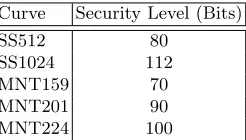
We tested several ABE constructions on all elliptic curve bilinear groups provided by Charm, i.e. three super-singular symmetric EC groups and two “MNT” [32] asymmetric EC groups. In Table 2 of App. C we present the approximate security level each group provides with respect to the discrete log problem. The source code of our implementations can be found in [46]. All our benchmarks were executed on a dual core IntelR XeonR CPU [email protected] with 2.0GB RAM
running Ubuntu R10.04 and Python3.2.3.
Implementation Details All Charm routines use formally asymmetric groups (although the underlining groups might be symmetric) and therefore we translated our schemes to the asymmetric setting. Namely, we have three groupsG1,G2andGT and the pairingeis a function fromG1×G2to
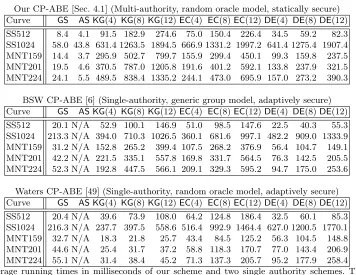
Our CP-ABE [Sec. 4.1] (Multi-authority, random oracle model, statically secure) Curve GS AS KG(4) KG(8)KG(12)EC(4) EC(8)EC(12)DE(4) DE(8)DE(12)
SS512 8.4 4.1 91.5 182.9 274.6 75.0 150.4 226.4 34.5 59.2 82.3 SS1024 58.0 43.8 631.4 1263.5 1894.5 666.9 1331.2 1997.2 641.4 1275.4 1907.4 MNT159 14.4 3.7 295.9 502.7 799.7 155.9 299.4 450.1 99.3 159.8 237.5 MNT201 19.5 4.6 370.5 787.0 1205.8 191.6 401.2 592.1 133.8 237.9 321.5 MNT224 24.1 5.5 489.5 838.4 1335.2 244.1 473.0 695.9 157.0 273.2 390.3
BSW CP-ABE [6] (Single-authority, generic group model, adaptively secure) Curve GS AS KG(4) KG(8)KG(12)EC(4) EC(8)EC(12)DE(4) DE(8)DE(12)
SS512 20.1 N/A 52.9 100.1 146.9 51.0 98.5 147.6 22.5 40.3 55.3 SS1024 213.3 N/A 394.0 710.3 1026.5 360.1 681.6 997.1 482.2 909.0 1333.9 MNT159 31.2 N/A 152.8 265.2 399.4 107.5 268.2 376.9 56.4 104.7 149.1 MNT201 42.2 N/A 221.5 335.1 557.8 169.8 331.7 564.5 76.3 142.5 205.5 MNT224 52.3 N/A 192.8 447.5 566.1 209.1 329.3 595.2 94.7 175.0 253.6
Waters CP-ABE [49] (Single-authority, random oracle model, adaptively secure) Curve GS AS KG(4) KG(8)KG(12)EC(4) EC(8)EC(12)DE(4) DE(8)DE(12)
SS512 20.4 N/A 39.6 73.9 108.0 64.2 124.8 186.4 32.5 60.1 85.3 SS1024 216.3 N/A 237.7 397.5 558.6 516.4 992.9 1464.4 627.0 1200.5 1770.1 MNT159 32.7 N/A 18.3 21.8 25.7 43.4 84.5 125.2 56.3 104.5 148.8 MNT201 44.6 N/A 25.4 31.7 37.2 58.8 118.3 170.7 77.0 143.4 206.9 MNT224 55.1 N/A 31.4 38.4 45.2 71.3 137.3 205.7 95.2 177.9 258.4
Table 1. Average running times in milliseconds of our scheme and two single authority schemes. The algorithms are denoted asGS: Global setup, AS: Authority setup,KG: Key generation for a user, EC: Encrypt, DE: Decrypt. The numbers in parentheses refer to the number of attributes in key generation, the number of rows of the policy in encryption, and the number of rows utilized during decryption. We can see the linear dependence between these numbers and the corresponding times.
to key generation. The reason is that the time taken to execute them in theG1group is considerably
smaller than G2 in specific asymmetric groups such as the “MNT” groups.
Regarding the comparisons to other schemes, the only fully decentralized multi-authority ABE scheme that provides expressive policies is the CP-ABE scheme of Lewko-Waters [27]. However, we decided to defer implementation and benchmarking of it for several reasons: Firstly, this scheme utilizes composite order groups, which are several orders of magnitude slower than the prime or-der groups that provide the same security level. We expect our scheme to be significantly faster. More information on the comparison between prime and composite groups can be found in Sec. D. Secondly, as mentioned in the introduction, the attributes utilized in the system have to be enumerated ahead of time and an one-use restriction is imposed on each attribute per policy. So even this scheme provides less flexibility than our construction. Thirdly, Charm does not support composite order groups, and finally, it is questionable the validity of the comparison between a prime order group and a composite order group, when the underlying elliptic curve is different and/or different optimizations have been applied to them.
Timing Results Timing results in milliseconds are shown in Table 1. We see that our scheme achieves similar operation times to the two established single-authority schemes. In general, we attempted to keep execution times for encryption and decryption relatively low, while the times for setup and key generation can be significantly higher, since they are called only once.
6 Static Security
Our main security theorem is shown below.
Theorem 1. If the q-DPBDHE2 assumption holds, then all probabilistic polynomial-time adver-saries with a challenge matrix of size at mostq×q have a negligible advantage in statically breaking our scheme in the random oracle model.
In our security proof we combined several techniques, which we think might be of independent interest in the study of CP-ABE systems. The first technique allows the simulator of our reduction to isolate an unauthorized set of rows and essentially ignore it for the remaining of the security reduction. It can ignore the contributions of these rows even in the construction of the challenge ciphertext. In our case the simulator does that for the corrupt authorities, which are controlled by the adversary. The lemma that makes this technique possible is shown below and its proof follows in appendix A. The lemma allows the simulator to “zero-out” a subset of columns for the unauthorized set.
Lemma 1. Let A ∈ Z`×n
p be the secret sharing matrix of a linear secret sharing scheme for an
access policy A and let C ⊆ [`] be a non-authorized set of rows. Let c∈N be the dimension of the
subspace spanned by the rows of C.
Then the distribution of the shares{λx}x∈[`]sharing the secretz∈Zp generated with the matrix
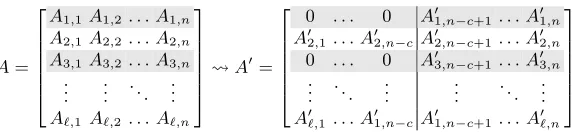
A is the same as the distribution of the shares {λ0x}x∈[`] sharing the same secret z generated with some matrixA0, where A0x,j = 0 for all (x, j)∈ C ×[n−c](see figure 1).
A=
A1,1A1,2 . . . A1,n A2,1A2,2 . . . A2,n A3,1A3,2 . . . A3,n
. .
. ... . .. ...
A`,1 A`,2 . . . A`,n
A0=
0 . . . 0 A01,n−c+1. . . A
0
1,n A02,1. . . A02,n−c A02,n−c+1. . . A02,n
0 . . . 0 A03,n−c+1. . . A
0
3,n
. .
. . .. ... ... . .. ...
A0`,1 . . . A
0
1,n−c A01,n−c+1. . . A0`,n
Fig. 1.Transformation of the policy matrixAto be used by the simulator. Rows that belong to corrupted authorities are highlighted.
Another technique utilized in the security proof is the “splitting” of the unknown parameters to two different vectors. During the generation of the authorities’ public keys, the elements in the first column of the challenge policy are programmed into thee(g, g)αθ component, while the remaining in
Proof. In order to prove the theorem we assume that there exists a probabilistic poly-time adversary A that breaks the scheme with more than negligible advantage and we show how to construct a probabilistic poly-time algorithm Bthat simulates the static security game withAand breaks the
q-DPBDHE2 assumption. Our simulator works as follows:
Global Parameters: Initially, it gets (D, T) from itsq-DPBDHE2 challenger and sends the public parameters GP = (G,p,g,U,UΘ,T) toA. The two random oraclesH, F will be programmed by the simulator.
Static security: According to the static security game, the attackerAoutputs the lists / compo-nentsCΘ,NΘ,Q={(GIDi, Si)}mi=1, (M0, M1)∈G2T, and (A, δ). Since we are in the random oracle model, the attacker also outputs a sequence LI of global identities for the H oracle queries and a
sequence L ⊆ U of attributes for theF oracle queries. W.l.o.g. we assume that all global ID’s and all attributes present inQ are queried on their respective oracle.
In order to proceed, the simulator substitutes the secret sharing matrix A with the matrix A0
from Lemma 1. After B calculates the matrix A0 (shown in figure 1) where C = CΘ it proceeds to compute all the inputs to A. According to the above lemma, if B uses A0 instead of A in the simulation the view of A in this game is information-theoretically the same as if it used the given matrixA. Therefore, the shares will be properly distributed. In the remainder of the proof, we use
n0 =n−c.
Authority Public Keys: The simulator has to provide the public keys of all non-corrupted authorities inθ∈ NΘ. To do that it considers two cases:
If the authority in question, θ, is not in the challenge policy, i.e.θ /∈ρ[`], the simulator Bpicks
αθ, yθ
R
←Zp itself and outputs the public key (e(g, g)αθ, gyθ).
For each authority θ ∈ ρ[`]\ CΘ, let X = {x|ρ(x) = θ} ⊆ [`]. This is the set of rows in the challenge policy that belong to authority θ. Then the simulator B picks ˜αθ,y˜θ
R
← Zp and sets implicitly αθ = ˜αθ +Px∈Xbxaq+1A0x,1 and yθ = ˜yθ +Px∈X
Pn0
j=2bxaq+2−jA0x,j. It outputs the public key
(e(g, g)αθ, gyθ) = (e(g, g)α˜θ Y
x∈X
e(gbxa, gaq)A0x,1, gy˜θ Y
x∈X n0 Y
j=2
gbxaq+2−jA
0
x,j
)
Since n0=n−c≤q and`≤q, the simulator can compute all these terms using suitable terms of the assumption. Also due to ˜αθ,y˜θ these terms are properly distributed.
H-Oracle Queries: If the queried global identity GID is in LI but not in{GIDi}i∈[m], then the
simulator outputs a random element of G for H(GID). These elements are not going to be used anywhere else.
If the queried global identity is equal to GIDi for someiand there is no rowxsuch thatδ(x)∈Si (i.e. if this user is not entitled to any shares), then the simulator picks ˜hi
R
←Zp and outputs
H(GIDi) =g
˜
hi·ga·ga2 · · · · ·gan0−1 =gh˜i
n0 Y
k=2 gak−1
Otherwise, for some rowsX0 ⊆[`] it is true thatδ(x)∈Si. According to our restriction we know that the set of these rows together with the set of the rows that belong to corrupted authorities is non-authorized. This means that there exists a vector di ∈ Z1×p n such that the first element is
Additionally, according to the construction of A0 we know that the set of the corrupted rows spans the entire subspace of dimensionc (see Lemma 1). Hence the vector di is orthogonal to any
of the vectors ( n0 z }| { 0, . . . ,0,
c
z }| {
0, . . . ,0,1,0, . . . ,0)∈Z1×p n. These are the vectors with exactly one “1” in one of the last c positions. This implies that di,j = 0 for n−c+ 1 ≤ j ≤ n. Hence hA0x,dii = 0 even if we restrict the row A0x and the vector di to the firstn0 =n−c positions. We will denote this inner product by hA0x,dii= 0.
In this case the simulator picks ˜hi
R
←Zp and outputs
H(GIDi) =g
˜
hi·(ga)di,2·(ga2)di,3 · · · · ·(gan0−1)di,n0 =g˜hi
n0 Y
k=2
gak−1di,k
All the answers programmed in the random oracle are uniformly random in G, thus properly distributed.
F-Oracle Queries: Let θ = T(u) be the authority of the queried attribute u. Then if θ /∈ ρ[`] orθ ∈ CΘ, the simulator outputs a random element of Gfor F(u) and stores the value so that he might reuse it in a secret key query.
If θ ∈ ρ[`], let X00 ={x|ρ(x) =θ} \ {x|δ(x) =u} ⊆ [`]. This is the set of rows that belong to authority θ butdo not have u as the corresponding attribute. Then the simulator picks ˜fu
R
← Zp and outputs
F(u) =gf˜ugPx∈X00
P
j∈[n0]bxaq+1
−jA0
x,j =gf˜u Y
x∈X00 Y
j∈[n0]
gbxaq+1−jA
0
x,j
Secret Keys: Consider the query (GIDi, Si) whereSi ⊆ U. The simulatorBhas to create the secret key {KGIDi,u,K0GIDi,u}for every u∈Si. It has to consider the following cases and act accordingly: • T(u) = θ /∈ ρ[`]: That is, the authority of the attribute is not present in the challenge policy. Here the simulator knows αθ and yθ. Therefore it picks t
R
← Zp and outputs KGIDi,u =
gαθH(GIDi)yθF(u)t and K0
GIDi,u=gt.
• T(u) = θ ∈ ρ[`] and Si ∩δ[`] = ∅: In this case, the authority of the attribute is present in the challenge policy, but none of the attributes of this user is in it. Then, according to the
H- andF-oracle phases H(GIDi) = g
˜
higPn
0
k=2ak−1 and F(u) =gf˜ug
P
x∈X
P
j∈[n0]bxaq+1−jA0x,j, where X={x|ρ(x) =θ}.
In this case, the simulator sets implicitly t=−P
k∈[n0]ak and computes the key KGIDi,u=gαθH(GIDi)yθF(u)t
=gPx∈Xbxaq+1A0x,1g
P
x∈X
Pn0 j=2
Pn0
k=2bxaq+1+k−jA0x,jg−
P
x∈X
P
j∈[n0]
P
k∈[n0]bxaq+1+k−jA0x,j
·gα˜θH(GIDi)˜yθ(gyθ)˜hi gtf˜u
=g−Px∈X
Pn0
j=2bxaq+2−jA0x,jg−
P
x∈X
Pn0
k=2bxaq+kAx,1gα˜θH(GID
i)y˜θ(gyθ)
˜
hi gtf˜u
=gα˜θH(GIDi)y˜θ(gyθ)˜hi gtf˜u Y x∈X
n0 Y
j=2
gbxaq+2−j
−A0x,j · Y
x∈X n0 Y
k=2
gbxaq+k
−A0x,1
K0GIDi,u=gt= Y k∈[n0]
Since t is not properly distributed, the simulator re-randomizes this key using the algorithm of section 4.1 and outputs the re-randomized key.
• T(u) = θ ∈ ρ[`] and Si∩δ[`]6= ∅: Now the user holds some shares of the challenge policy. Therefore, we have that H(GIDi) = g
˜
higPn
0
k=2ak−1di,k and F(u) = gf˜ug
P
x∈X00
P
j∈[n0]bxaq+1
−jA0
x,j
(Notice the X00). The simulator sets implicitly t=−P
k∈[n0]akdi,k and outputs KGIDi,u=gαθH(GIDi)yθF(u)t
=g
P
x∈Xbxaq+1A0x,1g
P
x∈X
Pn0 j=2
Pn0
k=2bxaq+1+k−jA0x,jdi,kg−
P
x∈X00
P
j∈[n0]
P
k∈[n0]bxaq+1+k−jA0x,jdi,k
·gα˜θH(GID
i)y˜θ(gyθ)
˜
hi gtf˜u
?? =g
P
x∈X\X00bxaq+1hA0x,diig
P
x∈X\X00
Pn0,n0
j=2,k=2 j6=k
bxaq+1+k−jA0x,jdi,k g−
P
x∈X
Pn0
j=2bxaq+2−jA0x,jdi,1
·g−Px∈X
Pn0
k=2bxaq+kA0x,1di,kgα˜θH(GID
i)y˜θ(gyθ)
˜
hi gtf˜u
??
= Y
x∈X\X00 n0,n0
Y
j=2,k=2
j6=k
gbxaq+1+k−jA
0
x,jdi,k Y
x∈X n0 Y
j=2
gbxaq+2−j−A
0
x,j
· Y x∈X
n0 Y
k=2
gbxaq+k−A
0
x,1di,k
gα˜θH(GIDi)y˜θ(gyθ)˜hi gtf˜u
K0GIDi,u=gt= Y k∈[n0]
(gak)−di,k
As beforeBre-randomizes this key using the public parameters and outputs the re-randomized key.
??: Notice that X\X00 ={x|δ(x) = u} contains rows that map to u in the challenge policy. Thus, if u /∈δ[`], this set is empty and the two products after the second equality are eliminated. On the other hand, ifu∈δ[`] according to our discussion in the creation of theH-oracle’s answers hAx,dii= 0.
Challenge Ciphertext: The first part of the ciphertext is calculated as C0 = Mb ·T, where
b ← {R 0,1} is a random bit and T is the challenge term. Thus the simulator B implicitly set
z=saq+1.
The simulator also sets implicitly
v = saq+1,0, . . . ,0
∈Znp and w=
n0
z }| {
0, saq, . . . , saq−n0+2,0, . . . ,0
∈Z
n p
Therefore for a row x∗ ∈ [`] that belongs to a corrupted authority we have that λx∗ = 0 and
ωx∗ = 0, due to the fact that these rows have all “0”s in the first n0 columns. Thus for these rows the simulator picks tx∗←R Zp and using the public key{e(g, g)αθ, gyθ}of the corrupted authority it computes:
C1,x∗ =e(g, g)λx∗e(g, g)αρ(x∗)tx∗ = (e(g, g)αρ(x∗))tx∗ C
2,x∗ =g−tx∗ C3,x∗ =gyρ(x∗)tx∗gωx∗ = (gyρ(x∗))tx∗ C
On the other hand for a row x∗ that does not belong to corrupted authorities, we have that
λx∗ = saq+1 ·A0
x∗,1 and ωx∗ = Pn 0
j=2saq+2−jA0x∗,j. For each one of these rows B sets implicitly
tx∗ =−s/bx∗ and computes:
C1,x∗=e(g, g)λx∗e(g, g)αρ(x∗)tx∗ =e(g, g)sa
q+1A0
x∗,1e(g, g)−
P
x∈Xsbxaq+1A0x∗,1/bx∗
= Y
x∈X\{x∗}
e(g, gsbxaq+1/bx∗)−A
0
x∗,1
C2,x∗=g−tx∗ =gs/bx∗ C3,x∗=gyρ(x∗)tx∗gωx∗ =g−
P
x∈X
Pn0
j=2sbxaq+2
−jA0
x∗,j/bx∗g
Pn0 j=2saq+2
−jA0
x∗,j
= Y
x∈X\{x∗} n0 Y
j=2
gsbxaq+2−j/bx∗
−A0x∗,j
C4,x∗=F(δ(x∗))tx∗ =g− P
x∈X00
P
j∈[n0]sbxaq+1
−jA0
x∗,j/bx∗ = Y
x∈X00 Y
j∈[n0]
gsbxaq+1−j/bx∗
−A0x∗,j
Notice that x∗ ∈/ X00. Therefore the simulator can computeC4,x∗. Since v,w and thetx∗’s are not properly distributed, the simulator re-randomizes the ciphertext using the algorithm of section 4.1.
Guess: If the attacker A correctly guessed the bit b, then the simulator B outputs that the challenge term was e(g, g)saq+1. That is because in this case it simulated the static security game perfectly. If the attacker did not guess the bit correctly, the simulator answers thatT was a random group element of GT. In this case the simulator produced an encryption of a random message. Therefore, if Ais successful with more than negligible advantage, so is B. ut
References
[1] Joseph A. Akinyele, Matthew Green, and Avi Rubin. Charm: A framework for rapidly prototyping cryptosys-tems. Cryptology ePrint Archive, Report 2011/617, 2011. http://eprint.iacr.org/.
[2] Sattam S. Al-Riyami, John Malone-Lee, and Nigel P. Smart. Escrow-free encryption supporting cryptographic workflow. Int. J. Inf. Sec., 5(4):217–229, 2006.
[3] Walid Bagga, Refik Molva, and Stefano Crosta. Policy-based encryption schemes from bilinear pairings. In ASIACCS, page 368, 2006.
[4] Manuel Barbosa and Pooya Farshim. Secure cryptographic workflow in the standard model. InINDOCRYPT, pages 379–393, 2006.
[5] Amos Beimel.Secure Schemes for Secret Sharing and Key Distribution. PhD thesis, Dept. of Computer Science, Technion, 1996.
[6] John Bethencourt, Amit Sahai, and Brent Waters. Ciphertext-policy attribute-based encryption. In IEEE Symposium on Security and Privacy, pages 321–334, 2007.
[7] Dan Boneh and Xavier Boyen. Efficient selective-id secure identity-based encryption without random oracles. InEUROCRYPT, pages 223–238, 2004.
[8] Dan Boneh and Matthew K. Franklin. Identity-based encryption from the weil pairing. SIAM J. Comput., 32(3):586–615, 2003. extended abstract in Crypto 2001.
[9] Dan Boneh, Craig Gentry, and Michael Hamburg. Space-efficient identity based encryption without pairings. InFOCS, pages 647–657, 2007.
[10] Dan Boneh, Amit Sahai, and Brent Waters. Functional encryption: Definitions and challenges. InTCC, pages 253–273, 2011.
[12] Robert W. Bradshaw, Jason E. Holt, and Kent E. Seamons. Concealing complex policies with hidden credentials. InACM Conference on Computer and Communications Security, pages 146–157, 2004.
[13] Charm. http://www.charm-crypto.com.
[14] Melissa Chase. Multi-authority attribute based encryption. InTCC, pages 515–534, 2007.
[15] Melissa Chase and Sherman S. M. Chow. Improving privacy and security in multi-authority attribute-based encryption. InACM Conference on Computer and Communications Security, pages 121–130, 2009.
[16] Ling Cheung and Calvin C. Newport. Provably secure ciphertext policy abe. InACM Conference on Computer and Communications Security, pages 456–465, 2007.
[17] Clifford Cocks. An identity based encryption scheme based on quadratic residues. InIMA Int. Conf., pages 360–363, 2001.
[18] David Mandell Freeman. Converting pairing-based cryptosystems from composite-order groups to prime-order groups. InEUROCRYPT, pages 44–61, 2010.
[19] Steven D. Galbraith, Kenneth G. Paterson, Nigel P. Smart, and Nigel P. Smart. Pairings for cryptographers. InDiscrete Applied Mathematics, 2008.
[20] Craig Gentry. Practical identity-based encryption without random oracles. InEUROCRYPT, pages 445–464, 2006.
[21] Vipul Goyal, Abhishek Jain, Omkant Pandey, and Amit Sahai. Bounded ciphertext policy attribute based encryption. InICALP (2), pages 579–591, 2008.
[22] Vipul Goyal, Omkant Pandey, Amit Sahai, and Brent Waters. Attribute-based encryption for fine-grained access control of encrypted data. InACM Conference on Computer and Communications Security, pages 89–98, 2006. [23] Jonathan Katz, Amit Sahai, and Brent Waters. Predicate encryption supporting disjunctions, polynomial
equations, and inner products. InEUROCRYPT, pages 146–162, 2008.
[24] Arjen K. Lenstra, Eric R. Verheul, and Eric R. Verheul. Selecting cryptographic key sizes. In Public Key Cryptography, pages 446–465, 2000.
[25] Allison B. Lewko. Tools for simulating features of composite order bilinear groups in the prime order setting. InEUROCRYPT, pages 318–335, 2012.
[26] Allison B. Lewko, Tatsuaki Okamoto, Amit Sahai, Katsuyuki Takashima, and Brent Waters. Fully secure func-tional encryption: Attribute-based encryption and (hierarchical) inner product encryption. InEUROCRYPT, pages 62–91, 2010.
[27] Allison B. Lewko and Brent Waters. Decentralizing attribute-based encryption. InEUROCRYPT, pages 568– 588, 2011.
[28] Allison B. Lewko and Brent Waters. Unbounded hibe and attribute-based encryption. InEUROCRYPT, pages 547–567, 2011.
[29] Ben Lynn. The stanford pairing based crypto library. http://crypto.stanford.edu/pbc.
[30] Gerome Miklau and Dan Suciu. Controlling access to published data using cryptography. In VLDB, pages 898–909, 2003.
[31] Miracl crypto sdk. https://certivox.com/solutions/miracl-crypto-sdk/.
[32] Atsuko Miyaji, Masaki Nakabayashi, and Shunzo Takano. Characterization of elliptic curve traces under fr-reduction. InICISC, pages 90–108, 2000.
[33] National Institute of Standards and Technology. Nist special publication 800-37, 2010.
[34] Tatsuaki Okamoto and Katsuyuki Takashima. Homomorphic encryption and signatures from vector decompo-sition. InPairing, pages 57–74, 2008.
[35] Tatsuaki Okamoto and Katsuyuki Takashima. Hierarchical predicate encryption for inner-products. In ASI-ACRYPT, pages 214–231, 2009.
[36] Tatsuaki Okamoto and Katsuyuki Takashima. Fully secure functional encryption with general relations from the decisional linear assumption. InCRYPTO, pages 191–208, 2010.
[37] Rafail Ostrovsky, Amit Sahai, and Brent Waters. Attribute-based encryption with non-monotonic access struc-tures. InACM Conference on Computer and Communications Security, pages 195–203, 2007.
[38] Dan Page, Nigel P. Smart, Frederik Vercauteren, and Frederik Vercauteren. A comparison of mnt curves and supersingular curves. InIACR Cryptology ePrint Archive, page 165, 2004.
[39] Matthew Pirretti, Patrick Traynor, Patrick McDaniel, and Brent Waters. Secure attribute-based systems. In ACM Conference on Computer and Communications Security, pages 99–112, 2006.
[43] Emily Shen, Elaine Shi, and Brent Waters. Predicate privacy in encryption systems. InTCC, pages 457–473, 2009.
[44] Elaine Shi and Brent Waters. Delegating capabilities in predicate encryption systems. InICALP (2), pages 560–578, 2008.
[45] Nigel P. Smart. Access control using pairing based cryptography. InCT-RSA, pages 111–121, 2003. [46] Source code of our constructions. www.rouselakis.com\RWABE.
[47] Brent Waters. Efficient identity-based encryption without random oracles. InEUROCRYPT, pages 114–127, 2005.
[48] Brent Waters. Dual system encryption: Realizing fully secure ibe and hibe under simple assumptions. In CRYPTO, pages 619–636, 2009.
[49] Brent Waters. Ciphertext-policy attribute-based encryption: An expressive, efficient, and provably secure real-ization. PKC, 2011.
A “Zero-Out” Lemma
In order to prove Lemma 1 we will use the following theorem:
Theorem 2. Let A ∈Z`×n
p be the secret sharing matrix of a linear secret sharing scheme for an
access policy A andL∈Znp×n be a matrix such that:
– The first row of L is (1,0, . . . ,0)∈Znp.
– The lower right matrix L0 ∈Zp(n−1)×(n−1) of L has rank n−1.
Then the distribution of the shares{λx}x∈[`] sharing the secret z∈Zp generated with the matrix A
is the same as the distribution of the shares {λ0x}x∈[`] sharing the secret z∈Zp generated with the matrix A·L.
Proof. Consider the distribution of the shares {λ0x}x∈[`]. According to the construction of LSS
schemes, it is true that λ0x = hALx,vi where ALx is the x-th row of the matrix AL and v is a random vector with its first element equal to z.
This implies that λ0x=hAx,Lvi, where Lv∈Znp is the vector acquired by multiplyingL with
v. Since L has the first row (1,0, . . . ,0) we get that the first element of Lv is z. Moreover the remainingn−1 elements are uniformly random fromZp because each one, say thei-th one, is equal toz·Li,1+hL0i,v0i whereL0i is the i-th row of L0 and v0 ∈Zpn−1 are the last n−1 elements of v. Since these are uniformly random andL0 is full rank, we get thathL0i,v0i is uniformly random.
Therefore, Lv is distributed exactly the same as a secret sharing vector of z. Thus the shares {λ0x}have the same distribution as the shares {λx}.
Proof of Lemma 1 To convert the matrix A to the target matrix A0 we will apply theorem 2. Let W1,W2, . . . ,Wc be the first c independent rows in C. These rows form a basis of size c of the relevant subspace and they can be computed from C in polynomial time using linear algebra operations.
Next we are going to extend this basis to sizensuch that the final basis spans the entire space. The first step is to add the row U = (1,0, . . . ,0) ∈ Zn
p to the set. Since the set of rows in C is unauthorized, U is not in in the subspace spanned by them and therefore this is a valid choice.
We continue by picking n−c−1 rows,V1,V2, . . . ,Vn−c−1, such that the set
{U,V1,V2, . . . ,Vn−c−1,W1,W2, . . . ,WW}
Finally construct the matrix
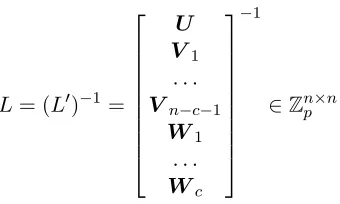
L= (L0)−1 = U V1 . . . Vn−c−1
W1 . . . Wc −1
∈Zn×n p
Using theorem 2 we will argue that the matrix A0 = A·L will give us same distribution for the{λx} shares. We should argue first that the matrixL satisfies the requirements of the theorem. This can be done by trying to compute the inverse matrix, but one straightforward way is to use the blockwise inversion formula shown in figure 2.
A B C D −1 =
A−1+A−1B(D−CA−1B)−1CA−1−A−1B(D−CA−1B)−1 −(D−CA−1B)−1CA−1 (D−CA−1B)−1
Fig. 2.Blockwise inversion formula
In our case we haveA= [1],B = (0,0, . . . ,0)∈Z1×(p n−1),C= (0,0, . . . ,0)> ∈Z(pn−1)×1, andD is the lower right submatrix of L0 of size (n−1)×(n−1). Therefore we have that
L=
1 0. . .0 0 D−1 .. . 0
SinceDis of full rank, we can see thatLsatisfies the requirements of theorem 2. The only thing left to prove is that A0 has the required form. That is, that for all rows A0x with x ∈ C, we have that the first n−c elements are equal to 0. We know that for fixed x ∈ C the row Ax is a linear combination of the basis rows{W1,W2, . . . ,Wc}. ThereforeAx =Pi∈[c]γiWi withγi constants inZp.
Finally, notice that for all ksuch that n−c+ 1≤k≤n we have that
(
n−cterms
z }| { 0, . . . ,0,
cterms 1 on thek-th position
z }| {
0, . . . ,0,1,0, . . . ,0)·L0=Wk =⇒ Wk·(L0)−1 = (
n−cterms
z }| { 0, . . . ,0,
cterms 1 on thek-th position
z }| {
0, . . . ,0,1,0, . . . ,0)
Therefore the row A0x=Ax·L=Pi∈[c]γiZi, where Zi= (
n−cterms
z }| { 0, . . . ,0,
cterms 1 on thei-th position
z }| {
0, . . . ,0,1,0, . . . ,0). As a
result the first n−c elements ofA0x are all equal to 0. ut
B Bilinear Groups
computable in the security parameter. Let g be a generator of G and e : G×G → GT be an efficiently computable pairing function that satisfies the following properties:
1. Bilinearity: for allu, v∈Gand a, b∈Zp it is true that e(ua, vb) =e(u, v)ab. 2. Non-degeneracy: e(g, g)6=1GT.
The above definition considers the so called symmetric groups, where the two arguments of the pairing belong to the same group. In general, there exist asymmetric bilinear groups, where
e : G1 ×G2 → GT and G1, G2, and GT are three different groups of prime order p. Several asymmetric instantiations of bilinear groups possess beneficial properties such as faster operations under the same security level and/or easier hashing to group elements.
C Approximate Security Level of all Charm Elliptic Curves
In Table 2 we present the approximate security levels of all the elliptic curves supported byCharm. Although the results of the table do not necessarily translate to the security level of our assumption (or the various assumptions of the other ABE schemes), they provides an intuitive comparison between the security levels of the different instantiations. For more information on the security of discrete log and ofq-type assumptions we refer the reader to [33, 24, 19, 38].
Curve Security Level (Bits)
SS512 80
SS1024 112
MNT159 70
MNT201 90
MNT224 100
Table 2.Approximate security levels of the utilized ECC groups. “SS” are super singular curves (symmetric bilinear groups), while “MNT” are the Miyaji, Nakabayashi, Takano curves (asymmetric bilinear groups). The number after the type of the curve denotes the size of the base field in bits.
D Prime vs Composite Order Group Operations
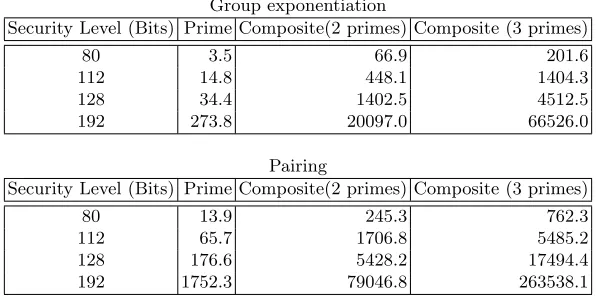
In order to demonstrate the generic difference in the efficiency of prime order vs composite order implementations, we timed the group exponentiation (of a random group element with a random exponent) and pairing operations (on random group elements) in the MIRACL framework [31] for different security levels. The benchmarks were executed on a dual core IntelR XeonR CPU
[email protected] with 2.0GB RAM running Ubuntu R10.04. The elliptic curve utilized for all benchmarks was the super-singular (symmetric) curvey2=x3+ 1 modpwith embedding degree 2 for suitable primes p.
Group exponentiation
Security Level (Bits) Prime Composite(2 primes) Composite (3 primes)
80 3.5 66.9 201.6
112 14.8 448.1 1404.3
128 34.4 1402.5 4512.5
192 273.8 20097.0 66526.0
Pairing
Security Level (Bits) Prime Composite(2 primes) Composite (3 primes)
80 13.9 245.3 762.3
112 65.7 1706.8 5485.2
128 176.6 5428.2 17494.4
192 1752.3 79046.8 263538.1