
ISSN: 2319-8753
I
nternational
J
ournal of
I
nnovative
R
esearch in
S
cience,
E
ngineering and
T
echnology
(An ISO 3297: 2007 Certified Organization)
Vol. 3, Issue 8, August 2014
Influence of Dithiocarbamate On
Metal Complex and Thin Film Depositions
P. BalaRamesh
1,*,
P. Venkatesh
2, A. Abdul Jabbar
31Assistant Professor, Department of Chemistry, RMK Engineering College, Chennai, Tamilnadu, India.
2Associate Professor, Department of Chemistry, Pachaiyappa’s College, Chennai, Tamil nadu, India.
3
Professor, Department of Chemistry, The New College, Chennai, Tamil nadu, India.
*corresponding author
ABSTRACT: This article focuses on the effects and applications of ethylenediamine dithiocarbamate (EDADTC) on
co-ordination and electro chemistry. EDADTC shows stable palladium (II) metal complex in organosulphur chemistry. Since they have soft sulphur donor atoms can make a strong metal binding property, act as the ligand and stable above pH 12. Due to their water soluble tendency, flow of electron from alkyl group to nitrogen, inductive effect and conjugation effect proved the stabilizing property in electroless plating process. EDADTC has improved the physical property and produce the quality deposits in electroless copper plating process. The palladium (II) metal complex was characterized by Rapid Elemental Analysis. The structure of the stable complex was confirmed with Electronic and I.R Spectral Analysis. The surface morphologies of copper deposits were characterized by AFM studies. The crystallite sizes of the copper deposits were measured by XRD studies and the quality of the copper deposits was investigated by cyclic voltammetry studies.
KEYWORDS: conjugation effect, copper deposits, crystallite sites, ligand, surface morphology
I . INTRODUCTION
The importance of co-ordination chemistry has now become broad and the applications of co-ordination compounds to the scientific world are tremendous.[1] Several donor atoms like oxygen, sulphur, nitrogen, phosphorous were reported earlier by many pioneer workers in this field. Dithiocarbamates have been invented early in the history of organosulphur chemistry. Synthesis of dithiocarbamic acid was first reported by Debus [2] in 1850. Delpine and many workers had taken venture in developing dithiocarbamates and several metal were synthesized due to the versatile nature of dithiocarbamates. Dithiocarbamates and dithiophosphates are the most widely studied complexes today. Because of the metal biding property and their chelates vital role to biological, agricultural and industrial field etc.
Dithiocarbanmate complex has a lone pair of electron on the nitrogen astom, that becomes more important for the donation of the electron for higher oxidation states of the metal. The π electron flow from the nitrogen atom to the sulphur atom via., a planar delocalized π orbital system is the special feature of π dithiocarbamates. The net effect is a strong donation, resulting in a high electron density on the metal.
ISSN: 2319-8753
I
nternational
J
ournal of
I
nnovative
R
esearch in
S
cience,
E
ngineering and
T
echnology
(An ISO 3297: 2007 Certified Organization)
Vol. 3, Issue 8, August 2014
Alkyl derivatives of dithiocarbamates complexes have many commercial application and are successfully used as fungicides and pesticides. [6] In the field of agriculture, tetraethyl thiuramdisulfide and dimethylamine dithiocarbamates are used for vegetable and corn seed treatment and extensively used for the control of apple scab is ferbam, the iron salt of dimethyl dithiocarbamates. Red stele decreases of strawberry was controlled by disodium ethylene dithiocarbamates. The important use is to cause a zone of act inhibition opposition to the bacterial cell.
Electroless (or) autocatalytic copper plating step is most important for Through Hole Plating (THP) of Printed Circuit Boards (PCBs). Various complexing agent have been used in electroless copper bath namely xylitol, mannitol and D- sorbitol were reported as environmentally friendly alternate copper (II) ligand in solution [7]. Formaldehyde is the most commonly used reducing agent [8] and play vital role in kinetics. [9-17] EDTA was used as most common complexing agent in electroless copper plating. [18-21] On the other hand EDTA was very weakly biodegradable. [22] Methane sulphonic acid (MSA) has gained more popularity in electroless copper plating related to electronic industries. Because methane sulphonate is characterized by excellent metal salt solubility, conductivity, bath stability and bio-degradability. Additions of methane sulphonic acid (MSA) in a small volume produce uniform and high quality coating.[23]
II . RELATED WORK
The complex of Palladium metal ion with ethylenediamine dithiocarbamate is found to be unreported in the literature survey. Since the complex have water soluble due to their hydrophilic moiety, used as crown of chelate, biological activities, agricultural and widespread industrial applications, this investigation wil pave a way for new finding. Many stabilizers has been reported in electroless copper deposition process. But the use of substituted dithiocarbamate as stabilizer in electroless copper plating process work is unreported. The influence of ethylenediamine dithiocarbamate on Palladium (II) complex and act as stabilizer on new bath based copper methane sulphonate replacing copper sulphate. Saccharose and xylitol were used as complexing agents with para formaldehyde has been developed the bath.
III. EXPERIMENTAL
Equipments
The molecular weights, of the complexes synthesized were determined using the Beckmann freezing point apparatus. The molecular formula of the complexes was ascertained using elemental analysis and molecular weights. Haraeus-Chn-O-Rapid analyser (West Germany) was used for the estimation of carbon, hydrogen, sulphur and nitrogen contents present in the complexes. Electronic spectra data were obtained with (Hitachi 210 modal) using a regular quarts cuvette 10 mm path length. Infrared spectra were recorded on a (Hitachi 210 modal) 200-4000 cm-1 using KB pellet.
The crystal structure of the copper deposits was investigated using XRD peaks and roughness of the deposits was characterized by AFM studies. Cyclic voltammetric curves were obtained by standard electrochemical analyser CHI 600D Austin USA.
Reagents
1. Ethylenediamine (Qualigens) 2. Ammonia solution (Fisher)
3. Carbon- disulphide (S.D. Fine Chem. Ltd) 4. Absolute ethanol (Reid-de-Ham)
5. Dry ether (Qualigens) 6. Saccharose (Fisher) 7. Xylitol (Qualigens)
ISSN: 2319-8753
I
nternational
J
ournal of
I
nnovative
R
esearch in
S
cience,
E
ngineering and
T
echnology
(An ISO 3297: 2007 Certified Organization)
Vol. 3, Issue 8, August 2014
Preparation of stock solutions
The 0.1 m stock solutions, Palladium (II) chloride were prepared by dissolving the required quantities of metal salts in H2O:H2SO (25:75). About 50g of copper carbonate was weighed and transferred into 500ml clean beaker and treated with approximately 60ml of methane sulphonic acid till the evaluation of carbon-di-oxide gas. Minimum quantity of double distilled water was added and the solution was made up to 250 ml standard measuring flask. The oil and suspended impurities present in the solution were removed by filtration and stored in a clean container. One ml of stock solution was analyzed by using N/10 of standard sodium thio sulphate and calculated the amount of copper.
Preparation of Ehtylenediamine Dithiocarbamate
M. M. Jones et al [24] reported the synthesis of Ethylenediamine Dithiocarbamate in 1979. 45 ml of concentrated aqueous ammonia (28%) 20ml of Ethylene diamine (0.33 mole) and 42 ml of absolute ethanol were added to a beaker equipped with a magnetic stirrer. A mixture of 81 ml of carbon disulphide dissolved in 45 ml ethanol was added in drop wise to the reaction mixture with constant stirring such that the temperature did not rise above 48°C, while adding the mixture. The clear yellow reaction mixtures become turbid upon addition of about 23 ml of a mixture containing carbon disulphide and ethanol solution. The off white precipitate settled shortly after the addition was complete and the reaction mixture was treated with 150 ml of anhydrous ether and stirred for 1.5 hrs. The beaker was covered with a film and allowed to stand overnight. The crystal formed were collected on a filter paper and allowed to air dry.
Preparation of Pd (II) Ethylenediamine dithiocarbamate
Pd(II) (edadtc)2 chelate was prepared by mixing an aqueous solution of palladium (II) chloride and EDADTC in the ratio 1:2 metal to ligand. Palladium (II) chloride was added drop wise to EDADTC solution and warmed with constant stirring. The pH of the above reaction was maintained at 3-5, since the yield was found to be more at this pH. The reaction resulted in the formation of a light green precipitate. It was filtered and dried.
Copper surface formation
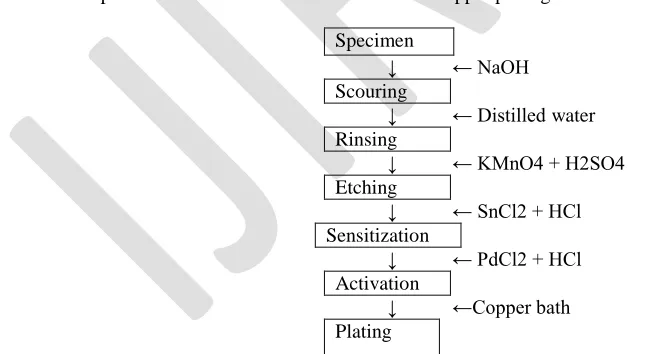
The plating experiments were performed on pure copper sheet (2.0 X 2.0 X 0.1 cm) in a 100 ml glass beaker. The copper plate was polished with fine grid paper, rinsed with double distilled water and carried out by following procedure.
Table 1. Multisteps-Process was carried out for electroless copper plating
Specimen
↓ ← NaOH Scouring
↓ ← Distilled water Rinsing
↓ ← KMnO4 + H2SO4 Etching
↓ ← SnCl2 + HCl Sensitization
↓ ← PdCl2 + HCl Activation
↓ ←Copper bath Plating
ISSN: 2319-8753
I
nternational
J
ournal of
I
nnovative
R
esearch in
S
cience,
E
ngineering and
T
echnology
(An ISO 3297: 2007 Certified Organization)
Vol. 3, Issue 8, August 2014
The rate of deposition (μm/h) = W × 104
/ DAT (1)
W-Weight of deposit (g) D-Density of the deposit (g/cm3) A-Surface area of the plates (cm2) T-Plating duration (hr)
IV. RESULT AND DISCUSSION
Physico-Chemical analysis
The ethylenediamine complex of Pd(II) was found to be pale green and found to be soluble in water. The hydrophilic moieties in this complex are responsible for their water solubility. In water, the conductance of 10-3M solution of all the complex prepared in deionised water was found to be < 10 M ohm-1 cm-2 mole-1. This shows that the complex are covalent in nature. The elemental analysis of this complex shows that the percentage composition of carbon, hydrogen, nitrogen, oxygen and sulphur corroborates with the theoretical value. The following results prove that the EDADTC and complex of palladium are bi-chelate.
Table 2. Elemental analysis of the complex in comparison with the ligand
S.No Ligands/ Complex
Carbon ℅ Hydrogen % Nitrogen % Sulphur % Metal %
1 EDADTC 26.42*
(26.45) 5.86* (5.92) 20.50* (20.56) 46.96* (47.07) -
2 [Pd(II) (edadtc)2]
18.96* (19.00) 4.22* (4.26) 13.90* (14.79) 31.26* (33.86) 27.90* (28.09)
*Average of six determinations. The values in the Parenthesis indicate theoretical percentage of the elements.
Table 3. Nature of the complex in comparison with the ligand
Ligand/ Complex Colour Solubility Nature of the ligand/complex
Molecular weight
Molecular formula
EDADTC Grey Water Covalent 136.24 C3H8N2S2
[Pd(II)(edadtc)2 Light green Water Covalent 378.84 C6H16N4S4Pd
Electronic spectral analysis
ISSN: 2319-8753
I
nternational
J
ournal of
I
nnovative
R
esearch in
S
cience,
E
ngineering and
T
echnology
(An ISO 3297: 2007 Certified Organization)
Vol. 3, Issue 8, August 2014
Fig. 1 Electronic spectrum of Palladium (II) bis ethylenediamine dithiocarbamate
IR spectral analysis
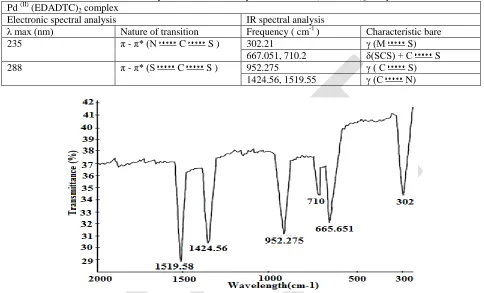
The thioureide band between 1424.56 cm-1 and 1519.55cm-1exhibits a partial double bond character between carbon and nitrogen. A single strong band observed at 952.275 cm-1 is attributed to the stretching vibration of C S bond. The stretching vibration of C S +S(SCS) band are observed at 710.2 cm-1 and 667.051 cm-1 In addition to the characteristic band of the ligands, a strong band of metal - sulphur linkage is observed at 302 cm-1 which confirm the formation of complex.
ISSN: 2319-8753
I
nternational
J
ournal of
I
nnovative
R
esearch in
S
cience,
E
ngineering and
T
echnology
(An ISO 3297: 2007 Certified Organization)
Vol. 3, Issue 8, August 2014
Table 4. Electrnic spectral data and ir frequencies of Pd (II) (EDADTC)2 complex Pd (II) (EDADTC)2 complex
Electronic spectral analysis IR spectral analysis
λ max (nm) Nature of transition Frequency ( cm-1 ) Characteristic bare
235 π - π* (N C S ) 302.21 γ (M S)
667.051, 710.2 δ(SCS) + C S
288 π - π* (S C S ) 952.275 γ ( C S)
1424.56, 1519.55 γ (C N)
Fig. 3 IR spectrum of Palladium (II) bis ethylenediamine dithiocarbamate
The absence of stabilizer unstable at longer experiments and the plating process is poorly reproducible. [25] So EDADTC was used as stabilizers in electroless copper methane sulphonate bath. The copper deposits on EDADTC bath are sufficiently stable at 1ppm, reaches 2.32 μm/h on saccharose bath and 2.82 in xylitol bath, at very low concentration there was no significance difference in rate of deposition.
The effect of temperature of electroless copper deposits on saccharose- and xylitol containing methane sulphonate plain bath, and EDADTC bath are studied. In plain bath (ie) methane sulphonate bath without stabilizer the temperature increases deposition rate also increase. But the bath is stable up to 40˚C, thereafter less stable at 45˚C and unstable when reaches 50˚C. The copper deposits on EDADTC bath is inhibit more than the plain bath and the bath are stable up to 45˚C and unstable at higher temperature. There is a turning point at 45˚C modify the stability of EDADTC bath.
Surface morphology
ISSN: 2319-8753
I
nternational
J
ournal of
I
nnovative
R
esearch in
S
cience,
E
ngineering and
T
echnology
(An ISO 3297: 2007 Certified Organization)
Vol. 3, Issue 8, August 2014
Fig. 1 Fig. 2
Fig. 4 SEM images for Saccharose plain bath (1), Xylitol plain bath (2), Saccharose with EDADTC bath (3), Xylitol with
EDADTC bath (4)
Fig. 5 XRD graph for Saccharose plain bath (a), Xylitol plain bath (b), Saccharose with EDADTC bath (c), Xylitol with
EDADTC bath (d)
Structural property
The crystal orientations and lattice parameters were studied by XRD. The peaks of the pure copper metal indicate preferred orientation of (111) plane. But Lee et al [26] concluded that copper methane sulphonate bath furnished more number of copper ions, because of high conductivity and solubility leading to (200) plane. The copper deposits on saccharose and xylitol containing methane sulphonate plain baths with EDADTC bath are give the preferred orientation of (200) plane. The crystallite size of the copper deposits can be estimated by the use of Debye-Scherer’s equation. [27]
D=K λ/β cosθ (2)
Where,
λ –wavelength of Cu Kα
β –Breadth of diffracted line (ie) FWHM (rad) θ –Bragg angle of diffracted rays
K – Constant (0.89)
Specific surface area of the copper deposits determined by the formula
S = 6×10³/ d ρ (3)
Where ρ is the crystallite size (nm) and d is the theoretical density of copper (8.94 g/cm3)
Electrochemical studies
ISSN: 2319-8753
I
nternational
J
ournal of
I
nnovative
R
esearch in
S
cience,
E
ngineering and
T
echnology
(An ISO 3297: 2007 Certified Organization)
Vol. 3, Issue 8, August 2014
Table [5] indicates the inhibiting property of EDADTC on saccharose and xylitol baths. Because it shows low anodic peak potential value than respective plain baths.
Fig. 6 Voltammogramme for Saccharose plain bath (a), Xylitol plain bath (b), Saccharose with EDADTC bath (c),
Xylitol with EDADTC bath (d)
Table 5. Influence of various surface morphologies on saccharose and xylitol with EDADTC baths
S.No Surface morphology
Saccharose Xylitol
Plain bath EDADTC bath
Plain bath EDADTC bath
1 Depositiion rate (μm/hr) 2.87 2.32 3.23 2.82
2 Roughness value (nm) 340 208 303 142
3 Crystallite size (nm) 131 133 128 130
4 Specific surface area (m2/g) 5.123 5.046 5.243 5.163 5 Anode peak potential value ( V) (Epa-1) -0.2354 -0.4044 -0.2275 -0.4040 6 Anodic peak current value ( A) (Ipa-1) 1.086 x10⁻⁵ 8.043 x10⁻⁶ 5.924 x10⁻⁶ 3.813 x10⁻⁶
V. CONCLUSIONS
The molecular formula of the [Pd(II) (edadtc)2 ] complex is C6H16N4S4Pd. It is pale green and the molecular weight of the complex has been found to be 378.84. The molecular weight determination and rapid elemental analysis supports the fact that the complex was water soluble and are bi-chelate. The electronic spectral analysis and IR Spectral analysis supports the fact that complex was covalent and very stable.
ISSN: 2319-8753
I
nternational
J
ournal of
I
nnovative
R
esearch in
S
cience,
E
ngineering and
T
echnology
(An ISO 3297: 2007 Certified Organization)
Vol. 3, Issue 8, August 2014
REFERENCES
[1] Day M.C. & J.S elbin ‘ Theoritical Inorganic chemistry’, second edition. 391 (1969) [2] Debus H. ‘Uberdie verdisdungerden sulfo carbaurinisarue annichen’ (Liebig’s ), 73, 26. (1850) [3] Somerville A.A., U.S Pat., 2, 4, 549,396, (1951) chem. Abstract 45, 5966, (1951).
[4] Cottom T.A. and Wilkinson G, ‘ Basic Inorganic chemistry’, John Wiley and Sons Inc., New York 262, (1962).
[5] Hald J and Jacobson .E, ‘Fixed drug erption from tetraethyl thiuram disulfide’ Acta pharmacology. Toxicol, 4, 305, (1948). [6] Angeli G and Ioriatti C., ‘Experimental and Applied Acarology, 18, (12), 669-679, (1994).
[7 ] Norcus, E, Vaskelis .A, Jaciauskiene. J ‘Environmentally friendly natural polyhydroxylic compounds in electroless copper plating baths: application of xylitol, D-mannitol and D-sorbitol as copper(II) ligands’, ‘J. Electrochem’. 35 , 41-47, (2005).
[8] Deckert C.A, ‘ Electroless Copper Plating. A Review Part -1’, Plating and Surface Finishing 82 (2) (1995) 48; Plating and Surface Finishing 82 (3), 58, (1995).
[9] Molenaar, A, Holdrinet . M.F and Van Beek I.K.H,’ "Kinetics of Electroless Copper Plating With EDTA as the Complexing Agent for Cupric Ions.’ ‘ Plating’, 61, 238, (1974).
[10] Lax. D.J and Maughan. P.A, ‘The electrochemical characteristics of a methanol stabilized electroless copper-plating solution.’ ‘J Appl.Electrochem’. 9, 337, (1979).
[11] Van Den Meerakar J.E.A.M , ‘On the mechanism of electroless plating. I. Oxidation of formaldehyde at different electrode surfaces’, J Electrochem . Soc., 11, 387, (1981).
[12] Bindra P and Roldan, J, ‘Mechanism of electroless plating’, J.Electrochem Soc., 132, 2581, (1985).
[13] Thomas M. Tam and Greg A. Fung., ‘The Determination of Nitrite Ion in Copper Pyrophosphate Plating Solution’ J. Electrochem. Soc. 130(4): 874-876; doi:10.1149/1.2119840J.( 1983).
[14] Paunovic,M.,’Electroless deposition of copper’ J.Electrochem Soc., 132, 157, (1951).
[15] Shumacher S, Pesek.J.J and Melroy,O.R,., ‘Methods in physical chemistry’, J, Phys. Chem.., 89, 4338, (1985).
[16] Gottesfeld.S, Beery.J, Paddett.M, Hollander.M and Maggiore.C., ‘ On the Anodic Oxidation of Formaldehyde during the Electroless Copper Plating Process’ . Electrochem. Soc., 133, 1344, (1986).
[17] Salkauskas.M and Vaskellis. A, ‘Chemical Metallizing of Plastics’, Khimiya, Leningrad, 1985. [18] Vaskelis.A and Salkankas.M, in Satas.D., ‘Plastics finishing and Decoration,’ New York, 1986
[19] Mallory.G.O, and Hajdu.J.B, (Eds.), Electroless Plating: Fundamentals and Applications, Americans Electroplaters and Surface Finishers Society, Orlando, 1990.
[20] Vaskellis.A, in Satas.D and Tractorcoation .A.A., ‘Techn. Hand book’, New York. Pg- 213. (1991).
[21] Narcus.E, and Vaskellis.A, ‘Application of environmentally friendly ligand for alkaline electroless copper plating system,’ Chimija.Vol.17, 4, 20, (2006).
[22] Paunivic.M and Arundt.R., ’Fundamental of electrochemical eposition’ J Eletrochem Soc.130, 794, (1980).
[23] Farid Hanna, Z. Abdel Hamid, A. Abdel Aal. ‘Controlling factors affecting the stability and rate of electroless copper plating’ Materials letters 58, 108, (2003).
[24] Jones M.M., Burka. L.T., H hunter M.E., Dasinger. M., Campo.G. and Weaver A.D., ‘Dithiocarbamate chelating agents for toxic heavy metals’. J.Inorg.neccl.Chem., 42, (5), 775, (1980).
[25] R.Junginger et al ‘On the Texture of Electroless Copper Films’, J. electrochem. Soc. 135, 2304, (1988). [26] D. N. Lee, Mat. Res. Soc. Symp. Proc. 427, 167 (1996).
[27] Cullity.B.D ‘Element of X-ray diffraction’, Addison-Wesley, London (1978).



![Table [5] indicates the inhibiting property of EDADTC on saccharose and xylitol baths](https://thumb-us.123doks.com/thumbv2/123dok_us/1688189.1213258/8.612.119.500.212.396/table-indicates-inhibiting-property-edadtc-saccharose-xylitol-baths.webp)