Chapter Four: Joan
Chapter Four: Joan
Joan (April to late August): silver banksias flower, rainfall increases
and the hidden narratives of the landscape emerge.
Country
Boodjar
Boodjar
Figure 18: Ngaala kaaditj Noongar moort kayen kaadak nidja boodja
I went ‘home’, to Western Australia: Nyungar Country.
I was in a deep process of decolonisation.
Back on Nyungar boodjar: where I was born, ‘back home!’
Working towards a post-colonial standpoint.
Following Laenui’s (2000) processes of colonisation and
de-colonisation I gazed inwards: at identity, belonging, and on the
meaning of home. I gazed outwards: my great-great grandfather,
a ‘pioneer’; a founding ‘father’, of the small rural town where I was
born: Gnowangerup5 (pronounced now -anger-up).
5 Ngow is Noongar for Mallefowl, and the town’s name is a version of the original Noongar name
Boodjar
His son, my great-grandfather: died recently at 103 years old, and
was once the local butcher during the 1930’s - 50’s.
At the same time, Noongar people were forced to live on a reserve
hidden out the back of town.
Figure 19: Gnowangerup mission, near present day Black Rd (drawing from a photo at the local library in Gnowangerup).
Figure 20: Black Road, Gnowangerup, near the Gnowangerup Mission and The Twisted Tree
Noongar moort6, were restricted to the old reserve with little to
no amenities, denied country without Government permits and
permission. Follow the ‘rules’, and maybe some kind of access will be
Boodjar
granted to the town, shops: for dripping and other simple ingredients,
only once a week.
Figure 21: ‘The Twisted Tree: 5km south of Gnowangerup, Western Australia, and a recognised historical tree prior to European arrival. A tree known for its cultural and
historical significance: a meeting place.
A place of cultural significance: and a place of exploitation.
Boodjar
Still you could only be wadjella7 or Noongar.
I am wadjella, from the other side of town. In the words of
Homi Bhabha (1990): “a colonial subject, difficult to place” and decolonisation is an on-going process. A process that unhinges my
colonial foundations to which my ancestry is chained. Figure 21
illustrates three men, of many who colonised Australia. They act as
faces for the hidden colonial narratives found within my own history
and that of Australia, gazing back at how Australian history and
identity is delivered in school settings (represented in the textured
background made up of words and charcoal smudges)
These men and their legacies continue to live in the landscape
by name, and impact. Amoung many others things; James Cook declared Australia terra nullius, Arthur Phillip illegally took possession
of Victoria, and James Stirling opened the south-west of Western
Australia for Europeans to populate and exploit (which my ancestors
took part in, and I benefit from today).
Figure 23: Chains: James Cook, Arthur Phillip and James Stirling.
Boodjar
Seen in the drawing of Australia (figure 22), I am writing from two separate places related by my life story.
Colonial legacies linger in my birthplace as well as, resonating in the landscape this research is connected to, Wurundjeri country.
Figure 24: Map of Australia highlighting places this research is connected to
Walking with plants
Walking with plants
A row of Sugar Gums mark a time in history when the landscape was different, yet bound together with the present moment. The silence of these trees speaks from the colonial, early European times through to the present moment. Across the western district of Melbourne these Sugar Gum remnants maintain a colonial presence in the landscape. They mark farmhouses, allotments, borders and boundaries: European notions of land ownership, Sugar Gums serve as a physical reminder of colonial markings on our sense of place.
Plants impart and maintain knowledge and memory. They provide insights into seasons, and carry an assortment of cultural meanings and histories. Plants have guided this research. It is through my interest in local plants that I came to the starting point of this research journey. Standing on the edge of remnant grasslands a small waterway marked the eastern boundary: a waterway called Jones Creek.
Figure 26: Jones Creek lagoons, looking towards remnant grasslands, behind the Sugar Gums
Walking with plants
action as it maps, and documents arts learning through unique creative processes that include actions like walking.
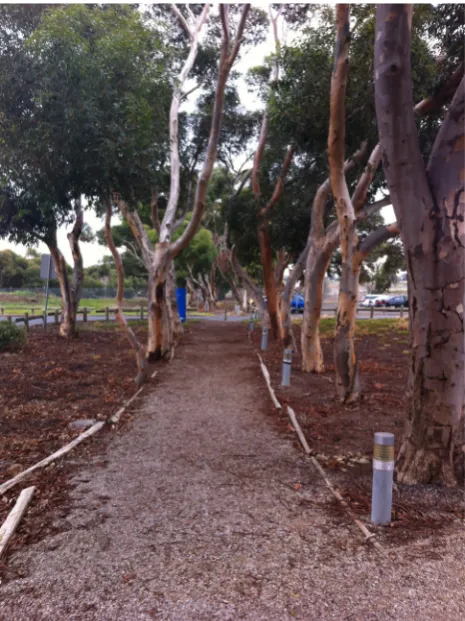
Figure 27: Sugar Gum walking path
Like Irwin (2013), I am lured into the in-between by the pulsating movements of walking this research, entering moments, opening possibilities for artistic processes to interact with the local environment: embracing the limen of fact and fiction. In this work walking was a way into the landscape enhancing my sense of place.
Following the plants as guides within the sentient landscape, led me back to the catchment ponds of Jones creek. I heard that maybe once, prior to the creek’s redevelopments, there were two springs of water: somewhere up near Main Rd8 West. In my research into the history of this waterway and area, there was no evidence to suggest there were two springs of water along this waterway. The curiosity to find out if once they existed resulted in a much deeper understanding
Jones Creek
of place. The thought that maybe there are still signs of these springs left in the landscape and in their search I walked the landscape to find the subtle lie of the land: looking for the silent patches of old pathways of water.
Jones Creek
I found that Jones Creek has an ambiguous history, despite its important role in the life of this landscape. Sourcing information about the creek’s past and present came from documents from the Victorian State library, local libraries and historical societies (Carstairs, Lane, & St Albans History Society, 1988; History of St Albans, 2013).
Information re-presented in maps (from the late 1800’s to the present day), memoirs, geological and ecological documents highlight the ‘at risk’ bio-diverse western grasslands, and their rapid destruction since European arrival (Presland, 1985). Most articulate a settler state mentality, with any links made to Jones creek told through a colonial narrative. Pubs, punts & pastures: the story of Irish pioneer
women on the Salt Water River (Carstairs et al., 1988) provided further insights as it told a female perspective in a white male dominated time and place. Within this book I came upon a map demarking Jones creek as Joan’s creek along with the waterway’s historical path.
Jones Creek
A local story is of children walking the train tracks near a large dam a few hundred metres from the Hume and Hovell9 memorial cairn. A dam big enough to swim in during the hot months and provide water for the immediate area, a once vital source of water, used to exist here. Today there is no dam, rather a muddy drain way underneath the train line.
Figure 29: Hume and Hovell Memorial Cairn
Figure 30: Joan’s Dam
Jones Creek has an ambiguous persona, prescribed and assimilated. Today the creek begins approximately three kilometres from where it once had begun. It starts today as a series of large ponds, that are connected to filter the water that drains off the streets, water plants help the series of lakes functioning as filters.
Jones Creek
People walk in-between the edge of the creek and the remnant grasslands daily, underneath large pylons of electricity and the flight paths of hawks, and planes.
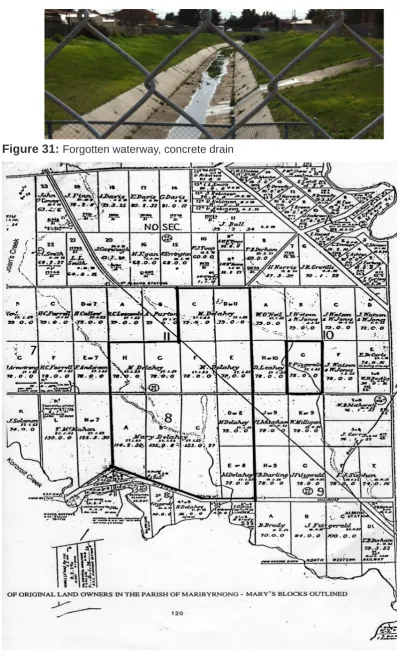
My focus on this waterway was the northern section of the creek, a section that has been erased from the landscape and developed as industrial, commercial, urban spaces and in some cases, parkland. St Albans since the late 1800’s continues to be increasingly sub-divided, once volcanic basalt plains, to squatters, capitalists and now property developers: a small seasonal creek is more of a hindrance to progress and development. The dirt from one of the local bluestone quarries was used to cover over this section of Jones creek. Houses have been erected except where the land would not give in, remaining a dip in the land, where grass and trees line the pathway like a silent avenue of honour.
A place shrouded in historical mystery Joan’s creek came to symbolise many things. I was unable to find any documentation about who Joan may have been; I went through the local histories of European families and ‘settlers’ along the waterway and found no strong connections with Joan. The only Joan that I could find was the author of the book containing the map marking the waterway as Joan’s creek. Spelling error or not, the idea of a forgotten person living on as a creek was interesting, a ghost-like character, Joan is both fact and fiction. Likewise, the male counterpart Jones was equally evasive in historical records.
Jones Creek
Figure 31: Forgotten waterway, concrete drain
Walking Jones Creek
Walking Jones Creek
Joan
Joan
(5.Joan.mp3) Verse One
She ripped her floral red dress, And her memory’s tired and
makes no sense,
She lingers in the flat lie of the
land, Chorus One
For Joan’s a ghost, with the
most beautiful hair,
(Oh no, oh no, oh no: there’s
two) Verse Two
Looking out over the grass plains,
She sees her house shimmer in a haze,
Nothings permanent but I think
she’s OK,
Chorus Two
For Joan’s a ghost, with the
most beautiful hair,
(Oh no, oh no, oh no: there’s
two)
Called to the spirits to make them leave,
The concrete walls slip and skid,
I thought you might just, like to know,
Your house is built on bones, belonging to,
Joan Verse Three
Her floral dressed wedged
between thistle stalks,
Taken away with not a thought,
For the people ask, but your name is gone,
Replaced by a man, a man called Mr Jones
Chorus Three
For Joan’s a ghost, with the
most beautiful hair
(Oh no, oh no, oh no: there’s
two)
Stepped in the water, I needed to see
How really deep is she?
Standing in the floating
debris
You know you’re standing on
bones, belonging to Joan Belonging to Joan
Where is Joan?
She’s not alone
Joan Instrumentation: Piano Drums Synth Bass Two Guitars Six voices
Interpretive Music Autoethnography: Klangfarbenmelodie
Figure 33: Joan in Logic Pro
Interpretive Music Autoethnography: Klangfarbenmelodie
This arts-based autoethnography as noted earlier makes use of narrative and messy texts, perceiving them as appropriate forms of expression to capture and embrace the theatre of the everyday. Refusing to be centred on any one set of repertoires re-presenting knowledge through a wide range of mediums shifting towards an interpretive turn that moves this arts-based autoethnography to sit alongside autoethnodrama (Denzin, 2013; Moriarty, 2013; Saldaña, 2010).Capturing data through a range of artistic methods of inquiry (Leavy, 2015) and in turn analysing data through a range of artistic methods. The idea of articulation re-imagines the concept of voices in scholarly writing in a new way. This new way places different ideas together to create new knowledge (Yunkaporta, 2009) where the interpretation of the word voice has added meanings.
Drawing upon Bakhtin (2010), and Johnston & Strong (2008) the articulation of this work perceives “meaning-making as something occurring in and from dialogic
interactions in ways that reflect time, place, and the voices we engage with as
we go” (Johnston & Strong 2008, p.48). My approach to reconciling voices in
Interpretive Music Autoethnography: Klangfarbenmelodie
as Polyphony and Klangfarbenmelodie from the realm of music to that of writing, this work theatrically highlights my voice and those I lean towards (Pelias, 2011). This document engages with a multiplicity of voices and narratives that contribute to my autoethnographic voice (Johnston & Strong, 2008, p. 49).
In music I perceive each instrument as a voice; each voice within an arranged or orchestrated piece of music has a unique and interconnected purpose melodies and harmonic progressions all shift through instrumental ranges and tonal possibilities: in solo, combination or as accompaniment. When orchestrating and arranging music, careful thought is required about how to construct and combine musical voices to give the desired aural effect (Blatter, 1997).
There are many voices being expressed within scholarly writing. Taking an interpretive turn, this research perceives the overlaps in the ideas associated with the term voice, from a musical and scholarly way of knowing. Following Denzin (2013) and interpretive autoethnographic methods of re-presentation, this research distinguishes the voices of others as actors. Woven into the autoethnography these voices contribute to the narrative from their cultural and academic stances.
Hall’s (1996 [1986]) theory of articulation resonates with this thinking, where he perceives articulation as being “how an ideology discovers its subject [enabling]
us to think how ideology empowers people, enabling them to begin to make
some sense or intelligibility of their … situation, without reducing those forms of
intelligibility” (p. 53).
Interpretive Music Autoethnography: Klangfarbenmelodie
Merging the artistic and scholarly in a polyphonic way can be made problematic by the experimental nature of performative approaches (Smigiel, 2008). Similarly, writing a thesis in an experimental way requires the boundaries of conventional academic writing to privilege holistic and artistic kinds of knowing and doing. This research follows the pathways of arts-based researchers who are re-shaping the conventional boundaries of scholarship (Barone & Eisner, 2012; Irwin, 2013; (Leavy, 2015); Manovski, 2014; Pelias, 2014): opening possibilities that I can contribute towards and benefit from as we interact and respond emotionally and intuitively, re-presenting data as musical narratives that evoke “many layered, non-linear insights and reactions” (Beer, 2015).
The use of Klangfarbenmelodie has the potential to be misunderstood beyond the knowledge walls of 20th Century Western classical music. As a result I will outline and connect how Klangfarbenmelodie is transferred into this text. Klangfarbenmelodie transforms a monophonic (single voiced) melody by sharing the melody across the aural possibilities of any group of instruments, the term refers to the effect it produces when employed.
1.Tone-colour-melody 2. Tone-colour-melody
Interpretive Music Autoethnography: Klangfarbenmelodie
Composed of photographic, musical, and autoethnographical narratives, my voice merges with those who have informed and guided this research project providing further elaborations to the autoethnographic, in a musical way that embraces the dramatic, the performative. This autoethnography makes connections with relevant literature by exploring Bakhtin’s (2010) ideas on the multi-layering of voices—challenging monophonic re-presentations—or as Cutcher (2015) calls multi-vocality, where multiple voices and expressions of voice make “robust connections to culture” (p. 224).
Branham (2005) notes that if written life stories shift between prose and writing styles or between layers of scholarly voices, the narrative is not held in suspension (p. 183) rather enhancing and developing the narrative, contributing to its aesthetic. The dynamic nature of such lyrical, and theatrical narratives can be seen as a canvas to experiment and enact linguistically rich performative polyphonic re-presentations of artistic prose (p. 183). The polyphonic layering of voice in this text re-presents an interpretive turn towards articulating the performative act through the concept of Klangfarbenmelodie, and is articulated in this work as follows:
[A] theory of articulation is both a way of understanding how ideological elements come, under certain conditions, to cohere together within a discourse, and a way of asking how they … become articulated, at specific conjunctures, to certain … subjects (Hall, 1996 [1986], p. 53).
Each one of us tells monologic vignettes of one kind or another, and we exchange improvised dialogue with others virtually every day of our lives. Theatre simply gives aesthetic shape and magnitude to what we already know how to do. Humans are theatre (Saldaña, 2010, p. 68).
Interpretive Music Autoethnography: Klangfarbenmelodie
We have been disciplined to write in neat and tidy ways because this shows that we have thought carefully about our practice, that it’s rigorous and credible. How do we write the messy, the ambiguous, the sublime, multilayered, dense, complex, gnarly performative practices? And how can we make that ambiguity and messiness accessible to other people? How can we demonstrate theoretical complexity? (Kilgard, 2011, p. 219).
Denzin (1994) comments on how the ‘worlds’ we confront are “neither easy to make sense of nor neat“ (p. 300), this messiness is part of the rich palette qualitative researchers, paint, negotiate, re-present and perform with. My research practices are performative, pedagogical, social, cultural, environmental, political and educational. These acts perform the worlds in which I traverse and study “enacting a way of seeing and being, [challenging] the official, hegemonic ways
of seeing and representing the other” (Denzin, 2006, p. 422).
All things that exist beyond the self or cultural group can be seen as the other, othering people, cultures, and landscapes only continue exclusionary dualisms and “politics of difference” (Gupta & Ferguson, 1992). It is in this research that I
engage with cross-cultural knowledge, and re-present this knowledge as music. In this way, the music draws from my musical background and experience.
This approach calls for reflexivity, flexibility and integrity when facing colonial legacies, settler state mentalities and issues surrounding whiteness (Yeung, Spanierman, & Landrum-Brown, 2013) sharing the dilemmas in re-presentation: re-presenting the messy, the complicated and complex nuances of life, at the same time bringing unique worldviews and standpoints into larger discourses.
Jones Creek as a musical writing process
relationships, new, radical forms of scholarship, new epiphanies (Denzin, 2013, pp. 137 - 139).
Jones Creek as a musical writing process
Musical concepts such as Klangfarbenmelodie, polyphony, timbre, texture and tone are transferable concepts that move across arts disciplines, across design, across creative practices. It is through the messiness of life that arts-based autoethnography is able to grasp the plurality of being, in order to express how we come to know: to express through music, visual images, metaphors, film, painting, drawing, contribution to scholarly knowledge, with intent to re-think place, the arts and education: holistically wed.
It seems to us to be particularly important to encourage students to explore the less well explored than simply to replicate tried and true research methods that break no new methodological grounds. It is better, we believe, to find new seas on which to sail than old ports at which to dock (Barone & Eisner, 2012, p. 4)
Barone and Eisner (2012) summarise arts-based research as “an approach to research that exploits the capacities of expressive form to capture qualities of
life that impact what we know and how we live” (p. 5). In this way, arts-based autoethnographies capture life stories, epiphanies, and personal issues through evocative expressions of making art.
Whether it is through poetry, prose, movement, drama, mime, meditation, painting, drawing, sculpture or any other non-traditional linguistic or non-linguistic form the important thing is to find a way or ways that will allow us to follow the natural internal flow of our inquiry. In a sense this is an essential element for researching through artistic expression “ (Cole and Knowles in, R. A. Stewart, 2003 ).
Jones Creek as a musical writing process
learning that emerges. In this way, both a/r/t/ography (Springgay, Irwin, & Kind, 2005) and arts-based research (Barone & Eisner, 2012) become blurred, where they act as two sides to the one spinning coin, promoting all aspects of artistic inquiry in qualitative research.
Eisner (2013) states that there is a tendency to experience a feeling of uneasiness, when approaching this work, and this uneasiness can drive the creative inquiry. This uneasy feeling Eisner reminds us is natural and expected when working with new methods of study, in this way this approach to conducting research is what Diversi and Moreira (2009) refer to as conducting research in-between, a “betweener” way of generating knowledge. I am positioning myself as a
betweener of based educational research and a/r/tography, between arts-based research and research found in the environmental sciences, between art music and the social sciences or cultural studies. Between being a researcher and a participant, a composer and a performer, or composer and listener, an educator and a student. Being in motion with the spinning coin of qualitative research I capture and generate imaginative, creative and expressive articulations of myself within and beyond schools: existing at the sites, and place of learning.
Chapter Five: The Flowering
Chapter Five: The Flowering
The Flowering (September): orchids, flax-lily flowers and numerous wildflowers; lizards emerge from their holes. Conceptual ideas and
artistic practices begin to unfold and emerge.
The warming ground
The skies live in relation to the climate.
Clear night skies; give crisp, cold, icy mornings, gentle sun glistens
off the swollen footprints of rain, washing the land. The days slowly
grow in length shifting the seasons on.
Crow is the first bird I see, gathering, and building nests, there are
other birds begin to show up: New Holland Wrens, Wattlebirds: the
Honey-eaters.
Flowers finally emerge on Acacia Floribunda: who have been
Holding the mirror
regeneration begins.
Sharing place: people, animals, minerals, birds, plants, climate,
skies, and waterways (Martin, 2008).
Flower unfolds, as does learning and awareness. Flowers are a
metaphor expressing the happenings found in this seasonal cycle.
Plants burst into bloom, acacias, eucalypts, weeds, flax, wildflowers
and orchids. I watched, photographed and spent time with plants
observing their growth and connections to the wider landscape.
During this time I was engaging with academic literature and
maintaining my sense of place and place within the community: from
shopping at the supermarket, engaging with post-colonial thinking, to
being one of few non-Vietnamese speaking members of a community
Tai Chi group communicating and acting beyond any language and
culture barriers. The idea of coming into blossom is found in the
connections within my everyday and this seasonal time. It becomes
a metaphor for this stage of my research, where the theoretical
concepts within this work’s design begin to meet and overlap: where they begin to flower.
Holding the mirror
Holding the mirror
Situating place at the heart of learning provides alternatives, openings, transformations in how we as educators can resist the restraints and boundaries of a standardised curriculum, and approaches to learning (G. A. Smith & Sobel, 2010; Stauffer, 2010; Wason-Ellam, 2010). The local places, peoples, natural histories and phenomena can be understood through a range of co-created interactions between, people, places, artistic processes and learning environments (Green, 2008; Popovich, 2008).
McInerney et al. (2011) contend that educators need to be exposed to, and undertake critical reading on the philosophies and concepts of ‘place’, ‘identity’ and ‘community’ from a place-based perspective: across all learning disciplines.
‘Place’ [is] a lens through which young people begin to make sense of themselves and their surroundings. It is where they form relationships and social networks, develop a sense of community and learn to live with others (McInerney et al., 2011, p. 5).
Place-based thinkers and educators argue: nature teaches, understanding place is crucial, and where and how, a student learns, is as vital as what a student learns (Inwood, 2008; Sassen, 2005; Semken & Brandt, 2010; Wason-Ellam, 2010). Inviting the learning possibilities of our local histories, cultures and landscapes into learning places. Place-based arts learning encourages art education to be embedded within the community, reflecting authentic, real world understandings of the human and non-human experience: not confined to museums or distant places (Lewicki, 1998).
Place is a subjective concept
Place is a subjective concept
Place and the ascribed meanings associated, become as diverse as all those who experience the place. The subjective nature of meanings at times coincide, at times come into conflict, as local demographics change, and are renegotiated through discourse, scholarship, media, economics, and law (Vanclay, 2008).
Born from our interactions with the physical, conceptual and spiritual qualities of our lives, definitions of place are complex, and subjective, biased to how we see, are within, and know the world around us.
We all ascribe meanings onto places that develop our sense of place.
Place can be seen as the co-creation of the tangible and the intangible (Vanclay, 2008), and is interpreted through socio-cultural and environmental values. Our cultural standpoints combined with the tangible and intangible qualities of the environment shape how we each define place.
We may come to witness shared or mutual gazes (Maoz, 2006) of the landscapes we are part of, as we come to know our own perceptions of our local landscapes. Looking outwardly, and inwardly, at what we value, feel, think and do, our worldviews offer personal and communal insights into how we construct reality: shaping various definitions of place.
Place is a subjective concept
communicating an intertextual sense of place through artistic inquiry enables engagement with the relational aspects of place where a “sense of place occurs when we are involved in an act of creation” (Lehman, 2008).
Lehman expresses his perspective by encouraging non-Aboriginal Australians to consider and respect the lore of the land. He states that places are living and are perceived as “manifestations of the creation beings” (p. 106), in constant communication with us.
A sense of place occurs when we are involved in an act of creation—through the processes of art, poetry, philosophical speculation and engagement with the relational aspects of the universe—not just at a local level but at a much broader and deeper state. This is what Martin Heidegger called ‘dasein’, being in the world in such a way that we realise our role in co-creating the context of our lives (Lehman, 2008, p. 106).
Developing and maintaining a sense of place requires non-Indigenous educators of Australia to critically question their knowledge and understanding of local and national Aboriginal culture, knowledge, and land, including their own cultural identities (Yunkaporta, 2009). This leads to processes of decolonisation and place-based alternatives; local knowledge bridges the school with the local communities. Inviting local voices and narratives into learning environments can expose any hidden colonial narratives. Demystifying misconceptions and monocultural re-presentations to promote an inclusive pedagogy of place.
Cultural protocols, and ways of engaging with Aboriginal perspectives are missing in contemporary Australian education. Harrison and Greenfield (2011) observe that non-Aboriginal educators are ineffectively engaging with Aboriginal knowledge; rather, they are applying a looking glass at Aboriginal people. As a result, non-Aboriginal educators tend to engage with and inform students from a removed meta-narrative about Aboriginal peoples.
Place is a subjective concept
Indigenous people, where the othering of another culture excludes, regulates and maintains unequal power dynamics (Harrison & Greenfield, 2011; L. T. Smith, 1999).
[T]here is considerable confusion over the difference between Aboriginal perspectives and Aboriginal knowledge with both concepts being used interchangeably to teach syllabus content and information about Aboriginal people (Harrison & Greenfield, 2011, p. 65).
Harrison and Greenfield (2011) sought possibilities for educators to avoid the objectification of Aboriginal people, asking questions about what might an ethically responsive pedagogy look like. This stance reacts against the identified stereotypical representations of Aboriginal people and culture. Diversi and Moreira (2009) also avoid the othering of culture by generating knowledge through a post-colonial lens, aiming to transform research as a dirty word into more productive and culturally aware discourses.
Like Harrison and Greenfield, Diversi and Moreira (2009) sought productive possibilities by casting critical gazes on issues associated with the objectification of ‘the other’, resisting and challenging colonial perspectives. Resisting and challenging colonial assumptions by committing to, and fostering deep relationships with local knowledge and communities permitting the critical gaze to enter places of learning. Harrison and Greenfield (2011) notes that developing strong relationships with place requires authentic collaboration between learning environments and their communities: Indigenous and non-Indigenous.
Place is a subjective concept
Western-thinking educators and researchers must make significant changes in order to address needs that are not currently being well met [such as] ethical protocols [that] incorporate Indigenous methodologies, [and] Indigenous knowledges (Tippins, Mueller, & van Eijck, 2010, p. 254).
The Melbourne Declaration on Education and the National Curriculum endorse healthy relationships with the diverse sectors and people within communities, both locally and globally (ACARA, 2012; MCEETYA, 2008). These policy documents endorse a strong emphasis upon local knowledge and experience with Indigenous culture, by nurturing shared reciprocal relationships with Indigenous families and communities (ACARA, 2012; MCEETYA, 2008).
These documents do not explicitly specify ‘how’ educators might begin to provide an ethically appropriate pedagogy that develops lifelong partnerships with the various sectors of the socio-environmental/cultural communities. Local Indigenous protocols and pluralistic ways of knowing, being and doing are at the heart of nurturing reciprocal relationships with local Indigenous communities (Mackinlay, 2010; McGinty, 2012; S. L. Stewart, 2010; Vaughan, 2005).
What is seen, however, is a one-size fits all approach, where Indigenous content is bolted onto curriculum (Burgess, 2009, p. 3). This results in “a greater potential
for the ‘watering down’ of … Indigenous knowledges, understandings, skills and
issues” (Burgess, 2009, p. 8). Nakata (2010) notes that knowledge from Western and non-western backgrounds “need[s] to privilege [each other] in the appropriate context for appropriate purposes” (p. 56).
Place is a subjective concept
Some teachers continue to talk about Aboriginal people in the past tense and to use the term ‘discovery’ of Australia. They talk about how the ‘[Aboriginal] system was incredible’ and how ‘they lived in harmony with the environment’ (Harrison & Greenfield, 2011, p. 70).
Such narrow re-presentations of Australian Aboriginal cultures exhibit cultural amnesia: forgetting and erasing histories, knowledges and experiences beyond the status quo. These are replaced with fractured, hybrid, neo-anthropological contexts and hidden narratives (Swartz, 2009) hidden within the legacy of colonisation.
Cultural inclusivity and awareness celebrates and collaborates with another (as opposed to the other) culture and people (Martin, 2008). This stance, opposes the notion of the cultural other, and values inclusion and intercultural reciprocity without positioning non-western knowledge systems and cultures to the fringes of Australian education.
A fundamental stance as a non-Aboriginal man is to express my growing knowledge of place—in this southern landscape—where it overlaps with Aboriginal knowledge, and the places this knowledge comes from. Expressing this sense and connection with place, there is an overlap between ways of knowing, being and acting in country. These overlaps allow for western and non-western knowledge to co-create new knowledge.
Coming from my understandings and sense of place I am able to find the overlaps with Aboriginal and non-Aboriginal notions of place through aligned place-based metaphors. Concepts that in essence bring meaning to my growing awareness of place and identity. Through art, I am able to see, be and share these overlaps and seek inclusive, and constructive possibilities. Promoting holistic views of place fostering the idea that “there is more than meets the eye … [and it] demands an on-going, open-ended effort at understanding its complexities and embeddedness
in relationships, and adapting our visions to those realities.” (Fettes & Judson,
Place and art: sharing our visions
Place and art: sharing our visions
Vanclay (2008) outlines three qualities to validate and generate deeper awareness of the landscapes we enact our lives in. These ideas are linked with my own approach to maintaining a relational awareness with what is around me, these are:
1. Begin to know our personal, cultural and communal attachments with the local places we live. Examining how we are connected to what is both familiar and unfamiliar
2. Be open to communicate about place awareness and knowledge developing collective attachments to where we live. Including the way we think and speak about these places, raising a diverse range of questions about;
3. How we commit to being within local landscapes and this impacts our sense of place, identity and community.
Music has the ability to conjure up powerful images of place, and express our deep attachments to, and with place (Hudson, 2006, p. 626).
Through art, people have communicated their relationality with local places for millennia (G. A. Smith & Sobel, 2010), the arts are “not merely “fluff” or pleasant
The Flowering
The Flowering
(6. TheFlowering.mp3)
This music tells a simple story, but a story that is essential to the
survival and regeneration of this local place. The story is of a flower
opening and unfolding its hidden scent, or colour, inviting bees and
birds. As the sun moves west, the flower tilts and follows the gentle
warm sun: closing slowly, waiting for the next days warming rays.
Figure 34: The Flowering in Logic Pro Instrumentation:
Piano 1 Piano 2
Sampled Gamelan
Three Guitars: Bowed, plucked and strummed Bass
Chapter Six: Seeds
Chapter Six: Seeds
Seeds (October): wildflowers set seed along with the bringing
together of conceptual ideas found in the sentient landscape.
September to October have very subtle seasonal changes. It was
only obvious due to previous yearly observations and a more focused
eye in this seasonal cycle. As a metaphor these two months are
represented as plants bringing together all resources to set flower, to
regenerate, and then to go through transformation and set seed.
The unfolding of theoretical concepts continue to ebb and flow
into each other exploring what is common across concepts,
beliefs, and knowledge. Like Dentith & Root (2012) revitalising and
The Cultural Commons
The Cultural Commons
[T]he cultural commons represents the intergenerational knowledge, skills, and mentoring relationships that enable [people] to be more self-reliant in the areas of food, healing, creative arts … narratives, ceremonies, civil liberties, and other aspects of daily life that are less dependent upon consumerism and participation in a money economy. Basically, it encompasses what is shared in common, which may also include traditions of exploitation and prejudice (Bowers, 2010, p. 18).
Bowers celebrates what is inclusively common through a culturally informed awareness; practice and knowledge of our local place permit multiple approaches to dwelling with the land. Working from the idea of the cultural commons, cultural knowledge is seen as being central in defining, making, re-making, and sustaining our unique communities.
An informed cultural commons does not only rely upon western ideologies and perspectives assuming “that western theorists possess the answers that another culture should live by” (Bowers, 2008, p. 325). Problematised by my own whiteness and position as a non-Aboriginal theorist, I am aware of my position as a colonial subject difficult to place (Bhabha H, 1994).
The communication of cultural understandings, awareness, and of knowledge, plays vital roles in transforming a more sustainable stance, grounded in the local. Looking at place, through Bowers’ (2010) idea of the cultural commons, reinforces a critical, reflexive gaze, on the systems and functions embedded in our teaching and learning. Replacing consumerist approaches cultivating an ecological intelligence that is aware of destructive linguistic patterns of erasure.
Redefining the landscape
Redefining the landscape
Jones creek has been subjected to rapid re-definitions since the 1800’s. The palimpsest treatment of Jones creek is a powerful
example of enclosure, enclosing local knowledge, history and natural
Redefining the landscape
Redefining the landscape
Decision-making about which practices sustain the commons may be undermined by authoritarian powers—including universal prescriptions that are too often couched in the language of progress and emancipation from traditions (Bowers, 2014).
Enclosure authorises itself through many guises, often subtle and well ingrained in dominant culture, through the privatisation, monetisation and amalgamation of dominant western industrial culture. Embracing creative, thick alternatives and descriptions brings the formation of new metaphors and ways of thinking to invert patriarchal, anthropocentric control.
Adopting new ways of thinking that implement communal reflexivity and engagement, instigating multiple gazes, and standpoints as being effective ways of valuing, being, knowing and doing. Accepting new metaphors—linguistic and artistic—and meanings to be carried into new contexts that evade the Universalist standardisation of how we can be in this world.
As globalisation and development spread, contestation over places important to different groups for different reasons can be expected to occur. This will be an evermore important effect as the world population grows, and as different ideologies and religions expand their spheres of influence” (Semken & Brandt, 2010, p. 294).
Entering the Dynamic Overlaps
David Sobel, a leading place-based educator urges teachers to work from a stance that moves from the students’ homes outwardly, to the global environmental, social, political, and cultural issues (Sobel, 1997). In this way, learning connects with students’ lived experiences and realities, based on experiential encounters, before engaging with abstract distant places: enabling a relational global view. Rejecting life in a ‘privatised Idaho’10 the dynamism found between the cultural commons and a southern view privilege intergenerational and communal knowledge.
Entering the Dynamic Overlaps
Indigenous and non-Indigenous approaches to pedagogy and knowledge are continually guiding my academic, educational and artistic processes. Yunkaporta (2009) communicates ten cultural interface protocols that allow me to ethically and effectively engage with and express, how I come to know and engage with place, Indigenous knowledge and culture. These protocols are:
1. Use Aboriginal ways of learning to come to Aboriginal knowledge.
2. Approach Aboriginal knowledge in gradual stages, not all at once.
3. Be grounded in your own cultural identity (not ‘colour’) with integrity.
4. Bring your highest self to the knowledge and settle your fears and
issues.
5. Share your own stories of relatedness and deepest knowledge.
6. See the shape of the knowledge and express it with images and
objects.
7. Build your knowledge around real relationships with Aboriginal
people.
8. Use this knowledge for the benefit of the Aboriginal community.
9. Bring your familiar understandings, but be willing to grow beyond
these.
10. Respect the aspects of spirit and place that the knowledge is
grounded in.
(Yunkaporta, 2009, pp. 114 - 115)
Entering the Dynamic Overlaps
I see these protocols as essential processes in knowing place and enacting a relational pedagogy that addresses McInerney et al. (2011) urge for educators to critically engage with place, identity and community. Willing to grow beyond my familiar understandings as I engage with this sentient landscape, my current expression of place-based knowledge is situated beside Indigenous knowledge. Listening and being aware of Indigenous knowledge alongside my own understandings of reading the landscape co-creates a southern view that is inclusive.
This is reflected by Nakata (2010) where he discusses traditional Torres Strait ecological knowledge, working besides and with western ecological knowledge. Nakata refers to this meeting of cultures as ‘The Cultural Interface’ (Nakata, 2007a, 2007b). Nakata (2007b) and Yunkaporta (2009) highlight the cultural interface as being a creative third space (Yunkaporta & McGinty, 2009), created when two or more cultures come together (Yunupingu, 1994b).
In this research, place is perceived as the physical cultural interface (as distinct from a theoretical construct), and privileges the overlaps born from, and in the landscape. In doing so, this contributes to how I critically engage with place, identity and community encouraged by McInerney et al. (2011) and Eijck (2010). Definitions of place and identity are complex and many-sided where Cutcher (2015) notes, identity is never complete, but rather a continually revolving fractal consisting of situations associated with the environmental, cultural “social, psychological, and physical” (p. 130) factors of individuals. In this way, there can be many similar and divergent knowledge and levels of awareness relating to local communal concerns. As with identity place is ever evolving, and our personal meanings are fluid, and at times may be contested. Education provides a rich avenue for engaging with local knowledge and practices for the benefit of all involved.
Entering the Dynamic Overlaps
reveal] and [be] used as a pedagogical [place] for authentic environmental and cultural learning” (p. 353).
It is through the connections and disconnections that this relational public pedagogical view constructs thick descriptions and critical analysis of the local, through sharing interlinked cultural perspectives, and individual perceptions of where we are: historically and contemporaneously. Thick descriptions of the places we dwell enable powerful transformations and expressions of where and how learning exists (Stevenson, 2008), with and in a sentient landscape.
Listening to intergenerational and inter-cultural knowledge this creative work reflects and reaches out to the cultural commons of my place: expressed through my cultural understandings. In so doing, this creative work endorses inclusive relationships with place to be less dependent upon capitalistic agendas for the elite few, celebrating what is common across places, identities and communities. This approach revitalises the commons and traditions of celebration by offering my own deep stories of relationality back to the place this work serves and commemorates. An aim of this research as stated throughout is to provide an example of how arts educators can draw upon their own knowledge traditions and find the intersections with local and global Indigenous knowledge traditions.
Entering the Dynamic Overlaps
The dynamic overlaps are vital for genuine engagement with Aboriginal knowledge and culture, connecting cultures through place with integrity, with availability, with flexibility, aiding relationality between people and country. Critical conversations about our cultural identities and their expressions of knowledge provide an inclusive view of the responsibilities educators provide to the wider community. Engaging with a relational sense of place allows educators to value, be, know and act in new ways and embrace new practices that acknowledge learning and teaching as being connected to place, requiring a “flexibility in thought, policy and
practice” (Marika et al., 2009, p. 406).
This kind of relational engagement is both conceptual and marked in the landscape. From the dynamic layers in our meanings of place, this research rejoices in the sentient landscape where knowledge can be situated and learnt from (Marker, 2006). A place-based, local understanding of place intersects with theoretical and philosophical understandings, creating a relational middle ground: a middle ground that is best understood through Yunkaporta’s idea of the dynamic overlap.
The dynamic overlap is more than an interface; it is a vital place of interactions and awareness, more than a third space, or a hybrid space. It is an actual place that is alive and dynamic (Yunkaporta, 2009), a meeting place comprised of changing relationships between the tangible and intangible. These overlaps, or interfaces are referred to by various names and meanings across disciplines Yunkaporta and McGinty (2009) highlight these dynamic overlaps as powerful sites of learning, born from the local landscape and from cultural knowledge of local places, where cultures meet at the edge.
Entering the Dynamic Overlaps
The edge is where the action is! Edges or eco-tones are the interfaces where two ecosystems come together to form a third, and more diverse, fertile and productive area, because energies and materials accumulate there and resources from both ecosystems can be used (Mollison & Holmgren, 1979, p. 2).
I considered the potential for rivers and creeks to act as cultural meeting places and the thought given to “ecotones,” or highly productive biological edges, in permaculture philosophy (Reinsborough, 2010, p. 50).
Yunupingu (1994a) shares the powerful metaphor, Ganma, coming from Yolngu bio-cultural knowledge. Ganma, a Yolngu concept, “views the interaction of opposite systems such as fresh and salt water as [being] a magical source of
creation” (Yunkaporta & McGinty, 2009, p. 58). In reference to this magical source
of creation, Yunupingu (1994a) states:
This pool is a balance between two different natural patterns, the pattern
of tidal flow, saltwater moving in through the mangrove channels, and the pattern of the fresh water streams varying in their flow across the wet and
dry seasons (p. 8).
Ganma is a metaphor. We are talking about natural processes but meaning at another level (Yunupingu, 1994a, p. 8).
It makes sense for us to find what pedagogy we have in common with non-Aboriginal ways too, balancing the two worlds. If we find the overlap between our best ways of learning and the mainstream’s best ways of learning then we will have an equal balance.
Setting seed
Setting seed
(7. Seeds.mp3)
Composing this music, I brought ideas together to create new
knowledge, relating it conceptually to this chapter. The way I felt best
to re-present this is by using extended chords, when deconstructed
appear to be two different chords played simultaneously.
Instrumentation
Any number of musicians can perform this work; as a solo piece or as an ensemble. In the musical score I have provided harmonic progressions with some melodic ideas as orchestration guides. As this music is a re-presentation of how conceptual ideas are brought together in this research, these ideas can also be found in the landscape. The metaphor of a seed holding all requirements for its life is applied to this musical score which holds all requirements for musicians to create their own interpretation of this music.
To extend the ideas being brought together in this work, this music has been notated to represent a musical seed. The idea behind this is that all information to create a version of this song is captured in a condense way, similar to a seed, and re-presnting this as circular notation bridging together the act of notating music and conducting music-based research
Chapter Seven: A Relative Location
Chapter Seven: A Relative Location
A Relative Location (November): kangaroo grass flowers, Orioncan be seen and Flax lily begins to fruit, adding purple colour to the
landscape: place-based response to place-based learning. This
chapter is dedicated this to Des Johnson.
1. Observation: Take time to pay attention to what the natural systems are doing. Permaculture is a cyclic pattern that mimics and supports the natural cycles of the places we inhabit. It is recommended that we observe, map, design, implement, and continue yearly cycles to know the interconnections between all things. It is from this principle, that this research implements the journey of seasonal cycles.
2. Every Element Supports Multiple Functions: the elements—plants, animals, waterways, air and climates—work in many ways, supporting at least two or more functions within the landscape, highlighting the diversity of all things in a location.
3. Relative Location: all elements make up the natural systems as they work in relation to each other.
Chapter Seven: A Relative Location
functions and should be utilised to its fullest potential. Mollison and Holmgren (1979).
Figure 37: Dynamically overlapping
McNiff (2008) in his arts-based research article states that the best way to understand, build an appreciation of, or develop awareness of a creative practice, or issue is to immerse the research into the study in a direct meaningful way (p. 31) In this final chapter I am completely immersed in this inquiry, my connections to this place and to my artful, musical encounters that mimic permaculture principles as I deeply witness this place.
Music is perceptible sound organised over a defined period of time and space (Gibson & Ewing, 2011). A more scientific explanation could be music or sound is a sensation and is composed and communicates through vibrations that resonate with other aural vibrations in the air and our hearing abilities (Scholes & Ward, 1970). Sound frequencies are measured as a hertz (Hz) or Kilohertz (KHz): 1000 Hz = 1 kHz. The hertz value of a sound indicates that it beats or vibrates a certain amount of times per second. An example would be 50Hz vibrates 50 times per second creating a particular frequency, commonly sound frequencies are illustrated as a sine wave.
Chapter Seven: A Relative Location
This approach to visualising sound is useful when understanding the acoustics, physics and phenomena of sound. Thinking about how sound reverberates outwardly into its environment and how it interacts with other sounds is circular and non-linear. Visualising sound this way transforms the sine wave into vibrations rippling outwardly, and merging with other sounds, contributing towards what is known in music as tone colour or timbre.
Timbre is the tone colour of sounds; each sound has its own unique quality, even within one instrument. This uniqueness is referred to as an aural colour, a feeling that incites certain reactions from each listener It is through timbre that composers are able to paint with sound, examples can be found throughout musical history (Blatter, 1997). In this way, I visualise sound as coloured concentric circles, vibrating and moving in all directions. Visualising sound this way enables me to re-present how timbre and harmony interact in a relational way.
Figure 39: Vibrations of Sound
Place-based learning: The waterways
Place-based learning: The waterways
Through this research the waterways of western Melbourne have been a recurring motif. Jones Creek has been discussed throughout this research: it was at the edge of this waterway and the remnant grasslands that this research began and it is at the edge of another small waterway that starts near Jones Creek this research concludes, where the small waterway meets with the powerful and dynamic Maribyrnong River, in the eastern section of St Albans.
Figure 40: The meeting of two waterways
Local Sunshine1 man Desmond Johnson has documented the western region’s waterways through photography for the past forty years. In conjunction with Brimbank Council and a local community based artist, Des’ photographic, cartographic and personal narratives were shared at a local community gallery space. The invitation to meet Des and attend his exhibition provided an exciting opportunity to discuss his experiences and knowledge of Jones Creek through photographs and stories. Over a forty-year period Des has worked and lived in the greater Sunshine area. Part of his working and personal life ensured he always carried a camera. As he walked, rode, and documented the waterways, through photographs, he has collated an impressive amount of information about the waterways of western Melbourne.
Place-based learning: The waterways
Figure 41: Des Johnson, photo taken by local artist Debbie Qadri, used with permission.
Looking through the Jones Creek album, Des shared stories of walking the concreted tunnels that cover Jones Creek: in the most southern part of the waterway. Additionally, in the Jones Creek album there was an extensive collection of photographs and maps of a nearby waterway that enters the Maribyrnong River.
Place-based learning: The waterways
Figure 42: Des’ annotated topographic map
Cray Creek begins in a similar way to Jones Creek, however Cray Creek is nurtured by a deep gully. The valleys are steep and end in a narrow, rocky, snake infested waterway. It is now impossible to walk this waterway as Des once did, especially during the dry hot time of the year.
Place-based learning: The waterways
With the three maps Des gifted me, I began mimicking his process of co-creating art with the waterways, using photographs and music. As this process was already part of the data collection process of this research, I wanted to capture a soundscape of this place illustrated by a graphic score. Following a similar process to Des, I intended to capture the intangible through the documentation of a moment in time. Like a photograph, capturing the moment, I wanted to create music that did the same thing aurally. I acknowledge Des Johnson as the starting point for the following expressions of creativity and co-creation.
Place-based learning: The waterways
Figure 44: The vibrating landscape
There is a Creek that crosses St Albans from north to south; it has the name Jones Creek. This creek begins in an open field, fenced away to house a radio transmitter, near the memorial for Hume and Hovell. .
Figure 45: Hume and Hovell Memorial
Place-based learning: The waterways
along the water’s edge in combination with the steep valley slopes, with protruding stones: feels like eyes upon you.
The water begins to follow a direct path, gradually opening into small ponds, slowly drifting the water gently pulls back into a direct flow before opening into a larger pool. The water ripples and rolls into one last force into the raging Maribyrnong River, rushing past basalt stones, fallen branches, car bonnets, and other accumulation of refuse, the waters meet and become new water.
A relative Location
A relative Location
(8. ARelativeLocation.mp3)
Figure 46: Kangaroo Grass
Dry grass shake remnant seed
This research project began when kangaroo grass is dry, shedding its seed to start another seasonal cycle. As this work began it finishes in the time when kangaroo grass is dry, when tussock grass is dry and where the landscape holds knowledge hidden within its design.
The music score for a Relative Location is ‘a graphic score’, a visual representation of the waterway and the musical form and structure: illustrating the tonal hues of the place and music (see; p. 121).
A relative Location
Figure 47: Thesis expressed as symbols
A relative Location
A Relative Location Photostory
A Relative Location Photostory
Conclusion: Closing the seasonal circle
Conclusion: Closing the seasonal circle
The dynamic and rich possibilities of education and place can create rich learning possibilities when combined, enhancing opportunities and connections between cross-cultural, and personal learning. These connections allowed me to work in a culturally safe (Bin-Sallik, 2003) manner, with both Aboriginal and non-Aboriginal worldviews. It is in the dynamic overlaps that the shared cultural understandings become innovative sites to view from multiple perspectives: observing the interconnectedness between all things; holding up windows and mirrors on ourselves, and those we interact with—human and non-human; embracing notions of a mutual gaze (Maoz, 2006) and a southern view (Connell, 2007b; Gale, 2009; Garbutt, 2011).
Diversi and Moreira (2009) enact a critical process of gazing back and forth by employing performative writing, placing them in-between, a liminal place Diversi and Moreiera call being a ‘betweener’. Embracing notions of a mutual gaze and southern view drive this post-colonial performative thinking towards being “ever more inclusive” (p. 20) as knowledge is constructed and worked with, navigating and negotiating cross-cultural betweeness.
Taking this stance allows me as artist, researcher and educator to re-think how Aboriginal and non-Aboriginal narratives can sit with each other in an educational context (within and beyond the arts). As highlighted in this work, I follow Yunkaporta (2009) by looking to the dynamic overlaps found between cultural practices, and make the cultural move as an educator towards working with Aboriginal concepts, metaphors, processes and pedagogies, as opposed to content about Aboriginal cultures.
Conclusion: Closing the seasonal circle
priorities. This work articulates my engagement with two of the three priorities: the inclusion in curriculum of Aboriginal and Torres Strait Islander cultures, histories and narratives and sustainability. This place-based awareness articulates the shared cultural, social and environmental connections with the landscape and local place: bridging cultural boundaries.
Gazing inwardly and outwardly benefits for me a local, southern hemisphere dialogue and seeks the overlaps. In these dynamic overlaps of the socio-cultural and socio-environmental, the ‘cracks’ of place become powerful performative sites of expression. This autoethnographic document offers many possibilities in re-thinking the art of learning and re-thinking the roles educators have beyond the classroom, in order to strengthen their classrooms. In doing so, this document also offers possibilities for strengthening student learning, by drawing on their knowledge, making learning relevant to their lives, and extending this learning through deep engagement with place.
The benefits of such a methodology are in its potential to bring about a shift towards creating a holistic and culturally aware approach to curriculum, policy, assessment and pedagogy. As studied throughout, this methodology is based on sharing life stories, co-creating experiences, and returning that knowledge back to the communities where teachers and students live and learn. This allows learning to swell back into the local places where we enact our professions, not restricted by the school gates. The cracks of creativity are thus found in everyday life.
Conclusion: Closing the seasonal circle
environmental and Indigenous knowledge and wisdom.
It is argued that the North has been positioned as the epicentre of knowledge production and worth (Connell, 2007a). This research problematises the homogenous western monopoly of what constitutes knowledge and pedagogy, celebrating the unique ways of approaching knowledge and culture from the southern landscape.
Expressing the redistribution of expertise, redistributing power imbalances and challenging dominant Eurocentric paradigms reconfigures our practices as educators, reconfiguring how we learn, teach, value, believe, and know.
Encouraging a re-thinking of the many layers of knowledge: as educators, artists, and as members of the wider community.
The intent to transform needs to be ethically grounded or else we wind up reproducing colonialist logics and oppressive conditions that are inhospitable to social change. If pedagogy is also on some level a philosophical orientation to one’s teaching, then to place ethics first is to relinquish control over outcomes in a way that allows for the transformative capacity of the encounter to emerge organically. The deliberate breaking of particular boundaries and subject positions that are set up to keep us from knowing one another is key to producing a public where justice can be realized (Rosario, 2015, p. 65 - 66).
Learning beyond institutions opens up connections with public pedagogy (Giroux, 2004) and enables us to privilege ‘learning’ over ‘education’. Learning exists beyond educational institutions and in this way; the role of an educator likewise, extends beyond the institution. There is an ‘ethic of connection’ (Rose, 1999) when accepting this stance as an educator, establishing connections through dialogue.
Conclusion: Closing the seasonal circle
Eurocentric hierarchy has been overlaid in much of how we perceive and enact learning and how these Eurocentric hierarchical systems of knowledge dissemination can reproduce oppression. This includes the way we engage with place or anything that is seen as ‘the other’: people, animals and all living systems. Flipping this dialogue around to be centred from a southern stance, we can ethically engage with southern systems and privilege place-based knowledge traditions and ways of being, knowing, doing and valuing as valid and innovative approaches to pedagogy, curriculum and assessment (Martin, 2008; Rose, 1999).
As noted in Chapter one Leaning in and out (Pelias, 2011) from lived experiences this relational pedagogy embraces interpretive autoethnography as a valid way for sharing such complex patterns of learning. Bowers (2012) encourages autoethnography as a way to express “how different aspects of the cultural commons are the basis of daily experience”. Bowers claims such autoethnographies can celebrate communal knowledge and intergenerational learning where cultural traditions are a vital foundation for individual and collective liberation.
When explicit awareness of the different forms of intergenerational knowledge and skills is lacking, outside economic and political forces may undermine or appropriate different aspects of the cultural commons without people knowing what has been lost. For example, important parts of our vocabulary have been lost to the forces of science and technology, just as non-western cultures have lost traditions of intergenerational knowledge as their youth have been socialized to adopt the western assumptions essential to making them dependent upon an industrial/consumer-dependent lifestyle. Socializing the poor to the values and vocabulary that support dependence … as well as the loss of intergenerational knowledge (Bowers, 2012).
“Both cultures [are] to be respected equally” (Yunupingu, 1989, p. 4).
Conclusion: Closing the seasonal circle
can be tension, as dynamic forces meet—“through the ebb and flow of competing
interests” (Yunupingu, 1994a, p. 4). These powerful sites of learning and sharing can be places of tension, but also sites of reconciliation (Yunkaporta & McGinty, 2009).
Transitional places begin to emerge through an in-between liminal process that can be pedagogical, seeking “possibilities for mutual care in a system of connections and reciprocities that includes humans, non-human living beings,
and environments” (Rose, 1999): a public pedagogy (Giroux, 2004). This is a transitional pedagogy that can help “us bridge the boundaries between self and other” (Burdick & Sandlin, 2013, p. 159), crossing the line between the person
we have been, and the person we are becoming (Ellsworth, 2005, in Burdick & Sandlin, 2013, p. 159).