Cryptography
Extended Abstract
∗Itay Berman1, Akshay Degwekar1, Ron D. Rothblum12, and Prashant Nalini Vasudevan1
1 MIT
{itayberm,akshayd,prashvas,ronr}@mit.edu 2
Northeastern University
Abstract. Since its inception, public-key encryption (PKE) has been one of the main cornerstones of cryptography. A central goal in cryp-tographic research is to understand the foundations of public-key en-cryption and in particular, base its existence on a natural and generic complexity-theoretic assumption. An intriguing candidate for such an assumption is the existence of a cryptographically hard language L ∈ NP∩SZK.
In this work we prove that public-key encryption can be based on the foregoing assumption, as long as the (honest) prover in the zero-knowledge protocol isefficient and laconic. That is, messages that the prover sends should be efficiently computable (given the NP witness) and short (i.e., of sufficiently sub-logarithmic length). Actually, our re-sult is stronger and only requires the protocol to be zero-knowledge for anhonest-verifier and sound against computationally bounded cheating provers.
Languages in NP with such laconic zero-knowledge protocols are known from a variety of computational assumptions (e.g., Quadratic Residuocity, Decisional Diffie-Hellman, Learning with Errors, etc.). Thus, our main result can also be viewed as giving a unifying framework for constructingPKEwhich, in particular, captures many of the assumptions that were already known to yieldPKE.
We also show several extensions of our result. First, that a certain weakening of our assumption on laconic zero-knowledge is actually equiv-alent to PKE, thereby giving a complexity-theoretic characterization of
PKE. Second, a mild strengthening of our assumption also yields a (2-message) oblivious transfer protocol.
1
Introduction
Underlying symmetric key encryption is a centuries-old idea:shared secrets en-able secure communication. This idea takes many forms: the Caeser cipher, the unconditionally secure one-time pads, fast heuristic constructions like AES, and
∗
a multitude of candidates based on the hardness of a variety of problems. The discovery of public-key encryption, by Diffie and Hellman [DH76] and Rivest, Shamir and Adleman [RSA78], was revolutionary as it gave us the ability to communicate securely without any shared secrets. Needless to say, this capabil-ity is one of the cornerstones of secure communication in today’s online world.
As is typically the case in cryptography, we are currently very far from es-tablishing the security of public-key cryptography unconditionally. Rather, to establish security, we rely on certain computational intractability assumptions. Despite four decades of extensive research, we currently only know constructions of public-key encryption from a handful of assumptions, most notably assump-tions related to the hardness of factoring, finding discrete logarithms and compu-tational problems related to lattices (as well as a few more exotic assumptions). One of the central open problems in cryptography is to place public-key encryption on firmer complexity-theoretic grounding, ideally by constructing public-key encryption from the minimal assumption that one-way functions exist. Such a result seems well beyond current techniques, and by the celebrated result of Impagliazzo and Rudich [IR89] requires a non-blackbox approach. Given that, a basic question that we would like to resolve is the following:
From what general complexity-theoretic assumptions can we construct public-key cryptography?
Our motivation for asking this question is twofold. First, we seek to under-stand: Why is it the case that so few assumptions give us public-key encryption? What kind of “structured hardness” is required? Secondly, we hope that this un-derstanding can guide the search for new concrete problems that yield public-key encryption.
1.1 Our Results
Our main result is a construction of a public-key encryption scheme from a gen-eral complexity-theoretic assumption: namely, the existence of a cryptographi-cally hard languageL ∈NPthat has alaconic (honest-verifier) statistical zero-knowledge argument-system. We first discuss the notions mentioned above, and then proceed to state the main result more precisely (yet still informally).
By acryptographically hard languagewe mean anNPlanguage that is average-case hard to decide with a solved instance generator. Namely, that there are two distributionsY andN, over YES and NO instances of the language respectively, such that (1)YandNare computationally indistinguishable; and (2) there exists an efficient solved instance generator for the YES distribution.3A proof-system is laconic [GH98, GVW02] if the number of bits sent from the prover to the
3Loosely speaking, a solved-instance generator for the YES distribution Y of an
verifier is very small.4 An argument-system is similar to an interactive proof, except that soundness is only required to hold againstcomputationally bounded (i.e., polynomial time) cheating provers. Honest verifier zero-knowledge means that the honest verifier learns no more in the interaction than the fact that x∈ L(i.e., the verifier can simulate the honest interaction by itself). Thus, our main result can be stated as follows:
Theorem 1.1 (Informally Stated, see Theorem 2.6). Assume that there exists a cryptographically hard language L ∈ NP with an r-round statistical honest-verifier zero-knowledge argument-system, with constant soundness, that satisfies the following two requirements:
– Efficient Prover:The startegy of the honest prover can be implemented in polynomial-time, given theNP witness.5
– Laconic Prover: The prover sends at most q bits in each of ther rounds, such thatr2·q3=O(logn), wherenis the input length.
Then, there exists a public-key encryption (PKE) scheme.
We emphasize that requiring onlyhonest-verifier zero-knowledge (as opposed to full-fledged zero-knowledge) andcomputational soundness (i.e., an argument-system) weakens our assumption, and therefore only strengthens our main result. We also comment that we can handle provers that are less laconic (i.e., send longer messages) by assuming that the language L is sub-exponentially hard. Lastly, we remark the assumption in Theorem 1.1 may be viewed as a gener-alization of the notion of hash proof systems [CS02].6 We discuss this point in more detail in Section1.2.
1.1.1 Instantiations
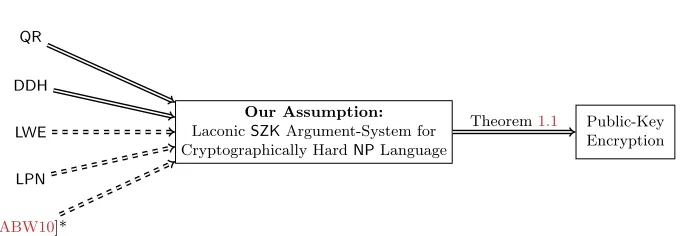
Many concrete assumptions (which are already known to yield public-key en-cryption schemes) imply the conditions of Theorem1.1. First, number-theoretic assumptions such as Quadratic Residuosity (QR) and Decisional Diffie-Hellman (DDH) can be shown to imply the existence of a cryptographically hardNP lan-guage with a laconic and efficientSZKargument-system and therefore satisfy the
4Laconic proof-systems with constant soundness and very short communication
(e.g., just a single bit) are indeed known. As a matter of fact, many of the known hard problems that are known to yield public-key encryption schemes have such laconicSZK
proof-systems (see Section1.1.1). 5
In the context ofargument-systems(in contrast to general interactive proofs), the assumption that the honest prover is efficient goes without saying. Nevertheless, we wish to emphasize this point here.
6As a matter of fact, hash proof systems can be viewed as a special case of our
conditions of Theorem 1.1 (these and the other implications mentioned below are proven in the full version of this paper).
We can also capture assumptions related to lattices and random linear codes by slightly relaxing the conditions of Theorem 1.1. Specifically, Theorem 1.1
holds even if we relax the completeness, soundness and zero-knowledge conditions of the argument-system to hold only for most (but not necessarily all) of the instances (chosen from the average-case hard distribution). We call arguments with these weaker propertiesaverage-case SZKarguments.
It is not hard to see thatlossy encryption [PVW08,BHY09] yields such an average-caselaconic and efficient zero-knowledge argument-system. Recall that a
PKEscheme islossyif its public-keys are indistinguishable from so-called “lossy keys” such that a ciphertext generated using such a lossy key does not contain information about the underlying plaintext. Consider the following proof-system for the language consisting of all valid keys: given an allegedly valid public-key, the verifier sends to the prover an encryption of a random bitband expects to get in response the valueb. It is not hard to see that this protocol is a laconic and efficient average-caseSZKargument-system.
Several concrete assumptions yield cryptographically hard languages with average-case laconic and efficientSZKarguments (whether via lossy encryption or directly). Most notably, Learning With Errors (LWE) [Reg05], Learning Parity with Noise (LPN) with small errors [Ale03] and most of the assumptions used by Applebaumet al.[ABW10] to constructPKE, all imply the existence of such languages.
Thus, Theorem 1.1 gives a common framework for constructing public-key encryption based on a variety of different intractability assumptions (all of which were already known to yield public-key encryption via a variety of somewhat ad hoc techniques), see also Fig.1.
One notable hardness assumption that we do not know to imply our assump-tion (even the average-case variant) isinteger factorization(and the related RSA assumption). We consider a further weakening of our assumption that captures also the factoring and RSA assumptions. As a matter of fact, we show that this further relaxed assumption is actuallyequivalent to the existence of a public-key encryption scheme. We discuss this in more detail in Section1.1.3.
1.1.2 Perspective — From SZK-Hardness to Public-Key Encryption
As noted above, one of the central goals in cryptography is to base public-key encryption on a general notion of structured hardness. A natural candidate for such structure is the class SZKof statistical zero-knowledge proofs, since many of the assumptions that are known to yield public-key encryption have SZK
proof-systems. Indeed, it is enticing to believe that the following dream version of Theorem1.1holds:
Our Assumption: LaconicSZKArgument-System for Cryptographically HardNPLanguage LWE
DDH QR
LPN
[ABW10]*
Public-Key Encryption Theorem1.1
Fig. 1: Instantiations of our assumption. Dashed arrows means that we only obtain average-case completeness, soundness and zero-knowledge. The (*) sign means that most, but not all, assumptions from [ABW10] imply our assumption.
(Here bySZKwe refer to the class of languages having statistical zero-knowledge proof-systems rather than argument-systems as in Theorem1.1. Assuming this additional structure only makes the statement of Open Problem1.1weaker and therefore easier to prove.)
Solving Open Problem1.1 would be an outstanding breakthrough in cryp-tography. For instance, it would allow us to base public-key cryptography on the intractability of the discrete logarithm (DLOG) problem,7since (a decision prob-lem equivalent to)DLOGhas a perfect zero-knowledge proof-system8[GK93], or under the plausible quasi-polynomial average-case9 hardness of the graph iso-morphism problem (via the perfect zero-knowledge protocol of [GMW87]).
We view Theorem 1.1 as an initial step toward solving Open Problem 1.1. At first glance, it seems that Theorem1.1must be strengthened intwoways in order to solve Open Problem1.1. Namely, we need to get rid of the requirements that the (honest) prover is (1) efficient and (2) laconic. However, it turns out that it suffices to remove onlyoneof these restrictions, no matter which one, in order to solve Open Problem1.1. We discuss this next.
Handling Inefficient Provers. Sahai and Vadhan [SV03] showed a problem, called statistical distance, which is both (1) complete forSZK, and (2) has an extremely laconic honest-verifier statistical zero-knowledge proof in which the prover only
7
Public-key schemes based on assumptions related to discrete log such as the de-cisional (or even computational) Diffie Hellman assumption are known to exist. Nev-ertheless, basing public-key encryption solely on the hardness of discrete log has been open since the original work of Diffie and Hellman [DH76].
8That proof-system is actually laconic but it is unclear how to implement the prover
efficiently.
9Graph isomorphism is in fact known to be solvable in polynomial-time for many
sends a single bit (with constant soundness error). The immediate implication is that any SZK protocol can be compressed to one in which the prover sends only a single bit.
Unfortunately, the foregoing transformation does not seem to maintain the computational efficiency of the prover. Thus, removing the requirement that the prover is efficient from Theorem 1.1 (while maintaining the laconism require-ment) would solve Open Problem1.1.
Handling Non-Laconic Provers. Suppose that we managed to remove the lacon-ism requirement from Theorem1.1and only required the prover to be efficient. It turns out that the latter would actually imply an even stronger result than that stated in Open Problem 1.1. Specifically, assuming only the existence of one-way functions, Haitner et al. [HNO+09] construct (non-laconic) statistical zero-knowledgearguments for any NPlanguage, with an efficient prover. Thus, removing the laconism requirement from Theorem 1.1 would yield public-key encryption based merely on the existence of one-way functions.
In fact, even a weaker result would solve Open Problem 1.1. Suppose we could remove the laconism requirement from Theorem 1.1 while insisting that the proof-system has statistical soundness (rather than computational). Such a result would solve Open Problem1.1 since Nguyen and Vadhan [NV06] showed that every language in NP∩SZK has anSZK protocol in which the prover is efficient (given theNPwitness).
To summarize, removing the laconism requirement from Theorem1.1, while still considering an argument-system, would yield public-key encryption from one-way functions (via [HNO+09]). On the other hand, removing the laconism re-quirement while insisting on statistical soundness would solve Open Problem1.1
(via [NV06]). (Note that neither the [NV06] nor [HNO+09] proof-systems are
la-conic, so they too cannot be used directly together with Theorem 1.1 to solve Open Problem1.1.)
1.1.3 Extensions
We also explore the effect of strengthening and weakening our assumption. A nat-ural strengthening gives us oblivious transfer, and as mentioned above, a certain weakening yields a complete complexity-theoretic characterization of public-key encryption.
We introduce a notion of (computationally sound) proof-systems for suchNP
search problems, which we callarguments of weak knowledge (AoWK). Loosely speaking, this argument-system convinces the verifier that the prover with which it is interacting has at least some partial knowledge of some witness. Or in other words, no efficient cheating prover can convince the verifier to accept givenonly the input. We further say that anAoWKiszero-knowledge if the verifier learns nothing beyond the fact that the prover has the witness.
We show that Theorem 1.1 still holds under the weaker assumption that there is an efficient and laconic SZK-AoWK(with respect to some hard solved instance generator). Namely, the latter assumption implies the existence ofPKE. Furthermore, we also show that the same assumption is alsoimpliedby anyPKE
scheme, thus establishing an equivalence between the two notions which also yields a certain complexity-theoretic characterization of public-key encryption.
Oblivious Transfer. Oblivious Transfer (OT) is a fundamental cryptographic primitive, which is complete for the construction of general secure multiparty computation (MPC) protocols [GMW87, Kil88]. We show that by making a slightly stronger assumption, Theorem1.1can extended to yield a (two-message) semi-honestOTprotocol.
For ourOT protocol, in addition to the conditions of Theorem1.1, we need to further assume that there is a way to sample instancesxsuch that it is hard to tell whetherx∈ Lorx6∈ Leven given the coins of the sampling algorithm.10 We refer to this property asenhanced cryptographic hardness in analogy to the notion ofenhanced trapdoor permutations.
1.2 Related Works
Cryptography and Hardness ofSZK. Ostrovsky [Ost91] showed that the existence of a language in SZK with average-case hardness implies the existence of one-way functions. Our result can be interpreted as an extension of Ostrovsky’s result: By assuming additional structure on the underlying SZK protocol, we construct a public-key encryption scheme. In fact, some of the ideas underlying our construction are inspired by Ostrovsky’s one-way function.
Average-case SZK hardness also implies constant-round statistically hiding commitments [OV08], a primitive not implied by one-way functions in a black-box way [HHRS15]. Assuming the existence of an average-case hard language in a subclass of SZK (i.e., of languages having perfect randomized encodings), Applebaum and Raykov [AR16] construct Collision Resistant Hash functions.
In the other direction, some cryptographic primitives like homomorphic en-cryption [BL13], lossy encryption, witness encryption and indistinguishability obfuscators [KMN+14,PPS15], andPIR(computational private information
re-10In particular, the sampling algorithm that tosses a coin b ∈ {0,1} and outputs
trieval) [LV16] imply the existence of average-case hard problems inSZK.11We also mention that many other primitives, such as one-way functions, public-key encryption and oblivious transfer do not imply the existence of average-case hard problems inSZK(under black-box reductions) [BDV16].
Hash Proof-Systems. Hash Proof-Systems, introduced by Cramer and Shoup [CS02], are a cryptographic primitive which, in a nutshell, can be described as a cryptographically hard language inNPwith a one-roundSZKprotocol in which the honest prover is efficient given theNPwitness anddeterministic(and without loss of generality sends only a single bit). This is precisely what we assume for our main result except that we can handlerandomized provers that send more bits of information (and the protocol can be multi-round). This special case of deterministic provers is significantly simpler to handle (and will serve as a warmup when describing our techniques). Our main technical contribution is handling arbitraryrandomized provers.
Public-key encryption schemes have been shown to imply the existence of cer-tainweak hash proof-systems [HLWW16]. Hash proof-systems were also shown in [GOVW12] to yieldresettablestatistical zero-knowledge proof-systems.
Laconic Provers. A study of interactive proofs in which the prover is laconic (i.e., transmits few bits to the verifier) was initiated by Goldreich and H˚astad [GH98] and was further explored by Goldreich, Vadhan and Wigderson [GVW02]. These focus in these works is on general interactive proofs (that are not necessarily zero-knowledge) and their main results are that laconic interactive proofs are much weaker than general (i.e., non-laconic) interactive proofs.
1.3 Techniques
To illustrate the techniques used, we sketch the proof of a slightly simplified ver-sion of Theorem1.1. Specifically, we construct aPKEgiven a cryptographically hard languageLwith asingle-round efficient-prover and laconicSZK argument-system (we shall briefly mention the effect of more rounds where it is most relevant). For simplicity, we also assume that theSZKprotocol hasperfect com-pleteness and zero-knowledge. In the actual construction, given in the technical sections, we handle constant completeness error, negligible simulation error, and more rounds of interaction. Lastly, since we find the presentation more appeal-ing, rather than presenting a public-key scheme, we construct a single-round key-agreement protocol.12 Any such protocol can be easily transformed into a public-key encryption scheme.
11
On a somewhat related note, we mention that combining [BL13] with our result gives a construction of public-key encryption from symmetric-key additively homomor-phic encryption. This was already shown in [Rot11] via a direct construction.
12Loosely speaking, a key agreement protocol allows Alice and Bob to agree on a
LetL ∈ NP be a cryptographically hard language with an SZK argument-system with proverP, verifierVand simulatorS. We assume that the argument-system has perfect completeness, no simulation error and soundness errors, for some s >0. LetYL be a solved-instance generator for L producing samples of
the form (x, w), where x∈ L and w is a valid witness for x. The fact that L is cryptographically hard means that there exists a sampler NL that generates
NO instances for L that are computationally indistinguishable from the YES instances generated byYL.
Deterministic Prover. As a warmup, we assume first that the honest prover in theSZKargument-system isdeterministic. As will be shown below, this case is significantly easier to handle than the general case, but it is a useful step toward our eventual protocol.
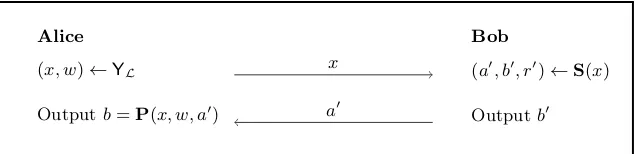
We construct a key-agreement protocol between Alice and Bob as follows. First Alice generates a solved instance-witness pair (x, w)←YL. Alice then sends xacross to Bob. Bob runs the simulatorS(x) to generate a transcript (a0, b0, r0), where a0 corresponds to the verifier’s message, b0 corresponds to the prover’s message and r0 correspond to the simulated random string for the verifier.13 Bob sends the first message a0 across to Alice. Bob then outputs the simulated second messageb0. Alice uses the witnesswto generate the prover’s responseb (i.e., the proverP’s actual response given the messagea0 from the verifier) and outputsb. The protocol is also depicted in Fig. 2.
Alice Bob
(x, w)←YL x (a0, b0, r0)←S(x)
Outputb=P(x, w, a0) a0 Outputb0
Fig. 2: Key Agreement from Deterministic Provers
To argue that Fig.2constitutes a key-agreement protocol, we need to show that Alice and Bob output the same value, and that no efficient eavesdropper Eve (who only sees their messages) can predict this output with good probability. That they agree on the same value follows from the fact that the prover is deterministic and the simulation is perfect. More specifically, since the simulation is perfect, the distribution of the simulated verifier’s messagea0 is the same as that of the actual verifier’s message; and now since the prover is deterministic, given (x, w, a0), the prover’s response b, which is also Alice’s output, is fixed.
13
Since the simulation is perfect and x ∈ L, if the simulator outputs (a0, b0, r0), thenb0, which is Bob’s output, is necessarily equal tob.
Next, we show that any eavesdropper Eve who is able to guess Bob’s output in the protocol can be used to break the cryptographic hardness of L. Suppose Eve is able to guess Bob’s output in the protocol with probabilityp. This means that given only x and a0, where (a0, b0, r0) is produced by the simulator S(x), Eve is able to find the messageb0:
Pr (x,·)←YL
(a0,b0,r0)←S(x)
[b0 =b00 whereb00←Eve(x, a0)] =p.
As theSZK argument has perfect completeness, and the simulation is also perfect, the transcripts produced by the simulator (on YES instances) are always accepted by the verifier. As Eve is able to produce the same prover messages as the simulator, her messages will also be accepted by the verifier. Namely,
Pr (x,·)←YL
(a0,b0,r0)←S(x)
[V(x, a0, b00;r0) = 1 where b00←Eve(x, a0)]≥p.
Again using the fact that the simulation is perfect, we can replace the simu-lated messagea0and simulated coin tossesr0with a verifier messageaand coins rgenerated by a real execution of the protocol:
Pr (x,·)←YL a←V(x;r)
[V(x, a, b00;r) = 1 where b00←Eve(x, a)]≥p.
Recall thatNL samples no-instances that are computationally
indistinguish-able from the YES instances generated by YL. If x had been a NO instance
sampled using NL, then the (computational) soundness of the SZK argument
implies that the verifier would reject with probability 1−s:
Pr
x←NL a←V(x;r)
[V(x, a, b00;r) = 1 where b00←Eve(x, a)]< s,
wheresis the soundness error. Ifpis larger thansby a non-negligible amount, then we have a distinguisher, contradicting the cryptographic hardness ofL. So, no efficient eavesdropper can recover the agreed output value with probability noticeably more thans, the soundness error of the SZKargument.
Notice that so far we have only guaranteed that the probability of success of the eavesdropper is s, which may be as large as a constant (rather than negligible).14Nevertheless, using standard amplification techniques (specifically those of Holenstein and Renner [HR05]) we can compile the latter to a full-fledged key-agreement protocol.
14
Randomized Prover. So far we have handled deterministic provers. But what happens if the prover were randomized? Agreement is now in jeopardy as the prover’s message b is no longer completely determined by the instance x and the verifier’s message a. Specifically, after Alice receives the simulated verifier message a0 from Bob, she still does not know the value ofb0 that Bob obtained from the simulator – if she ranP(x, w, a0), she could get one of several possible b’s, any of which could be the correctb0. Roughly speaking, Alice only has access to thedistributionfrom whichb0 was sampled (but not to the specific value that was sampled).
Eve, however, has even less to work with than Alice; we can show, by an approach similar to (but more complex than) the one we used to show that no polynomial-time eavesdropper can guessb0 in the deterministic prover case, that no polynomial-time algorithm can sample from any distribution that is close to the true distribution ofb0 for mostx’s anda0’s.
We make use of this asymmetry between Alice and Eve in the knowledge of the distribution of b0 (given xand a) to perform key agreement. We do so by going through an intermediate useful technical abstraction, which we call a Trapdoor Pseudoentropy Generator, that captures this asymmetry. We first construct such a generator, and then show how to use any such generator to do key agreement.
Trapdoor Pseudoentropy Generator. A distribution is said to possess pseudoen-tropy [HILL99] if it is computationally indistinguishable from another distribu-tion that has higher entropy15. We will later claim that in the protocol in Fig.2 (when used with a randomized prover), the distribution ofb0has some pseudoen-tropy for the eavesdropper who sees onlyxanda0. In contrast, Alice, who knows the witness w, can sample from the distribution that b0 was drawn from. This set of properties is what is captured by our notion of a trapdoor pseudoentropy generator.
A trapdoor pseudoentropy generator consists of three algorithms. The key generation algorithm KeyGenoutputs a public and secret key pair (pk,sk). The encoding, given a public keypk, outputs a pair of strings (u, v), where we call uthe public message and vthe private message.16 Thedecoding algorithmDec, given as input the corresponding secret key and the public message u, outputs a value v0. These algorithms are required to satisfy the following properties (simplified here for convenience):
– Correctness: The distributions ofv andv0 are identical, givenpk,sk, and u.
– Pseudoentropy: The distribution of v has some pseudoentropy given pk
andu.
15By default, the measure of entropy employed is that of Shannon entropy.
The Shannon entropy of a variable X given Y is defined as: H(X|Y) = Ey
−P
xPr[X =x|y]·log(Pr[X=x|y])
. 16
Correctness here only means that the secret key can be used to sample from the distribution of the private messagevcorresponding to the given public mes-sage u. This captures the weaker notion of agreement observed in the protocol earlier when Alice had sampling access to the distribution of Bob’s output.
The pseudoentropy requirement says that without knowledge of the secret key, the private messagevseems to have more entropy – it looks “more random” than it actually is. This is meant to capture the asymmetry of knowledge between Alice and Eve mentioned earlier.
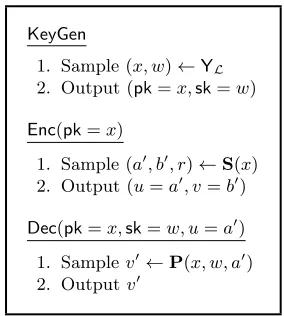
Constructing a Trapdoor Pseudoentropy Generator. Our construction of a trap-door pseudoentropy generator is described in Fig. 3. It is an adaptation of the earlier key exchange protocol for deterministic provers (from Fig.2). The pub-lic key is an instance x in the language L and the corresponding secret key is a witness w for x– these are sampled using the solved-instance generator. To encode with public keyx, the simulator from theSZKargument forLis run on xand the simulated verifier messagea0 is set to be the public message, while the simulated prover message b0 is the private message. To decode given x, w and a0, the actual prover is run with this instance, witness and verifier message, and the response it generates is output.
KeyGen
1. Sample (x, w)←YL 2. Output (pk=x,sk=w)
Enc(pk=x)
1. Sample (a0, b0, r)←S(x) 2. Output (u=a0, v=b0)
Dec(pk=x,sk=w, u=a0)
1. Samplev0←P(x, w, a0) 2. Outputv0
Fig. 3: Trapdoor Pseudoentropy Generator
Now we argue that this is a valid pseudoentropy generator. Since we will need to be somewhat precise, for the rest of this section, we introduce the jointly-distributed random variables X, A and B, where X represents the instance (sampled fromYL),Arepresents the verifier’s message (with respect toX), and Brepresents the prover’s response (with respect toXandA). Note that since the simulation in theSZKargument is perfect,AandB represent the distributions of the messages output by the simulator as well.
the simulated prover’s messageb0, while the output ofDecis the actual prover’s responsebwith the same instance and verifier’s message. Both of these have the same distribution, which corresponds to that of B conditioned on X =x and A=a0.
In order to satisfy the pseudoentropy condition, the variableBneeds to have some pseudoentropy given X and A. What we know, as mentioned earlier, is that B is unpredictable given X and A – that no polynomial-time algorithm, givenxand a0, can sample from a distribution close to that of the correspond-ing prover’s message b. Towards this end, we will use a result of Vadhan and Zheng [VZ12], who give a tight equivalence between unpredictability and pseu-doentropy. Applied to our case, their results say what we want – that the variable B has additional pseudoentropy log(1/s) givenX andA, where sis the sound-ness error from theSZKargument. More precisely, there exists a variableCsuch that:
(X, A, B)≈c(X, A, C) and H(C|X, A)>H(B|X, A) + log(1/s), (1)
where the above expressions refer toShannon entropy. The result of Vadhan and Zheng applies only when the variableB has a polynomial-sized domain, which holds since the proof-system is laconic (this is the first out of several places in which we use the laconism of the proof-system). The above shows that the construction in Fig. 3 is indeed a trapdoor pseudoentropy generator. Finally, and this will be crucial ahead, note that the private message produced by Enc
is short (i.e., the same length as the prover’s message in theSZK argument we started with).
In the case of anSZKprotocol withrrounds, the above construction would be modified as follows. The encoder Enc samples a transcript fromS(x), picks i ∈ [r] at random, sets the public message u to be all the messages in the transcript upto the verifier’s message in theith round, and the private message vto be the prover’s message in theithof the transcript. The decoderDecsamples v0 by running the prover on the partial transcriptu to get the actual prover’s
response in theithround.17Zero knowledge ensures thatv0andvare distributed
identically, and unpredictability arguments similar to the ones above tell us that v0 has pseudoentropy at least log(1/s)/r.
From Laconic Trapdoor Pseudoentropy Generator to Key Agreement. Next, given a trapdoor pseudoentropy generator, such as the one in Fig.3, we show how to construct a single-round key agreement protocol. We start with a pseudoentropy generator in which the public key ispk, the private key issk, the public message isu, the private message isv, and the output ofDecisv0. The random variables corresponding to these are the same symbols in upper case.v andv0 come from the distribution Vpk,u (V conditioned on P K = pk and U = u), and V has
additional pseudo-Shannon-entropyηgivenP K andU, whereη can be thought of as a constant (η was log(1/s) in the foregoing construction).
17
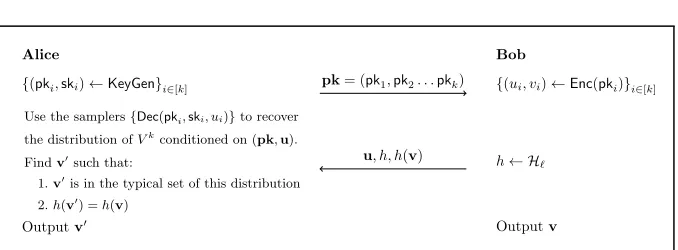
In the key agreement protocol, first Alice samples a key pair (pk,sk) for the pseudoentropy generator and sends the public key pk to Bob. Bob runs (u, v)←Enc(pk), keeps the private message v and sends the public messageu to Alice. We would like for Alice and Bob to agree on the stringv. In order for this to be possible, Bob needs to send more information to Alice so as to specify the specific v that was sampled from Vpk,u. A natural idea is for Bob to send,
along with the messageu, a hashh(v) ofv, wherehis a sampled from a pairwise independent hash function familyH.
Alice, on receiving the hash functionhand the hash valueh(v), uses rejection sampling to findv. She can sample freely from the distributionVpk,uby running
Dec(sk, u) because she knows the secret keysk of the pseudoentropy generator and the public message u. She keeps drawing samples v0 from Vpk,u, until she
finds one that hashes toh(v). Note that this brute force search is only feasible if the number of strings in the support of V is small, which is the case if the number of bits in v is small – considering the big picture, this is one of the reasons we want the the prover from theSZKargument to be laconic.
The main question now is how to set the length of the hash function. On the one hand, having a long hash helps agreement, as more information is revealed to Alice aboutv. On the other hand, security demands a short hash that does not leak “too much” information about v.
For agreement, roughly speaking, if the hash length were more than the max-entropy18ofV givenP K andU, which we denote by Hmax(V|P K, U), then the set of possible prover responses is being hashed to a set of comparable size, so with good probability, the hash valueh(v) will have a unique pre-image, which Alice can identify.
For security we would like to argue, using the Leftover Hash Lemma, that to any eavesdropper h(v) looks uniformly random given (pk, u, h). This would be true if the hash length were less than themin-entropy19 ofV givenP K andU, which we denote by Hmin(V|P K, U). Unfortunately, both of the above conditions cannot hold simultaneously because the min-entropy is upper-bounded by the max-entropy.
At this point we use the fact that Eve is computationally bounded. Hence, a computational analogue of high min-entropy, which we will call pseudo-min-entropy, would suffice for security. Concretely, consider a random variableCsuch that (P K, U, C) is computationally indistinguishable from (P K, U, V). Further-more, suppose that the min-entropy ofCgivenP KandU is considerably larger than the hash length. We can then use the Leftover Hash Lemma to argue that h(V) looks uniform to efficient eavesdroppers:
(P K, U, h, h(V))≈c(P K, U, h, h(C))≈s(P K, U, h, R)
18The max entropy corresponds to the logarithm of the support size. The
condi-tional max entropy of a random variable X given Y is defined as: Hmax(X|Y) = maxylog(|Supp(X|Y =y)|).
19
The min-entropy of a variable X given Y is defined as: Hmin(X|Y) =
whereR is the uniform distribution over the range ofh.
The benefit of this observation is that, since C is only required to be com-putationally close and not statistically close to V, the min-entropy ofC given P K andU could be much larger than that ofV givenP K andU. And if we can find a C such that Hmin(C|P K, U) is sufficiently larger than Hmax(V|P K, U), then we will indeed be able to choose a hash length that is both large enough for agreement and small enough for security.
Also notice that for the agreement to work, it is not necessary for the hash length to be larger than the max-entropy ofV (givenP KandU) itself – instead, if there was another variable D such that (P K, U, D) is statistically close to (P K, U, V), and also Alice is somehow able to sample from D givenP K =pk
andU =u, then it is sufficient for the hash to be longer than Hmax(D|P K, U). Given such a variable, Bob will operate as he did earlier, but Alice can assume that he is actually sampling from Dpk,u instead of Vpk,u, and since these two
distributions are close most of the time, the probability of Alice’s subsequent computation going wrong is small. This helps us because now we might be able to find such aD that has lower max-entropy givenP K andU thanV, and then Hmin(C|P K, U) would only have to be larger than this.
Following these observations, we set ourselves the following objective: find variablesC andD such that:
(P K, U, D)≈s(P K, U, V)≈c(P K, U, C)
and (2)
Hmax(D|P K, U)<Hmin(C|P K, U)
What we do know about V is that it has some pseudo-Shannon-entropy given P K andU. That is, there is a variable C such that:
(P K, U, V)≈c(P K, U, C) and H(C|P K, U)>H(V|P K, U) +η (3)
The rest of our construction deals with using this pseudo-Shannon-entropy to achieve the objectives above. This we do using a technique from Information Theory dating back to Shannon [Sha48] which is often referred to in the cryptog-raphy literature as flattening of distributions, which we describe next. We note that this technique has found use in cryptography before [HILL99,GV99,SV03].
Flattening and Typical Sets. The central idea here is that repetition essentially reduces the general case to the case where the distribution is “almost flat”. Namely, if we start with a distribution that has Shannon entropy ξand repeat it k times, then the new distribution is close to being uniform on a set whose size is roughly 2kξ. This set is called the typical set; it consists of all elements
whose probability is close to 2−kξ.
In our case, consider the distribution (P Kk, Uk, Vk), which is the k-fold
Vk conditioned on any (pk,u) in the support20 of (P Kk, Uk) as follows21:
TVk|pk,u=
n
v : Pr
Vk=v(P Kk, Uk) = (pk,u)
≈2−kH(V|P K,U)o
Considering the typical set is useful for several reasons. On the one hand, the typical set is quite small (roughly 2kH(V|P K,U)) in size, which means that any distribution supported within it has somewhat low max-entropy. On the other hand, there is an upper bound on the probability of any element that occurs in it, which could be useful in lower bounding min-entropy, which is what we want to do.
The most important property of the typical set it that it contains most of the probability mass of the conditional repeated distribution. That is, for most (pk,u,v) sampled from (P Kk, Uk, Vk), it holds that v lies in the typical set
conditioned on (pk,u); quantitatively, Holenstein and Renner [HR11] show the following:
Pr
(pk,u,v)←(P Kk,Uk,Vk)
v6∈ TVk|pk,u<2−Ω(k/q
2)
(4)
where qis the number of bits in each sample fromV. Recall that in our earlier construction of the trapdoor pseudoentropy generator, this corresponds to the length of the prover’s message in theSZK argument we started with. We want the above quantity to be quite small, which requires thatkq2. This is one of the considerations in our ultimate choice of parameters, and is another reason we want the prover’s messages to not be too long.
Back toPKEConstruction. We shall use the above facts to now show thatVkhas
pseudo-min-entropy givenP Kk andUk. LetCbe the random variable from the
expression (3) above that we used to show thatV has pseudo-Shannon-entropy. After repetition, we have that:
(P Kk, Uk, Vk)≈c(P Kk, Uk, Ck) and
H(Ck|P Kk, Uk) =k·H(C|P K, U)> k·(H(V|P K, U) +η).
Next, consider the variableC0 that is obtained by restricting, for eachpkandu, the variableCkto its typical set conditioned on (pk,u). By applying the bound
of Holenstein and Renner (4) with an appropriate choice ofk, we infer that:
(P Kk, Uk, Ck)≈s(P Kk, Uk, C0).
Further, the upper bound on the probabilities of elements in the typical set tells us thatC0 has high min-entropy22 givenP Kk andUk:
Hmin(C0|P Kk, Uk)≈H(Ck|P Kk, Uk)≥k·(H(V|P K, U) +η).
20
The support of (P Kk, Uk) consists of vectors withkelements. We represent vectors by bold symbols, e.g.,v.
21The actual definition quantifies how different from 2−kHthe probability is allowed
to be. 22
Putting the above few expressions together tells us thatVkhas some
pseudo-min-entropy givenP Kk andUk, which is in fact somewhat more than its
Shan-non entropy:
(P Kk, Uk, Vk)≈c(P Kk, Uk, C0)
and (5)
Hmin(C0|P Kk, Uk)
&H(Vk|P Kk, Uk) +k·η.
This satisfies our objective of getting a variable –Vk here – that has high pseudo-min-entropy (givenP Kk andUk). Our goal is now to find another vari-able that is statistically close to Vk given P Kk and Uk, and also has small max-entropy givenP Kk andUk. We do this using the same approach as above. Consider the variableV0 that is constructed from Vk in the same way C0 was
fromCk – for each (pk,u), restrictVk to its typical set conditioned on (pk,u).
Again, bound (4) tells us that the new distribution is close to the old one. And also, because of the upper bound on the size of the typical set, we have an upper bound on the max-entropy23 ofV0 givenP Kk andUk.
(P Kk, Uk, Vk)≈s(P Kk, Uk, V0)
and (6)
Hmax(V0|P Kk, Uk)
.H(Vk|P Kk, Uk).
Putting together expressions (5) and (6), we find that the relationship we want between these entropies ofC0 andV0 is indeed satisfied:
Hmin(C0|P Kk, Uk)
&Hmax(V0|P Kk, Uk) +k·η.
To summarize, we manage to meet the conditions of expression (2) with respect to (P Kk, Uk, Vk) (instead of (P K, U, V)) with C0 taking the role ofC and V0
taking the role of D. We can now finally fix the length of our hash – call it ` – to be between Hmax(V0|P Kk, Uk) and Hmin(C0|P Kk, Uk), which can be done
by setting it to a value between H(Vk|P Kk, Uk) and H(Vk|P Kk, Uk) +kη for
an appropriate k, and emulate the earlier protocol. We will be able to use the Leftover Hash Lemma as desired to argue security and use the low max-entropy ofV0 to argue agreement.
The final key agreement protocol from a trapdoor pseudoentropy generator is presented in Fig.4.
set – it can contain elements whose probabilities are slightly larger than 2−kH(C|P K,U). We need to pick this slack carefully – if it is too large,C0 loses its min-entropy, and if it is too small the typical set also becomes too small and the bound in (4), which actually depends on this slack, becomes meaningless. This is another constraint on our choice of parameters.
23
Alice Bob
{(pki,ski)←KeyGen}i∈[k] pk= (pk1,pk2. . .pkk) {(ui, vi)←Enc(pki)}i∈[k]
Use the samplers{Dec(pki,ski, ui)}to recover the distribution ofVkconditioned on (pk,u). Findv0such that:
1.v0is in the typical set of this distribution 2.h(v0) =h(v)
u, h, h(v) h← H
`
Outputv0 Outputv
Fig. 4: Key Agreement from Trapdoor Pseudoentropy Generator
How Laconic? To examine how long the prover’s message can be, lets recall the restrictions of our construction. First, we need both parties to be efficient. While Bob is clearly efficient, Alice performs an exhaustive search over the domain of possible prover messages. The size of this domain is 2q·k because the parties repeat the underlying protocolktimes and the length of each prover’s message is qbits. For Alice to be efficient, this domain has to be polynomial-sized, requiring that q·k = O(logn), where n is the input length. Second, we need that the concentration bound for the typical set (Eq. (4)) to be meaningful; that is, we need k/q2 to be at least a constant. Together, these imply thatq3 needs to be O(logn). Lastly, this setting of parameters also suffices for the [VZ12] result that we used in Eq. (1).
2
The Assumption and Main Theorem
In this section, we specify our assumption on the existence of laconic zero-knowledge proof-systems, and state our main theorem regarding its implication for public-key encryption. Due to space limitations, the formal descriptions of our constructions and the proof of our theorem are deferred to the full version of this paper.
We first introduce some necessary definitions and notations. Throughout this section, we use L to denote an NPlanguage with witness relation RL. We use
YL and NL to denote probabilistic polynomial-time algorithms that are to be
seen as sampling algorithms for YES and NO instances of L. More specifically, the sampler YL(1λ) outputs samples of the form (x, w) such that with all but
negligible probability (in λ), it holds that (x, w) ∈ RL. We call YL a solved
instance generator. On the other hand,NL(1λ) outputs samplesxsuch that with
all but negligible probability,x /∈ L. We shall not rely on the fact that the NO samplerNL is anefficient algorithm. Still we find it easier to present it as such
for symmetry withYL (which must be efficient).
instances (where YES instances come with corresponding witnesses). Since the choice of YES and NO distributions is always clear from the context, we often simply refer to the above tuple as the language (although we actually mean the languageLwith these specific distributions over its instances). We start by defining what we mean when we say that such a language is cryptographically hard.
Definition 2.1 (Cryptographic Hardness).Lett=t(λ)∈Nandε=ε(λ)∈ [0,1]. The language (L,YL,NL)is (t, ε)-cryptographically hard if YL is a solved instance generator, and for every probabilistic algorithm Athat on input (1λ, x) runs in time t(λ)and for all sufficiently large λ∈Nit holds that:
Pr (x,·)←YL(1λ)
A(1λ, x) = 1− Pr
x←NL(1λ)
A(1λ, x) = 1
≤ε(λ),
where the above probabilities are also over the random coins of A. We say that (L,YL,NL) is cryptographically hard if it is (λc,1/λc)-hard for every constant c >0.
Beingcryptographically hard is a stronger requirement than the usual notion ofaverage-case hardness(the latter means that it is hard to distinguish a random YES instance from a random NO instance). Specifically, cryptographic hardness requires both (1) average-case hardnessand(2) the existence of a solved instance generator (wrt the average-case hard distribution). In particular, the existence of a cryptographically hard language is equivalent to the existence of one-way functions.24 As noted above, when we say that the languageL is cryptograph-ically hard we are actually implicitly referring to the sampling algorithms YL
andNL.
Next we define honest-verifier statistical zero-knowledge (SZK) arguments, which are similar to statistical honest-verifier zero-knowledge proofs but the soundness condition is only required to hold against malicious provers that run in polynomial-time. We remark that since we will be using the existence of
SZK arguments to construct other objects, both the relaxations that we em-ploy (namely requiring only computational soundness and honest verifier zero knowledge) only strengthen our results.
Below, we use (P,V)(1λ, x) to refer to the transcript of an execution of an
interactive protocol with prover Pand verifierV on input (1λ, x). We also use
(P(w),V)(1λ, x) to denote a similar execution where the prover is additionally
24
That YES instances are indistinguishable from NO instances implies that it is hard to compute a witness for a YES instance. Given this, a function that takes coins for
given a witnesswas an auxiliary input. In both cases, we sometimes also use the same notation to refer to the result (i.e., verifier’s output) of such an execution – the appropriate interpretation will be clear from context.
Definition 2.2 (SZK Arguments). Let c = c(λ) ∈ [0,1] and s = s(λ) ∈ [0,1]. An interactive protocol (P,V) is an Honest Verifier SZK Argument with completeness error c and soundness error s for a language L ∈NP, with witness relation RL, if the following properties hold:
– Efficiency: BothPandV are probabilistic polynomial-time algorithms.
– Completeness: For any(x, w)∈ RL, and all large enoughλ:
Pr(P(w),V)(1λ, x)accepts≥1−c(λ),
where the parameterc is called the completeness error.
– Soundness:For any probabilistic polynomial-timecheating proverP?, any x /∈ L, and large enoughλ:
Pr(P∗,V)(1λ, x) accepts≤s(λ),
where the parametersis called the soundness error.
– Honest Verifier Statistical Zero Knowledge: There is a probabilistic polynomial-time algorithmS(called the simulator) that when given anyx∈ L simulates the transcript of the interactive proof on input x. That is, for any(x, w)∈ RL and for all sufficiently large λ:
SD (P(w),V)(1λ, x),S(1λ, x)
≤negl(λ).
Note that our definition only deals withNPlanguages and requires that the prover is efficient. Typically, when defining an SZK proof (rather than argu-ment) this is not done, and the honest prover is allowed to be computationally unbounded. However, this is the natural choice since we focus onargument sys-tems (where the soundness requirement is only against malicious provers that are also efficient).
Remark 2.3 (Restricted-view Simulation). For our main result, it suffices that the simulator only simulates the transcript of the interactive proof and not the random-coins of the verifier. The standard definition of simulation is stronger – it also requires that the simulator output random-coins for the verifier that are consistent with the transcript. Ostrovsky [Ost91] called the weaker no-tion restricted-view simulation, and showed that average-case hard languages with honest-verifier SZK proofs with restricted-view simulation (without effi-cient provers) imply the existence of one-way functions.
Definition 2.4 (Laconism). Let q= q(λ) ∈N and r =r(λ)∈ N. An inter-active protocol(P,V)is said to ber-round andq-laconic if it has at mostr(λ) rounds, and each message from Pto V is at most q(λ) bits long when run on any input (1λ, x), for large enough λ.
We can now state our main assumption as follows.
Assumption 2.5 There exists a cryptographically hard language (L,YL,NL) for which there is an r-round and q-laconic honest-verifier SZKargument with completeness errorc and soundness error ssuch that:
– There is a constant β >0 such that 1−c(λ)> s(λ) +β, for large enough λ∈N.
– qandr are such thatr2·q3=O(log(λ)).
Our main result is given in the next theorem.
Theorem 2.6 (PKEfrom Laconic SZK).If Assumption2.5holds, then there exists a public-key encryption scheme.
The construction of our public-key encryption scheme from Assumption2.5, and the proof of Theorem 2.6, are presented in the full version of this paper. There, in addition, we consider two relaxations of Assumption2.5, each of which still suffices for our construction. We also present a comparison of our assump-tions to concrete assumpassump-tions that have been used in the past to construct public-key encryption.
Acknowledgments
We thank Vinod Vaikuntanathan for his encouragement and for helpful dis-cussions. We thank the anonymous reviewers for very useful comments and in particular for suggesting the abstraction of trapdoor pseudoentropy generator.
[ABW10] Benny Applebaum, Boaz Barak, and Avi Wigderson. Public-key cryptography from different assumptions. In Proceedings of the 42nd ACM Symposium on Theory of Computing, STOC 2010, Cam-bridge, Massachusetts, USA, 5-8 June 2010, pages 171–180, 2010. [Ale03] Michael Alekhnovich. More on average case vs approximation
com-plexity. In 44th Symposium on Foundations of Computer Science (FOCS 2003), 11-14 October 2003, Cambridge, MA, USA, Proceed-ings, pages 298–307. IEEE Computer Society, 2003.
[AR16] Benny Applebaum and Pavel Raykov. On the relationship between statistical zero-knowledge and statistical randomized encodings. In Annual Cryptology Conference, pages 449–477. Springer, 2016. [Bab16] L´aszl´o Babai. Graph isomorphism in quasipolynomial time
[ex-tended abstract]. InProceedings of the 48th Annual ACM SIGACT Symposium on Theory of Computing, STOC 2016, Cambridge, MA, USA, June 18-21, 2016, pages 684–697, 2016.
[BDV16] Nir Bitansky, Akshay Degwekar, and Vinod Vaikuntanathan. Struc-ture vs hardness through the obfuscation lens. IACR Cryptology ePrint Archive, 2016:574, 2016.
[BHY09] Mihir Bellare, Dennis Hofheinz, and Scott Yilek. Possibility and impossibility results for encryption and commitment secure under selective opening. InEUROCRYPT, pages 1–35, 2009.
[BIN97] Mihir Bellare, Russell Impagliazzo, and Moni Naor. Does paral-lel repetition lower the error in computationally sound protocols? In 38th Annual Symposium on Foundations of Computer Science, FOCS ’97, Miami Beach, Florida, USA, October 19-22, 1997, pages 374–383, 1997.
[BL13] Andrej Bogdanov and Chin Ho Lee. Limits of provable security for homomorphic encryption. In Ran Canetti and Juan A. Garay, edi-tors,Advances in Cryptology - CRYPTO 2013 - 33rd Annual Cryp-tology Conference, Santa Barbara, CA, USA, August 18-22, 2013. Proceedings, Part I, volume 8042 ofLecture Notes in Computer Sci-ence, pages 111–128. Springer, 2013.
[CS02] Ronald Cramer and Victor Shoup. Universal hash proofs and a paradigm for adaptive chosen ciphertext secure public-key encryp-tion. In Advances in Cryptology - EUROCRYPT 2002, Interna-tional Conference on the Theory and Applications of Cryptographic Techniques, Amsterdam, The Netherlands, April 28 - May 2, 2002, Proceedings, pages 45–64, 2002.
[GH98] Oded Goldreich and Johan H˚astad. On the complexity of interactive proofs with bounded communication. Inf. Process. Lett., 67(4):205– 214, 1998.
[GK93] Oded Goldreich and Eyal Kushilevitz. A perfect zero-knowledge proof system for a problem equivalent to the discrete logarithm. Journal of Cryptology, 6(2):97–116, 1993.
[GMW87] Oded Goldreich, Silvio Micali, and Avi Wigderson. How to play any mental game or A completeness theorem for protocols with honest majority. In Proceedings of the 19th Annual ACM Symposium on Theory of Computing, 1987, New York, New York, USA, pages 218– 229, 1987.
[Gol08] Oded Goldreich. Computational complexity - a conceptual perspec-tive. Cambridge University Press, 2008.
[GOVW12] Sanjam Garg, Rafail Ostrovsky, Ivan Visconti, and Akshay Wadia. Resettable statistical zero knowledge. In Ronald Cramer, editor, Theory of Cryptography - 9th Theory of Cryptography Conference, TCC 2012, Taormina, Sicily, Italy, March 19-21, 2012. Proceedings, volume 7194 ofLecture Notes in Computer Science, pages 494–511. Springer, 2012.
[GV99] Oded Goldreich and Salil P. Vadhan. Comparing entropies in statis-tical zero knowledge with applications to the structure of SZK. In Proceedings of the 14th Annual IEEE Conference on Computational Complexity, Atlanta, Georgia, USA, May 4-6, 1999, page 54, 1999. [GVW02] Oded Goldreich, Salil Vadhan, and Avi Wigderson. On interactive proofs with a laconic prover. Computational Complexity, 11(1-2):1– 53, 2002.
[HHRS15] Iftach Haitner, Jonathan J Hoch, Omer Reingold, and Gil Segev. Finding collisions in interactive protocols—tight lower bounds on the round and communication complexities of statistically hiding commitments. SIAM Journal on Computing, 44(1):193–242, 2015. [HILL99] Johan H˚astad, Russell Impagliazzo, Leonid A. Levin, and Michael
Luby. A pseudorandom generator from any one-way function.SIAM J. Comput., 28(4):1364–1396, 1999.
[HLWW16] Carmit Hazay, Adriana L´opez-Alt, Hoeteck Wee, and Daniel Wichs. Leakage-resilient cryptography from minimal assumptions. J. Cryp-tology, 29(3):514–551, 2016.
[HNO+09] Iftach Haitner, Minh-Huyen Nguyen, Shien Jin Ong, Omer Rein-gold, and Salil P. Vadhan. Statistically hiding commitments and statistical zero-knowledge arguments from any one-way function. SIAM J. Comput., 39(3):1153–1218, 2009.
[HR11] Thomas Holenstein and Renato Renner. On the randomness of in-dependent experiments.IEEE Transactions on Information Theory, 57(4):1865–1871, 2011.
[IR89] Russell Impagliazzo and Steven Rudich. Limits on the provable consequences of one-way permutations. InProceedings of the twenty-first annual ACM symposium on Theory of computing, pages 44–61. ACM, 1989.
[Kil88] Joe Kilian. Founding crytpography on oblivious transfer. In Pro-ceedings of the twentieth annual ACM symposium on Theory of com-puting, pages 20–31. ACM, 1988.
[KMN+14] Ilan Komargodski, Tal Moran, Moni Naor, Rafael Pass, Alon Rosen, and Eylon Yogev. One-way functions and (im)perfect obfuscation. In55th IEEE Annual Symposium on Foundations of Computer Sci-ence, FOCS 2014, Philadelphia, PA, USA, October 18-21, 2014, pages 374–383. IEEE Computer Society, 2014.
[LV16] Tianren Liu and Vinod Vaikuntanathan. On basing private informa-tion retrieval on np-hardness. In Eyal Kushilevitz and Tal Malkin, editors, Theory of Cryptography - 13th International Conference, TCC 2016-A, Tel Aviv, Israel, January 10-13, 2016, Proceedings, Part I, volume 9562 ofLecture Notes in Computer Science, pages 372–386. Springer, 2016.
[NV06] Minh-Huyen Nguyen and Salil P. Vadhan. Zero knowledge with efficient provers. In Proceedings of the 38th Annual ACM Sympo-sium on Theory of Computing, Seattle, WA, USA, May 21-23, 2006, pages 287–295, 2006.
[Ost91] Rafail Ostrovsky. One-way functions, hard on average problems, and statistical zero-knowledge proofs. InProceedings of the Sixth Annual Structure in Complexity Theory Conference, Chicago, Illinois, USA, June 30 - July 3, 1991, pages 133–138, 1991.
[OV08] Shien Jin Ong and Salil P. Vadhan. An equivalence between zero knowledge and commitments. InTheory of Cryptography, Fifth The-ory of Cryptography Conference, TCC 2008, New York, USA, March 19-21, 2008., pages 482–500, 2008.
[PPS15] Omkant Pandey, Manoj Prabhakaran, and Amit Sahai. Obfuscation-based non-black-box simulation and four message concurrent zero knowledge for NP. In Yevgeniy Dodis and Jes-per Buus Nielsen, editors, Theory of Cryptography - 12th Theory of Cryptography Conference, TCC 2015, Warsaw, Poland, March 23-25, 2015, Proceedings, Part II, volume 9015 ofLecture Notes in Computer Science, pages 638–667. Springer, 2015.
[PVW08] Chris Peikert, Vinod Vaikuntanathan, and Brent Waters. A frame-work for efficient and composable oblivious transfer. In CRYPTO, pages 554–571, 2008.
Computing, Baltimore, MD, USA, May 22-24, 2005, pages 84–93. ACM, 2005.
[Rot11] Ron Rothblum. Homomorphic encryption: From private-key to public-key. In Theory of Cryptography Conference, pages 219–234. Springer, 2011.
[RSA78] Ronald L. Rivest, Adi Shamir, and Leonard M. Adleman. A method for obtaining digital signatures and public-key cryptosystems. Com-mun. ACM, 21(2):120–126, 1978.
[Sha48] C. E. Shannon. A mathematical theory of communication.The Bell System Technical Journal, 27(3):379–423, July 1948.