I
Journal of
Volume 9, Nwnber 2 Xarch 1956
RANGE
MANAGEMENT
Report of the President, 1955
Presidential Address-Ninth Annual Meeting, American Society of Range Management, Denver, Colorado, January 24-27, 1956.
A. P. ATKINS
Box 470, Guymon, Oldahomct
This report. is not intended to be a narrative of accomplishment, but rath- er an outline of prospects and possibil- ities for the future. As justification for any pointed suggestions or blunt comments which it contains, I remind you that, of all the occupational groups in the Society, only the ranchers wear spurs.
To have served as your President during the past’ year has been an honor which I deeply and sincerely appreci- ate. It has also been a responsibility which I ha,ve tried to carry to the best of my ability. From a personal stand- point, it has been a genuine pleasure to have been associated with a group of fine and able men who have cont,rib- uted generously of their time and tal- ent to make this a successful year. I want. to express my personad gratitude to the Executive Secretary, the Edit,or of the JOURNAL, the Vice President and Direetors, the Local Section offi- cers, and the Chairmen and members of the various committees. You have elected a fine group of officers for the coming year and I know they can count on your continued support.
For the past five years, first as a Director, and then as your Vice Pres- ident and President, I ha,ve had a better-than-average opportunity to ob- serve the Society’s growth and develop- ment, and also its problems, during a very critical period of its life. I firmly believe that the Society is filling a distinct need by furnishing a common - meeting ground bet,ween scientific re-
search and pradical application in a field whose importance is only now be- ing accorded the recognition which it
has long deserved. Our objectives are well known-they are printed on the inside cover of every issue of the JOITRNN,. From an organizational standpoint, we still need a substantial increase in membership if we are to continue to advance toward those ob- jectives.
We definitely need an additional thousand members to reduce unit costs, pasticularly of printing the JOURNAL and the housekeeping duties of the Executive Secretary’s office. Also, we need to boost the JOURNAL’S subscrip- tion list, in order to meet’ the established minimum requirements maintained by national advertisers. This increase in membership would alleviate financial problems and give us the freedom to undertake worthwhile projects which are now beyond our capabilities. Al- though overgra,zing of ranges has been
the besetting sin of stockmen since Biblical times, I am sure that the So- ciety is not overgrazing its opportuni- ties, either in membership or in the scope of its activities.
It is my definite conviction that the future growth and development of the Society will depend principally upon the growth and development of the local Sections. Your Directors reached this conclusion back in 1953 when the policy was adopted of collecting both National and Section dues through the Executive Secretary’s office, and re- mitting Section dues back to the local officers. Since that time, the number of Section affiliates has nearly doubled, rancher membership has increased nearly 50 percent, and total Society membership by more than 17 percent. Section activities in the same period increased as follows :
LMeetings and tours (other than an- nual business meetings)
1952 : 9 out of 15 Sections held one or more
1955: 12 out’ of 17 held and 9 held three. Range schools, judging other activities for youth 1952 : 3 were reported.
t,wo or more,
contests and
1955 : 10 were reported.
In 1952, 4 Sections issued one or more newsletters to their affiliates.
In 1955, newsletters were issued by 15 Sections.
The total attendance at Section meetings in 1955 was unquest,ionably greater than the total Society member- ship. Rancher interest in particular is stimulated by local activities, and ranches also offer our best opportunity for membership expansion.
64 REPORT OF THE PRESIDENT, 1955
way to secure members than by per- sonal contact, and the best way to handle a big job is to cut it into pieces that small groups can handle. A year ago, I asked the Section Chairmen to assume the responsibility of a member- ship drive. Each of them set a modest, goal for his own Section and agreed to organize and supervise an effort to reach it. I firmly believe that this is the proper method; however, the Sec- t.ion officers can’t do it by themselves. They need the enthusiastic support of every member.
This Ninth Annual Meeting is some- thing of a landmark, since it is the first time that the Society has gone back to a former location for ita An- nual Meeting. On behalf of all of us who have joined tha Society since it met here seven years ago, I offer con- gra,tulations and best wishes to our senior members.
If you will investigate the begin- nings of the Society, you will find that there was considerable discussion as to
whether to start an entirely new or- ganization or to organize as a subsid- iary group within one of the older pro- fessional societies. There was also a question as to membership-whether it should be limited to professional sci- entists and administrators or broad- ened to include ranchers and others.
The men who organized this Society are to be commended for their refusal to become a minority within a larger and older group. They preferred the more difficult, task of starting a pioneer organization, and although ma,ny of them were scientists, of considerable renown, they opened the membership of the Society to anyone interested in range management,, without regard to academic qualifications. I submit to you that the present status of the So- ciety is vindication of their judgment.
However, this is no time for relaxa- tion or complacency-either as an or- ganization or as individuals. Many ranchers have found that pre-war standards of production and efficiency
are not adequate for this period rising costs and declining prices. Gra is far too valuable to abuse, and tc expensive for inefficient< use. Ma,y remind the professional groups with this organization that we ranchers e pect you, too, to keep abreast of tl times? (We are like the fellow WI threatened to vote against his Co gressman unless he received a pa tieular favor which the Congressmz could not grant. The Congressman r minded him of all the fa.vors of pa years, and the fellow said, “Yes, that all true, but what have you done fc me lately?”
The opportunities for leadership ar progress in the field of range manag ment are as wide as the horizons. Tl problems of 1956 constitute a challeng to scientists, teachers, technicians, ac minis8trators and ranchers alike. earnestly hope and sincerely belieT that the Society will meet that cha lenge.
MESSAGE FROM THE NEW PRESIDENT 65
John D. (Danny) Freeman
1956 President of American Society of Range Management
Area Conservationist, U. S. Soil Conservation Service, Prescott, Arizona. Born in Tulia, Texas in 1911. Spent early life in a farm-ranch environment. Obtained the B. S. degree in Agri- culture in 1935 from New Mexico A. & M. Col- lege with a major in animal husbandry and bot- any. Began work as Range Examiner, in the Soil Conservation Service at Safford, Arizona in 1935. Has worked continuously since this time in range management and soil conservation in Arizona, New Mexico, Colorado and Utah. A charter member of the American Society of Range Management. Served as Vice-Chairman, Secretary-Treasurer and Chairman of the Ari- zona Section. Vice President of the American Society of Range Managemeut in 19%
A Message from the New President-
It is indeed a great honor and privilege to be elected president of such a grand or- ganization. I hope I am worthy of your confidences and can live up to your ex- pectations. 1’11 try.
To me the American Society of Range. Management is just about the greatest thing that ever came into being. It serves as an excellent meeting ground for techni- cians, educators, ranchers, economists, re- search people and others to discuss and learn more about good range management. I’ve noticed that at all National and Sec- tion meetings everyone comes with an open mind; there are no chips on shoulders nor axes to grind. It’s a friendly and congenial atmosphere. Through such surroundings much good can be accomplished.
To gain in stature, prestige and service to members we need more members. We have a comfortable 3,000 now but we need an- other l,OOO-at least a minimum of 500- to interest more national advertisers so the Journal can become self -supporting. That accomplished, the Society could then get going on more of its objectives and goals.
I am a firm believer in the Sections. I am convinced that the future of our organ- ization rests squarely with the Sections. It’s the local interest and participation in programs, tours and projects that pay off and keep the members interested. I am in- deed happy to see the leadership develop- ing in the Sections. It is only natural that the parent organization should look to the Sections for leadership and guidance.
Plant Vigor as a Criterion of
Range Condition
L. R. SHORT AND E. J. WOOLFOLK’
Range l’echnicia,n, F. A. O., Tel aviv, Israel; Chief, Divi- sion of Range Man,agement Research, Califorka Forest & Range Experimend Station, Forest Service, USDA, Berke- Zey, California
Research and long experience have taught that range vegetation and soils change with weather and grazing use. Favorable weather and conservative grazing are con- ducive to improvement, optimum productivity and relative stability of the range resource. Conversely, too heavy grazing or adverse weather may thin the vegetation, change its composition, reduce the vigor of desirable species, decrease herbage production, expose the soil to wind and water erosion and adversely affect soil-water relation- ships. Range productivity as re- lated to potential, under good man- agement, is commonly known as range condition. Simply stated, range condition is range health. Numerous workers have shown that range health can be deter- mined from study of such vegeta- tion features as speciation, density, and herbage production together with organic matter, friability, in- filtration rate and other soil as- pects. Reappraisal, after a time lapse, of these same features on a given range indicates the trend or change in condition that has oc- curred. .
Perhaps the most noteworthy re- cent occurrence in the considera- tion of range condition and trend was the development of the 3-step method (Parker, 1951). This use- ful, rapid method evaluates sev- eral easily observed features of range vegetation and soils. One of these, plant vigor, which is esti- mated in terms of plant height, has been a subject of controversy
IAuthors formerly at Northern Rocky Mountain Forest 4 Range Experiment Station, Forest Service, USDA, Missoula, Montana.
among range technicians. Common objections to the use of plant vigor as a measure or criterion of range welfare are : (1) it is difficult to describe or measure, (2) it is ob- scured by the effects of current weather, and (3) widely spaced climax perennial grasses may in some instances become more robust on range in poor condition than in better condition situations. In re- gard to these objections, Parker
(1954) points out, “The first two objections are believed to have been met by the methodology spe- cified in the 3-step method. The third criticism is not serious, since it is the very thing that we wish to see happen on ranges in unsatis- factory condition. Whenever a change is made in the intensity of grazing use, it is first reflected in vigor, later to be followed by changes in density, composition and soil stability. Vigor is thus in- dicative of short time trends.”
Protection or a history of very light grazing, at most, of some plants on representative sites com- parable to adjacent grazed areas is a requirement of studies involving plant vigor. This condition is often difficult to meet and even with advance planning the protected areas may require time for recov- ery from grazing use. Fortunately, the natural widespread occurrence of pricklypear (Opuntia polyacalz- tha) in the Great Plains (Costello, 1941) provides natural protection which will suffice in most instances.
Grazing animals largely avoid range herbage protected by prick- lypear as long as adequate herbage is available elsewhere. Even when herbage is scarce cattle graze only very lightly above pricklypear and
66
sheep rarely make any effort to utilize herbage that is interspersed with or extends above the clumps
(Woolfolk, 1949). Comparisons of plants protected by pricklypear with those adjacent but unpro- tected on range pastures stocked heavily and lightly for many years and obviously in poor and good condition, respectively, offered a reliable means of appraising plant height in terms of existing range condition. Such comparisons also provided a procedure which would eliminate the confounding influ- ence of current weather between years and which could be used at most any time during the year. Earlier observations by Reed and Peterson (1952) firmly established a strong association ‘between un- grazed plant heights and range condition using the same range areas described herein and the six most important grasses. Accord- ingly, this association and the ob- servations of plant heights on northern Great Plains ranges in different condition classes con- vinced the authors of the sound- ness and value of plant height as an expression of vigor and of vigor, so measured, as an important cri- terion in the classification of range condition.
The objective herein is to pre- sent the results of a study of blue- stem wheatgrass heights conducted at the United States Range Live- stock Experiment Station near Miles City, Montana.2 This study was conducted to test the relation between vigor as reflected by plant heights, and range condition and to determine the value of prickly- pear-protected plants for plant height comparisons.
The Study
Two range areas were selected which had been stocked for 16 years at light and heavy intensi- 2The ranges used constituted the basis for a rate-of-stocking experiment con-
PLANT VIGOR A CRITERION OF RANGE CONDITION 67
_- ties, respectively, for at least 6 summer months each year, begin ning mid-May. These levels of stocking had maintained one range in good condition and caused the other to deteriorate to a poor con- dition (Holscher and Woolfolk, 1953 ; Reed and Peterson, 1952). Height of bluestem wheatgrass (Agropyron smithii) plants was studied on these two ranges from 1948 through 1950 in an effort to relate plant vigor to range condi- tion.
The study was confined to one major range subtype character- ized by deep, fine-textured, very slowly permeable soils occupying a terrace position, and a vegetation cover dominated by bluestem wheatgrass. The range vegetation also include some pricklypear, Sandberg bluegrass (Pea secunda) , buffalograss (Buchloe dactyZoides), green needlegrass (Xtipa Grid&a), tumblegrass (Xchedonnardus pani- culatus) , big sagebrush (Artemisia tridentata) and several perennial forb species.
Four study areas were selected where across-the-fence comparisons between the two ranges in differ- ent condition classes could be made. Observations consisted of measurements to the nearest half centimeter of the tallest ungrazed leaves of fully grown bluestem wheatgrass plants nearest to points located by a restricted-random method within each study area. Thirty-three such measurements were made on each side of the fence in each of the four study areas using plants that were grow- ing within the shelter of prickly- pear clumps. An equal number of plants growing adjacent but out- side the pricklypear clumps was also measured. Measurements were made in July each year in range pastures grazed currently since mid-May. At observation time each year the cool-weather bluestem wheatgrass plants had reached _ maximum development and a large majority had not yet been grazed even on the range in poor condi- tion (Fig. 1).
Results
Plant vigor, as reflected by height of bluestem wheatgrass plants, varied in this study from the effects of weather, of protection from grazing, and of cumulative range condition. These variations establish and strengthen “vigor” as a criterion of range condition.
Between Ranges
The relative condition of the two ranges studied has been firmly established. Holscher and Woolfolk
(1953) and Reed and Peterson (1952) showed that heavy forage utilization year after year reduced herbage yield, decreased forage quality, reduced water intake by the soil, reduced calf weight and beef production per cow, and in- creased need for supplemental feeding.
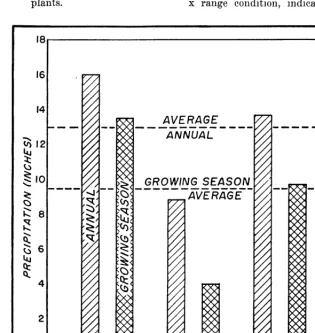
bluestem plants was nearly 19 cm. in 1948. In 1949 it was less than 15.5 cm., and in 1950 16.4 cm. Un- der poor condition the plants aver- aged 16.2 cm. in 1948, 14.4 cm. in ’ 1949, and 15.1 cm. in 1950. These variations can be largely explained by examining the precipitation rec- ords. The initial year, 1948, was unusually favorable. Total preci- pitation for the year was 22 per- cent above the record mean, and_ growing season precipitation was 42 percent above the amount usu- ally received. Growing season rain- fall in 1948 was actually higher than the longtime average annual of 13.10 inches for Miles City (Fig. 2). In 1949 annual precipitation was down to less than 9 inches and growing season moisture was only 42 percent of the record mean. Bluestem heights dropped accord-
FIGURE 1. Bluestem wheatgrass plants on Northern Great Plains cattle range in poor condition (left) and good condition (right). The bluestem in the left half of each photo is protected by pricklypear cactus and that on the right is unprotected. Note the large proportion of ungrazed leaves and the difference in leaf height between
good and poor range. Photographed July 18, 1950.
Each year of the study bluestem wheatgrass plants averaged smaller in stature on the range in poor condition. The differences ranged from 2.45 cm. in 1948 to 0.95 cm. in 1949. These differences appear small but translated to inches the 1948 difference becomes practically a full inch. Size of plant, one of the two important determinants in herbage production, and conse- quently grazing capacity, was defi- nitely smaller on the range in poor condition.
Between Years
Bluestem wheatgrass heights va- ried from one year to the next in this study. On range in good con- dition the average height of all
ingly in all situations. The follow- ing year, 1950, was more favorable, slightly above the annual and growing season means, and blue- stem heights improved in all situ- ations.
Inside and Outside Pricklypear Clumps
68 L. R. SHORT AND E. J. WOOLFOLK
Table 1. Comparative heights of ungrazed bluestem plants protected and un- Very poor vigor- protected by pricklypear on northern Great Plains ranges in good and poor con-
dition. Data from 4 study areas, 1948-1950. h e i g h t of pricklypear-pro- Less than 67 percent of the m tected plants.
il Range in good condition Range in poor condition Another and perhaps somewhat Year Protected Unprotected Difference Protected Unprotected Difference broader use . would establish two
ems. ems. ems. % ems. ems. ems. % vigor classes, “satisfactory” and
1948 19.5 17.8 1.7 91.3 18.6 13.8 4.8 74.2 “unsatisfactory,” depending upon 1949 16.1 14.7 1.4 91.3 16.8 12.1 4.7
1950 17.5 15.3 2.2 87.4 17.6 12.7 4.9 ii*: 72*g the level of the vigor ratio (un- protected vs. protected plants) Aver. 17.7 16.0 1.7 90.4 17.7 12.9 4.8
above or below 80 percent, respec-
what shorter. For the three years the average difference in height between protected and unprotected plants was 1.7 cm. (Table 1).
On range in poor condition blue- stem wheatgrass heights inside the pricklypear clumps varied from 16.2 cm. to 19.6 cm. Outside the clumps, the variation was from 11.5 to 14.8 cm. and the average difference in height between pro- tected and unprotected plants over the 3-year period was 4.8 cm.
A further comparison shows a definite correlation between range condition and the percentage or ratio of leaf heights of unpro- tected to protected bluestem wheat- grass (Table 1). On range in good condition, bluestem plants un- grazed and outside the the prickly- pear averaged about 90 percent as vigorous, based on height, as those inside the clumps. On range in poor condition the unprotected plants averaged slightly less than 73 percent as vigorous as the pro- tected ones.
The study included only ranges in “good” and “poor” condition; data are lacking for excellent, fair and very poor condition classes. Regardless, the aforementioned ra- tios suggest a possible guide to evaluation of the vigor factor, based on bluestem heights, in prep- aration of standards for classify- ing range condition. Using the ap- proximate mid-point between the two established ratios, i.e., 81 per- cent, as an anchor for the “fair” vigor class, the following guide is developed wherein each vigor class corresponds to a comparable con- dition class.
Excellent vigor-
height of pricklypear-protected plants.
Good vigor-
86 to 94 percent of the height of pricklypear-protected plants.
Fair vigor-
77 to 85 percent of the height of pricklypear-protected
plants. Poor vigor-
68 to 76 percent of the height of pricklypear-protected plants.
tively. Again these vigor classes would indicate comparable ccmdi- tion situations.
Analysis of Variance
Somewhat more complete inter- pretations of resulting data are possible from analysis of vari- ance (Table 2). There can be no doubt of the statistical significance of the difference between bluestem heights within and outside the pricklypear clumps (“Location” in Table 2.) Similarly, the signif- icance of the interaction, location x range condition, indicates that
GROWlNG SEASON
.h
1948 I949 1950
FIGURE 2. Annual and growing season ( April-Sept.) precipitation for 1948-1950, Miles Citv. Montana.
PLANT VIGOR A CRITERION OF RANGE CONDITION 69
Table 2. Analysis of variance, three years ungrazed bluestem heights, protected and unprotected by pricklypear on ranges in good and poor condition.
Source of variation
Degrees
Of
freedom
Mean
square F ratio
Study area __________________________________________~____~.__.____._~___~.~~~~~_ 3 35.0 1.54 Range condition _________.__________~-._-.______________-.~_-~_.._~.~~._..__ 1 960.0 42.29”s Year __________________._______________________________________________.___~_.______.__ 2 852.0 37.53** Study area x range condition ____________________._________~.~~_. 3 15.0 1.51 Study area x year _____ ____ ____ .___ _________ ___.______ ______________________ 6 46.5 2.05 Range condition x year _________________.___________ ._______________ 2 85.5 3.77” Study area s range condition x year (Error l)____ 6 22.7 1.85 Remainder ______________________________________________~~~_____.___._.__~____~_ 768 12.3
Location (in or out of pricklypear) ____.___________________ Location x study area _._______________________________________~._.__. Location x range condition _______.____________________________._.. Location x year ___________.____________._~________________.__._~_~_______~_ Location x study area x range condition ________________
Location x study area x year ____.__________.____________________ Location x range condition x year __ __..__ ____________
1 4248.0 386.18””
3 6.3 1.75
1 921.0 83.73**
2 7.5 1.47
3 3.0 3.67
6 3.8 2.89
2 3.5 3.14
Location x range condition x study area x year 6 7.0 1.57 Remainder (Error 2) _______________.__.____________..___.______~__~.____ 768 11.0
*Significant to the 5 percent level, **Significant to the 1 percent level.
the greater spread between blue- stem heights within and outside pricklypear clumps on poor range than on good range was real. Fur- _ ther, this relationship held true for the several study areas and was uniform in the three years of the study as shown by the lack of sig- nificance for the “location x range condition x area” and the “loca- tion x range condition x year” in-
range each year or at least for each observation or study year. The natural occurrence of pricklypear on Great Plains ranges provides very nicely the protected plants necessary for this annual determi- nation, which in turn satisfies one aspect of the “pricklypear tech- nique.”
Summary and Conclusions
teractions.3 The vigor concept, using leaf
The significance of the main ef- heights of bluestem wheatgrass feet “year” means that yearly plants growing within and outside weather had a real effect on plant - pricklypear clumps was studied height. It will be recalled that this for three years on northern Great was one of the objections to the Plains ranges in good and poor use of vigor as a study criterion. condition. The study was con- The finding does not detract from ducted at the United States Range the value of the criterion because Livestock Experiment Station near the relation of unprotected heights Miles City, Montana, on range of bluestem holds for all years and areas used in a rate-of-stocking range condition classes observed in experiment conducted by the For- the study regardless of weather. est Service in cooperation with the Also the significance of the main Bureau of Animal Industry (now “year” effect contains the reason Animal and Poultry Research why the S-step method (Parker, Branch of ARS) and the Montana 1951) specifies that a new height Agricultural Experiment Station standard be developed for a given beginning in 1931.
3Acknowledgment is made to M. J. Reed, Resulting data showed that plant Range Management Research Division, vigor, as expressed by bluestem Forest Service, USDA, Washington, D. C., wheatgrass heights, varied with formerly, Northern Rocky Nountain For- range condition, with protection est & Range Experiment Station, for de- afforded by pricklypear, and with signing and assisting in carrying out yearly precipitation.
the analysis of variance. Analysis of variance substanti-
ated the relationship between blue- stem heights unprotected by prick- lypear in two range condition situ- ations. Extrapolation of the estab- lished relationship indicated the possible development of two alter- native vigor classifications based on the percentage relationship of unprotected to protected bluestem wheatgrass plant heights.
Primarily, the study established the usefulness of vigor, as reflected by plant height, as a criterion for the appraisal or estimation of range condition. The major ob- jections to the use of the plant vigor concept were largely dis- pelled. Vigor is easily determined on northern Plains ranges simply by utilizing the natural protection provided by plains pricklypear and comparing unprotected and protected plants. The wide fluctu- ations of weather from above nor- mal precipitation to severe drought did not alter the established rela- tion between unprotected and protected plants. These findings demonstrate the soundness of the vigor concept and show how it can be used almost any time of year on northern Plains range to indi- cate current range conditions.
LITERATURE CITED COSTELLO, DAVID F. 1941. Pricklypear
contro1 on short grass range in the central Great Plains. U. S. Dept. Agr. Leaflet 210.
HOLSCHER, CLARK E. AND E. J. WOOL- FOLK. 1953. Forage utilization by cattle on northern Great Plains ranges. U. S. Dept. Agr. Circ. 918.
PARKKK, KENNETH W. 1951. A method for measuring trend in range condi- tion on National Forest ranges. U. S. Forest Service, Washington D. C. 26 pp. proc.
. 1954. Application of ecology in the determination of rangeJcondi- tion and trend. Jour. Range Mangt. 7(l) : 14-23.
REED, M. J. AND R. A. PETFXSON. 1952. Response of range vegetation, soils and cattle to stocking rate in the northern Great Plains. Forest Service, U. S. Dept. Agr. publ. pending.
Response of Velvet Mesquite in
Southern
Arizona to
Airplane Spraying
with 2,4,5-T1
MACK E. ROACH AND GEORGE E. GLENDENINGZ 507 Gilbert l;nr~, Sa+z Antonio, Texas; Agricultural Repre- sentative, Copper State Chemical Company, l’ucson, Ari- xorha
An increasing amount of atten- tion has been given to the use of chemicals for control of undesir- able plants. Recent reports have noted the possibility of chemical control of mesquite (Prosopis spp.) now occurring to some degree on about 70 million acres of south- western rangeland (Glendening, 1952; Fisher and Meadors, 1953). Application of 2,4,5-T by airplane has been recommended.
Velvet mesquite (P. julifiora var.
uelutina) infests about 9 million acres of the rangelands of south- ern Arizona to some extent (Fig. 1). In the last half century velvet mesquite has increased and moved from its natural habitat along the drainageways out onto the grass covered flats and ridges (Brown, 1950; Culley, 1949 ; Parker and Martin 1953). As mesquite spreads into the grassed areas, perennial grass forage production decreases and thereby beef production is low- ered (Parker and, Martin, 1953). Maintaining the productivity of southern Arizona rangelands is de- pendent to a large extent on find- ing a cheap, effective method of controlling velvet mesquite.
IInvestigations conducted by the Rocky Mountailn Forest and Range Experiment Station, maintained by the Forest Serv- ice, U. S. Dept. of Agriculture, with headquarters at Colorado A. & &fad. Col-
lege, Fort Collins, Colorado.
2Formerly Range Conservationist (Re- search;), Field Crops Research Branch, Agrieultura81 Research. $ervice, Tucson, Arizona and Range ConservatConist, Rocky Mountain Forest 4 Range Experiment. Station, Forest Service, USDA, Fort Col- lins, Colorado.
l’he authors wish to acknowledge co- operatio% of the Dow Chemical Company, American Chemical Paint Company, Shell CfiemicaJ Company, Colloidal Products Corporation, Marsh Aviation Company and Lazy 8 Flying Service.
This paper presents data from tests to determine the response of the velvet mesquite of southern Arizona to airplane spraying with two forms of 2,4,5-T, in each of four carriers, at three volumes, and on three sites.
series. The plots are laid out on a gentle outwash slope at about 4,000 feet elevation and with an average annual rainfall of about 15 inches. Velvet mesquite of mixed age covered the area at a density of 200 to 300 plants per acre. Treatments were designed to compare all possible combinations of : (1) an amine salt and a low- volatile ester of 2,4,5-T at ah pound acid equivalent per acre; (2) ap- plication of 5, 10 and 20 gallons of solution per acre ; (3) 1:3 and 1:7 oil-water emulsions as carriers ; and (4) diesel oil and a nonphytotoxic
FIGURE 1. Velvet mesquite, typical of the growth form found in southern Arizona under 13-17 inches of average annual rainfall.
Methods
The study consists of two parts: (a) extensive tests of ester and amine forms of 2,4,5-T, carriers and volumes of spray solutions on the Santa Ri t a Experimental Range (located about 35 miles south of Tucson, Arizona), and (b) less extensive tests of ester and amine forms of 2,4,5-T and vol- ume of application at three sites in Arizona.
The study area on the’ Santa Rita Experimental Range was lo- cated on coarse sandy loam soils of the Tumacacori and White House
70
oil (Helix 20) as the oil phase of the carrier.
RESPONSE OF
annual rainfall averaging slightly over 16 inches. Ranch B plots were on coarse sandy loam soils at about 4,000 feet elevation receiving an average annual rainfall of just under 17 inches.
Spraying was conducted at the growth stage at which velvet mes- quite had been found most suscep- tible to 2,4,5-T (Roach and Glen- dening, 1953). This optimum stage is characterized by fully-developed but succulent 1 e a v e s, blooming nearly complete on most flower clusters, and development of some pods up to one inch in length. Treatments were made on &acre plots separated by 100-foot isola- tion strips. Application was by a Stearman plane equipped with pressure-tip orifices in the boom set for 42-foot flight swaths. Fly- ing was just above the tree tops.
The comparisons of the amine and ester formulations stemmed from results of earlier field and laboratory tests with forms of 2, 4,5-T at the Santa Rita Research Center (Rocky Mountain Forest & Range Expt. Sta. Ann. Rept., 1953). Amine salts were found to translocate more readily than esters in the laboratory tests at the Santa Rita Research Center. In field tests the esters had usually given higher percentage plant kills than the amines, but the highest per- centage kill from any single field treatment prior to 1951 was with an amine. In the 1951 tests it was decided to study the effect of vol- ume at 5, 10 and 20 gallons per acre, ignoring the added cost of applying the higher rates. Other work indicated the higher volumes should increase the effectiveness of the herbicide. Cost of treatment was considered in making the com- parisons of the 1:3 and 1:7 ratios of oil-water emulsions. Some oil was considered to be necessary to obtain effective penetration of the herbicide and carrier and to act as a spreader, but the optimum amount was not known (Crafts, - 1953, 1953a; Fisher, Fults and
Hopp, 1946). If the 1:7 emulsion proved adequate, the cost of diesel oil could be cut in half. A non-
VELVET MESQUITE TO SPRAYING WITH 2,4,5-T 71
.
Table 1. Percent plant kill and topkill of velvet mesquite from aerial spray applications at Santa Rita Experimental Range in May, 1951 of ester and amine forms of 2,4,5,-T at 3/4 lb/A as related to volume of application and nature of oil
in emulsion carrier. Observations made August, 1953.
Volume and Ester
type of oil Amine Mean
in carrier ES 1:3 o/w TE 1 :7 O/W E TE 1:3 o/w E TE li7 o’w TE E TK
5 gal/acre Diesel Nontoxic
22 70 28 74 22 69 26 74 24.5 71.8 24 68 28 68 24 65 28 69 26.0 67.5
- -
25.2 69.6 10 gal/acre
Diesel Nontoxic
44 79 40 78 30 67 40 81 40 69 18 69
20 gal/acre Diesel ISontosic
44 81 52 83 32 68 20 61 3i.0 73.2 30 83 30 70 38 76 20 69 29.5 74.5
- -
33.2 73.9 Average
Diesel Kontoxic
36.7 76.7 31.3 7i.3
1:3 o/w 30.7 73.0
40.0 78.3 28.0 68.0 22.7 68.7 31.8 72.9 32.7 69 0 . 26.6 70.0 23.3 69.0 28.5 71.3
30.2 ‘i2.1 Anline
25.2 68.9 1:7 o/w Ester
29.7 71.2 35.2 75.3 Total Avg.**
*K-percent of trees with tops dead and no sprouting;
functional, based on individual trees. TK-percent of crown rendered non- **Least square difference in plant kill .at 0.01 level for ester vs. amine was 2.74: at 0.05 level for volume, 3.73; ratio and oil in carrier, no significant difference. In percentage topkill at 0.01 level for ester VS. amine. the L.S.D. was 2.96; for ratio, 2.96; and for volume and oil
in carrier, no significant difference.
toxic oil was compared to diesel oil to see if a reduction in the acute toxic effect of the oil phase of the carrier would result in increased final effectiveness of the herbicidal mixture.
Results
Santa Rita Experimental Range Plots The ester of 2,4,5-T gave a higher percentage top kill and ac- tual plant kill than did the amine (Table 1). The mean percentage plant kill of 35.2 obtained on the ester plots was 10 percent higher than from the amine; and the mean top kill was 6.4 percent higher. An analysis of variance showed these differences to be sig- nificant at the 1 percent level.
The mean percentage plant kill of 25.2 from the 5 gallons of spray solution per acre was 6.8 and 8.0 percent lower than from the 10 and 20 gallon per acre rates, res- pectively. These differences were significant at the 5 percent level. The difference between plant kills
from the lo-and 20-gallon rates and differences in top kill between all three volumes were small and did not approach statistical signif- icance.
The comparison of diesel oil ver- sus a nontoxic oil in the carrier showed little difference either in plant kill or top kill. The slightly higher percentages of both plant kill and top kill favored the use of diesel oil.
The 1:3 ratio of oil and water gave an average kill of 30.7 per- cent compared to 29.7 percent for the 1:7 ratio. The top kills were 73.0 percent and 71.2 percent for the 1:3 and 1:7 ratios, respectively. There was no significant differ- ence in actual plant kill. The dif- ference in top kill is highly sig- nificant, but not important from a practical standpoint.
Site Differences
72 MACK E. ROACH ASD GEORGE E. GLENDENING
Table 2. Percent plant kill and topkill from applications of ester and amine forms of 2,4,5,-T at 3/4 lb/A acid equivalent
at three sites. t
Volume Santa Ritn Ranch ,4 Ranch B Average Mean**
Gals/A Ester Amine Ester Amine Ester Amine Ester Amine
RK TK K TK K TK K TK K TK K TK K TK K TK K TK
5 26 66 20 58 30 78 - 78 16 61 20 65 23.7 68.3 15.0 67.0 19.3 67.7
10 53 79 30 70 20 88 28 91 25 79 15 75 32.7 82.0 21.7 78.7 27.2 80.3
20 65 90 20 58 10 82 10 86 15 81 25 80 30.0 84.3 18.3 74.7 24.2 79.5 Avg. 47.7 78.3 23.3 62 20 82.7 11.7 85 18.7 73.7 20 73.3 28.8 78.2 18.3 73.5 23.6 75.8
*Kill and topkill percentages are based on counts of 20 marked trees in each 5-acre plot.
**Lease square differences in mean percentage plant kill at the 0.01 level for site is 8.61, and for ester vs. amine, 7.02. At the 0.05 level L.S.D. for volume is 6.32. In terms of mean percentage topkill the L.S.D. at the 0.01 level is-site, 5.66; volume, 5.66; and ester vs. amine, 4.61.
plant kill and top kill as much as e i t h e r formulations or volumes
(Table 2). The average percent- ages of plant kill and top kill for all three sites showed the ester form to be more effective than the amine salt. These differences were highly significant as shown by val- ues for Least Square Differences.
For all three sites percentage of plant kill and top kill from the lo- and 20-gallons-per-acre rates were higher than from 5 gallons per acre. The average of 7.9 percent difference in plant kill between the 5- and lo-gallon rates was signif- icant but the 4.8 percent difference between the 5- and 20-gallon rates was not significant. However, in terms of percentage of top kill the differences in the 5- and lo-gallon rates were highly significant, indi- cating that volume is highly im- portant in respect to top kill.
The more effective results with the ester form in contrast to the amine concur with results of a great number of tests. However, an important point was the effect of site on form of 2,4,5-T (Table 2). At the Santa Rita Experi- mental Range the ester form re- sulted in a much better plant kill and a slightly better top kill than the amine. At Ranch A the ester produced a better plant kill from . 5 gallons of spray per acre but the
amine was equally effective in plant kill and top kill in applica- tions at lo- and 20-gallons per acre. At Ranch B plant kill and top kill of mesquite were variable but averaged practically the same with either form of 2,4,5-T.
Discussion
The 10 gallon-per-acre rate was the most effective volume with either the ester or amine in terms of plant kill and top kill at the three sites, but the relationship for volumes varied between form at the three sites. Though the lo-gal- lon rate was more effective than the 5-gallon rate, careful consider- ation should be given to the added cost of using 10 gallons. On the 1ow;value rangelands of southern Arizona and with the relatively low percentage plant kills obtained, even from the lo-gallon rate, costs must be kept very low to justify the use of airplane sprays in place of slower but surer ground appli- cation methods.
The results of the diesel oil/non- toxic oil comparison favor the con- tinued use of diesel oil in the oil phase because of its much lower cost. Cost also favors the use of a 1:7 oil-water emulsion over the 1:3 emulsion.
T h e difference in percentage plant kill due to effect of site is extremely important. It might be evidence of genetic differences in the plants, variations in soils, or climatic differences with accompa- nying differences in plant develop- ment at spray time. Ranches A and B both receive slightly more average annual rainfall than does the Santa Rita. It has generally been the feeling of researchers in this area that added moisture would increase the effectiveness of 2,4,5-T. This one study indicates that added tests are needed at sev- eral additional sites before recom-
mendations for widespread air- plane spraying of velvet mesquite with 2,4,5-T can be made.
Summary
Tests were made of the effects of ester and amine forms of 2,4,5-T volume of spray application, ratio of oil-water in the carrier, diesel oil and nontoxic oil, and site on spraying of velvet mesquite by air- plane at the Santa Rita Experi- mental Range and two cooperating ranches in southern Arizona
in
1951.The percentage plant kills ranged from 5 to 65 for different treat- ments at different sites, and aver- aged 23.6 percent for all tests. Percentage top kills ranged from 58 to 91 and averaged 75.8 percent for all treatment on all sites.
Site differences caused much var- iation in results. The ester of 2,4,5- T was much superior to the amine at one site and slightly superior at a second site, but the two forms were almost equally effective at a third site. The most effective vol- ume varied with site and with for- mulation, but 10 gallons per acre gave the best average results. At the Santa Rita Experimental Range comparisons of oil-water ra- tio (1:3 vs. 1:7) and oil (diesel oil vs. nontoxic oil) showed the 1:3 ratio was only slightly superior and diesel oil was as good or bet- ter than the nontoxic oil.
LITEBATURX CIT’ED
RESPONSE OF
absorption and translocation. Agr. & Food Chem. Jour. 1: 51.
-. 1953a. Herbicides. Ann. Rev. Plant Physiol. 4: 253-282.
CULLEY, MATT J. 1949. The Santa Rita Experimental Range. Southwestern For. & Range Expt. Sta. Proc.
FISHER, C?. E., J~nss L. FULTS AND HENRY HOPP. 1946. Factors affecting action of oils and water-soluble chemicals in
VELVET MESQUITE TO SPRAYING WITH 2,4,5-T 73
.
mesquite eradication. Ecol. Mono- graphs 16 : 109-126.
FISHER, C. E. AND C. H. MEADORS. 1953. Mesquite control on Texas ranges. Sheep & Goat Raiser 33: 26-29. GLENDENING, GEORGE E. 1952. Some
quantitative data on the increase of mesquite and cactus on a. desert grass- land range in southern Arizona. Ecol- ogy 33: 319-328.
PARKE,R, K. W. AND S. CLARK MARTIN. 1953. The mesquite problem on south-
ern Arizona ranges. U. S. Dept. Agr. Circ. 908.
ROACH, MACK E. AND G~RUE E. GLEN- DENING. 1953. Relationship of growth stage to response of velvet mesquite trees following foliage application of 2,4,5-T. Res. Rept. Western Weed Con- trol Conference.
U. S. DEPT. OP AGRICULTURE, FOREST SERVICE. 1953. Rocky Mountain For- est and Range Experiment Station An- nual Report, pp. 16.
Factors to Consider in the
Evaluation of Vegetation Condition 1
DAVID F. COSTELLO
Rage Conservation,ist (Research), Pacific Northwest Forest a’n,d Ra,n’ged Experimen(t Station, Forest Service, U. X. Dept. of Agriculture, Portland, Oregolz
In recent years the concepts of range condition and trend have re- ceived so much attention that most of you are thoroughly familiar with the general principles of judg- ing the range. Many of you are acquainted w it h the different schools of thought and with differ- ent methods that have been devel- oped by individual workers or groups of workers.
Most of us will agree that range evaluation should have an ecolog- ical basis. Of course, with this ap- proach, we immediately come into contact with principles and proc- esses, of which succession is one of the most important. And succes- sion leads us to a consideration of the “top”, the optimum, or the cli-
IPaper presented at the Eighth Annzlal meeting of American Society of Range Management, San Jose, California, Jari- uary 25-28, 2955.
max condition. Right here we have disagreement.
Even the ecologists do not agree on what is the climax (Whittaker, 1953). And not all range men are convinced that climax should be synonymous with “top” range con- dition. Hence we have a perennial question : Should we wait and hope that the ecologists will get to- gether, or should we formulate our own definitions of top condition for the various range types?
If we formulate our own defini- tions of top condition, where shall we draw the line on broad plant communities or range types? Whit- taker (1953) has stated that (6 . . . . climax vegetation is a pat- tern of populations corresponding to the pattern of environmental gradients, and more or less diverse according to diversity of environ- ments and kinds of populations in the pattern.” This means essen-
tially that every site has its own potential. It means, for example, in the ponderosa pine type of the Rocky Mountains, that dry rocky ridge tops, wet meadows, shrub covered slopes, and bunchgrass communities are different popula- tions in the overall pattern of the ponderosa pine-Douglas fir climax of the region. These populations are present because of diversities in the broad climax.
How shall we develop condition and trend standards for these dis- tinct populations? Shall we de- velop standards for the type as a whole? Or shall we follow the rule that each meadow, ridge top, or other community depicts a site that is capable of developing its own topographic, physiographic, edaphic or biotic climax? A study of the many, methods range men have developed shows that one or the other of these practices has been followed, depending upon background, training, facilities for work, and extent of territory un- der supervision.
What does this lack of uniform- ity in approach mean? It indi- cates at least that joint discussion by those who advocate or use dif- ferent methods might point the way to more consistent study in the future.
RESPONSE OF
absorption and translocation. Agr. & Food Chem. Jour. 1: 51.
-. 1953a. Herbicides. Ann. Rev. Plant Physiol. 4: 253-282.
CULLEY, MATT J. 1949. The Santa Rita Experimental Range. Southwestern For. & Range Expt. Sta. Proc.
FISHER, C?. E., J~nss L. FULTS AND HENRY HOPP. 1946. Factors affecting action of oils and water-soluble chemicals in
VELVET MESQUITE TO SPRAYING WITH 2,4,5-T 73
.
mesquite eradication. Ecol. Mono- graphs 16 : 109-126.
FISHER, C. E. AND C. H. MEADORS. 1953. Mesquite control on Texas ranges. Sheep & Goat Raiser 33: 26-29. GLENDENING, GEORGE E. 1952. Some
quantitative data on the increase of mesquite and cactus on a. desert grass- land range in southern Arizona. Ecol- ogy 33: 319-328.
PARKE,R, K. W. AND S. CLARK MARTIN. 1953. The mesquite problem on south-
ern Arizona ranges. U. S. Dept. Agr. Circ. 908.
ROACH, MACK E. AND G~RUE E. GLEN- DENING. 1953. Relationship of growth stage to response of velvet mesquite trees following foliage application of 2,4,5-T. Res. Rept. Western Weed Con- trol Conference.
U. S. DEPT. OP AGRICULTURE, FOREST SERVICE. 1953. Rocky Mountain For- est and Range Experiment Station An- nual Report, pp. 16.
Factors to Consider in the
Evaluation of Vegetation Condition 1
DAVID F. COSTELLO
Rage Conservation,ist (Research), Pacific Northwest Forest a’n,d Ra,n’ged Experimen(t Station, Forest Service, U. X. Dept. of Agriculture, Portland, Oregolz
In recent years the concepts of range condition and trend have re- ceived so much attention that most of you are thoroughly familiar with the general principles of judg- ing the range. Many of you are acquainted w it h the different schools of thought and with differ- ent methods that have been devel- oped by individual workers or groups of workers.
Most of us will agree that range evaluation should have an ecolog- ical basis. Of course, with this ap- proach, we immediately come into contact with principles and proc- esses, of which succession is one of the most important. And succes- sion leads us to a consideration of the “top”, the optimum, or the cli-
IPaper presented at the Eighth Annzlal meeting of American Society of Range Management, San Jose, California, Jari- uary 25-28, 2955.
max condition. Right here we have disagreement.
Even the ecologists do not agree on what is the climax (Whittaker, 1953). And not all range men are convinced that climax should be synonymous with “top” range con- dition. Hence we have a perennial question : Should we wait and hope that the ecologists will get to- gether, or should we formulate our own definitions of top condition for the various range types?
If we formulate our own defini- tions of top condition, where shall we draw the line on broad plant communities or range types? Whit- taker (1953) has stated that (6 . . . . climax vegetation is a pat- tern of populations corresponding to the pattern of environmental gradients, and more or less diverse according to diversity of environ- ments and kinds of populations in the pattern.” This means essen-
tially that every site has its own potential. It means, for example, in the ponderosa pine type of the Rocky Mountains, that dry rocky ridge tops, wet meadows, shrub covered slopes, and bunchgrass communities are different popula- tions in the overall pattern of the ponderosa pine-Douglas fir climax of the region. These populations are present because of diversities in the broad climax.
How shall we develop condition and trend standards for these dis- tinct populations? Shall we de- velop standards for the type as a whole? Or shall we follow the rule that each meadow, ridge top, or other community depicts a site that is capable of developing its own topographic, physiographic, edaphic or biotic climax? A study of the many, methods range men have developed shows that one or the other of these practices has been followed, depending upon background, training, facilities for work, and extent of territory un- der supervision.
What does this lack of uniform- ity in approach mean? It indi- cates at least that joint discussion by those who advocate or use dif- ferent methods might point the way to more consistent study in the future.
74 DAVID F. COSTELLO
condition and trend seems to have grown out of the efforts of a mul- titude of ecologists and range in- vestigators. By common consent we have accepted certain criteria as being more reliable than others. Parker (1954) has enumerated those most frequently used: den- sity, composition; vigor of desir- able forage species, amount of lit- ter coverage, current erosion, and soil stability. These are important. But they represent only a few of the environmental f a c t o r s and forces that affect growth, struc- ture, and reproduction of plants and plant communities.
tion. Hanson (1950) lists the principal qualitative characteris- tics as follows: kinds of species, stratification above and below the soil surface, periodicity (phenol- ogp), vitality, life forms, and so- ciability or association of species.
Billings (1952) lists 17 factors and 43 factor subdivisions in his discussion of the holocoenotic en- vironment . In a diagrammatic scheme, he indicates how these fac- tors interact on one another and on the vegetation itself. It is ap- parent that we are not using or measuring all available factors in the formulation of range condition standards. And we are largely ignoring their interactions. Like- wise, it is obvious that we cannot and should not use all of them. But the question remains : Are we using the factors that should be used ?
A complete description of a plant community must deal with many, if not all of these character- istics. Available time, facilities, training of personnel, and other limitations probably always will limit the number of these factors that can be selected for detailed study and use. However, the re- search worker has an obligation to consider as many factors as pos- sible in the development of range condition standards. Failure to consider the multiple factor com- plex operating on the range can lead to excessive simplification in the practice of judging range con- dition. Then, when divergences due to local influences in a range type are encountered there is a loss in confidence in the entire method.
Are we standardizing our cri- teria into a stereotyped pattern by our emphasis on density, composi- tion, and vigor as factors relating to vegetation and our use of litter, erosion, and stability as factors re- lating to soil? These are quantita- tive characteristics. But there are others, such as number of indi- vidual plants, height, weight, vol- ume and frequency. The . signif- icance of these has been discussed by Ahlgren (1947), Cracker and Tiver (1948), Hanson (1950), Brown (1954), and many other in- vestigators. But full use of these criteria is seldom made in connec- tion with range condition studies. They have not been sufficiently considered in the interpretation of ecological processes on the range.
A sound method of judging the range must have an ecological ba- sis. It must recognize the struc- tural characteristics of plant com- munities, characteristics which are susceptible to measurement as well as qualitative description. It must recognize the dynamics of vegeta- tion and therefore range trend, which can be measured in terms of change in structure and yield over varying periods of time. It must recognize the physical environment
which includes climatic, edaphic, ~/BILLINGS, W. D. 1952. The environmen- pyric, and biotic factors including tal complex in relation to plant growth animals and man. And it must and distribution. Quart. Rev. Biol. recognize practical use of the mul- 27 :251-265. 1954. Methods of tiple products of the land on a BROWN, DOROTHY. surveying and measuring vegetation. sustained yield economy. A sound Bull. 42. Commonwealth Agricultural method should include the impor- Bureaux, England.
tant f a c t o r s in the following CR~OCKER, Survey methods in grassland ecology. R. L. AND TIVER, N. S. 1948. groups : Jour. Brit. Gras& Sot. 3 :l-26.
Ecological principles and proc- HANSON, HERBERT C. 1950. Ecology of esses.- There is a need for more the grassland. II. Bot. Rev. 16:283- knowledge of the order in which 360.
successional stages occur and of PARKER, KENNEL W. 1954. Application of ecology in the determination of
Likewise, the qualitative charac- teristics of plant communities have been neglected as factors to con- sider in evaluation of range condi-
the causes that speed up, delay, range condition and trend. Jour. or deflect their normal progress. Range Mangt. 7 : 14-23.
We need to make increased ap- WHITTAKER, R. H. 1953. A considera- plication of that knowledge in a population and pattern. Ecol. Monog. tion of climax theory: the climax aa judging range condition.
Environmental factors. - We -
need to integrate site character- istics into our judging schemes so they will be of greater use to individual range managers. This will require closer attention to the local effects of physiographic, edaphic and biotic forces.
Production criteria. - Yields of forage by range condition classes need more attention in order that productivity may be tied directly to animal output and rancher income. From the standpoint of range improvement we need to place greater empha- sis on yields of litter and organic matter by nonforage plants.
Multiple use.-Any system of judging range, which does not include consideration of all prod- ucts of the land, is incomplete. We must include measurement or evaluation of factors which affect stream flow, siltation, wa- ter yield, wildlife production, and recreational values.
In recent years we have come a long way in our development of range standards. We still have a long way to go. But our presence here in this panel group to discuss the factors that must be considered is an indication that we are mak- ing progress.
LITE;RATURE CITED
AHLGREN, H. L. 1947. A comparison of methods used in evaluating the results of pasture research. Jour. Amer. Sot. / Agron. 39:24O-259.
Cover Requirements for the Protection of
Range Site and Biota
BEN OSBORN
Soil Conserz;ationist, Soil Co~se~mtion Service, Washing- ton, D. C.
How much forage can be re- moved from ranges by grazing without reducing later yields? This is the crucial question of proper range use. Various standards have been devised, each based on some important consideration in range welfare or livestock management. Common criteria are the physio- logical responses of certain key plants, observed “improvement” of the range, or condition of the ani- mals.
These guides have been useful in improving range management. But many ranges managed by them have continued to waste away, or have met disaster from drought. A reexamination of uti- lization standards seems in order. This paper proposes to consider range utilization from the view- point of bioecology, and to exam- ine available information on the requirements of site protection as an essential of safe range use.
The Range Bbta
Leopold (1939) stated the biotic view of land and illustrated it with an adaptation of the Elton- ian “pyramid of life.” The ap- plication of these concepts to grass- land ranges is illustrated in Fig- ure 1.
A range with its population of livestock and wildlife constitutes a complex of biotic communities. The health of this biota depends upon the continued flow of energy and matter from the inorganic en- vironment through the different levels of life and back to the be- ginning of the cycle. The magni- tude of this flow depends upon the climatic and edaphic base of each ecological association, and general- ly varies from large to small as the climate changes from wet to dry and from warm to cold.
Forage production is one of the manifestations of this energy- matter cycle. Under undisturbed natural conditions, its volume is maintained at a sustained level, changing from year to year only as the weather varies within the climatic pattern.
In using the range, man has im- posed a livestock population into the structure of the biota. To some extent domestic grazing animals have been substituted for wild ones, but to a varying degree they have been added to the original grazing animal population. The matter which goes into the build- ing of livestock bodies, unlike that in native animals, does not return in its entirety to the earth from which it came, but part is drawn off for man’s use in other regions. The natural replenishment of the energy cycle is possible from only a few sources. The principal ones are : (1) the release of min- erals in the local site by weather- ing of the parent rock and decay of plant and animal remains; (2) the interchange of gases and moist- ure in the atmosphere between dif- ferent parts of the world and their incorporation into the local cycle; and (3) the intake of energy in the form of sunlight and the man- ufacture of new organic materials by photosynthesis. The supply of energy may be increased locally by the addition of artificial fertilizers to the soil or the importation of livestock feed produced elsewhere. The continued full-scale function- ing of the range biota, therefore, depends upon three corresponding fundamental requirements : (1) The soil must be kept intact from wastage by erosion or other im- pairment ; (2) the continued in- take and use of water and gases
75
from the atmosphere must be as- sured; and (3) the volume of pho- tosynthetic tissue in the vegetation must be maintained at a level to utilize the energy of the sunlight.
The mantle of vegetative cover on the land is the means of meet- ing all these requirements. This includes both the living plants of the season and the accumulation of dead plant parts on and in the soil. Proper range use, then, is a question of how much of the cur- rent foliage production can be safely diverted to the use of live- stock and ultimate withdrawal from the local energy cycle, and how much must be left to carry on growth processes and be allowed to follow its natural course through the bodies of native animals and back to the soil.
Effects of Foliage Remov&l The first effect of grazing is upon the volume of living plant material on the land. This is im- portant both to the individual plants and to the whole biotic community.
Early research on range utiliza- tion was aimed at determining the percentage of foliage that could be removed from the plant without endangering its survival or reduc- ing forage yields, The first utiliza- tion standards were based upon this consideration. Removal of 75 to 90 percent of the herbage of palatable species was regarded as “proper” utilization (Sampson and Malmsten 1926).