International Journal of Research (IJR)
e-ISSN: 2348-6848, p- ISSN: 2348-795X Volume 2, Issue 4, April 2015Available at http://internationaljournalofresearch.org
Design of Data Acquisition System for Analysis of Ecg Signal
Using Low Power Processor
Rakesh Kumar
1; Rajvir Singh
2.1,2 SEEE, Chitkara University Rajpura (Punjab), India.
rkumarchandigarh@)gmail.com1; [email protected]
Abstract—
More efficient ECG system design, having low power embedded hardware technology & advanced signal processing platforms have emerged. Earlier ECG system was used for diagnosis of heart disease of the patients, now being used as a lifestyle product. User friendly, affordable and portable system that can be managed by the user is a great research area. The size, cost, performance, recording time energy efficient medical equipment design has undergone a great transition along with a timeline. In this work, we are going to design a portable ultra-low power consuming, ECG data acquisition system using MSP430 controller.
Index Terms— Analog front end unit,
Electrocardiograph (ECG), Long-time monitoring, Ultra-Low Power, MSP430 Microcontroller, MATLAB, Portable size.
1.INTRODUCTION
Electrocardiography (ECG or EKG) evaluated
from the Greek word- “Karda” [17].
Electrocardiography is a transthoracic
interpretation of the electrical activity of heart over a period of time [8]. The non-invasive procedure is used for ECG waveform
recording. The electrodes are placed on body skin where the electrical potential of the skin can be
recorded and recording is known as
electrocardiogram [16]. This waveform is used to measure the rate and regulation of heart beats and position and size of the chambers of the heart [15].
1.1 Mechanism of ECG Waveform
The heart muscle cells have a negative charge. Decreasing this negative charge towards zero is called depolarization [18,6] and increasing from zero is called repolarization. The ECG waveform is a graphical display of electrical activity of the heart. The ECG machine detects the tiny electrical signals on the skin, amplify and display in graphical form. The diagnosis of heart disease can be done with ECG waveform [6].
The standard ECG Waveform of a normal human’s heart mentioned with P, QRS- complex, T and U waves is shown in Figure 1.
International Journal of Research (IJR)
e-ISSN: 2348-6848, p- ISSN: 2348-795X Volume 2, Issue 4, April 2015Available at http://internationaljournalofresearch.org
2.LITERATURESURVEY
Ira Mahajan [1] has been designed an ECG data acquisition system using integrated analog front end. The ECG data acquisition system developed by choosing appropriate components such as electrodes, analog front end unit (ADS1292), P89V51RD2 microcontroller and display unit. ADS1292 AFE Chip has 24 bit 8-channel ADC for Patient monitoring. It has very less size reduce the components in the system by 95% and reduce the power (1 to 5 mv) by 95% also. ECG waveform displayed on the oscilloscope.
Thakor, Prof. Kher and Prof. Patel [2] have been written a paper on development of innovative wearable and ambulatory systems that able to monitoring the physio-pathological parameters of the patient’s daily activities. This Wearable ECG
recording system provides the longtime
monitoring. The ECG signal is amplified by the instrumentation amplifier (INA 321 from Texas Instruments) then amplified ECG signals are converted into digital signal using ultra-low power microcontroller (MSP 430FG439) and storage in the SD card. The Ultra-low power microcontroller board from Texas instruments MSP 430 family, consists of several devices and use in various applications. Also used accelerometer for the suitable monitoring for human movements and applicability to the monitoring of different movements likes gait, sit to stand transfers, postural sway and falls etc. It has five power saving modes that makes battery saving operated instrumentation. The MSP430 microcontroller has many special features that we are going to use i.e. ADC, OP-AMPs, DAC and UART etc.
The MSP430 microcontroller has several low power modes, which disables the CPU and unneeded clocks, to reduce current draw to 1 uA
(microampere) or lower while still keeping the peripherals active. The total system standby current of 1 μA will allow the instrument to operate with CR2032 220-mAh coin cell battery for over 20 years [12]. MSP430 series microcontrollers can wake up in less than 1 microsecond, which make a rapid response for external peripheral and keeping low power consumption and can be suitable for battery operated instrumentation.
Suhas Kale and C. S. Khandelwal [3] has written on physiological parameters such as ECG, pulse rate, temperature measurement using ARM7 LPC 2138 processor and waveform showed on the GUI-MAT-LAB window. Also having facility if any vital parameter under goes to abnormal range, and alert to Doctor via SMS immediately. Team viewer Software and low cost hardware components transmit the ECG data to the physician regardless of Patient’s location for monitoring, diagnosis and Patients care at a low cost. The body parameters are processed by ARM processor and display on the LCD and on Patient side, waveforms show on personal computer using MAT-LAB GUI window. Also same data can be viewed by the physician on the PC. The ECG signal obtained by the electrodes due to 1 to 5 mv weak signal level, the signal give to an instrumentation amplifier to amplify and the acquired signal Software Implementation of system using ARM7 LPC2138 processor.
3.SYSTEMARCHITECTURE
International Journal of Research (IJR)
e-ISSN: 2348-6848, p- ISSN: 2348-795X Volume 2, Issue 4, April 2015Available at http://internationaljournalofresearch.org
Figure 2. Block diagram of ECG system design
The ECG system design is bifurcated into these two main parts:
ECG machine and
ECG System Display
4.ECGMACHINE
The ECG machine is designed using these components.
1. Analog Front End (AFE) chip
2. MSP430 microcontroller Unit
3. USB to UART Bridge (CP2102)
These all major components are SMD chips that are make helpful for designing of portability of the system design. There are many advantages over existing systems.
4.1 Analog front end (AFE) chip
In order to deal with extremely weak signals (0.5 mV to 5 mV) the analog front end to be designed with programmable gain amplifier, low input referred noise and reconfigurable bandwidth. An analog front end unit is consisting of certain components such as Instrumentation amplifier, filter, multiplexer, 24 bit analog to digital converter, oscillators, control register & serial peripheral interface (SPI). SPI interface serially sends and receives data to MSP430 controller.
4.2 MSP430Microcontroller Unit
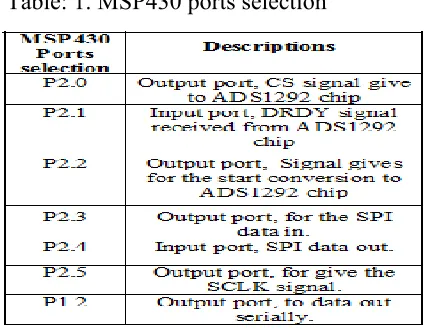
MSP430 Microcontrollers further enhance the performance of the ECG systems. The ultra-low power consumption of MCUs extends the battery life of machines [12]. MSP430 board has associated circuit components such as MSP430 controller IC, MSP430 interface IC, SPI, capacitors, resistors, etc. The Ports selection is done by programming and also signals processing which received from ADS1292 AFE Chip and gives to the MSP430 Board.
For the ECG system design, we have interfaced the ADS1292 AFE Chip with MSP430 BOARD. Here we assign the ports as input and output for ECG signal receiving by the ADS1292 AFE Chip and the outputs give to the MSP430 BOARD. The MSP430 LAUNCHPAD board receives the input signal and gives output to the USB to UART Bridge (cp2102). The Ports selection of MSP430 controller and ADS1292 chip with descriptions are given in table 1 below.
Table: 1. MSP430 ports selection
4.3 USB to UART Bridge (CP2102)
International Journal of Research (IJR)
e-ISSN: 2348-6848, p- ISSN: 2348-795X Volume 2, Issue 4, April 2015Available at http://internationaljournalofresearch.org
space. The compact 5 x 5 mm MLP-28 package CP2102 includes full-speed USB 2.0 function controller, Serial with USB transceiver, EEPROM, voltage regulator and universal asynchronous receiver transmitter (UART) with control signals. With this chip, no any USB connection has been required. The EEPROM on-board can be programmed via the USB using the programming step. Silicon Laboratories provide the virtual COM Port (VCP) device drivers on the CP2102chip to select a COM port with PC communication. The CP2102 UART Bridge chip implements all RS-232 signals, control signals and handshaking signals also Here buffering the ECG signals and step by step reached to the output port P1.2 of MSP430 Launch pad board. The output of MSP430 BOARD makes as input for the USB to UART Bridge (CP2102).
After completed the hardware connections, we have done the programming on the MSP430 controller in the CCS software. The steps of the program can be shown with the help of Flowchart as given as figure 3 below.
Figure 3: Programming of MSP430 Controller
5. ECGSYSTEMDISPLAY
International Journal of Research (IJR)
e-ISSN: 2348-6848, p- ISSN: 2348-795X Volume 2, Issue 4, April 2015Available at http://internationaljournalofresearch.org
Mat-lab software. Mat-lab software is an effective acquisition and processing of ECG [11]. It is universally accepted data processing platform. It supports many advanced programming languages like Java, C, VB, etc., and having a wide range of signal processing tool boxes called “Simulink” [4]. Automatic ECG analysis using different techniques provides the patient’s cardiac information and
assists to the cardiologist in detecting
abnormalities.
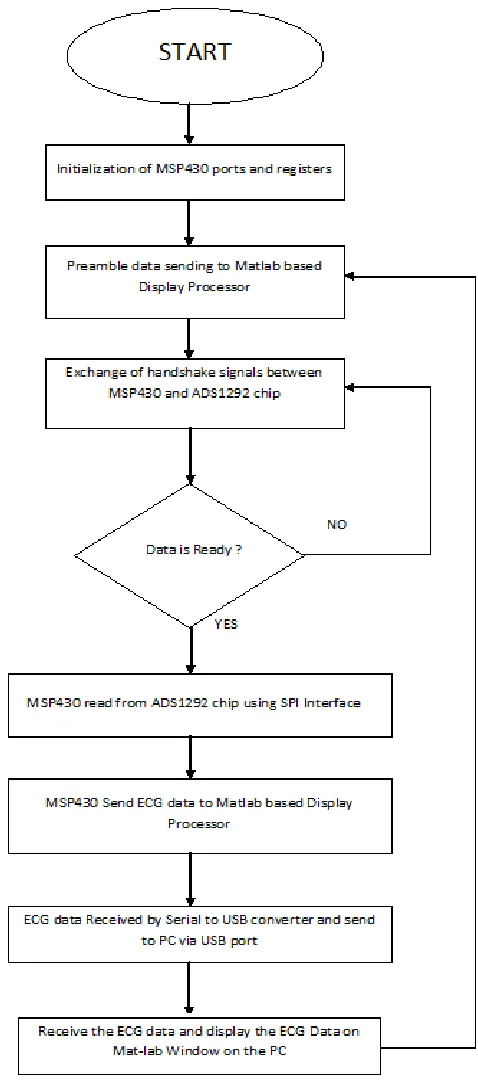
For the ECG waveform display, here we used the Mat lab window as graphical form called “GUI” window and PC. We need installation of the MATLAB Software for the ECG simulation on the GUI window. We write a program on the MATLAB according to data coming from the MSP430 controller and after connect with PC run the program. The ECG signal receives from output of CP2102 Bridge chip and comes to the com port of the computer. MATLAB port synchronizes with USB to UART Bridge (CP2102) port and receives the ECG data and display the ECG signal in MATLAB window. We have easily described a whole ECG system design with a flow-diagram given in figure 4 below.
Figure 4: Flow diagram of ECG system design
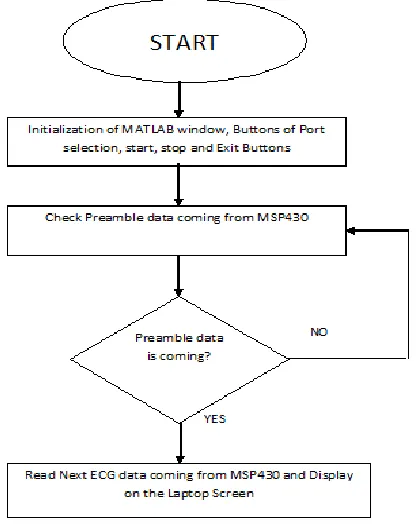
The steps of the program on the Mat lab can be shown with the help of Flowchart as given below.
Figure 5: Flowchart of MATLAB Programming.
6.RESULT
The ECG data acquisition system successfully
designed with using MSP430 controller and ADS1292 chip which having low power consumption, cost-effective and compact size also. The ECG data successfully received on the Mat lab window. Ideally the Simulator ECG Signals available at MATLAB-window on the PC should look like as shown in the Fig. 6.
International Journal of Research (IJR)
e-ISSN: 2348-6848, p- ISSN: 2348-795X Volume 2, Issue 4, April 2015Available at http://internationaljournalofresearch.org
7.CONCLUSION
There is a growing demand for affordable, portable/handheld ECG machine. The remote monitoring of the patients proposes to tackle this problem, by using portable/handheld monitoring systems. So by choosing the appropriate components suitable for portable applications, portable/handheld ECG machine can be developed. It can perform reliable measurements, extended power autonomy, and also they are generic enough for reducing the costs. By using low cost components and user friendly techniques, the product would reach to a common man.
8.FUTURESCOPE
In future, we can improve features in this machine. There is open scope to modify multi-channel ECG machine. For this we need to take recording of all leads simultaneously for better diagnosis. The wireless ECG sensors connectivity with this machine will make a wireless ECG machine that’s will record signals without contact with patient. In that, it will be easy to carry machine and will also comfortable for the Patient. In future we use MSP430 processor in another medical instruments likes Ultrasound machine, CT scan, BP machine etc.
REFERENCES
[1]. Ira Mahajan, “Design and Development of ECG data Acquisition system using integrated analog front end”, Thesis Report, Master of Technology (Electronic product design & technology), C-DAC, Mohali, June 2013.
[2] Asifiqbal Thakor, Prof. Rahul Kher and Prof. Dipak Patel, “Wearable ECG Recording and Monitoring System based on MSP430 Microcontroller”, International Journal of Computer Science and
Telecommunications Volume 3, Issue 10, October 2012.
[3]. Suhas Kale and C. S. Khandelwal, “Design and Implementation of Real Time Embedded Tele-Health Monitoring System”, International Journal of Computer Science and Network, 2013.
[4]. R Gupta, J N Bera,M Mitra, “Development of an embedded system and matlab based GUI for online acquisition and analysis of ECG signal”, Measurement 43, 2010 Science Direct, pp 1119-1126, 2010.
[5]. Noureddine BelgacemFethi Bereksi-Reguig,
“Bluetooth portable device for ECG and patient
motion monitoring Biomedical engineering
laboratory”, Abou bekr belkaid university, Bp 230 Tlemcen, 13000, Algeria,issue 4, pp 19-23 Nov 2010.
[6]. “Heart rate and EKG monitor using MSP430 Microcontroller”, Application notes & Datasheets from Texas Instruments©, 2013.
[7]. Geng Yang , Jian Chen et al , “A novel wearable ECG monitoring system based on active cable and intelligent electrode”, 10th IEEE International Conference on e-Health Networking, Applications and Service, pp 156-159, 2008.
[8] Life Hugger. "ECG -simplified. Aswini Kumar M.D.". retrieved, 11 Feb. 2010.
[9]. Yogita L, Pankaj H. Rangaree, “A Biometric ECG Identification using LNF in Wireless Body Area Sensor Network”, International Journal of Recent Technology and Engineering (IJRTE), ISSN: 2277-3878, Volume-1, Issue-2, June 2012.
International Journal of Research (IJR)
e-ISSN: 2348-6848, p- ISSN: 2348-795X Volume 2, Issue 4, April 2015Available at http://internationaljournalofresearch.org
[11]. Noureddine Belgacem, Said Assous, Fethi Bereksi-Reguig, “Bluetooth portable device and matlab-based gui for ECG signal acquisition and analysis”, 7th International workshop on systems, signal processing and their applications (Wosspa), Algeria, pp. 87-90, 2011.
[12]. Srinivasa R.Sridhara, “Ultra-low power
microcontrollers for portable, wearable and
implantable medical-electronics”, Design
Atomation Conference (ASP-DAC), 16th Asia and South Pacific, pp 556-560. 2011.
[13]. D.Balasubramaniam, D.Nedumaran, “Imple-mentation of ecg signal processing and analysis techniques in digital signal processor based system Memea”, International workshop on medical measurements and applications, Italy, pp 60-63,May 2009.
[14]. Borromeo S, Rodriguez-Sanchez C, Machado F, Hernandez-Tamames JA, de la Prieta R., “A Reconfigurable, Wearable, Wireless ECG System”, Proceedings of the 29th Annual International Conference of the IEEE EMBSCité International, Lyon, France August 23-26, 2007.
[15]. RS khandpur, “Handbook of Biomedical
Instrumentation”, 2nd edition, Tata McGraw-Hill,
pp.154-166, 2010,
[16]. Arthur C. Guyton, John E. Hall, “Textbook of Medical Physiology”, 10th edition, guyton & hall,
pp.114-133, ISBN-81-8147-084-2,.