Interoperability
V. Ashok kumar
1, K.Venkata Ramana
2Assistant Professor, Department of CSE, Srikalahasteeswara Institute of Technology, Andhra Pradesh, India
Research Scholar, Department of CSE, Srikalahasteeswara Institute of Technology, Andhra Pradesh, India
ABSTRACT: The Intercloud is an interconnected global "cloud of clouds" and an extension of the Internet "network of networks" on which it is based. It became popular and has also been used to describe the datacenter of the future. The Intercloud scenario is based on the key concept that each single cloud does not have infinite physical resources or ubiquitous geographic footprint. The Intercloud scenario would address such situations where each cloud would use the computational, storage, or any kind of resource (through semantic resource descriptions, and open federation) of the infrastructures of other clouds. This is analogous to the way the Internet works, in that a service provider to which an endpoint is attached, will access or deliver traffic from/to source/destination addresses outside of its service area by using Internet routing protocols with other service providers with whom it has a pre-arranged exchange or peering relationship. It is also analogous to the way mobile operators implement roaming and inter-carrier interoperability.This paper gives a glance at IntercloudTopology and Intercloud Interoperability.
KEYWORDS: parallel, Distributed, Cloud, virtual computers, Computing, Resources, Service, Multi-Cloud, Inter-Cloud,Topology and Ontology..
1. INTRODUCTION
The cloud is the service being delivered from remote sites. As public and private industry budgets continue to shrink, executives areplotting new strategies to become more efficient and cost effective. Cloud computing hasgleaned a lot of attention over the past several years as a means to reduce ITexpenditures, improve scalability and reduce administration over head. As savings amount and efficiencies increases, cloud computing will continue to grow. Most of the enterprises are already operating their applications or infrastructure in a cloud environment. Now a day's most of the personal and general purpose services are also provided to personal cloud user by the cloud service providers. Up to 2015 the top 10
cloud services[1] are Rack space, Amazon Web Services(AWS), Site Ground, Storm On Demand, Microsoft Azure, Digital
Ocean, Liquid web, Net magic Solutions, Ctrls and Servint.
1.1. Definition of cloud Computing
The National Institute of Standards and Technology has defined Cloud computing[2] as “a model for enabling ubiquitous,
convenient, on-demand network access to a shared pool of configurable computing resources (e.g., networks, servers, storage, applications, and services) that can be rapidly provisioned and released with minimal management effort or service provider interaction”. (Mell&Grance, 2011, p. 2).There is little consensus on how to define the Cloud and I add yet another
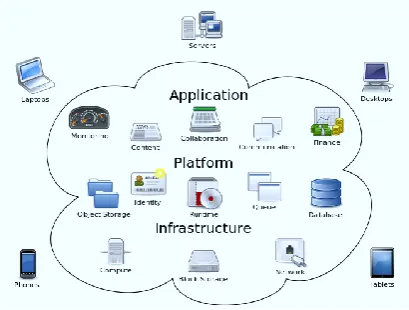
Figure 1: Cloud Computing Layout Diagram
A large-scale distributed computing paradigm that isdriven by economies of scale, in which a pool ofabstractedvirtualized, dynamically-scalable, managed computing power, storage, platforms, and services aredelivered on demand to external customers over the internet.
Cloud Computing is anything that provides hosted services over the internet [5]. These services are sharing to the end users.
The main uses of cloud are data storage, process and management services on the internet rather than having local servers. The service provider has to look up all the issues related to the cloud. The end-user doesn‟t require any server to maintain, simply requesting the services from the cloud and pay for using it.Fig.1 depicts the cloud computing layout diagram.
II. CLOUD COMPUTING ENVIRONMENT
NIST also defines five key and essential characteristics, three service models and four deployment models are shown inbelow [2].
Figure2: NIST defined Essential characteristics, Service models and Deployment models.
4. Rapid elasticity
5. Measured service
NIST categorizes Cloud computing into a Service Model and a Deployment Model.
III. INTRODUCTION TO INTER-CLOUD
3.1. What is Intercloud?
The Intercloud [6] is an interconnected global "cloud of clouds"and an extension of the Internet "network of networks" on
which it is based.[7] The term was first used in the context of cloud computing in 2007 when Kevin Kelly opined that
"eventually we'll have the intercloud, the cloud of clouds". It became popular in late 2008 and has also been used to
describe the datacenter of the future. [8]The Intercloud scenario is based on the key concept that each single cloud does not
have infinite physical resources or ubiquitous geographic footprint. If a cloud saturates the computational and storage resources of its infrastructure, or is requested to use resources in a geography where it has no footprint, it would still be able satisfy such requests for service allocations sent from its clients. The Intercloud scenario would address such situations where each cloud would use the computational, storage, or any kind of resource (through semantic resource descriptions, and open federation) of the infrastructures of other clouds. This is analogous to the way the Internet works, in that a service provider, to which an endpoint is attached, will access or deliver traffic from/to source/destination addresses outside of its service area by using Internet routing protocols with other service providers with whom it has a pre-arranged exchange or peering relationship. It is also analogous to the way mobile operators implement roaming and inter-carrier interoperability. Such forms of cloud exchange, peering, or roaming may introduce new business opportunities among
cloud providers if they manage to go beyond the theoretical framework.[9]
3.2. Intercloud definition
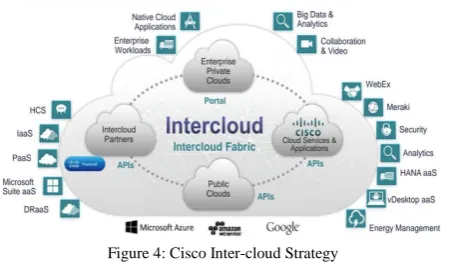
Inter-cloudor „cloud of clouds‟ is a term refer to a theoretical model for cloud computing services based on the idea of combining many different individual clouds into one seamless mass in terms of on-demand operations. The inter-cloud would simply make sure that a cloud could use resources beyond its reach, by taking advantage of pre-existing contracts with other cloud providers. Cisco inter-cloud strategy is shown below.
Figure 4: Cisco Inter-cloud Strategy
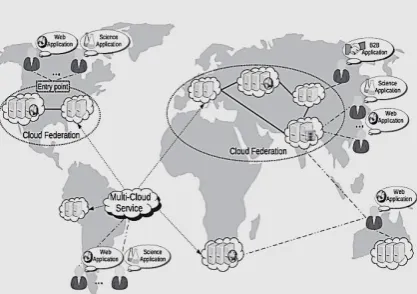
Essentially, an Inter-Cloud allows for the dynamic coordination and distribution of load among a set of cloud data centers
Figure 5.Overviews of Inter-Cloud approaches and use cases.
IV. INTERCLOUD INTEROPERABILITY
Currently, Intercloud computing is an emerging computation paradigm in the area of cloud computing. Although Intercloud Computing shared cloud a service has been increasingly utilized by diverse users, the research on Intercloud computing is still at an early stage. There are many challenges that have not been fully addressed in Intercloud Computing in addition to the new emerging issues introduced by enterprise applications. One of the existence challenges is the Inter-cloud Interoperability issue.
Intercloud addresses the interoperability between various cloud computing instantiations where each cloud would use computing resources of other clouds. Cloud Computing environments need to be interoperable in order to reduce scaling/producing cost within the development of the components. Cloud costumers should be able to migrate in and out of the cloud and switch between providers based on their needs, without a lock-in which restricts customers from selecting an alternative provider. Furthermore, cloud providers should be able to interoperate among themselves to find an alternative cloud provider to give better services. The present Intercloud network merely connects different cloud systems and each
cloud provider has its own way on how cloud applications/customers interact with the cloud. Fieldhouse [16]summarized the
current challenges in Cloud Interoperability as follow:
Several different Cloud Standards from different parties are available.
Existing Open Grid Forum (OGF) standards not or only partly ready for the cloud.
A consistent OGF Cloud Portfolio is needed.
Strategies for combining different Cloud Standards / APIs are needed.
Existing implementations of Cloud APIs need to get interoperable.
Combined Interoperability Verification Suites need to be developed.
It is essential to discuss on issues related to specifications and implementation.
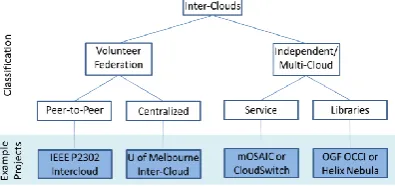
Currently different organizations, such as IEEE, are working on developing essential standards and appropriate APIs for Intercloud Interoperability. The future Intercloud network will expand the required functions to prepare collaboration among cloud services. Grozev&Buyya summarized their studies and classified 20 major Intercloud developments
including both academic and industry projects [17]. According to their studies, Intercloud is classified as Volunteer
Figure6. Architectural classification of Intercloud[17].
Figure 7: Intercloud developments‟ architecture.
1. Volunteer federation: when there is voluntarily collaboration between cloud providers that is often feasible for
governmental clouds or private cloud portfolios and is classified as two architectural categories Centralised
&Peer-to-Peeras in figure 7.
2. Independent: when an application or its broker independently from the cloud providers (both governmentally and
private clouds) exploit multiple clouds and is classified in two architectural categories Services&Libraries as in figure
7.
V. INTERCLOUD TOPOLOGY
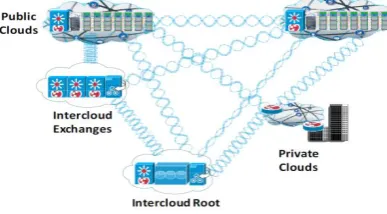
Figure 8. The Intercloud Vision
The reference topology for realizing this vision ismodelled after the public Internet infrastructure. Again,using the
generally accepted terminology [18][19][20][21], there are Public Clouds,which are analogous to ISP‟s and Service
Providersoffering routed IP in the Internet world. There arePrivate Clouds which is simply a Cloud which anorganization builds to serve itself.
There are Intercloud Exchanges (analogous toInternet Exchanges and Peering Points) where cloudscan interoperate, and there is an Intercloud Root,containing services such as Naming Authority, TrustAuthority, Directory Services, and other “root”capabilities. It is envisioned that the Intercloud root is ofcourse physically not a single entity, a global replicatingand
hierarchical system similar to DNS [23] would beutilized. All elements in the Intercloud topology containsome gateway
capability analogous to an Internet Router,implementing Intercloud protocols in order toparticipate in Intercloud interoperability. We call theseIntercloud Gateways. The entire topology is detailed in Figure 9.
Figure 9: Reference Intercloud Topology
The Intercloud Gateways would provide mechanism for supporting the entire profile of Intercloud protocols and standards. The Intercloud Root and Intercloud Exchanges would facilitate and mediate the initialIntercloud negotiating process among Clouds. Once the initial negotiating process is completed, each of these Cloud instance would collaborate directly with eachother via a protocol and transport appropriate for the interoperability action at hand; for example, a reliableprotocol might be needed for transaction integrity, or ahigh speed streaming protocol might be neededoptimized for data movement over a particular link.
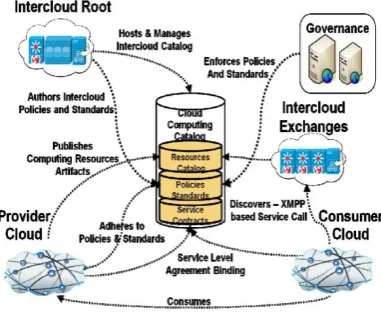
5.1. Intercloud Root, Exchanges, and Catalog
Various providers will emerge in the enablement ofthe Intercloud. We first envision a community governedset of Intercloud Root providers who will act as brokersand host the Cloud Computing Resource Catalogs forthe Intercloud
computing resources. They would begoverned in a similar way in which DNS, Top LevelDomains [24] or Certificate
byfacilitating as mediators for enabling connectivityamong disparate cloud environments. This is a muchpreferred alternative to each cloud vendor establishingconnectivity and collaboration among themselves(point-to-point), which would not scale physically or ina business sense.
5.1.2 Intercloud Exchanges: Intercloud Exchange providers will facilitate thenegotiation dialog and collaboration among
disparateheterogeneous cloud environments, working in concert with Intercloud Root instances as described previously[22].
Intercloud Root instances will host the root XMPPservers containing all presence information forIntercloud Root instances, Intercloud ExchangeInstances, and Internet visible Intercloud capable Cloudinstances. Intercloud Exchanges will host second-tierXMPP servers. Individual Intercloud capable Cloudswill communicate with each other, as XMPP clients, via XMPP server environment hosted by Intercloud Roots and Intercloud Exchanges.
5.1.3 Intercloud Catalog: In order for the Intercloud capable Cloud instances tofederate or otherwise interoperate
resources, a CloudComputing Resources Catalog system is necessaryinfrastructure. This catalog is the holistic and abstractedview of the computing resources across disparate cloudenvironments. Individual clouds will, in turn, will utilizethis catalog in order to identify matching cloudresources by applying certain Preferences andConstraints to the resources in the computing resourcescatalog.The technologies to use for this are based on theSemantic Web which provides for a way to add“meaning and relatedness” to objects on the Web. Toaccomplish this, one defines a system for normalizingmeaning across terminology, or Properties. Thisnormalization is called Ontology.
5.2. Ontology based Cloud Computing Resources Catalog
The Intercloud system not only focuses on theprovisioning of computing resources inside a singlecloud; it provides a holistic and abstracted view of thecomputing resources across disparate cloudenvironments. Participating cloud providers willadvertise their resource capabilities within the cloudcomputing resources catalog hosted by Intercloud RootProviders. Management of the thousands of resourcesand configurations requires careful control and planningto achieve business objectives and avoid errors. Thechief objectives of the planned configuration are toprovide cost effective use of computing resources and tomeet the business objectives of the enterprise. In order to automate an environment wherebysoftware agents versus traditional human users discoverand consume services, intelligent ontology based serviceregistries are needed for dynamically discovering andprovisioning computing resources across variouscomputing cloud environments (Amazon, Azure etc.etc.).
Comprehensive semantic descriptions of services are essential to exploit them in their full potential. That isdiscovering them dynamically, and enabling automatedservice negotiation, composition and monitoring. Thesemantic mechanisms
currently available in serviceregistries such as UDDI [30] are based on taxonomiescalled “tModel” [31]. tModel fails to
provide the meansto achieve this, as they do not support semanticdiscovery of services [32][33]. tModel supports aconstruct
Figure 10. Cloud Computing Catalog
Although the terms “taxonomy” and “ontology” are sometimes used interchangeably, there is a critical difference. Taxonomy indicates only class/subclass relationship whereas Ontology describes a domain completely. The essential mechanisms that ontology languages provide include their formal specification (which allows them to be queried) and their ability to define properties of classes. Through these properties, very accurate descriptions of services can be definedand services can be related to other services or resources.We are proposing a new and improved service directoryon the lines of
UDDI but based on RDF/OWL [34]ontology framework instead of current tModel basedtaxonomy framework. This catalog
captures thecomputing resources across all clouds in terms of“Capabilities”, “Structural Relationships” and Policies(Preferences and Constraints).
VII. CONCLUSION
As of June 2015, The Intercloud has yet to show real world demonstration of federation and interoperability, and challenges remain regarding security and trust, governance and legal issues, QoS, monitoring, arbitrage, and billing. The Intercloud is the only solution to the clouds to provide the unlimited services with no barriers by giving flexibility to the users. Hear I give a glans on Intercloud issues and are still under research and development led by the major companies like CISCO pumped with billions of funds.
REFERENCES
[1]“Twenty Experts Define Cloud Computing”, SYS-CON Media Inc, http://cloudcomputing.sys-con.com/read/ 612375_p.htm, 2008. [2] NIST Cloud Computing Special publication, National Institute of Standards and Technology, Gaithersburg, MD 20899-8930, July 2011. [3] “Twenty Experts Define Cloud Computing”, SYS-CON Media Inc, http://cloudcomputing.sys-con.com/read/612375_p.htm, (January 25, 2011 [4] Foster, I., Zhao, Y., Raicu, I., Lu, S.: Cloud Computing And Grid Computing 360-Degree Compared. IEEE Grid Computing Environments, Gce
(2008)
[5] “What is Cloud Computing?”, Whatis.com. http://searchsoa.techtarget.com/sDefinition/0,,sid26_gci1287881,00.html, 2008.
[6] Bernstein, David; Ludvigson, Erik; Sankar, Krishna; Diamond, Steve; Morrow, Monique (2009-05-24). "Blueprint for the Intercloud - Protocols and Formats for Cloud Computing Interoperability".IEEE Computer Society.
[7] Vint Cerf: Despite Its Age, The Internet is Still Filled with Problems [8] Head in the clouds? Welcome to the future
[9] Celesti, F. Tusa, M. Villari, A. Puliafito - How to Enhance Cloud Architectures to Enable Cross-Federation - Cloud Computing (CLOUD). 2010 IEEE 3rd International Conference on Cloud Computing
[10] http://www.gictf.jp/
[11] http://standards.ieee.org/develop/project/2302.html