Unbounded Inner Product Functional
Encryption from Bilinear Maps
Junichi Tomida1 and Katsuyuki Takashima2 1
NTT
Mitubishi Electric
Abstract. Inner product functional encryption (IPFE), introduced by Abdalla et al. (PKC2015), is a kind of functional encryption supporting only inner product functionality. All previous IPFE schemes are bounded schemes, meaning that the vector length that can be handled in the scheme is fixed in the setup phase. In this paper, we propose the first unbounded IPFE schemes, in which we do not have to fix the lengths of vectors in the setup phase and can handle (a priori) unbounded polyno-mial lengths of vectors. Our first scheme is private-key based and fully function hiding. That is, secret keys hide the information of the asso-ciated function. Our second scheme is public-key based and provides adaptive security in the indistinguishability based security definition. Both our schemes are based on SXDH, which is a well-studied standard assumption, and secure in the standard model. Furthermore, our schemes are quite efficient, incurring an efficiency loss by only a small constant factor from previous bounded function hiding schemes.
Keywords: functional encryption, inner product, function hiding, un-bounded, bilinear maps
1
Introduction
Functional encryption (FE) [9, 27] is an advanced cryptographic paradigm that is expected to drastically enhance the availability of encrypted data. Traditional encryption schemes can provide only “all-or-nothing” decryption capability over encrypted data, i.e., an owner of a legitimate decryption key can learn the entire data from a ciphertext and the others can learn nothing. In contrast, FE allows a legitimate user to learn some computed results from encrypted data without revealing any other information. More precisely, FE supporting a function class
F allows an owner of a master secret keymskto issue a secret keyskf for any functionf ∈ F, and decrypting a ciphertextctmof a messagemwithskf reveals onlyf(m) and nothing else.
purpose FEs are far from practical, and this is why Abdalla et al. [1] initiated the study of a more specific and practical FE, i.e., inner product functional encryp-tion (IPFE). In IPFE, an owner of a master secret keymskcan issue a secret key
sky for a vectoryand decrypting a ciphertextctx of a vectorxwithsky reveals
only the inner product⟨x,y⟩. The inner product is a simple but interesting func-tion, because it is sufficient to directly compute weighted means over numerical data and useful for statistical computations. Furthermore, we can evaluate any polynomial over the data by encrypting all monomials appearing in the desired family of polynomials beforehand.
Following the work of Abdalla et al., there arose two main streams of works on IPFE. The first stream is for public-key based IPFE [2, 5], aiming to obtain the adaptive security, and the second stream is for private-key based IPFE [8,13, 21, 22, 24, 28], aiming to obtain function privacy and better efficiency. Function privacy is an important property of FE when it is used to delegate computation to another party. Recently, a multi-input version of IPFE has also been considered in [3, 4, 14].
Although most above (single-input) IPFE schemes are efficient and based on standard assumptions, all have one inconvenient property: they arebounded. That is, we need to fix the maximum length of vectors to be handled in the scheme at the beginning. After fixing the maximum length, we cannot handle vectors whose lengths exceed it. This is very inconvenient because it is almost impossible in the setup phase to predict which data will be encrypted. One may think that we can solve the problem by setting the maximum length to a quite large value. However, the size of a public parameter of bounded schemes expands at least linearly with the fixed maximum length, and such a solution incurs an unnecessary efficiency loss. Hence, it is desirable that we do not need to declare the maximum length of vectors to be handled in the scheme at the beginning and can make encryption or key generation for vectors with unbounded lengths. In the context of inner product predicate encryption (IPPE) [20] and attribute-based encryption [19], there exist unbounded schemes [10,11,23,26], whose public parameters do not impose a limit on the maximum length of vectors or number of attributes used in the scheme. Thus, we naturally have the following question:
Can we construct IPFE schemes that can handle vectors with unbounded lengths?
Our contributions We answer the question affirmatively. More precisely, we construct two concrete unbounded IPFE (UIPFE) schemes on the basis of the standard SXDH assumption that are both secure in the standard model.
1. The first scheme is private-key IPFE with fully function hiding, which is the strongest indistinguishability based security notion when considering func-tion privacy [13].
private-key scheme
scheme |msk| |ct| |sk| pairing assumption
DDM16 [13] (8m2+ 12m+ 28)|Zp|(4m+ 8)|G1|(4m+ 8)|G2|Yes SXDH
TAO16 [28] (4m2+ 18m+ 20)|Zp|(2m+ 5)|G1|(2m+ 5)|G2|Yes XDLIN
KKS17 [22] (6m+ 8)|Zp| (2m+ 8)|G1|(2m+ 8)|G2|Yes SXDH
Ours 1 |PRF key| 4m|G1| 4m|G2|+α Yes SXDH
public-key scheme
scheme |pk| |msk| |ct| |sk| pairing assumption
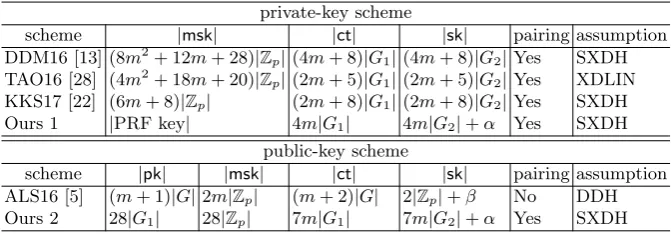
ALS16 [5] (m+ 1)|G|2m|Zp| (m+ 2)|G| 2|Zp|+β No DDH Ours 2 28|G1| 28|Zp| 7m|G1| 7m|G2|+α Yes SXDH Table 1.Comparison among private-key schemes that are fully function hiding and public-key schemes with adaptive security in the standard model. Although Lin also presented a construction of function hiding scheme [24], her scheme is the selective secure one and we do not adopt it here. A natural numberm∈Ndenotes a length of a vector associated with the ciphertext or secret key. In our schemes,αdenotes a bit length that is necessary to specify an index set associated with a vector. In the ALS16 scheme,βdenotes a bit length that is necessary to specify a vector to be embed into a secret key. In this table, we omit a group description in a public key.
Table 1 compares efficiency among private-key schemes that are fully function hiding and public-key schemes with adaptive security in the standard model. Both our schemes achieve almost the same efficiency as the previous bounded fully function hiding IPFE schemes except the small constant factor. Note that previous public-key based schemes do not need pairing when instantiated from a cyclic group [1, 5]. However, we do not know how to construct unbounded public-key based IPFE schemeswithout pairing.
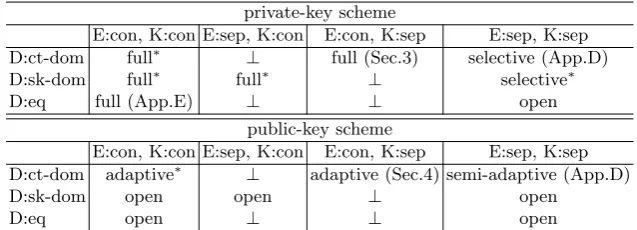
that encryption is xx setting, key generation is yy setting, and decryption is zz setting. It is not difficult to observe that the setting (E:sep, K:con, D:ct-dom) is meaningless because only the consecutivepart ofseparateciphertexts can be decrypted with anyconsecutivesecret key. For example, for a ciphertext with an index set{1,2,4}, the element indexed as 4 is never used for decryption in the K:con setting. Hence, it is the same as the (E:con, K:con, D:ct-dom) setting. Sim-ilarly, (E:con, K:sep, D:sk-dom), (E:con, K:sep, D:eq), and (E:sep, K:con, D:eq) are also meaningless. Thus, we can consider eight types of UIPFE schemes.
In this paper, we focus on the D:ct-dom setting because we believe it is the most convenient for real applications. Consider the situation where Alice holds a huge encrypted database in an untrusted server. When she wants the server to make some computation over the database, she can obtain the result by sending a corresponding secret key to the server. If the necessary part of the database for the computation is very small, the D:ct-dom setting allows Alice to issue a compact secret key. This is because the size of a secret key of IPFE schemes typically grows linearly to the length of the corresponding vector. In the other settings, Alice needs to issue a secret key that is at least larger than some constant multiple of the size of the database, and this incurs a big efficiency loss. Both our schemes are the (E:con, K:sep, D:ct-dom) setting, which suggests (E:con, K:con, D:ct-dom). Some readers may wonder why we do not consider the most general setting of D:ct-dom, (E:sep, K:sep, D:ct-dom), which suggests all D:ct-dom schemes. The reason is we can prove the security of our schemes against adaptive adversaries only in the (E:con, K:sep, D:ct-dom) setting. The intuitive reason for this limitation is that, in security proofs, reduction algorithms need to guess the contents of an index set with which an adversary queries an encryption oracle. This is possible in the E:con setting because the length of vectors queried by an adversary is a polynomial and a reduction algorithm can correctly guess the length with a non-negligible probability. In the E:sep setting, however, the possibility of index sets is exponential and is unpredictable for reduction algorithms. For this reason, our schemes are secure against selective adversaries in the (E:sep, K:sep, D:ct-dom) setting (Appendix D). In particular, our public-key scheme is semi-adaptively secure in the (E:sep, K:sep, D:ct-dom) setting, which means that the adversary declares a challenge message right after obtaining a public key in a security game [12]. Note that the fully function hiding private-key IPFE scheme in the (E:sep, K:con, D:sk-dom) setting is trivial with our scheme because the roles of ciphertexts and secret keys are the same in fully function hiding private-key IPFE. In addition, the fully function hiding private-key IPFE in the (E:con, K:con, D:eq) setting is easily constructible and we describe it in Appendix E. We summarize our result in Table 2.
1.1 Our Techniques
private-key scheme
E:con, K:con E:sep, K:con E:con, K:sep E:sep, K:sep
D:ct-dom full∗ ⊥ full (Sec.3) selective (App.D)
D:sk-dom full∗ full∗ ⊥ selective∗
D:eq full (App.E) ⊥ ⊥ open
public-key scheme
E:con, K:con E:sep, K:con E:con, K:sep E:sep, K:sep D:ct-dom adaptive∗ ⊥ adaptive (Sec.4) semi-adaptive (App.D)
D:sk-dom open open ⊥ open
D:eq open ⊥ ⊥ open
Table 2.Summary of our result. An asterisk indicates that the scheme is not explicitly demonstrated in this paper, but trivially suggested by our result. A symbol⊥indicates that the scheme is meaningless.
Private-key UIPFE Our starting point is the fully function hiding unbounded multi-input IPFE (MIPFE) scheme proposed by Datta et al. [14]. In an un-bounded MIPFE scheme, an index space for slots are not determined in the setup phase. Then, roughly speaking, an encryption algorithm can generate a ciphertext that corresponds to a vector x and an arbitrary index i ∈ N. Also, a key generation algorithm can issue a secret key that is associated with indexed vectors (S,{yi}i∈S) for an arbitrary set S ⊂ N. Only if a decryp-tor has all ciphertexts corresponding to elements of the set S, i.e., {cti :=
MIPFE.Enc(pp,msk, i,xi)}i∈S, the secret key for S can be used for legitimate decryption and reveals∑i∈S⟨xi,yi⟩. Their scheme is based on the dual pairing vector spaces (DPVS) framework introduced by Okamoto and Takashima [25] and utilizes a pseudorandom function (PRF) to handle an unbounded index space. Consider the unbounded MIPFE scheme in which the vector length is set to 1 and observe that such a scheme already serves the function of UIPFE in the D:ct-dom setting. More precisely, to encrypt x := (x1, . . . , xm) ∈ Zm, the en-cryption algorithm computescti:=MIPFE.Enc(pp,msk, i, xi) for alli∈[m] and setct:= (ct1, . . . ,ctm). In key generation for an indexed vector (S,y:= (yi)i∈S ∈
ZS), the key generation algorithm computessk:=MIPFE.KeyGen(pp,msk, S,y). Then MIPFE.Dec(pp,ct,sk) outputs ∑i∈Sxiyi. However, this construction al-lows recomposition of ciphertexts due to the property of MIPFE. That is, for
ct1 := (ct1,1, . . . ,ct1,m) and ct2 := (ct2,1, . . . ,ct2,m), we can decrypt a cipher-text like (ct1,1,ct2,2, . . . ,ct2,m) correctly whereas UIPFE should not allow such recomposition of ciphertexts.
To prevent such recomposition, each ciphertext of our scheme has a unique randomness that all elements in a ciphertext share. Decryption is possible only if an input ciphertext has a consistent randomness, so this unique randomness prevents recomposed ciphertexts from being decrypted correctly. Essentially, a ciphertext for index i of the MIPFE scheme by Datta et al. has a form like [ci]1 := [(xi,1)Bi]1 and each element of a secret key has a form like [ki]2 := [(yi, ri)B∗i]2, whereBiis a 2×2 regular matrix,B∗i := (B−
1
elements in Zp s.t. ∑
i∈Sri = 0. Bases Bi are generated unboundedly with a PRF. A decryption algorithm computes [∑i∈S⟨ci,ki⟩]T and it reveals the inner product ∑i∈S(xiyi+ri) =
∑
i∈Sxiyi. In this construction, switching elements of one ciphertext that have the same indices as others does not affect the correct decryption. On the other hand, an element of one ciphertext corresponding to index i of our scheme has a form like [ci]1 := [(xi, z)Bi]1 where z is a unique randomness for each ciphertext, whereas each element of a secret key is the same as in the MIPFE scheme. Then it is easy to confirm that unless allci fori∈S
have the same randomness, [∑i∈S⟨ci,ki⟩]T does not reveal the inner product ∑
i∈Sxiyi and this construction prevents recomposition of ciphertexts.
Although the concept of the construction is simple, the security proof of the scheme is rather complicated. The basic proof strategy of our scheme is the same as that by Tomida et al. [28], who proposed a fully function hiding bounded IPFE scheme, and this strategy is also employed in [14]. In the case of unbounded MIPFE and UIPFE, however, we encounter a new challenging problem that does not appear inboundedIPFE: how to prove collusion resistance against illegitimate secret keys queried by an adversary. More precisely, in the D:ct-dom setting, secret keys whose index sets are not included in the index set of a ciphertext must be useless to decrypt the ciphertext even if their owners collude. For example, an owner of a ciphertext ct1 for a index set{1,2,3} and two secret keys sk1 and sk2 for index sets {1,2,4} and {3,4} respectively must not learn any information about underlying vectors in the ciphertext and secret keys.
In the context of unbounded MIPFE, the problem was solved by cleverly utilizing symmetric key encryption (SKE). Briefly, ciphertexts for indexicontain a secret key of SKE that is unique to the indexi. On the other hand, a secret key of unbounded MIPFE for an index set S is iteratively encrypted by SKE with all secret keys of SKE in the setS. Then, unless an owner of the secret key for a setS has all ciphertexts in the setS, he or she cannot decrypt the secret key of unbounded MIPFE encrypted by SKE and the secret key is useless to derive information from ciphertexts corresponding to any proper subset of S. Due to UIPFE not allowing the recomposition of ciphertexts, however, we cannot apply a similar technique to UIPFE schemes.
keys are randomized. The intuitive reason to take this step is to ensure that partial decryption does not leak any information on underlying vectors. That is, in the above example, one can correctly compute the termxiyifor indices 1 and 2 withsk1and 3 withsk2, which is masked by the termzri. What we want to prove here is that the all zri terms are indistinguishable from independently random elements inZpand they completely hide the termsxiyi. Recall that elements in each secret key contain the random numbersrisuch that
∑
i∈Sri= 0. Then, if at least one ofris in each secret key is randomized, entireris become completely random elements inZp. At this point, partial decryption with illegitimate secret keys reveals no meaningful information and we can complete the proof.
Public-key UIPFE Our public-key UIPFE scheme is technically more intricate than our private-key one. Because we do not need to publish any information for encryption in the private-key UIPFE scheme, we can utilize PRFs to generate dual orthonormal bases unboundedly, which is necessary for encryption. More precisely, an encryption algorithm generates a basis for indexi asFK(i) where
FK is a PRF, and encode the i-th element of the vector using the basis. In the public-key setting, however, a setup algorithm needs to publish information that is needed to encrypt vectors. Thus an encryptor cannot utilize PRFs to generate bases because if a key of a PRF is public, the output is no longer pseudorandom. Our approach to overcome this problem is an indexing technique [26], which is introduced to construct unbounded inner productpredicateencryption (IPPE) and attribute based encryption (ABE) schemes. Briefly, we add a two-dimensional prefix that specifies an index to a vector to be encoded, and only if the indices of a ciphertext and a secret key are equal, the correct inner product value is computable. In a ciphertext side, an encoding of the i-th element of a vec-tor x := (x1, . . . , xm) is the form like [ci]1 := [(πi(1, i), xi, z)B]1 and in a se-cret key side, the index j of an indexed vector (S,y := (yj)j∈S) is encoded as [kj]2 := [(ρj(−j,1), yj, rj)B∗]2. Then, although all indices share the same dual orthonormal bases, [⟨ci,kj⟩]T reveals the meaningful value only ifi=j. By this construction, each element in ciphertexts and secret keys is encoded as if dual orthonormal bases that are unique to each index were used.
The basic concept of the security proof of our public-key scheme is also similar to that in [26]. That is, we prove lemmas that say that normal ciphertexts and secret keys are indistinguishable from ones encoded on “somewhat” random dual orthonormal bases for each index by amplifying the entropy of the two-dimensional prefix. More concretely, we use a kind of the following relation in the security proof. Note that it is just a toy example for an intuitive explanation and an informal one. That is, for any polynomial m := m(λ), we have the computational indistinguishability:
{
[(πi(1, i), xi, z, . . .)B]1 [(ρi(−i,1), yi, ri, . . .)B∗]2
}
i∈[m]
≈c {
[(πi(1, i), xi, z, . . .)Di]1 [(ρi(−i,1), yi, ri, . . .)D∗i]2
}
i∈[m]
,
where {πi}i∈[m],{ρi}i∈[m] U
encoded on “somewhat” random dual orthonormal bases for each index. Here, eachWi need not be a completely random matrix, and it is sufficient if Wi is chosen from some specific distribution for our security proof. This is why we call Di “somewhat” random. At this point, we can use the proof strategy similar to that of the private-key IPFE scheme because dual orthonormal bases are gener-ated somewhat randomly for each index and we have a similar situation to the private-key IPFE scheme. Although the top-level concept of the techniques are similar to [26], i.e., indexing and entropy amplification, we cannot directly use their techniques because the security proof of our scheme is completely different from that of their scheme. Therefore, we managed to tailor lemmas of entropy amplification suitable for our scheme.
1.2 Discussion
In this work, we cannot achieve the schemes that have the following two features. We quickly discuss the difficulty about them.
Public-key UIPFE scheme without pairing. We briefly explain the rea-son why constructing unbounded public-key IPFE without pairing is difficult. First, we recall the bounded scheme without pairing by Abdalla et al. in [1] (and the scheme in [5] essentially follows the construction of Abdalla et al.). In their scheme, a master secret key is a randomly chosen vector s ∈ Znp and a public key is a vector of group elements gs ∈ Gn. To encrypt a vector x ∈ Zn, an encryption algorithm choose a random numberr∈Zp and compute the cipher-text as ct := (gr, grs+x) ∈Gn+1. On the other hand, a secret key for a vector y∈Zn is set as sk:= (⟨y,s⟩,y)∈Zn+1p , and a decryption algorithm computes
g⟨rs+x,y⟩/gr⟨y,s⟩=g⟨x,y⟩. To handle vectors with unbounded lengths, an
encryp-tion algorithm or a key generaencryp-tion algorithm needs to generate an element s.t.
grs+x or ⟨y,s⟩ respectively for a vectorswith an arbitrary length from a fixed
public key or master secret key.
As we explained in the technical section, we obtain such a situation by en-tropy amplification and it requires computational arguments. However, if secret keys consist of elements inZp likely to the scheme by Abdalla et al., we cannot apply computational arguments to secret keys. Therefore, it seems inevitable to encode elements in secret keys on the exponent of group elements to leverage computational arguments, and it incurs the necessity of pairing in decryption.
simulates secret keys. We know that we can obtain adaptively secure multi-use KP-ABE from so-calledq-type assumptions [6,7], then we might be able to obtain adaptively secure (E:sep, K:sep) schemes from q-type assumptions similarly.
1.3 Concurrent Work
Concurrently and independently, Dufour Sans and Pointcheval also presented UIPFE schemes [15]. In our term, they proposed public-key (E:sep, K:sep, D:eq) and (E:sep, K:sep, D:ct-dom) schemes in their paper. Their schemes have short secret keys, meaning that they contain one group element and a corresponding vector. However, their schemes rely on the random oracle model and achieve only the selective security, and their (E:sep, K:sep, D:ct-dom) scheme also re-lies on a new interactive assumption. More precisely, they assume that a kind of problem is hard for all PPT adversaries even if they are allowed to access some oracles. In addition, their (E:sep, K:sep, D:ct-dom) scheme does not have collusion resistance of illegitimate secret keys, which means that a combination of illegitimate keys can become a legitimate key.
2
Preliminary
2.1 Notations
For a primep,Zpdenotes a fieldZ/pZ. For natural numbersn, m∈N, [n] denotes a set{1, . . . , n}, and [m, n] denotes a set{m, . . . , n}(ifm > n,[m, n] :=ϕ). For
a set S, s ←−U S denotes that s is uniformly chosen from S. We treat vectors as row vectors. For a vector x, ||x||∞ denotes its infinity norm. For a field K,
Mn(K) and GLn(K) denote a set of all n×n matrices and all n×n regular matrices whose elements are inK, respectively. We use a bold upper-case letter to denote a matrix, e.g., A, and a bold lower-case version of the same letter with subscripti to denote the i-th row of the matrix, e.g.,ai. For example, ai denotes the i-th row of A. For a regular matrix A, A∗ denotes (A−1)⊤. For a generator gι of a cyclic group Gι, a matrix A, and vector a, [A]ι and [a]ι denote the corresponding matrix and vector on the exponent ofgι, respectively. For vectors x := (x1, . . . , xn) and y := (y1, . . . , yn) ∈ Znp, let e([x]1,[y]2) :=
e(g1, g2)⟨x,y⟩be a function that computes the inner product on the exponent by ∏
i∈[n]e([xi]1,[yi]2). A function f :N→Ris called negligible if f(λ) =λ−ω(1) and denotesf(λ)≤negl(λ).
2.2 Basic Notions
Definition 2.1 (Pseudorandom Functions).A pseudorandom function (PRF) familyF :={FK}K∈Kλ with a key space Kλ, a domainXλ, and a rangeYλ is
of functions consisting of all functions whose domain and range areXλ andYλ respectively. For any PPT adversary A, the following condition holds,
AdvPRFA (λ) :=Pr[1← AFK(·)]−Pr[1← AR(·)]≤negl(λ),
whereK←− KU λ andR U
←− Rλ.
Definition 2.2 (Bilinear Groups).Bilinear groupsG:=(p, G1, G2, GT, g1, g2,
e) consist of a primep, cyclic groupsG1, G2, GT of order p, generators g1 and
g2 ofG1 andG2 respectively, and a bilinear map e:G1×G2→GT, which has two properties.
– (Bilinearity):∀h1∈G1, h2∈G2, a, b∈Zp, e(ha1, hb2) =e(h1, h2)ab.
– (Non-degeneracy): For generatorsg1 andg2,e(g1, g2) is a generator ofGT. A bilinear group generator GBG(1λ) takes security parameter 1λ and outputs bilinear groupsGwith aλ-bit primep.
Definition 2.3 (SXDH Assumption).Forι∈ {1,2}, we define the following distribution,
G← GBG(1λ), a, e, f U
←−Zp, D:= (G,[a]ι,[e]ι) [tβ]ι:= [ae+βf]ι forβ∈ {0,1}.
We say the SXDH assumption holds if for any PPT adversary A and both
ι∈ {1,2},
AdvSXDHA (λ) :=|Pr[1← A(D,[t0]ι)]−Pr[1← A(D,[t1]ι)]| ≤negl(λ).
2.3 Unbounded Inner Product Functional Encryption for (E:con, K:sep, D:ct-dom)
In this paper, we propose two unbounded inner product functional encryption schemes. The first scheme is private-key unbounded IPFE that is fully function hiding and the second one is public-key unbounded IPFE with adaptive security. Both our schemes can handle (a-priori) unbounded polynomial lengths of vectors for encryption and key generation, and support a function that we call limited-norm inner product. As explained in the introduction, our schemes support inner product in the (E:con, K:sep, D:ct-dom) setting. Informally, for a ciphertext of a vector whose length is m and a secret key with a setS, only if S ⊆[m], we can decrypt the ciphertext with the secret key and learn the inner product value over the setS. Note that in previous works [3,4], the termbounded-normis used, but in this paper, boundedgenerally refers to vector length. Therefore, we use limited-normfor the functionality in this paper.
Definition 2.4 (Limited-Norm Inner Product). This function family F consists of functions fS,X,Yy :Zm→ZwhereX, Y ∈N,S⊂N,y:= (y
s.t. ||y||∞ ≤ Y, and m ∈ N s.t. S ⊆ [m]. We define the function for every x:= (x1, . . . , xm)∈Zm s.t.||x||∞≤X as
fS,X,Yy (x) :=∑ i∈S
xiyi.
Formal definitions of inner products in the other settings are in Appendix B.
Definition 2.5 (Private-Key Unbounded Inner Product Functional En-cryption). Let X := {Xλ}λ∈N,Y := {Yλ}λ∈N be ensembles of norm-limit. Private-key unbounded inner product functional encryption (Priv-UIPFE) con-sists of four algorithms.
Setup(1λ): This algorithm takes a security parameter 1λ, and outputs a public parameterppand a master secret key msk.
Enc(pp,msk,x): This algorithm takespp,msk, and a vectorx:= (x1, . . . , xm)∈
Zmwherem:=m(λ) is any polynomial. It outputs a ciphertextct m
KeyGen(pp,msk, S,y): This algorithm takespp,msk, a non-empty index setS⊆
[s] wheres:=s(λ) is any polynomial, and an indexed vectory:= (yi)i∈S ∈
ZS. It outputs a secret keysk S.
Dec(pp,ctm,skS): This algorithm takespp,ctmandskS and outputs a decrypted valued∈Zor a symbol⊥.
Correctness Priv-UIPFE is correct if it satisfies the following condition. For any λ∈ N, x ∈Zm s.t. m:=m(λ) is any polynomial and ||x||
∞ ≤Xλ, index set S ⊆ [s] s.t. s := s(λ) is any polynomial and S ⊆ [m], and y ∈ ZS s.t.
||y||∞≤Yλ, we have
Pr
d=∑
i∈S
xiyi
(pp,msk)←Setup(1λ)
ctm←Enc(pp,msk,x)
skS ←KeyGen(pp,msk, S,y)
d:=Dec(pp,ctm,skS)
≥1−negl(λ).
Security Priv-UIPFE is fully function hiding if it satisfies the following con-dition. That is, the advantage of A against Priv-UIPFE defined as follows is negligible inλfor any PPT adversaryA,
AdvPriv-UIPFEA (λ) :=
Pr
[
1← AOEnc,0(pp,msk,·),OKG,0(pp,msk,·,·)(pp) :
(pp,msk)←Setup(1λ)
]
−Pr
[
1← AOEnc,1(pp,msk,·),OKG,1(pp,msk,·,·)(pp) :
(pp,msk)←Setup(1λ)
] .
Here, OEnc,β(pp,msk,·) with β ∈ {0,1} is an encryption oracle that takes a pair of vectors (x0,x1) ∈ (Zm)2 with the same polynomial length m, and outputs Enc(pp,msk,xβ). O
KG,β(pp,msk,·,·) with β ∈ {0,1} is a key genera-tion oracle that takes a set S including polynomial indices and a pair of in-dexed vectors (y0,y1) ∈ (ZS)2 associated with the index set S, and outputs
condition on A’s queries. Let qct (resp. qsk) be a total number of ciphertext query (resp. secret key query) of A. For allj∈[qct] andℓ∈[qsk], if Sℓ ⊆[mj], then
∑
i∈Sℓ
x0j,iy0ℓ,i=∑ i∈Sℓ
x1j,iyℓ,i1 . (1)
Consider the modified game where the adversary queries all vectors in one-shot, i.e.,{(x0
j,x1j)}j∈[qct] and{(y
0 ℓ,y
1
ℓ)}ℓ∈[qsk], right after obtaining a public
pa-rameter, and then the adversary receive all ciphertexts and secret keys for queried vectors for β-side. If the advantage of all PPT adversary against the modified game is negligible, we say that Priv-UIPFE isselectively function hiding.
Definition 2.6 (Public-key Unbounded Inner Product Functional En-cryption). Let X := {Xλ}λ∈N,Y := {Yλ}λ∈N be ensembles of norm-limit. Public-key unbounded inner product functional encryption (Pub-UIPFE) con-sists of four algorithms.
Setup(1λ): This algorithm takes a security parameter 1λ, and outputs a public keypkand a master secret keymsk.
Enc(pk,x): This algorithm takespkand a vectorx:= (x1, . . . , xm)∈Zmwhere
m:=m(λ) is any polynomial. It outputs a ciphertextctm
KeyGen(pk,msk, S,y): This algorithm takespk,msk, a non-empty index setS⊆
[s] wheres:=s(λ) is any polynomial, and an indexed vectory:= (yi)i∈S ∈
ZS. It outputs a secret keysk S.
Dec(pk,ctm,skS): This algorithm takespk,ctmandskSand outputs a decrypted valued∈Zor a symbol⊥.
Correctness Pub-UIPFE is correct if it satisfies the following condition. For any λ∈ N, x ∈Zm s.t. m:=m(λ) is any polynomial and ||x||
∞ ≤Xλ, index set S ⊆ [s] s.t. s := s(λ) is any polynomial and S ⊆ [m], and y ∈ ZS s.t.
||y||∞≤Yλ, we have
Pr
d=∑
i∈S
xiyi
(pk,msk)←Setup(1λ)
ctm←Enc(pk,x)
skS ←KeyGen(pk,msk, S,y)
d:=Dec(pk,ctm,skS)
≥1−negl(λ).
Security Pub-UIPFE is adaptively secureif it satisfies the following condition. That is, the advantage of Aagainst Pub-UIPFE defined as follows is negligible in λfor any stateful PPT adversaryA,
AdvPub-UIPFEA (λ) := Pr β = 1
(pk,msk)←Setup(1λ)
(x0,x1)← AKeyGen(pk,msk,·,·)(pk)
ctm∗←Enc(pk,x0)
β← AKeyGen(pk,msk,·,·)(pk,ct m∗)
−Pr β= 1
(pk,msk)←Setup(1λ)
(x0,x1)← AKeyGen(pk,msk,·,·)(pk)
ctm∗←Enc(pk,x1)
Here, the challenge vectorsx0andx1thatAoutputs must have the same length
m∗. To avoid a trivial attack ofA, we have the following condition onA’s queries. Letqskbe a total number of secret key query ofA. For allℓ∈[qsk], ifSℓ⊆[m∗], then
∑
i∈Sℓ
x0iyℓ,i= ∑
i∈Sℓ
x1iyℓ,i. (2)
Consider the modified game where the adversary is prohibited to make a secret-key query before outputting challenge vectors (x0,x1). If the advantage of all PPT adversary against the modified game is negligible, we say that Pub-UIPFE issemi-adaptively secure.
3
Private-Key Unbounded Inner Product Functional
Encryption
Our schemes are based on the DPVS framework introduced by Okamoto and Takashima [25]. We briefly explain the property of DPVS in Appendix A.
3.1 Construction
In the following scheme, norm limits Xλ, Yλ are some polynomials. Let F :=
{FK}K∈Kλ be a PRF family with a key spaceKλ consisting of functionsFK : {0,1}λ→M
4(Zp).
Setup(1λ): Takes a security parameter 1λ and chooses bilinear groups G ←
GBG(1λ) and a PRF keyK←− KU
λ. Outputs
pp:=G, msk:=K.
Enc(pp,msk,x): Takes pp,msk and x := (x1, . . . , xm) ∈ Zm where m :=m(λ) is any polynomial. Sets Bi := FK(i) and ci := (xi,0, z,0)Bi ∈ Z4p for all
i∈[m], wherez←−U Zp. Outputs
ctm:= ([c1]1, . . . ,[cm]1).
If there existsi∈[m] such thatBi is a singular matrix, outputs⊥.
KeyGen(pp,msk, S,y): Takespp,msk, a non-empty index setS ⊆[s] wheres:=
s(λ) is any polynomial, and an indexed vectory := (yi)i∈S ∈ZS. Chooses
{ri}i∈S U
←−Zps.t. ∑
i∈Sri= 0. SetsBi:=FK(i) andki:= (yi,0, ri,0)B∗i ∈
Z4
pfor alli∈S. Outputs
skS := (S,{[ki]2}i∈S).
Dec(pp,ctm,skS): Takes pp, a ciphertext ctm for m dimensional vector, and a secret keyskS for a index setS. IfS⊆[m], then computes
h:=∏ i∈S
e([ci]1,[ki]2),
and searches fords.t.e(g1, g2)d=hexhaustively in the range of−|S|XλYλ to|S|XλYλ. If suchdis found, outputsd. Otherwise, outputs⊥.
Correctness Our Priv-UIPFE scheme is correct if F is a PRF family. We consider the case where for a natural numberm∈N,Bi:=FK(i) for alli∈[m] is invertible. Then, we observe that ifS⊆[m],
h=∏ i∈S
e([ci]1,[ki]2) =e(g1, g2)
∑
i∈S⟨ci,ki⟩=e(g
1, g2)
∑
i∈S(xiyi+zri).
Here we have ∑i∈Sri = 0, then h = e(g1, g2)
∑
i∈Sxiyi. If ||x||
∞ ≤ Xλ and
||y||∞ ≤Yλ, | ∑
i∈Sxiyi| ≤ |S|XλYλ and Dec outputs ∑
i∈Sxiyi. Hence, if Bi for alli∈[m] is invertible without a negligible probability, our scheme is correct.
Letm:=m(λ) be any polynomial. Fori∈[m], we havePr[∃i,detBi= 0|Bi U
←− M4(Zp)] = 2−Ω(λ) from Lemma A.1 and |Pr[∃i,detBi = 0|Bi
U
←− M4(Zp)]−
Pr[∃i,detBi= 0|K←− KU λ,Bi :=FK(i)]| ≤negl(λ) from the definition of PRF. Consequently,Pr[∃i,detBi= 0|K
U
←− Kλ,Bi:=FK(i)]≤negl(λ).
Remark 3.1. Similarly to all previous IPFE schemes based on a cyclic group or bilinear groups, the decryption algorithm of our schemes need to solve the small discrete logarithm problem. As pointed out in [21], however, this step does not affect efficiency so much in many practical applications.
3.2 Security
Theorem 3.1. Assume that the SXDH assumption holds andF is a PRF fam-ily, then our Priv-UIPFE is fully function hiding. More formally, let mmax be the maximum length of vectors with which A makes a query to the encryption oracle, then for any PPT adversary A and security parameter λ, there exists a PPT adversaryB1 for the SXDH andB2 for the PRF family, we have
AdvPriv-UIPFEA (λ)≤ {4qsk+ 2(mmax+ 1)qct+ 2}AdvSXDHB1 (λ) + 2AdvPRFB2 (λ) + 2−Ω(λ).
space to handle intermediate states between β = 0 and β = 1, and the fourth space is utilized to make a situation where we can focus on only one query even if an adversary makes multiple queries. In other words, we can see the fourth space as a semi-functional space of dual system methodology proposed by Waters [29]. First, the form of secret keys is changed from [(y0
ℓ,i,0, rℓ,i,0)B∗i]2 to [(y0
ℓ,i, yℓ,i1 , rℓ,i,0)B∗i]2 in the Game 1 sequence. Next, we change the form of ciphertexts from [(x0
j,i,0, zj,0)Bi]1to [(0, x1j,i, zj,0)Bi]1in the Game 3 sequence, and here we leverage the game condition Eq.(1). Then we switch the first space with the second space as [(x1j,i,0, zj,0)Bi]1and [(y1ℓ,i, y
0
ℓ,i, rℓ,i,0)B∗i]2. Finally, the form of secret keys is changed from [(yℓ,i1 , y0ℓ,i, rℓ,i,0)B∗i]2 to [(yℓ,i1 ,0, rℓ,i,0)B∗i]2 as the reverse of the Game 1 sequence. The most complicated and important part is the Game 3 sequence, in which we need to deal with the ciphertexts and secret keys that do not satisfy the condition Eq.(1). In Game 3 sequence, we change the ciphertexts from 0-side to 1-side one by one, and in the ν-th iteration of Game 3 sequence, we change theν-th ciphertexts from 0-side to 1-side. For the
ν-th ciphertext, we can classify secret keys queried by an adversary into three types. Let mν be the length of the ciphertext.
1. The index set S of the secret key is included in [mν], i,e., maxS≤mν. 2. A part of the index setS is included in [mν], i.e., (maxS > mν)∧(minS≤
mν).
3. The index set S and [mν] are disjoint, i.e., minS > mν.
The cumbersome secret keys are type 2 keys because they can correctly decrypt a part of the ciphertext even though they may not satisfy the condition Eq.(1). We want to change the form of the ν-th ciphertext from 0-side to 1-side by information-theoretical change in Game 3-ν-1-4, but it does not work without any treatment due to the above property of type 2 keys. Therefore, we manage to randomize or “sanitize” type 2 keys from Game 3-ν-1-1 to Game 3-ν-1-3.
Proof. We prove Theorem 3.1 by a series of games. For each game transition, we prove that the difference between probabilities that the adversaryAoutputs 1 in both games is negligible.
Game 0: This game is the same as the real security game when β = 0 in Definition 2.5. That is, the j-th ciphertext query with a pair of vectors (x0
j,x1j)∈(Zmj)2 is replied as
cj,i:= (x0j,i,0, zj,0)Bi for alli∈[mj]
ctj,mj := ([cj,1]1, . . . ,[cj,mj]1).
Theℓ-th secret key query with an index setSℓand a pair of vectors (yℓ0,y 1 ℓ)∈ (ZSℓ)2 is replied as
kℓ,i:= (yℓ,i0 ,0, rℓ,i,0)B∗i for alli∈Sℓ
Game 0’: This game is the same as Game 0 except for the way of making dual orthonormal bases. In Game 0, the dual orthonormal bases for thei-th element are made as (Bi,B∗i) whereBi :=FK(i), but in Game 0’, they are made asBi ←−U GL4(Zp). More precisely, the cipertext oracle and secret key oracle have the same listL for bases. When the oracle needs a basis for the
i-th element, it searches for (i,Bi) from L. If the oracle find it, the oracle
uses the bases, and if not, it generatesBi ←−U GL4(Zp) and records them as (i,Bi) intoL.
Game 1-µ-1 (µ∈[qsk]): We define Game 1-0-3 as equivalent to Game 0’. This game is the same as Game 1-(µ−1)-3 except that in the µ-th secret key query,kµ,i is set as
w←−U Zp, kµ,i:= (y0µ,i,0, rµ,i, wrµ,i)B∗i for alli∈Sµ.
Game 1-µ-2 (µ∈[qsk]): This game is the same as Game 1-µ-1 except that in theµ-th secret key query,kµ,i is set as
w←−U Zp, kµ,i:= (yµ,i0 , y 1
µ,i , rµ,i, wrµ,i)B∗i for alli∈Sµ.
Game 1-µ-3 (µ∈[qsk]): This game is the same as Game 1-µ-2 except that in theµ-th secret key query,kµ,i is set as
kµ,i:= (yµ,i0 , y1µ,i, rµ,i, 0 )B∗i for alli∈Sµ.
Game 2: This game is the same as Game 1-qsk-3 except that in all secret key queries,kℓ,i for allℓ∈[qsk] is set as
kℓ,i:= (yℓ,i0 , y 1
ℓ,i, rℓ,i, ˜rℓ,i )B∗i for alli∈Sℓ,
where ˜rℓ,i U
←−Zp s.t. ∑
i∈Sℓr˜ℓ,i= 0.
Game 3-ν-1 (ν ∈[qct]): Game 2 is equivalent to Game 3-0-3. This game is the same as Game 3-(ν −1)-3 except that in theν-th ciphertext query, cν,i is set as
˜
zν U
←−Zp, cν,i:= (x0ν,i,0, zν, z˜ν )Bi for alli∈[mν].
Game 3-ν-2 (ν ∈[qct]): This game is the same as Game 3-ν-1 except that in theν-th ciphertext query,cν,iis set as
˜
zν U
←−Zp, cν,i:= ( 0, x1ν,i , zν,z˜ν)Bi for alli∈[mν].
Game 3-ν-3 (ν ∈[qct]): This game is the same as Game 3-ν-2 except that in theν-th ciphertext query,cν,iis set as
Game 4: This game is the same as Game 3-qct-5 except that in all ciphertext and secret key queries,cj,i andkℓ,iare set as
cj,i:= (x1j,i,0 , zj,0)Bi for alli∈[mj],
kℓ,i:= (y1ℓ,i, yℓ,i0 , rℓ,i,r˜ℓ,i)B∗i, for alli∈Sℓ.
Game 5: This game is the same as the real security game when β = 1 in Definition 2.5. That is, the j-th ciphertext query with a pair of vectors (x0j,x1j)∈(Zmj)2 is replied as
cj,i:= (x1j,i,0, zj,0) Bi for alli∈[mj]
ctj,mj := ([cj,1]1, . . . ,[cj,mj]1).
Theℓ-th secret key query with an index setSℓand a pair of vectors (yℓ0,y 1 ℓ)∈ (ZSℓ)2 is replied as
kℓ,i:= (yℓ,i1 , 0 , rℓ,i, 0 ) B∗i for alli∈Sℓ
skℓ,Sℓ := (Sℓ,{[kℓ,i]2}i∈Sℓ).
Note thatBi is generated asBi:=FK(i) in Game 5.
Thanks to Lemma 3.1 to Lemma 3.10, we can conclude the proof of Theorem 3.1.
⊓ ⊔
In the following, we denote the event thatAoutputs 1 in GameιbyEι. Lemma 3.1. For any PPT adversary A, there exists a PPT adversary B for PRFs s.t.
|Pr[E0]−Pr[E0′]| ≤AdvPRFB (λ) + 2−Ω(λ).
Proof. First, we consider Game 0M, which is the same as Game 0 except that
Bi is generated as Bi ←−U M4(Zp) for each i. The following inequality directly follows from the property of PRF s.t. |Pr[E0]−Pr[E0M]| ≤Adv
PRF
B (λ). Next, we have |Pr[E0M]−Pr[E0′]| ≤2−
Ω(λ) from Lemma A.1. Then Lemma 3.1 holds. ⊓⊔
Lemma 3.2. For any PPT adversary A, there exists a PPT adversary B for the SXDH s.t.
|Pr[E1-(µ−1)-3]−Pr[E1-µ-1]| ≤AdvSXDHB (λ) + 2−Ω(λ).
Proof. We show that we can make a reduction algorithmBfor the SXDH using
A.Bobtains an instance of SXDH with ι:= 2, i.e., (G,[a]2,[e]2,[tβ]2), and sets
pp:=G.B defines random dual orthonormal basesBi,B∗i as follows,
Wi ←−U GL4(Zp), Bi:= 1
1 0 1 1−a
Wi, B∗i := 1
1
a1 1 0
ThenBsimulates all ciphertext queries and all secret key queries except theµ-th one as follows.
[cj,i]1:= [(x0j,i,0, zj,i,0)Bi]1 for alli∈[mj],
[kℓ,i]2:= {
[(yℓ,i0 , y1ℓ,i, rℓ,i,0)B∗i]2 for alli∈Sℓ (ℓ < µ) [(y0
ℓ,i,0, rℓ,i,0)B∗i]2 for alli∈Sℓ (ℓ > µ).
Note thatBcannot compute [bi,4]1because it does not know [a]1, but the above instances are computable without [bi,4]1. For theµ-th secret key query,Breplies toAfor alli∈Sµ as
ri′ ←−U Zp s.t. ∑
i∈Sµ r′i= 0,
[kµ,i]2:= [(y0µ,i,0,0,0)B∗i +r′i(0,0, tβ, e)W∗i]2= [(y0µ,i,0, er′i, βf r′i)B∗i]2. Observe that we can implicitly setrµ,i :=eri′ andw:=f /e unlesse= 0, then
A’s view is the same as in Game 1-(µ−1)-3 (resp. Game 1-µ-1) ifβ = 0 (resp.
β = 1). ⊓⊔
Lemma 3.3. For any PPT adversary A, we have
|Pr[E1-µ-1]−Pr[E1-µ-2]| ≤2−Ω(λ).
Proof. We define (Di,D∗i) as
Di:= 1 0 1 y 1 µ,i wrµ,i 1 0 1
Bi, D∗i := 1 1 1
0− y
1 µ,i
wrµ,i 0 1
B∗i ∈GL4(Zp).
Observe that (Di,D∗i) are random dual orthonormal bases. Then, for allj∈[qct] andℓ∈[qsk], we have
cj,i= (x0j,i,0, zj,i,0)Bi= (x0j,i,0, zj,i,0) 1 0
1 − y
1 µ,i wrµ,i 1 0 1
Di= (x0j,i,0, zj,i,0)Di,
kℓ,i= (y0ℓ,i, βℓyℓ,i1 , rℓ,i,βˆℓwrµ,i)B∗i = (y 0
ℓ,i, βℓyℓ,i1 , rℓ,i,βˆℓwrµ,i) 1 1 1 0 y 1 µ,i
wrµ,i 0 1
D∗i
= (y0ℓ,i,(βℓ+ ˆβℓ)yℓ,i1 , rℓ,i,βˆℓwrµ,i)D∗i,
where βℓ = 0 ifℓ ≥µ andβℓ = 1 if ℓ < µ, and ˆβℓ = 0 ifℓ ̸=µ and ˆβℓ = 1 if
ℓ=µ. Then ifw̸= 0 and rµ,i ̸= 0,A’s view is identically distributed in Game
Lemma 3.4. For any PPT adversary A, there exists a PPT adversary B for the SXDH s.t.
|Pr[E1-µ-2]−Pr[E1-µ-3]| ≤AdvSXDHB (λ) + 2−Ω(λ).
This lemma can be proven almost the same as Lemma 3.2, so we omit the proof.
Lemma 3.5. For any PPT adversary A, there exists a PPT adversary B for the SXDH s.t.
|Pr[E1-qsk-3]−Pr[E2]| ≤Adv
SXDH
B (λ) + 2−Ω(λ)
Proof. We show that we can make a reduction algorithmBfor the SXDH using
A.Bobtains an instance of SXDH with ι:= 2, i.e., (G,[a]2,[e]2,[tβ]2), and sets
pp:=G.B defines random dual orthonormal basesBi,B∗i as follows,
Wi ←−U GL4(Zp), Bi:= 1
1 0 1 1−a
Wi, B∗i := 1
1
a1 1 0
W∗i ∈GL4(Zp).
ThenBsimulates all ciphertext queries and all secret key queries as follows.
[cj,i]1:= [(x0j,i,0, zj,i,0)Bi]1 for alli∈[mj],
r′ℓ,i, r′′ℓ,i←−U Zp s.t. ∑
i∈Sℓ
rℓ,i′ = ∑ i∈Sℓ
r′′ℓ,i= 0,
[kℓ,i]2:= [(y0ℓ,i, y 1
ℓ,i, rℓ,i′ ,0)B∗i +rℓ,i′′ (0,0, tβ, e)W∗i]2 = [(yℓ,i0 , y1ℓ,i, r′ℓ,i+er′′ℓ,i, βf rℓ,i′′ )B∗i]2 for alli∈Sℓ.
Note thatBcannot compute [bi,4]1because it does not know [a]1, but the above instances are computable without [bi,4]1. Observe that we can implicitly set
rℓ,i:=r′ℓ,i+erℓ,i′′ and ˜rℓ,i:=f rℓ,i′′ unlessf = 0, thenA’s view is the same as in Game 1-qsk-3 (resp. Game 2) ifβ = 0 (resp.β= 1). ⊓⊔
Lemma 3.6. For any PPT adversary A, there exists a PPT adversary B for the SXDH s.t.
|Pr[E3-(ν−1)-3]−Pr[E3-ν-1]| ≤AdvSXDHB (λ).
Proof. We show that we can make a reduction algorithmBfor the SXDH using
A.Bobtains an instance of SXDH with ι:= 1, i.e., (G,[a]1,[e]1,[tβ]1), and sets
pp:=G.B defines random dual orthonormal basesBi,B∗i as follows,
Wi ←−U GL4(Zp), Bi:= 1
1
a1 1 0
Wi, B∗i := 1
1 0 1 1−a
Then B simulates all ciphertext queries except the ν-th one and all secret key queries as follows,
[cj,i]1:= {
[(0, x1j,i, zj,i,0)Bi]1 for alli∈[mj] (j < ν) [(x0
j,i,0, zj,i,0)Bi]1 for alli∈[mj] (j > ν),
rℓ,i′ , rℓ,i′′ ←−U Zp s.t. ∑
i∈Sℓ
r′ℓ,i=∑ i∈Sℓ
r′′ℓ,i= 0,
[kℓ,i]2:= [(yℓ,i0 , y1ℓ,i, r′ℓ,i,0)B∗i + (0,0, rℓ,i′′ ,0)W∗i]2 = [(y0ℓ,i, yℓ,i1 , rℓ,i′ +ar′′ℓ,i, rℓ,i′′ )B∗i]2 for alli∈Sℓ.
Note thatBcannot compute [b∗i,4]2because it does not know [a]2, but the above instances are computable without [b∗i,4]2. Observe that we can implicitly set
rℓ,i:=rℓ,i′ +arℓ,i′′ and ˜rℓ,i:=r′′ℓ,i, soBcorrectly simulates the answer for queries. For theν-th ciphertext query,Breplies toAfor alli∈[mν] as
[cν,i]1:= [(x0ν,i,0,0,0)Bi+ (0,0, tβ, e)Wi]1= [(xν,i0 ,0, e, βf)Bi]1. Observe that we can implicitly set zν :=e and ˜zν := f, then A’s view is the same as in Game 3-(ν−1)-3 (resp. Game 3-ν-1) ifβ= 0 (resp.β = 1). ⊓⊔
Lemma 3.7. Let mmax be the maximum length of vectors with which Amakes a query to the encryption oracle. For any PPT adversaryA, there exists a PPT adversaryB for the SXDH s.t.
|Pr[E3-ν-1]−Pr[E3-ν-2]| ≤2mmaxAdvSXDHB (λ) + 2−Ω(λ).
Proof. To prove Lemma 3.7, we consider the following intermediate games be-tween Game 3-ν-1 and 3-ν-2. In each intermediate game, the challenger chooses
a random elementm′ν ←−U [mmax] as a guess ofmνat the beginning of the games. Game 3-ν-1-1(ν∈[qct]): This game is the same as Game 3-ν-1 except that the challenger aborts the game immediately if the vector length of theν-th ciphertext query is not m′ν i.e., m′ν ̸=mν. We define thatA’s output is ⊥ when the game is aborted.
Game 3-ν-1-2(ν∈[qct]): This game is the same as Game 3-ν-1-1 except the following. In theℓ-th secret key query for allℓ s.t. whose index setSℓ con-tains both elements that are greater thanm′ν and not greater thanm′ν, i.e., (maxSℓ> m′ν)∧(minSℓ≤m′ν),kℓ,i is set as
kℓ,i:= {
(y0ℓ,i, yℓ,i1 , rℓ,i,r˜ℓ,i)B∗i (i∈Sℓ, i≤m′ν) (y0
ℓ,i, yℓ,i1 , rℓ,i, ar˜ℓ,i )B∗i (i∈Sℓ, i > m′ν) wherea←−U Zp,˜rℓ,i
U
←−Zp s.t. ∑
i∈Sℓr˜ℓ,i= 0.
Game 3-ν-1-3(ν∈[qct]): This game is the same as Game 3-ν-1-2 except that in the ℓ-th secret key query for all ℓ s.t. (maxSℓ > m′ν)∧(minSℓ ≤m′ν), kℓ,iis set as
¯
rℓ,i U
←−Zp, kℓ,i:= (y0ℓ,i, y 1
Game 3-ν-1-4(ν∈[qct]): This game is the same as Game 3-ν-1-3 except that in theν-th ciphertext query,cν,i is set as
˜
zν U
←−Zp, cν,i:= ( 0, x1ν,i , zν,z˜ν)Bi for alli∈[m′ν].
Game 3-ν-1-5(ν∈[qct]): This game is the same as Game 3-ν-1-4 except that in all secret key queries,kℓ,iare set as
kℓ,i:= (yℓ,i0 , yℓ,i1 , rℓ,i, r˜ℓ,i )B∗i for alli∈Sℓ,
where ˜rℓ,i U
←−Zp s.t. ∑
i∈Sℓr˜ℓ,i= 0.
Next we consider the probability thatAoutputs 1 in each game. Thanks to Claim 1 to Claim 6, we have
|Pr[E3-ν-1]−Pr[E3-ν-2]|=mmax|Pr[E3-ν-1-1]−Pr[E3-ν-1-5]|
≤2mmaxAdvSXDHB (λ) + 2−Ω(λ)
This concludes the proof of Lemma 3.7. ⊓⊔
Claim 1. For any PPT adversaryA, we have
Pr[E3-ν-1-1] = 1
mmax
Pr[E3-ν-1]
Proof. First, we consider the game (denoted by Game X) that is the same as Game 3-ν-1 except thatA’s output is defined as⊥when m′ν ̸=mν. Note that the challenger does not abort the game in GameX in contrast to Game 3-ν-1-1. It is obvious that the probabilities thatAoutputs 1 are equal in Game X and Game 3-ν-1-1 respectively. Then, we have
Pr[E3-ν-1-1] =Pr[EX] = ∑
i∈[mmax]
Pr[m′ν =i]Pr[mν =i∧E3-ν-1|m′ν=i]
= 1
mmax ∑
i∈[mmax]
Pr[mν =i∧E3-ν-1]
= 1
mmax
Pr[E3-ν-1].
The second line follows from the fact thatm′ν is chosen independently fromA’s view in GameX and its value does not affectA’s behavior. ⊓⊔
Claim 2. For any PPT adversaryA, we have
Proof. Fori > m′ν, we define (Di,D∗i) as Di:= 1 1 1 a
Bi, D∗i := 1 1 1 1/a
B∗i ∈GL4(Zp).
Ciphertexts except the ν-th one and secret keys that have indices greater than
m′ν are changed as
cj,i= (βjx0j,i,(1−βj)x1j,i, zj,0)Bi= (βjx0j,i,(1−βj)x1j,i, zj,0) 1 1 1 1/a Di
= (βjx0j,i,(1−βj)x1j,i, zj,0)Di for alli > m′ν,
kℓ,i= (y0ℓ,i, y 1
ℓ,i, rℓ,i,r˜ℓ,i)B∗i = (y 0 ℓ,i, y
1
ℓ,i, rℓ,i,r˜ℓ,i) 1 1 1 a D∗i
= (y0ℓ,i, yℓ,i1 , rℓ,i, ar˜ℓ,i)D∗i for alli > m′ν,
whereβj= 0 ifj < ν andβj = 1 ifj≥ν. Note that secret keys whose all indices are greater thanm′ν are not affected by the basis change because{r˜ℓ,i}i∈Sℓ s.t.
∑
i∈Sℓr˜ℓ,i = 0 and {ar˜ℓ,i}i∈Sℓ s.t.
∑
i∈Sℓ˜rℓ,i = 0 are identically distributed.
Finally, when m′ν = mν, this basis change does not affect ctν,mν because it is
applied only for the bases with indices i > mν. Hence, in Game 3-ν-1-1 and Game 3-ν-1-2,A’s view is identically distributed unless a= 0. ⊓⊔
Claim 3. For any PPT adversary A, there exists a PPT adversary B for the SXDH s.t.
|Pr[E3-ν-1-2]−Pr[E3-ν-1-3]| ≤AdvSXDHB (λ) + 2−Ω(λ).
Proof. We show that we can make a reduction algorithmBfor the SXDH using
A. In the beginning of the simulation, Bchooses a m′ν ←−U [mmax] as a guess of
mν. If the guess is incorrect,Baborts and outputs 0. Otherwise,BoutputsA’s output as it is.Bobtains an SXDH instance withι:= 2, i.e., (G,[a]2,[e]2,[tβ]2) and gives pp := Gto A. B defines dual orthonormal bases as Bi ←−U GL4(Zp) for each index i. Then, all ciphertexts and the ℓ-th secret key s.t. (maxSℓ ≤
m′ν)∨(minSℓ> mν′) can be generated by usingBi andB∗i. For theℓ-th secret key s.t. (maxSℓ> m′ν)∧(minSℓ≤m′ν),Bcomputes secret keys as follows.
uℓ,i, u′ℓ,i U
←−Zp s.t. ∑
i∈Sℓ uℓ,i=
∑
i∈Sℓ
u′ℓ,i= 0,
[kℓ,i]2:=
[(yℓ,i0 , y1ℓ,i, rℓ,i, euℓ,i+u′ℓ,i)B∗]2 (i∈Sℓ, i≤m′ν) [(y0
ℓ,i, y1ℓ,i, rℓ,i, tβuℓ,i+au′ℓ,i)B∗]2
= [(yℓ,i0 , y1ℓ,i, rℓ,i, a(euℓ,i+u′ℓ,i) +βf uℓ,i)B∗]2
Then, we can define ˜rℓ,i := euℓ,i+uℓ,i′ . In the case of β = 0, [kℓ,i]2 is dis-tributed identically to Game 3-ν-1-2. Next, we consider the case β = 1. First,
{˜rℓ,i}i∈Sℓ and{uℓ,i}i∈Sℓ are independently distributed because the information
of{uℓ,i}i∈Sℓ in {r˜ℓ,i}i∈Sℓ is completely hidden by{u′ℓ,i}i∈Sℓ. Therefore, we can
set ¯rℓ,i := {
˜
rℓ,i (i∈Sℓ, i≤m′ν)
ar˜ℓ,i+f uℓ,i (i∈Sℓ, i > m′ν)
, unless f = 0. Hence, [kℓ,i]2 is
dis-tributed identically to Game 3-ν-1-3 ifβ = 1. ⊓⊔
Claim 4. For any PPT adversaryA, we have
|Pr[E3-ν-1-3]−Pr[E3-ν-1-4]| ≤2−Ω(λ).
Proof. Here, we denote the event such thatm′ν =mν in Gameι byXι. By the game definition, we have
|Pr[E3-ν-1-3]−Pr[E3-ν-1-4]|
=|Pr[X3-ν-1-3]Pr[E3-ν-1-3|X3-ν-1-3]−Pr[X3-ν-1-4]Pr[E3-ν-1-4|X3-ν-1-4]| =|Pr[X3-ν-1-3](Pr[E3-ν-1-3|X3-ν-1-3]−Pr[E3-ν-1-4|X3-ν-1-4])|.
In the third line, we use the fact that A’s view is identical before the ν-th ciphertext query and then we have Pr[X3-ν-1-3] = Pr[X3-ν-1-4]. Therefore, it is sufficient to prove that|Pr[E3-ν-1-3|X3-ν-1-3]−Pr[E3-ν-1-4|X3-ν-1-4])| ≤2−Ω(λ). For the purpose, we analyzeA’s view under the condition such thatm′ν =mν.
We define (Di,D∗i) for all i∈[mν] as
Di:=
1 1
1 x0
ν,i
˜ zν −
x1 ν,i
˜ zν 0 1
Bi, D∗i :=
1 −x
0 ν,i
˜ zν
1 x
1 ν,i
˜ zν
1 0
1
B∗i ∈GL4(Zp).
Observe that (Di,D∗i) are random dual orthonormal bases. Then, for allj∈[qct], we have
cj,i= (βjx0j,i,(1−βj)x1j,i, zj,βˆjz˜ν)Bi
= (βjx0j,i,(1−βj)x1j,i, zj,βˆjz˜ν)
1 1
1
−x0ν,i
˜ zν
x1 ν,i
˜ zν 0 1
Di