ISSN(Online): 2320-9801 ISSN (Print): 2320-9798
I
nternational
J
ournal of
I
nnovative
R
esearch in
C
omputer
and
C
ommunication
E
ngineering
(An ISO 3297: 2007 Certified Organization) Vol. 3, Issue 5, May 2015
Copyright to IJIRCCE DOI: 10.15680/ijircce.2015.0305080 4547
Energy Effective Routing Protocol for
Maximizing Network Lifetime of WSN
Rachana Ballal
1, S.Girish
24th sem M.tech , Dept.of CS&E, Sahyadri College of Engineering and Management, Adyar, Mangalore, India1
Assistant Professor, Dept.of CS&E, Sahyadri College of Engineering and Management, Adyar, Mangalore, India2
ABSTRACT: Efficiency is the keynote factor going to be addressed in this paper. Considering the fact that there are relatively very few wireless sensor networks and hardly any efficient ones, EMBA (Efficient Multihop Broadcast Asynchronous), a duty-scheduled asynchronous wireless sensor networks is being proposed that carries the ability to wake up according to its own schedule. This is accomplished by the forwarders’ guidance and the overhearing of broadcast messages and ACK. A forwarders’ guidance is when a node transmits broadcast messages to its neighbour nodes by using unicast transmissions thereby reducing redundant transmissions and arising collisions. The active time of nodes is considerably decreased by the overhearing of broadcast messages and ACKs by keeping a thorough check on the number of transmissions and reducing them. In this paper, we put the EMBA and conventional protocols of ADB and RI-MAC broadcast to test in both sparse and dense networks. And, in the end, results exhibit that EMBA achieve a lower message cost due to higher efficiency and lower energy consumption than the conventional protocols.
KEYWORDS: Wireless sensor networks, multihop broadcast, asynchronous duty-cycling.
I.INTRODUCTION
Wireless Sensor Networks (WSNs) are specifically designed to report authentic sensing data to the sink. Since the WSN applications carry a prerequisite of energy efficiency, the applications’ nodes are required to function for long durations but under a limited battery capacity. WSNs nodes can sense the environment, can communicate with neighbouring nodes, and can, in many cases performs basic computations on the data being collected. WSNs are often located in unattended environment, making it difficult to change their batteries. As a result, energy conservation becomes of paramount importance in WSNs to increase the lifetime of the sensor nodes[1].
II. LITERATURE SURVEY
Strictly due to the independent sleep schedules of nodes, multihop broadcast in asynchronous is relatively complicated. Hence, X-MAC-UPMA[2] is the XMAC implementation for the UMPA (Unified Power Management Architecture for Wireless Sensor Networks) package of TinyOS[3]. This is due to the ability of its two way broadcasting abilities either by the use of X-MAX-UPMA apart from its uni-cast transmissions. Nevertheless, both these schemes are highly inefficient due to the receiving of multiple copies of the message. This repetition of messages causes redundancy which increases the risk of frequent collisions and inevitable energy consumption. If multihop broadcast were able to decrease the redundant transmissions and arising collisions, it can become more efficient in an asynchronous approach.
Y.Sun[3] proposed DW-MAC is one of the synchronous sleep scheduling protocols. It supports multihop broadcast by using multihop forwarding. There are three parts in DW-MAC: Sync, Data and Sleep. In Sync period, each node synchronizes its clock with its neighbour nodes. In Data period, a sender transmits a scheduling frame indicating the start point for broadcast transmission and this is performed within a following Sleep period.
ISSN(Online): 2320-9801 ISSN (Print): 2320-9798
I
nternational
J
ournal of
I
nnovative
R
esearch in
C
omputer
and
C
ommunication
E
ngineering
(An ISO 3297: 2007 Certified Organization) Vol. 3, Issue 5, May 2015
Copyright to IJIRCCE DOI: 10.15680/ijircce.2015.0305080 4548
ADB is destined to exhibit poor performance due to its limitations to triangle shapes as supposed to polygonal topologies.
B-MAC[6], X-MAC[7] and WiseMac[8] which are the current asynchronous approaches, allow nodes to operate independently. Each node has its own duty cycle schedule. In B-MAC, each node wakes up systematically to check if there are any activities currently on the wireless channel. If it is active, the node remains active to receive a possible incoming packet. Before the transmission of the data frame, a long wakeup signal called a preamble is transmitted by a sender which is longer than the receiver’s sleep period. This is done so that, during the preamble, the receiver wakes up at least once and based on the schedule allow node to alternate between wake up period and sleep period. Under light traffic, B-MAC is very energy effective as the time in which a node spends in observing the activity of a channel is short. The disadvantage of B-MAC is that, a node may remain awake to receive the data that is not meant for that node. This is shown in figure 1.
B-MAC Preamble Data
Figure1: Preamble in B-MAC
To overcome the problem of overhearing of B-MAC, X-MAC uses sequence of short preambles before the data is transmitted. This is shown in figure 2.
X-MAC ack data
Figure 2: Preamble in X-MAC
In this, the target address is incorporated in each short preamble, which helps the unimportant nodes to go to sleep immediately and allows the intended receiver to send an early acknowledgement to the sender so that the sender stops the preamble transmission and starts transmitting the data frame immediately.
Under light traffic load, B-MAC and X-MAC achieve high efficiency but the disadvantage is that the transmissions of the preamble uses the wireless channel for a long time till the data is delivered making them less efficient in case of contending traffic flows.
WiseMac uses preamble sampling technique to minimize the utilization of power. In this, a node listens to the medium for a short duration. The sender in WiseMac efficiently minimizes the length of the wakeup preamble by exploiting the sampling of the schedules of its direct neighbours. By learning the wakeup schedules of the neighbours, a node in WiseMac synchronizes with its neighbours. Each node in WiseMac should maintain the same regular wakeup schedule over time.
III.PROPOSED WORK
ISSN(Online): 2320-9801 ISSN (Print): 2320-9798
I
nternational
J
ournal of
I
nnovative
R
esearch in
C
omputer
and
C
ommunication
E
ngineering
(An ISO 3297: 2007 Certified Organization) Vol. 3, Issue 5, May 2015
Copyright to IJIRCCE DOI: 10.15680/ijircce.2015.0305080 4549
fixed nodes without the ability to move. In such a network model, a transmission is highly likely to be unsuccessful while over a poor network. Under such scenes, re-transmission becomes inevitable thereby increasing energy consumption. In other words, for a node to transmit seemingly, good quality network links become mandatory. EMBA uses SOFA[9], STLE[10] and four-bit link estimation[11] to judge the link quality to choose the best link thereby eliminating the possibility of re-transmission and ultimately becoming more energy efficient.
RI-MAC have always achieved higher throughput by being highly energy efficient with lower end-to-end delays. However, EMBA, although based on RI-MAC triumphs over the same due to the implementation of other asynchronous protocols such as B-MAC, X-MAC and Wise MAC. Due to its compatibility with other protocols, EMBA turns out to be more efficient and widely usable.
For example, each node maintains a 1-hop neighbor table which consists of 1- hop neighbor list with which links and quality information is shared. In this case, the neighbor list of node shall be called as N (s) and the link quality between s and its neighbor node as LQ(s/r). Node s generates an advertisement and exchanges it with its neighbors which then share the link quality information. The information helps a node decide whether to take responsibility to cover for an uncovered neighbor or not. If not, it is delegated to another node with a comparatively better link. This periodically conducted test keeps the nodes and the transmission link quality in check.
A. Overview of Forwarder’s Guidance
There are two types of senders, a source node that is the source of the message and another node that forwards the broadcast message generated by the source node. These both are called forwarders. For example, in a multihop broadcast, a forwarder transmits the broadcast message to the neighbor node r, which then prepares to behave as a forwarder which upon forwarding sends messages to its neighbor nodes. In the mean time, there is a possibility for an uncovered neighbor v to receive the same message. This leads to collision due to simultaneous transmissions. EMBA reduces such a collision by using forwarder’s guidance.
B. The Overhearing of Broadcast Messages and ACKs
EMBA adopts this technique such that the doubly forwarded message is prevented and collisions are avoided thereby increasing efficiency. This is done by quickly identifying the active node as supposed to the node assigned to do the role. This reduces the active time of the forwarders and the quantity of transmissions. This technique is particularly useful in dense networks where there is an increased possibility of overhearing messages.
IV. SIMULATION AND RESULTS
Toevaluate the performance of EMBA in various network density scenarios, we have used ns-2 simulator. We have randomly deployed 50 nodes. We compare EMBA with ADB broadcast. In this we show an evaluation of the performance of ADB and EMBA.
A. Simulation Model
SIMULATOR Network Simulator 2
SIMULATION OF NODES Random 5 Mobile nodes
INTERFACE TYPE Phy/WirelessPhy
CHANNEL Wireless Channel
MAC TYPE Mac/802_11
QUEUE TYPE Queue/DropTail/PriQueue
QUEUE LENGTH 201 Packets
ISSN(Online): 2320-9801 ISSN (Print): 2320-9798
I
nternational
J
ournal of
I
nnovative
R
esearch in
C
omputer
and
C
ommunication
E
ngineering
(An ISO 3297: 2007 Certified Organization) Vol. 3, Issue 5, May 2015
Copyright to IJIRCCE DOI: 10.15680/ijircce.2015.0305080 4550
PROPAGATION TYPE TwoRay Ground
SIZE OF PACKET Five hundred and twelve
PROTOCOL EMBA
TRAFFIC TCP
Table1: A simulation Model
Figure 3: Throughput Vs delay for 3 node topology
ISSN(Online): 2320-9801 ISSN (Print): 2320-9798
I
nternational
J
ournal of
I
nnovative
R
esearch in
C
omputer
and
C
ommunication
E
ngineering
(An ISO 3297: 2007 Certified Organization) Vol. 3, Issue 5, May 2015
Copyright to IJIRCCE DOI: 10.15680/ijircce.2015.0305080 4551
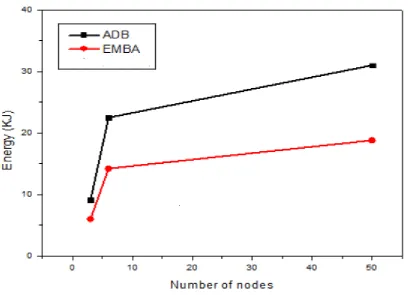
Figure 4: Energy comparison graph
Figure 4 shows an energy comparison graph with number of nodes between the operations of EMBA and ADB protocol. Energy determines the lifetime of WSN and it is the scarcest resource of WSN nodes. The results obtained are such that the proposed protocol EMBA shows less energy utilization than that of ADB.
V.CONCLUSION
EMBA supports multihop broadcasts in sparse networks. This is accomplished by the application of forwarder’s guidance and overhearing of broadcast messages and ACKs that reduce redundant transmissions. By default, EMBA displays excellent performance in dense network conditions thereby outperforming ADB in all conditions
ACKNOWLEDGEMENT
We express our sincere gratitude to Management to Staff of Sahyadri College of Engineering and Management, Mangalore, for providing platform to conduct research and experimentation.
REFERENCES
1
.
Ingook Jang, Suho Yang, Hyunsoo Yoon, Member, IEEE, and Dongwook Kim: “EMBA: An Efficient Multihop Broadcast Protocol for Asynchronous Duty-Cycled Wireless Sensor Networks”, VOL.12, NO.4, April 20132. K.Klues, G.Hackmann, O.Chipara, and C.Lu, “A component based architecture for power-efficient media access control in wireless sensor networks,” in Proc.2007 SenSys, pp.59-72.
ISSN(Online): 2320-9801 ISSN (Print): 2320-9798
I
nternational
J
ournal of
I
nnovative
R
esearch in
C
omputer
and
C
ommunication
E
ngineering
(An ISO 3297: 2007 Certified Organization) Vol. 3, Issue 5, May 2015
Copyright to IJIRCCE DOI: 10.15680/ijircce.2015.0305080 4552
4. Y.Sun, O.Gurewitz, and D.Johnson, “RI-MAC: a receiver-initiated asynchronous duty-cycle MAC protocol for dynamic traffic loads in wireless sensor networks,” in Proc.2008 ACM SenSys, pp.1-14.
5. Y.Sun, O.Gurewitz, and D.Johnson,” ADB: an efficient multihop broadcast protocol based on asynchronous duty-cycling in wireless sensor networks,” in proc 2009 ACM SenSys, pp.43-56.
6. J.Polastre, J.Hill and D.Culler, “Versatile low power media access for wireless sensor networks,” in Proc. 2004 ACM SenSys, pp. 95-107 7. M. Buettner, G.Yee, E. Anderson, and R.Han, “X-MAC: a short preamble MAC protocol for duty cycled wireless sensor networks,” in Proc. 2006 ACM SenSys, pp. 307-320
8. A.El-Hoiydi and J.D. Dectognie, “WiseMac: an ultra low power MAC protocol for multi-hop wireless sensor networks,” in Proc. 2004 ALGOSENSORS, pp. 18-31