Aerial Image Analysis Using Dynamic
Bayesian Network
L.D.Rani
1, Dr.Ch.G.V.N.Prasad
2, CH. Kedari Rao
31M.Tech (CS), Department of Computer Science & Engineering 2Professor, Head of the Dept, Dept of CSE,
3
Associate Professor, Department of Computer Science & Engineering, Sri Indu College of Engineering &Technology, Sheriguda (V), Ibrahimpatnam (M), RR Dist – 501510. E-mail: [email protected]
Abstract
Importance to accuracy, performance and efficiency is growing fast in computer technology which minimizes the manual intervention. Edge detection is a very important area in the field of Computer Vision. Edges define the boundaries between regions in an image, which helps with segmentation and object recognition. They can show where shadows fall in an image or any other distinct change in the intensity of an image. Edge detection is a fundamental of low-level image processing and good edges are necessary for higher level processing.
In this paper we are improving the edge detection mechanism using improvised Canny Edge detector and providing security to the sensitive information from security attacks using HMA VPN. Adding VPN to this Aerial image analysis using dynamic Bayesian network is necessary as these videos can contain a nations security information in case this system begin used in defense.
A HMA VPN works exactly as described, but it's not used to connect to a certain network for getting access to private data; It's main goal is to make its users anonymous through giving them a new IP that will be showed everywhere online instead of the users real IPs. That, together with high encryption methods for making the internet traffic unusable for everyone who might intercept it, brings the anonymity, security and privacy you need nowadays
A Dynamic Bayesian Network (DBN) is constructed for classification purpose. A well trained DBN can estimate the probability of a pixel belonging to a vehicle or not. It also relates among neighboring pixels in a region.
Keywords
Dynamic Bayesian Networks (DBNs), Improvised Canny Edge Detector, Vehicle Tracking, Vehicle
Tracking secured with HMA VPN.
I. Introduction
The increase in the number of vehicles on the roadway network has forced the transport management agencies to depend on advanced technologies to take better decisions. In this perspective aerial surveillance has better place nowadays. Aerial surveillance provides monitoring results in case of fast- moving targets because spatial area coverage is greater. One of the main topics in intelligent aerial surveillance is vehicle detection and tracking. Aerial surveillance has a long history in the military for observing enemy activities and in the commercial world for monitoring resources. Edge detection is an important part of the digital image processing. The edge is the set of the pixel, whose surrounding gray is rapidly changing. The internal characteristics of the edge-dividing areaare the same, while different areas have different characteristics. The edge is the basic characteristics of the image.
There is a lot of information of the image in the edge. Edge detection is to extract the characteristics of discrete parts by the difference in the image characteristics of the object, and then to determine the image area according to the closed edge.
II. DBN Frame Work
vehicle detection using DBNs. (Dynamic Bayesian
Network). We use morphological operations to enhance the detection mask and perform connected component labeling to get the vehicle objects .In this paper, we do not perform region based classification, highly depend on results of color segmentation algorithm of mean shift and IPs generation using HMA VPN.
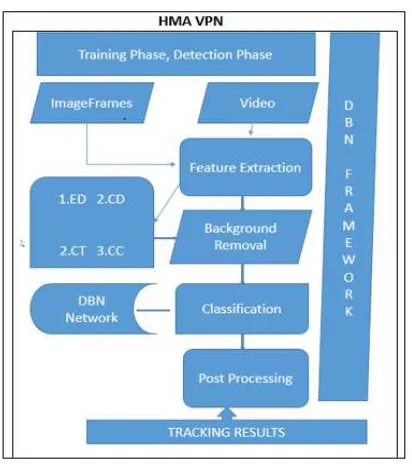
A. Frame Extraction
In this module providing video as input and it extract the number of frames from that video. The frames are formed dynamically based on pixel calculation, Edge detection and error correction.
B. Background Color Removal
Background removal is often the first step in surveillance applications. It reduces the computation required by the down- stream stages of the surveillance pipeline. Background sub- traction also reduces the search space in the video frame for the object detection unit by filtering out the uninteresting background.
In this module we construct the color histogram of each frame and remove the colors that appear most frequently in the scene. These removed pixels do not need to be considered in subsequent detection
processes. Performing background color removal cannot only reduce false alarms but also speed up the detection process.
C. Feature Extraction
In this module we extract the feature from the image frame. In This module we do the following Edge Detection, Corner Detection, color Transformation and color classification. The frame edge image is able to transfer by performing detect edge, corners and places for color transform
D. Classification
In this module we perform pixel wise classification for vehicle detection using DBNs (Dynamic Bayesian Network). We obtain the conditional probability tables of the DBN model via expectation-maximization algorithm by providing the ground-truth labelling of each pixel and its corresponding observed features from several videos.
Fig. 2: DBN Model for Pixelwise Classification
The Bayesian rule is used to obtain the probability that a pixel belongs to a vehicle i.e.
E. Post Processing
In this module we can use morphological operations to enhance the detection mask and perform connected component labelling to get the vehicle objects. The size and the aspect ratio constraints are applied again after morphological operations in the post processing stage to eliminate objects that are impossible to be vehicles.
III Canny Edge Detection
detection problem as a signal processing
optimization problem, so he developed an objective function to be optimized [2]. The solution to this problem was a rather complex exponential function, but Canny found several ways to approximate and optimize the edge-searching problem.
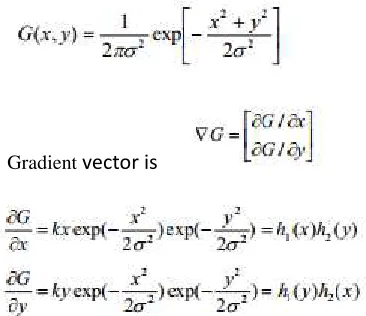
A. Smoothing Using Gaussian Filter
It is a known fact that all images taken from a camera will contain some amount of noise. To prevent that noise is mistaken for edges, noise must be reduced. Therefore the image is first smoothed by applying a Gaussian filter.
Gradient
vector is
Parameters σ stands for the width of the Gaussian filter, meaning smoothness. The larger σ is, the wider the frequency band of Gaussian filters is. Parameters σ can be adjusted according to the different images.
Fig (a). Original (b). Smoothing
B. Find the Magnitude & Gradients
The Canny algorithm foremost detects the edges where the grayscaleintensity of the image changes the most. The gradient magnitudes can then be determined as a Euclidean distance measure. The partial derivatives of the two directions of the point(x, y) are
The gradient magnitude and direction of the point(i,
j) are:
M(i,j)
stands for the edge strength. And thedirection angle, at which
M(i,j)
has the localmaximum reflects the direction of the edge.
C. Non - Maximum Suppression
In order to determine the edge of the image, the roof ridge of gradient magnitude image shall be refined. Only the local maximum of the magnitude shall be kept, that is, non-maxima shall be suppressed to get the refined edge.
1. Round the gradient direction to nearest 45◦, corresponding to the use of an 8-connected neighborhood.
2. Compare the edge strength of the current pixel with the edge strength of the pixel in the positive and negative gradient direction.
I.e. if the gradient direction is north (theta =90◦), compare with the pixels to the north and south.
3. If the edge strength of the current pixel is largest; preserve the value of the edge strength. If not, suppress (i.e. remove) the value.
D. Double Thresholding
The Canny edge detection algorithm uses double thresholding. Edge pixels stronger than the high threshold are marked as strong; edge pixels weaker than the low threshold are suppressed and edge pixels between the two thresholds are marked as weak.
E Edge Tracking by Hysteresis
Strong edges are interpreted as “certain edges”, and can immediately be included in the final edge image. Weak edges are included if and only if they are connected to strong edges. Edge tracking can be implemented by BLOB-analysis.
IV. Enhanced Canny Algorithm
The formal Canny operator calculates, in the
neighborhood of 2×2, the difference the gradient magnitude, the gradient directions are horizontal, vertical, left diagonal and right diagonal zones. This method is more sensitive to noise. The non-edge could be detected and the real non-edge could be missed. We presents a gradient magnitude in the 8 neighborhood, which can effectively suppress noise and precisely locate the edge.
First of all, calculate the first order partial
derivatives of x direction and y direction of. The
mathematical formula is:
Then calculate the gradient magnitude and direction of the point. The mathematical formula is:
Fig: 8x8 image block
4.2 Enhanced method of finding the
Threshold
There is some deficiencies of the dual thresholds [11] of Canny operator, though they are more flexible than one threshold. A too-high-setting threshold may miss important information, while a too-low-setting one may put too much importance on the minor matters.
It is Difficult to set a general threshold. Otsu [12], a Japanese scholar, put forward an adaptive method of determining the threshold, referred to his name OTSU. The main idea is to select a threshold, which minimize the within-class variance or maximize the between-class variance. This threshold can both suppress noise and keep the fine edge.
Set the number of image pixels as N, the range of gray scale as [0, L −1], the corresponding pixel number of gray level i as ni , the probability is: pi = ni / n i=0,1,2,L-1
The image pixels, by gray level are divided into two groups: C0 and C1.
C0 is composed of the pixels, whose gray level value is between [ 0,T ] . C1 is composed of the pixels, whose value is between [T +1,L−1] . The mean of the gray level distribution probability of the whole image is:
Let T take values in turn in the range of [0,L −1]. The best threshold of this method is the T-value, which
makes maximum. The threshold is applied in Canny operator to determine Tl by the formula Tl=0.5Th
V. HMA VPN :-
The purpose of edge detection in general is to significantly reduce the amount of data in a image, while preserving the structural properties to be used for further image processing. The canny edge detection algorithm runs in 5 steps as follows and using with HMA VPN for different IP’s selection based on Locations.
VI. Experimental Results
Experimental results are demonstrated here. To analyze the performance of the proposed system, various video sequences with different scenes and different filming altitudes are used along with different IP’s using HMA VPN.
A. Frames Extraction
(a). Input Video
(b). Dynamic Frame generation
B. Background Color Removal
These removed pixels need not to be considered in subsequent detection processes. Performing background color removal not only reduces false alarms but also speed up the detection process
(c). Background Color Removal Results
C. Detect Edge
The Frame edge Image is able to transfer by performing Detect edge
(d). Edge Detection
D. Colour Classification
When employing SVM, we need to select the block
size to form a sample and perform vehicle color classification.
(f). Colour Classification
E. Post Processing
We use morphological operations to enhance the detection mask and perform connected component labeling to get the vehicle. In the post processing stage we eliminate objects that are impossible to be vehicles
(g). Detecting Each and Every Vehicle
F. Analysis of results with Improved Canny
Edge Detector
Compared to the traditional Canny operator, the improved Canny method can automatically determine high and low threshold parameters according to the actual feature of the image, to get more integrated information. The continuity of the edge is strong, and positioning is accurate.
G.HMA VPN
A VPN (Virtual Private Network) is a clever piece of technology that gives you the choice from being an ordinary Internet user – to being an Internet VIP. It’s like having a golden ticket for the Internet - it will let you bypass censorship, unblock content and protects your privacy and security whilst you’re online
Anytime you use a public internet service you are putting your security and privacy at risk. Personal data can easily be misused and stolen in cafes, hotels, airports and other free Wi-Fi hotspots. Hide My Ass! Pro VPN offers you government-level protection and peace of mind for your personal data whenever you surf the internet – wherever you are. How this HMA VPN used with Vehicle Tracking using Canny Edge detector.
1. When running vehicle tracking using launch HMA VPN using connector.
2. Using connector HMA VPN launched based Locations IPs changed and targeted for specific locations based on location.
VII.
Canny operator can be applied to different situations. Canny operator can detect the edge clearly. In order to improve its performance, we propose the calculation of gradient magnitude and gradient direction based on 8 neighborhoods, and makes the adaptive calculation of the threshold of canny operator by OTSU method. The experimental results show that the edge detected by the improved canny operator has more continuity, and greater signal to noise ratio. The number of frames required to train the DBN is very small. Overall, the entire framework does not require a large amount of training samples. We have also applied moment preserving to enhance the canny edge detector, which increases the adaptability and the accuracy for detection in various aerial images. Along with this using HMA VPN, system become anonymous and protects your online identity. Bypass censorship and internet restrictions
References:-[1] Hsu-Yung Cheng, Member, IEEE, Chih-Chia Weng, Yi-Ying Chen,"Vehicle Detection in Aerial Surveillance Using Dynamic Bayesian Networks", March 21, 2012. Lecture Notes in Computer Science Project 99-2628-E-008-098. [2] J. Y. Choi, Y. K. Yang,“Vehicle detection
from aerial images using local shape information”, Adv. Image Video Technol., vol. 5414, Lectures Notes in Computer Science, pp. 227–236, Jan. 2009.
[3] J. F. Canny,“A computational approach to edge detection”, IEEE Trans. Pattern Anal. Mach. Intell., Vol. PAMI-8, No. 6, pp. 679– 698, Nov.1986.
[4]
C. G. Harris, M. J. Stephens,“A combined corner and edge detector”, In Proc. 4th Alvey Vis. Conf., 1988, pp. 147– 151[5] R. Lin, X. Cao, Y. Xu, C.Wu, H. Qiao,“Airborne moving vehicle detection for urban traffic surveillance”, In Proc. 11th Int. IEEE Conf.Intell. Transp. Syst., Oct. 2008, pp. 163– 167
[6] R. Lin, X. Cao, Y. Xu, C.Wu, H. Qiao,“Airborne moving vehicle detection for video surveillance of urban traffic”, In
Proc. IEEE Intell.Veh. Symp, 2009, pp. 203– 208.
[7] S. Srinivasan, H. Latchman, J. Shea, T. Wong, J. McNair,
2nd Int. Workshop Video
Surveillance Sens. Netw, 2004, pp. 131–135. [8] W. H. Tsai,“Moment-preserving thresholding: A
new approach, “Compute. Vis.Graph, Image Process, Vol. 29, No. 3, pp. 377–393, 1985.
[9] Mori, H., Charkai, “Shadow and Rhythm as Sign Patterns of Obstacle Detection,” Proc. Int’l Symp. Industrial Electronics, pp. 271-277, 1993. [24] Hoffmann, C., Dang, T., Stiller, “Vehicle detection fusing 2D visual features,” IEEE Intelligent Vehicles Symposium, 2004.
[10] [10] Kim, S., Kim, K et al, “Front and Rear Vehicle Detection and Tracking in the Day and Night Times using Vision and Sonar Sensor Fusion, Intelligent Robots and Systems,” IEEE/RSJ International Conference, pp. 2173-2178, 2005.
[11] S.G. Chan, B. Yu, and M. Vetterli. Spatially Adaptive Wavelet Thresholding with Context Modeling for Image
Denoising. IEEE Trans. On Image Processing,9(9): 1522-1531, 2000.