ISSN(Online): 2320-9801
ISSN (Print): 2320-9798
I
nternational
J
ournal of
I
nnovative
R
esearch in
C
omputer
and
C
ommunication
E
ngineering
(An ISO 3297: 2007 Certified Organization)
Vol. 3, Issue 5, May 2015
A Geographic Routing Oriented Sleep
Scheduling Algorithm in Duty-Cycled Mobile
Sensor Networks
Pratik R.Mantri
1, Prof. Mahip M.Bartere
2ME (CSE), Second Year, Department of CSE, G.H.Raisoni College of Engineering and Management, Amravati.
Sant Gadgebaba Amravati University, Amravati, Maharashtra, India 1
Assistant Professor, Department of CSE, G.H.Raisoni College of Engineering and Management, Amravati.
Sant Gadgebaba Amravati University, Amravati, Maharashtra, India2
ABSTRACT: Newly, the research center on geographic routing, a capable routing scheme in wireless (Mobile) sensor networks (WSNs), is changing in the direction of duty-cycled WSNs in which sensors are sleep scheduled to reduce energy consumption. However, distant from the connected-k neighborhood (CKN) sleep scheduling algorithm and the geographic routing slanting sleep scheduling (GSS) algorithm, nearly all study work about geographic routing in duty-cycled WSNs has alert on the geographic forwarding mechanism; further, most of the nearby work has unnoticed the fact that sensors can be mobile. In this paper, we spotlight on sleep scheduling for geographic routing in duty-cycled WSNs with mobile sensors and recommend two geographic-distance-based related-k neighborhood (GCKN) sleep scheduling algorithms. The first one is the geographic-distance-based connected-k-neighborhood for first path (GCKNF) sleep scheduling algorithm. The second one is the geographic-distance-based connected-k-neighborhood for all paths (GCKNA) sleep scheduling algorithm. By abstract analysis and simulations, we express that when there are mobile sensors, geographic routing can realize shorter average lengths for the first transmission path explored in WSNs employing GCKNF sleep scheduling and all transmission paths searched in WSNs employing GCKNA sleep scheduling compared with those in WSNs employing CKN and GSS sleep scheduling. finally we evaluate different routing protocol with accessible scenario.
KEYWORDS: Connected-k neighborhood (CKN), duty-cycle, geographic routing, Wireless (mobile) sensor networks (WSNs).
I. INTRODUCTION
The main distinction of this work from existing opportunistic routing schemes is that it considers the practical issues of duty cycling and presents an opportunistic routing protocol tailored to WSNs. A packet is forwarded by the primary awoken neighbor that efficiently receives it and offers routing progress towards the goal. As a effect, by minimizing the average numbers of duty-cycles required for end-to-end packet delivery and considerably improve energy efficiency and decrease delay compared to unicast routing in WSNs. This achieves by introducing a new anycast routing metric, EDC (Estimated Duty Cycled wake-ups), that focuses on energy capability and delay instead of elevated throughput.
ISSN(Online): 2320-9801
ISSN (Print): 2320-9798
I
nternational
J
ournal of
I
nnovative
R
esearch in
C
omputer
and
C
ommunication
E
ngineering
(An ISO 3297: 2007 Certified Organization)
Vol. 3, Issue 5, May 2015
sleep scheduling and all transmission paths explore in mobile WSNs employing GCKNA sleep scheduling compared with those in mobile WSNs employing connected k neighbored or geographical sleep scheduling and comparisons of the routing protocol with offered system mobile objects can be provided to nearby customers. in addition, roughly all nearby works about geographic routing in duty-cycled wireless sensor networks try to change the geographic forwarding method to compact with the dynamic topology caused by various nodes being cycled off or departing to sleep mode. For instance, it is optional in to wait for the exterior of the anticipated forwarding successor first and select a backup node if the first method fails. In the sensor field is sliced into some k-reporting fields, then some always-on group heads are elected to collect the data from their close sensors and lastly transmit all data to the sink. Apart from the connected-k neighborhood (CKN) sleep scheduling algorithm proposed in and the geographic routing oriented sleep scheduling (GSS) algorithm presented in, few research works have tackled the node accessibility improbability issue in duty-cycled WSNs from the view of sleep scheduling. This paper address the sleep scheduling difficulty in duty-cycled WSNs with mobile nodes employing geographic routing. We propose two geographic-distance-based connected k neighbor-hood (GCKN) sleep scheduling algorithms.
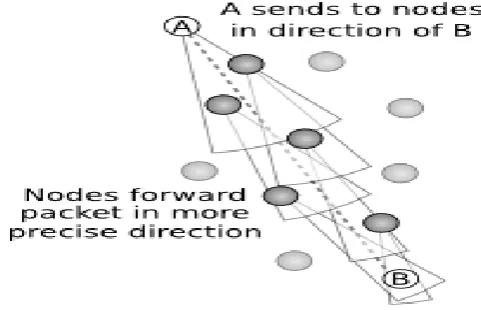
Figure 1.1 Geographic Routing Schemes
II. OBJECTIVE AND SCOPE
The goal of research is to plan an ultra-low duty cycle scheduling protocol mass for a wireless sensor network that satisfies the following requirement.
Optimizations goals:
Quality of Service The design should cover that traffic arrives at the movable sensor node in a appropriate manner.
Energy Efficiency The plan should strive to expand network lifetime while still adhering to Quality of
Service (QOS) consideration.
Scalability The propose must be scalable and task proficiently for arrangement of any size.
Robustness The propose should insure that the global performance of the scheme is not perceptive to
individual device failure.
The range of this research is the expansion of energy efficient and adaptive protocol stack for low data rate wireless connectivity with mobile sensor node beside different devices and very restricted energy consumption requirements, normally operating in a range of about 10 m .The aim is to be use various collective method to offer proficient sleep scheduling and mounting the network lifetime while monitoring the tradeoff between improved system lifetime, bandwidth and reliability.
III. SLEEP SCHEDULING
ISSN(Online): 2320-9801
ISSN (Print): 2320-9798
I
nternational
J
ournal of
I
nnovative
R
esearch in
C
omputer
and
C
ommunication
E
ngineering
(An ISO 3297: 2007 Certified Organization)
Vol. 3, Issue 5, May 2015
two targets: point coverage and node coverage. For point coverage, the awake nodes in each period are chosen to cover each position of the deployed field.
Existing point coverage oriented algorithms change in their sleep scheduling goals: minimizing energy consumption or minimizing normal event detection latency for node coverage awake nodes are designated to assemble a globally associated network such that each sleeping node is an immediate neighbor of at least one awake node. However, all these mechanism normally paying attention on the medium access layer of static wireless sensor networks with fixed nodes.
System Execution Details
Main scenario :
Create main scnario by RUN • Run option
• Enter the Source and Destination conside choose source 3 and destination 43 respectively.Then it firstly sense the data andchoose the path according to exact location.For that first it find the neighbour and non neighbourhood node whenvever neighbour node find then it find the exact location of each node according to energy level it find the path which have minimum.
•
•
Graph 1.1 Throughput comparisons with different routing protocol.
Graph 1.1 shows time verses throughput scenario in which throughput is in kbps and time is in second. Maximum throughput is in HPR (High Performance Routing) and other routing protocol gives less performance so it is maximum
0 10 20 30 40 50 60 70
5 10 15 20 25
T
hro
ug
hp
ut(
K
bp
s)
TIME
DSR
AODV
ISSN(Online): 2320-9801
ISSN (Print): 2320-9798
I
nternational
J
ournal of
I
nnovative
R
esearch in
C
omputer
and
C
ommunication
E
ngineering
(An ISO 3297: 2007 Certified Organization)
Vol. 3, Issue 5, May 2015
at every level. The throughput of a communication system may be affected by various factors, including the limitations of underlying analog physical medium, available processing power of the system components, and end-user behavior. When various protocol overheads are taken into account, useful rate of the transferred data can be significantly lower than the maximum achievable throughput.
Packet dropped/loss, Pd = Ps – Pa Where Ps is the amount of packet sent and
Pa amount of packet received.
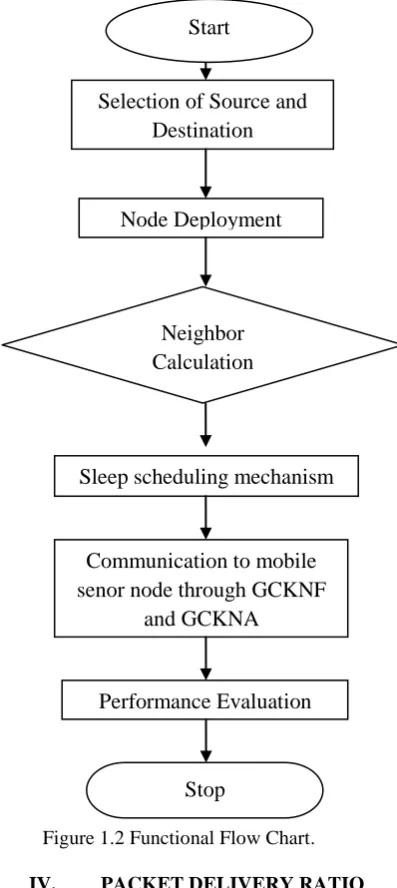
A. Functional Diagram of System Flow Diagram
Figure 1.2 Functional Flow Chart.
IV. PACKET DELIVERY RATIO
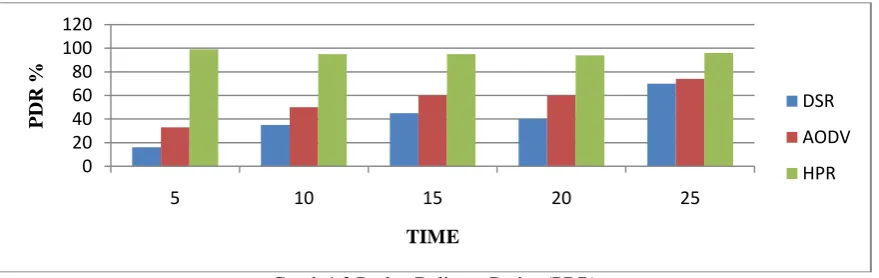
Packet Delivery Ratio is defined as the average of the ratio of the number of data packets received by each receiver over the number of data packets sent by the source from Figure describes the comparison of HPR, AODV and DSR
Selection of Source and
Destination
Node Deployment
Neighbor Calculation
Neighbor
Calculation
Sleep scheduling mechanism
Communication to mobile
senor node through GCKNF
and GCKNA
Performance Evaluation
ISSN(Online): 2320-9801
ISSN (Print): 2320-9798
I
nternational
J
ournal of
I
nnovative
R
esearch in
C
omputer
and
C
ommunication
E
ngineering
(An ISO 3297: 2007 Certified Organization)
Vol. 3, Issue 5, May 2015
Packet delivery ratio = No of Packet received
No of Packet send
Table 1.1 Packet Delivery Ratio Comparison scenarios.
TIME(Sec) DSR AODV HPR
05 16 33 99
10 35 50 95
15 45 60 95
20 40 60 94
25 70 74 96
30 86 90 99
From the graph 1.2 it is clears that in the geographic routing when compare different routing protocol for the packet Delivery ratio then Dynamic Source Routing Protocol is give very less performance and High performance Routing Protocol gives high performance. In 15 second the DSR gives 45% AODV gives 60% and HPR gives more than 95% Packet.
Graph 1.2 Packet Delivery Ratios (PDR)
Delivery ratio. In the Table 7.3 gives at different time interval packet delivery ratio and compare all these protocol suppose at the time 25 sec the HPR gives 96% and AODV gives 76% and DSR gives 72% so it is conclude that High Performance Routing Protocol gives high performance for packet delivery ratio.
V. PACKET DROP
Packet loss occurs one or more packets of records travelling across a network fail to reach their goal. Packet loss is typically caused by network blockage. When content arrives for a constant period at a given router or network fragment
at a rate greater than it is probable to send through, then there is no other choice than to drop packets.If a particular
router or link is constraining the capacity of the total travel path or of network travel in general, it is known as
a restricted access.Packet loss may be calculated as frame loss rate defined as the proportion of frames that should have
been forwarded by a network load were not forwarded due to lack of resources.
Packet dropped/loss, Pd = Ps – Pa Where Ps is the amount of packet sent and
Pa amount of packet received.
Table 1.2 Packet Drop Ratio Comparison scenarios. 0
20 40 60 80 100 120
5 10 15 20 25
P
DR
%
TIME
DSR
AODV
ISSN(Online): 2320-9801
ISSN (Print): 2320-9798
I
nternational
J
ournal of
I
nnovative
R
esearch in
C
omputer
and
C
ommunication
E
ngineering
(An ISO 3297: 2007 Certified Organization)
Vol. 3, Issue 5, May 2015
TIME(sec) DSR AODV HPR
05 06 03 02
10 02 02 02
15 10 01 03
20 12 07 03
25 08 08 03
30 04 04 02
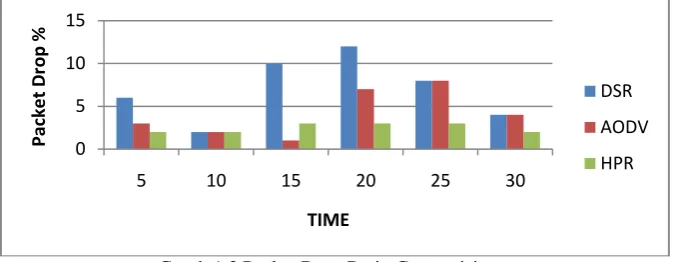
From the table 7.4 conclude that when the time is 5 second, 10 second etc. then compare packet drop ratio wirth different routing protocol like Dynamic Source Routing (DSR) protocol, Ad hoc On Demand Routing protocol(AODV) and High Performance Routing (HPR) protocol from that work it clear that High Performance Routing protocol is minimum packet drop ratio.In 5 sec time DSR is loss 6 packet,AODV loss 3 packet and HPR loss 2 packet in average respectively.So using High perforamnce routing protocol in mobile sensor network is very advantageous.
Graph 1.3 Packet Drop Ratio Comparisions.
VI. ENERGY CONSUMPTION
As shown in the table 1.3 the comparision between the HPR,AODV and DSR energy is calculated and plot in the form of the graph. The graph completely shows that the praposed HPR is definitely saves some amount of energy in the network.
Table 1.3 Average Energy Consumption Comparison scenarios.
TIME(Sec) DSR AODV HPR
05 72 80 90
10 76 84 93
15 77 85 92
20 76 84 90
25 72 82 93
0 5 10 15
5 10 15 20 25 30
P
acke
t
D
rop
%
TIME
DSR
AODV
ISSN(Online): 2320-9801
ISSN (Print): 2320-9798
I
nternational
J
ournal of
I
nnovative
R
esearch in
C
omputer
and
C
ommunication
E
ngineering
(An ISO 3297: 2007 Certified Organization)
Vol. 3, Issue 5, May 2015
Graph 1.4 Average Energy Consumption Comparisions.
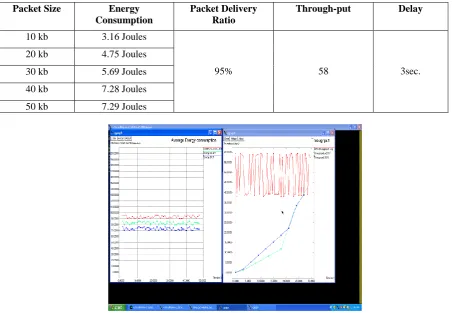
From the following table conclude that using mobile sensor network in geographic routing and using different sleep algorithm with high performance routing protocol consumed energy and packet delivery ratio, throughput these parameter give high performance and delay time can be reduced.
Table 1.4 Total performance evaluation
Packet Size Energy
Consumption
Packet Delivery Ratio
Through-put Delay
10 kb 3.16 Joules
95% 58 3sec.
20 kb 4.75 Joules
30 kb 5.69 Joules
40 kb 7.28 Joules
50 kb 7.29 Joules
Graph 1.5 Energy and Throughput comparison graph 0
2 4 6 8 10 12 14
5 10 15 20 25 30
Pack
e
t
D
ro
p
%
TIME
DSR
AODV
ISSN(Online): 2320-9801
ISSN (Print): 2320-9798
I
nternational
J
ournal of
I
nnovative
R
esearch in
C
omputer
and
C
ommunication
E
ngineering
(An ISO 3297: 2007 Certified Organization)
Vol. 3, Issue 5, May 2015
Above Graph shows that the Average energy consumption with High performance routing protocol compare with the Dynamic source routing protocol and Ad hoc on demand distance vector routing protocol and also compare Throughput. Average energy consumption is more in HPR.
VII. APPLICATION SCENARIOS
Mobile wireless sensor network are much more versatile than static sensor network as they can be deployed in any scenario and change with rapid topology changes many of their application are similar, such as environment monitoring or surveillance. Mobile sensor network increases the number of applications beyond those for which static wireless static networks are used. This work advantages to better energy efficiency, improved coverage, enhance target tracking and superior channel capacity sensors can be used to people for monitoring environment Due to the advance in technology, network communication, embedded system sensor nodes can now be designed and integrated into devices much smaller and cost effective than before although the processing power efficiency has increased, Mobile sensors are able to monitor a wide variety of ambient conditions that include but are not limited to temperature, humidity ,and lightning condition. Main application of this work is find the geographical closest path and send the data because of this energy consumption and data will be fast move in any geographic area. This dissertation work is used for the building automation, logistic the controlling and monitoring measurement and communication of heating validation and air conditioning in an industrial setting.
VIII. CONCLUSION
This dissertation work is able to achieve duty-cycled mobile WSNs and proposed two geographic-distances based connected-k neighborhood (GCKN) first is GCKNF and second is GCKNA sleep scheduling algorithms. GCKNF and GCKNA are very effective in shortening the length of the transmission path explored by geographic routing in duty-cycled mobile WSNs. The scope of the research was to develop energy efficient. The research involved using various combined to provide efficient sleep scheduling and increasing the network lifetime while monitoring the trade-off between increased network lifetime and latency, bandwidth and reliability. The High Performance Routing protocol shows promising performance in balancing the energy and prolonging network lifetimes.
REFERENCES
[1] E. M. Royer, P. M. Melliar-Smith, and L. E. Moser, “An analysis of the optimum node density for ad hoc mobile networks,” in Proc. IEEE ICC, 2001, pp. 857–861.
[2] Yu Gu and Tian He propose, “Dynamic Switching-based Data Forwarding for Low-Duty-Cycle Wireless Sensor Networks,” Proceeding of the IEEE student’s Technology symposium, 2007.
[3] S. Zhang, J. Cao, L. Chen, and D. Chen, “Locating nodes in mobile sensor networks more accurately and faster,” in Proc. IEEE SECON, 2008, pp. 37–45.
[4]Dongsook Kim proposes, “Delay-Driven Routing for Low-Duty-Cycle Sensor Networks Proceeding,” IJDSN, 2008.
[5] Omprakash Gnawali, Jongkeun Na, Ramesh Govindan proposes, “Application-Informed Radio Duty-Cycling in a Re-Testable Multi-User SensingSystem,” IJCA, vol.8, 2008.
[6] S. Guo, Y. Gu, B. Jiang, and T. He, “Opportunistic is flooding in low-duty-cycle wireless sensor networks with unreliable links,” in Proc. MobiCom, 2009, pp. 133–144.
[7] K. P. Naveen and A. Kumar, “Tunable locally-optimal geographical forwarding in wireless sensor networks with sleep-wake cycling nodes,” in Proc. IEEE INFOCOM, 2010, pp. 1–9.
[8] Binoy Ravindran, Chair, Paul Plassmann Y. Thomas Hou Anil Vullikanti Yaling Yang proposes, “Duty-Cycled Wireless Sensor Networks: Wakeup Scheduling, Routing and Broadcasting,” IEEE ISCC, 2010, pp. 487–492.
[9] K.Wang, L.Wang, C. Ma, L. Shu, and J. Rodrigues, “Geographic routing in random duty-cycled wireless multimedia sensor networks,” in Proc. IEEE GLOBECOM Workshops, 2010, pp. 230–234.
[10] H. Zhang and H. Shen, “Energy-efficient beaconless geographic routing in wireless sensor networks,” IEEE Trans. Parallel Distribute. Syst., vol. 21, no. 6, pp. 881–896, Jun. 2010.
[11] Jamal N. Al-Karaki Ahmed E. Kamal proposes, “Routing Techniques in Wireless Sensor Networks: A Survey,” Computer Applications Technology (ICCAT), 2012.
[12] Abdul Hanan Abdullah, Shukor Abd Razak and Md.Asri Nagdi propose, “An Overview of Data Routing Approaches for Wireless Sensor Networks,” in IJPRET, 2012. [13] R. C. Luo and O. Chen, “Mobile sensor node deployment and asynchronous power management for wireless sensor networks,” IEEE Trans. Ind. Electron., vol. 59, no. 5, pp. 2377–2385, May 2012.
[14] H. Song, V. Shin, and M. Jeon, “Mobile node localization using fusion prediction-based interacting multiple model in cricket sensor net-work,” IEEE Trans. Ind. Electron., vol. 59, no. 11, pp. 4349–4359, Nov. 2012.
ISSN(Online): 2320-9801
ISSN (Print): 2320-9798
I
nternational
J
ournal of
I
nnovative
R
esearch in
C
omputer
and
C
ommunication
E
ngineering
(An ISO 3297: 2007 Certified Organization)
Vol. 3, Issue 5, May 2015
[16] C. Zhua, L. T. Yang, L. Shu, T. Q. Duong, and S. Nishio, “Secured energy-aware sleep scheduling algorithm in duty-cycled sensor networks,” in Proc. IEEE ICC, 2012, pp. 1953–1957.
[17] H. Le, J. V. Eck, and M. Takizawa, “An efficient hybrid medium access control technique for digital ecosystems,” IEEE Trans. Ind. Electron., vol. 60, no. 3, pp. 1070–1076, Mar. 2013.
[18] P. Cheng, F. Zhang, J. Chen, Y. Sun, and X. Shen, “A distributed TDMA scheduling algorithm for target tracking in ultrasonic sensor networks,” IEEE Trans. Ind. Electron., vol. 60, no. 9, pp. 3836–3845, Sep. 2013.