A Review on Object Oriented Database using Object
Relational Modelling and MVC
Ravindra KumarP
#1
P
,PPMohd. Suaib0TP
#2
P
#1
P
CSE, Integral University, Lucknow, India E-mail- [email protected]
P
#2
P
Assistant Professor CSE, Integral University, Lucknow, India E-mail- [email protected]
#1- Corresponding author
Abstract: Presently, the size of database of business
organizations is growing day by day due to the exponential growth of size of database, complexity of database is increasing and results high cost of robust and scalable web application development and maintenance. The data flow mismatch problem also arises so the database optimization is highly required using OODBMS and use modern web application development methodologies. ORM, UML and MVC can be put altogether to get combined advantages in web applications with complex database. Object Role Modeling (ORM) is designed for conceptual analysis of the object-oriented database. The present work is accomplished by using ORM, UML and MVC.UML model (UML class, sequence and use-case diagrams) has been used to represent database objects. This helps in handling conceptual schema and physical schema of the database and improving the web application performance.
1T1TKeywords: ORM, Object Oriented Database, UML
Modeling, MVC.
1. INTRODUCTION
UML stands for Unified Modeling Language. It is used to specify, visualize, construct, and prepare standard document of software and system. UML was firstly introduced by Object Management Group. The UML 1.0 specifications were proposed to the OMG (Object Modeling Group) in January 1997.It provides the architectural approach to design and develop application step by step. For the analysis purpose it is unbeatable and provides better way for the system or software development analysis, design and deployment. Large application need to analyse very carefully to achieve robustness and scalability. So using UML a 360 degree analysis can be made and shows standard outcomes either is parallel development or post development of the application. The whole prototype of the application is made before the actual development so that feasibility study of the application becomes vary easier and accordingly the
development plans are designed and developed. It has power of all object oriented features thus the representation of entities and their behaviour, collaboration, interaction can be visualised very effectively.
UML also offers conceptual model. A conceptual model is made of concepts and their relationships. A conceptual model is pre required before the representation of UML diagram. It useful in understanding the entities in that exists in the real world either physically or logically and how they interact with each other and the class association can be made as per the requirements. The objects are treated as the real world entities that exist physically or logically. The OOPS concepts like abstraction, encapsulation, inheritance, polymorphism can be represented using UML.
It is well known that using the Unified Modeling Language (UML) the modeling of software can be done very effectively but it is not very efficient to develop and validate conceptual data models or schema. Object Role Modeling is used to deal at the conceptual level and object schema specification to deal with the change made in the database. It is helpful in finding the object association and it behaviour with other object when frequently changes occur in the database. All the properties of the database object are updated in real time thus it handles the flow of data and interaction with other objects. It corresponds with revered engineering like code generation from database and vice versa thus application handling becomes effective and faster. Entity framework support ORM. The ORM can be used with most popular web application design pattern MVC (Model, View and Controller).This layered architecture is widely used in developing faster , responsive and complex web applications globally. The parallel design and development is also achieved when the web application needs big team of developers. The coupling and cohesion in database objects becomes more manageable. Hence, development time and cost can be analysed effectively. The application performance improves using MVC and ORM.
2. RELATED WORK
Relational Database is the most trendy and long practiced approach to store the database but with the IT revolution the growth of the online website user have grown and increasing day by day. Due to this a new approach is in need that is object oriented databases. Large dynamic website have many times data flow and persistency problem and it becomes cumbersome to manage and scale. Object oriented database approach; object relational mapping (ORM) and MVC altogether provide a better solution for it. Now let us consider the related works to get clearer overview.
Halpin [1] has stated Object Role Modeling (ORM) is a fact-oriented approach specifically designed to facilitate conceptual analysis and to minimize the impact on change. Since ORM models can be used to derive UML class diagrams, ORM offers benefits even to UML data modelers. R. Elmasri and S. Navathe [2] have told Clear explanations of theory and design, broad coverage of models and real systems, and an up-to-date introduction to modern database technologies result in a leading introduction to database systems. Thampi and Ashwin [3] have presented that Object relational mapping became important due to increasing coupling between relational database management systems and object oriented application concepts and development. There are tools to automate these mapping tasks, which can be distinguished by the degree to which they abstract the storage logic for the application.
In [4] an object database when you have a business need for high performance on complex data. Generally, an object database is a good choice when you have all three factors: business need, high performance, and complex data. Recently, people have also been considering an object database even when their data is not particularly complex. An object database can allow for a smaller team and faster development because there is only one data model. More information on these topics can be found in the related content below. Rick Cattell [5] has explained that with the advent of the web, especially Web 2.0 sites where millions of users may both read and write data, scalability for simple database operations has become more important. For example, applications may search and update multi-server databases of electronic mail, personal profiles, web postings, wikis, customer records, online dating records, classified ads, and many other kinds of data. These all generally fit the definition of “simple operation” applications: reading or writing a small number of related records in each operation. Barry & Associates [6] described When an Object Database Should Be Used Consider an object database when you have a business need for high performance on complex data. Generally, an object database is a good choice when you have all three factors: business need, high performance, and complex data.
RoMiller [7] has described as Entity Framework (EF) is an object-relational mapper that enables .NET developers to work with relational data using domain-specific objects. It eliminates the need for most of the data-access code that developers usually need to write. Entity Framework is actively developed by the Entity Framework team which is assigned to the Microsoft Open Tech Hub and in collaboration with a community of open source developers. Together we are dedicated for creating the best possible data access experience for web application developers.
3. ENTITY FRAMEWORK
Entity Framework (EF) is an object-relational mapper that enables web application developers to work with relational data using domain-specific objects. It eliminates the need for most of the data-access code that developers usually need to write [6]. The physical layer, conceptual layer and presentation layer of the database becomes manageable and maintainable.
3.1 OBJECT RELATIONAL MODEL
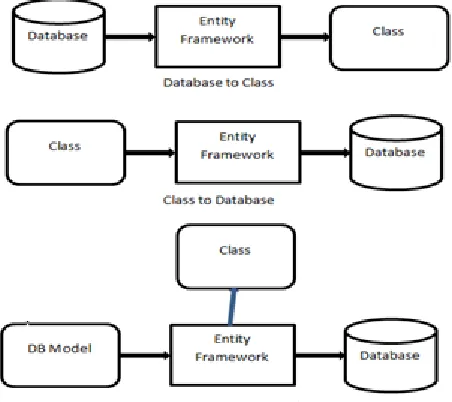
ORM is a tool used to store data from entity state to relational database like MS SQL Server automatically in easy and maintainable way. ORM has three main parts: Domain class objects, Relational database objects and Mapping information on how domain objects map to relational database objects (tables, views & stored procedures)[1]. Using ORM database design is kept separate from domain class design. Due to this application becomes extendable, robust and maintainable and standard CRUD operation (Create, Read, Update & Delete) are maintained automatically. There is need to write manual programmes. ORM is implemented using entity framework.
Figure 1. Entity Framework
3.2 MVC
The MVC architecture is used to separate the application into three parts these are Model, View and Controller. It is an alternative design pattern for developing complex web applications with lightweight framework. Asp.net MVC supports entity framework that uses modern features of ORM. Due to its scalable and robust features developing complex dynamic web application give faster response time. The Model is used to handle logic for the application data. Model objects fetch data (and store data) from a database. The View is used to render the data. Views can be created from the model data. The Controller handles user interaction. Controllers read data from a view, control user input, and send input data to the model.
Using layered approach of MVC the web page renders faster as it uses only client side control. The view state problem is resolved so the query processing time is lesser than other the website which uses server side control and view state. The cross browser issue is ideally resolved thus object oriented query processing time becomes ideal and web performance improves.
Figure 2. MVC Architecture
4. UML CLASS DIAGRAM
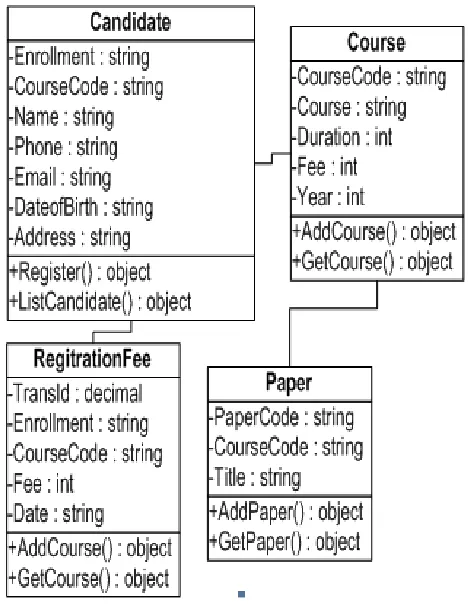
The Ideal Query Response Time (QRT) system has been modelled with the help of UML class diagram. The QRT system contains the four major classes with their major attributes as shown in Figure 3 below. In the present work, the complete process of computing the query response time for UML models is explained in the form of UML class diagram. The candidate class has association with the Course class; the Candidate class is used to describe the Course Registration for making certifications in different courses. The Registration Fee class has also multiple associations with candidate class; the course class is associated with the paper class. The paper class has multiple associations with
the course class, the course is allowed to the requested Candidate; Registration Fee class executes a query to find the candidates who have been registered and accordingly the course has been allotted to them. Course allotment depends on candidate registration and registration class depends on registration fee class.
Figure 3. A UML class diagram
5. UML SEQUENCE DIAGRAM
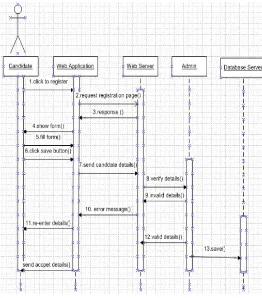
A UML sequence diagram represents the dynamic behaviour of system which is represented in Figure 4. Using object lifeline the sequence process is given as how these objects interact with each other. A UML sequence diagram is designed to show the complete process of exchanging information about the registration of the candidates for the different course. The five main objects are Candidate, Website, Web Server, Admin and database (dB). Arrow along the communication message represents the information exchange between two objects. The candidates executes a query to get the registration then according to the sequence diagram the request is posted back to the server via website the authorization of request is done then message is
passed to the candidate to fill all the details and as per the authorization and authentication of the candidates details acknowledgement is sent to the candidate. The main purpose of this diagram is to check whether the designed model is functioning or not.
Figure 4. Sequence Diagram of Candidate Registration
6. COMPUTATION OF QUERY RESPONSE TIME
When user interacts with the front end a request is initiated then this request is forwarded to the query processor which processes the requested query. The suitable strategy of query processing is selected by the query processor because as query processing is completed in many steps and query is translated in standard SQL form during this the parser verifies the query syntax and its relational attributes. After the query is converted into relational algebraic expression the query optimization is done to choose the best and less costly plan for query execution among the all other plans available. The application sends the requested query to the database and accordingly the background operation are processed in order to avail the result to the user device. The query response time (QRT) is the part of the query processing strategy (QPS)
For calculating the response time the algorithm given below as
DECLARE@EndTime DateTime DECLARE@StartTime DateTime DECLARE@x int
SET@x= 0
SET@StartTime = GETDATE() SET@EndTime = GETDATE() while(@x<10)
begin
PRINT 'StartTime = ' + CONVERT(VARCHAR(30), @StartTime,121)
Select Name, Phone, DateofBirth from Candidate SET @x= @x+1
PRINT' EndTime = ' + CONVERT (VARCHAR(30), @EndTime,121)
PRINT 'RESPONSETIME = '+ CONVERT (VARCHAR (30),@ENDTIME-@STARTTIME,114)+''
end
Using above SQL code, a query response time is calculated in five run. The computing time is measured in millisecond so as per five runs, average response time is evaluated. In query, lines of codes are increase from 10 to 10P
5
P
. This is shown in the table-1 given below
Thus from the above analysis the query response time is directly proportional to the line of codes which are executed. QRT α LOC (Line of codes) [11]
Line of Code
10 10P
2
10P
3
10P
4
10P
5
No of Runs
1 416 3320 89889 318511 321776 2 341 3878 89061 318791 340167 3 397 3789 89310 317988 322045 4 567 3751 89491 319943 323708 5 351 3912 88522 319682 323967
Average QRT
414 3730 89254 318983 326333
Table 1. Average query response
7. CONCLUSION
Form the presented work, it is observed that the UML, MVC with ORM is a powerful modeling to to visualise object oriented database. This approach is helpful in designing and developing complex database web application in parallel when modeling, designing and coding is done by different teams of software professionals. The UML helps in understanding the association between different entities while ORM helps in avoiding data type mismatch problem and thus maintainability cost is lessen. An ideal query
response time is achieved as the rendering of the web page is done smoothly without caring view state and cross browser issues.
8. REFERENCES
[1] Dr Terry Halpin ,” UML Data Models from an ORM perspective:Part1”, Journal of Conceptual Modeling, no. 1,1998. 36Twww.inconcept.com36T
[2] R. Elmasri and S. Navathe, “Fundamentals of Database Systems,” 4th Edition, Addison Wesley, New York, 2003. [3] Sabu M. Thampi and Ashwin A.K, “Performance Comparison of Persistence Frameworks,”.
http://www.chimu.com
[4] OMG, “When an Object Database Should Be Used,”
http://www.service-architecture.com/articles/object-orienteddatabases/when_an_object_database_should_be_use d.html
[5] Rick Cattell, “Scalable SQL and NoSQL Data Stores,” SIGMOD Record, December 2010 (Vol. 39, No. 4)
[6] RoMiller on CodePlex Project Hosting for Open Source
Software,“What is EF,” 2013.
36T
https://entityframework.codeplex.com/36T
[7] Barry & Associates, Inc on service architecture, “When an Object Database Should Be Used,” 2015.
http://www.service-architecture.com/articles/object-orienteddatabases/when_an_object_database_should_be_use d.html
[8]. Object Oriented Query Response Time for UML Models Journal of Software engineering and Applications Vol. 5 No. 7 (2012), Article ID: 19736,6
esDOI:10.4236/jsea.2012.57059
[9] IBM, IBM Rational Software Modeler Version 7.0.5 Information Center, IBM Corporation, 2005-2007, [E-Book] Available: IBM Support Portal.
[10] A. Holzinger, K. H. Struggl, Appling Model-View-Controller (MVC) in design and development of information systems, e-Business (ICE-B), Proceedings of the 2010 International Conference, 26-28 July 2010, Pages 1-6. [11] Saxena v. and Kumar S., 2012, Object Oriented Query Response Time for UML Models, Journal of Software Engineering and Applications, Vol. 5, Issue 7, pp. 508-512.