Towards Key-Length Extension
with Optimal Security:
Cascade Encryption and Xor-cascade Encryption
?Jooyoung Lee??
Faculty of Mathematics and Statistics Sejong University, Seoul, Korea 143-747
Abstract. This paper discusses provable security of two types of cascade encryptions. The first constructionCEl, calledl-cascade encryption, is obtained by sequentially composinglblockcipher calls with independent keys. The security of CEl has been a longstanding open problem until Gaˇzi and Maurer [9] proved its security up to 2κ+min{n
2,κ}query complexity for large cascading
length, where κ and n denote the key size and the block size of the underlying blockcipher, respectively. We improve this limit by proving the security ofCEl up to 2κ+min{κ,n}−16l(n2+2)
query complexity: this bound approaches 2κ+min{κ,n}
with increasing cascade lengthl.
The second constructionXCElis a natural cascade version of the DESX scheme with intermediate keys xored between blockcipher calls. This can also be viewed as an extension of double XOR-cascade proposed by Gaˇzi and Tessaro [10]. We prove thatXCEl is secure up to 2κ+n−8l(
n
2+2)
query complexity. As cascade lengthlincreases, this bound approaches 2κ+n.
In the ideal cipher model, one can obtain all the evaluations of the underlying blockcipher by making 2κ+nqueries, so the (κ+n)-bit security becomes the maximum that key-length extension
based on a singleκ-bit keyn-bit blockcipher is able to achieve. Cascade encryptionsCEl(with n≤κ) andXCElprovide almost optimal security with large cascade length.
1 Introduction
The key length of a blockcipher, say κ, is a crucial factor that limits its achievable security level: no matter how carefully designed, one can recover its secret key simply by trying all possible 2κ keys. For example, the Data Encryption Standard (DES) [1] using 56-bit keys was one of the most predominant algorithms for encryption of data. No feasible attacks faster than a brute-force attack have been proposed (as most of them require a huge amount of data), while advances in computational power made a brute-force attack itself practical. As a result, DES was replaced by a new standard algorithm AES [4]. On the other hand, in order to protect legacy applications based on DES, there have been considerable research on constructing DES-based encryption schemes which employ longer keys. This approach is calledkey-length extension, for which Triple-DES [2, 3, 5] and DESX (due to Rivest) are the most popular constructions.
The Triple-DES approach transforms a κ-bit key n-bit blockcipher E into an encryption scheme that accepts threeκ-bit keysk1, k2, k3∈ {0,1}κ and encrypts ann-bit message block
u as v = Ek3(Ek2(Ek1(u))). Bellare and Rogaway [6] proved its security up to 2
κ+min{2n,κ}
?
c
IACR 2013. This article is the final version submitted by the author to the IACR and to Springer-Verlag on February 22, 2013. The version published by Springer-Verlag is available at http://dx.doi.org/10.1007/978-3-642-38348-9 25.
?? The work of J. Lee was supported by Basic Science Research Program through the National Research
query complexity assumingE is an ideal blockcipher. The triple encryption can be naturally extended to sequentially composing more than three blockcipher calls with independent keys. It has been a longstanding open problem if the security of cascade encryption improves with increasing cascade length. Recently, Gaˇzi and Maurer [9] partially answered this question by showing the security bound (in terms of the threshold number of queries) approaches roughly the value 2κ+min{n2,κ}. In this paper, we will revisit this question.
The DESX approach transforms aκ-bit keyn-bit blockcipherEinto an encryption scheme that accepts aκ-bit key k∈ {0,1}κ and additionaln-bit whitening keys k
i, ko ∈ {0,1}n and encrypts ann-bit message block u asv = ko⊕Ek(ki ⊕u). Killan and Rogaway [13] proved its security up to 2κ+2n query complexity. As an efficient key-length extension, Gaˇzi and
Tessaro [10] proposed a cascade of two DESX schemes with some refinement, and proved its security up to 2κ+n2 query complexity.
Our Contribution.Since one can obtain all the evaluations of aκ-bit keyn-bit blockcipher
by making 2κ+n queries, the (κ +n)-bit security becomes the maximum that key-length extension based on a single κ-bit key n-bit blockcipher is able to achieve: a standard brute-force attack of 2κ+n query complexity is given in Appendix A.
Therefore it is natural to ask if there is key-length extension with the optimal (κ+n)-bit security. In order to answer this question, we consider two types of cascade encryptions. The first construction is a regular cascade encryption. Formally, l-cascade encryption CEl accepts an lκ-bit keyk= (k1, . . . , kl)∈({0,1}κ)l and encrypts a plaintextu∈ {0,1}n by computing
v=CElk[E](u) =Ekl◦Ekl−1◦ · · · ◦Ek2 ◦Ek1(u).
In this paper, we prove that CEl is pseudorandom up to 2κ+min{κ,n}−16l( n
2+2) query
complex-ity (ignoring log factor). As cascade length l increases, this bound approaches 2κ+min{κ,n}, improving the limit 2κ+min{n2,κ} given by Gaˇzi and Maurer when n
2 < κ.
The second construction can be viewed as a cascade of DESX: l-xor-cascade encryption
XCEl accepts an (lκ+ (l+ 1)n)-bit key (k,z)∈({0,1}κ)l×({0,1}n)l+1 and for
k= (k1, . . . , kl)∈({0,1}κ)l and z= (z0, . . . , zl)∈({0,1}n)l+1,
encrypts a plaintextu∈ {0,1}n by computing
v=XCElk,z[E](u) =⊕zl◦Ekl◦ ⊕zl−1 ◦ · · · ◦ ⊕z1◦Ek1◦ ⊕z0(u),
where forz∈ {0,1}n,⊕
z denotes the mapping x7→x⊕z from{0,1}nto itself. We prove the security of XCEl up to 2κ+n−8l(
n
2+2) query complexity. With increasing cascade length, this
bound approaches 2κ+n. SoXCElasymptotically provides optimal security with large cascade length, and this observation also applies to cascade encryptionCEl ifn≤κ (as in the case of DES and AES). See Figure 1 for pictorial representation of CEl and XCEl.
Proof Techniques. We will use a combinatorial framework that lifts the NCPA-security
u E E E v k1 k2 kl
(a)l-cascade encryptionCEl
u E E E v
z0
⊕
z1
⊕
zl
⊕
k1 k2 kl
(b) l-xor-cascade encryptionXCEl
Fig. 1.Two types of cascade encryptions
constructions, while a difficulty comes from the fact that the two components are commonly based on a single blockcipher. We address this problem by usingrandom key space separation: randomly partition a key space into two subspaces of the same size and make the first l/2 blockcipher calls use keys from one key subspace and the last l/2 calls from the other. The modified key sampling process is shown to be indistinguishable from the original one, while by having the two components use their keys from separate key subspaces, we can view a cascade encryption as a composition of two independent ones.
The NCPA-security of each component is proved by coupling technique. Since first intro-duced by Mironov [16] in a cryptographic context and recently revisited by Morris, Rogaway and Stegers [17] to analyze the security of maximally unbalanced Feistel networks, it became a powerful tool used for the security proof of various types of iterated constructions includ-ing generalized Feistel networks, shufflinclud-ing-based encryption schemes and key-alternatinclud-ing ci-phers [14, 11, 12]. Careful definition and analysis of a coupling, given in the proof of Lemma 5, is the core of our security proof.
Other Related Work. Recently, Gaˇzi [8] presented a distinguishing attack on cascade
encryption of odd (resp. even) length l using roughly 2κ+ll−+11n (resp. 2κ+
l−2
l n) queries. For xor-cascade encryption of lengthl(and its generalization), a distinguishing attack of 2κ+l−l1n query complexity is presented. In the random system framework, the security of xor-cascade encryption of odd (resp. even) length l is proved up to 2κ+ll−+11n (resp. 2κ+
l−2
l n) query com-plexity, and especially up to 2κ+l−l1n query complexity forl∈ {3,4}. These lower bounds are tighter than ours.
2 Preliminaries
2.1 General Notation
For an integer n≥1, let In ={0,1}n be the set of binary strings of length n. The set of all permutations onInwill be denotedPn. We will usually writeN = 2n.
For a set T and an integer s≥1, T∗s denotes the set of all sequences that consists of s pairwise distinct elements ofT. For integers 1≤s≤t, we will write (t)s=t(t−1)· · ·(t−s+1). If|T|=t, then (t)s becomes the size ofT∗s.
2.2 The Ideal Cipher Model
and E−1(k, y) for x, y ∈ {0,1}n and k ∈ K.1 The response to an inverse query E−1(k, y) is
x∈ {0,1}n such thatE(k, x) =y.
2.3 Indistinguishability
Let C ∈ {CEl,XCEl} be an n-bit encryption scheme that employs λ-bit keys and makes oracle queries to a blockcipher E ∈ BC(κ, n). So each key k ∈ {0,1}λ and a blockcipher E∈BC(κ, n) define a permutationCk[E] onIn. In theindistinguishability framework (in the ideal cipher model), Ck[E] uses a random secret key k and makes oracle queries to an ideal
blockcipherE, while a permutationP is chosen uniformly at random fromPn. A distinguisher
A would like to tell apart two worlds (Ck[E], E) and (P, E) by adaptively making forward
and backward queries to the permutation and the blockcipher. Formally, A’s distinguishing advantage is defined by
AdvPRPC (A) =Pr
h
P ← P$ n, E ←$ BC(κ, n) :A[P, E] = 1 i
−Prhk← {$ 0,1}λ, E $
←BC(κ, n) :A[Ck[E], E] = 1
i .
Forq1,q2>0, we define
AdvPRPC (q1, q2) = max
A Adv
PRP C (A),
where the maximum is taken over all adversariesA making at most q1 queries to the outer
permutation and at mostq2 queries to the underlying blockcipher.
Combinatorial Framework.We assume that a distinguisherAmakingq1 forward and/or
backward queries to the permutation oracle records a query history
Q1= (ui, vi)1≤i≤q1,
where (ui, vi) represents the evaluation obtained by thei-th query to the permutation oracle. So according to the instantiation, it implies eitherCk[E](ui) =vi orP(ui) =vi. By making
q2 queries to the underlying blockcipherE,Aalso records the second query history
Q2 = (xi, ki, yi)1≤i≤q2,
where (xi, ki, yi) represents the evaluation E(ki, xi) = yi obtained by the i-th query to the blockcipher. The pair of the query histories
T = (Q1,Q2)
is called thetranscript of the attack; it contains all the information thatA has obtained at the end of the attack. In this work, we will only consider information theoretic distinguishers. Therefore we can assume that a distinguisher is deterministic without making any redundant queries, and hence the output of A can be regarded as a function of T, denoted A(T) or
A(Q1,Q2).
If a permutationCk[E](resp.P) is consistent withQ1, i.e.,Ck[E](ui) =vi(resp.P(ui) =
vi) for every i = 1, . . . , q1, then we will write Ck[E] ` Q1(resp. P ` Q1). Similarly, if a 1
blockcipher E ∈BC(κ, n) is consistent with Q2 (i.e., E(ki, xi) = yi for i= 1, . . . , q2), then
we will writeE ` Q2. Using these notations, we have
AdvPRPC (A) = X A(Q1,Q2)=1
PrhP ← P$ n, E ←$ BC(κ, n) :P ` Q1∧E ` Q2i
− X
A(Q1,Q2)=1
Prhk← {$ 0,1}λ, E ←$ BC(κ, n) :Ck[E]` Q1∧E` Q2
i , (1)
where the sum is taken over all the possible transcriptsT = (Q1,Q2) such thatA(Q1,Q2) = 1.2
2.4 Coupling Technique
Given a finite event spaceΩand two probability distributionsµandν defined onΩ, thetotal variation distance betweenµand ν, denoted kµ−νk, is defined as
kµ−νk= 1 2
X
x∈Ω
|µ(x)−ν(x)|.
The following definitions are also all equivalent.
kµ−νk= max
S⊂Ω{µ(S)−ν(S)}= maxS⊂Ω{ν(S)−µ(S)}= maxS⊂Ω{|µ(S)−ν(S)|}. Acouplingofµandνis a distributionτ onΩ×Ωsuch that for allx∈Ω,P
y∈Ωτ(x, y) =µ(x) and for ally∈Ω,P
x∈Ωτ(x, y) =ν(x). In other words,τis a joint distribution whose marginal distributions are respectively µ and ν. We will use the following two lemmas in subsequent security proofs.
Lemma 1. Let µ and ν be probability distributions on a finite event space Ω, let τ be a coupling of µandν, and let (X, Y) be a random variable sampled according to distribution τ. Then kµ−νk ≤Pr[X 6=Y].
Lemma 2. Let Ω be some finite event space andν be the uniform probability distribution on
Ω. Let µbe a probability distribution on Ω such that kµ−νk ≤. Then there is a set S⊂Ω
such that
1. |S| ≥(1−√)|Ω|,
2. µ(x)≥(1−√)ν(x) for everyx∈S.
The proof of the above lemmas is given in [14]. For completeness, we include the same proof in Appendix B.
2
Here we only consider “valid” transcripts that A might produce by communicating with a permutation P∈ Pnand a blockcpherE∈BC(κ, n). For example, in a valid transcriptT = (Q1,Q2), (x, y) and (x0, y)
3 Security Proofs
In the security proof of cascade encryptionCEl, we will assume that for anyx,y∈In, there are at mostβ keysk such that (x, k, y)∈ Q2. Define the weight ofQ2 by
ω(Q2) = max
x,y∈In|{k: (x, k, y)∈ Q2}|. Then we have
Pr
h
E ←$ BC(κ, n) :ω(Q2)> β
i
≤22n−β (2)
for anyβ ≥e2κ−n+1. Note that a distinguisher A is deterministic, so once E is chosen then
Q2, and hence ω(Q2) is uniquely determined. This bound has already been used in [6, 9], while for completeness we give a proof in Appendix C. With this probabilistic restriction, the security proof of cascade encryptionCEl will use the following lemma.
Lemma 3. Let δ >0 and β ≥e2κ−n+1. Assume that for any transcript T = (Q1,Q2) such that|Q1|=q1, |Q2|=q2 and ω(Q2)≤β, we have
p1(Q1|Q2)≥(1−δ)p2(Q1|Q2),
where
p1(Q1|Q2) =Pr
k←$ Iκl, E ←$ BC(κ, n) :CElk[E]` Q1
|
E ` Q2,
p2(Q1|Q2) =Pr
P ← P$ n, E ←$ BC(κ, n) :P ` Q1
|
E` Q2
= 1/(N)q1.
Then we have
AdvPRPCEl (A)≤δ+ 22n−β.
Proof. For a transcriptT = (Q1,Q2), define
p(Q2) =Pr
h
E←$ BC(κ, n) :E ` Q2
i ,
p1(Q1,Q2) =Pr
h
k←$ Iκl, E ←$ BC(κ, n) :CElk[E]` Q1∧E` Q2i
=p1(Q1|Q2)p(Q2),
p2(Q1,Q2) =Pr
h
P ← P$ n, E ←$ BC(κ, n) :P ` Q1∧E ` Q2
i
Then by (1) and (2), we have
AdvPRPCEl(A) =
X
A(Q1,Q2)=1
p2(Q1,Q2)−
X
A(Q1,Q2)=1
p1(Q1,Q2)
= X
A(Q1,Q2)=1
ω(Q2)≤β
p2(Q1|Q2)p(Q2)−
X
A(Q1,Q2)=1
ω(Q2)≤β
p1(Q1|Q2)p(Q2)
+ X
A(Q1,Q2)=1
ω(Q2)>β
p2(Q1,Q2)−
X
A(Q1,Q2)=1
ω(Q2)>β
p1(Q1,Q2)
≤ X
A(Q1,Q2)=1
ω(Q2)≤β
p2(Q1|Q2)p(Q2)−
X
A(Q1,Q2)=1
ω(Q2)≤β
p1(Q1|Q2)p(Q2) +
X
ω(Q2)>β
p2(Q2)
≤ X
A(Q1,Q2)=1
ω(Q2)≤β
p2(Q1|Q2)p(Q2)−(1−δ)
X
A(Q1,Q2)=1
ω(Q2)≤β
p2(Q1|Q2)p(Q2) + 22n−β
≤δ X
A(Q1,Q2)=1
ω(Q2)≤β
p2(Q1,Q2) + 22n−β ≤δ+ 22n−β. ut
In the security proof of xor-cascade encryptionXCEl, we put no restriction on the weight ofQ2. In this case, we can use the following lemma whose proof is similar as Lemma 3. (We might simply applyβ=∞to Lemma 3.)
Lemma 4. Let δ >0. Assume that for any transcript T = (Q1,Q2) such that |Q1|=q1 and
|Q2|=q2, we have
p1(Q1|Q2)≥(1−δ)p2(Q1|Q2),
where
p1(Q1|Q2) =Pr
k←$ Iκl,z←$ Inl+1, E ←$ BC(κ, n) :XCElk,z[E]` Q1
|
E ` Q2,
p2(Q1|Q2) =Pr
P ← P$ n, E ←$ BC(κ, n) :P ` Q1
|
E` Q2
= 1/(N)q1.
Then we have
AdvPRPXCEl(q1, q2)≤δ.
3.1 Security of Cascade Encryption
In this section, we analyze the security of cascade encryptionCEl for even length l= 2d. We begin with slightly modifying the key sampling process ofCEl. Consider the following three key sampling processes.
A: Choose k∈Iκl uniformly at random.
B: Choose k∈(Iκ)∗l uniformly at random.
C: Randomly partition T1∪T2 =Iκ so that |T1|=|T2|, choose k0 ∈(T1)∗d and k00 ∈(T2)∗d
One can distinguish sampling processesA andB with advantage at most
l 2
1 2κ ≤
l2
2κ+1. (3)
On the other hand, sampling processesB and Chave exactly the same probability distribu-tion. (See Appendix D for the proof.) Taking into account (3), we will analyze the security of
CElk[E] =CEdk00[E]◦CEdk0[E],
wherek,k0 and k00 are defined by key sampling processCinstead of the original process A. IfCElk[E]` Q1 for a query historyQ1= (ui, vi)1≤i≤q1, then it follows that
CEdk0[E]`(ui, wi)1≤i≤q1 andCEdk00[E]`(wi, vi)1≤i≤q1,
for some w= (wi)1≤i≤q1 ∈(In)
∗q1. Therefore for a transcriptT = (Q
1,Q2), we have
p1(Q1|Q2) =
X
w∈Ω
Pr
[
T1 $← P2κ−1(Iκ),k0 $
←(T1)∗d,k00 $
←(T2)∗d,
E←$ BC(κ, n) :CEdk0[E]`(ui, wi)∧CEdk00[E]`(wi, vi)
|
E ` Q2]
,where Ω= (In)∗q1,P
2κ−1(Iκ) is the set of all subsets of Iκ of size 2κ−1, and T2=Iκ\T1.
Given a partition (T1, T2) of Iκ, a blockcipherE ∈BC(κ, n) is naturally partitioned into
two blockciphers E0 ∈BC(T1, n) andE00∈BC(T2, n), and vice versa. Given a query history
Q2forE, then this partition also induces two query historiesQ0
2forE0andQ002 forE00. Namely,
for Q2 = (xi, ki, yi)1≤i≤q2,Q
0
2 = (xi, ki, yi)1≤i≤q2,ki∈T1 and Q
00
2 = (xi, ki, yi)1≤i≤q2,ki∈T2. With
these notations, we have
Pr
[
T1 $← P2κ−1(Iκ),k0 $
←(T1)∗d,k00 $
←(T2)∗d, E $
←BC(κ, n) :
CEdk0[E]`(ui, wi)∧CEkd00[E]`(wi, vi)
|
E ` Q2]
= 21κ
2κ−1
X
T1∪T2=Iκ
|T1|=|T2|=2κ−1
Pr
[
k0 ←$ (T1)∗d,k00 $←(T2)∗d, E0 $
←BC(T1, n),
E00←$ BC(T2, n) :CEdk0[E0]`(ui, wi)∧CEdk00[E00]`(wi, vi)
|
E0 ` Q02∧E00` Q002]
,and hence
p1(Q1|Q2) =
1
2κ
2κ−1
X
T1∪T2=Iκ
|T1|=|T2|=2κ−1
X
w∈Ω
Pr
[
k0 ←$ (T1)∗d,k00 $←(T2)∗d, E0 $
←BC(T1, n),
where X
w∈Ω
Pr
[
k0 ←$ (T1)∗d,k00 $←(T2)∗d, E0 $
←BC(T1, n), E00 $
←BC(T2, n) :
CEdk0[E0]`(ui, wi)∧CEdk00[E00]`(wi, vi)
|
E0 ` Q02∧E00 ` Q002]
= X
w∈Ω
Pr
[
k←$ (T1)∗d, E $←BC(T1, n) :CEdk[E]`(ui, wi)
|
E ` Q0
2
]
×Pr
[
k←$ (T2)∗d, E $←BC(T2, n) :CEdk[E]`(wi, vi)
|
E` Q002]
. (4)In order to upper bound each factor of the products appearing in (4), we fix a query history Q2 = (xi, ki, yi)1≤i≤q0 such that q0 ≤ q2 and ω(Q2) ≤ β, and define a probability
distributionµs for eachs= (si)1≤i≤q1 ∈Ω, where for eachw= (w
i)
1≤i≤q1 ∈Ω,
µs(w) =Pr
k←$ (Iκ)∗d, E
$
←BC(κ, n) :CEdk[E]`(si, wi)1≤i≤q1
|
E` Q2.
Using the coupling technique, we can upper bound the statistical distance between µs and
the uniform probability distribution. The proof will be given at the end of this section.
Lemma 5. Let dbe even, let µs be the probability distribution defined as above, and let ν be
the uniform probability distribution onΩ. Then forM >0, we have kµs−νk ≤, where
=q1
2q2
M(2κ−d) + 2M β 2κ−d+
2M N−M
d2 .
Applying Lemma 5 withs=u= (ui)1≤i≤q1,Q2=Q
0
2 and
µu(w) =Pr
[
k $←(T1)∗d, E $
←BC(T1, n) :CEdk[E]`(ui, wi)
|
E` Q0
2
]
,and using Lemma 2, we have a subsetS1 ⊂Ω such that |S1| ≥(1−
√
)|Ω|and
Pr
[
k←$ (T1)∗d, E $←BC(T1, n) :CEdk[E]`(ui, wi)
|
E` Q0
2
]
≥(1−√)ν(w) = 1−
√
(N)q1
for everyw∈S1, where
=q1
2q2
M(2κ−1−d) +
2M β 2κ−1−d+
2M N−M
d2 .
Here BC(T1, n) is viewed as equivalent to BC(κ−1, n).
For Q002, define Q0002 where (x, k, y) ∈ Q002 if and only if (y, k, x) ∈ Q0002. Again, applying Lemma 5 withs=v= (vi)1≤i≤q1,Q2=Q
000
2 and
µv(w) =Pr
[
k $←(T2)∗d, E $
←BC(T2, n) :CEdk[E]`(vi, wi)
|
E` Q0002]
=Pr
[
k←$ (T2)∗d, E $←BC(T2, n) :CEdk[E]`(wi, vi)
|
E` Q00
we have a subsetS2 ⊂Ω such that|S2| ≥(1−
√
)|Ω|and
Pr
[
k←$ (T2)∗d, E $←BC(T2, n) :CEdk[E]`(wi, vi)
|
E ` Q00
2
]
≥(1−√)ν(w) = 1−
√
(N)q1
for everyw∈S2. LetS =S1∩S2. Since|S| ≥(1−2
√
)|Ω|, it follows that
X
w∈Ω
Pr
[
k←$ (T1)∗d, E $←BC(T1, n) :CEdk[E]`(ui, wi)
|
E` Q0
2
]
×Pr
[
k←$ (T2)∗d, E $←BC(T2, n) :CEdk[E]`(wi, vi)
|
E` Q00
2
]
≥(1−2√)|Ω| ·
1−√ (N)q1
2
≥(1−4√)p2(Q1|Q2).
Therefore we have
p1(Q1|Q2)≥
1
2κ
2κ−1
X
T1∪T2=Iκ
|T1|=|T2|=2κ−1
(1−4√)p2(Q1|Q2)
= (1−4√)p2(Q1|Q2). (5)
By (3), (5) and Lemma 3, we have the following theorem.
Theorem 1. Let CEl be an l-cascade encryption scheme using a κ-bit keyn-bit blockcipher. If l= 2dand dis even, then for M >0 andβ ≥e2κ−n,
AdvPRPCEl(q1, q2)≤
l2 2κ+1 + 4q
1 2 1
2q2
M(2κ−1−d) +
2M β 2κ−1−d+
2M N−M
d
4
+ 22n−β.
Optimizing parameters.Letβ ≥max{3n, e2κ−n}. Then 3n≤β, and hence 22n−β ≤1/2n.
Let M =qq2
β by solving
2q2
M(2κ−1−d) = 2M β
2κ−1−d. Then for q2 ≤2κ+n, M ≤
q
2κ+n
e2κ−n ≤ √Ne and hence
1 N −M ≤
1−√1
e −1 1 N ≤ e N. This implies 2M N −M ≤
2M ·e2κ−n
2κ ≤
2M β 2κ−1−d
= 4M β 2κ−l
.
Using this inequality, the upper bound of Theorem 1 is simplified as follows.
Corollary 1. Let CEl be anl-cascade encryption scheme using aκ-bit key n-bit blockcipher. If l is a multiple of4, then forβ ≥max{3n, e2κ−n},
AdvPRPCEl(q1, q2)≤
l2 2κ+1 + 4q
1 2 1
12√βq2
2κ−l l8
Interpretation.Assuming that l2/2κ+1 and 1/2n are negligible, focus on the second term
of the above upper bound. If we set q1 = 2n to the maximum number of queries to the
outer permutation and approximate 2κ−l≈2κ, then the distinguishing advantage becomes negligible when
q2
22κ−16l( n
2+2)
144β ≤min (
22κ−16l( n
2+2)
432n ,
2κ+n−16l( n
2+2)
144e )
.
Alternatively, letq2 = min
n
22κ
432n,
2κ+n
144e o
. Then the second term is upper bounded by 2n2+2−
l
8,
approaching zero as the lengthlincreases.
Proof of Lemma 5.Fixs= (si)1≤i≤q1 and form= 0, . . . , q1, define probability distributions
πm where for eachw= (w1, . . . , wq1)∈Ω,
πm(w) =Pr
[
(um+1, . . . , uq1)$
←(In\{s1, . . . , sm})∗(q1−m),k
$
←(Iκ)∗d,
E ←$ BC(κ, n) :CEdk[E]`(si, wi)1≤i≤m∧CEdk[E]`(ui, wi)m+1≤i≤q1
|
E ` Q2]
.Then we can check that π0 =ν and πq1 =µs. Since
kµs−νk ≤
q1−1
X
m=0
kπm+1−πmk, (6)
we will focus on upper bounding kπm+1−πmk for each m= 0, . . . , q1−1. In order to couple
πm+1 and πm, we will define a random variable (T, V) on Ω×Ω by the sampling process
described in Figure 2. In this description,
D(k) ={x∈In: (x, k, y)∈ Q2 for somey},
R(k) ={y∈In: (x, k, y)∈ Q2 for somex},
for each key k∈Iκ. So they denote the domain points and the range points of the evaluations of E(k,·) determined byQ2, respectively.
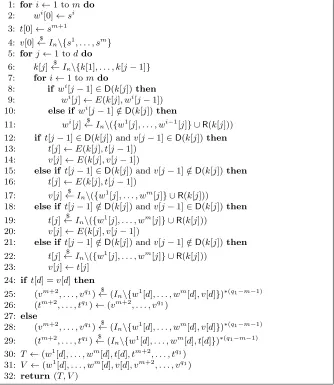
In lines 1 to 4, the firstm+ 1 elements are initialized. They are updated in lines 5 to 23 along cascade encryption. Specifically, the firstmelements are faithfully updated in lines 7 to 11, while the (m+ 1)-th element is updated in lines 12 to 23 according to four conditions. The last q1−m−1 elements of the output are determined in lines 24 to 29 without any update
process.
As for this random variable, we point out some noteworthy properties. 1. In any case, the firstm elements of T and V are equal.
2. Ift[d] =v[d], then T =V at the end of the experiment.
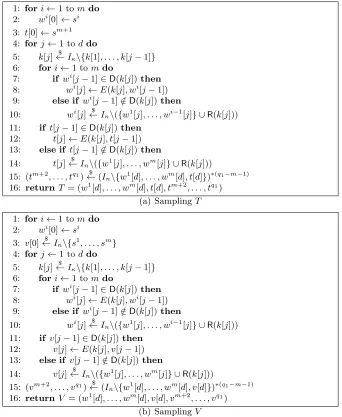
3. By ignoring the steps used to sampleV, we obtain the process for samplingT as described in Figure 3(a). Similarly, we obtain the process for samplingV as described in Figure 3(b). We can check that T and V follow probability distributions πm+1 and πm, respectively. Therefore by Lemma 1, we have
1: fori←1 tomdo 2: wi[0]←si
3: t[0]←sm+1
4: v[0]←$ In\{s1, . . . , sm}
5: forj←1 toddo
6: k[j]←$ Iκ\{k[1], . . . , k[j−1]}
7: fori←1 tomdo
8: if wi[j−1]∈D(k[j])then 9: wi[j]←E(k[j], wi[j−1]) 10: else if wi[j−1]∈/D(k[j])then
11: wi[j]←$ In\({w1[j], . . . , wi−1[j]} ∪R(k[j]))
12: if t[j−1]∈D(k[j]) andv[j−1]∈D(k[j])then 13: t[j]←E(k[j], t[j−1])
14: v[j]←E(k[j], v[j−1])
15: else if t[j−1]∈D(k[j]) andv[j−1]∈/D(k[j])then 16: t[j]←E(k[j], t[j−1])
17: v[j]←$ In\({w1[j], . . . , wm[j]} ∪R(k[j]))
18: else if t[j−1]∈/D(k[j]) andv[j−1]∈D(k[j])then 19: t[j]←$ In\({w1[j], . . . , wm[j]} ∪R(k[j]))
20: v[j]←E(k[j], v[j−1])
21: else if t[j−1]∈/D(k[j]) andv[j−1]∈/D(k[j])then 22: t[j]←$ In\({w1[j], . . . , wm[j]} ∪R(k[j]))
23: v[j]←t[j] 24: if t[d] =v[d]then
25: (vm+2, . . . , vq1)←$ (I
n\{w1[d], . . . , wm[d], v[d]})∗(q1−m−1)
26: (tm+2, . . . , tq1)←(vm+2, . . . , vq1)
27: else
28: (vm+2, . . . , vq1)←$ (I
n\{w1[d], . . . , wm[d], v[d]})∗(q1−m−1)
29: (tm+2, . . . , tq1)←$ (I
n\{w1[d], . . . , wm[d], t[d]})∗(q1−m−1)
30: T←(w1[d], . . . , wm[d], t[d], tm+2, . . . , tq1)
31: V ←(w1[d], . . . , wm[d], v[d], vm+2, . . . , vq1)
32: return(T, V)
1: fori←1 tomdo 2: wi[0]←si 3: t[0]←sm+1 4: forj←1 toddo
5: k[j]←$ Iκ\{k[1], . . . , k[j−1]}
6: fori←1 tomdo
7: if wi[j−1]∈D(k[j])then 8: wi[j]←E(k[j], wi[j−1])
9: else if wi[j−1]∈/D(k[j])then
10: wi[j]←$ In\({w1[j], . . . , wi−1[j]} ∪R(k[j]))
11: if t[j−1]∈D(k[j])then 12: t[j]←E(k[j], t[j−1]) 13: else if t[j−1]∈/D(k[j])then
14: t[j]←$ In\({w1[j], . . . , wm[j]} ∪R(k[j]))
15: (tm+2, . . . , tq1)←$ (I
n\{w1[d], . . . , wm[d], t[d]})∗(q1−m−1)
16: return T= (w1[d], . . . , wm[d], t[d], tm+2, . . . , tq1)
(a) SamplingT
1: fori←1 tomdo 2: wi[0]←si
3: v[0]←$ In\{s1, . . . , sm}
4: forj←1 toddo
5: k[j]←$ Iκ\{k[1], . . . , k[j−1]}
6: fori←1 tomdo
7: if wi[j−1]∈D(k[j])then 8: wi[j]←E(k[j], wi[j−1])
9: else if wi[j−1]∈/D(k[j])then
10: wi[j] $
←In\({w1[j], . . . , wi−1[j]} ∪R(k[j]))
11: if v[j−1]∈D(k[j])then 12: v[j]←E(k[j], v[j−1]) 13: else if v[j−1]∈/D(k[j])then
14: v[j]←$ In\({w1[j], . . . , wm[j]} ∪R(k[j]))
15: (vm+2, . . . , vq1)←$ (I
n\{w1[d], . . . , wm[d], v[d]})∗(q1−m−1)
16: return V = (w1[d], . . . , wm[d], v[d], vm+2, . . . , vq1)
(b) SamplingV
Sincet[j] =v[j] implies t[j+ 2] =v[j+ 2] forj= 0, . . . , d−2 (actually,t[j0] =v[j0] for every j0 > j), we have
Pr[t[d]6=v[d]]≤
d
2
Y
h=1
Pr
t[2h]6=v[2h]
|
t[2h−2]6=v[2h−2]. (8)
For a fixed h = 1, . . . ,d2, assume that t[2h−2] 6=v[2h−2], and on this condition, consider the probability that t[2h] and v[2h] are different. In order for this event to happen, either t[2h−2] or v[2h−2] should map to a point within D(k[2h]) since otherwise t[2h−1] and v[2h−1] both outsideD(k[2h]) would map to an identical pointt[2h] =v[2h]. We divide this event into three subcases. In the following description, we fix a parameterM >0, and call a keyk heavy if|R(k)|=|D(k)|> M.
Case 1: Either k[2h−1] or k[2h] is heavy. Since there are at mostq2/M heavy keys and
k[2h−1] andk[2h] are chosen from the set of size at least 2κ−d, the probability of this case is at most
2q2
M(2κ−d). (9)
Case 2:k[2h] is not heavy, and either (t[2h−2], k[2h−1], y)∈ Q2 or (v[2h−2], k[2h−
1], y)∈ Q2 for some y∈D(k[2h]). First, assume thatk[2h] is not heavy. Since|D(k[2h])| ≤
M and ω(Q2) ≤ β, the number of keys k such that either (t[2h−2], k, y) ∈ Q2 or (v[2h−
2], k, y) ∈ Q2 for some y ∈ D(k[2h]) is at most 2M β. Therefore the probability that one of
such keys is chosen ask[2h−1] is at most 2M β
2κ−d. (10)
Case 3: The remaining case. Here we assume that any ofk[2h−1] andk[2h] is not heavy. Furthermore,k[2h−1] andQ2 do not determine a mapping from one oft[2h−2] andv[2h−2]
to any point withinD(k[2h]). However eithert[2h−2] orv[2h−2] might still go intoD(k[2h]) by probabilistic sampling. Since|D(k[2h])| ≤M and|R(k[2h−1])| ≤M, this case occurs with probability at most
2M
N−M. (11)
We notice that the update ofwi[2h−2], i= 1, . . . , m, does not affect this upper bounding. By (6), (7), (8), (9), (10) and (11), we obtain
kµs−νk ≤q1
2q2
M(2κ−d) + 2M β 2κ−d+
2M N −M
d2 .
3.2 Security of Xor-cascade Encryption
In this section, we analyze the security of xor-cascade encryptionXCElfor even lengthl= 2d. The argument is very similar to the security proof of the original cascade encryption except modifying key sampling process and applying Lemma 6. First, the following original key sampling processAis modified into B:
B: Randomly partition T1∪T2 =Iκ so that |T1|=|T2|, choose k0 ∈(T1)∗d and k00 ∈(T2)∗d
uniformly at random, and then definek= (k0,k00). Next, choose z0 = (z00, . . . , zd0)∈Ind+1 and z00= (z000, . . . , zd00)∈Ind+1 uniformly at random, and then define
z= (z00, . . . , z0d⊕z000, . . . , zd00)∈Inl+1.
One can distinguish sampling processes A andB with advantage at most
l 2
1 2κ ≤
l2
2κ+1. (12)
Taking into account (12), we analyze the security of
XCElk,z[E] =XCEdk00,z00[E]◦XCEdk0,z0[E],
where (k,z), (k0,z0) and (k00,z00) are defined by key sampling processB. ForQ1= (ui, vi)1≤i≤q1 and Q2 = (x
i, ki, yi)
1≤i≤q2, we can prove
p1(Q1|Q2) =
1
2κ
2κ−1
×
X
T1∪T2=Iκ
|T1|=|T2|=2κ−1
X
w∈Ω
(
Pr[
k←$ (T1)∗d,z $←Ind+1, E ←$ BC(T1, n) :XCEkd[E]`(ui, wi)
|
E ` Q02]
×Pr
[
k←$ (T2)∗d,z $←Ind+1, E ←$ BC(T2, n) :XCEdk[E]`(wi, vi)
|
E ` Q00
2
]
)
,with the same notations as the previous section. In order to estimate the probabilities ap-pearing as the summands, we fix a query historyQ2 = (xi, ki, yi)1≤i≤q0 such thatq0 ≤q2, and
for eachs∈Ω define a probability distribution µs such that for each w= (wi)1≤i≤q1 ∈Ω,
µs(w) =Pr
[
k $←(Iκ)∗d,z
$
←Ind+1, E ←$ BC(κ, n) :
XCEdk[E]`(si, wi)1≤i≤q1
|
E ` Q2]
.Then we have the following lemma.
Lemma 6. Let d >0, letµs be the probability distribution defined as above, and let ν be the
uniform probability distribution onΩ. Then for M >0, we havekµs−νk ≤, where
=q1
q2
M(2κ−d) + 2M
N d
.
The proof will be given at Appendix E. Using this lemma and exactly the same argument for the original cascade encryption, we can also prove the following theorem.
Theorem 2. Let XCEl be an l-xor-cascade encryption scheme using a κ-bit key n-bit block-cipher. Ifl= 2d, then forM >0,
AdvPRPXCEl(q1, q2)≤
l2 2κ+1 + 4q
1 2 1
q2
M(2κ−1−d) +
2M N
Optimizing Parameters.By solving M(2κq−21−d) = 2NM, we set M =
q N q2
2κ−l, obtaining the following corollary.
Corollary 2. LetXCElbe anl-cascade encryption scheme using aκ-bit keyn-bit blockcipher. If l is even, then
AdvPRPXCEl(q1, q2)≤
l2
2κ+1 + 4q 1 2 1
16q2
N(2κ−l) 8l
.
Interpretation.Assuming thatl2/2κ+1 is negligible, setq1 = 2n and approximate 2κ−l≈
2κ. Then the distinguishing advantage becomes negligible when q22κ+n−4−
8
l( n
2+2).
Alternatively, letq2 = 2κ+n−5. Then we can check thatAdvCEPRPl(2n,2κ+n−5) approaches zero as the lengthlincreases (up to the condition that l2/2κ+1 is negligible).
References
1. FIPS PUB 46: Data Encryption Standard (DES). National Institute of Standards and Technology (1977) 2. ANSI X9.52: Triple Data Encryption Algorithm Modes of Operation (1998)
3. FIPS PUB 46-3: Data Encryption Standard (DES). National Institute of Standards and Technology (1999) 4. FIPS PUB 197: Advanced Encryption Standard (AES). National Institute of Standards and Technology
(2001)
5. NIST ST 800-67: Recommendation for the Triple Data Encryption Algorithm (TDEA) Block Cipher. National Institute of Standards and Technology (2004)
6. M. Bellare and P. Rogaway: The Security of Triple Encryption and a Framework for Code-Based Game-Playing Proofs. Eurocrypt 2006, LNCS 4004, pp. 409–426, Springer, Heidelberg (2006)
7. A. Bogdanov, L. R. Knudsen, G. Leander, F. Standaert, J. Steinberger, and E. Tischhauser: Key-Alternating Ciphers in a Provable Setting: Encryption Using a Small Number of Public Permutations. Eurocrypt 2012, LNCS 7237, pp. 45–62, Springer, Heidelberg (2012)
8. P. Gaˇzi: Plain versus Randomized Cascading-Based Key-Length Extension for Block Ciphers. Cryptology ePrint Archive, Report 2013/019, 2013. Available at http://eprint.iacr.org/2013/019
9. P. Gaˇzi and U. Maurer: Cascade Encryption Revisited. Asiacrypt 2009, LNCS 5912, pp. 37–51, Springer, Heidelberg (2009)
10. P. Gaˇzi and S. Tessaro: Efficient and Optimally Secure Key-Length Extension for Block Ciphers via Randomized Cascading. Eurocrypt 2012, LNCS 7237, pp. 63–80, Springer, Heidelberg (2012)
11. V. T. Hoang, B. Morris and P. Rogaway: An Enciphering Scheme Based on a Card Shuffle. CRYPTO 2012, LNCS 7417, pp. 7–13, Springer, Heidelberg (2012)
12. V. T. Hoang and P. Rogaway: On Generalized Feistel Networks. In: Rabin, T. (ed.) CRYPTO 2010. LNCS, vol. 6223, pp. 613630. Springer, Heidelberg (2010)
13. J. Kilian and P. Rogaway: How to Protect DES Against Exhaustive Key Search (an Analysis of DESX). Journal of Cryptology 14, pp. 1735. Springer, Heidelberg (2001)
14. R. Lampe, J. Patarin and Y. Seurin: An Asymptotically Tight Security Analysis of the Interated Even-Mansour Cipher. Asiacrypt 2012, To appear.
15. U. Maurer, K. Pietrzak and R. Renner: Indistinguishability Amplification. CRYPTO 2007, LNCS 4622, pp. 130-149. Springer, Heidelberg (2007)
16. I. Mironov: (Not So) Random Shuffles of RC4. CRYPTO 2002, LNCS 2442, pp. 304-319. Springer, Hei-delberg (2002)
A A Brute-force Attack of 2κ+n Query Complexity
In this section, we describe a standard information theoretic brute-force attack against a λ-bit keym-bit encryption scheme C that makes a certain number of calls to a κ-bit key n-bit blockcipherE.3 An adversaryA executes the following steps.
1. Amakes all possible 2κ+n queries to the underlying blockcipherE.
2. Amakestnonadaptive forward queries to the outer permutation, recording query history
Q= (ui, vi)1≤i≤t.
3. If there is aλ-bit keyksuch thatCk[E](ui) =vi for everyi= 1, . . . , t, thenAoutputs 0.
Otherwise,Aoutputs 1. Since we have
Prhk← {$ 0,1}λ, E ←$ BC(κ, n) :A[Ck[E], E] = 0
i = 1,
PrhP ← P$ n, E←$ BC(κ, n) :A[P, E] = 0i≤ 2
λ (2m)
t ,
AdvPRPC (A) gets close to 1 ast λ m.
B Proof of Lemma 1 and Lemma 2
Proof of Lemma 1. Let λbe a coupling of µand ν and let (X, Y)∼λ. By definition, for
anyz∈Ω,λ(z, z)≤min{µ(z), ν(z)}. Since Pr[X=Y] =P
z∈Ωλ(z, z), we have
Pr[X=Y]≤X
z∈Ω
min{µ(z), ν(z)}.
Therefore we have
Pr[X 6=Y]≥1−X
z∈Ω
min{µ(z), ν(z)}=X z∈Ω
(µ(z)−min{µ(z), ν(z)})
= X
z∈Ω µ(z)≥ν(z)
(µ(z)−ν(z)) = max
S⊂Ω{µ(S)−ν(S)}=kµ−νk.
Proof of Lemma 2.LetS ={x∈Ω:µ(x)≥(1− √
)ν(x)}. By definition, any element ofS satisfies the second condition. Contary to the first condition, suppose that|S|<(1−√)|Ω|. This implies ν(Ω\S) = 1− |S|/|Ω|>√, and hence
ν(Ω\S)−µ(Ω\S)≥ν(Ω\S)− 1−√ν(Ω\S) =√ν(Ω\S)> √2 =. This is a contradiction to kµ−νk ≤.
3
C Proof of Inequality (2)
Fixx,y∈In. For any β >0,
Pr
h
E ←$ BC(κ, n) :|{k:E(k, x) =y}| ≥β i
≤
2κ
β 1 2n
β
≤
e2κ β2n
β .
Therefore for anyQ2 (which might be the maximum query history of size 2κ+n including all
the evaluations ofE), ω(Q2) is smaller thanβ except with probability
P= 22n
e2κ β2n
β ,
whereP≤22n−β ifβ ≥e2κ−n+1.
D Equivalence of Key Sampling Processes B and C for CEl
Fix a key k = (k0,k00) ∈ (Iκ)∗l, where k0 = (k10, . . . , kd0) and k00 = (k001, . . . , k00d). Then the number of partitions (T1, T2) such that {k10, . . . , kd0} ⊂ T1 and {k
00
1, . . . , k00d} ⊂T2 is
2K−2d K−d
, where K = 2κ−1. For each (T
1, T2), key sampling process C chooses k0 and k00 from T1 and
T2, respectively, with probability (1/(K)d)2. So the probability thatCchoosesk0 and k00 is
2K−2d K−d
2K K
1 (K)d
2
= (2K−2d)!(K!)
2
(2K)!((K−d)!)2 ·
(K−d)! K!
2
= (2K−2d)! (2K)! =
1 (2κ)
2d ,
which is the same as the probability that key sampling process B choosesk= (k0,k00).
E Proof of Lemma 6
Fix s = (si)1≤i≤q1 and for m = 0, . . . , q1, define probability distributions πm where for each
w= (w1, . . . , wq1)∈Ω,
πm(w) =Pr
[
(um+1, . . . , uq1)$
←(In\{s1, . . . , sm})∗(q1−m),k
$
←(Iκ)∗d,z
$
←Ind+1,
E←$ BC(κ, n) :XCEdk[E]`(si, wi)1≤i≤m∧XCEdk[E]`(ui, wi)m+1≤i≤q1
|
E ` Q2]
.Then we can check that π0 =ν and πq1 =µs. Since
kµs−νk ≤
q1−1
X
m=0
kπm+1−πmk, (13)
we focus on upper boundingkπm+1−πmkfor eachm= 0, . . . , q1−1. In order to coupleπm+1
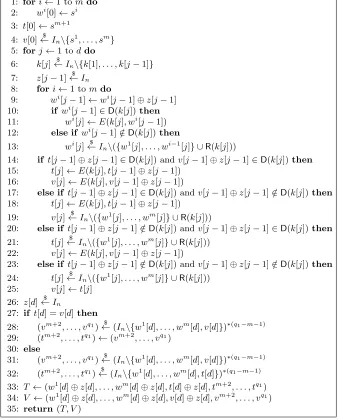
and πm, we will define a random variable (T, V) onΩ×Ω by the sampling process described in Figure 4. Then we can check that their marginal distributions are πm+1 and πm, and
1: fori←1 tomdo 2: wi[0]←si
3: t[0]←sm+1
4: v[0]←$ In\{s1, . . . , sm}
5: forj←1 toddo
6: k[j]←$ Iκ\{k[1], . . . , k[j−1]}
7: z[j−1]←$ In
8: fori←1 tomdo
9: wi[j−1]←wi[j−1]⊕z[j−1] 10: if wi[j−1]∈D(k[j])then
11: wi[j]←E(k[j], wi[j−1]) 12: else if wi[j−1]∈/D(k[j])then
13: wi[j] $
←In\({w1[j], . . . , wi−1[j]} ∪R(k[j]))
14: if t[j−1]⊕z[j−1]∈D(k[j]) andv[j−1]⊕z[j−1]∈D(k[j])then 15: t[j]←E(k[j], t[j−1]⊕z[j−1])
16: v[j]←E(k[j], v[j−1]⊕z[j−1])
17: else if t[j−1]⊕z[j−1]∈D(k[j]) andv[j−1]⊕z[j−1]∈/D(k[j])then 18: t[j]←E(k[j], t[j−1]⊕z[j−1])
19: v[j]←$ In\({w1[j], . . . , wm[j]} ∪R(k[j]))
20: else if t[j−1]⊕z[j−1]∈/D(k[j]) andv[j−1]⊕z[j−1]∈D(k[j])then 21: t[j]←$ In\({w1[j], . . . , wm[j]} ∪R(k[j]))
22: v[j]←E(k[j], v[j−1]⊕z[j−1])
23: else if t[j−1]⊕z[j−1]∈/D(k[j]) andv[j−1]⊕z[j−1]∈/D(k[j])then 24: t[j]←$ In\({w1[j], . . . , wm[j]} ∪R(k[j]))
25: v[j]←t[j] 26: z[d]←$ In
27: if t[d] =v[d]then
28: (vm+2, . . . , vq1)←$ (I
n\{w1[d], . . . , wm[d], v[d]})∗(q1−m−1)
29: (tm+2, . . . , tq1)←(vm+2, . . . , vq1)
30: else
31: (vm+2, . . . , vq1)←$ (I
n\{w1[d], . . . , wm[d], v[d]})∗(q1−m−1)
32: (tm+2, . . . , tq1)←$ (I
n\{w1[d], . . . , wm[d], t[d]})∗(q1−m−1)
33: T←(w1[d]⊕z[d], . . . , wm[d]⊕z[d], t[d]⊕z[d], tm+2, . . . , tq1)
34: V ←(w1[d]⊕z[d], . . . , wm[d]⊕z[d], v[d]⊕z[d], vm+2, . . . , vq1)
35: return(T, V)
Sincet[j] =v[j] implies t[j+ 1] =v[j+ 1] for j= 0, . . . , l−1, we have
Pr[t[d]6=v[d]]≤
d Y
j=1
Pr
t[j]6=v[j]
|
t[j−1]6=v[j−1]. (15)
In order to upper bound Pr
t[j]6=v[j]
|
t[j−1]6=v[j−1]for each j, we first choose k[j] from the set of size at least 2κ −d. For a parameter M > 0, there are at most q2/M
heavy keys k such that
|R(k)|=|D(k)|> M. Therefore the probability that k[j] is heavy is at most
q2
M(2κ−d). (16)
Conditioned on the case thatk[j] is not heavy, either t[j−1]⊕z[j−1] orv[j−1]⊕z[j−1] should map to a point within D(k[j]) since otherwiset[j]⊕z[j−1] andv[j]⊕z[j−1] both outside D(k[j]) would map to an identical point t[j+ 1] = v[j+ 1]. The probability of this event over the random choice of z[j−1] is at most
2M
N . (17)
Then by (13), (14), (15), (16) and (17), we obtain
kµs−νk ≤q1
q2
M(2κ−d) + 2M
N d